
Industrial Connectivity Market Report 2026
Global Outlook – By Component (Hardware, Software, Services), By Technology (Industrial Ethernet, Fieldbus Communication, Cellular Connectivity, Low Power Wide Area Networks, Industrial Wireless Local Area Networks), By Network Connectivity (Wired, Wireless), By Deployment (On-Premise, Cloud-Based), By End Use (Aerospace And Defense, Automotive, Chemical, Energy And Utilities, Food And Beverage, Healthcare, Manufacturing, Mining And Metal, Oil And Gas, Transportation, Other Industrial Connectivity End Users) – Market Size, Trends, Strategies, and Forecast to 2030
Industrial Connectivity Market Overview
• Industrial Connectivity market size has reached to $55.76 billion in 2025 • Expected to grow to $79.49 billion in 2030 at a compound annual growth rate (CAGR) of 7.4% • Growth Driver: Surge In Demand For Real-time Industrial Data Visibility Fueling The Growth Of The Market Due To Accelerated Adoption Of IoT For Real-time Monitoring And Decision-Making • Market Trend: Innovations In Industrial Connectivity Enable Seamless Cellular And Satellite IoT Integration • North America was the largest region in 2025 and Asia-Pacific is the fastest growing region.Market Gains By 2030 – Top Opportunities By Segment
Market Gain identifies the most promising market opportunities by highlighting the segments or products expected to generate the highest incremental revenue growth over the next five years.
What Is Covered Under Industrial Connectivity Market?
Industrial connectivity refers to the communication infrastructure that enables seamless data exchange between machines, sensors, control systems, and software within industrial environments. It uses wired and wireless networks to support real-time monitoring, automation, and control of industrial processes. It helps to ensure reliable, secure, and low-latency connectivity that improves operational efficiency, enables smart manufacturing, and supports industrial digital transformation. The main components of industrial connectivity include hardware, software, and services. Hardware refers to the physical devices and equipment that enable secure and reliable communication across industrial networks, supporting data transfer, monitoring, and automation. These solutions utilize technologies such as Industrial Ethernet, fieldbus communication, cellular connectivity, low power wide area networks, and industrial wireless local area networks. They support network connectivity through wired and wireless modes and can be deployed on-premises or via cloud-based platforms. End users include aerospace and defense companies, automotive manufacturers, chemical industries, energy and utilities organizations, food and beverage producers, healthcare providers, manufacturing firms, mining and metal industries, oil and gas companies, transportation sectors, and other industrial connectivity end users.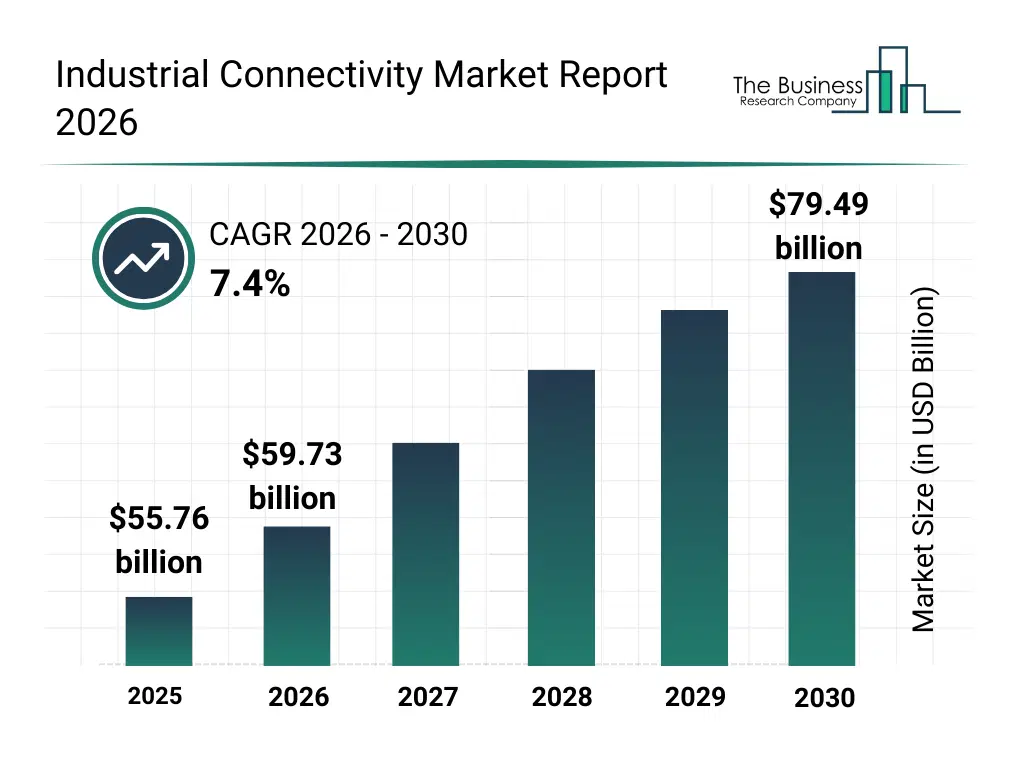
What Is The Industrial Connectivity Market Size and Share 2026?
The industrial connectivity market size has grown strongly in recent years. It will grow from $55.76 billion in 2025 to $59.73 billion in 2026 at a compound annual growth rate (CAGR) of 7.1%. The growth in the historic period can be attributed to growth of smart manufacturing initiatives, increasing adoption of Industrial Automation, rising demand for low-latency connectivity, expansion of wired and wireless industrial networks, early adoption of industrial Ethernet and fieldbus systems.What Is The Industrial Connectivity Market Growth Forecast?
The industrial connectivity market size is expected to see strong growth in the next few years. It will grow to $79.49 billion in 2030 at a compound annual growth rate (CAGR) of 7.4%. The growth in the forecast period can be attributed to integration of ai and predictive analytics in connectivity, increasing deployment of industrial 5g networks, growth in cloud-based industrial network management, rising demand for cybersecurity in industrial networks, expansion of managed connectivity and optimization services. Major trends in the forecast period include real-time data transmission and monitoring, secure remote connectivity, industrial network management, machine-to-machine communication services, network design and integration services.
Global Industrial Connectivity Market Segmentation
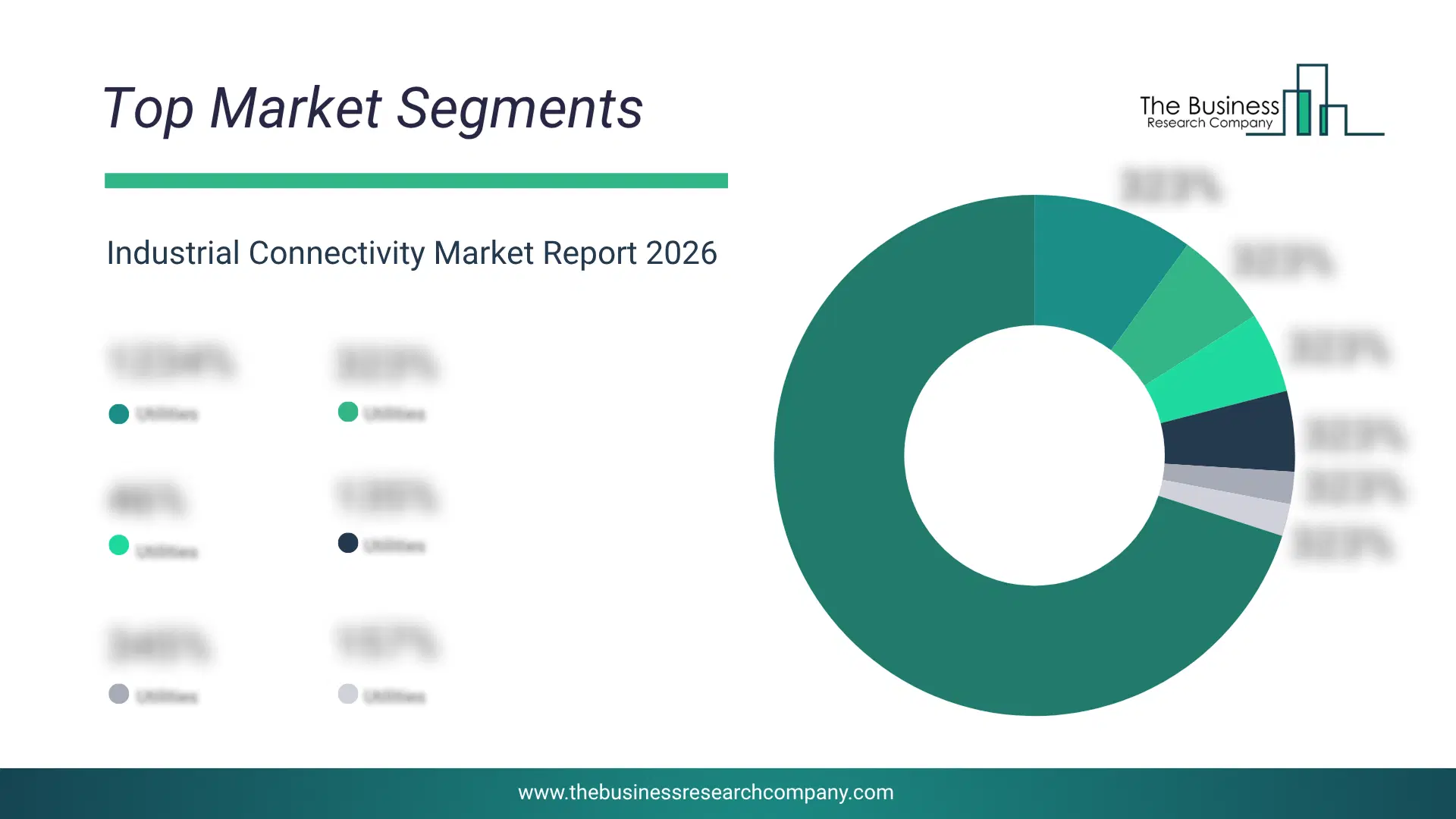
1) By Component: Hardware, Software, Services 2) By Technology: Industrial Ethernet, Fieldbus Communication, Cellular Connectivity, Low Power Wide Area Networks, Industrial Wireless Local Area Networks 3) By Network Connectivity: Wired, Wireless 4) By Deployment: On-Premise, Cloud-Based 5) By End Use: Aerospace And Defense, Automotive, Chemical, Energy And Utilities, Food And Beverage, Healthcare, Manufacturing, Mining And Metal, Oil And Gas, Transportation, Other Industrial Connectivity End Users Subsegments: 1) By Hardware: Industrial Routers, Industrial Switches, Industrial Gateways, Connectivity Modules, Industrial Cables And Connectors, Network Interface Devices 2) By Software: Network Management Software, Industrial Communication Software, Connectivity Middleware, Device Management Software, Data Integration Platforms, Network Security Software 3) By Services: Installation And Configuration Services, Network Design And Engineering Services, Maintenance And Support Services, Managed Connectivity Services, System Integration Services, Network Optimization And Monitoring Services The top segments in the industrial connectivity market will be: • Hardware will reach $36.48 Billion by 2030. • Services will reach $20.82 Billion by 2030. • Software will reach $17.55 Billion by 2030.What Is The Driver Of The Industrial Connectivity Market?
The increasing demand for real-time industrial data visibility is expected to propel the growth of the industrial connectivity market going forward. Real-time industrial data visibility refers to the ability to continuously capture, monitor, and analyze data generated from industrial operations as it occurs, enabling faster decision-making and proactive management across industrial and supply chain activities. The rise in demand for real-time industrial data visibility is driven by the growing need for faster, more accurate, and data-driven decisions within industrial environments. Industrial connectivity supports real-time industrial data visibility by enabling seamless, continuous data exchange between machines, sensors, and software platforms. For instance, in March 2024, according to Tive, Inc., a US-based supply chain visibility and logistics technology platform, 53% of respondents used IoT devices for real-time shipment tracking, more than doubling from 25% in 2023. Therefore, the increasing demand for real-time industrial data visibility is driving the growth of the industrial connectivity industry.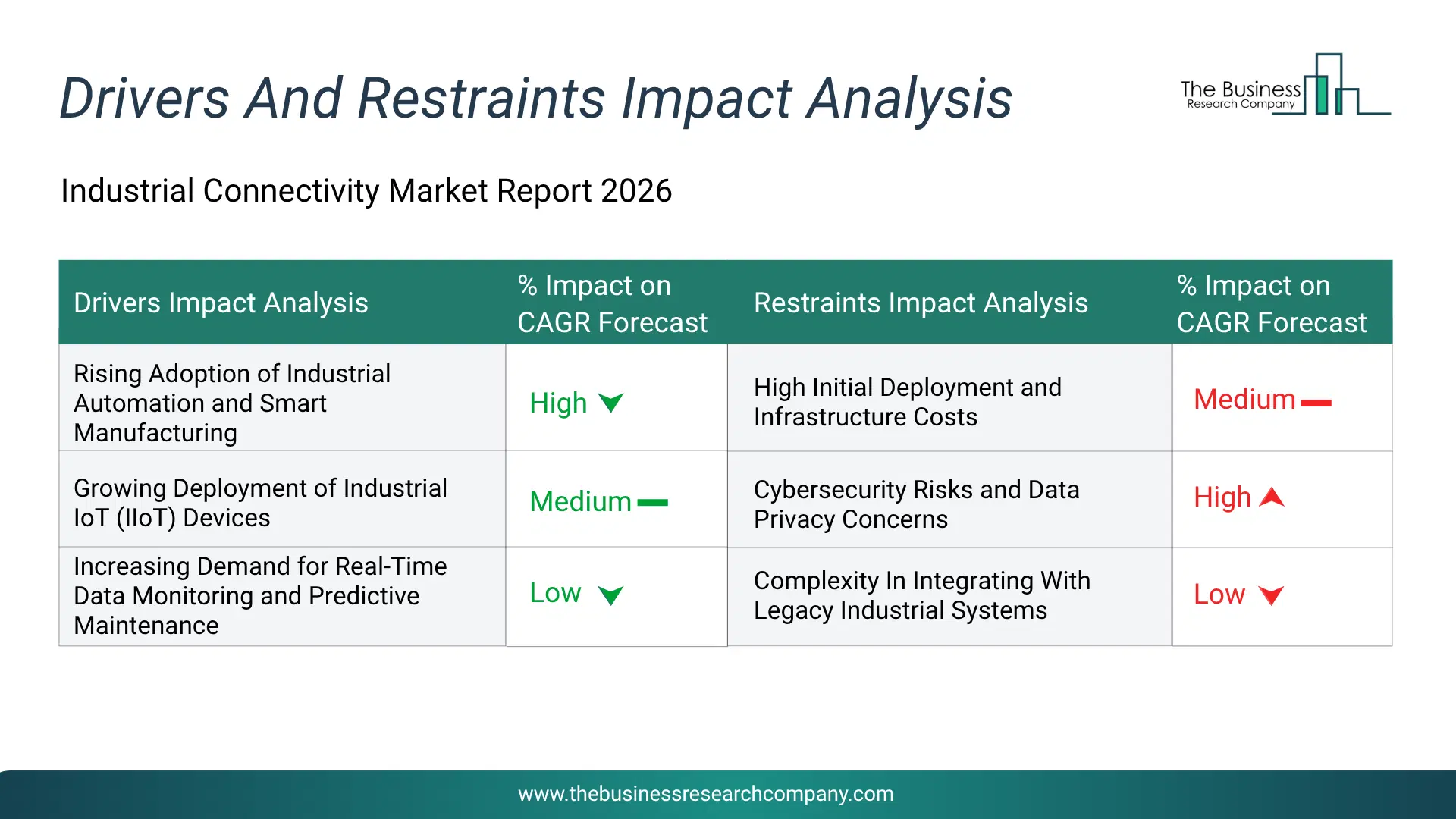
Infographic Chart Showing Key Market Drivers Analysis And Restraints For Industrial Connectivity Market
The chart presents an impact analysis of key drivers and restraints, quantifying their relative influence on the market's growth rate and helping assess the balance between growth enablers and limiting factors. This chart offers a high-level perspective; the full report contains more detailed insights.
How Will The Drivers Impact Growth In The Global Industrial Connectivity Market?
• Rising Adoption of Industrial Automation and Smart Manufacturing (High) – During the forecast period, the rising adoption of industrial automation and smart manufacturing is expected to become a key growth driver for the industrial connectivity market by 2030. Industries are increasingly adopting automation technologies to improve productivity, reduce operational costs, and minimize human intervention in critical processes. Industrial connectivity enables seamless communication between machines, robots, sensors, and control systems, which is essential for smart manufacturing environments. Connected industrial systems provide real-time monitoring, predictive maintenance, and automated decision-making capabilities. The growth of Industry 4.0 initiatives across manufacturing, energy, automotive, and logistics sectors is accelerating demand for reliable industrial networks. As factories become more data-driven and interconnected, the need for advanced industrial connectivity solutions continues to expand significantly. • Growing Deployment of Industrial IoT (IIoT) Devices (Medium) – During the forecast period, the growing deployment of industrial IoT (IIoT) devices is expected to emerge as a major factor driving the expansion of the industrial connectivity market by 2030. The rapid increase in Industrial Internet of Things (IIoT) deployments is a major factor driving the industrial connectivity market. Industrial facilities are integrating connected sensors, smart meters, actuators, and monitoring devices to collect and analyze operational data in real time. Industrial connectivity solutions enable these devices to communicate efficiently across production systems and enterprise platforms. This improves asset visibility, operational efficiency, and process optimization while reducing downtime and maintenance costs. The expansion of connected industrial ecosystems is therefore creating strong demand for scalable and secure connectivity infrastructure. • Increasing Demand for Real-Time Data Monitoring and Predictive Maintenance (Low) – During the forecast period, the increasing demand for real-time data monitoring and predictive maintenance is expected to act as a key growth catalyst for the industrial connectivity market by 2030. Modern industrial operations require continuous monitoring of machines and processes to ensure efficiency, quality control, and equipment reliability. Industrial connectivity enables real-time data transmission from production assets to centralized control systems and analytics platforms. Companies are increasingly using predictive maintenance strategies that rely on connected equipment and advanced data analytics to identify potential failures before breakdowns occur. This reduces unplanned downtime, maintenance expenses, and production losses.How Will The Restraints Impact Growth In The Global Industrial Connectivity Market?
• High Initial Deployment and Infrastructure Costs (High) – During the forecast period, the implementing industrial connectivity solutions often requires substantial investment in networking equipment, industrial ethernet infrastructure, gateways, sensors, software platforms, and cybersecurity systems. Many industrial facilities also need upgrades to legacy systems to support modern connected operations. The integration process can involve high installation, configuration, and maintenance costs, particularly in large-scale industrial environments. Small and medium-sized enterprises may face budget constraints that limit adoption of advanced industrial connectivity technologies. These high upfront expenditures can slow market growth, especially in cost-sensitive industries and developing regions • Cybersecurity Risks and Data Privacy Concerns (Medium) – During the forecast period, the industrial systems become increasingly connected, they also become more vulnerable to cyberattacks, ransomware, unauthorized access, and data breaches. Industrial connectivity networks often handle critical operational and production data, making cybersecurity a major concern for manufacturers and infrastructure operators. A successful cyberattack can disrupt operations, damage equipment, and result in significant financial and reputational losses. Many industries are cautious about connecting mission-critical systems to external or cloud-based networks due to security risks. Concerns regarding network security, regulatory compliance, and data protection therefore act as key restraints for market adoption. • Complexity In Integrating With Legacy Industrial Systems (Low) – During the forecast period, the complexity in integrating with legacy industrial systems is restraining the growth of the industrial connectivity market because many manufacturing facilities continue to rely on outdated machinery and proprietary communication protocols that are not designed for modern connected environments. Integrating these legacy systems with advanced industrial connectivity solutions often requires specialized hardware, protocol converters, and customized software, increasing implementation complexity and deployment timelines. Compatibility issues can disrupt production processes and raise operational costs, discouraging organizations from adopting industrial connectivity technologies at scale.Key Players In The Global Industrial Connectivity Market
Major companies operating in the industrial connectivity market are Google LLC, Microsoft Corporation, Verizon Business Network Services Inc, Siemens Aktiengesellschaft, International Business Machines Corporation, Cisco Systems Inc, Intel Corporation, Orange SA, Telefonica SA, Schneider Electric SE, Qualcomm Technologies Inc, Honeywell International Inc, ABB Ltd, Rockwell Automation Inc, Belden Inc., PTC Inc., Advantech Co Ltd, Digi International Inc, Moxa Inc, and Inductive Automation LLC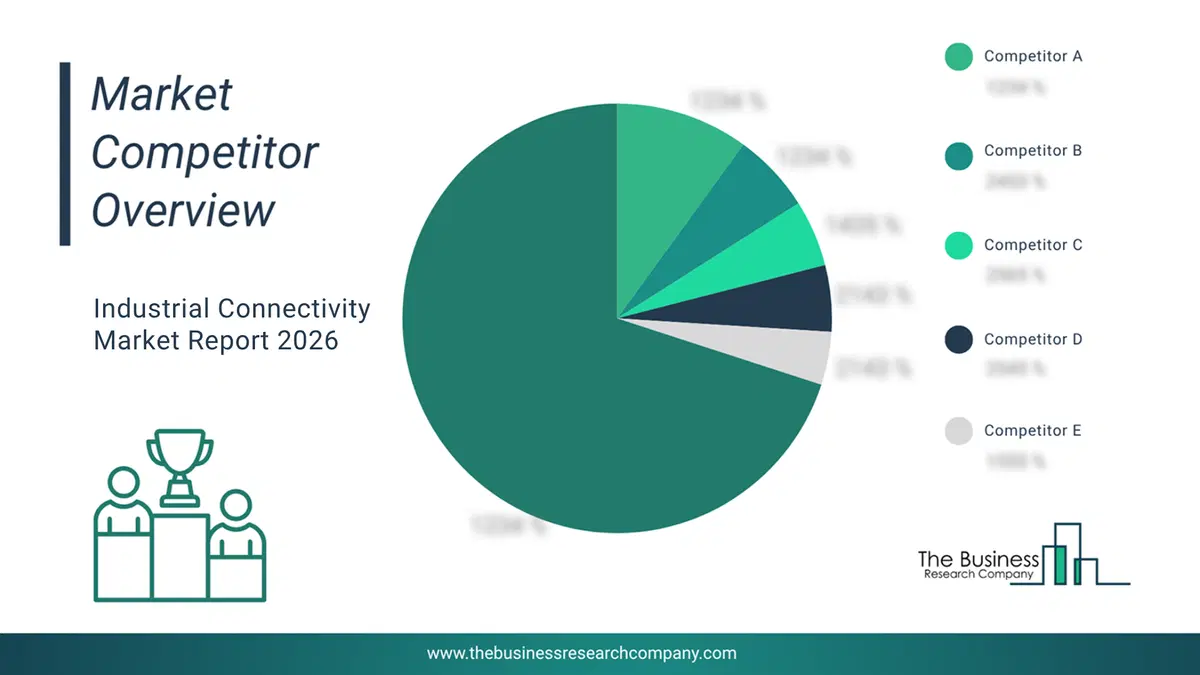
This chart is for illustrative purposes; the full report includes a detailed competitor analysis and comprehensive overview of the top 10 companies in the market.
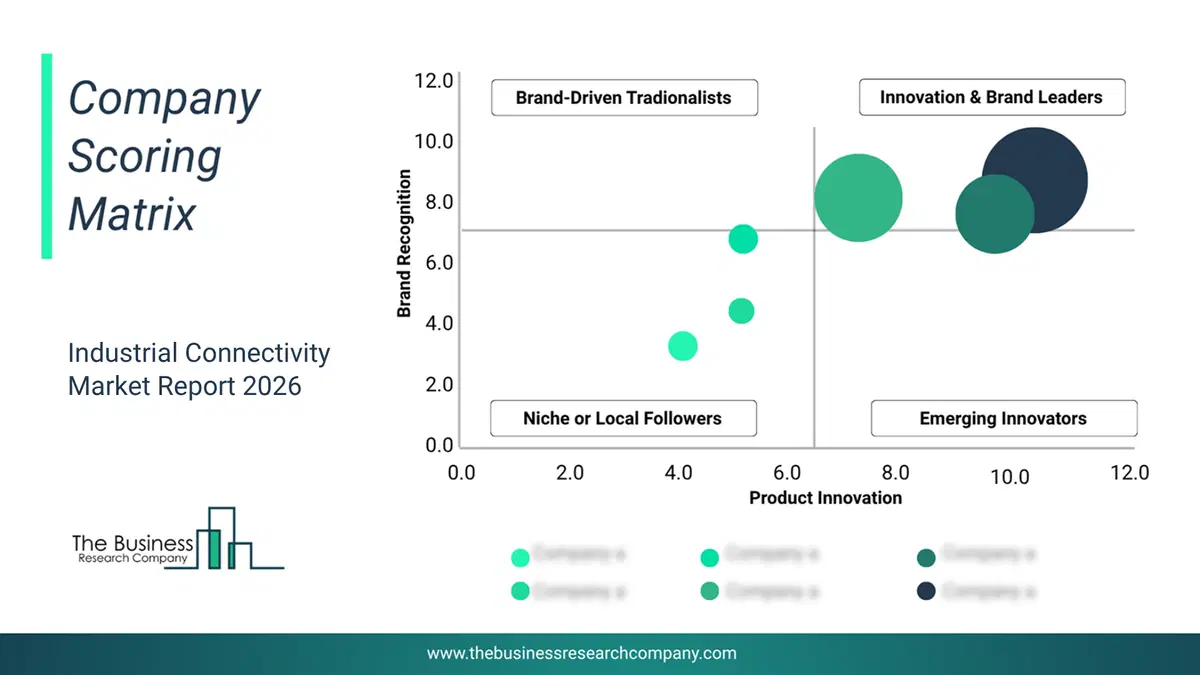
This chart maps companies by product innovation and brand strength, with bubble size indicating relative revenue, helping identify market leaders, challengers, and niche players. This is an illustrative chart; the full report provides a complete and accurate competitive analysis.
Global Industrial Connectivity Market Trends and Insights
Major companies operating in the industrial connectivity market are focusing on delivering unified IoT connectivity solutions to ensure reliable, always-on communication across industrial environments, including remote and hard-to-reach locations. Unified IoT connectivity solutions integrate terrestrial and non-terrestrial networks, allowing industrial devices to maintain uninterrupted data transmission for applications such as asset tracking, remote monitoring, and industrial automation. For instance, in October 2025, Semtech Corporation, a US-based semiconductor and Internet of Things (IoT) solutions provider, partnered with Skylo Technologies, Inc., a US-based satellite connectivity provider, to launch a single-vendor device-to-cloud cellular and satellite IoT solution. The solution delivers an end-to-end industrial connectivity system from a single provider, enabling devices to automatically switch between cellular and satellite networks to ensure continuous data transmission. It also includes a unified management platform and smart SIM solution, allowing industrial enterprises to monitor, manage, and bill connected devices from a single dashboard, thereby improving operational efficiency and connectivity reliability across diverse industrial use cases.What Are Latest Mergers And Acquisitions In The Industrial Connectivity Market?
In September 2025, SJE, Inc., a US-based company specializing in control systems and industrial equipment solutions, acquired AMI Global, LLC from Cimbria Capital for an undisclosed amount. Through this acquisition, SJE aims to expand its industrial Internet of Things (IIoT) and cloud-connected solutions capabilities by integrating AMI Global’s expertise in remote connectivity, monitoring, and cloud-based management of industrial equipment. AMI Global, LLC is a US-based company specializing in industrial Internet of Things (IIoT) technology, including hardware, software, and cloud services for monitoring and connecting industrial devices.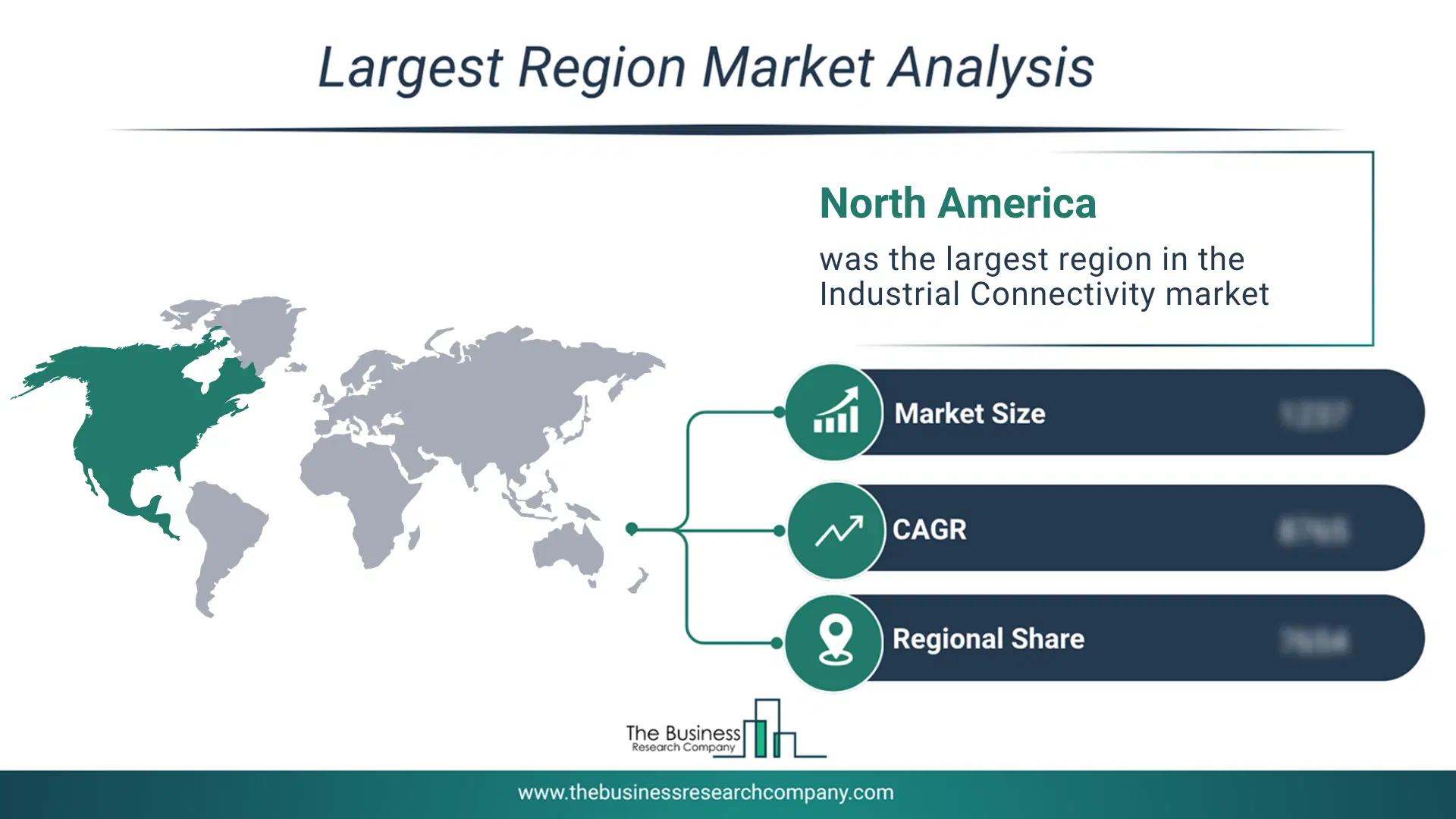
Regional Outlook
North America was the largest region in the industrial connectivity market in 2025. Asia-Pacific is expected to be the fastest-growing region in the forecast period. The regions covered in this market report are Asia-Pacific, South East Asia, Western Europe, Eastern Europe, North America, South America, Middle East, Africa. The countries covered in this market report are Australia, Brazil, China, France, Germany, India, Indonesia, Japan, Taiwan, Russia, South Korea, UK, USA, Canada, Italy, Spain.What Defines the Industrial Connectivity Market?
The industrial connectivity market consists of revenues earned by entities by providing services such as industrial network design and integration, machine-to-machine communication services, real-time data transmission and monitoring, industrial network management, and secure remote connectivity services. The market value includes the value of related goods sold by the service provider or included within the service offering. The industrial connectivity market also includes sales of industrial Ethernet switches, wireless access points, industrial gateways, connectivity modules, and network management software platforms. Values in this market are ‘factory gate’ values, that is, the value of goods sold by manufacturers or creators of the goods, whether to other entities (including downstream manufacturers, system integrators, distributors, and service providers) or directly to end users. The value of goods in this market includes related services sold by the creators of the goods, such as installation, configuration, maintenance, and network optimization services.How is Market Value Defined and Measured?
The market value is defined as the revenues that enterprises gain from the sale of goods and/or services within the specified market and geography through sales, grants, or donations in terms of the currency (in USD unless otherwise specified). The revenues for a specified geography are consumption values that are revenues generated by organizations in the specified geography within the market, irrespective of where they are produced. It does not include revenues from resales along the supply chain, either further along the supply chain or as part of other products.
This chart presents market attractiveness based on a quantitative evaluation of growth, competition, strategic alignment, and risk, offering a clear view of opportunity areas for decision-making. This chart is for illustrative purposes; the full report contains the complete analysis.

This chart highlights the Total Addressable Market (TAM) by estimating the maximum revenue opportunity using an assumption-driven approach, supporting strategic planning and opportunity sizing across markets. The chart is illustrative; the full report provides a more comprehensive analysis.
What Key Data and Analysis Are Included in the Industrial Connectivity Market Report 2026?
The industrial connectivity market research report is one of a series of new reports from The Business Research Company that provides market statistics, including industry global market size, regional shares, competitors with the market share, detailed market segments, market trends and opportunities, and any further data you may need to thrive in the industrial connectivity industry. The market research report delivers a complete perspective of everything you need, with an in-depth analysis of the current and future state of the industry.Industrial Connectivity Market Report Forecast Analysis
| Report Attribute | Details |
|---|---|
| Market Size Value In 2026 | $59.73 billion |
| Revenue Forecast In 2030 | $79.49 billion |
| Growth Rate | CAGR of 7.1% from 2026 to 2030 |
| Base Year For Estimation | 2025 |
| Actual Estimates/Historical Data | 2020-2025 |
| Forecast Period | 2026 - 2030 |
| Market Representation | Revenue in USD Billion and CAGR from 2026 to 2030 |
| Segments Covered | Component, Technology, Network Connectivity, Deployment, End Use |
| Regional Scope | Asia-Pacific, Western Europe, Eastern Europe, North America, South America, Middle East, Africa |
| Country Scope | The countries covered in the report are Australia, Brazil, China, France, Germany, India, ... |
| Key Companies Profiled | Google LLC, Microsoft Corporation, Verizon Business Network Services Inc, Siemens Aktiengesellschaft, International Business Machines Corporation, Cisco Systems Inc, Intel Corporation, Orange SA, Telefonica SA, Schneider Electric SE, Qualcomm Technologies Inc, Honeywell International Inc, ABB Ltd, Rockwell Automation Inc, Belden Inc., PTC Inc., Advantech Co Ltd, Digi International Inc, Moxa Inc, and Inductive Automation LLC |
| Customization Scope | Request for Customization |
| Pricing And Purchase Options | Explore Purchase Options |