

Industrial Edge Market Report 2026
Global Outlook – By Component (Hardware, Software, Services), By Deployment Mode (On Premises, Cloud Based), By Organization Size (Large Enterprises, Small And Medium Enterprises), By Application (Predictive Maintenance, Real Time Monitoring And Control, Asset Tracking And Management, Remote Monitoring And Management, Automation And Robotics, Quality Control And Inspection, Process Optimization, Security And Compliance, Other Applications), By End Use (Manufacturing, Energy And Utilities, Transportation And Logistics, Healthcare, Oil And Gas, Automotive, Other End Users) – Market Size, Trends, Strategies, and Forecast to 2030
Industrial Edge Market Overview
• Industrial Edge market size has reached to $17.94 billion in 2025 • Expected to grow to $39.64 billion in 2030 at a compound annual growth rate (CAGR) of 17.1% • Growth Driver: Rapid Adoption Of Industry 4.0 And Smart Factory Initiatives Driving The Market Growth Due To Increasing Demand For Real-Time Data Processing, Automation, And Low-Latency Decision Making • Market Trend: Next-Generation Industrial Rugged Edge Devices Strengthening Industrial Connectivity • North America was the largest region in 2025 and Asia-Pacific is the fastest growing region.What Is Covered Under Industrial Edge Market?
Industrial edge refers to a distributed computing approach in which data processing, analytics, and control functions are performed close to industrial assets such as machines, sensors, and production systems rather than relying solely on centralized cloud infrastructure. It enables real-time decision-making, reduced latency, improved operational efficiency, and enhanced reliability in industrial environments by integrating edge devices, industrial IoT systems, and advanced software platforms. The main components of industrial edge include hardware, software, and services. Hardware refers to edge computing devices, gateways, industrial controllers, sensors, and networking equipment that process and analyze operational data close to industrial assets for low-latency decision-making. These solutions are deployed through on premises and cloud based environments and are adopted by large enterprises and small and medium enterprises. They find application in predictive maintenance, real time monitoring and control, asset tracking and management, remote monitoring and management, automation and robotics, quality control and inspection, process optimization, security and compliance, and others, serving end uses including manufacturing, energy and utilities, transportation and logistics, healthcare, oil and gas, automotive, and others.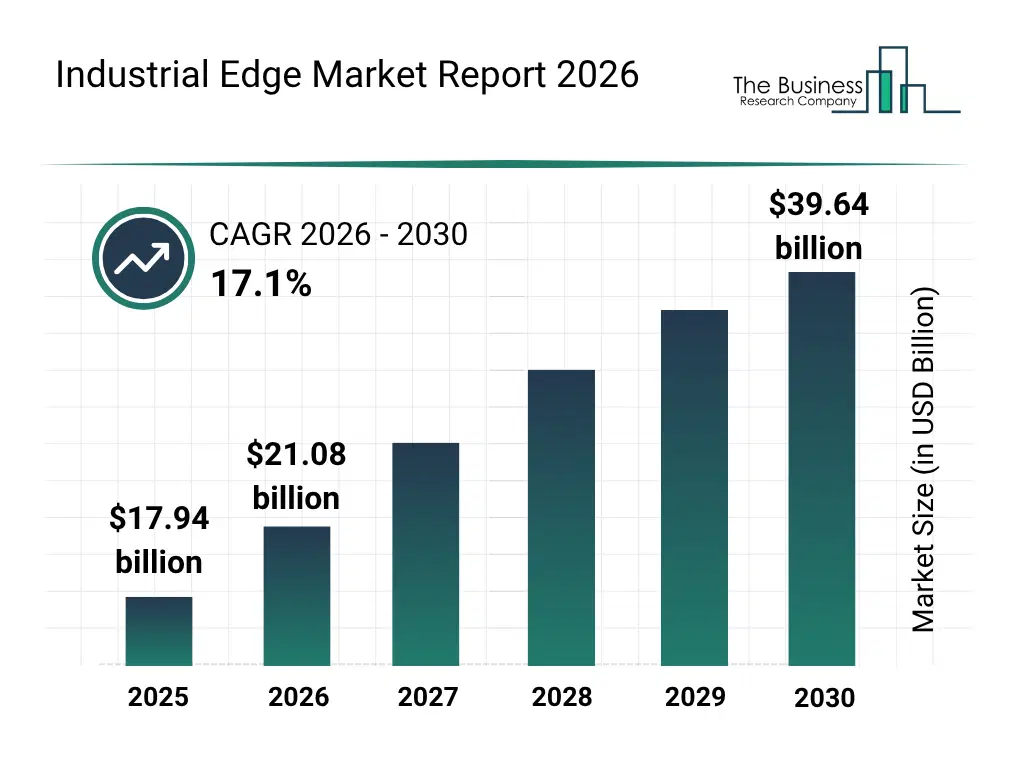
What Is The Industrial Edge Market Size and Share 2026?
The industrial edge market size has grown rapidly in recent years. It will grow from $17.94 billion in 2025 to $21.08 billion in 2026 at a compound annual growth rate (CAGR) of 17.5%. The growth in the historic period can be attributed to increasing adoption of industrial automation technologies, rising demand for real time operational monitoring, growing implementation of industrial IoT solutions, increasing need for improved production efficiency, rising deployment of connected industrial equipment.What Is The Industrial Edge Market Growth Forecast?
The industrial edge market size is expected to see rapid growth in the next few years. It will grow to $39.64 billion in 2030 at a compound annual growth rate (CAGR) of 17.1%.The growth in the forecast period can be attributed to increasing adoption of AI powered edge analytics solutions, growing demand for autonomous industrial operations, rising investments in smart manufacturing infrastructure, increasing deployment of secure industrial edge platforms, expanding integration of edge computing with industrial robotics. Major trends in the forecast period include increasing adoption of real time industrial data processing, growing demand for edge based predictive maintenance solutions, rising integration of industrial edge security platforms, increasing deployment of distributed industrial computing architectures, growing demand for low latency industrial automation systems.
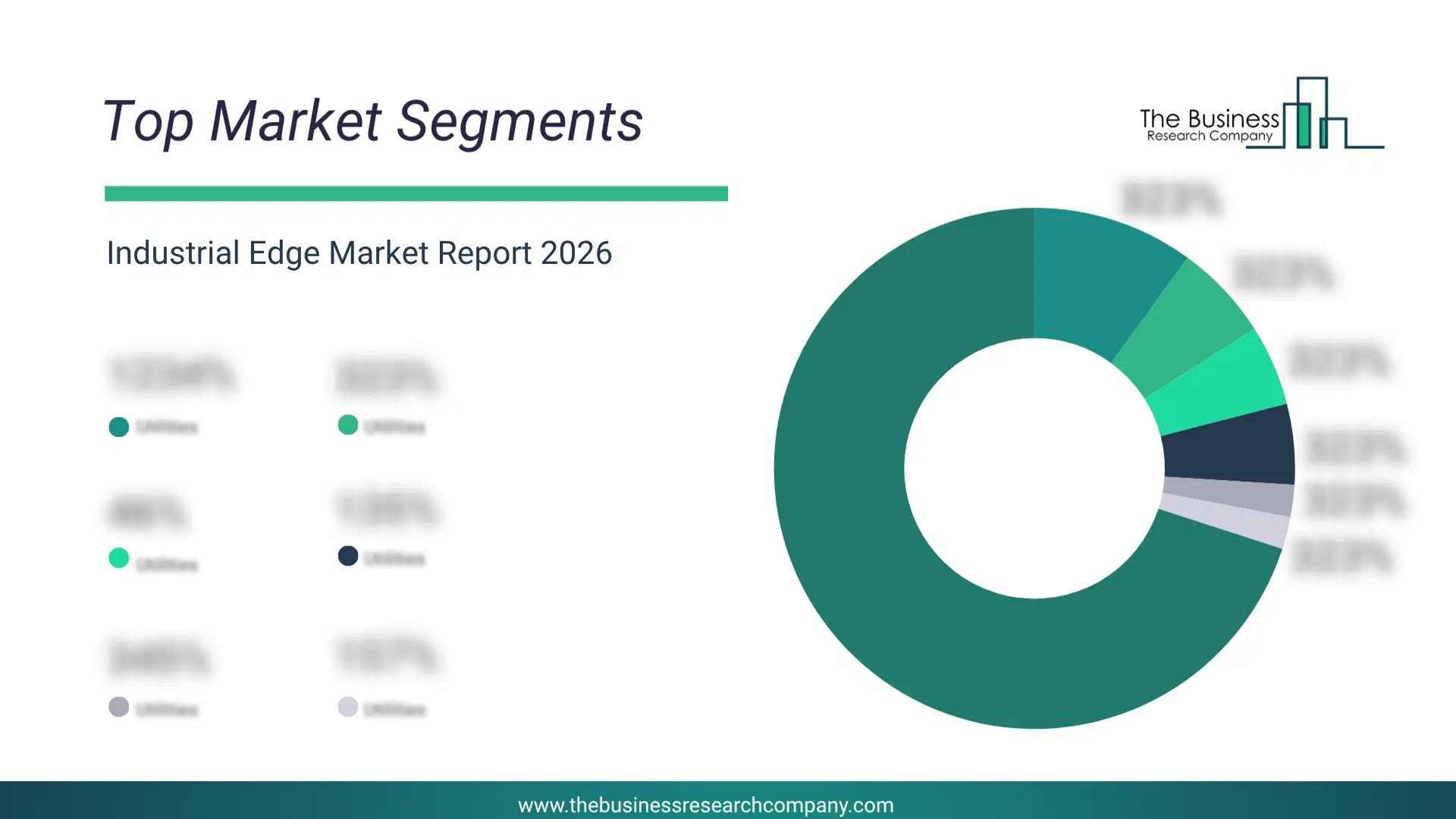
Global Industrial Edge Market Segmentation
2) By Deployment Mode: On Premises, Cloud Based 3) By Organization Size: Large Enterprises, Small And Medium Enterprises 4) By Application: Predictive Maintenance, Real Time Monitoring And Control, Asset Tracking And Management, Remote Monitoring And Management, Automation And Robotics, Quality Control And Inspection, Process Optimization, Security And Compliance, Other Applications 5) By End Use: Manufacturing, Energy And Utilities, Transportation And Logistics, Healthcare, Oil And Gas, Automotive, Other End Users Subsegments: 1) By Hardware: Industrial Edge Gateways, Edge Servers, Industrial Edge Controllers, Industrial Sensors And Edge Devices 2) By Software: Edge Data Management Software, Edge Analytics Software, Edge Orchestration And Management Software, Industrial Edge Security Software 3) By Services: Industrial Edge Consulting Services, Deployment And Integration Services, Managed Industrial Edge Services, Maintenance And Support ServicesWhat Is The Driver Of The Industrial Edge Market?
The rapid adoption of Industry 4.0 and smart factory initiatives are expected to propel the growth of the industrial edge market going forward. Industry 4.0 and smart factories refer to the integration of advanced digital technologies such as IoT, artificial intelligence, machine learning, and automation into manufacturing systems to create highly connected, intelligent, and self-optimizing production environments. The adoption of Industry 4.0 and smart factory initiatives is increasing due to the need for real-time data processing, as modern manufacturing operations generate large volumes of data from connected machines that must be analyzed instantly to enable faster and more accurate decision-making. Industry 4.0 and smart factory initiatives drive industrial edge by enabling real-time, on-site data processing, seamless machine-to-machine connectivity, and intelligent automation at the production level, resulting in faster decision-making, reduced latency, improved operational efficiency, and enhanced predictive maintenance across modern manufacturing environments. For instance, in March 2024, according to Rockwell Automation Inc., a US-based automation company, 83% of manufacturers expected to adopt generative artificial intelligence (GenAI) in their operations. Additionally, 95% of manufacturers were either implementing or assessing smart manufacturing technologies, an increase from 84% in 2023. Therefore, the rapid adoption of Industry 4.0 and smart factory initiatives is driving the growth of the industrial edge industry.Key Players In The Global Industrial Edge Market
Major companies operating in the industrial edge market are Microsoft Corporation, Amazon Web Services Inc, Huawei Technologies Co. Ltd., Siemens AG, Dell Technologies Inc, Intel Corporation, International Business Machines Corporation, Cisco Systems Inc, NVIDIA Corporation, Robert Bosch GmbH, Emerson Electric Co, Honeywell International Inc, Schneider Electric SE, Hewlett Packard Enterprise Company, ABB Ltd, Rockwell Automation Inc, Vertiv, Advantech Co. Ltd., Phoenix Contact GmbH & Co. KG, Beckhoff Automation GmbH & Co. KG, Moxa Inc, OnLogic Inc, Hilscher Gesellschaft für Systemautomation mbH, ZEDEDA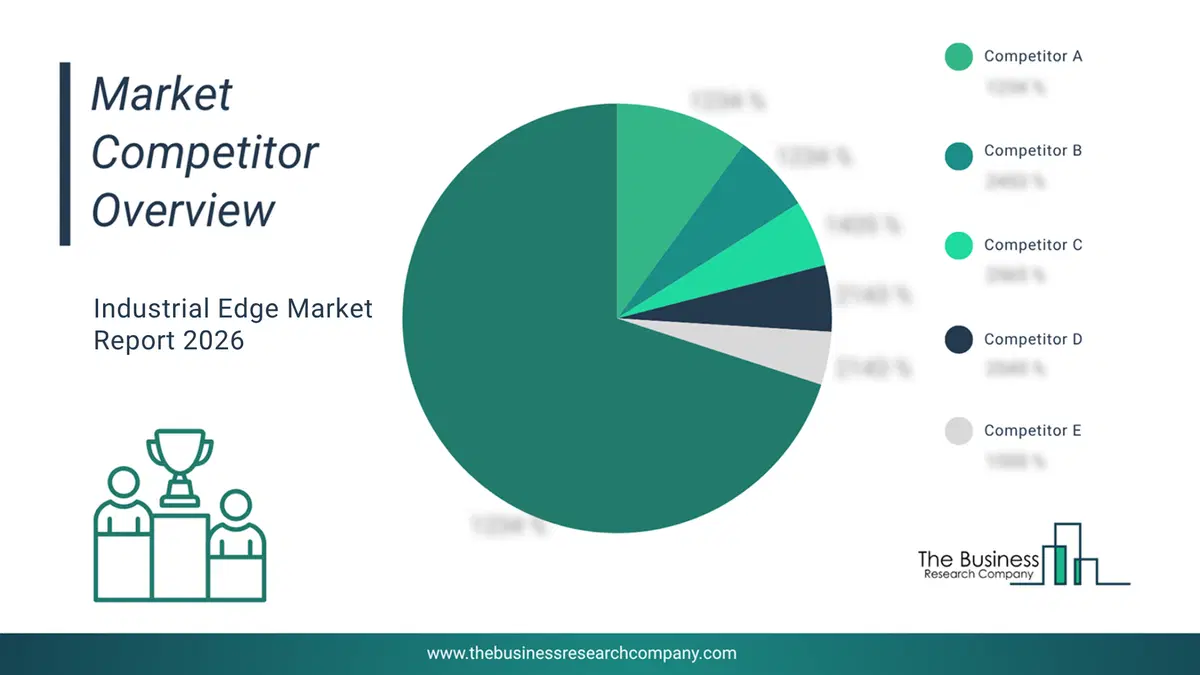
This chart is for illustrative purposes; the full report includes a detailed competitor analysis and comprehensive overview of the top 10 companies in the market.
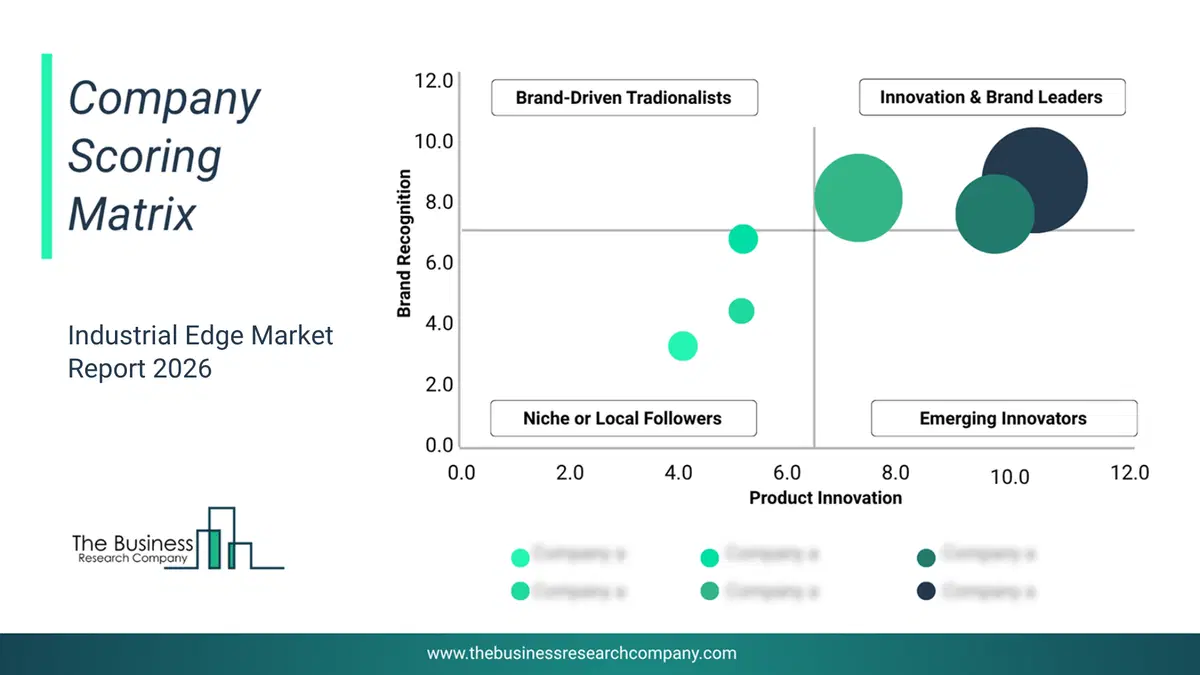
This chart maps companies by product innovation and brand strength, with bubble size indicating relative revenue, helping identify market leaders, challengers, and niche players. This is an illustrative chart; the full report provides a complete and accurate competitive analysis.
Global Industrial Edge Market Trends and Insights
Major companies operating in the industrial edge market are focusing on developing innovative products, such as industrial rugged edge devices to enhance secure OT or IT integration, real-time data processing, and scalable industrial IoT deployments. Industrial rugged edge devices are durable computing systems designed to operate in harsh industrial environments that help organizations process data closer to equipment, enabling real-time decision-making, reducing latency, enhancing cybersecurity, and supporting secure, scalable OT/IT integration and Industrial IoT deployments. For instance, in December 2025, Softing Industrial Automation GmbH, a Germany-based industrial connectivity and automation solutions provider, launched edgeNode Portainer, an industrial edge device designed for secure and scalable deployment of containerized applications. The solution integrates centralized container lifecycle management, supports Docker-based edge applications, and enables secure connectivity to industrial controllers through OPC UA and MQTT protocols. Developed in alignment with IEC 62443 cybersecurity standards, the device offers robust security features, simplified application updates, and reliable operation in industrial environments, supporting large-scale OT/IT integration and industrial edge computing initiatives.What Are Latest Mergers And Acquisitions In The Industrial Edge Market?
In October 2025, NXP Semiconductors N.V., a Netherlands-based semiconductor technology company, acquired Kinara Inc. for $307 million. With this acquisition, NXP strengthened its edge artificial intelligence (AI) portfolio by integrating Kinara's advanced neural processing unit (NPU) technology, enhancing its ability to deliver high-performance, energy-efficient AI solutions for automotive, industrial, and Internet of Things (IoT) applications while accelerating intelligent edge computing and real-time AI inference capabilities. Kinara Inc. is a US-based artificial intelligence technology company that specializes in providing industrial edge solutions.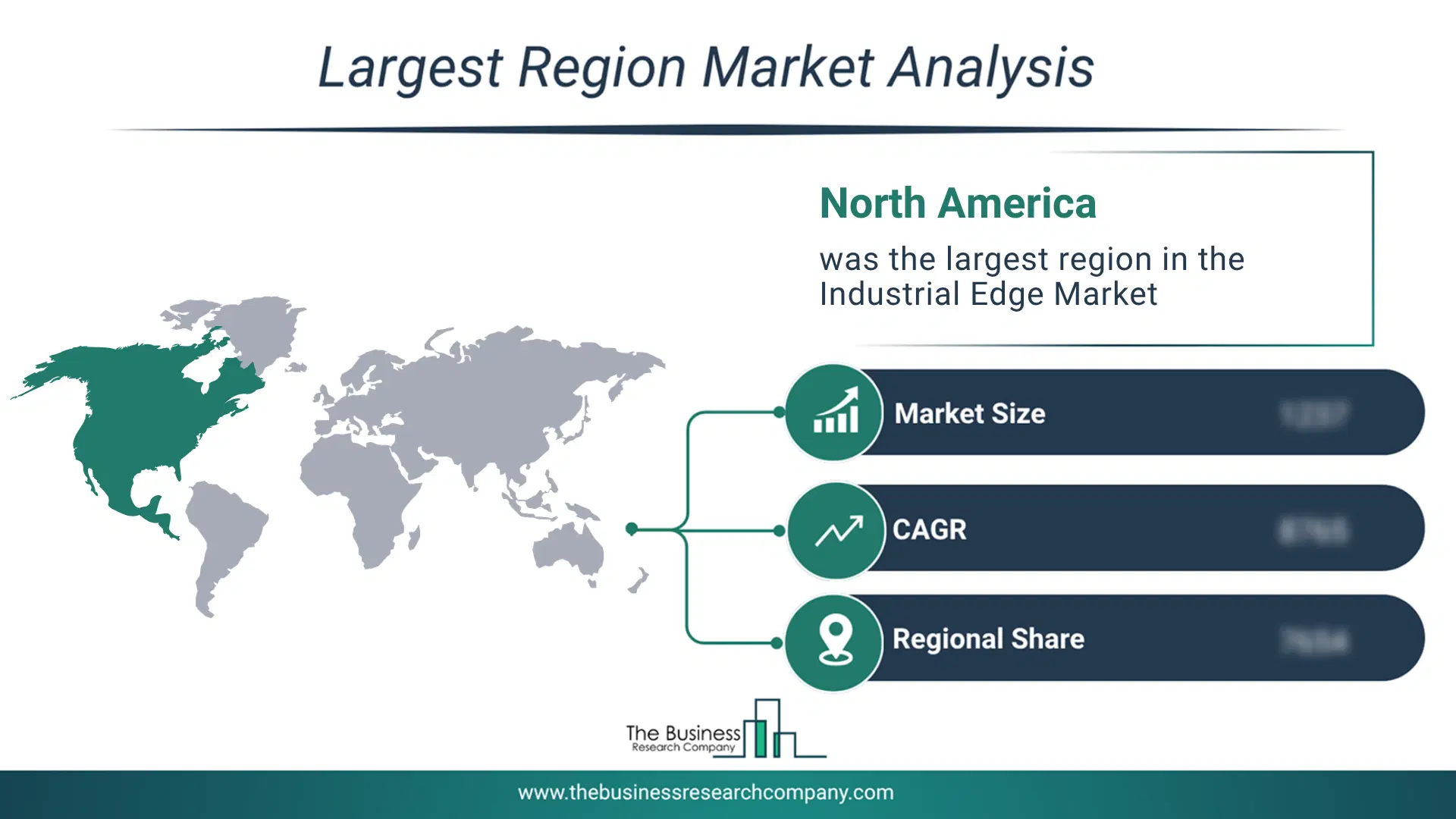
Regional Outlook/Insights
North America was the largest region in the industrial edge market in 2025. Asia-Pacific is expected to be the fastest-growing region in the forecast period. The regions covered in this market report are Asia-Pacific, South East Asia, Western Europe, Eastern Europe, North America, South America, Middle East, Africa. The countries covered in this market report are Australia, Brazil, China, France, Germany, India, Indonesia, Japan, Taiwan, Russia, South Korea, UK, USA, Canada, Italy, Spain.What Defines the Industrial Edge Market?
The industrial edge market consists of revenues earned by entities by providing services such as edge computing platform deployment, real-time data processing, device and edge node management, system integration and maintenance. The market value includes the value of related goods sold by the service provider or included within the service offering. The industrial edge market also includes sales of industrial edge servers, ruggedized computing devices, industrial PCs, sensors, controllers, and networking equipment. Values in this market are ‘factory gate’ values, that is the value of goods sold by the manufacturers or creators of the goods, whether to other entities (including downstream manufacturers, wholesalers, distributors and retailers) or directly to end customers. The value of goods in this market includes related services sold by the creators of the goods.How is Market Value Defined and Measured?
The market value is defined as the revenues that enterprises gain from the sale of goods and/or services within the specified market and geography through sales, grants, or donations in terms of the currency (in USD unless otherwise specified). The revenues for a specified geography are consumption values that are revenues generated by organizations in the specified geography within the market, irrespective of where they are produced. It does not include revenues from resales along the supply chain, either further along the supply chain or as part of other products.
This chart presents market attractiveness based on a quantitative evaluation of growth, competition, strategic alignment, and risk, offering a clear view of opportunity areas for decision-making. This chart is for illustrative purposes; the full report contains the complete analysis.

This chart highlights the Total Addressable Market (TAM) by estimating the maximum revenue opportunity using an assumption-driven approach, supporting strategic planning and opportunity sizing across markets. The chart is illustrative; the full report provides a more comprehensive analysis.
What Key Data and Analysis Are Included in the Industrial Edge Market Report 2026?
The industrial edge market research report is one of a series of new reports from The Business Research Company that provides industrial edge market statistics, including industrial edge industry global market size, regional shares, competitors with a industrial edge market share, detailed industrial edge market segments, market trends and opportunities, and any further data you may need to thrive in the industrial edge industry. This industrial edge market research report delivers a complete perspective of everything you need, with an in-depth analysis of the current and future scenario of the industry.Industrial Edge Market Report Forecast Analysis
| Report Attribute | Details |
|---|---|
| Market Size Value In 2026 | $21.08 billion |
| Revenue Forecast In 2030 | $39.64 billion |
| Growth Rate | CAGR of 17.1% from 2026 to 2030 |
| Base Year For Estimation | 2025 |
| Actual Estimates/Historical Data | 2020-2025 |
| Forecast Period | 2026 - 2030 |
| Market Representation | Revenue in USD Billion and CAGR from 2026 to 2030 |
| Segments Covered | Component, Deployment Mode, Organization Size, Application, End Use |
| Regional Scope | Asia-Pacific, Western Europe, Eastern Europe, North America, South America, Middle East, Africa |
| Country Scope | The countries covered in the report are Australia, Brazil, China, France, Germany, India, Indonesia, Japan, Taiwan, Russia, South Korea, UK, USA, Canada, Italy, Spain. |
| Key Companies Profiled | Microsoft Corporation, Amazon Web Services Inc, Huawei Technologies Co. Ltd., Siemens AG, Dell Technologies Inc, Intel Corporation, International Business Machines Corporation, Cisco Systems Inc, NVIDIA Corporation, Robert Bosch GmbH, Emerson Electric Co, Honeywell International Inc, Schneider Electric SE, Hewlett Packard Enterprise Company, ABB Ltd, Rockwell Automation Inc, Vertiv, Advantech Co. Ltd., Phoenix Contact GmbH & Co. KG, Beckhoff Automation GmbH & Co. KG, Moxa Inc, OnLogic Inc, Hilscher Gesellschaft für Systemautomation mbH, ZEDEDA |
| Customization Scope | Request for Customization |
| Pricing And Purchase Options | Explore Purchase Options |