
Industrial Energy Efficiency Services Market Report 2026
Global Outlook – By Type (Energy Auditing Or Consulting, Product And System Optimization, Monitoring And Verification, Energy Management Software), By Service Type (Outsourced, In-House), By Application (Petrochemical, Chemical Industry, Electric Power, Textile, Building Materials, Mining, Manufacturing, Food And Beverage), By End-User (Commercial, Industrial) – Market Size, Trends, Strategies, and Forecast to 2030
Industrial Energy Efficiency Services Market Overview
• Industrial Energy Efficiency Services market size has reached to $11.59 billion in 2025 • Expected to grow to $15.09 billion in 2030 at a compound annual growth rate (CAGR) of 5.5% • Growth Driver: Growing Focus On Decarbonization Is Driving The Growth Of The Industrial Energy Efficiency Services Market. • Market Trend: Innovative Energy Efficiency And Sustainability Solutions Drive Market Evolution • North America was the largest region in 2025 and Europe is the fastest growing region.Market Gains By 2030 – Top Opportunities By Segment
Market Gain identifies the most promising market opportunities by highlighting the segments or products expected to generate the highest incremental revenue growth over the next five years.
What Is Covered Under Industrial Energy Efficiency Services Market?
Industrial energy efficiency services refer to the range of solutions and practices aimed at helping industries reduce their energy consumption and improve overall energy efficiency. These services help companies lower operating costs, reduce carbon emissions, and comply with environmental regulations by identifying areas where energy is wasted and implementing strategies to reduce it. The main types of industrial energy efficiency services are energy auditing or consulting, product and system optimization, monitoring and verification, and energy management software. Energy auditing or consulting involves the evaluation of a facility's energy use to identify inefficiencies and recommend improvements. This service encompasses various types, such as outsourced and in-house, catering to a wide range of applications like the petrochemical, chemical, electric power, textile, building materials, mining, manufacturing, and food and beverage industries. Additionally, it serves diverse end-users, including commercial and industrial sectors.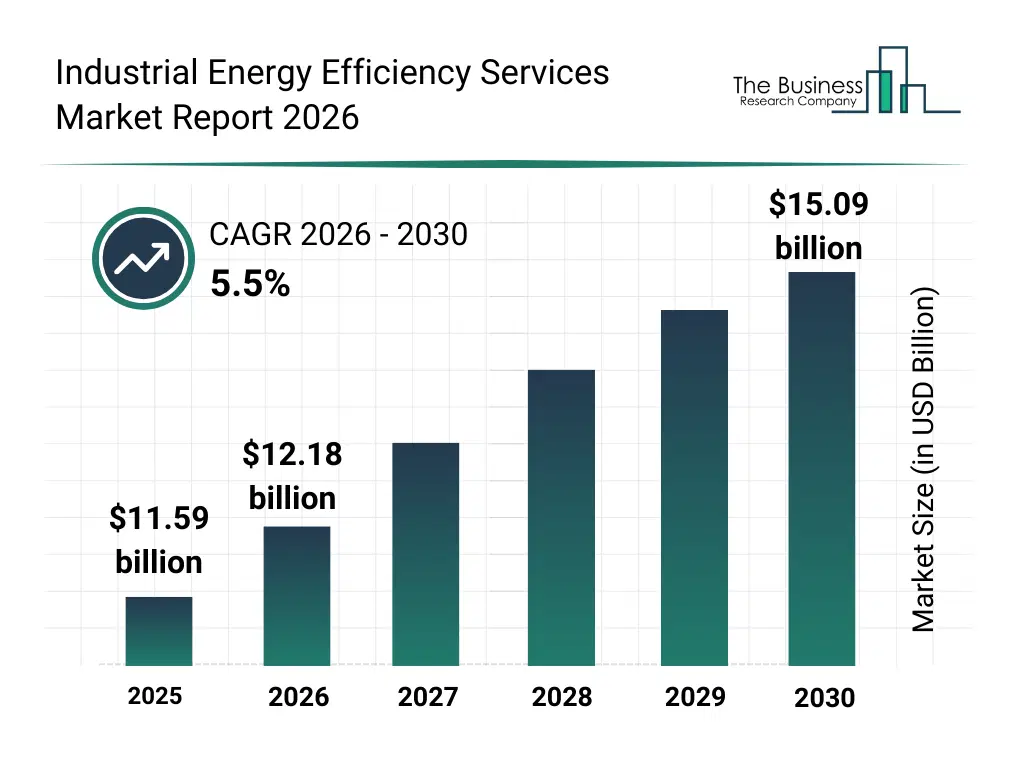
What Is The Industrial Energy Efficiency Services Market Size and Share 2026?
The industrial energy efficiency services market size has grown strongly in recent years. It will grow from $11.59 billion in 2025 to $12.18 billion in 2026 at a compound annual growth rate (CAGR) of 5.1%. The growth in the historic period can be attributed to increasing industrial energy consumption, adoption of basic energy audits, rising cost of electricity and fuel, introduction of environmental regulations, early implementation of equipment retrofitting.What Is The Industrial Energy Efficiency Services Market Growth Forecast?
The industrial energy efficiency services market size is expected to see strong growth in the next few years. It will grow to $15.09 billion in 2030 at a compound annual growth rate (CAGR) of 5.5%. The growth in the forecast period can be attributed to advancements in energy management software, integration of iot-based monitoring systems, growing demand for process optimization services, stricter energy efficiency regulations, expansion of industrial energy consulting services. Major trends in the forecast period include integration of real-time energy monitoring systems, adoption of automated energy management software, growth in equipment upgrades and retrofitting services, expansion of energy auditing and consulting services, implementation of process optimization services across industries.
Global Industrial Energy Efficiency Services Market Segmentation
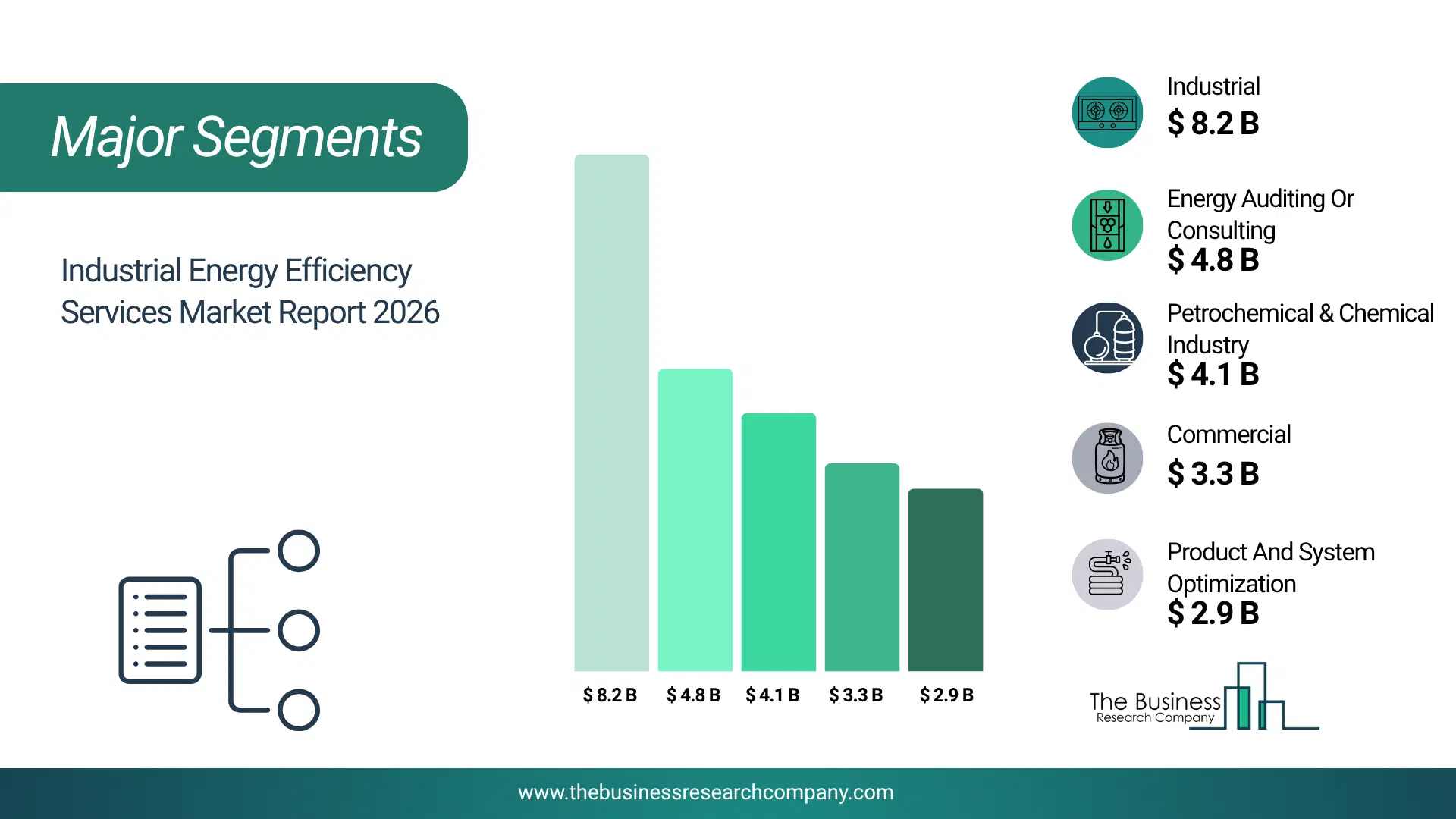
1) By Type: Energy Auditing Or Consulting, Product And System Optimization, Monitoring And Verification, Energy Management Software 2) By Service Type: Outsourced, In-House 3) By Application: Petrochemical, Chemical Industry, Electric Power, Textile, Building Materials, Mining, Manufacturing, Food And Beverage 4) By End-User: Commercial, Industrial Subsegments: 1) By Energy Auditing Or Consulting: Comprehensive Energy Audits, Specialized Energy Consultations, Regulatory Compliance Audits 2) By Product And System Optimization: Equipment Upgrades And Retrofitting, Process Optimization Services, Design And Implementation Of Energy-Efficient Systems 3) By Monitoring And Verification: Energy Usage Monitoring Services, Performance Measurement And Verification Protocols, Real-time Data Analytics And Reporting 4) By Energy Management Software: Energy Management Information Systems (EMIS), Data Analysis And Visualization Tools, Automated Energy Reporting Solutions The top segments in the industrial energy efficiency services market will be: • Industrial will reach $8287.06 Million by 2025. • Energy Auditing Or Consulting will reach $4829.07 Million by 2025. • Petrochemical & Chemical Industry will reach $4102.28 Million by 2025. • Commercial will reach $3300.65 Million by 2025. • Product And System Optimization will reach $2907.63 Million by 2025.What Is The Driver Of The Industrial Energy Efficiency Services Market?
The growing focus on decarbonization is expected to propel the growth of the industrial energy efficiency services market going forward. Decarbonization refers to the process of reducing or eliminating carbon dioxide (CO₂) emissions from various sectors of the economy, particularly in energy production, transportation, and industry. The focus on decarbonization is due to the urgent need to mitigate climate change and the increasing regulatory pressures that mandate lower greenhouse gas emissions. Industrial energy efficiency services play a crucial role in decarbonization by helping industries reduce their energy consumption, lower greenhouse gas (GHG) emissions, and transition to cleaner, more sustainable operations. For instance, in April 2024, according to the United States Department of Energy, a US-based government department, the U.S. developed a blueprint to decarbonize U.S. buildings, targeting a 65% reduction in greenhouse gas emissions by 2035 and a 90% reduction by 2050. Therefore, a growing focus on decarbonization is driving the growth of the industrial energy efficiency services industry.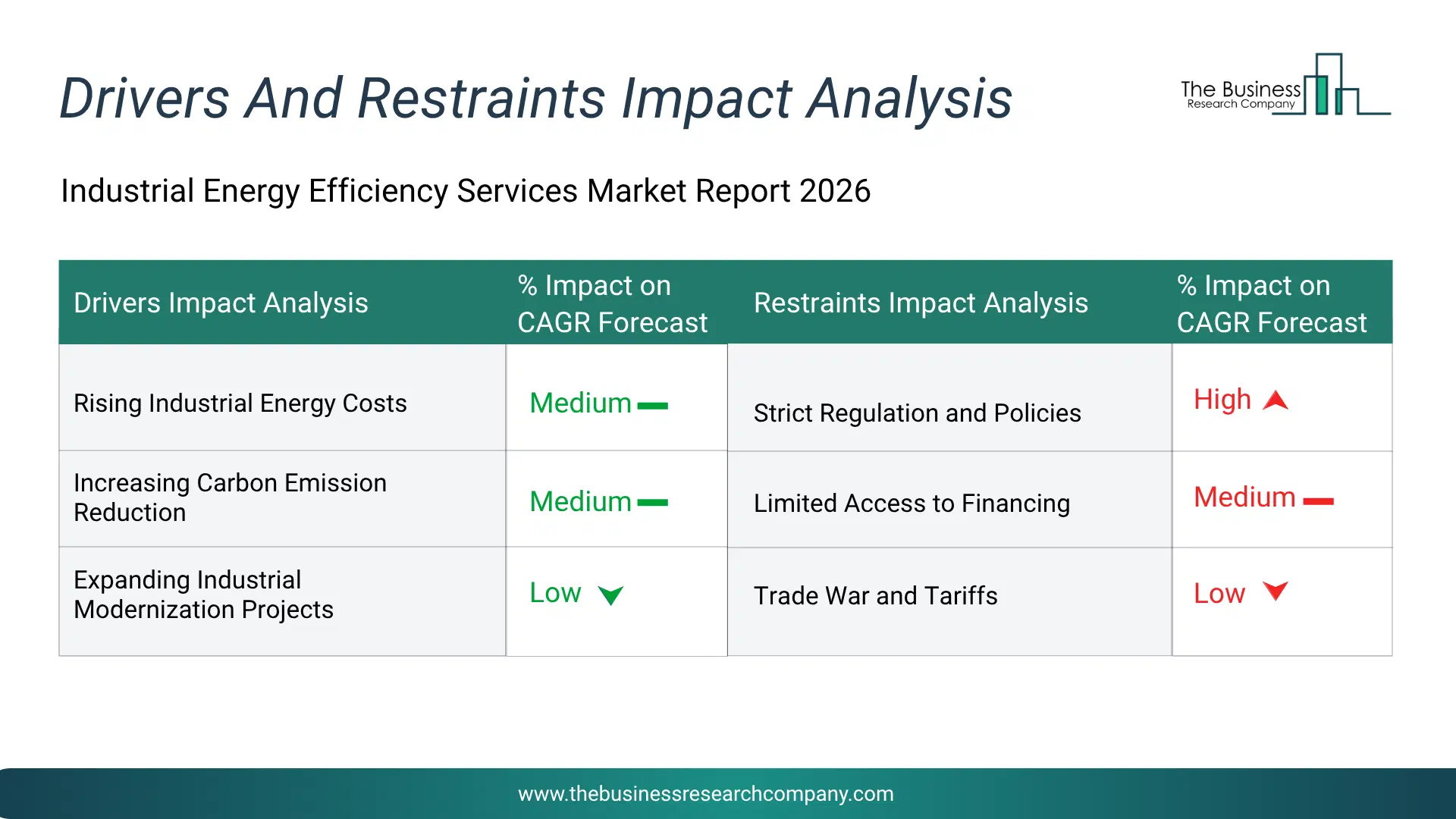
Infographic Chart Showing Key Market Drivers Analysis And Restraints For Industrial Energy Efficiency Services Market
The chart presents an impact analysis of key drivers and restraints, quantifying their relative influence on the market's growth rate and helping assess the balance between growth enablers and limiting factors. This chart offers a high-level perspective; the full report contains more detailed insights.
How Will The Drivers Impact Growth In The Global Industrial Energy Efficiency Services Market?
• Rising Industrial Energy Costs (Medium) – The rising industrial energy costs will become a key driver of growth in the industrial energy efficiency services market by 2030. As energy prices continue to escalate, manufacturers and industrial operators are increasingly seeking solutions to reduce consumption and improve cost efficiency. Energy efficiency services help businesses optimize energy usage, minimize wastage and implement advanced technologies that lower operating expenses. By reducing dependency on expensive energy sources and improving process performance, these services enable industries to maintain profitability and competitiveness. This economic pressure is encouraging greater investment in energy efficiency initiatives across multiple industrial sectors. As a result, the rising industrial energy costs is anticipated to contributing to a 1.3% annual growth in the market. • Increasing Carbon Emission Reduction (Medium) – The increasing carbon emission reduction will emerge as a major factor driving the expansion of the industrial energy efficiency services market by 2030. With stricter environmental regulations and rising corporate sustainability commitments, industries are prioritizing strategies to lower their carbon footprint. Energy efficiency services enable businesses to achieve these goals by optimizing energy usage, implementing advanced technologies and reducing wastage. These solutions not only help in meeting regulatory compliance but also enhance operational efficiency and cost savings. As companies aim for greener operations and align with global climate targets, the demand for energy efficiency services is expected to increase substantially. Consequently, the accelerating increasing carbon emission reduction capabilities is projected to contributing to a 1.0% annual growth in the market. • Expanding Industrial Modernization Projects (Low) – The expanding industrial modernization projects processes will serve as a key growth catalyst for the industrial energy efficiency services market by 2030. As industries upgrade their facilities with advanced technologies, automation and digital solutions, the demand for energy optimization becomes increasingly important. Modernization projects often involve the integration of smart energy management systems, efficient equipment and process improvements to reduce energy consumption and operating costs. Energy efficiency services play a critical role in ensuring these upgrades deliver maximum performance and sustainability. This trend aligns with global efforts to enhance productivity, reduce carbon emissions and comply with stringent energy regulations, driving market growth. Therefore, this expanding industrial modernization projects operations is projected to supporting to a 0.8% annual growth in the market. • Rise in Adoption of Renewable Energy Sources (Low) – The rise in adoption of renewable energy sources will become a significant driver contributing to the growth of the industrial energy efficiency services market by 2030. As industries transition toward sustainable energy solutions such as solar, wind and biomass, the need for efficient energy management becomes critical to maximize performance and minimize operational costs. Energy efficiency services play a vital role in integrating renewable energy into industrial processes by optimizing energy usage, reducing waste and enhancing overall productivity. This trend is further supported by regulatory incentives and corporate sustainability goals, creating strong demand for advanced energy efficiency solutions across various industrial sectors. Consequently, the rise in adoption of renewable energy sources strategies is projected to contributing to a 0.5% annual growth in the market.How Will The Restraints Impact Growth In The Global Industrial Energy Efficiency Services Market?
• Strict Regulation and Policies (Medium) – Strict Regulation and Policies will restrict the growth of the Industrial Energy Efficiency Services market during the forecast period. Industrial energy efficiency services must comply with strict environmental regulations and energy efficiency standards. Compliance with evolving regulations adds to service costs and complexity. Regulatory requirements can affect the scope and profitability of energy efficiency projects, limiting market growth. • Limited Access to Financing (Low) – Limited Access to Financing will restrict the growth of the Industrial Energy Efficiency Services market during the forecast period. Industrial energy efficiency projects often require significant capital investment that may be limited by financing availability. Limited access to affordable financing creates barriers for industrial facilities seeking efficiency upgrades. Financing constraints can delay project implementation and limit market growth. • Trade War and Tariffs (Low) – Trade War and Tariffs will restrict the growth of the Industrial Energy Efficiency Services market during the forecast period. Trade tensions and economic uncertainty can affect industrial investment in energy efficiency. Reduced manufacturing activity during trade disputes may limit demand for efficiency services. Trade barriers may also impact the availability and cost of energy efficiency technologies.Key Players In The Global Industrial Energy Efficiency Services Market
Major companies operating in the industrial energy efficiency services market are Siemens AG, Schneider Electric SE, Honeywell International Inc, Johnson Controls International plc, ABB Ltd, ENGIE SA, Ameresco Inc, Trane Technologies plc, Eaton Corporation plc, Rockwell Automation Inc, DNV Group AS, WSP Global Inc, Tetra Tech Inc, Bureau Veritas SA, SGS SA, ISTA SE, Getec Energy Solutions (G+E GETEC Holding GmbH), DuPont de Nemours Inc, TERI (The Energy and Resources Institute), EnerNOC (Energy Network Company), EnergyCAP LLC, NORESCO LLC, Ecofys (now part of Navigant/WSP), E.ON Energy Consulting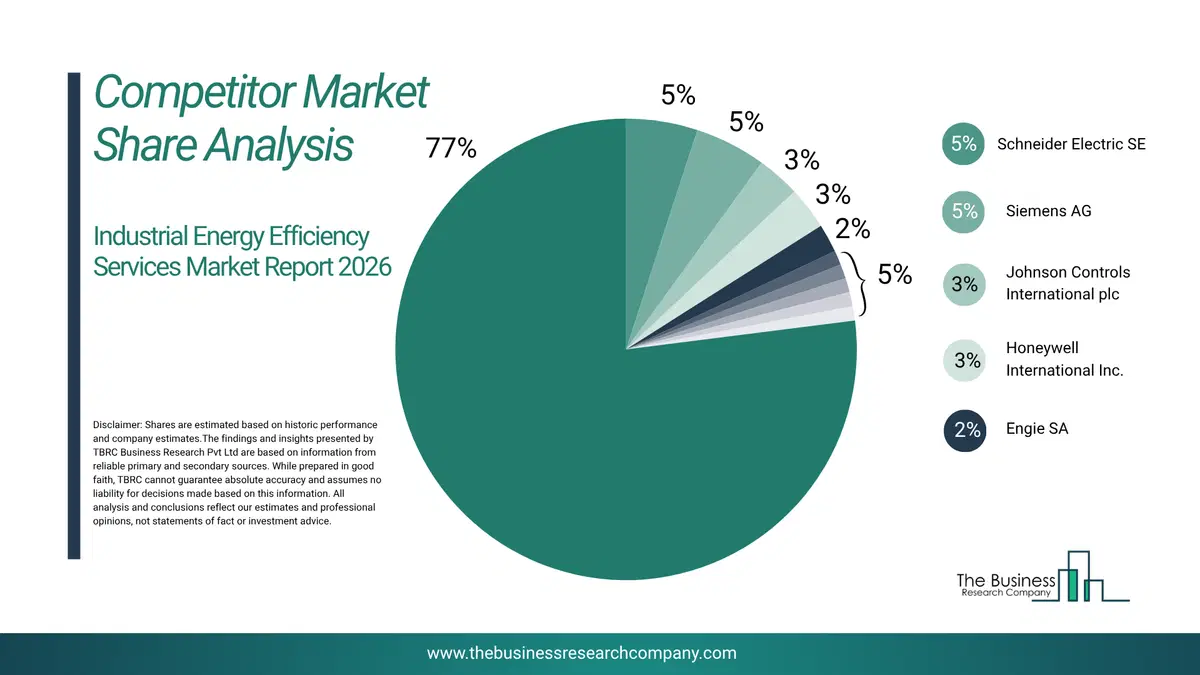
This chart is for illustrative purposes; the full report includes a detailed competitor analysis and comprehensive overview of the top 10 companies in the market.
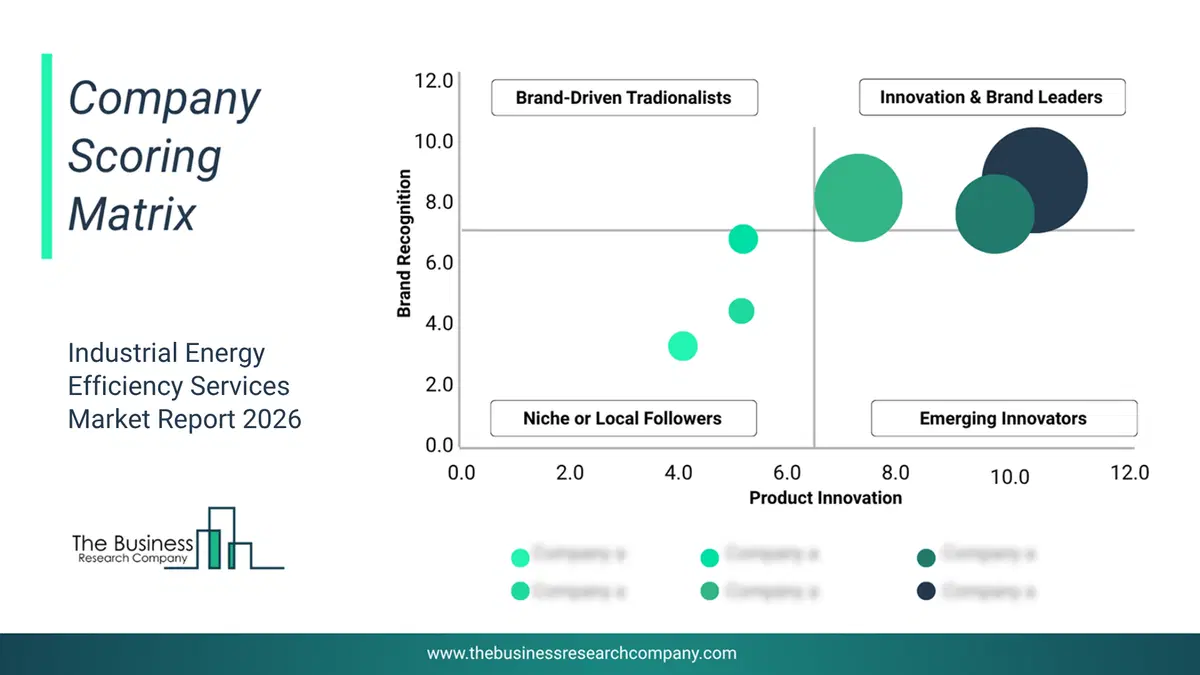
This chart maps companies by product innovation and brand strength, with bubble size indicating relative revenue, helping identify market leaders, challengers, and niche players. This is an illustrative chart; the full report provides a complete and accurate competitive analysis.
Global Industrial Energy Efficiency Services Market Trends and Insights
Major companies operating in the industrial energy efficiency services market are focusing on developing innovative solutions, such as industrial energy-efficient manufacturing technologies, to enhance offerings and meet the growing demand for sustainable solutions. Industrial energy-efficient manufacturing technologies refer to advanced methods and systems designed to reduce energy consumption and improve efficiency in manufacturing processes. For instance, in August 2024, VTT Technical Research Centre of Finland, a Finland-based limited liability company, launched the Energy First initiative, a collaborative project to develop sustainable, energy-efficient, and recyclable fiber-based products for the forestry and textile industries. This initiative is designed to address significant energy and resource consumption challenges in these sectors. The primary goals are to reduce water consumption by up to 90% and energy use by 50% while creating viable alternatives for cardboard packaging, hygiene products, and non-woven fabrics. The initiative aligns with EU sustainability directives, enhancing resource efficiency and promoting recyclable materials in the forestry and textile industries.What Are Latest Mergers And Acquisitions In The Industrial Energy Efficiency Services Market?
In July 2023, EMCOR Group Inc., a US-based mechanical and electrical construction company, acquired ECM Holding Group LLC for an undisclosed amount. Through this acquisition, EMCOR Group aims to strengthen its energy efficiency specialty services and broaden its sustainability solutions by leveraging ECM's expertise and client relationships to provide a more comprehensive range of services. ECM Holding Group LLC is a US-based cleantech contractor that offers industrial energy efficiency services.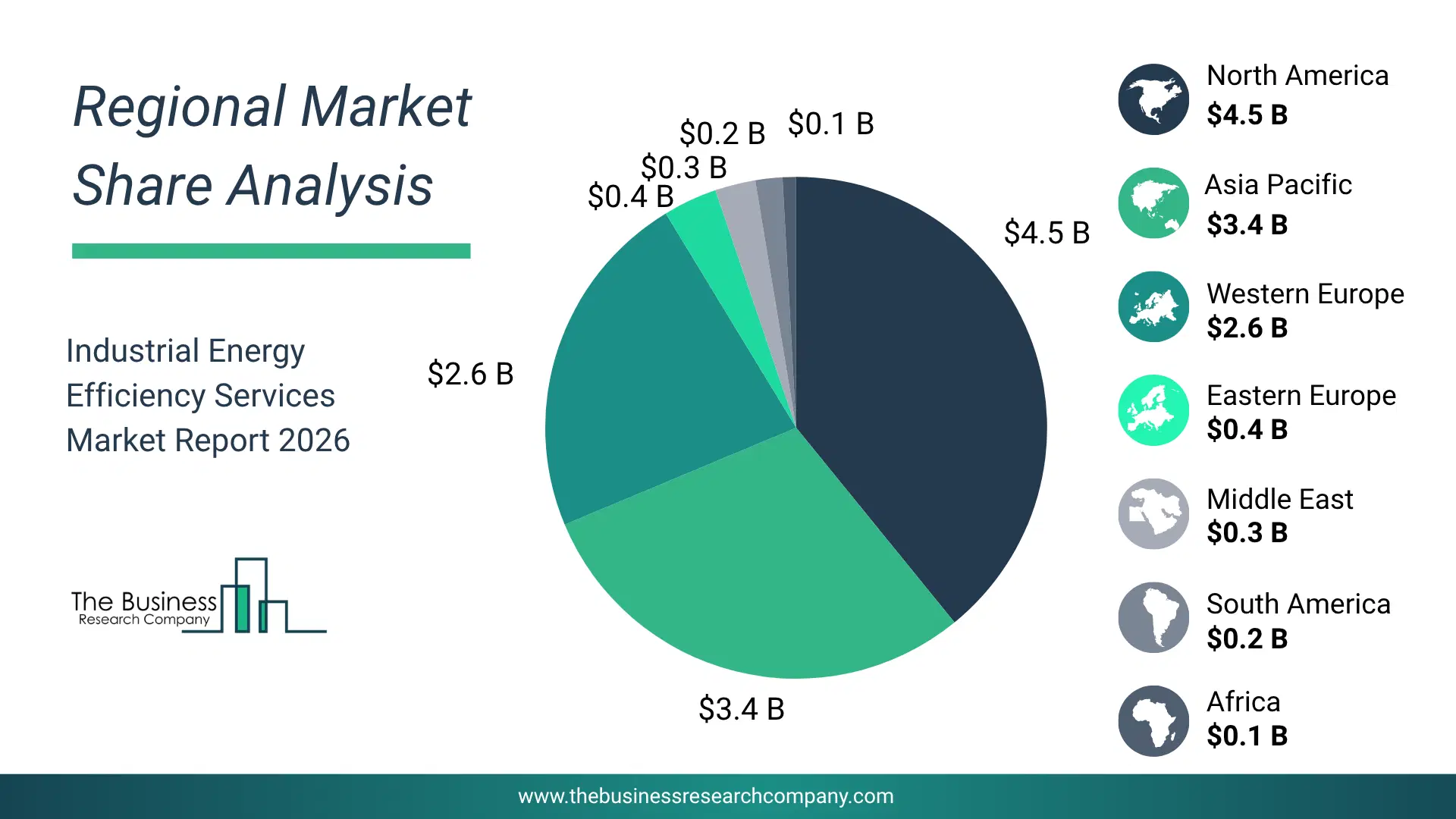
Regional Outlook
North America was the largest region in the industrial energy efficiency services market in 2025. Europe is expected to be the fastest-growing region in the forecast period. The regions covered in this market report are Asia-Pacific, South East Asia, Western Europe, Eastern Europe, North America, South America, Middle East, Africa. The countries covered in this market report are Australia, Brazil, China, France, Germany, India, Indonesia, Japan, Taiwan, Russia, South Korea, UK, USA, Canada, Italy, SpainWhat Defines the Industrial Energy Efficiency Services Market?
The industrial energy efficiency services market includes revenues earned by entities by providing services such as energy audits and assessments, process optimization, equipment upgrades, waste heat recovery, and power factor correction. The market value includes the value of related goods sold by the service provider or included within the service offering. Only goods and services traded between entities or sold to end consumers are included.How is Market Value Defined and Measured?
The market value is defined as the revenues that enterprises gain from the sale of goods and/or services within the specified market and geography through sales, grants, or donations in terms of the currency (in USD unless otherwise specified). The revenues for a specified geography are consumption values that are revenues generated by organizations in the specified geography within the market, irrespective of where they are produced. It does not include revenues from resales along the supply chain, either further along the supply chain or as part of other products.
This chart presents market attractiveness based on a quantitative evaluation of growth, competition, strategic alignment, and risk, offering a clear view of opportunity areas for decision-making. This chart is for illustrative purposes; the full report contains the complete analysis.

This chart highlights the Total Addressable Market (TAM) by estimating the maximum revenue opportunity using an assumption-driven approach, supporting strategic planning and opportunity sizing across markets. The chart is illustrative; the full report provides a more comprehensive analysis.
What Key Data and Analysis Are Included in the Industrial Energy Efficiency Services Market Report 2026?
The industrial energy efficiency services market research report is one of a series of new reports from The Business Research Company that provides market statistics, including Market Report 2026?global market size, regional shares, competitors with the market share, detailed market segments, market trends and opportunities, and any further data you may need to thrive in the industrial energy efficiency services Market Report 2026? The market research report delivers a complete perspective of everything you need, with an in-depth analysis of the current and future state of the Market Report 2026?Industrial Energy Efficiency Services Market Report Forecast Analysis
| Report Attribute | Details |
|---|---|
| Market Size Value In 2026 | $12.18 billion |
| Revenue Forecast In 2030 | $15.09 billion |
| Growth Rate | CAGR of 5.1% from 2026 to 2030 |
| Base Year For Estimation | 2025 |
| Actual Estimates/Historical Data | 2020-2025 |
| Forecast Period | 2026 - 2030 |
| Market Representation | Revenue in USD Billion and CAGR from 2026 to 2030 |
| Segments Covered | Type, Service Type, Application, End-User |
| Regional Scope | Asia-Pacific, Western Europe, Eastern Europe, North America, South America, Middle East, Africa |
| Country Scope | The countries covered in the report are Australia, Brazil, China, France, Germany, India, Indonesia, Japan, Taiwan, Russia, South Korea, UK, USA, Canada, Italy, Spain. |
| Key Companies Profiled | Siemens AG, Schneider Electric SE, Honeywell International Inc, Johnson Controls International plc, ABB Ltd, ENGIE SA, Ameresco Inc, Trane Technologies plc, Eaton Corporation plc, Rockwell Automation Inc, DNV Group AS, WSP Global Inc, Tetra Tech Inc, Bureau Veritas SA, SGS SA, ISTA SE, Getec Energy Solutions (G+E GETEC Holding GmbH), DuPont de Nemours Inc, TERI (The Energy and Resources Institute), EnerNOC (Energy Network Company), EnergyCAP LLC, NORESCO LLC, Ecofys (now part of Navigant/WSP), E.ON Energy Consulting |
| Customization Scope | Request for Customization |
| Pricing And Purchase Options | Explore Purchase Options |