

Industrial Ethernet Global Market Opportunities And Strategies To 2035
By Offering (Hardware, Software, Services), By Protocol (EtherCAT, EtherNet or IP, Profinet, Powerlink, Sercos III, CC-Link IE, Other Protocols), By Application (Oil And Gas, Aerospace And Defense, Energy And Power, Electrical And Electronics, Automotive And Transport, Chemicals, Other Applications), And By Region, Opportunities And Strategies – Global Forecast To 2035
Industrial Ethernet Market Definition
Industrial ethernet is a robust and specialized form of Ethernet networking designed for industrial environments and automation systems. It enables real-time communication between devices such as programmable logic controllers (PLCs), sensors, actuators, robots and industrial computers, using standard Ethernet protocols adapted for reliability, determinism and resistance to harsh conditions like vibration, temperature and electromagnetic interference. The primary purpose of industrial Ethernet is to provide high-speed, reliable and real-time data communication for industrial automation and control systems. The industrial ethernet market consists of revenues generated by entities (organizations, sole traders and partnerships) by providing Ethernet-based networking solutions specifically designed for industrial applications, including hardware components, software platforms and associated services that enable communication and control in industrial environments. The market includes solutions that facilitate real-time data transmission, network reliability and interoperability across industrial systems.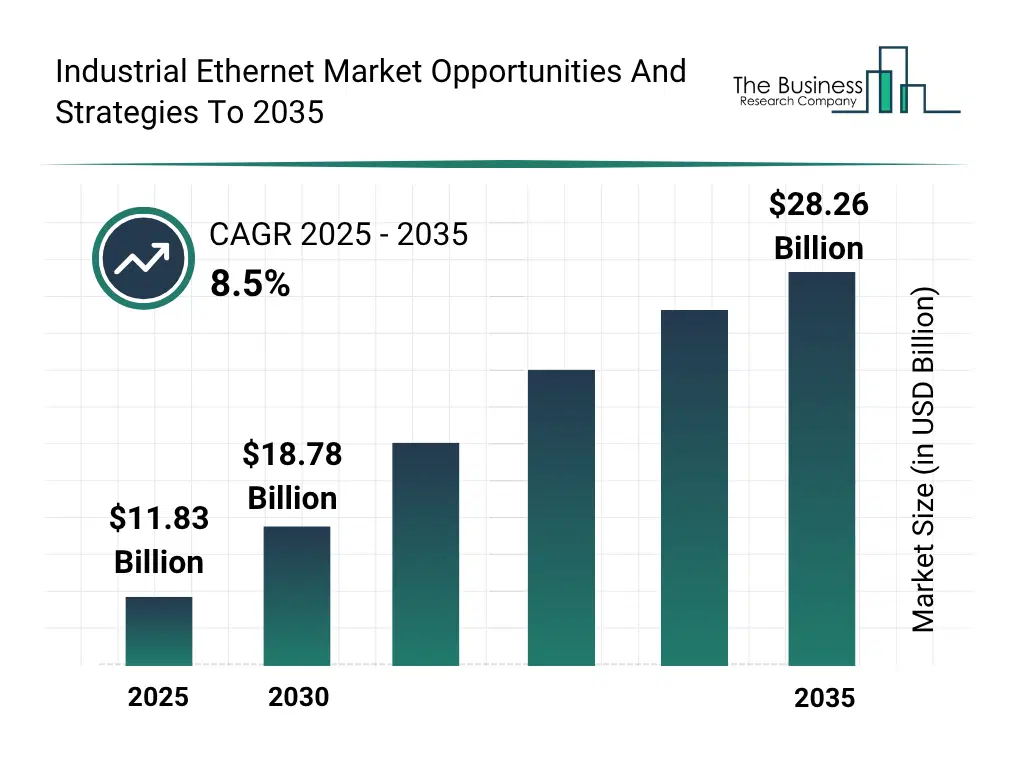
Industrial Ethernet Market Size
The global industrial ethernet market reached a value of nearly $11,834.6 million in 2025, having grown at a compound annual growth rate (CAGR) of 10.7% since 2020. The market is expected to grow from $11,834.6 million in 2025 to $18,777.6 million in 2030 at a rate of 9.7%. The market is then expected to grow at a CAGR of 8.5% from 2030 and reach $28,262.0 million in 2035. Growth in the historic period resulted from rising adoption of industrial automation, expansion of manufacturing industries, rising adoption of industrial IoT (IIoT) and government support for smart manufacturing programs. Factors that negatively affected growth in the historic period were cybersecurity risks in industrial networks and shortage of skilled workforce. Going forward, increasing integration of edge computing in industrial setups, expansion of government funding for smart grid project, growing digital transformation across industries and growth of smart factories and industry 4.0 initiatives will drive the growth. Factors that could hinder the growth of the industrial ethernet market in the future include high initial setup cost, expensive maintenance and upgrades and impact of trade wars and tariffs.
Industrial Ethernet Market Segmentation
The industrial ethernet market is segmented by offering, by protocol, by application.By Offering –
The industrial ethernet market is segmented by offering into:
- a) Hardware
- b) Software
- a) Services
By Protocol –
The industrial ethernet market is segmented by protocol into:
- a) EtherCAT
- b) Ether Net Or IP
- c) Profinet
- d) Powerlink
- e) Sercos III
- f) CC-Link IE
- g) Other Protocols
By Application –
The industrial ethernet market is segmented by application into:
- a) Oil And Gas
- b) Aerospace And Defense
- c) Energy And Power
- d) Electrical And Electronics
- e) Automotive And Transport
- f) Chemicals
- g) Other Applications
By Geography - The industrial ethernet market is segmented by geography into:
- China
- India
- Japan
- Australia
- Indonesia
- South Korea
- USA
- Canada
- Brazil
- France
- Germany
- UK
- Italy
- Spain
- Russia
-
o Asia Pacific
o Africa