
Industrial Exoskeletons Market Report 2026
Global Outlook – By Type (Full-Body Exoskeletons, Upper-Limb Exoskeletons, Lower-Limb Exoskeletons, Soft Exoskeletons ), By Mechanism (Active, Passive ), By Application (Construction, Manufacturing, Logistics, Healthcare, Military ), By End Use (Industrial, Medical, Defense, Rehabilitation ) – Market Size, Trends, Strategies, and Forecast to 2030
Industrial Exoskeletons Market Overview
• Industrial Exoskeletons market size has reached to $0.97 billion in 2025 • Expected to grow to $1.65 billion in 2030 at a compound annual growth rate (CAGR) of 11.4% • Growth Driver: Rising Work-Related Injuries Is Fueling The Growth Of The Market Due To Increasing Need For Workplace Safety And Injury Prevention Solutions • Market Trend: Innovation In Battery Efficiency And Power Systems Is Fueling Growth Due To Extended Operational Duration And Enhanced Productivity • North America was the largest region in 2025 and Asia-Pacific is the fastest growing region.What Is Covered Under Industrial Exoskeletons Market?
Industrial Exoskeletons are wearable mechanical devices designed to support and enhance the physical capabilities of workers in industrial environments. They are worn on the body like a framework and help reduce physical strain, fatigue, and the risk of musculoskeletal injuries during tasks such as lifting heavy objects, repetitive movements, or overhead work. Industrial exoskeletons work by redistributing weight, supporting muscles and joints, or providing powered assistance to movements. The main types of industrial exoskeletons include full-body exoskeletons, upper-limb exoskeletons, lower-limb exoskeletons, and soft exoskeletons. Full-body exoskeletons provide comprehensive support to the entire body, enhancing strength and reducing fatigue in physically demanding tasks. The mechanisms include active and passive systems based on power assistance levels. The various applications involved are construction, manufacturing, logistics, healthcare, and military, and they are used by several end users such as industrial, medical, defense, and rehabilitation.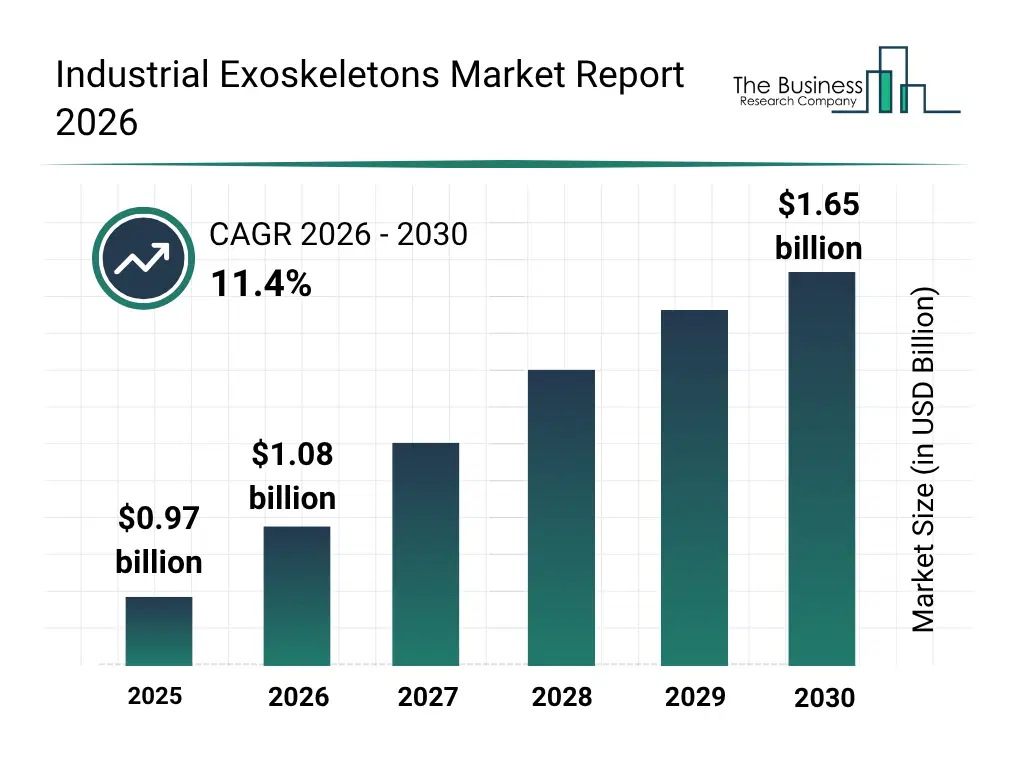
What Is The Industrial Exoskeletons Market Size and Share 2026?
The industrial exoskeletons market size has grown rapidly in recent years. It will grow from $0.97 billion in 2025 to $1.08 billion in 2026 at a compound annual growth rate (CAGR) of 11.1%. The growth in the historic period can be attributed to high incidence of musculoskeletal injuries among industrial workers, growing awareness of workplace safety standards, early adoption of passive exoskeletons in manufacturing, increasing labor-intensive industrial operations, government regulations promoting occupational health and safety.What Is The Industrial Exoskeletons Market Growth Forecast?
The industrial exoskeletons market size is expected to see rapid growth in the next few years. It will grow to $1.65 billion by 2030 at a compound annual growth rate (CAGR) of 11.4%. The growth in the forecast period can be attributed to advancements in robotics and sensor technologies, rising demand for powered and soft exoskeletons, integration of ai for adaptive movement assistance, growth in construction and logistics sectors, increasing focus on productivity enhancement and injury reduction. Major trends in the forecast period include increasing adoption of exoskeletons for worker safety, rising focus on ergonomic workplace solutions, growing integration of wearable sensors with exoskeletons, expansion of powered and soft exoskeleton technologies, increasing demand for customized industrial exoskeleton solutions.
Global Industrial Exoskeletons Market Segmentation
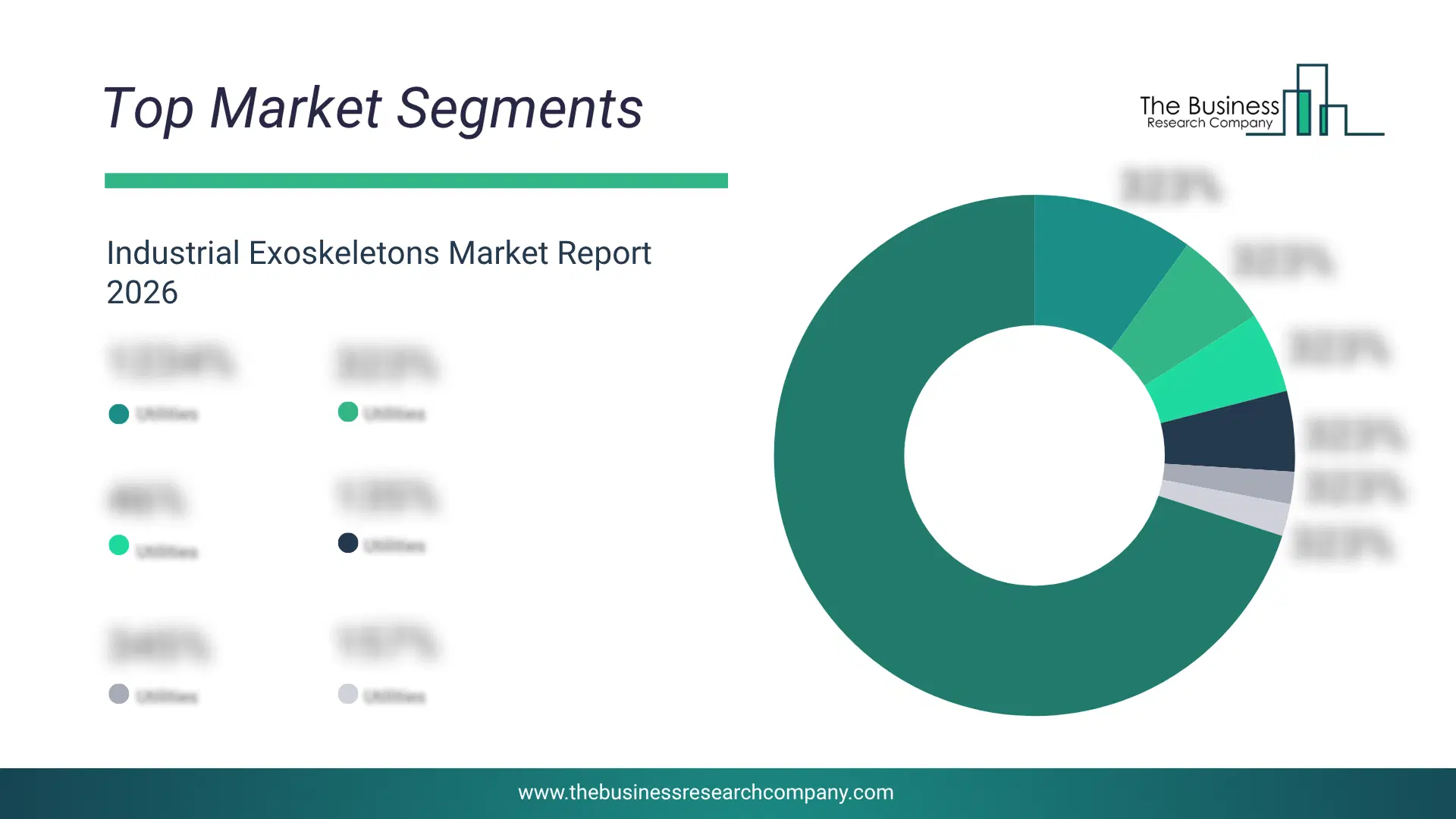
1) By Type: Full-Body Exoskeletons, Upper-Limb Exoskeletons, Lower-Limb Exoskeletons, Soft Exoskeletons 2) By Mechanism: Active, Passive 3) By Application: Construction, Manufacturing, Logistics, Healthcare, Military 4) By End Use: Industrial, Medical, Defense, Rehabilitation Subsegments: 1) By Full-Body Exoskeletons: Powered Full-Body Exoskeletons, Passive Full-Body Exoskeletons, Battery Operated Full-Body Exoskeletons, Hydraulic Assisted Full-Body Exoskeletons, Pneumatic Assisted Full-Body Exoskeletons 2) By Upper-Limb Exoskeletons: Shoulder Support Exoskeletons, Arm And Elbow Support Exoskeletons, Overhead Work Support Exoskeletons, Powered Upper-Limb Exoskeletons, Passive Upper-Limb Exoskeletons 3) By Lower-Limb Exoskeletons: Hip Support Exoskeletons, Knee Support Exoskeletons, Ankle Support Exoskeletons, Powered Lower-Limb Exoskeletons, Load Bearing Lower-Limb Exoskeletons 4) By Soft Exoskeletons: Textile Based Soft Exoskeletons, Cable Driven Soft Exoskeletons, Elastic Assisted Soft Exoskeletons, Motor Assisted Soft Exoskeletons, Lightweight Wearable Soft ExoskeletonsWhat Is The Driver Of The Industrial Exoskeletons Market?
The rising work-related injuries is expected to propel the growth of the industrial exoskeletons market going forward. Work-related injuries refer to physical harm or health conditions that occur as a result of workplace activities, including repetitive strain, heavy lifting, and prolonged physical exertion. The increase in work-related injuries, particularly musculoskeletal disorders caused by repetitive tasks and manual handling, is encouraging organizations to adopt technologies that improve worker safety and reduce physical strain. Industrial exoskeletons support injury prevention efforts by providing mechanical assistance to workers during physically demanding tasks, helping reduce fatigue, improve posture, and minimize the risk of musculoskeletal injuries. For instance, in June 2023, according to the U.S. Bureau of Labor Statistics, a US-based government agency, private industry employers reported approximately 2.8 million nonfatal workplace injuries and illnesses in 2022, highlighting the continued need for advanced workplace safety technologies. Therefore, rising work-related injuries are driving the growth of the industrial exoskeletons industry.Key Players In The Global Industrial Exoskeletons Market
Major companies operating in the industrial exoskeletons market are Honda Motor Co. Ltd., Lockheed Martin Corporation, Mitsubishi Heavy Industries Ltd., ULS Robotics, Ottobock SE And Co. KGaA, Comau S.p.A., Sarcos Technology And Robotics Corporation, Cyberdyne Inc., German Bionic Systems GmbH, Ekso Bionics, Innophys Co. Ltd., HUNIC GmbH, RB3D, Wearable Robotics Srl, RoboMate, GOGOA Mobility Robots, B-Temia Inc, Bioservo Technologies AB, Laevo BV, Atoun Inc., Noonee AG, Skeletonics Inc., Japet Technologies.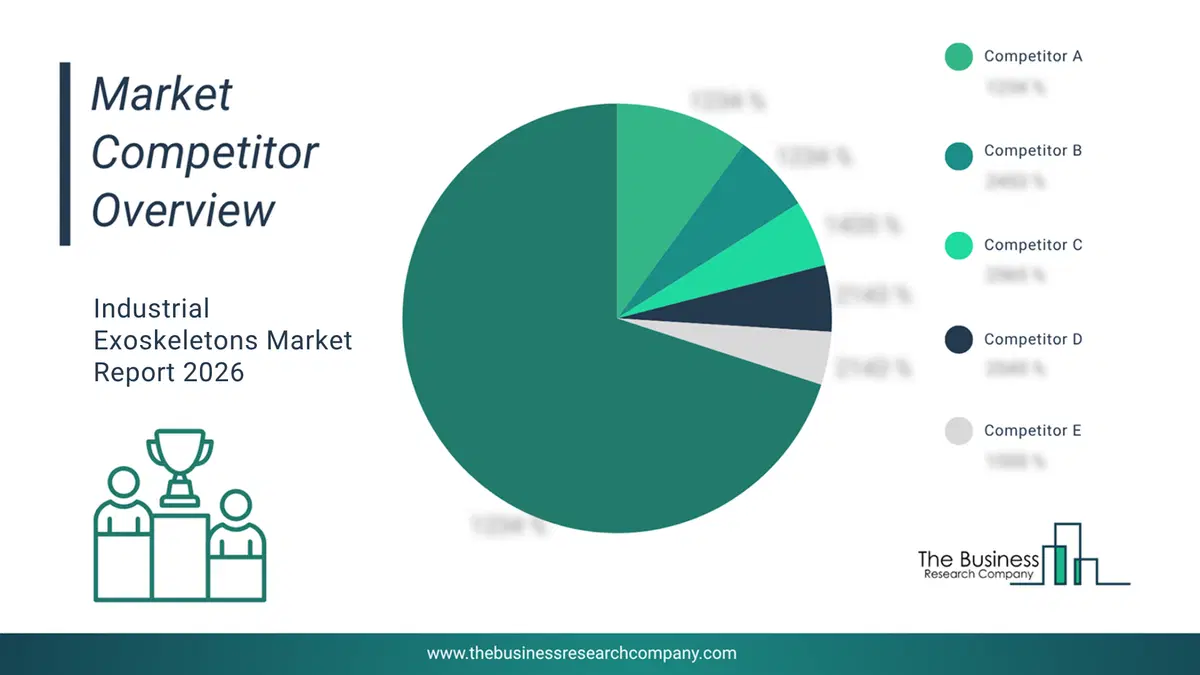
This chart is for illustrative purposes; the full report includes a detailed competitor analysis and comprehensive overview of the top 10 companies in the market.
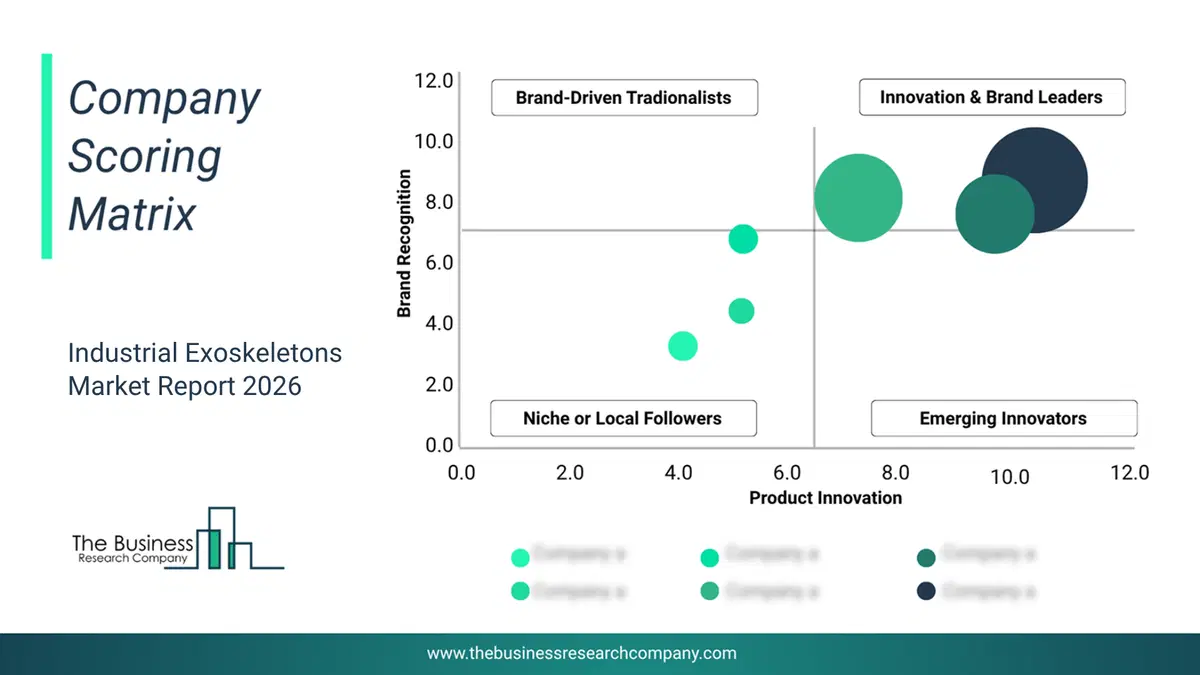
This chart maps companies by product innovation and brand strength, with bubble size indicating relative revenue, helping identify market leaders, challengers, and niche players. This is an illustrative chart; the full report provides a complete and accurate competitive analysis.
Global Industrial Exoskeletons Market Trends and Insights
Major companies operating in the industrial exoskeletons market are focusing on innovations in battery efficiency and power systems, such as high-performance modular battery architectures, to gain a competitive advantage. These advanced battery systems combine lightweight, high-energy-density cells with efficient power management technologies to provide longer operational duration, faster battery replacement, and reduced downtime in demanding industrial environments. For instance, in 2025, Ottobock, through its SUITX division, launched the IX BACK VOLTON powered exoskeleton equipped with the Bosch AMPShare battery system, which provides up to eight hours of continuous operation and enables quick battery interchangeability with compatible tools. These innovations enhance productivity, support longer work shifts, and improve operational efficiency in industrial applications.What Are Latest Mergers And Acquisitions In The Industrial Exoskeletons Market?
In September 2024, German Bionic GmbH, a Germany-based robotics technology company specializing in industrial and wearable robotic exoskeletons, partnered with Servco Pacific Inc. for the distribution of the Apogee E-exoskeletons across Hawaiʻi and select industrial markets for an undisclosed amount. Through this collaboration, German Bionic aimed to expand its industrial exoskeleton market presence by leveraging Servco’s extensive distribution network to bring advanced biomechanical support systems to more industrial and commercial customers, enhancing workplace ergonomics and reducing musculoskeletal injury risks. Servco Pacific Inc. is a US-based diversified distributor that will introduce German Bionic’s Apogee smart exoskeletons wearable robotic systems designed to augment human strength and mobility in physically demanding tasks across logistics, manufacturing, and construction environments.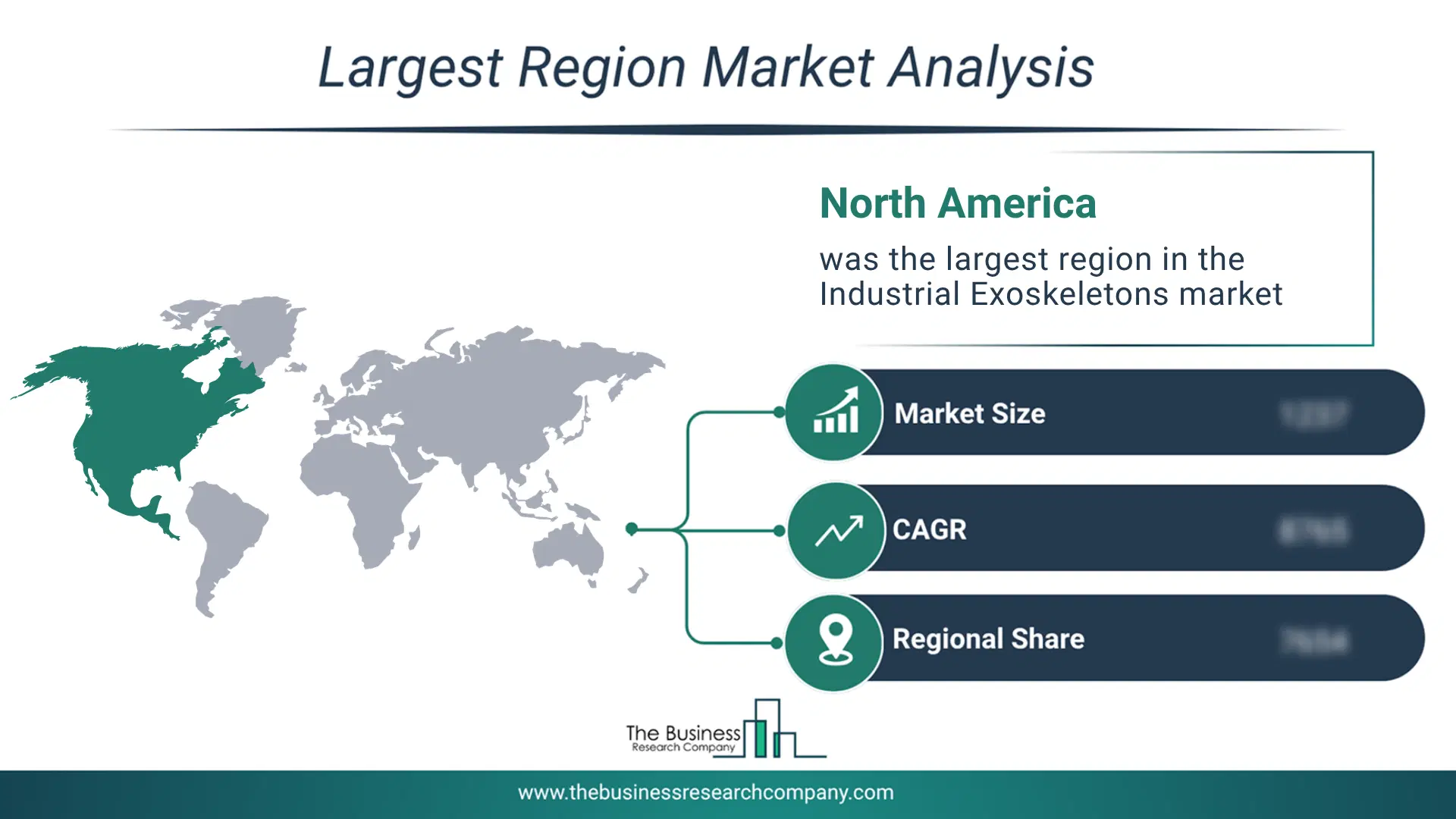
Regional Insights
North America was the largest region in the industrial exoskeletons market in 2025. Asia-Pacific is expected to be the fastest-growing region in the forecast period. The regions covered in this market report are Asia-Pacific, South East Asia, Western Europe, Eastern Europe, North America, South America, Middle East, Africa. The countries covered in this market report are Australia, Brazil, China, France, Germany, India, Indonesia, Japan, Taiwan, Russia, South Korea, UK, USA, Canada, Italy, Spain.What Defines the Industrial Exoskeletons Market?
The industrial exoskeletons market consists of sales of wearable exoskeleton devices, supportive mechanical suits, power-assist systems, and related software solutions designed to enhance human strength, endurance, and safety in industrial tasks. Values in this market are ‘factory gate’ values, that is, the value of goods sold by the manufacturers or creators of the goods, whether to other entities (including downstream manufacturers, wholesalers, distributors, and retailers) or directly to end customers. The value of goods in this market includes related services sold by the creators of the goods.How is Market Value Defined and Measured?
The market value is defined as the revenues that enterprises gain from the sale of goods and/or services within the specified market and geography through sales, grants, or donations in terms of the currency (in USD unless otherwise specified). The revenues for a specified geography are consumption values that are revenues generated by organizations in the specified geography within the market, irrespective of where they are produced. It does not include revenues from resales along the supply chain, either further along the supply chain or as part of other products.
This chart presents market attractiveness based on a quantitative evaluation of growth, competition, strategic alignment, and risk, offering a clear view of opportunity areas for decision-making. This chart is for illustrative purposes; the full report contains the complete analysis.

This chart highlights the Total Addressable Market (TAM) by estimating the maximum revenue opportunity using an assumption-driven approach, supporting strategic planning and opportunity sizing across markets. The chart is illustrative; the full report provides a more comprehensive analysis.
What Key Data and Analysis Are Included in the Industrial Exoskeletons Market Report 2026?
The industrial exoskeletons market research report is one of a series of new reports from The Business Research Company that provides market statistics, including industry global market size, regional shares, competitors with the market share, detailed market segments, market trends and opportunities, and any further data you may need to thrive in the industrial exoskeletons industry. The market research report delivers a complete perspective of everything you need, with an in-depth analysis of the current and future state of the industry.Industrial Exoskeletons Market Report Forecast Analysis
| Report Attribute | Details |
|---|---|
| Market Size Value In 2026 | $1.08 billion |
| Revenue Forecast In 2030 | $1.65 billion |
| Growth Rate | CAGR of 11.4% from 2026 to 2030 |
| Base Year For Estimation | 2025 |
| Actual Estimates/Historical Data | 2020-2025 |
| Forecast Period | 2026 - 2030 |
| Market Representation | Revenue in USD Billion and CAGR from 2026 to 2030 |
| Segments Covered | Type, Mechanism, Application, End Use |
| Regional Scope | Asia-Pacific, Western Europe, Eastern Europe, North America, South America, Middle East, Africa |
| Key Companies Profiled | Honda Motor Co. Ltd., Lockheed Martin Corporation, Mitsubishi Heavy Industries Ltd., ULS Robotics, Ottobock SE And Co. KGaA, Comau S.p.A., Sarcos Technology And Robotics Corporation, Cyberdyne Inc., German Bionic Systems GmbH, Ekso Bionics, Innophys Co. Ltd., HUNIC GmbH, RB3D, Wearable Robotics Srl, RoboMate, GOGOA Mobility Robots, B-Temia Inc, Bioservo Technologies AB, Laevo BV, Atoun Inc., Noonee AG, Skeletonics Inc., Japet Technologies. |
| Customization Scope | Request for Customization |
| Pricing And Purchase Options | Explore Purchase Options |