
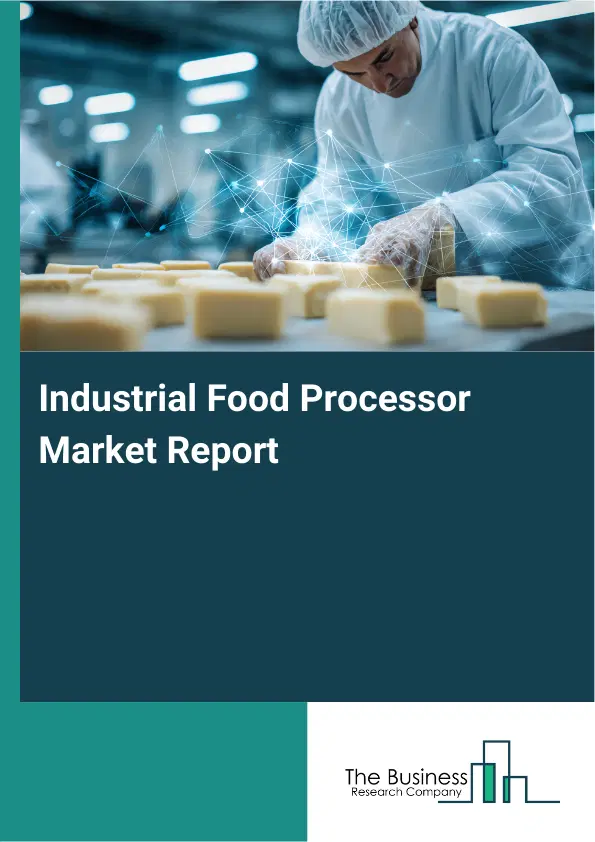
Industrial Food Processor Market Report 2026
Global Outlook – By Type (Cutting And Chopping, Mixing, Chilling And Freezing, Grinding, Baking, Frying, Ovens, Other Types), By Mode Of Operation (Automatic, Semi-automatic), By Application (Dairy processing, Meat Or Poultry Processing, Beverage Processing, Bakery, Fruit And Vegetable Processing, Other Applications) – Market Size, Trends, Strategies, and Forecast to 2030
Industrial Food Processor Market Overview
• Industrial Food Processor market size has reached to $69.91 billion in 2025 • Expected to grow to $92.34 billion in 2030 at a compound annual growth rate (CAGR) of 6% • Growth Driver: Rising Demand For Processed Foods Fuels Growth In The Industrial Food Processor Market • Market Trend: Innovative Double Interlock Mechanism Enhances Safety In Industrial Food Processor Offerings • Asia-Pacific was the largest region in 2025.What Is Covered Under Industrial Food Processor Market?
An industrial food processor is a large-scale machine used in the food industry to automate various tasks such as cutting, blending, mixing and grinding, significantly enhancing efficiency and production capacity. It plays a crucial role in processing raw ingredients into finished food products on an industrial scale. The main types of industrial food processors are cutting and chopping, mixing, chilling and freezing, grinding, baking, frying, ovens and others. Cutting and chopping refer to the action of dividing or severing objects, typically using a sharp implement such as a knife or axe. These are operated in automatic and semi-automatic modes for several applications, such as dairy processing, meat or poultry processing, beverage processing, bakery, fruit and vegetable processing and others.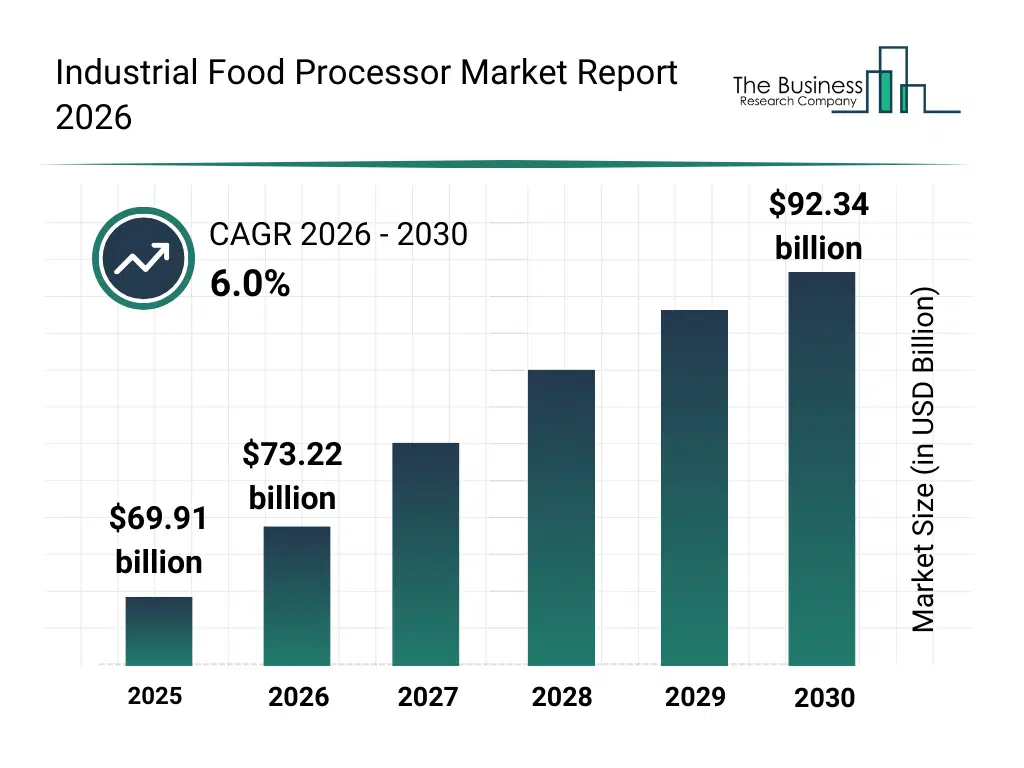
What Is The Industrial Food Processor Market Size and Share 2026?
The industrial food processor market size has grown steadily in recent years. It will grow from $69.91 billion in 2025 to $73.22 billion in 2026 at a compound annual growth rate (CAGR) of 4.7%. The growth in the historic period can be attributed to growth of processed and packaged food consumption, expansion of large-scale food manufacturing facilities, rising labor costs in food processing, increasing demand for consistent food quality, availability of industrial-grade processing equipment.What Is The Industrial Food Processor Market Growth Forecast?
The industrial food processor market size is expected to see strong growth in the next few years. It will grow to $92.34 billion in 2030 at a compound annual growth rate (CAGR) of 6.0%. The growth in the forecast period can be attributed to increasing investments in smart food factories, rising focus on sustainable food processing, expansion of ready-to-eat and convenience food segments, growing adoption of AI-enabled quality inspection, demand for flexible and modular processing systems. Major trends in the forecast period include increasing adoption of automated food processing lines, rising demand for high-capacity processing equipment, growing integration of smart monitoring and control systems, expansion of energy-efficient food processing solutions, enhanced focus on food safety and hygiene standards.
Global Industrial Food Processor Market Segmentation
1) By Type: Cutting And Chopping, Mixing, Chilling And Freezing, Grinding, Baking, Frying, Ovens, Other Types 2) By Mode Of Operation: Automatic, Semi-automatic 3) By Application: Dairy processing, Meat Or Poultry Processing, Beverage Processing, Bakery, Fruit And Vegetable Processing, Other Applications Subsegments: 1) By Cutting And Chopping: Slicers, Dicers, Shredders 2) By Mixing: Batch Mixers, Continuous Mixers, High-Shear Mixers 3) By Chilling And Freezing: Blast Freezers, Tunnel Freezers, Spiral Freezers 4) By Grinding: Meat Grinders, Coffee Grinders, Spice Grinders 5) By Baking: Batch Ovens, Conveyor Ovens, Rotary Ovens 6) By Frying: Deep Fryers, Pressure Fryers, Continuous Fryers 7) By Ovens: Convection Ovens, Infrared Ovens, Steam Ovens 8) By Other Types: Emulsifiers, Homogenizers, ExtrudersWhat Is The Driver Of The Industrial Food Processor Market?
The increasing demand for processed food products is expected to propel the growth of the industrial food processor market going forward. Processed food refers to any raw agricultural products that have undergone any process that modifies their original form, including heating, pasteurization, blanching, cooking, canning, freezing and drying. Convenience foods are a subset of processed foods specifically designed for easy and quick preparation, catering to the modern lifestyle's demand for efficiency. An industrial food processor is utilized to slice rapidly and conveniently, dice, shred, blend and puree practically any food to create a variety of processed foods, including convenience foods. For instance, in July 2023, according to Food and Drinks Malaysia by SIAL Group, a Malaysia-based food and beverage exhibition, the convenience food sector in Malaysia increased by 3.0% in volume in 2023 and is expected to reach 7,829.2 kg by 2027. Further, in Malaysia, the revenue from convenience food amounts to $31.84 billion in 2022, which is expected to increase by 5.49% during 2022–2027. Therefore, the increasing demand for processed food products is driving the growth of the industrial food processor industry.Key Players In The Global Industrial Food Processor Market
Major companies operating in the industrial food processor market are Tetra Pak International S.A., GEA Group AG, Alfa Laval AB, Krones AG, Middleby Corporation, Bucher Industries AG, Bühler Holding AG, JBT Corporation, Marel hf, SPX Flow Inc., Tomra Systems ASA, Duravant LLC, Hosokawa Micron International Inc., Heat and Control Inc., Baader Gmbh & Company KG, Schenck Process Holding GmbH, RHEON Automatic Machinery Co. Ltd., Urschel Laboratories Inc., Key Technology Inc., Pacific Food Machinery Ltd., Ishida Co. Ltd., Wenger Manufacturing Inc., Satake Corporation, ProXES GmbH, Risco S.p.A., Anko Food Machine Co. Ltd., Cretel, Food Machinery Australasia Ltd.
This chart is for illustrative purposes; the full report includes a detailed competitor analysis and comprehensive overview of the top 10 companies in the market.
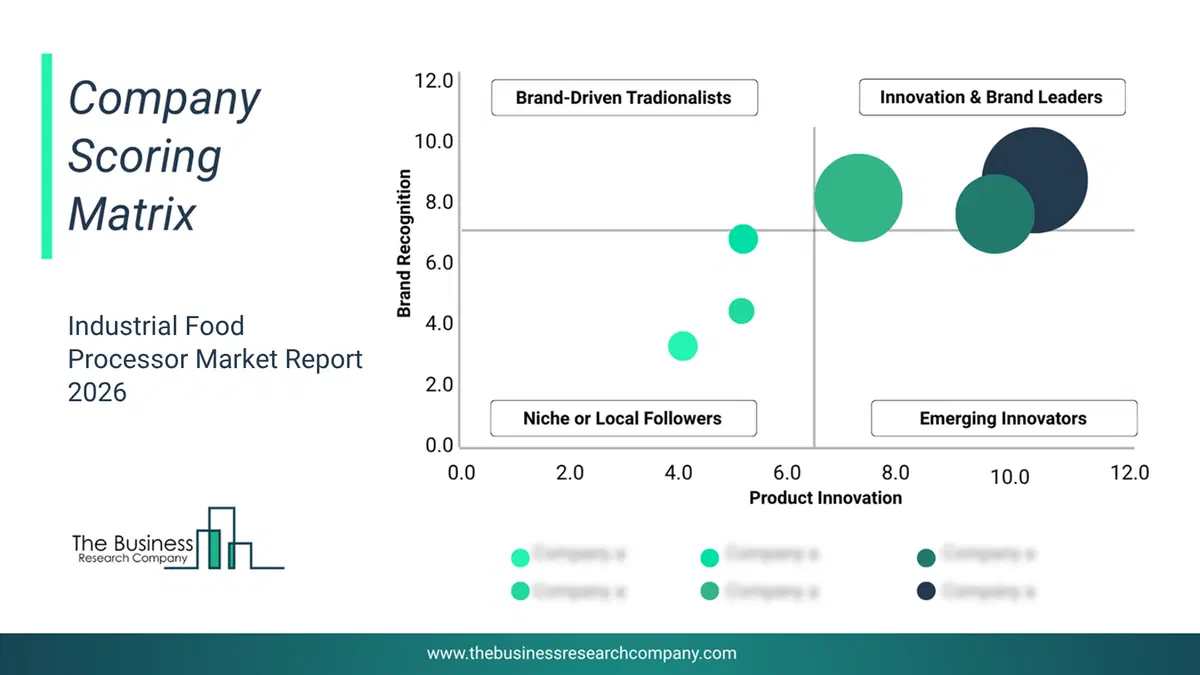
This chart maps companies by product innovation and brand strength, with bubble size indicating relative revenue, helping identify market leaders, challengers, and niche players. This is an illustrative chart; the full report provides a complete and accurate competitive analysis.
Global Industrial Food Processor Market Trends and Insights
Major companies operating in the industrial food processor market are increasing their focus on introducing products with double interlock mechanism to maximize their profits in the market. The double interlock mechanism in food processors is a safety feature that ensures the processor will not operate unless the bowl and lid are securely locked in place. For instance, in April 2023, Hobart Corporation, a US-based commercial grocery and food service equipment provider, added the FP300i floor model to its lineup of continuous-feed food processors. This heavy-duty food processor has a base, a stacking feed cylinder and a manual pusher plate for greater adaptability. It can process up to 88 pounds of goods per minute. The FP300i food processor has a double interlock mechanism to ensure operator safety by preventing it from operating when the pusher plate is open or swings away. Additionally, it includes a no-volt release that stops it from turning on if the power goes out.What Are Latest Mergers And Acquisitions In The Industrial Food Processor Market?
In November 2025, UNOX S.p.A., an Italy-based cooking equipment manufacturing company, acquired Roboqbo for an undisclosed amount. With this acquisition, Unox aims to expand its advanced kitchen automation capabilities, enhance its product range by integrating robotic and process-automation technologies, and accelerate the creation of a complete ecosystem for fully automated professional kitchen operations. Roboqbo Srl is an Italy-based food processing technology manufacturer that specialises in robotic food processing systems, including multifunctional all-in-one units capable of replacing multiple pieces of equipment for professional kitchens and applications in the food and cosmetics industries.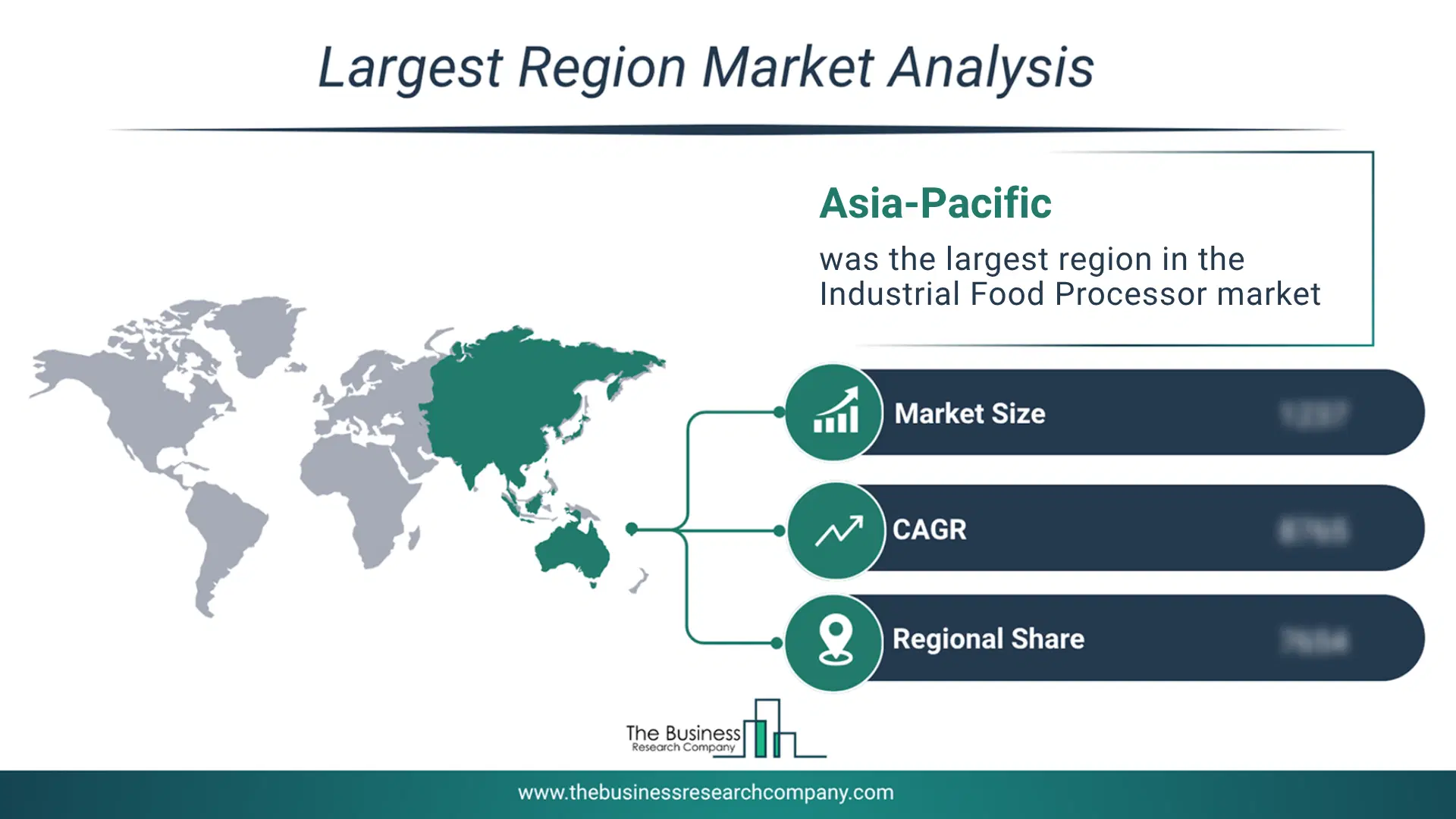
Regional Outlook
Asia-Pacific was the largest region in the industrial food processor market in 2025. The regions covered in this market report are Asia-Pacific, South East Asia, Western Europe, Eastern Europe, North America, South America, Middle East and Africa. The countries covered in this market report are Australia, Brazil, China, France, Germany, India, Indonesia, Japan, Taiwan, Russia, South Korea, UK, USA, Italy, Spain, CanadaWhat Defines the Industrial Food Processor Market?
The industrial food processor market consists of sales of commercial food blenders, batch bowl processors, combination processors, vertical cutter mixers and industrial food mixers. Values in this market are ‘factory gate’ values, that is, the value of goods sold by the manufacturers or creators of the goods, whether to other entities (including downstream manufacturers, wholesalers, distributors and retailers) or directly to end customers. The value of goods in this market includes related services sold by the creators of the goods.How is Market Value Defined and Measured?
The market value is defined as the revenues that enterprises gain from the sale of goods and/or services within the specified market and geography through sales, grants, or donations in terms of the currency (in USD unless otherwise specified). The revenues for a specified geography are consumption values that are revenues generated by organizations in the specified geography within the market, irrespective of where they are produced. It does not include revenues from resales along the supply chain, either further along the supply chain or as part of other products.
This chart presents market attractiveness based on a quantitative evaluation of growth, competition, strategic alignment, and risk, offering a clear view of opportunity areas for decision-making. This chart is for illustrative purposes; the full report contains the complete analysis.

This chart highlights the Total Addressable Market (TAM) by estimating the maximum revenue opportunity using an assumption-driven approach, supporting strategic planning and opportunity sizing across markets. The chart is illustrative; the full report provides a more comprehensive analysis.
What Key Data and Analysis Are Included in the Industrial Food Processor Market Report 2026?
The industrial food processor market research report is one of a series of new reports from The Business Research Company that provides market statistics, including industry global market size, regional shares, competitors with the market share, detailed market segments, market trends and opportunities, and any further data you may need to thrive in the industrial food processor industry. The market research report delivers a complete perspective of everything you need, with an in-depth analysis of the current and future state of the industry.Industrial Food Processor Market Report Forecast Analysis
| Report Attribute | Details |
|---|---|
| Market Size Value In 2026 | $73.22 billion |
| Revenue Forecast In 2030 | $92.34 billion |
| Growth Rate | CAGR of 4.7% from 2026 to 2030 |
| Base Year For Estimation | 2025 |
| Actual Estimates/Historical Data | 2020-2025 |
| Forecast Period | 2026 - 2030 |
| Market Representation | Revenue in USD Billion and CAGR from 2026 to 2030 |
| Segments Covered | Type, Mode Of Operation, Application |
| Regional Scope | Asia-Pacific, Western Europe, Eastern Europe, North America, South America, Middle East, Africa |
| Country Scope | The countries covered in the report are Australia, Brazil, China, France, Germany, India, Indonesia, Japan, Taiwan, Russia, South Korea, UK, USA, Canada, Italy, Spain. |
| Key Companies Profiled | Tetra Pak International S.A., GEA Group AG, Alfa Laval AB, Krones AG, Middleby Corporation, Bucher Industries AG, Bühler Holding AG, JBT Corporation, Marel hf, SPX Flow Inc., Tomra Systems ASA, Duravant LLC, Hosokawa Micron International Inc., Heat and Control Inc., Baader Gmbh & Company KG, Schenck Process Holding GmbH, RHEON Automatic Machinery Co. Ltd., Urschel Laboratories Inc., Key Technology Inc., Pacific Food Machinery Ltd., Ishida Co. Ltd., Wenger Manufacturing Inc., Satake Corporation, ProXES GmbH, Risco S.p.A., Anko Food Machine Co. Ltd., Cretel, Food Machinery Australasia Ltd. |
| Customization Scope | Request for Customization |
| Pricing And Purchase Options | Explore Purchase Options |