

Industrial Mold Market Report 2026
Global Outlook – By Mold Type (Injection Molds, Compression Molds, Transfer Molds, Blow Molds, Die Casting Molds, Thermoforming Molds, Rotational Molds, Other Mold Types), By Mold Material (Steel Molds, Aluminum Molds, Copper & Copper-Alloy Molds, Composite Molds, Silicone & Elastomeric Molds, Other Mold Materials), By End-Use Industry (Automotive, Packaging, Consumer Goods, Electrical & Electronics, Medical Devices, Industrial Equipment, Aerospace & Defense, Construction, Other End-Use Industries) – Market Size, Trends, Strategies, and Forecast to 2030
Industrial Mold Market Overview
• Industrial Mold market size has reached to $54.04 billion in 2025 • Expected to grow to $75.57 billion in 2030 at a compound annual growth rate (CAGR) of 7.1% • Growth Driver: Industrial Mold Market Growth Driven By Expanding Manufacturing And Production Sectors • Market Trend: Advanced Technology Launches Strengthen Competitiveness And Drive Integrated Manufacturing Solutions • North America was the largest region in 2025 and Western Europe is the fastest growing region.Market Gains By 2030 – Top Opportunities By Segment
Market Gain identifies the most promising market opportunities by highlighting the segments or products expected to generate the highest incremental revenue growth over the next five years.
What Is Covered Under Industrial Mold Market?
The industrial mold refers to a matrix or cavity, in which a plastic substance or fluid is shaped into a desired finished product. These molds can be made from various materials such as metal, plastic, or silicone and are essential in industries. The main types of industrial mold are metal molds and other types. Metal molds refer to the molds that involve the process of metal casting. The materials used are plastics, glass, and rubber. These are used in manufacturing, automotive, and other applications.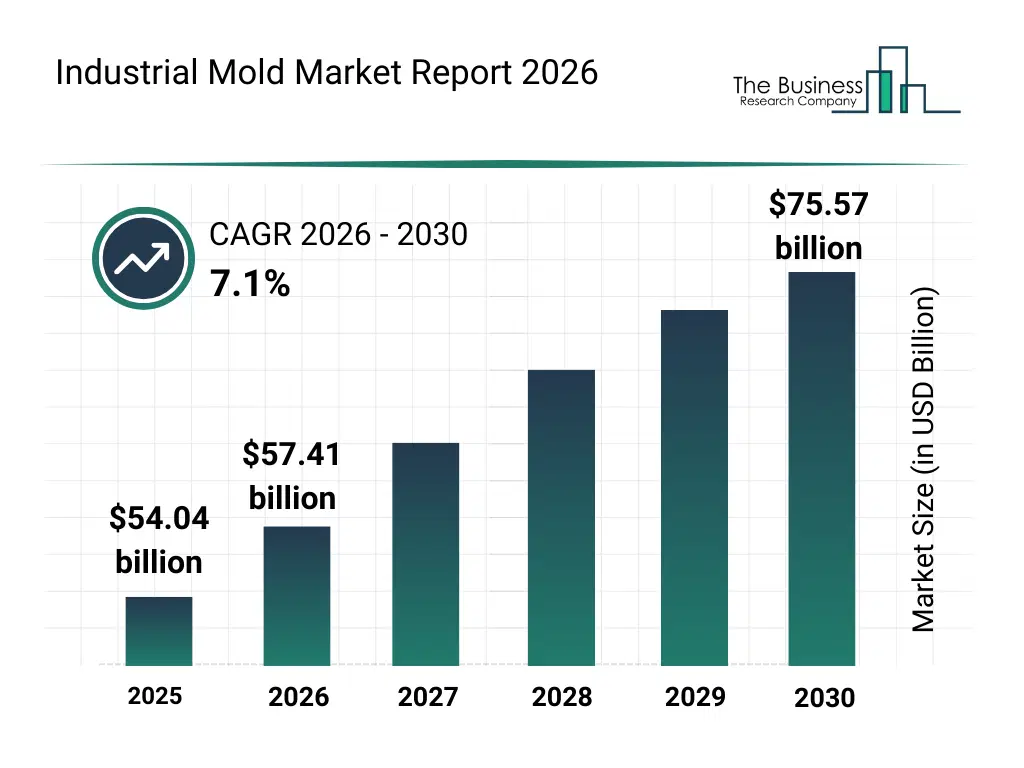
What Is The Industrial Mold Market Size and Share 2026?
The industrial mold market size has grown strongly in recent years. It will grow from $54.04 billion in 2025 to $57.41 billion in 2026 at a compound annual growth rate (CAGR) of 6.2%. The growth in the historic period can be attributed to expansion of plastic manufacturing, growth of automotive production, demand for mass-produced components, reliance on metal molds, industrial tooling requirements.What Is The Industrial Mold Market Growth Forecast?
The industrial mold market size is expected to see strong growth in the next few years. It will grow to $75.57 billion in 2030 at a compound annual growth rate (CAGR) of 7.1%. The growth in the forecast period can be attributed to customized manufacturing demand, adoption of lightweight materials, growth of electric vehicle components, advanced tooling technologies, automation in mold making. Major trends in the forecast period include demand for high-precision mold manufacturing, growth of custom mold designs, adoption of advanced mold materials, expansion of automotive and manufacturing applications, focus on mold durability and lifecycle.
Global Industrial Mold Market Segmentation
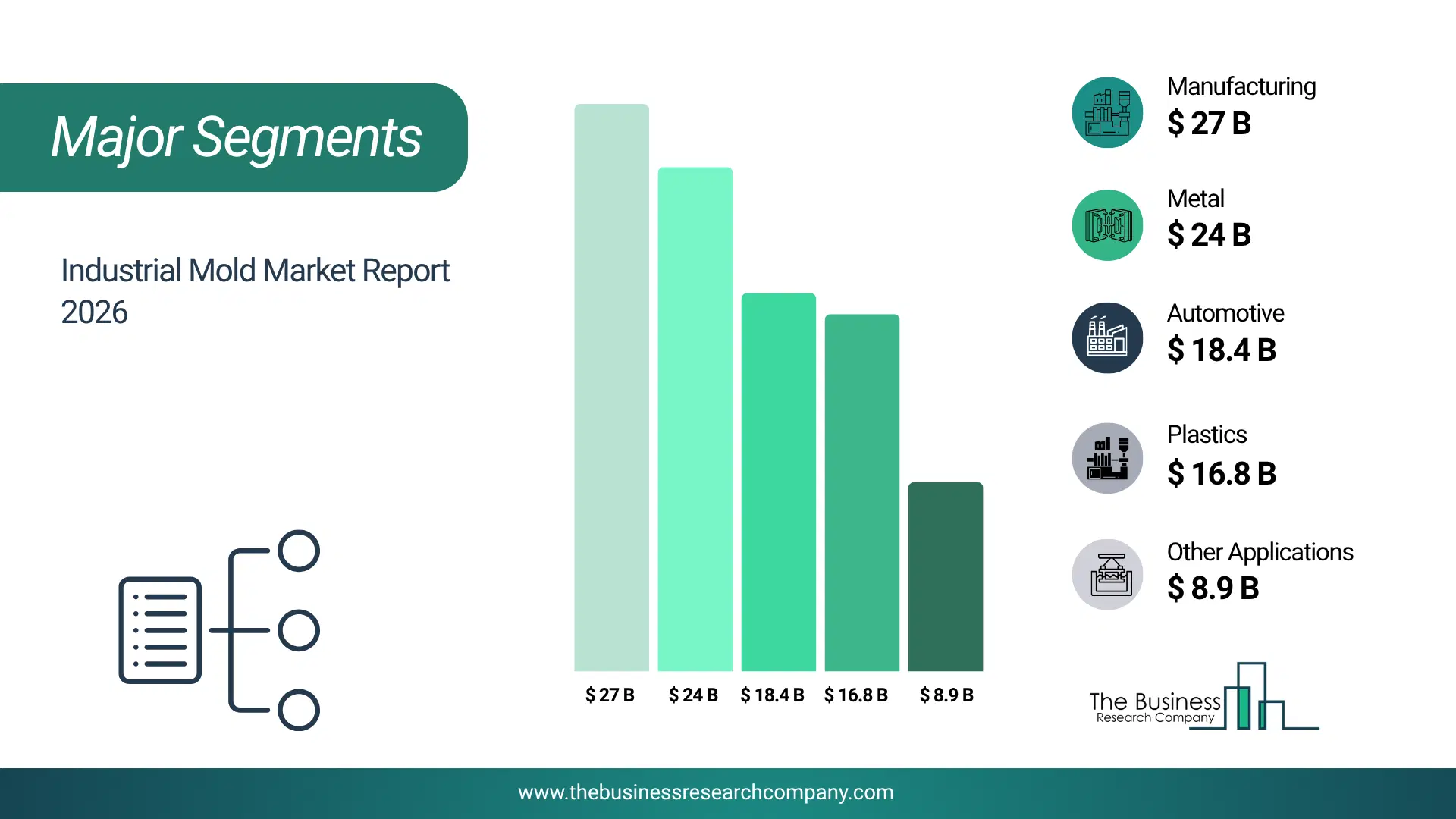
1) By Mold Type: Injection Molds, Compression Molds, Transfer Molds, Blow Molds, Die Casting Molds, Thermoforming Molds, Rotational Molds, Other Mold Types 2) By Mold Material: Steel Molds, Aluminum Molds, Copper & Copper-Alloy Molds, Composite Molds, Silicone & Elastomeric Molds, Other Mold Materials 3) By End-Use Industry: Automotive, Packaging, Consumer Goods, Electrical & Electronics, Medical Devices, Industrial Equipment, Aerospace & Defense, Construction, Other End-Use Industries Subsegments: 1) By Injection Molds: Two-Plate Injection Molds, Three-Plate Injection Molds, Hot Runner Injection Molds, Cold Runner Injection Molds, Stack Injection Molds, Multi-Cavity Injection Molds, Family Injection Molds 2) By Compression Molds: Flash Compression Molds, Positive Compression Molds, Semi-Positive Compression Molds, Heated Compression Molds, Multi-Cavity Compression Molds 3) By Transfer Molds: Open Transfer Molds, Closed Transfer Molds, Pot Transfer Molds, Runner Transfer Molds, Multi-Cavity Transfer Molds 4) By Blow Molds: Extrusion Blow Molds, Injection Blow Molds, Injection Stretch Blow Molds (ISBM – Injection Stretch Blow Molds), Multi-Cavity Blow Molds 5) By Die Casting Molds: Hot Chamber Die Casting Molds, Cold Chamber Die Casting Molds, Single-Cavity Die Casting Molds, Multi-Cavity Die Casting Molds, High-Pressure Die Casting Molds 6) By Thermoforming Molds: Vacuum Forming Molds, Pressure Forming Molds, Plug-Assist Forming Molds, Matched Mold Thermoforming Molds, Twin-Sheet Thermoforming Molds 7) By Rotational Molds: Single-Arm Rotational Molds, Bi-Axial Rotational Molds, Rock And Roll Rotational Molds, Clamshell Rotational Molds, Multi-Cavity Rotational Molds 8) By Other Mold Types: Reaction Injection Molding Molds (RIM – Reaction Injection Molding), Structural Reaction Injection Molding Molds (SRIM – Structural Reaction Injection Molding), Pultrusion Molds, Extrusion Molds, Investment Casting Molds The top segments in the industrial mold market will be: • Manufacturing will reach $27060.22 Million by 2025. • Metal will reach $24007.46 Million by 2025. • Automotive will reach $18451.14 Million by 2025. • Plastics will reach $16877.1 Million by 2025. • Other Applications will reach $8975.43 Million by 2025.What Is The Driver Of The Industrial Mold Market?
The growing manufacturing and production industry is expected to fuel the growth of the industrial mold market going forward. The manufacturing and production industry encompasses a wide range of activities related to the creation and assembly of goods and products. Industrial molds are versatile tools that enhance the manufacturing and production processes by enabling the cost-effective, precise, and scalable production of a wide range of products across multiple industries. For instance, in 2024, according to the United Nations Industrial Development Organization (UNIDO), an Austria-based international agency, global industrial value-added grew by 2.4 percent in 2023, and manufacturing output alone expanded by 2.8 percent over the prior year. Therefore, the expansion of the manufacturing and production sectors will drive the growth of the industrial mold industry.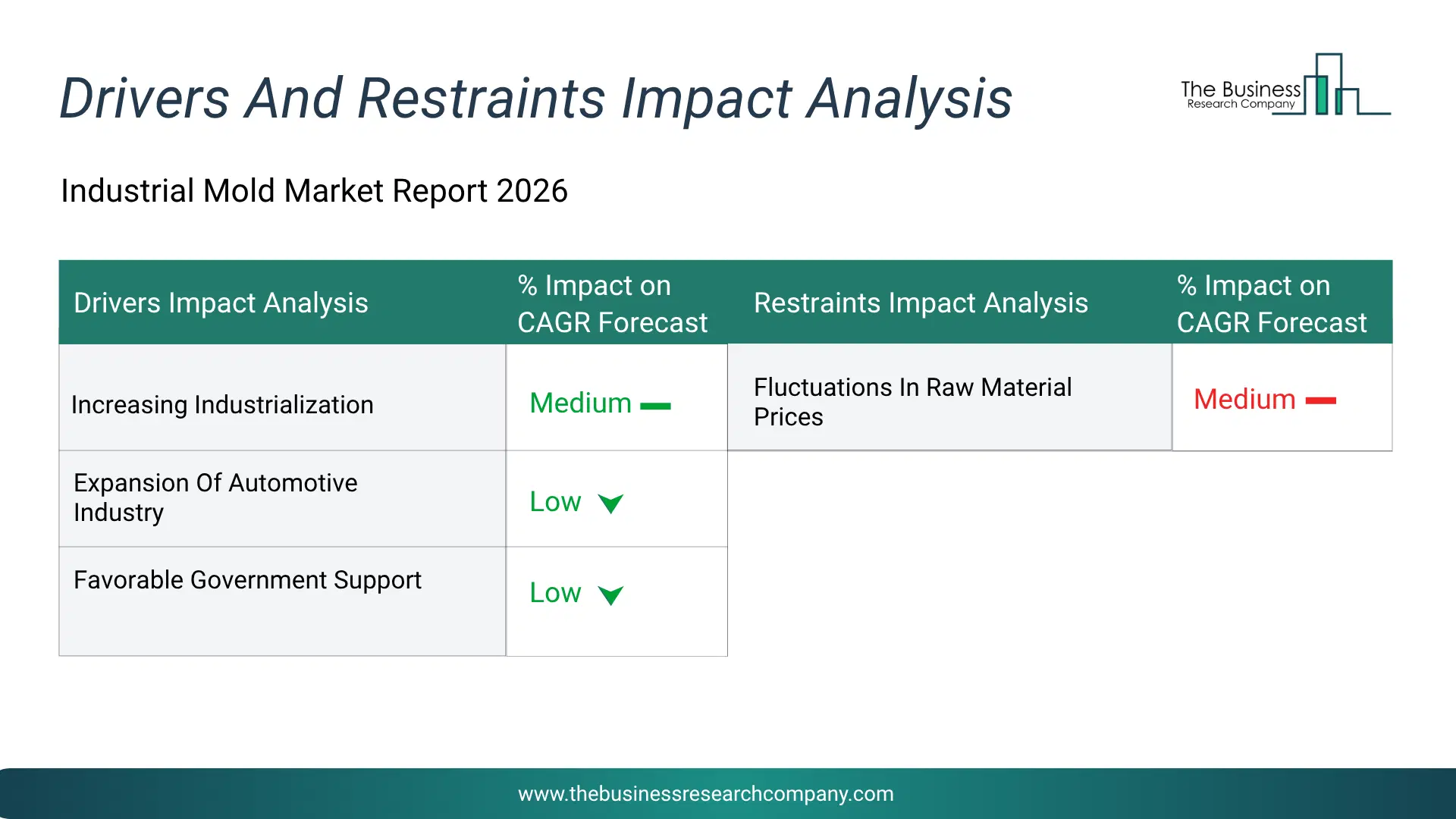
Infographic Chart Showing Key Market Drivers Analysis And Restraints For Industrial Mold Market
The chart presents an impact analysis of key drivers and restraints, quantifying their relative influence on the market's growth rate and helping assess the balance between growth enablers and limiting factors. This chart offers a high-level perspective; the full report contains more detailed insights.
How Will The Drivers Impact Growth In The Global Industrial Mold Market?
• Increasing Industrialization (Medium) – The increasing industrialization will become a key driver of growth in the industrial mold market by 2030. As new factories and production plants are established, the need for molds rises significantly. These molds are essential for shaping materials like plastics, metals, and ceramics, serving as the foundation for a wide range of industrial products. With industrialization, there is an increased focus on precision and efficiency. Innovations in mold technologies such as 3D printing for prototyping and the use of high-performance materials enhance the molding process, making it faster and more cost-effective. • Expansion Of Automotive Industry (Low) – The expansion of automotive industry will serve as a key growth catalyst for the industrial mold market by 2030, In the automotive industry there is a need for molds essential in manufacturing various components like engine parts, body panels, interiors and electrical systems. Additionally, the industry is placing a greater emphasis on customizing designs, introducing new model variants, and incorporating advanced technologies. These factors contribute to the higher requirement for molds to support innovative designs and accommodate the shifting focus towards sustainability and advanced manufacturing processes. • Favorable Government Support (Low) – The favorable government support will become a significant driver contributing to the growth of the industrial mold system market by 2030. Governments globally are providing financial incentives, grants and subsidies to promote the adoption of advanced manufacturing technologies within the molding industry. This support enables companies to invest in innovative molding solutions, enhancing productivity and driving cost efficiencies. Additionally, with a growing focus on environmental sustainability, many governments are encouraging industries to implement greener practices, further fostering the transition to more sustainable manufacturing methods. • Increasing Construction Activities (Low) – The increasing constriction activities will emerge as a major factor driving the expansion of the industrial mold market by 2030. In the construction industry, molds are essential for creating precise and durable components used in walls, floors, and other structural elements. With the construction industry emphasizing efficiency, custom molds enable manufacturers to produce complex components quickly and with greater accuracy. This is particularly valuable for unique designs and large-scale projects, where speed and precision are critical. Customization of molds helps streamline production, supporting the industry's shift towards faster, high-quality construction.How Will The Restraints Impact Growth In The Global Industrial Mold Market?
• Fluctuations In Raw Material Prices (Medium) – Fluctuations In Raw Material Prices will restrict the growth of the Industrial Mold market during the forecast period. Industrial mold manufacturing relies on metals including steel, aluminum, and specialty alloys, which are subject to price volatility. Raw material cost fluctuations affect production costs and pricing strategies, creating uncertainty for mold manufacturers. Price volatility can impact profit margins and may discourage investment in new mold production capacity, limiting market growth.Key Players In The Global Industrial Mold Market
Major companies operating in the industrial mold market are Husky Injection Molding Systems Ltd., ENGEL Austria GmbH, ARBURG GmbH + Co. KG, KraussMaffei Group GmbH, Milacron Holdings Corp., Sumitomo (SHI) Demag Plastics Machinery GmbH, Nissei Plastic Industrial Co., Ltd., Shibaura Machine Co., Ltd., The Cannon Group, Inc., StackTeck Systems Ltd., Sino Mould Co., Ltd., DMG MORI Co., Ltd., U.S. Industrial Machinery, Inc., Takween Advanced Industries, Apex Plastics, Inc., Proto Labs, Inc., Rosti Group AB, Aria Mold & Engineering Co., Jaco Tool, Inc., Mold-Masters Limited, Progressive Components International Corporation, HASCO Hasenclever GmbH + Co. KG, DME Company LLC, FCPK Mold & Engineering Inc.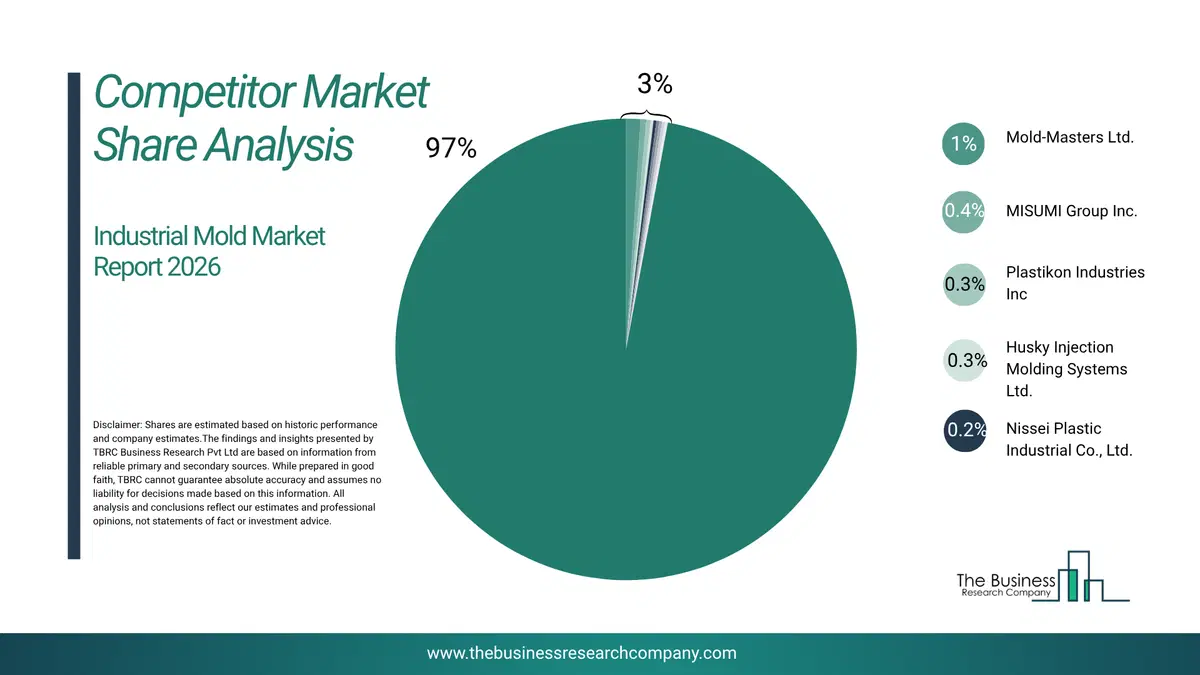
This chart is for illustrative purposes; the full report includes a detailed competitor analysis and comprehensive overview of the top 10 companies in the market.
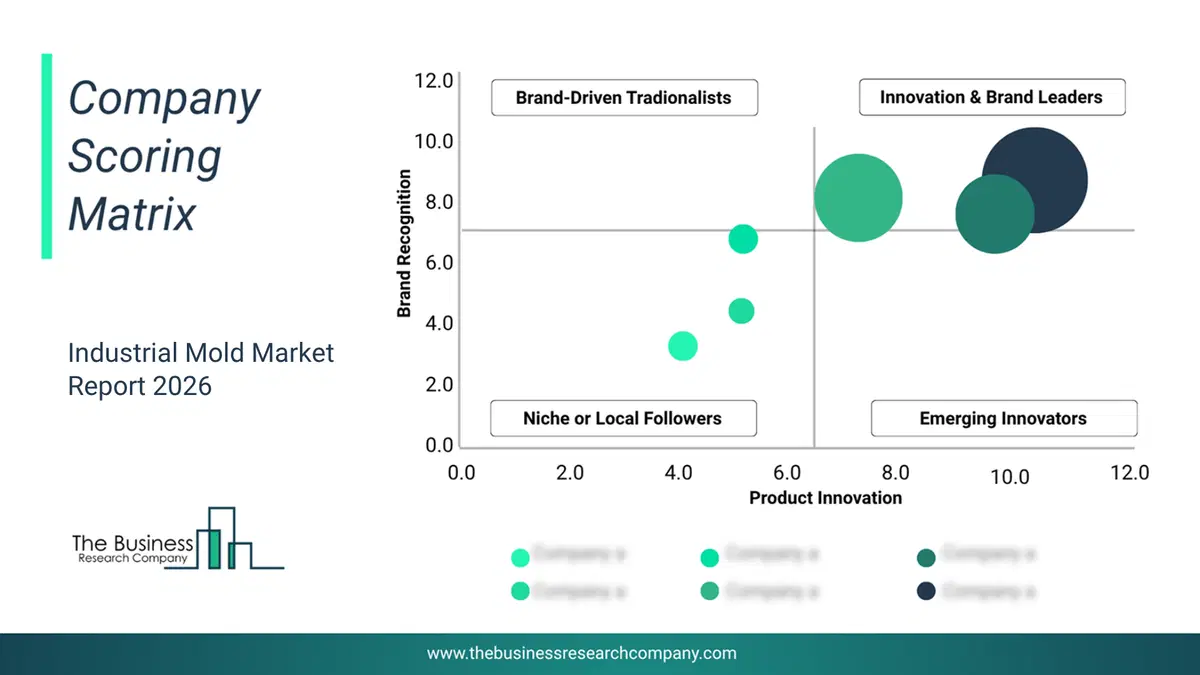
This chart maps companies by product innovation and brand strength, with bubble size indicating relative revenue, helping identify market leaders, challengers, and niche players. This is an illustrative chart; the full report provides a complete and accurate competitive analysis.
Global Industrial Mold Market Trends and Insights
Major companies operating in the industrial mold market are increasingly focusing on launching advanced, integrated molding technologies to strengthen their competitive position and meet rising demands for efficiency, automation, and high-precision production. These next-generation solutions combine innovative machine platforms, digital monitoring, and automation capabilities to enhance performance across diverse molding applications. For instance, in April 2024, Milacron, a US-based industrial company, unveiled a new lineup at NPE 2024 featuring its upgraded M-Series injection molding machines, along with co-injection systems, in-mold labeling and decoration technologies, hot-runner solutions, IIoT-enabled process monitoring, and fully automated cell integrations. This comprehensive suite demonstrates the market’s shift toward holistic, system-level solutions that improve output quality, energy efficiency, and operational uptime. By offering end-to-end molding ecosystems rather than standalone machines, companies like Milacron are enabling manufacturers to reduce production complexity, achieve higher precision, and accelerate time-to-market, ultimately advancing competitiveness within the global industrial mold landscape.What Are Latest Mergers And Acquisitions In The Industrial Mold Market?
In July 2024, Blackford Capital, a US-based investment company, acquired Industrial Molding Corporation for an undisclosed amount. With this acquisition, Blackford Capital aims to enhance its capabilities in the injection-molded plastics sector, particularly for the automotive industry, as part of its strategic transformation plan. Industrial Molding Corporation is a US-based company that provides industrial molds.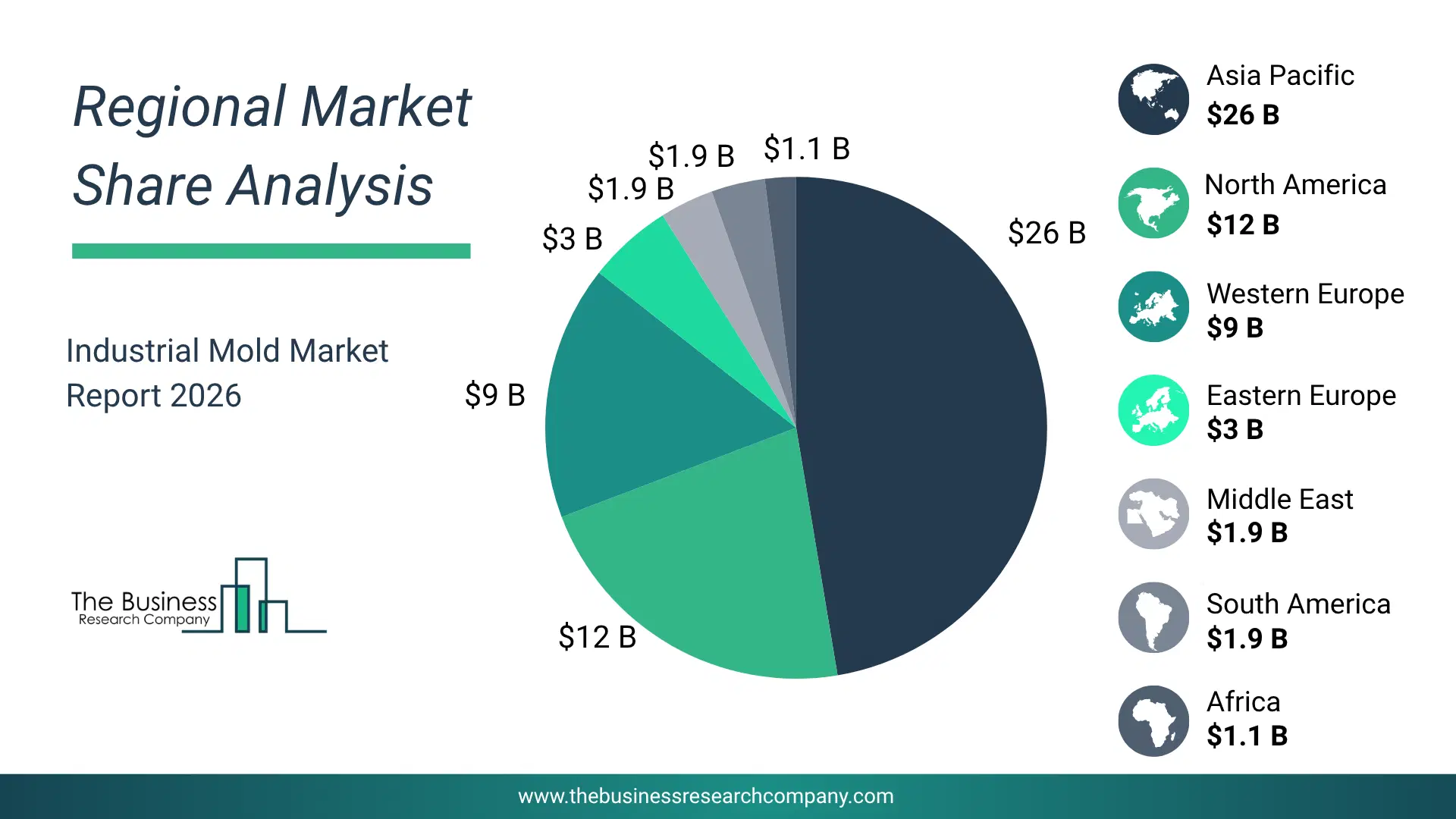
Regional Outlook
North America was the largest region in The industrial mold market in 2025. Western Europe was the second largest region of the industrial mold market. The regions covered in this market report are Asia-Pacific, South East Asia, Western Europe, Eastern Europe, North America, South America, Middle East, Africa The countries covered in this market report are China, India, Japan, Australia, Indonesia, South Korea, Bangladesh, Thailand, Vietnam, Malaysia, Singapore, Philippines, Hong Kong, Taiwan, New Zealand, UK, Germany, France, Italy, Spain, Austria, Belgium, Denmark, Finland, Ireland, Netherlands, Norway, Portugal, Sweden, Switzerland, Russia, Czech Republic, Poland, Romania, Ukraine, USA, Canada, Mexico, Brazil, Chile, Argentina, Colombia, Peru, Saudi Arabia, Israel, Iran, Turkey, UAE, Egypt, Nigeria, South Africa.What Defines the Industrial Mold Market?
The industrial mold market consists of sales of compression molding, melt molding, transfer molding, injection molding. Values in this market are ‘factory gate’ values, that is the value of goods sold by the manufacturers or creators of the goods, whether to other entities (including downstream manufacturers, wholesalers, distributors and retailers) or directly to end customers. The value of goods in this market includes related services sold by the creators of the goods.How is Market Value Defined and Measured?
The market value is defined as the revenues that enterprises gain from the sale of goods and/or services within the specified market and geography through sales, grants, or donations in terms of the currency (in USD unless otherwise specified). The revenues for a specified geography are consumption values that are revenues generated by organizations in the specified geography within the market, irrespective of where they are produced. It does not include revenues from resales along the supply chain, either further along the supply chain or as part of other products.
This chart presents market attractiveness based on a quantitative evaluation of growth, competition, strategic alignment, and risk, offering a clear view of opportunity areas for decision-making. This chart is for illustrative purposes; the full report contains the complete analysis.

This chart highlights the Total Addressable Market (TAM) by estimating the maximum revenue opportunity using an assumption-driven approach, supporting strategic planning and opportunity sizing across markets. The chart is illustrative; the full report provides a more comprehensive analysis.
What Key Data and Analysis Are Included in the Industrial Mold Market Report 2026?
The industrial mold market research report is one of a series of new reports from The Business Research Company that provides market statistics, including industry global market size, regional shares, competitors with the market share, detailed market segments, market trends and opportunities, and any further data you may need to thrive in the industrial mold industry. The market research report delivers a complete perspective of everything you need, with an in-depth analysis of the current and future state of the industry.Industrial Mold Market Report Forecast Analysis
| Report Attribute | Details |
|---|---|
| Market Size Value In 2026 | $57.41 billion |
| Revenue Forecast In 2030 | $75.57 billion |
| Growth Rate | CAGR of 6.2% from 2026 to 2030 |
| Base Year For Estimation | 2025 |
| Actual Estimates/Historical Data | 2020-2025 |
| Forecast Period | 2026 - 2030 |
| Market Representation | Revenue in USD Billion and CAGR from 2026 to 2030 |
| Segments Covered | Mold Type, Mold Material, End-Use Industry |
| Regional Scope | Asia-Pacific, Western Europe, Eastern Europe, North America, South America, Middle East, Africa |
| Country Scope | The countries covered in the report are Australia, Brazil, China, France, Germany, India, Indonesia, Japan, Taiwan, Russia, South Korea, UK, USA, Canada, Italy, Spain. |
| Key Companies Profiled | Husky Injection Molding Systems Ltd., ENGEL Austria GmbH, ARBURG GmbH + Co. KG, KraussMaffei Group GmbH, Milacron Holdings Corp., Sumitomo (SHI) Demag Plastics Machinery GmbH, Nissei Plastic Industrial Co., Ltd., Shibaura Machine Co., Ltd., The Cannon Group, Inc., StackTeck Systems Ltd., Sino Mould Co., Ltd., DMG MORI Co., Ltd., U.S. Industrial Machinery, Inc., Takween Advanced Industries, Apex Plastics, Inc., Proto Labs, Inc., Rosti Group AB, Aria Mold & Engineering Co., Jaco Tool, Inc., Mold-Masters Limited, Progressive Components International Corporation, HASCO Hasenclever GmbH + Co. KG, DME Company LLC, FCPK Mold & Engineering Inc. |
| Customization Scope | Request for Customization |
| Pricing And Purchase Options | Explore Purchase Options |