

Industrial Precision Time Protocol (PTP) Time Synchronization Market Report 2026
Global Outlook – By Component (Hardware, Software, Services), By Deployment Mode (On-Premises, Cloud), By Application (Industrial Automation, Smart Factories, Process Control, Robotics And Manufacturing, Power And Energy, Telecommunications, Transportation, Aerospace And Defense), By End-User (Manufacturing Industries, Energy And Utilities, Automotive Industry, Aerospace And Defense, Oil And Gas, Information Technology And Telecom, Financial Services) – Market Size, Trends, Strategies, and Forecast to 2030
Industrial Precision Time Protocol (PTP) Time Synchronization Market Overview
• Industrial Precision Time Protocol (PTP) Time Synchronization market size has reached to $1.52 billion in 2025 • Expected to grow to $2.66 billion in 2030 at a compound annual growth rate (CAGR) of 11.7% • Growth Driver: Surge In Demand For Deterministic Communication Driving Growth Of The Market Due To Increasing Need For Precise, Coordinated, And Real-Time Industrial Operations • Market Trend: Deploying Terrestrial High-Accuracy PTP Grandmaster Clocks For Sub-Nanosecond Time Synchronization Over Optical Networks • North America was the largest region in 2025 and Asia-Pacific is the fastest growing region.What Is Covered Under Industrial Precision Time Protocol (PTP) Time Synchronization Market?
The industrial precision time protocol time synchronization refers to technologies and systems that provide accurate and reliable time synchronization across industrial networks to ensure precise coordination of operations, automation processes, and data acquisition. Its primary purpose is to maintain deterministic timing, reduce latency, and improve operational efficiency in industrial environments. It also enables enhanced system reliability, improved process monitoring, and seamless integration with smart factory and industrial automation solutions. The main components of industrial ptp time synchronization include hardware, software, and services. Hardware refers to the physical components of a computer or electronic system, such as processors, memory devices, and peripheral equipment. Different deployment modes are on-premises and cloud. Various applications are industrial automation, smart factories, process control, robotics and manufacturing, power and energy, telecommunications, transportation, and aerospace and defense, and they are used by several end-users such as manufacturing industries, energy and utilities, automotive industry, aerospace and defense, oil and gas, information technology and telecom, financial services, and others.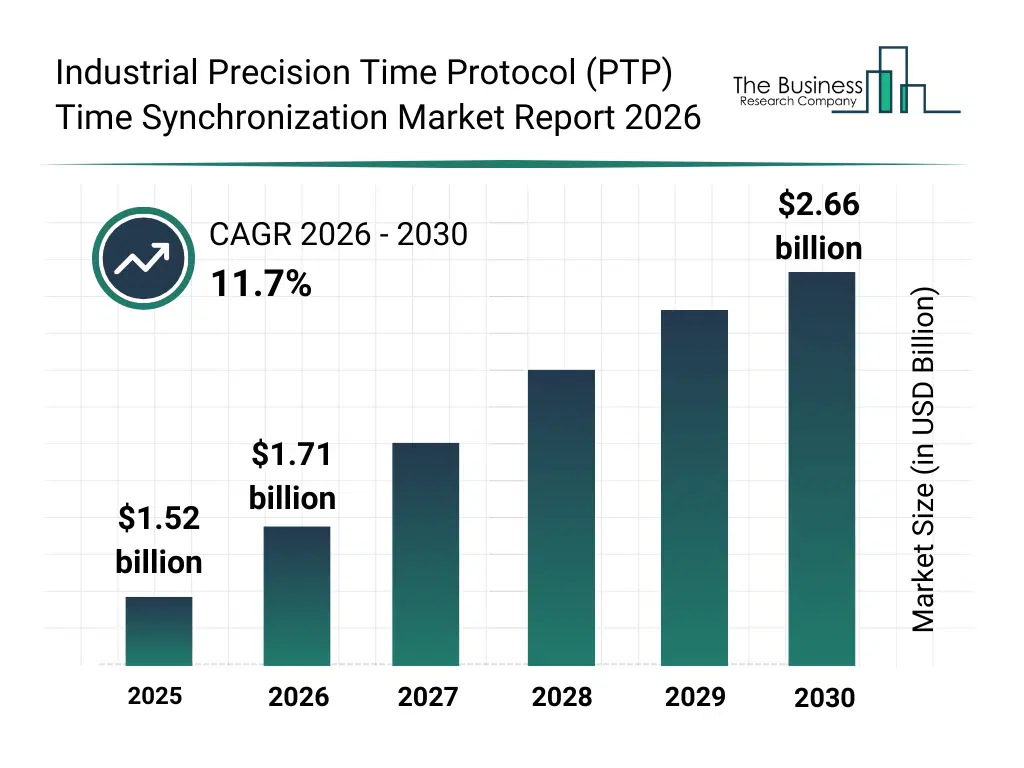
What Is The Industrial Precision Time Protocol (PTP) Time Synchronization Market Size and Share 2026?
The industrial precision time protocol (PTP) time synchronization market size has grown rapidly in recent years. It will grow from $1.52 billion in 2025 to $1.71 billion in 2026 at a compound annual growth rate (CAGR) of 12.0%. The growth in the historic period can be attributed to growing adoption of industrial automation, increasing need for accurate time synchronization in manufacturing environments, rising deployment of ethernet based communication networks, expansion of smart grid modernization initiatives, growing focus on reducing operational downtime.What Is The Industrial Precision Time Protocol (PTP) Time Synchronization Market Growth Forecast?
The industrial precision time protocol (PTP) time synchronization market size is expected to see rapid growth in the next few years. It will grow to $2.66 billion in 2030 at a compound annual growth rate (CAGR) of 11.7%. The growth in the forecast period can be attributed to increasing integration with industrial internet of things technologies, rising demand for ultra low latency industrial communication, growing adoption of autonomous and connected industrial systems, expansion of high precision control applications, rise in smart factory and digital twin deployments. Major trends in the forecast period includetechnology driven precision timing innovations, advancements in hardware based time stamping solutions, developments in network timing accuracy and security technologies, rising research and development in deterministic industrial networking, innovation in scalable and interoperable precision time protocol architectures.
Global Industrial Precision Time Protocol (PTP) Time Synchronization Market Segmentation
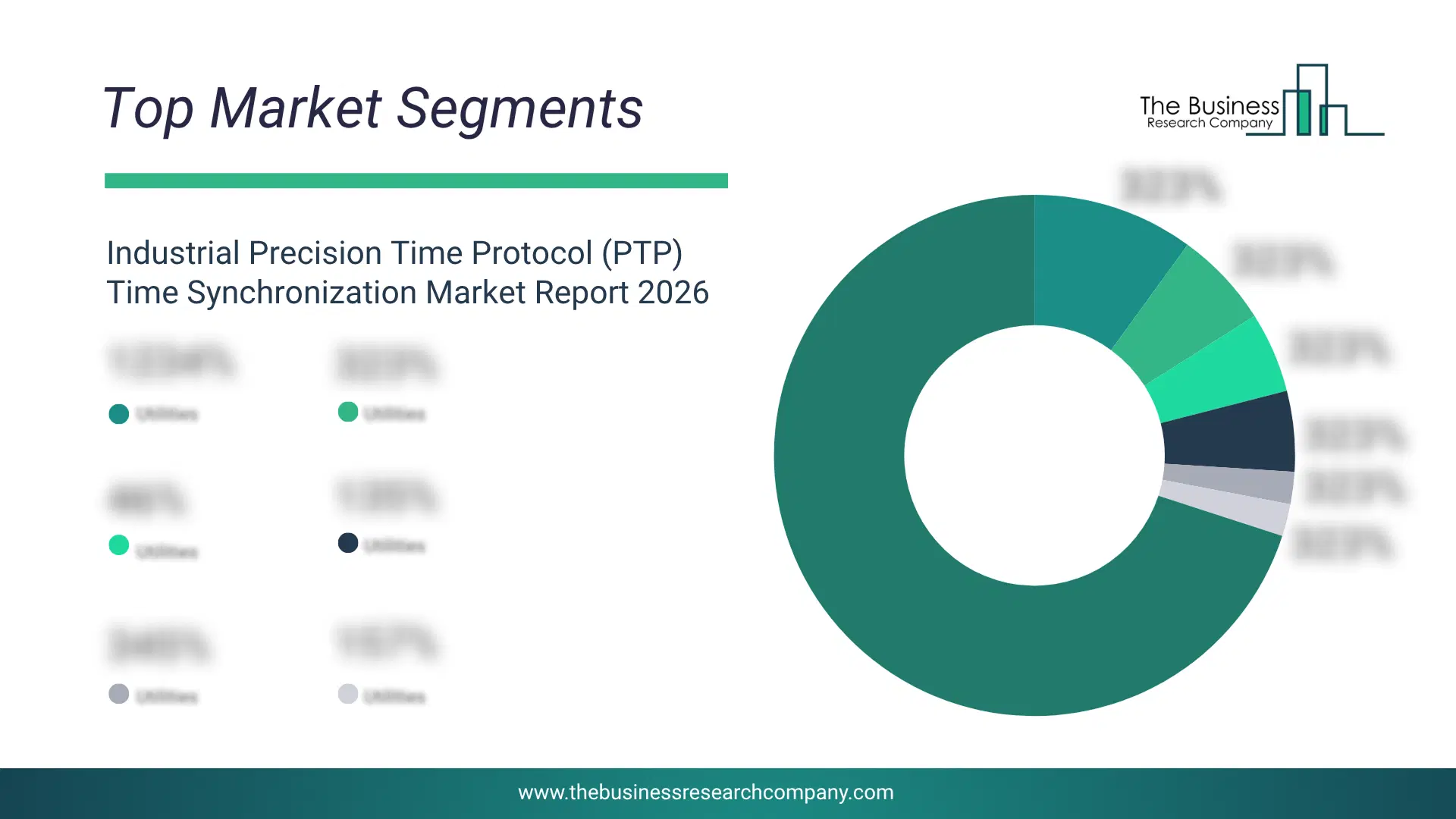
1) By Component: Hardware, Software, Services 2) By Deployment Mode: On-Premises, Cloud 3) By Application: Industrial Automation, Smart Factories, Process Control, Robotics And Manufacturing, Power And Energy, Telecommunications, Transportation, Aerospace And Defense 4) By End-User: Manufacturing Industries, Energy And Utilities, Automotive Industry, Aerospace And Defense, Oil And Gas, Information Technology And Telecom, Financial Services Subsegments: 1) By Hardware: Grandmaster Clocks, Boundary Clocks, Slave Clocks 2) By Software: PTP Management Software, Network Monitoring Software, Synchronization Control Software 3) By Services: Installation And Integration Services, Maintenance And Support Services, Consulting And Training ServicesWhat Are The Drivers Of The Industrial Precision Time Protocol (PTP) Time Synchronization Market?
The rising need for deterministic communication in robotics, process control, and industrial IoT is expected to propel the growth of the industrial precision time protocol time synchronization market going forward. Deterministic communication refers to the transmission of data over a network within strictly defined time bounds, ensuring predictable latency and minimal jitter, which is critical for coordinated control in real-time industrial systems. The rise in demand for deterministic communication is due to the increasing adoption of advanced automation, collaborative robots, and process control systems that require precise timing to maintain operational safety, reduce errors, and optimize efficiency. Industrial precision time protocol time synchronization deterministic communication by enabling sub-microsecond time alignment across devices, ensuring controllers, sensors, and actuators operate in a fully coordinated manner. For instance, in September 2024, according to the International Federation of Robotics, a Switzerland-based independent robotics association, the number of operational industrial robots worldwide increased from approximately 3.9 million in 2022 to over 4.28 million in 2023, marking a 9.7% rise compared to 2022. Therefore, the rising need for deterministic communication in robotics, process control, and industrial IoT is driving the growth of theindustrial precision time protocol time synchronization market. The increasing focus on enhancing reliability and reducing downtime in industrial environments is expected to propel the growth of the industrial precision time protocol time synchronization market going forward. Reliability in industrial contexts refers to the consistent and uninterrupted operation of equipment and processes to meet production goals and maintain safety and quality standards. Industrial operators intensify their focus on reliability and downtime reduction because unplanned stoppages and unpredictable failures directly erode productivity, revenues, and competitiveness. Industrial precision time protocol time synchronization supports this focus by enabling precise, deterministic clock alignment across controllers, sensors, machines, and networks, which improves coordination of systems, enhances real-time monitoring, and contributes to faster detection and resolution of operational issues. For instance, in August 2024, according to the MaintainX, a US-based software company, 85% of facilities reported either stable or decreased unplanned downtime over the previous year while operational costs associated with downtime continued to rise, and maintenance leaders emphasized proactive strategies to improve asset reliability and reduce disruptions; the report noted average unplanned downtime costs of about $25,000 per hour, with larger organizations seeing costs exceed $500,000 per hour. Therefore, the increasing focus on enhancing reliability and reducing downtime in industrial environments is driving the growth of the industrial precision time protocol time synchronization market.Key Players In The Global Industrial Precision Time Protocol (PTP) Time Synchronization Market
Major companies operating in the industrial precision time protocol (ptp) time synchronization market are Siemens AG, Cisco Systems Inc., Safran S.A., Microchip Technology Inc., Juniper Networks Inc, Trimble Inc., Seiko Solutions Inc., World Time Solutions Ltd., EndRun Technologies Inc., Brandywine Communications Inc., FEI-Zyfer Inc., Moxa Inc., Oscilloquartz SA, Calnex Solutions Ltd., Galleon Systems Limited, Meinberg Funkuhren GmbH & Co. KG, Moser-Baer AG, National Instruments Corp., Elproma Elektronika Sp. z o.o., Masterclock Inc., Chronos Technology Ltd., Scientific Devices Australia Pty Ltd., BDStar Time Technology Co. Ltd.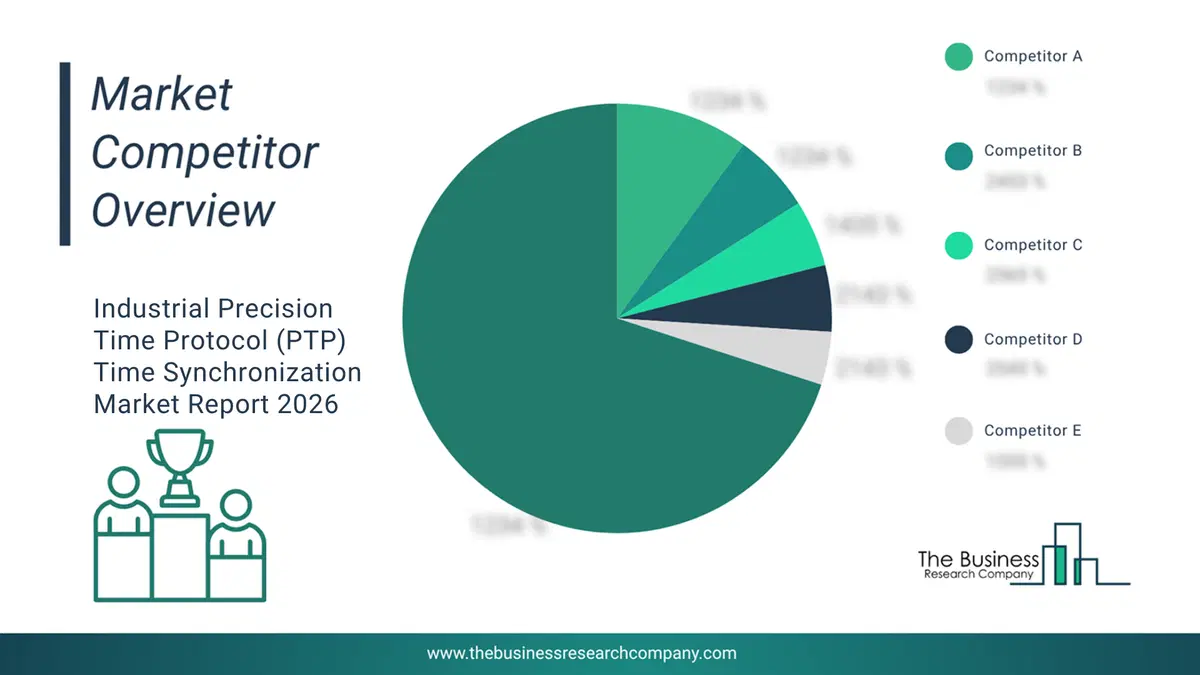
This chart is for illustrative purposes; the full report includes a detailed competitor analysis and comprehensive overview of the top 10 companies in the market.
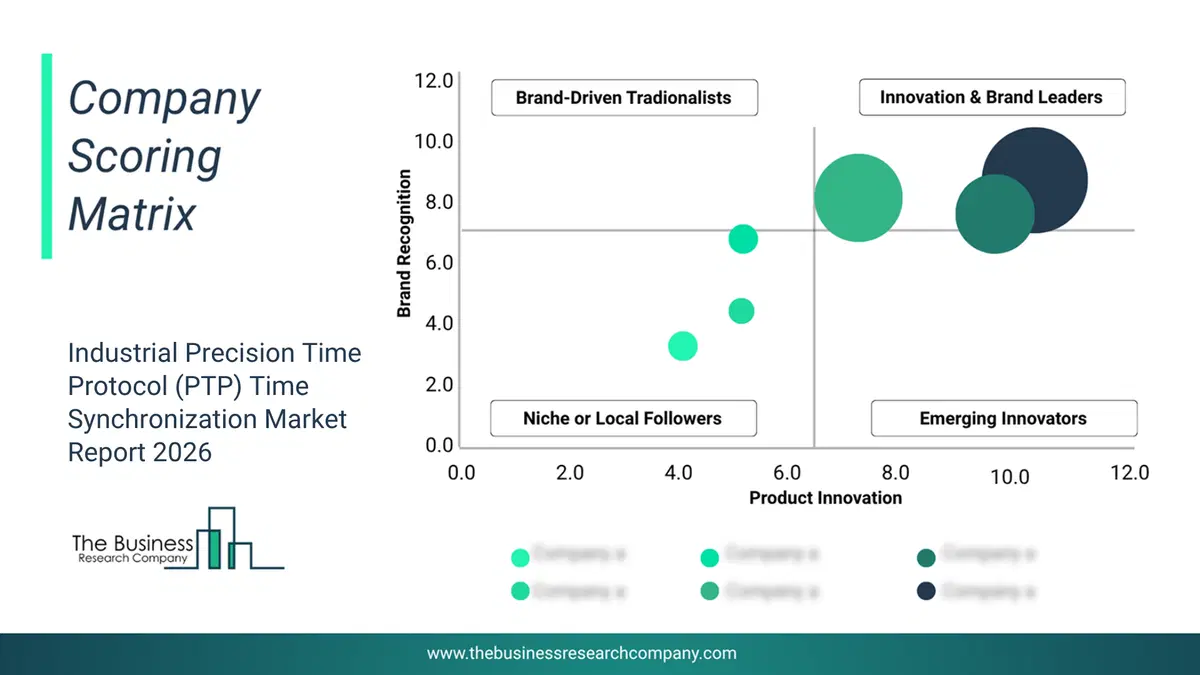
This chart maps companies by product innovation and brand strength, with bubble size indicating relative revenue, helping identify market leaders, challengers, and niche players. This is an illustrative chart; the full report provides a complete and accurate competitive analysis.
Global Industrial Precision Time Protocol (PTP) Time Synchronization Market Trends and Insights
Major companies operating in the industrial precision time protocol time synchronization market are focusing on developing terrestrial high-accuracy grandmaster clock solutions to deliver sub-nanosecond coordinated time over long-haul optical networks without reliance on GNSS. Terrestrial high-accuracy grandmaster clock solutions are land-based timing systems that provide ultra-precise and stable time and frequency references to networks using local oscillators and synchronization protocols such as PTP, without relying on satellite-based signals. For instance, in October 2025, Microchip Technology Inc., a United States-based semiconductor and timing systems company, launched the TimeProvider 4500 v3 grandmaster clock, a product providing sub-nanosecond accuracy with High Accuracy Time Transfer (HA-TT) over optical networks, offers integration with standard Ethernet and optical interfaces, and enables a terrestrial alternative to GNSS timing by using UTC(k) references from national metrology laboratories. The clock achieves approximately 5 ns time delay over 800 km (about 500 ps average per node), supports multiple operating modes including virtual Primary Reference Time Clock (vPRTC) architectures, and meets evolving carrier-grade PTP standards for critical infrastructure synchronization.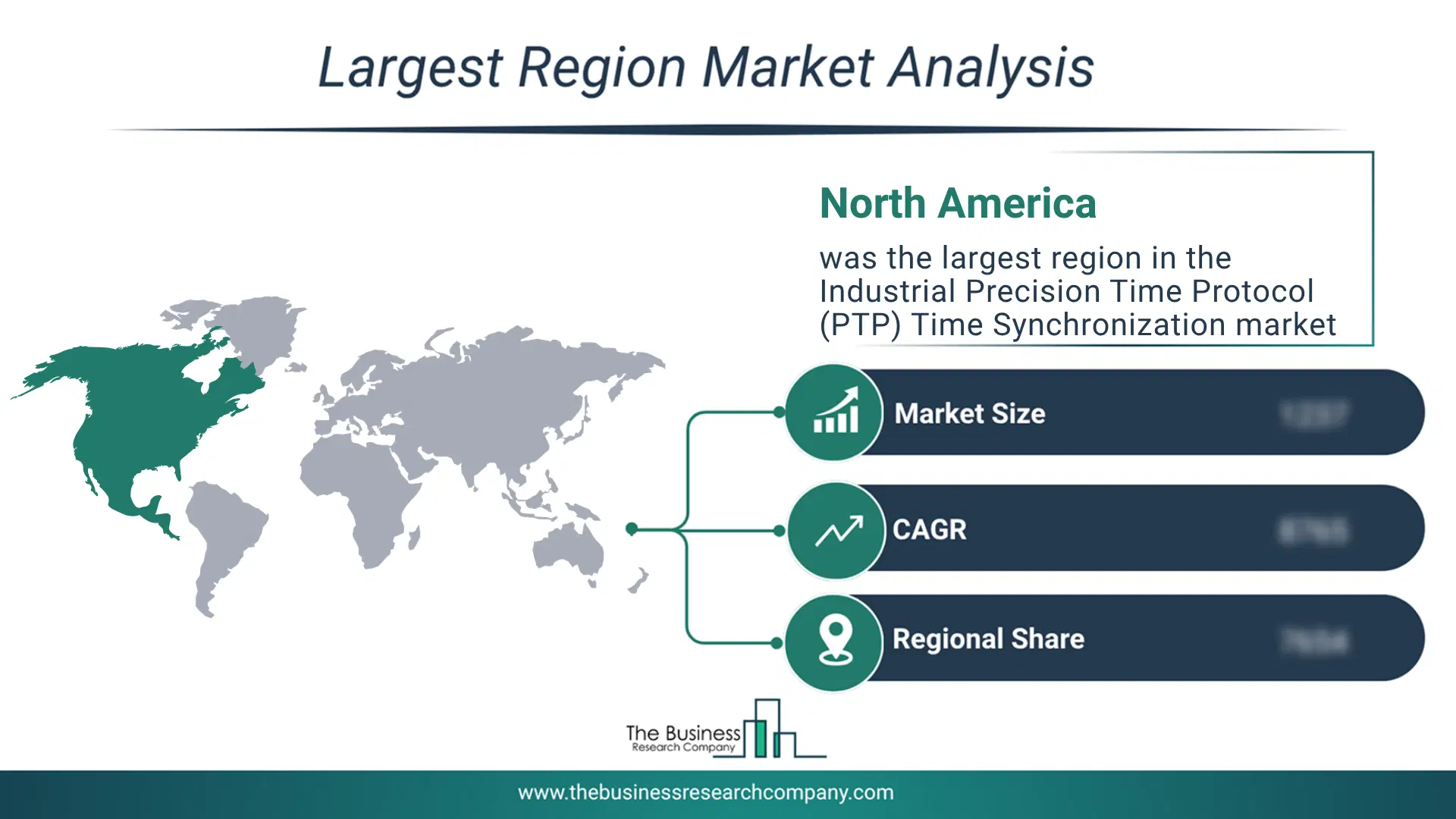
Regional Insights
North America was the largest region in the industrial precision time protocol (PTP) time synchronization market in 2025. Asia-Pacific is expected to be the fastest-growing region in the forecast period. The regions covered in this market report are Asia-Pacific, South East Asia, Western Europe, Eastern Europe, North America, South America, Middle East, Africa. The countries covered in this market report are Australia, Brazil, China, France, Germany, India, Indonesia, Japan, Taiwan, Russia, South Korea, UK, USA, Canada, Italy, Spain.What Defines the Industrial Precision Time Protocol (PTP) Time Synchronization Market?
The industrial precision time protocol time synchronization consists of revenues earned by entities by providing products such as precision time protocol master clocks, industrial precision time protocol time servers, boundary clocks, transparent clocks, and network time synchronization modules. The market value includes the value of related goods sold by the service provider or included within the service offering. The industrial precision time protocol time synchronization market includes sales of industrial-grade oscillators, timing distribution hardware, synchronization monitoring software, and precision time protocol-enabled network switches. Values in this market are ‘factory gate’ values, that is, the value of goods sold by the manufacturers or creators of the goods, whether to other entities (including downstream manufacturers, wholesalers, distributors, and retailers) or directly to end customers. The value of goods in this market includes related services sold by the creators of the goods.How is Market Value Defined and Measured?
The market value is defined as the revenues that enterprises gain from the sale of goods and/or services within the specified market and geography through sales, grants, or donations in terms of the currency (in USD unless otherwise specified). The revenues for a specified geography are consumption values that are revenues generated by organizations in the specified geography within the market, irrespective of where they are produced. It does not include revenues from resales along the supply chain, either further along the supply chain or as part of other products.
This chart presents market attractiveness based on a quantitative evaluation of growth, competition, strategic alignment, and risk, offering a clear view of opportunity areas for decision-making. This chart is for illustrative purposes; the full report contains the complete analysis.

This chart highlights the Total Addressable Market (TAM) by estimating the maximum revenue opportunity using an assumption-driven approach, supporting strategic planning and opportunity sizing across markets. The chart is illustrative; the full report provides a more comprehensive analysis.
What Key Data and Analysis Are Included in the Industrial Precision Time Protocol (PTP) Time Synchronization Market Report 2026?
The industrial precision time protocol (ptp) time synchronization market research report is one of a series of new reports from The Business Research Company that provides market statistics, including industry global market size, regional shares, competitors with the market share, detailed market segments, market trends and opportunities, and any further data you may need to thrive in the industrial precision time protocol (ptp) time synchronization industry. The market research report delivers a complete perspective of everything you need, with an in-depth analysis of the current and future state of the industry.Industrial Precision Time Protocol (PTP) Time Synchronization Market Report Forecast Analysis
| Report Attribute | Details |
|---|---|
| Market Size Value In 2026 | $1.71 billion |
| Revenue Forecast In 2030 | $2.66 billion |
| Growth Rate | CAGR of 11.7% from 2026 to 2030 |
| Base Year For Estimation | 2025 |
| Actual Estimates/Historical Data | 2020-2025 |
| Forecast Period | 2026 - 2030 |
| Market Representation | Revenue in USD Billion and CAGR from 2026 to 2030 |
| Segments Covered | Component, Deployment Mode, Application, End-User |
| Regional Scope | Asia-Pacific, Western Europe, Eastern Europe, North America, South America, Middle East, Africa |
| Country Scope | The Countries Covered In This Market Report Are Australia, Brazil, China, France, Germany, India, Indonesia, Japan, Taiwan, Russia, South Korea, Uk, Usa, Canada, Italy, Spain. |
| Key Companies Profiled | Siemens AG, Cisco Systems Inc., Safran S.A., Microchip Technology Inc., Juniper Networks Inc, Trimble Inc., Seiko Solutions Inc., World Time Solutions Ltd., EndRun Technologies Inc., Brandywine Communications Inc., FEI-Zyfer Inc., Moxa Inc., Oscilloquartz SA, Calnex Solutions Ltd., Galleon Systems Limited, Meinberg Funkuhren GmbH & Co. KG, Moser-Baer AG, National Instruments Corp., Elproma Elektronika Sp. z o.o., Masterclock Inc., Chronos Technology Ltd., Scientific Devices Australia Pty Ltd., BDStar Time Technology Co. Ltd. |
| Customization Scope | Request for Customization |
| Pricing And Purchase Options | Explore Purchase Options |