

Industrial Real Estate Market Report 2026
Global Outlook – By Product (Industrial, Warehousing), By Size (Small, Medium, Large), By Application (Manufacturing, Distribution, Logistics, Research And Development, Data Centers, Other Applications) – Market Size, Trends, Strategies, and Forecast to 2030
Industrial Real Estate Market Overview
• Industrial Real Estate market size has reached to $279.43 billion in 2025 • Expected to grow to $359.68 billion in 2030 at a compound annual growth rate (CAGR) of 5.2% • Growth Driver: Industrial Real Estate Market Is Poised For Growth Driven By the Booming Construction Industry • Market Trend: Panattoni Expands Presence In India's Thriving Industrial Real Estate Market • North America was the largest region and fastest growing region.Market Gains By 2030 – Top Opportunities By Segment
Market Gain identifies the most promising market opportunities by highlighting the segments or products expected to generate the highest incremental revenue growth over the next five years.
What Is Covered Under Industrial Real Estate Market?
Industrial real estate refers to commercial properties used primarily for industrial purposes, such as manufacturing, warehousing, distribution, research and development (R&D), and logistics. These properties are designed and equipped to support specific industrial activities and typically feature amenities such as high ceilings, large floor areas, heavy-duty flooring, loading docks, and access to transportation infrastructure. The main product types of industrial real estate include industrial and warehousing. Industrial properties are facilities used for manufacturing, processing, or production activities. Different sizes available are small, medium, and large, and they are used by several applications such as manufacturing, distribution, logistics, research and development, data centers, and others.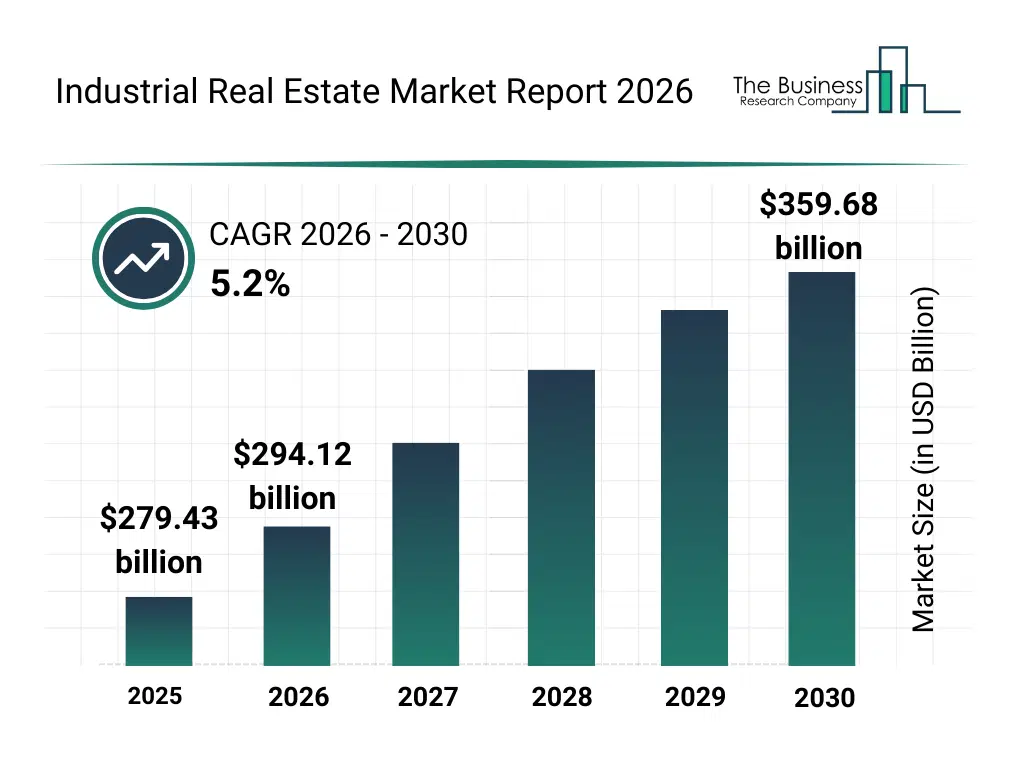
What Is The Industrial Real Estate Market Size and Share 2026?
The industrial real estate market size has grown strongly in recent years. It will grow from $279.43 billion in 2025 to $294.12 billion in 2026 at a compound annual growth rate (CAGR) of 5.3%. The growth in the historic period can be attributed to increasing industrial expansion driven by e-commerce, early investment in large-scale warehousing, growth in manufacturing modernization, rising demand for logistics infrastructure, expansion of industrial business parks.What Is The Industrial Real Estate Market Growth Forecast?
The industrial real estate market size is expected to see strong growth in the next few years. It will grow to $359.68 billion in 2030 at a compound annual growth rate (CAGR) of 5.2%. The growth in the forecast period can be attributed to growing integration of smart industrial systems, increased demand for energy-efficient warehouses, expansion of automated logistics hubs, rising investment in regional manufacturing, development of sustainable industrial buildings. Major trends in the forecast period include growing adoption of automated warehousing designs, expansion of high-capacity distribution infrastructure, increased demand for flexible industrial space, rising use of energy-efficient building materials, growth in smart industrial park developments.
Global Industrial Real Estate Market Segmentation
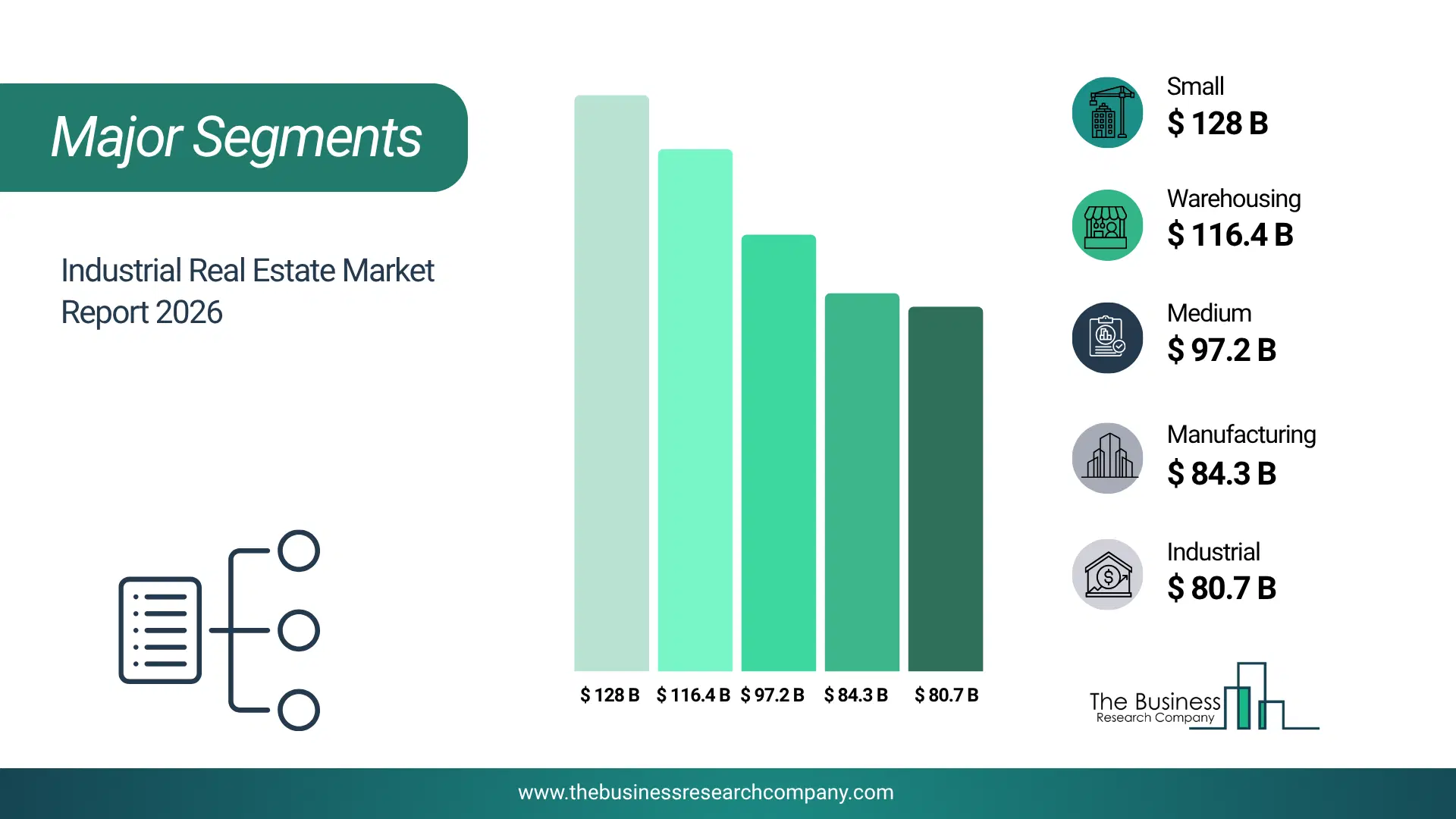
1) By Product: Industrial, Warehousing 2) By Size: Small, Medium, Large 3) By Application: Manufacturing, Distribution, Logistics, Research And Development, Data Centers, Other Applications Subsegments: 1) By Industrial: Manufacturing Facilities, Distribution Centers, Industrial Parks 2) By Warehousing: Cold Storage Facilities, Fulfillment Centers, Bulk Warehouses The top segments in the industrial real estate market will be: • Small will reach $128041.7 Million by 2025. • Warehousing will reach $116479.75 Million by 2025. • Medium will reach $97273.25 Million by 2025. • Manufacturing will reach $84367.12 Million by 2025. • Industrial will reach $80751.11 Million by 2025.What Is The Driver Of The Industrial Real Estate Market?
The increasing construction is expected to propel the growth of the industrial real estate market going forward. Construction activities involve the physical development of buildings, infrastructure, and other structures. The increasing construction and real estate activities are due to rapid urbanization, infrastructure development, and a focus on efficiency and accuracy in building projects. Industrial real estate supports construction by providing the necessary infrastructure, facilities, and logistical support to streamline operations, enhance efficiency, and facilitate the construction process from planning through to completion. For instance, in July 2023, according to the Australian Bureau of Statistics, an Australian-based government administration, in the March quarter of 2023, there were 240,813 dwellings under construction, an increase from 240,065 in 2022. Therefore, the increasing construction drives the industrial real estate industry.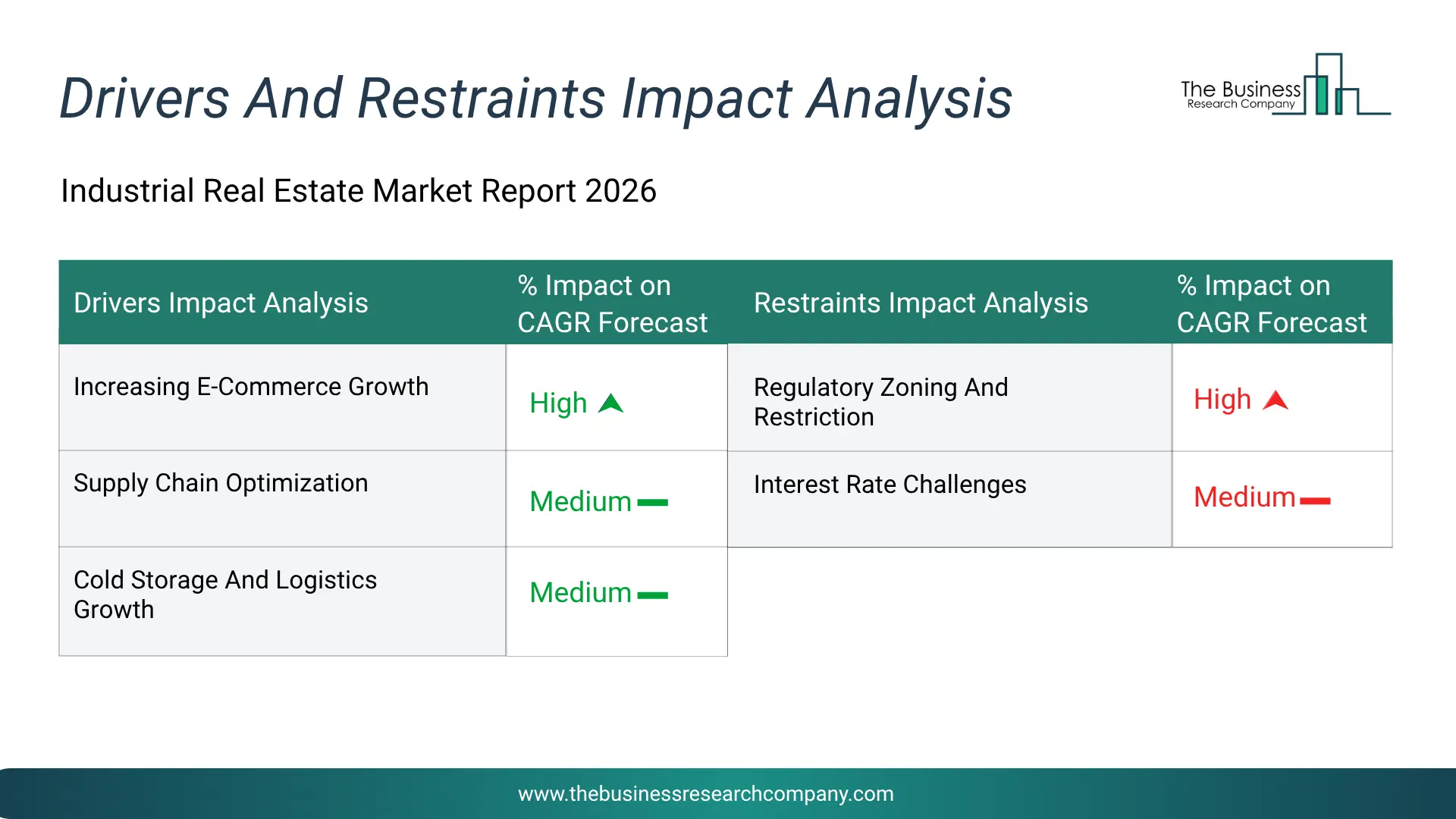
Infographic Chart Showing Key Market Drivers Analysis And Restraints For Industrial Real Estate Market
The chart presents an impact analysis of key drivers and restraints, quantifying their relative influence on the market's growth rate and helping assess the balance between growth enablers and limiting factors. This chart offers a high-level perspective; the full report contains more detailed insights.
How Will The Drivers Impact Growth In The Global Industrial Real Estate Market?
• Increasing E-Commerce Growth (High) – The increasing e-commerce growth will become a key driver of growth in the industrial real estate market by 2030. Industrial real estate is essential for the e-commerce industry as it provides warehouses, fulfilment centers and distribution hubs that enable efficient storage, processing and rapid delivery of goods to customers. With the increasing demand for faster shipping and streamlined logistics, strategically located industrial properties help e-commerce businesses optimize supply chains and enhance operational efficiency. As a result, the increasing e-commerce growth is anticipated to contributing to a 3.0% annual growth in the market. • Supply Chain Optimization (Medium) – The supply chain optimization will emerge as a major factor driving the expansion of the industrial real estate market by 2030. Supply chain optimization enhances industrial real estate by increasing demand for strategically located warehouses, distribution centers and logistics hubs, ensuring efficient inventory management and faster deliveries. This leads to improved space utilization, reduced operational costs and stronger market competitiveness for businesses. Consequently, the supply chain optimization is projected to contributing to a 1.5% annual growth in the market. • Cold Storage And Logistics Growth (Medium) – The cold storage and logistics growth within digital manufacturing processes will serve as a key growth catalyst for the industrial real estate market by 2030. Cold storage and logistics are significantly driving growth in the industrial real estate sector due to rising demand for temperature-controlled facilities. With the expansion of e-commerce, particularly in the grocery and pharmaceutical sectors, companies require specialized warehouses to store and distribute perishable goods efficiently. This demand has accelerated investments in modern cold storage infrastructure, increasing the need for larger, strategically located properties near urban centers to facilitate quicker delivery times. Therefore, the cold storage and logistics growth is projected to supporting to a 1.0% annual growth in the market. • Favorable Government Support (Low) – The favorable government support will become a significant driver contributing to the growth of the industrial real estate market by 2030. Favourable government support, such as tax incentives, infrastructure investments and streamlined regulations, enhances industrial real estate by attracting businesses, reducing operational costs and encouraging development. These policies drive economic growth, boost demand for industrial properties and facilitate the expansion of manufacturing, logistics and warehousing sectors. Consequently, the favorable government support is projected to contributing to a 0.5% annual growth in the market.How Will The Restraints Impact Growth In The Global Industrial Real Estate Market?
• Regulatory Zoning And Restriction (High) – Regulatory Zoning And Restriction will restrict the growth of the Industrial Real Estate market during the forecast period. Zoning regulations and land use restrictions affect the availability and development of industrial real estate properties. Restrictions on industrial activities, building heights, and operational hours can limit property development and usage. Regulatory requirements for environmental assessments and permits add to development timelines and costs, affecting market growth and property availability. • Interest Rate Challenges (Medium) – Interest Rate Challenges will restrict the growth of the Industrial Real Estate market during the forecast period. Rising interest rates affect the affordability and availability of financing for industrial real estate acquisitions and development. Higher borrowing costs reduce investor returns and may lead to slower transaction volumes and property development. Interest rate sensitivity in the real estate market can create cyclical challenges for industrial property investment and development.Key Players In The Global Industrial Real Estate Market
Major companies operating in the industrial real estate market are CBRE Group Inc., Jones Lang LaSalle Incorporated, Cushman & Wakefield, Prologis Inc., Colliers International, Sealy & Company LLC, Exeter Property Group, Duke Realty Corporation, Hillwood Development Company, Stag Industrial Inc., Rexford Industrial Realty Inc., First Industrial Realty Trust, EastGroup Properties Inc., Trammell Crow Company, Rockefeller Group, Terreno Realty Corporation, Panattoni Development Company, Dermody Properties LLC, Bridge Development Partners LLC, Conor Commercial Real Estate, Avison Young, CenterPoint Properties, Lincoln Property Company, Clarion Partners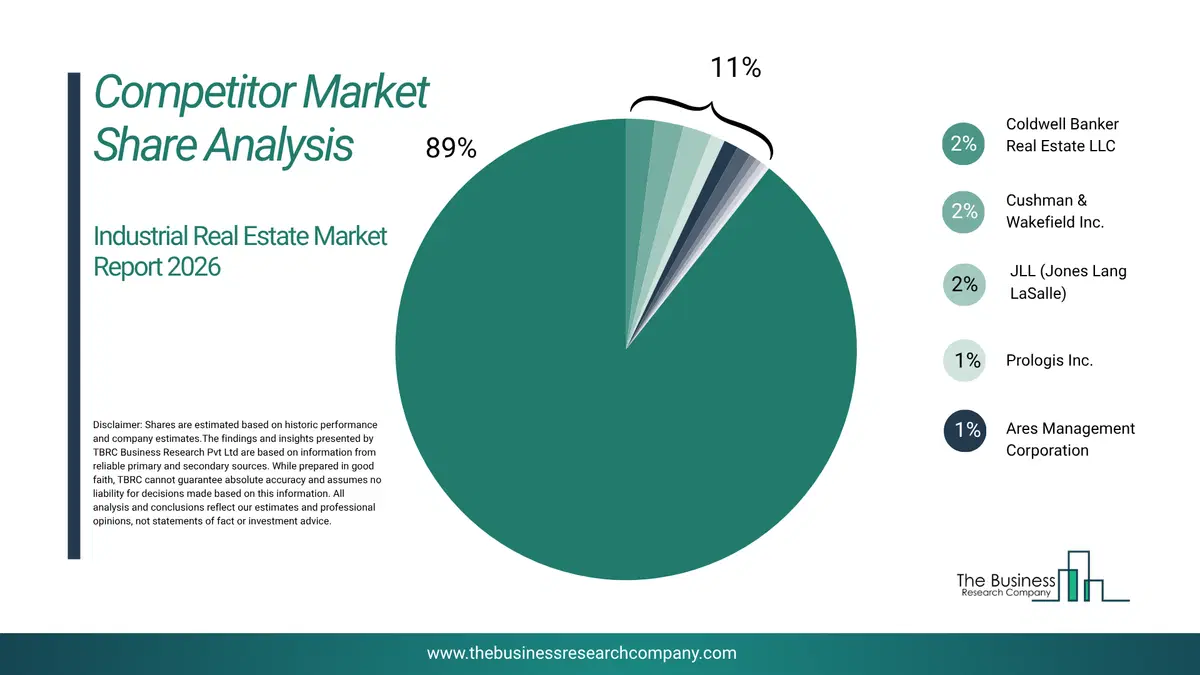
This chart is for illustrative purposes; the full report includes a detailed competitor analysis and comprehensive overview of the top 10 companies in the market.
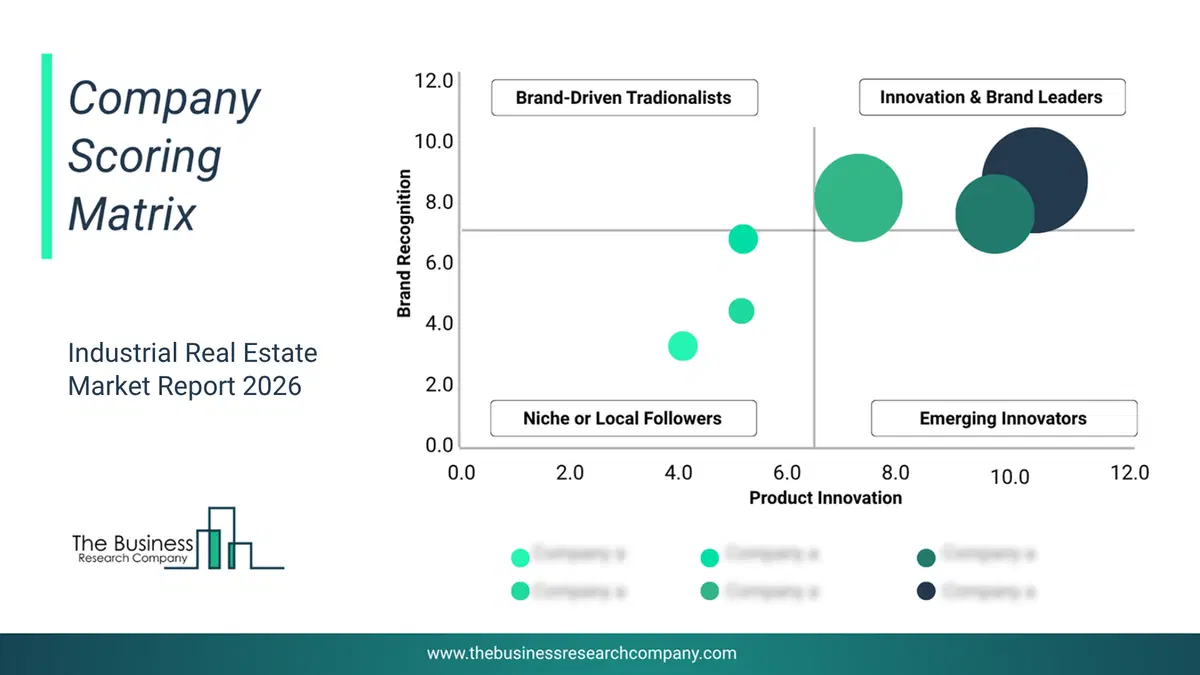
This chart maps companies by product innovation and brand strength, with bubble size indicating relative revenue, helping identify market leaders, challengers, and niche players. This is an illustrative chart; the full report provides a complete and accurate competitive analysis.
Global Industrial Real Estate Market Trends and Insights
Major companies operating in the industrial real estate market are investing in real estate projects to expand their property portfolios, enhance logistics capabilities, and meet the growing demand for modern industrial spaces. The investment highlights the company's strategic focus on tapping the rapidly expanding industrial real estate market through sustainable, large-scale developments. For instance, in December 2023, Panattoni Development Company, a US-based industrial real estate company, invested over USD 101.4 million (€100 million) in India to significantly expand its presence there. The company has announced plans to invest $100 million in India annually for several years to build industrial warehouses in key markets such as Delhi NCR, Mumbai, Bengaluru, Chennai, and Pune.What Are Latest Mergers And Acquisitions In The Industrial Real Estate Market?
In June 2023, Prologis, a United States-based provider of logistics real estate investment trust (REIT) services, acquired nearly 14 million square feet of industrial properties from opportunistic real estate funds affiliated with Blackstone for $3.1 billion. With this acquisition, Prologis aimed to expand its presence in key U.S. markets, grow its customer relationships by adding 77 new customers and deepening ties with 50 existing clients, and enhance its Strategic Essentials platform by scaling its portfolio with high-quality warehouse properties. Blackstone is a United States-based real estate investor that manages opportunistic real estate funds offering high-quality warehouse and industrial properties across multiple markets in North America and worldwide.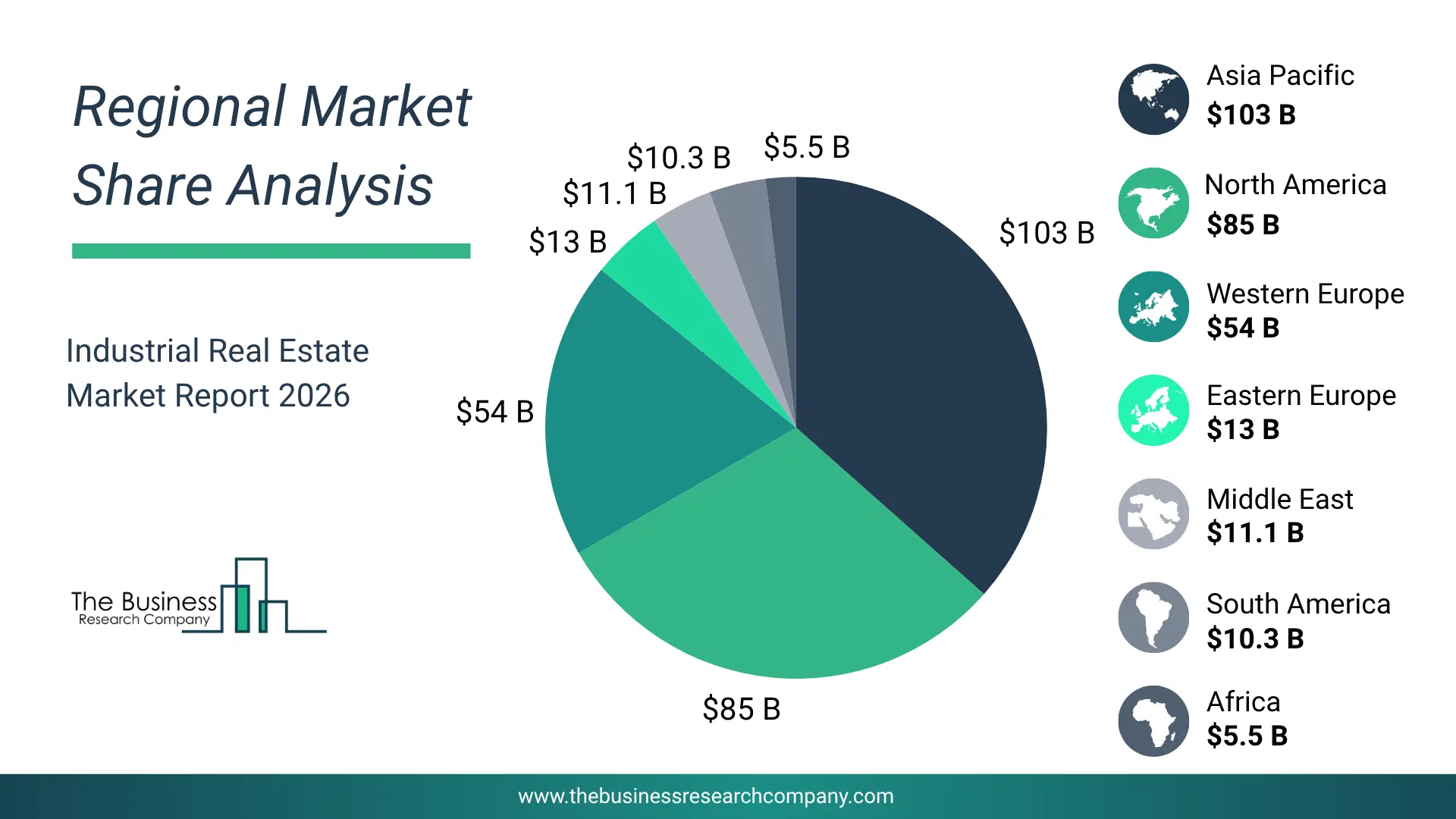
Regional Insights
North America was the largest region in the industrial real estate market in 2025. The regions covered in this market report are Asia-Pacific, South East Asia, Western Europe, Eastern Europe, North America, South America, Middle East, Africa. The countries covered in this market report are Australia, Brazil, China, France, Germany, India, Indonesia, Japan, Taiwan, Russia, South Korea, UK, USA, Canada, Italy, Spain.What Defines the Industrial Real Estate Market?
The industrial real estate market includes revenues earned by entities through the leasing, development, management, and sale of industrial properties such as warehouses, distribution centers, manufacturing facilities, and industrial parks. The market value includes the value of related goods sold by the service provider or included within the service offering. Only goods and services traded between entities or sold to end consumers are included.How is Market Value Defined and Measured?
The market value is defined as the revenues that enterprises gain from the sale of goods and/or services within the specified market and geography through sales, grants, or donations in terms of the currency (in USD unless otherwise specified). The revenues for a specified geography are consumption values that are revenues generated by organizations in the specified geography within the market, irrespective of where they are produced. It does not include revenues from resales along the supply chain, either further along the supply chain or as part of other products.
This chart presents market attractiveness based on a quantitative evaluation of growth, competition, strategic alignment, and risk, offering a clear view of opportunity areas for decision-making. This chart is for illustrative purposes; the full report contains the complete analysis.

This chart highlights the Total Addressable Market (TAM) by estimating the maximum revenue opportunity using an assumption-driven approach, supporting strategic planning and opportunity sizing across markets. The chart is illustrative; the full report provides a more comprehensive analysis.
What Key Data and Analysis Are Included in theIndustrial Real Estate Market Report 2026?
The industrial real estate market research report is one of a series of new reports from The Business Research Company that provides market statistics, including industry global market size, regional shares, competitors with the market share, detailed market segments, market trends and opportunities, and any further data you may need to thrive in the industrial real estate industry. The market research report delivers a complete perspective of everything you need, with an in-depth analysis of the current and future state of the industry.Industrial Real Estate Market Report Forecast Analysis
| Report Attribute | Details |
|---|---|
| Market Size Value In 2026 | $294.12 billion |
| Revenue Forecast In 2030 | $359.68 billion |
| Growth Rate | CAGR of 5.3% from 2026 to 2030 |
| Base Year For Estimation | 2025 |
| Actual Estimates/Historical Data | 2020-2025 |
| Forecast Period | 2026 - 2030 |
| Market Representation | Revenue in USD Billion and CAGR from 2026 to 2030 |
| Segments Covered | Product, Size, Application |
| Regional Scope | Asia-Pacific, Western Europe, Eastern Europe, North America, South America, Middle East, Africa |
| Country Scope | The countries covered in the report are Australia, Brazil, China, France, Germany, India, Indonesia, Japan, Taiwan, Russia, South Korea, UK, USA, Canada, Italy, Spain. |
| Key Companies Profiled | CBRE Group Inc., Jones Lang LaSalle Incorporated, Cushman & Wakefield, Prologis Inc., Colliers International, Sealy & Company LLC, Exeter Property Group, Duke Realty Corporation, Hillwood Development Company, Stag Industrial Inc., Rexford Industrial Realty Inc., First Industrial Realty Trust, EastGroup Properties Inc., Trammell Crow Company, Rockefeller Group, Terreno Realty Corporation, Panattoni Development Company, Dermody Properties LLC, Bridge Development Partners LLC, Conor Commercial Real Estate, Avison Young, CenterPoint Properties, Lincoln Property Company, Clarion Partners |
| Customization Scope | Request for Customization |
| Pricing And Purchase Options | Explore Purchase Options |