Contact Us
  Search
The Business Research Company Logo
Industrial Real Estate Market 2025
Published :May 2025
Pages :315
Format :PDF
Delivery Time :2-3 Business Days
Why 2-3 days? We update the report with the latest data and news before delivery. Let us know if you need us to expedite.
Report Price :$4,490.00

Industrial Real Estate Market 2025

By Product (Industrial, Retail, Office, Warehousing), By Size (Small, Medium, Large), By Application (Manufacturing, Distribution, Logistics, Research And Development, Data Centers, Other Applications), And By Region, Opportunities And Strategies – Global Forecast To 2035

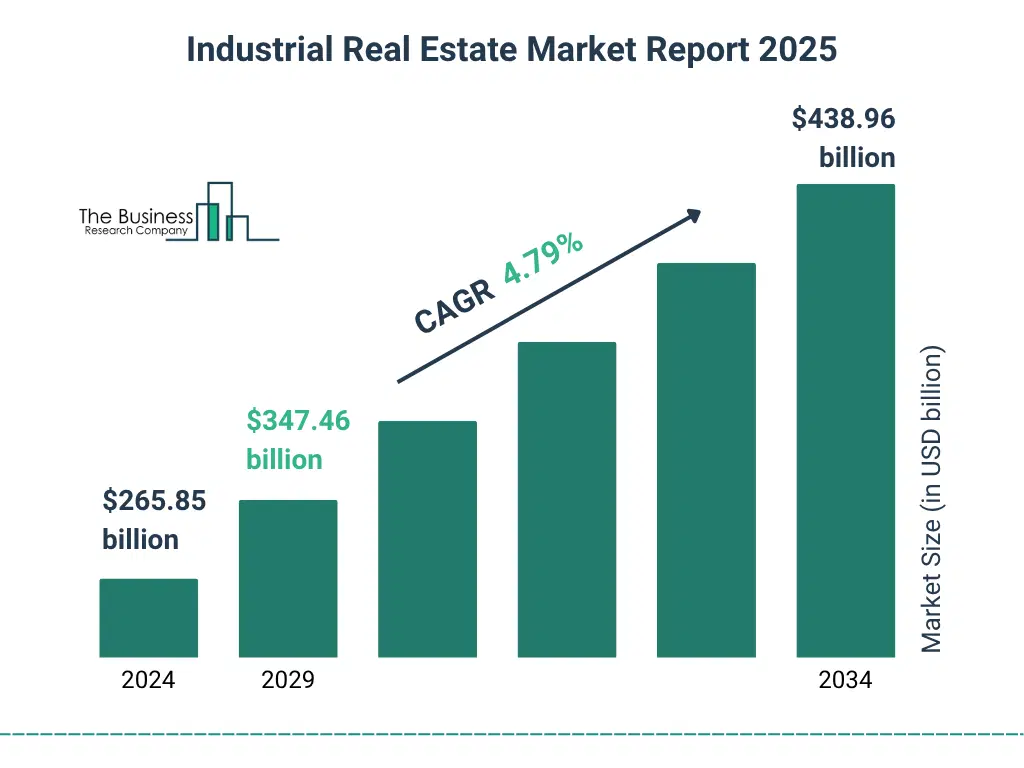
Industrial Real Estate Market Size and growth rate 2025 to 2029: Graph

Industrial Real Estate Market Definition

Industrial real estate refers to properties specifically designed and utilized for industrial purposes, including manufacturing, warehousing, distribution and research and development. These properties are designed to accommodate businesses that require large spaces for production, storage and logistical operations. The industrial real estate market consists of sales, by entities (organizations, sole traders, or partnerships), of industrial real estate that are used for manufacturing processes, assembly lines, storage and transportation hubs. They include large warehouses, distribution centers, production plants and specialized facilities such as data centers and research labs. These properties are often located in industrial parks, logistics hubs and near major transportation routes such as highways, railways, ports and airports to facilitate efficient goods movement.


Research Expert

Book your 30 minutes free consultation with our research experts

Industrial Real Estate Market Size

The global industrial real estate market reached a value of nearly $265,849.57 million in 2024, having grown at a compound annual growth rate (CAGR) of 3.56% since 2019. The market is expected to grow from $265,849.57 million in 2024 to $347,457.70 million in 2029 at a rate of 5.50%. The market is then expected to grow at a CAGR of 4.79% from 2029 and reach $438,958.27 million in 2034. Growth in the historic period resulted from the increasing infrastructure development, increasing construction activities and increased industrialization. Factors that negatively affected growth in the historic period were rising construction material costs and rising energy costs. Going forward, the increasing e-commerce growth, supply chain optimization, cold storage and logistics growth and favorable government support will drive the growth. Factor that could hinder the growth of the industrial real estate market in the future include regulatory zoning and restrictions and interest rate challenges.

Industrial Real Estate Market Drivers

The key drivers of the industrial real estate market include: Increasing E-Commerce Growth During the forecast period, the increasing e-commerce growth is expected to propel the growth of the industrial real estate market. Industrial real estate is essential for the e-commerce industry as it provides warehouses, fulfillment centers and distribution hubs that enable efficient storage, processing and rapid delivery of goods to customers. With the increasing demand for faster shipping and streamlined logistics, strategically located industrial properties help e-commerce businesses optimize supply chains and enhance operational efficiency. For instance, in August 2024, according to the United States Census Bureau, a US-based principal agency of the US-based federal statistical system, in the second quarter of 2024, US retail e-commerce retail sales reached $291.6 billion, marking a 6.7% increase from the same quarter in 2023 and a 1.3% rise from the first quarter of 2024. Therefore, the e-commerce growth will people the growth of the industrial real estate market.

Industrial Real Estate Market Restraints

The key restraints on the industrial real estate market include: Regulatory And Zoning Restrictions Regulatory and zoning restrictions is expected to restrict the growth of the industrial real estate market going forward. Government-imposed land-use regulations, environmental compliance mandates, and zoning ordinances often limit the locations where industrial facilities can be developed. For instance, in January 2025, the Atlanta City Council imposed a ban on new data centers near key urban areas. This decision responds to concerns that the rapid expansion of data centers is consuming valuable land that could be used for housing and other commercial purposes, thereby affecting community development. Therefore, regulatory and zoning restrictions may hinder the growth of the industrial real estate market.

Need data on a specific region in this market?

Opportunities And Recommendations In The Industrial Real Estate Market

Opportunities – The top opportunities in the industrial real estate markets segmented by product will arise in the warehousing segment, which will gain $47,409.19 million of global annual sales by 2029. The top opportunities in the industrial real estate markets segmented by size will arise in the small segment, which will gain $40,505.24 million of global annual sales by 2029. The top opportunities in the industrial real estate markets segmented by application will arise in the manufacturing segment, which will gain $22,673.76 million of global annual sales by 2029. The industrial real estate market size will gain the most in the USA at $16,482.89 million. Recommendations- To take advantage of the opportunities, The Business Research Company recommends the industrial real estate companies to focus on warehousing to capitalize on rapid market growth, expand in emerging markets, continue to focus on developed markets, focus on developing strategic partnerships to expand distribution channels, focus on optimizing pricing strategies for industrial real estate, focus on leveraging digital channels to reach target audiences, focus on building relationships with key stakeholders and focus on targeting key end-user segments in industrial real estate.
Chat with us