
Industrial Robot Battery Market Report 2026
Global Outlook – By Battery Type ( Lithium-Ion Batteries, Nickel-Metal Hydride Batteries, Lead-Acid Batteries, Sodium-Ion Batteries, Other Battery Types), By Robot Type ( Articulated Robots, Selective Compliance Articulated Robot Arm (SCARA) Robots, Delta Robots, Collaborative Robots (Cobots), Mobile Robots ), By Capacity ( Below 1,000 mAh, 1,000 mAh - 5,000 mAh, 5,000 mAh - 10,000 mAh, Above 10,000 mAh), By Application ( Welding, Material Handling, Painting, Palletizing, Inspection And Quality Control), By End-Use Industry ( Manufacturing, Logistics And Warehousing, Automotive, Electronics, Food And Beverage, Healthcare, Aerospace) – Market Size, Trends, Strategies, and Forecast to 2030
Industrial Robot Battery Market Overview
• Industrial Robot Battery market size has reached to $2.58 billion in 2025 • Expected to grow to $4.67 billion in 2030 at a compound annual growth rate (CAGR) of 12.5% • Growth Driver: Rise In Industrial Automation Fueling The Growth Of The Market Due To Increasing Demand For Continuous And Efficient Robotic Operations • Market Trend: Advancements In Fast-Charging And Long-Life Battery Systems Enhancing Industrial Automation • North America was the largest region in 2025 and Asia-Pacific is the fastest growing region.What Is Covered Under Industrial Robot Battery Market?
An industrial robot battery is a specialized power source designed to supply energy to industrial robots, ensuring uninterrupted operation during automated manufacturing processes. These batteries are engineered to deliver high energy density, long cycle life, and resistance to harsh industrial environments. They play a crucial role in maintaining operational efficiency, enabling robots to function autonomously and reliably across production lines. The main battery types in industrial robot battery are lithium-ion batteries, nickel-metal hydride batteries, lead-acid batteries, sodium-ion batteries, and others. Lithium-ion batteries are preferred for their high energy density, fast charging, and long cycle life. It is used in various robot types, such as articulated robots, selective compliance articulated robot arm (SCARA) robots, delta robots, collaborative (Cobots) robots, and mobile robots. Capacity ranges from below 1,000 mAh, 1,000 mAh - 5,000 mAh, 5,000 mAh - 10,000 mAh and above 10,000 mAh. Key applications include welding, material handling, painting, palletizing, and inspection and quality control, serving industries such as manufacturing, logistics and warehousing, automotive, electronics, food and beverage, healthcare, and aerospace.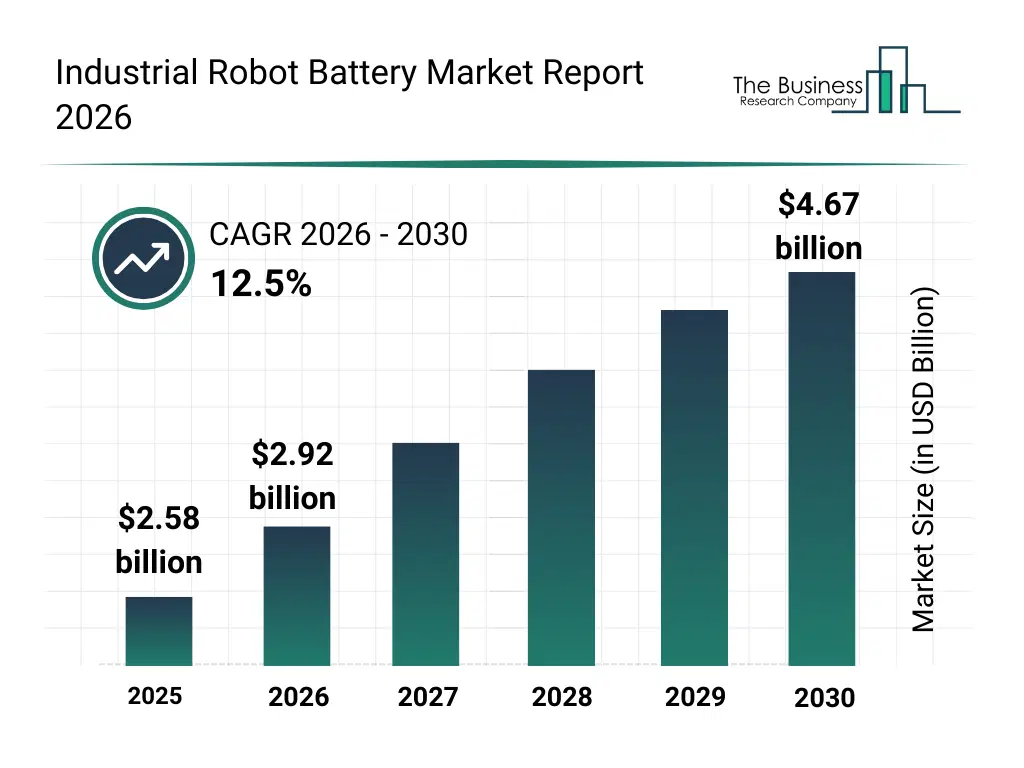
What Is The Industrial Robot Battery Market Size 2026 And Growth Rate?
The industrial robot battery market size has grown rapidly in recent years. It will grow from $2.58 billion in 2025 to $2.92 billion in 2026 at a compound annual growth rate (CAGR) of 12.8%. The growth in the historic period can be attributed to rising adoption of industrial automation, demand for reliable robotic operation, advancements in lithium-ion technology, high energy requirements of robots, need for uninterrupted production.What Is The Industrial Robot Battery Market Growth Forecast?
The industrial robot battery market size is expected to see rapid growth in the next few years. It will grow to $4.67 billion in 2030 at a compound annual growth rate (CAGR) of 12.5%. The growth in the forecast period can be attributed to increasing deployment of collaborative robots (cobots), growth in e-commerce and warehouse automation, expansion of advanced manufacturing facilities, development of solid-state and high-capacity batteries, integration with predictive maintenance and smart factory systems. Major trends in the forecast period include high energy density battery development, long cycle life and durability enhancements, harsh environment resistant battery designs, modular and scalable battery solutions for robots, efficient battery management systems.
Global Industrial Robot Battery Market Segmentation
1) By Battery Type: Lithium-Ion Batteries, Nickel-Metal Hydride Batteries, Lead-Acid Batteries, Sodium-Ion Batteries, Other Battery Types 2) By Robot Type: Articulated Robots, Selective Compliance Articulated Robot Arm (SCARA) Robots, Delta Robots, Collaborative Robots (Cobots), Mobile Robots 3) By Capacity: Below 1,000 mAh, 1,000 mAh - 5,000 mAh, 5,000 mAh - 10,000 mAh, Above 10,000 mAh 4) By Application: Welding, Material Handling, Painting, Palletizing, Inspection And Quality Control 5) By End-Use Industry: Manufacturing, Logistics And Warehousing, Automotive, Electronics, Food And Beverage, Healthcare, Aerospace Subsegments: 1) By Lithium-Ion Batteries: Nickel Manganese Cobalt (NMC), Lithium Iron Phosphate (LFP Or LiFePO4), Nickel Cobalt Aluminum (NCA), Lithium Titanate Oxide (LTO), High-Energy Cells, High-Power Cells, Cylindrical Cells, Prismatic Cells, Pouch Cells, Module-Level (Pack) Configurations 2) By Nickel-Metal Hydride Batteries (NiMH): Standard (AA Or AAA style) Cylindrical Cells, Prismatic Industrial Cells, High-Capacity NiMH, Low-Self-Discharge NiMH, Hybrid Or Rapid-Charge NiMH, Module Or Pack Assemblies 3) By Lead-Acid Batteries: Flooded (Wet) Lead-Acid, Valve Regulated Lead-Acid (VRLA), Absorbent Glass Mat (AGM), Gel Lead-Acid, Enhanced Flooded Battery (EFB), Tubular Or OpzS Deep-Cycle, Starter Batteries, Deep-Cycle Industrial Packs 4) By Sodium-Ion Batteries: Layered-Oxide Cathode Sodium-Ion, Polyanionic (NASICON-Type) Sodium-Ion, Prussian-Blue Analogue Cathode, Aqueous Sodium-Ion, Solid-State Sodium-Ion, Cylindrical Or Prismatic Or Pouch Formats, Cell-Level And Pack-Level Configurations 5) By Other Battery Types: Lithium-Sulfur (Li-S), Solid-State Batteries, Flow Batteries, Zinc-ion Or Zinc-Air, Aluminum-Ion, Metal-Air, Supercapacitors Or Ultracapacitors, Fuel-Cell (Hydrogen) Hybrid ModulesWhat Is The Driver Of The Industrial Robot Battery Market?
The rise in industrial automation is expected to propel the growth of the industrial robot battery market going forward. Industrial automation is the use of control systems, robots, and information technologies to operate machinery and processes in manufacturing and other industries with minimal human intervention. Industrial automation is increasing due to the growing need for higher productivity and operational efficiency in manufacturing processes. Industrial robot batteries are used in industrial automation to provide reliable, uninterrupted power for robotic systems, enabling continuous and efficient operation without dependence on fixed power sources. For instance, in September 2024, according to the International Federation of Robotics (IFR), a Germany-based non-profit organization, industrial robot installations in the UK rose by 51%, reaching 3,830 units, while in the Americas, over 50,000 units were installed for the third consecutive year, totaling 55,389 units in 2023. Therefore, the rise in industrial automation is driving the growth of the industrial robot battery industry.Key Players In The Global Industrial Robot Battery Market
Major companies operating in the industrial robot battery market are TotalEnergies SE, Tesla Inc., BYD Company Limited, Hitachi Ltd., Panasonic Holdings Corporation, Contemporary Amperex Technology Co. Limited (CATL), LG Chem Ltd., ABB Ltd., Samsung SDI Co. Ltd., Wanxiang Group Corporation, FANUC Corporation, Yaskawa Electric Corporation, Exide Technologies LLC, Stäubli International AG, VARTA AG, Ultralife Corporation, Hangzhou Iplusmobot Technology Co. Ltd., Bentork Motion Systems Co. Ltd., Artek Energy Solutions Pvt. Ltd.
This chart is for illustrative purposes; the full report includes a detailed competitor analysis and comprehensive overview of the top 10 companies in the market.
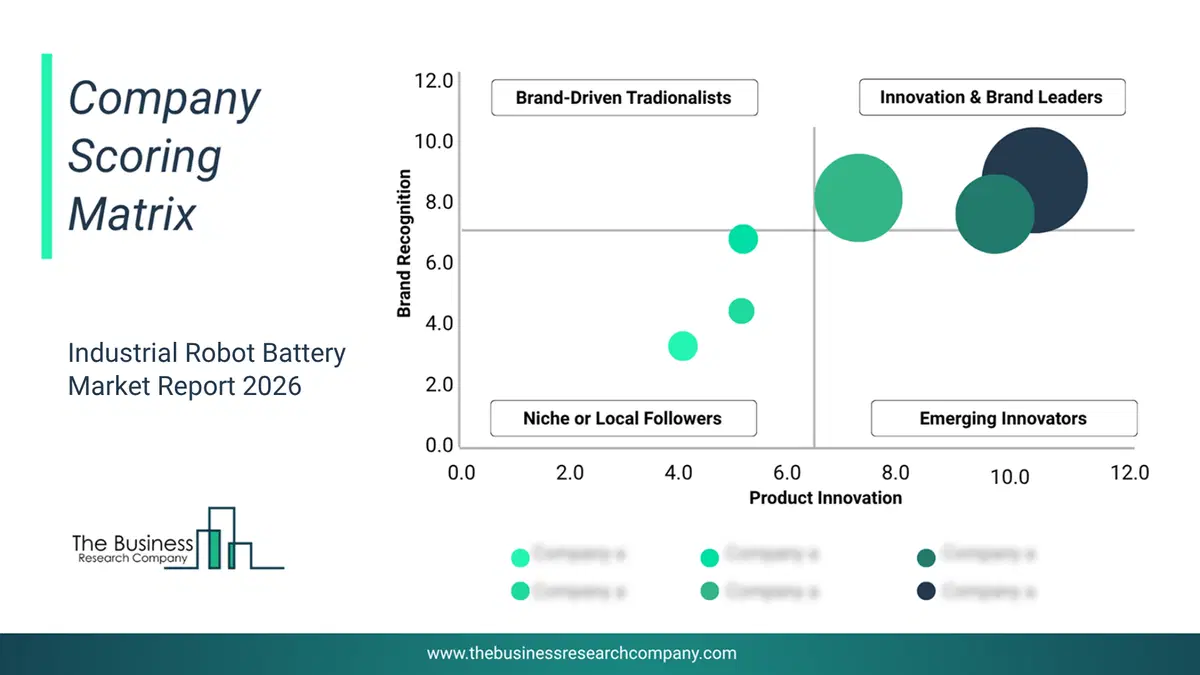
This chart maps companies by product innovation and brand strength, with bubble size indicating relative revenue, helping identify market leaders, challengers, and niche players. This is an illustrative chart; the full report provides a complete and accurate competitive analysis.
Global Industrial Robot Battery Market Trends and Insights
Major companies operating in the industrial robot battery market are focusing on introducing advanced and customized battery systems with longer life, faster charging, and higher energy efficiency to support continuous robotic operations and cater to the increasing demand for automation across industrial sectors. A fast-charging battery system enables batteries to regain power quickly by optimizing energy transfer and minimizing charging time without compromising safety or performance. For instance, in July 2025, Electrovaya Inc., a Canada-based battery technology company, launched multiple battery system products for new robotic vehicle platforms developed with three leading OEMs, two in the U.S. and one in Japan. These advanced battery systems are designed for applications such as material handling and surveillance, offering long run times, extended life cycles, and rapid wireless charging for 24/7 operation. This reflects Electrovaya’s strategic focus on the growing robotics market, leveraging its expertise in battery safety, durability, and performance. Initial deliveries begin in 2025, with commercial expansion expected in the financial year 2026, aligning with rising AI-driven automation demand.What Are Latest Mergers And Acquisitions In The Industrial Robot Battery Market?
In February 2025, HyundAI Motor Company, a South Korea-based automotive manufacturing company, and Kia Corporation, a South Korea-based automotive manufacturing company, partnered with Samsung SDI Co. Ltd. to jointly develop next-generation, high-performance robot batteries aimed at significantly enhancing the energy density, power output, and operational duration of service robots. This collaboration focuses on leveraging Samsung SDI’s expertise in advanced lithium-ion battery technology to create compact, durable, and high-efficiency power solutions optimized for robotic applications. Samsung SDI Co. Ltd. is a South Korea-based battery manufacturing company that specializes in manufacturing advanced lithium-ion batteries and energy storage solutions for industrial robots.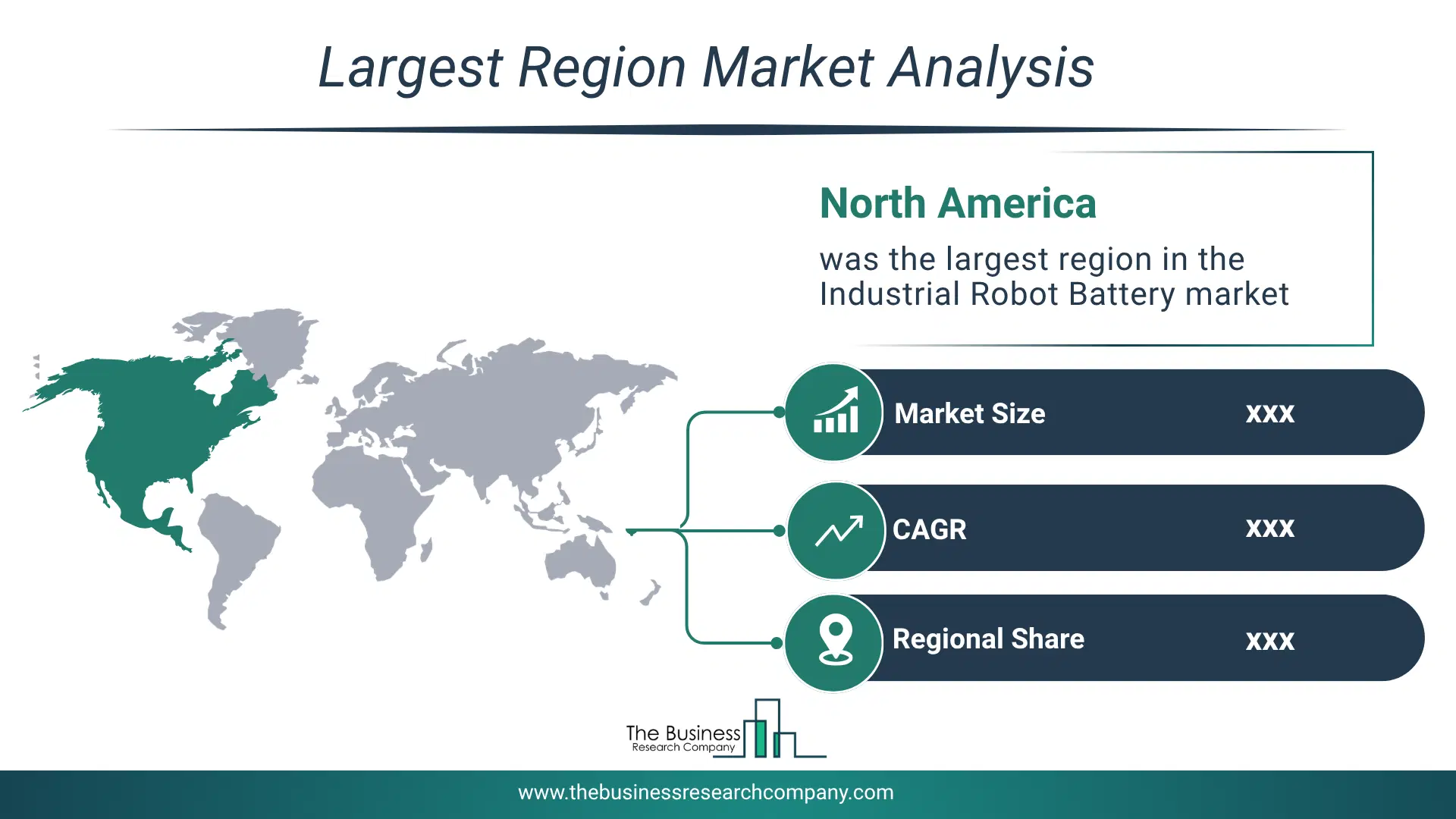
Regional Outlook
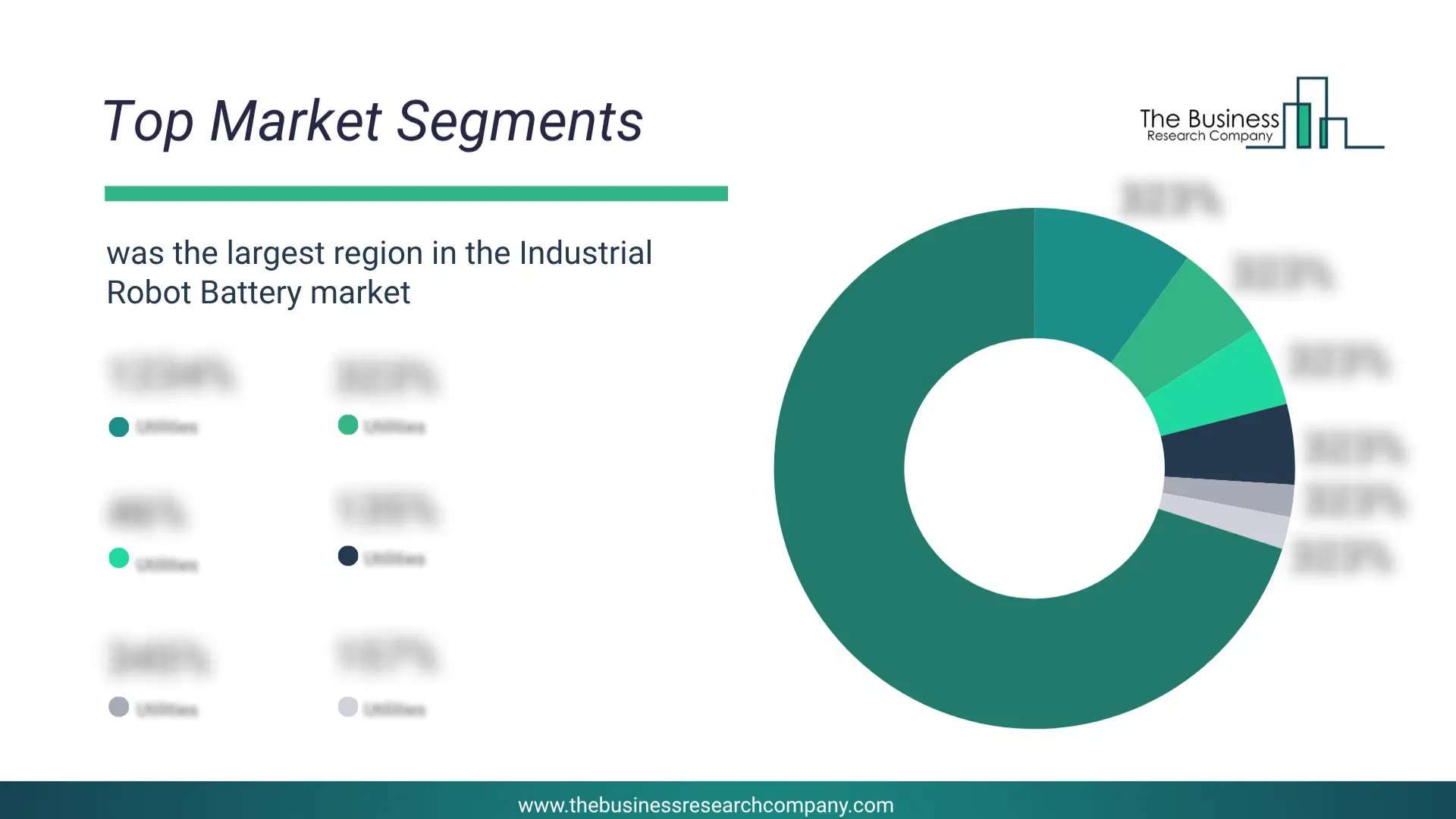
North America was the largest region in the industrial robot battery market in 2025. Asia-Pacific is expected to be the fastest-growing region in the forecast period. The regions covered in this market report are Asia-Pacific, South East Asia, Western Europe, Eastern Europe, North America, South America, Middle East, Africa. The countries covered in this market report are Australia, Brazil, China, France, Germany, India, Indonesia, Japan, Taiwan, Russia, South Korea, UK, USA, Canada, Italy, Spain.What Defines the Industrial Robot Battery Market?
The industrial robot battery market consists of sales of battery packs, battery modules, battery management systems (BMS), chargers, power control units, and battery monitoring devices. Values in this market are ‘factory gate’ values, that is, the value of goods sold by the manufacturers or creators of the goods, whether to other entities (including downstream manufacturers, wholesalers, distributors, and retailers) or directly to end customers. The value of goods in this market includes related services sold by the creators of the goods.How is Market Value Defined and Measured?
The market value is defined as the revenues that enterprises gain from the sale of goods and/or services within the specified market and geography through sales, grants, or donations in terms of the currency (in USD unless otherwise specified). The revenues for a specified geography are consumption values that are revenues generated by organizations in the specified geography within the market, irrespective of where they are produced. It does not include revenues from resales along the supply chain, either further along the supply chain or as part of other products.
This chart presents market attractiveness based on a quantitative evaluation of growth, competition, strategic alignment, and risk, offering a clear view of opportunity areas for decision-making. This chart is for illustrative purposes; the full report contains the complete analysis.

This chart highlights the Total Addressable Market (TAM) by estimating the maximum revenue opportunity using an assumption-driven approach, supporting strategic planning and opportunity sizing across markets. The chart is illustrative; the full report provides a more comprehensive analysis.
What Key Data and Analysis Are Included in the Industrial Robot Battery Market Report 2026?
The industrial robot battery market research report is one of a series of new reports from The Business Research Company that provides market statistics, including industry global market size, regional shares, competitors with the market share, detailed market segments, market trends and opportunities, and any further data you may need to thrive in the industrial robot battery industry. The market research report delivers a complete perspective of everything you need, with an in-depth analysis of the current and future state of the industry.Industrial Robot Battery Market Report Forecast Analysis
| Report Attribute | Details |
|---|---|
| Market Size Value In 2026 | $2.92 billion |
| Revenue Forecast In 2030 | $4.67 billion |
| Growth Rate | CAGR of 12.5% from 2026 to 2030 |
| Base Year For Estimation | 2025 |
| Actual Estimates/Historical Data | 2020-2025 |
| Forecast Period | 2026 - 2030 |
| Market Representation | Revenue in USD Billion and CAGR from 2026 to 2030 |
| Segments Covered | Battery Type, Robot Type, Capacity, Application, End-Use Industry |
| Regional Scope | Asia-Pacific, Western Europe, Eastern Europe, North America, South America, Middle East, Africa |
| Country Scope | The countries covered in the report are Australia, Brazil, China, France, Germany, India, Indonesia, Japan, Taiwan, Russia, South Korea, UK, USA, Canada, Italy, Spain. |
| Key Companies Profiled | TotalEnergies SE, Tesla Inc., BYD Company Limited, Hitachi Ltd., Panasonic Holdings Corporation, Contemporary Amperex Technology Co. Limited (CATL), LG Chem Ltd., ABB Ltd., Samsung SDI Co. Ltd., Wanxiang Group Corporation, FANUC Corporation, Yaskawa Electric Corporation, Exide Technologies LLC, Stäubli International AG, VARTA AG, Ultralife Corporation, Hangzhou Iplusmobot Technology Co. Ltd., Bentork Motion Systems Co. Ltd., Artek Energy Solutions Pvt. Ltd. |
| Customization Scope | Request for Customization |
| Pricing And Purchase Options | Explore Purchase Options |