
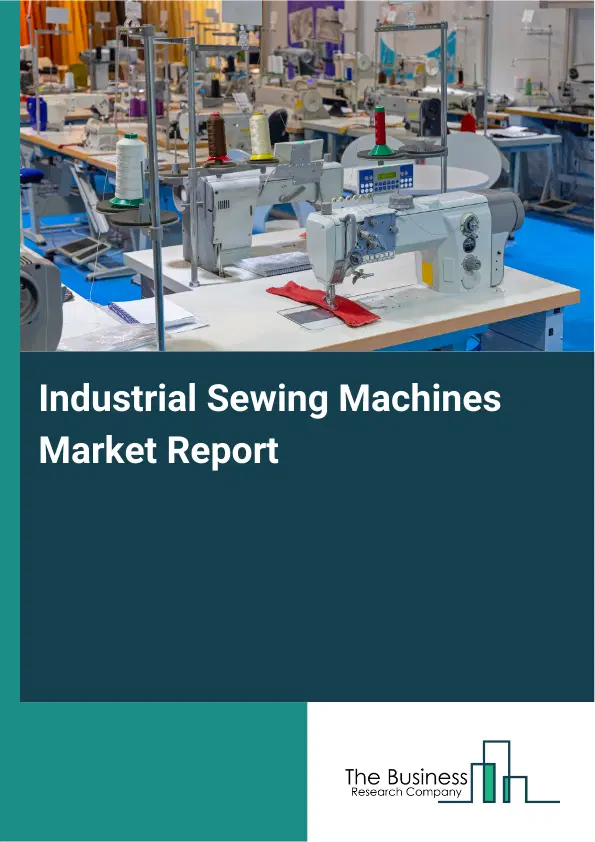
Industrial Sewing Machines Market Report 2026
Global Outlook – By Product (Flat Bed Sewing Machine, Cylinder Bed Sewing Machine, Post Bed Sewing Machines, Long Arm Sewing Machine, Other Products), By Operation (Manual Sewing Machine, Automatic Sewing Machine, Computer Controlled Sewing Machine), By Sales Channel (Direct Channel, Indirect Channel), By Application (Apparel, Non-Apparel) – Market Size, Trends, Strategies, and Forecast to 2030
Industrial Sewing Machines Market Overview
• Industrial Sewing Machines market size has reached to $3.66 billion in 2025 • Expected to grow to $4.64 billion in 2030 at a compound annual growth rate (CAGR) of 4.8% • Growth Driver: Rising Apparel Demand Drives Growth In Industrial Sewing Machines Market • Market Trend: Innovative Artificial Intelligence-Powered Overlock Machines Enhance Precision, Speed And Fabric Handling • Asia-Pacific was the largest region in 2025.What Is Covered Under Industrial Sewing Machines Market?
Industrial sewing machines refer to heavy-duty machines designed for high-volume sewing tasks in manufacturing and production settings. They offer greater speed, durability, and specialized features compared to domestic sewing machines, making them ideal for industries such as apparel, automotive, and upholstery. These machines are built to handle continuous operation and sew through thick or multiple layers of material. The main products in industrial sewing machines are flat bed sewing machine, cylinder bed sewing machine, post bed sewing machine, long arm sewing machine, and others. A flat bed sewing machine is a versatile sewing machine with a flat working surface that allows for easy handling and stitching of a wide range of fabrics and garment types, which are commonly used in general sewing tasks and garment construction. These machines are categorized by operation into manual, automatic, and computer-controlled sewing machines. Sales occur through both direct and indirect channels, and they are used in various applications, such as apparel and non-apparel.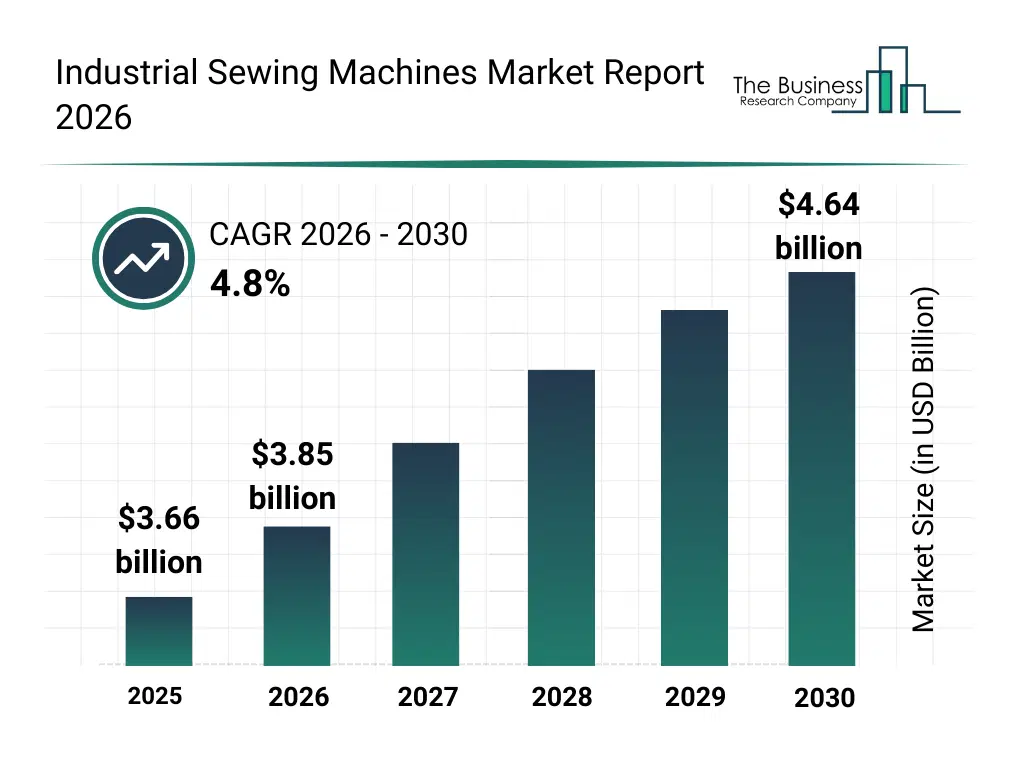
What Is The Industrial Sewing Machines Market Size and Share 2026?
The industrial sewing machines market size has grown strongly in recent years. It will grow from $3.66 billion in 2025 to $3.85 billion in 2026 at a compound annual growth rate (CAGR) of 5.1%. The growth in the historic period can be attributed to growth of apparel manufacturing, expansion of textile exports, demand for mass production sewing, industrialization of garment units, rise in upholstery production.What Is The Industrial Sewing Machines Market Growth Forecast?
The industrial sewing machines market size is expected to see steady growth in the next few years. It will grow to $4.64 billion in 2030 at a compound annual growth rate (CAGR) of 4.8%. The growth in the forecast period can be attributed to automation in textile manufacturing, demand for customized apparel, growth of automotive upholstery, investment in smart factories, labor productivity improvement. Major trends in the forecast period include growing demand for high speed sewing machines, increasing adoption of computer controlled sewing systems, expansion of automated garment production lines, rising use of specialized sewing machines, focus on consistent stitching quality.Tariff Impact On Industrial Sewing Machines Market
Tariffs have increased costs of motors, electronic controls, and metal components used in industrial sewing machines. Asia pacific manufacturing hubs are most impacted. Automatic sewing machines face higher cost pressure. At the same time, tariffs are encouraging regional sourcing and localized machine assembly.
Global Industrial Sewing Machines Market Segmentation
1) By Product: Flat Bed Sewing Machine, Cylinder Bed Sewing Machine, Post Bed Sewing Machines, Long Arm Sewing Machine, Other Products 2) By Operation: Manual Sewing Machine, Automatic Sewing Machine, Computer Controlled Sewing Machine 3) By Sales Channel: Direct Channel, Indirect Channel 4) By Application: Apparel, Non-Apparel Subsegments: 1) By Flat Bed Sewing Machine: Single-Needle Flat Bed Sewing Machines, Multi-Needle Flat Bed Sewing Machines 2) By Cylinder Bed Sewing Machine: Single-Needle Cylinder Bed Sewing Machines, Multi-Needle Cylinder Bed Sewing Machines 3) By Post Bed Sewing Machines: Single-Needle Post Bed Sewing Machines, Multi-Needle Post Bed Sewing Machines 4) By Long Arm Sewing Machine: Quilting Long Arm Sewing Machines, Heavy-Duty Long Arm Sewing Machines 5) By Other Products: Overlock Sewing Machines, Blind Stitch Sewing Machines, Chain Stitch Sewing Machines, Embroidery Sewing MachinesWhat Is The Driver Of The Industrial Sewing Machines Market?
The growing demand for apparel products is expected to propel the growth of the industrial sewing machines market going forward. Apparel products refer to clothing items and accessories designed for wear, including garments such as shirts, pants, dresses, and outerwear, as well as related accessories such as hats, belts, and scarves. The rising demand for apparel products is fueled by evolving fashion trends, higher disposable incomes, greater online shopping ease, global market expansion, and a growing emphasis on personalized and eco-friendly fashion. Industrial sewing machines are used in apparel manufacturing to efficiently produce high-quality, durable garments through rapid and precise stitching. For instance, in May 2024, according to the Australia Institute, an Australia-based independent think tank, Australia has overtaken the United States as the largest consumer of textiles per capita in the world. On average, Australians purchase 56 new clothing items annually, exceeding the US at 53 items, the UK at 33, and China at 30. Therefore, the growing demand for apparel products is driving the growth of the industrial sewing machines industry.Key Players In The Global Industrial Sewing Machines Market
Major companies operating in the industrial sewing machines market are Brother Industries, JUKI Corporation, Pegasus Sewing Machine Mfg, Yamato Sewing Machine Mfg, Seiko Sewing Machine, Mitsubishi Electric, Jack Sewing Machine, Typical Sewing Equipment, Zoje Sewing Machine, SunStar Machinery, Kansai Special, Durkopp Adler, Pfaff Industrial, Bernina International, Toyota Industries, Siruba Sewing Machine, Tajima Industries, Highlead Sewing Machine, Feiyue Sewing Machine, Maqi Sewing Machine, ZSK Stickmaschinen, Richpeace
This chart is for illustrative purposes; the full report includes a detailed competitor analysis and comprehensive overview of the top 10 companies in the market.
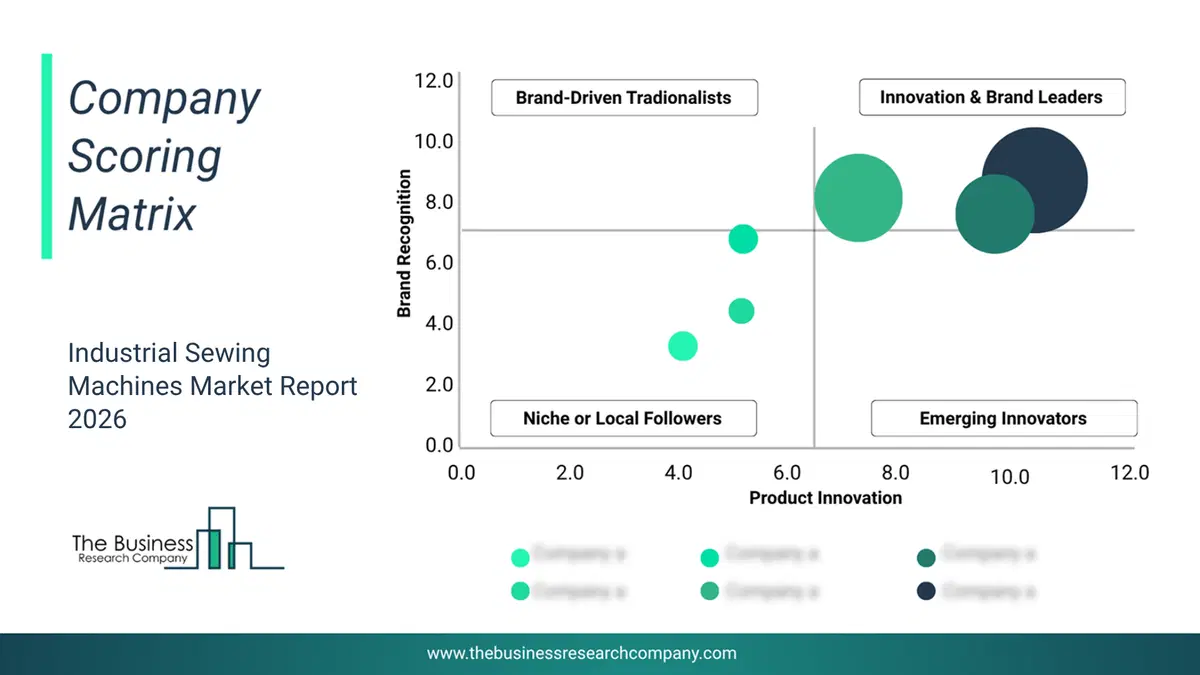
This chart maps companies by product innovation and brand strength, with bubble size indicating relative revenue, helping identify market leaders, challengers, and niche players. This is an illustrative chart; the full report provides a complete and accurate competitive analysis.
Global Industrial Sewing Machines Market Trends and Insights
Major companies operating in the industrial sewing machine market are focusing on developing innovative products, such as next-generation artificial intelligence (AI)-powered overlock sewing machines, to sustain their position in the market. Next-generation AI-powered overlock sewing machines use advanced artificial intelligence to enhance stitching precision, automate adjustments, and optimize fabric handling for superior sewing efficiency and quality. For instance, in June 2024, Jack Technology Co. Ltd., a China-based industrial sewing machine company, launched URUS for the sewing industry. This features an AI full-speed feeding system and a super brain with a million-level pressure-to-feed ratio model library, enabling it to handle diverse fabrics with precision and maintain high speeds. Its presser foot transformer and smart rhino feeding technologies provide rapid adjustments to fabric thickness and accurate power distribution, enhancing performance and addressing common issues in traditional overlock machines.What Are Latest Mergers And Acquisitions In The Industrial Sewing Machines Market?
In November 2025, Brother Internationale Industriemaschinen GmbH, a Germany-based industrial machinery company, acquired Konrad Busche GmbH & Co. KG, for an undisclosed amount. With this acquisition, Brother Internationale Industriemaschinen GmbH aims to strengthen its manufacturing and automation capabilities in the textile sector by integrating Konrad Busche’s advanced industrial sewing machine technologies to improve production efficiency, precision, and scalability. Konrad Busche GmbH & Co. KG is a Germany-based company that specializes in industrial sewing machines for textile and apparel manufacturing.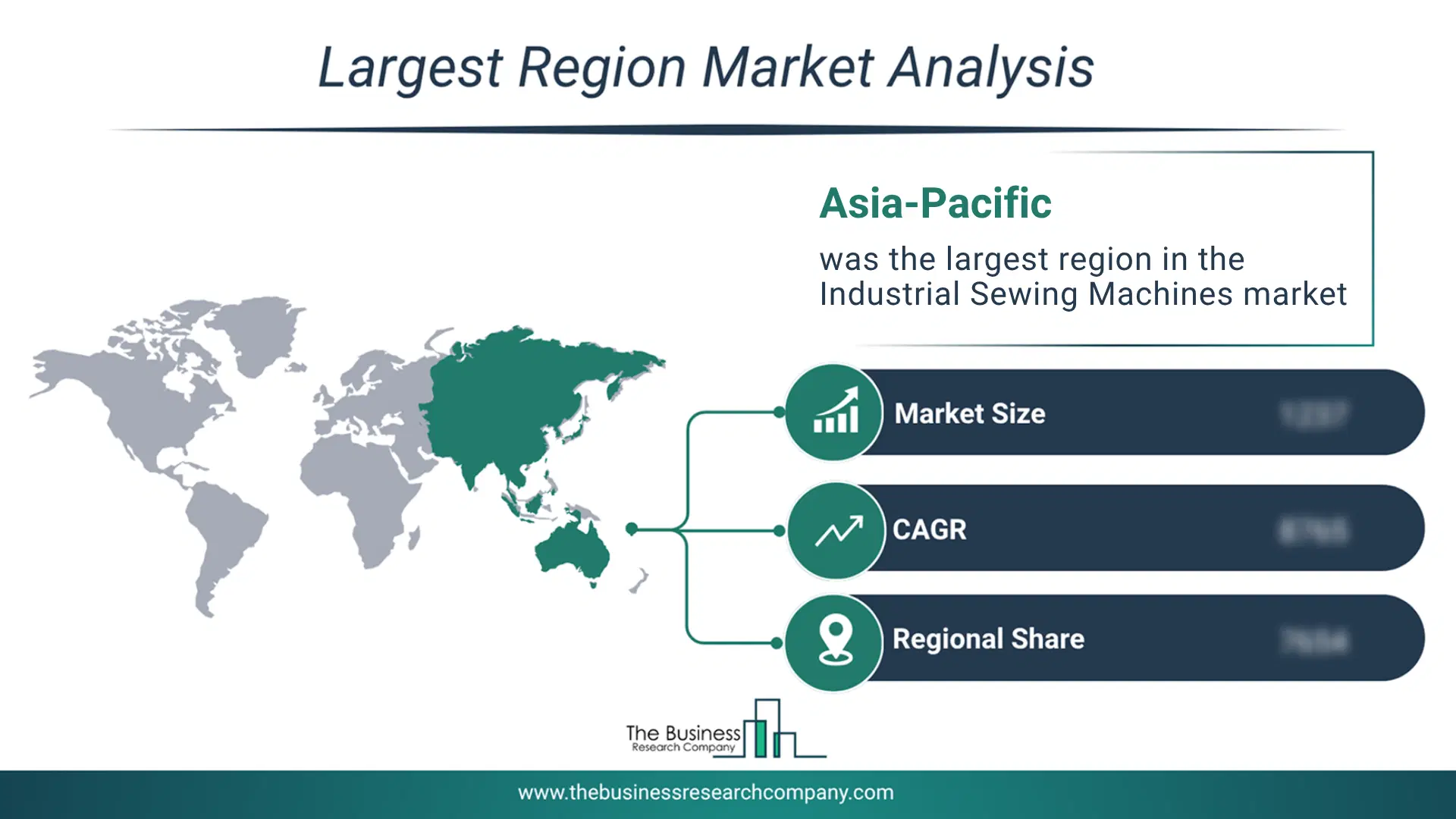
Regional Outlook
Asia-Pacific was the largest region in the industrial sewing machines market in 2025. The regions covered in this market report are Asia-Pacific, South East Asia, Western Europe, Eastern Europe, North America, South America, Middle East, Africa The countries covered in this market report are Australia, Brazil, China, France, Germany, India, Indonesia, Japan, Taiwan, Russia, South Korea, UK, USA, Canada, Italy, Spain.What Defines the Industrial Sewing Machines Market?
The industrial sewing machines market consists of sales of overlock sewing machines, blind stitch sewing machines, bar tack sewing machines, and buttonhole sewing machines. Values in this market are ‘factory gate’ values, that is, the value of goods sold by the manufacturers or creators of the goods, whether to other entities (including downstream manufacturers, wholesalers, distributors, and retailers) or directly to end customers. The value of goods in this market includes related services sold by the creators of the goods.How is Market Value Defined and Measured?
The market value is defined as the revenues that enterprises gain from the sale of goods and/or services within the specified market and geography through sales, grants, or donations in terms of the currency (in USD unless otherwise specified). The revenues for a specified geography are consumption values that are revenues generated by organizations in the specified geography within the market, irrespective of where they are produced. It does not include revenues from resales along the supply chain, either further along the supply chain or as part of other products.
This chart presents market attractiveness based on a quantitative evaluation of growth, competition, strategic alignment, and risk, offering a clear view of opportunity areas for decision-making. This chart is for illustrative purposes; the full report contains the complete analysis.

This chart highlights the Total Addressable Market (TAM) by estimating the maximum revenue opportunity using an assumption-driven approach, supporting strategic planning and opportunity sizing across markets. The chart is illustrative; the full report provides a more comprehensive analysis.
What Key Data and Analysis Are Included in the Industrial Sewing Machines Market Report 2026?
The industrial sewing machines market research report is one of a series of new reports from The Business Research Company that provides market statistics, including industry global market size, regional shares, competitors with the market share, detailed market segments, market trends and opportunities, and any further data you may need to thrive in the industrial sewing machines industry. The market research report delivers a complete perspective of everything you need, with an in-depth analysis of the current and future state of the industry.Industrial Sewing Machines Market Report Forecast Analysis
| Report Attribute | Details |
|---|---|
| Market Size Value In 2026 | $3.85 billion |
| Revenue Forecast In 2030 | $4.64 billion |
| Growth Rate | CAGR of 4.8% from 2026 to 2030 |
| Base Year For Estimation | 2025 |
| Actual Estimates/Historical Data | 2020-2025 |
| Forecast Period | 2026 - 2030 |
| Market Representation | Revenue in USD Billion and CAGR from 2026 to 2030 |
| Segments Covered | Product, Operation, Sales Channel, Application |
| Regional Scope | Asia-Pacific, Western Europe, Eastern Europe, North America, South America, Middle East, Africa |
| Key Companies Profiled | Brother Industries, JUKI Corporation, Pegasus Sewing Machine Mfg, Yamato Sewing Machine Mfg, Seiko Sewing Machine, Mitsubishi Electric, Jack Sewing Machine, Typical Sewing Equipment, Zoje Sewing Machine, SunStar Machinery, Kansai Special, Durkopp Adler, Pfaff Industrial, Bernina International, Toyota Industries, Siruba Sewing Machine, Tajima Industries, Highlead Sewing Machine, Feiyue Sewing Machine, Maqi Sewing Machine, ZSK Stickmaschinen, Richpeace |
| Customization Scope | Request for Customization |
| Pricing And Purchase Options | Explore Purchase Options |