
Industrial Truck Market Report 2026
Global Outlook – By Type (Pallet Truck, Lifting Truck, Forklift Truck, Platform Truck, Other Types), By Power (Fuel Operated, Electric Operated), By Application (Logistics Application, Manufacturing And Production Applications, Aviation And Airport Handling Applications), By End-Use Industry (Aviation Industry, Manufacturing Industry, Transport And Shipping Industry ) – Market Size, Trends, Strategies, and Forecast to 2030
Industrial Truck Market Overview
• Industrial Truck market size has reached to $26.39 billion in 2025 • Expected to grow to $33.45 billion in 2030 at a compound annual growth rate (CAGR) of 5% • Growth Driver: Automation Driving Force Behind The Industrial Truck Market Growth • Market Trend: Hydrogen And High-Voltage Electrification Drive Next-Generation Industrial Truck Innovation • Asia-Pacific was the largest region in 2025.What Is Covered Under Industrial Truck Market?
Industrial trucks are specialized goods carriers that are designed to carry materials within a factory. It is specially made for extra flexibility in movement across the factory. These trucks use mechanized pickup and de-loading. The main types of industrial trucks are pallet truck, lifting truck, forklift truck, platform truck and others. A pallet truck is a type of truck specially designed to transport pallets that are used in the warehousing of goods. These trucks are fuel and electric operated and are used for various applications including mining, logistics, construction and others by aviation industry, construction industry, manufacturing industry and transport and shipping industry.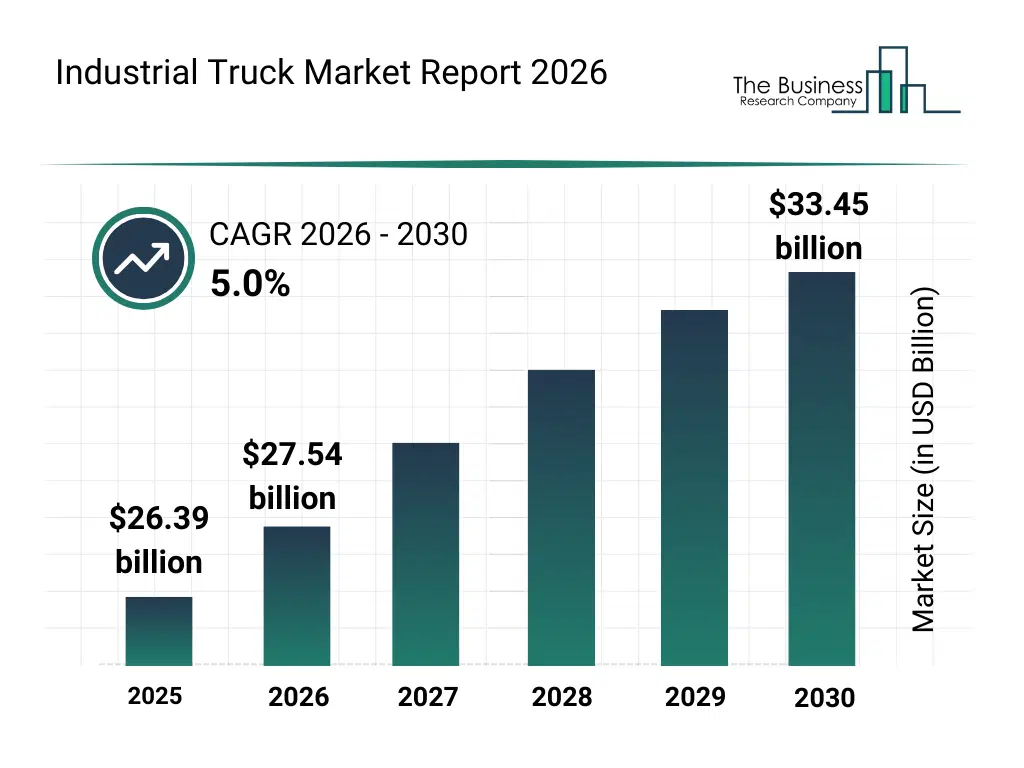
What Is The Industrial Truck Market Size and Share 2026?
The industrial truck market size has grown steadily in recent years. It will grow from $26.39 billion in 2025 to $27.54 billion in 2026 at a compound annual growth rate (CAGR) of 4.3%. The growth in the historic period can be attributed to growth of manufacturing facilities, expansion of warehouse infrastructure, demand for efficient material handling, industrialization in emerging economies, reliance on fuel operated trucks.What Is The Industrial Truck Market Growth Forecast?
The industrial truck market size is expected to see steady growth in the next few years. It will grow to $33.45 billion in 2030 at a compound annual growth rate (CAGR) of 5.0%. The growth in the forecast period can be attributed to growth of e commerce logistics, adoption of autonomous material handling, investments in smart factories, stricter emission regulations, rising demand for electric industrial vehicles. Major trends in the forecast period include rising adoption of electric industrial trucks, integration of automation in material handling, growing demand for warehouse optimization, expansion of industrial trucks in logistics, focus on energy efficient material transport.
Global Industrial Truck Market Segmentation
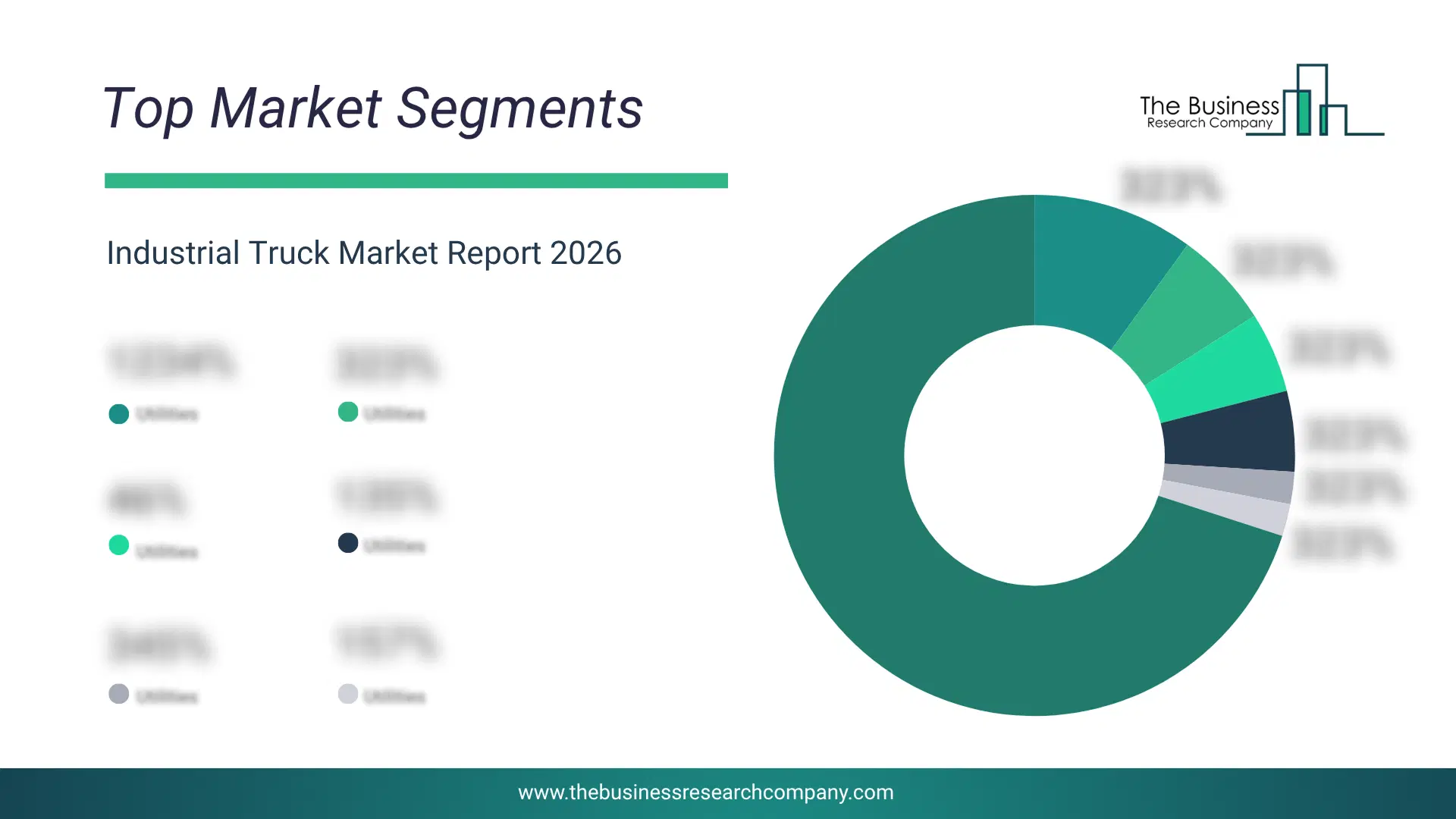
1) By Type: Pallet Truck, Lifting Truck, Forklift Truck, Platform Truck, Other Types 2) By Power: Fuel Operated, Electric Operated 3) By Application: Logistics Application, Manufacturing And Production Applications, Aviation And Airport Handling Applications 4) By End-Use Industry: Aviation Industry, Manufacturing Industry, Transport And Shipping Industry Subsegments: 1) By Pallet Truck: Manual Pallet Truck, Electric Pallet Truck 2) By Lifting Truck: Electric Lifting Truck, Manual Lifting Truck 3) By Forklift Truck: Counterbalance Forklift, Reach Truck, Order Picker, Stackers 4) By Platform Truck, Manual Platform Truck, Electric Platform Truck 5) By Other Types: Tow Tractor, Side Loader, Rough Terrain ForkliftWhat Is The Driver Of The Industrial Truck Market?
The increasing adoption of automation is expected to propel the growth of the industrial truck market in the coming years. Automation is the use of technology to do activities with minimum human input, eliminating the need for manual involvement in different operations, and includes a broad range of technologies and applications, including cybersecurity, process measurement and control, sensors, wireless applications, robotics, expert systems, telemetry, communications, electro-optics, and systems integration. Automation in industrial trucks can serve to relieve people of hazardous job stressors and occupational injuries, raise productivity and efficiency, and boost automobile manufacturing efficiency and speed. For instance, in October 2023, according to Cavintek Inc., a US-based firm that offers productivity software and workflow automation, nearly 80% of company leaders reported growing productivity automation and the use of remote workers. 43% of organizations plan to reduce their workforce by implementing automation technology solutions. Therefore, the increasing adoption of automation is driving the industrial truck industry.Key Players In The Global Industrial Truck Market
Major companies operating in the industrial truck market report include Combilift Material Handling Solutions, Doosan Corporation, Crown Controls Corp., Caterpillar Inc, Kion Group AG, Mitsubishi Nichiyu Forklift Co Ltd, Clark Material Handling Co Ltd, Hangcha Group Co Ltd, Anhui Heli Co Ltd, Hyster-Yale Materials Handling Inc, Jungheinrich AG, Komatsu Ltd, Dearborn Mid-West Company LLC, UniCarriers Americas Corporation, Lonking Forklift Company Ltd, HD Hyundai Co Ltd, Nissan Forklift Corp, TCM Limited, Kawasaki Heavy Industries Ltd, Toyota Industries Corporation, Manitou Group, Linde Material Handling GmbH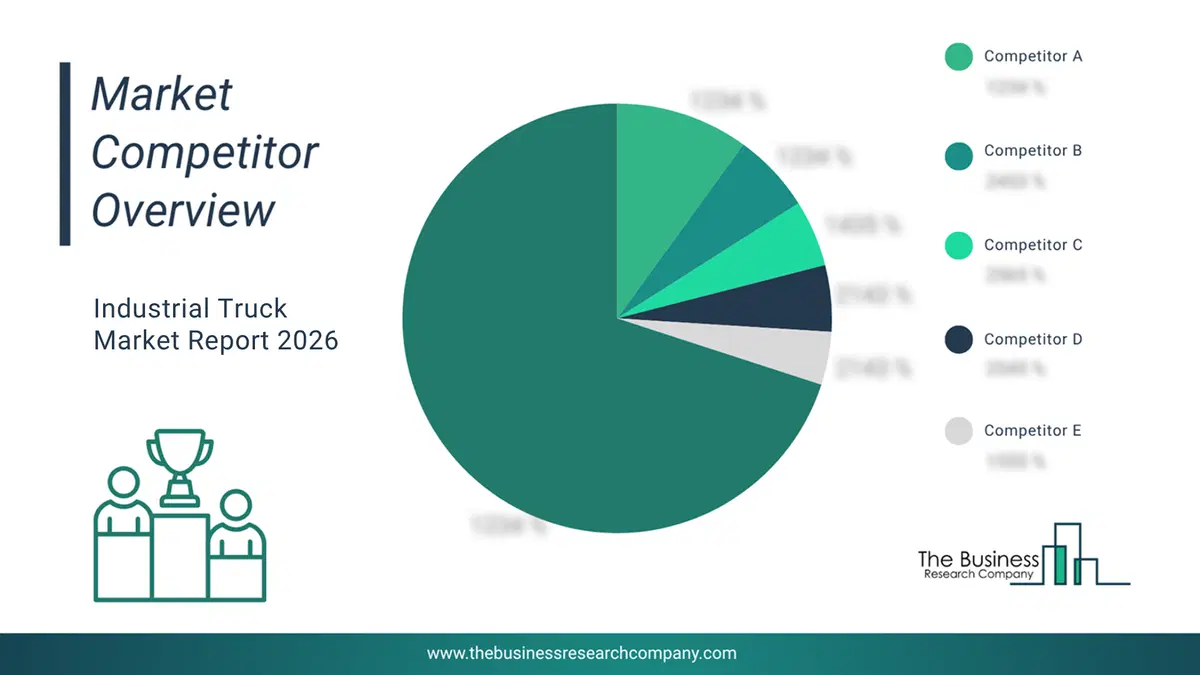
This chart is for illustrative purposes; the full report includes a detailed competitor analysis and comprehensive overview of the top 10 companies in the market.
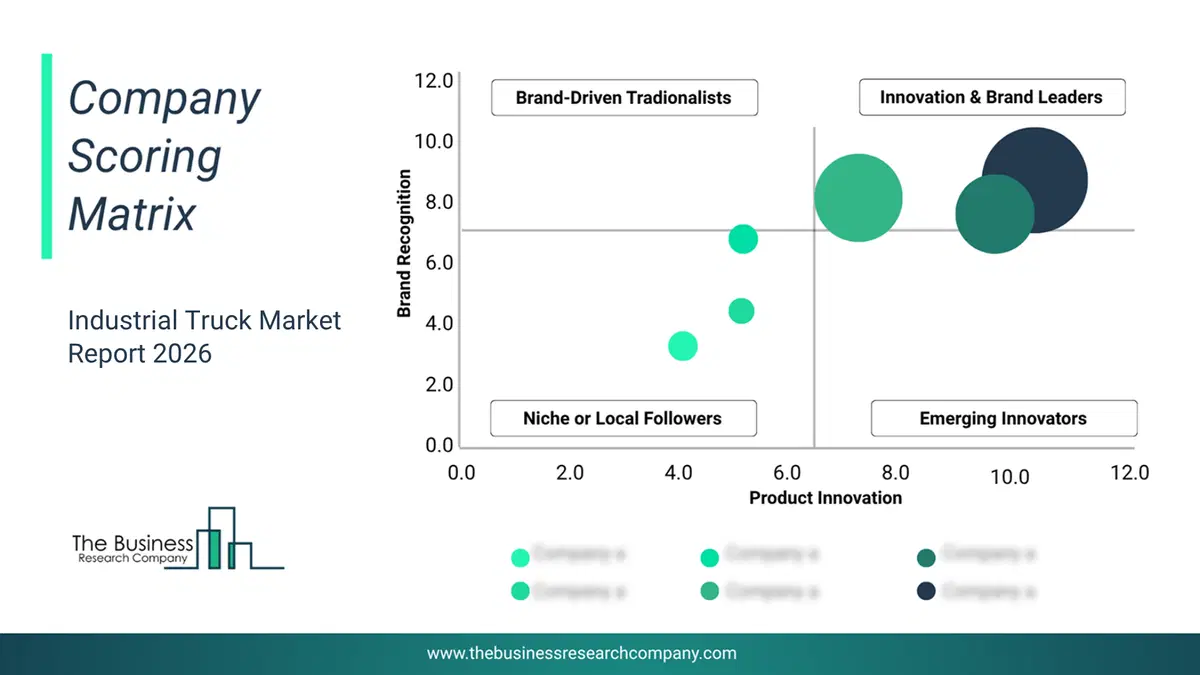
This chart maps companies by product innovation and brand strength, with bubble size indicating relative revenue, helping identify market leaders, challengers, and niche players. This is an illustrative chart; the full report provides a complete and accurate competitive analysis.
Global Industrial Truck Market Trends and Insights
Major companies operating in the industrial truck market are focusing on developing innovative products, such as hydrogen fuel-cell propulsion systems and higher-voltage electric drivetrains, to meet rising demand for rapid refuelling turnaround, lower operational emissions, and longer runtime in multi-shift logistics and outdoor yard applications. Hydrogen fuel-cell propulsion systems refer to technologies that generate electricity from hydrogen to power electric motors for clean, efficient transportation. For instance, in November 2023, KION Group AG, a Germany-based intralogistics company, launched its 24-volt fuel-cell system for warehouse trucks to expand alternatives to batteries and diesel. The 24-V fuel-cell system is a compact hydrogen fuel-cell stack paired with power electronics and a modular interface for fitting into existing warehouse truck platforms; it generates electricity on board from hydrogen rather than storing it, enabling very fast refuelling compared with battery swap/charge cycles. The system’s key features include continuous power delivery comparable to lead-acid or lithium-ion systems, a small footprint for installation in narrow-aisle and counterbalance trucks, integrated safety and thermal management, and scalability. Compared with traditional battery-electric trucks, the fuel-cell solution reduces downtime, extends operational range in cold or outdoor conditions, and lowers life-cycle emissions when hydrogen is sourced renewably; compared with internal-combustion engines, it cuts local NOx/PM emissions and noise.What Are Latest Mergers And Acquisitions In The Industrial Truck Market?
In March 2024, Hyundai Motor Company, a South Korea–based automotive and mobility technology company, partnered with Iveco Group N.V., to explore synergies for electric heavy-duty trucks in European markets. With this partnership, Hyundai and Iveco aim to accelerate the transition to zero-emission commercial transport by combining Hyundai’s electric and fuel-cell vehicle technology with Iveco’s manufacturing footprint and market presence, enabling the development and roll-out of battery-electric and fuel-cell heavy-duty trucks across Europe. Iveco Group N.V. is a Netherlands-based company that designs, manufactures, and distributes heavy, medium, and light-duty trucks, buses, and powertrain solutions across.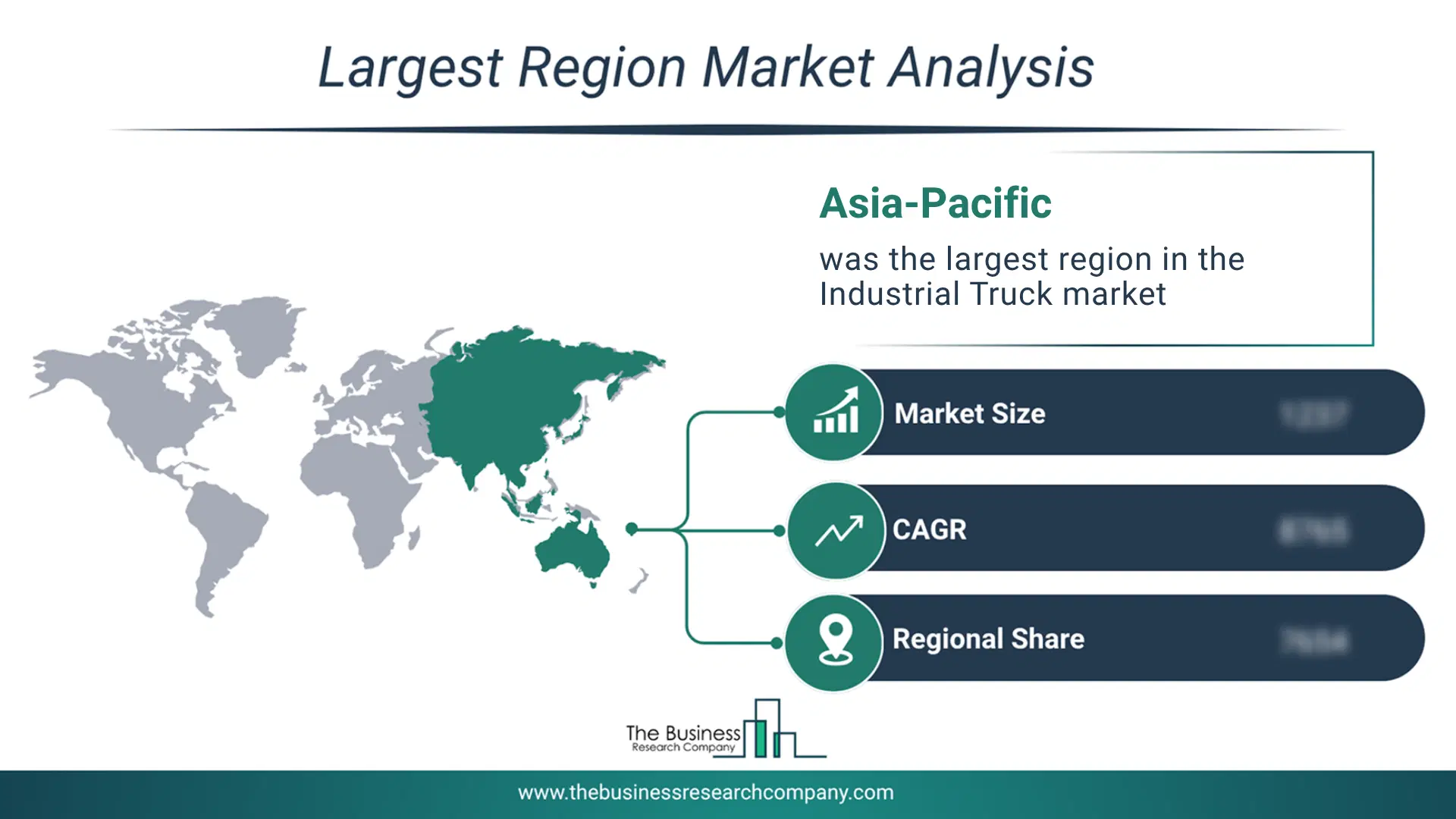
Regional Outlook
Asia-Pacific was the largest region in the industrial truck market share in 2025. The regions covered in this market report include Asia-Pacific, South East Asia, Western Europe, Eastern Europe, North America, South America, Middle East, Africa. The countries covered in this market report include Australia, Brazil, China, France, Germany, India, Indonesia, Japan, Taiwan, Russia, South Korea, UK, USA, Canada, Italy, SpainWhat Defines the Industrial Truck Market?
The industrial trucks market consists of sales of hand trucks, narrow-aisle straddle trucks, turret trucks, and automatic guided vehicles used for assistance in industrial operations. Values in this market are ‘factory gate’ values, that is the value of goods sold by the manufacturers or creators of the goods, whether to other entities (including downstream manufacturers, wholesalers, distributors, and retailers) or directly to end customers. The value of goods in this market includes related services sold by the creators of the goods.How is Market Value Defined and Measured?
The market value is defined as the revenues that enterprises gain from the sale of goods and/or services within the specified market and geography through sales, grants, or donations in terms of the currency (in USD unless otherwise specified). The revenues for a specified geography are consumption values that are revenues generated by organizations in the specified geography within the market, irrespective of where they are produced. It does not include revenues from resales along the supply chain, either further along the supply chain or as part of other products.
This chart presents market attractiveness based on a quantitative evaluation of growth, competition, strategic alignment, and risk, offering a clear view of opportunity areas for decision-making. This chart is for illustrative purposes; the full report contains the complete analysis.

This chart highlights the Total Addressable Market (TAM) by estimating the maximum revenue opportunity using an assumption-driven approach, supporting strategic planning and opportunity sizing across markets. The chart is illustrative; the full report provides a more comprehensive analysis.
What Key Data and Analysis Are Included in the Industrial Truck Market Report 2026?
The industrial truck market research report is one of a series of new reports from The Business Research Company that provides market statistics, including industry global market size, regional shares, competitors with the market share, detailed market segments, market trends and opportunities, and any further data you may need to thrive in the industrial truck industry. The market research report delivers a complete perspective of everything you need, with an in-depth analysis of the current and future state of the industry.Industrial Truck Market Report Forecast Analysis
| Report Attribute | Details |
|---|---|
| Market Size Value In 2026 | $27.54 billion |
| Revenue Forecast In 2030 | $33.45 billion |
| Growth Rate | CAGR of 4.3% from 2026 to 2030 |
| Base Year For Estimation | 2025 |
| Actual Estimates/Historical Data | 2020-2025 |
| Forecast Period | 2026 - 2030 - 2030 |
| Market Representation | Revenue in USD Billion and CAGR from 2026 to 2030 |
| Segments Covered | Type, Power, Application, End-Use Industry |
| Regional Scope | Asia-Pacific, Western Europe, Eastern Europe, North America, South America, Middle East, Africa |
| Country Scope | The countries covered in the report are Australia, Brazil, China, France, Germany, India, Indonesia, Japan, Taiwan, Russia, South Korea, UK, USA, Canada, Italy, Spain. |
| Key Companies Profiled | Combilift Material Handling Solutions, Doosan Corporation, Crown Controls Corp., Caterpillar Inc, Kion Group AG, Mitsubishi Nichiyu Forklift Co Ltd, Clark Material Handling Co Ltd, Hangcha Group Co Ltd, Anhui Heli Co Ltd, Hyster-Yale Materials Handling Inc, Jungheinrich AG, Komatsu Ltd, Dearborn Mid-West Company LLC, UniCarriers Americas Corporation, Lonking Forklift Company Ltd, HD Hyundai Co Ltd, Nissan Forklift Corp, TCM Limited, Kawasaki Heavy Industries Ltd, Toyota Industries Corporation, Manitou Group, Linde Material Handling GmbH |
| Customization Scope | Request for Customization |
| Pricing And Purchase Options | Explore Purchase Options |