
Industrial Vehicle Market Report 2026
Global Outlook – By Product Type (Forklift, Tow Tractor, Aisle Truck, Container Handler), By Drive Type (Internal Combustion Engine (ICE), Battery-Operated, Gas-Powered), By Level of Autonomy (Non Or Semi-Autonomous, Autonomous), By Application (Manufacturing, Warehousing, Freight And Logistics, Other Applications) – Market Size, Trends, Strategies, and Forecast to 2030
Industrial Vehicle Market Overview
• Industrial Vehicle market size has reached to $50.11 billion in 2025 • Expected to grow to $66.41 billion in 2030 at a compound annual growth rate (CAGR) of 6% • Growth Driver: Manufacturing Industry Surge Fuels Robust Growth In The Industrial Vehicle Market • Market Trend: Emerging Electrification And Automation Trends Reshaping Next-Generation Industrial Vehicles • North America was the largest region in 2025 and Asia-Pacific is the fastest growing region.Market Gains By 2030 – Top Opportunities By Segment
Market Gain identifies the most promising market opportunities by highlighting the segments or products expected to generate the highest incremental revenue growth over the next five years.
What Is Covered Under Industrial Vehicle Market?
Industrial vehicles refer to any push or powered carriers used to transfer materials around a factory with minimum restrictions on movement. Industrial vehicles are used for mechanized load collection and delivery, eliminating the need for physical lifting and transportation. The main types of industrial vehicles are forklifts, tow trucks, aisle trucks, and container handlers. A forklift is a compact vehicle with two power-operated prongs at the front for transporting and stacking materials in warehouses, shipping depots, and other locations. Forklifts are widely used in industrial settings for lifting and moving heavy loads. They are powered by drive types, including internal combustion engines (ICE), battery-operated, gas-powered, non- or semi-autonomous, and autonomous levels of autonomy used in manufacturing, warehousing, freight and logistics, and other applications.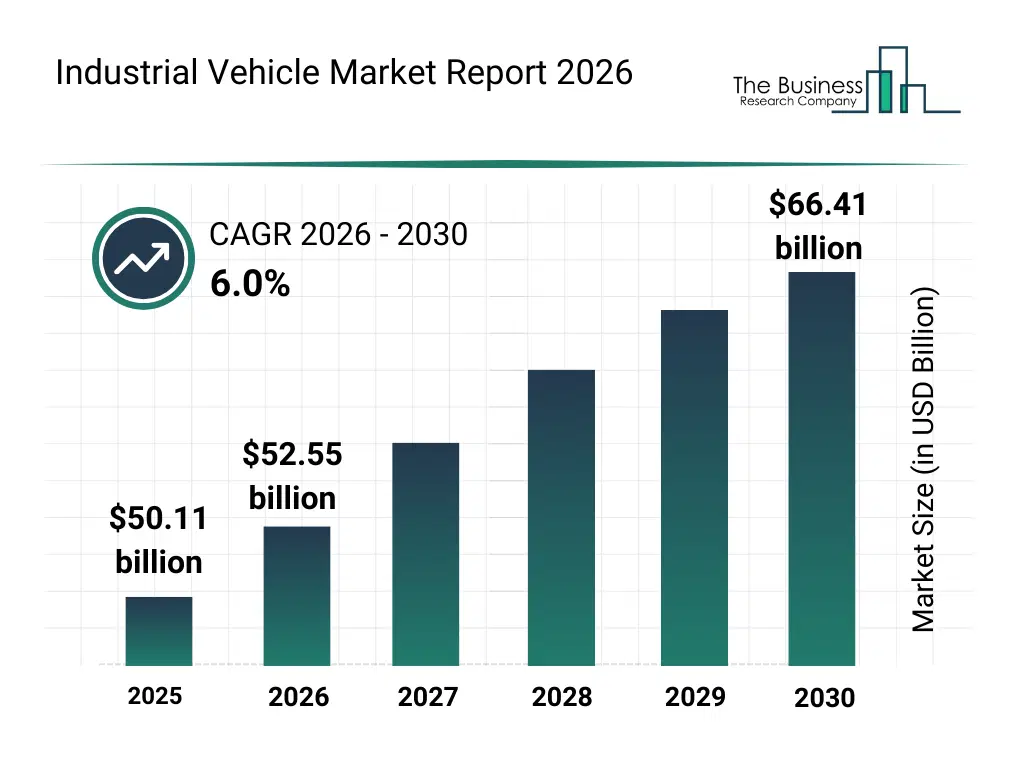
What Is The Industrial Vehicle Market Size and Share 2026?
The industrial vehicle market size has grown steadily in recent years. It will grow from $50.11 billion in 2025 to $52.55 billion in 2026 at a compound annual growth rate (CAGR) of 4.9%. The growth in the historic period can be attributed to manufacturing sector expansion, labor cost reduction needs, growth in warehousing activities, demand for efficient material handling, industrial productivity optimization.What Is The Industrial Vehicle Market Growth Forecast?
The industrial vehicle market size is expected to see strong growth in the next few years. It will grow to $66.41 billion in 2030 at a compound annual growth rate (CAGR) of 6.0%. The growth in the forecast period can be attributed to automation in factories, growth of e commerce logistics, adoption of electric industrial vehicles, smart warehouse investments, focus on workplace safety. Major trends in the forecast period include adoption of autonomous industrial vehicles, shift toward battery operated material handling equipment, integration of smart sensors and telematics, rising demand for compact and maneuverable vehicles, growth of warehouse automation.
Global Industrial Vehicle Market Segmentation
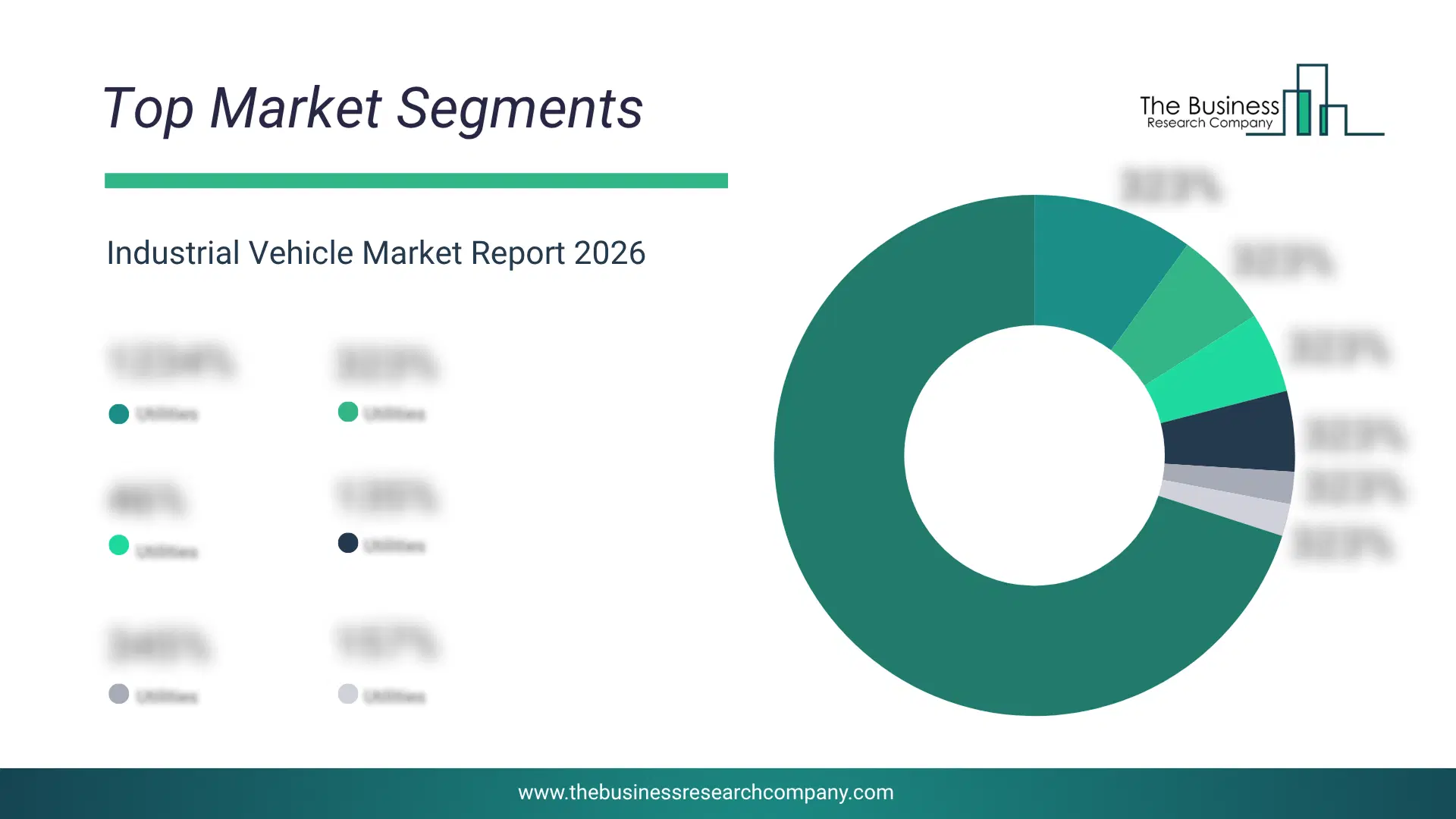
1) By Product Type: Forklift, Tow Tractor, Aisle Truck, Container Handler 2) By Drive Type: Internal Combustion Engine (ICE), Battery-Operated, Gas-Powered 3) By Level of Autonomy: Non Or Semi-Autonomous, Autonomous 4) By Application: Manufacturing, Warehousing, Freight And Logistics, Other Applications Subsegments: 1) By Forklift: Electric Forklifts, Internal Combustion Forklifts, Reach Trucks, Pallet Jacks 2) By Tow Tractor: Electric Tow Tractors, Internal Combustion Tow Tractors, Heavy-Duty Tow Tractors 3) By Aisle Truck: Narrow Aisle Trucks, Very Narrow Aisle Trucks, Order Pickers 4) By Container Handler: Straddle Carriers, Reach Stackers, Rubber-Tired Gantry (RTG) Cranes The top segments in the industrial vehicle market will be: • Forklift will reach $29.76 Billion by 2030. • Container Handler will reach $16.62 Billion by 2030. • Aisle Truck will reach $12.17 Billion by 2030. • Tow Tractor will reach $10.49 Billion by 2030.What Is The Driver Of The Industrial Vehicle Market?
The increasing demand in the manufacturing industry is expected to propel the growth of the industrial vehicle market going forward. The manufacturing industry refers to the sector of the economy involved in the production of goods through various processes, techniques, and technologies. The integration of industrial vehicles in the manufacturing industry offers increased productivity, flexible manufacturing layouts, reduced manual labor, quick and efficient transportation, enhanced safety, continuous operation, and efficient warehouse operations. For instance, in May 2024, according to the Office for National Statistics, a UK-based government agency, the production output increased by 0.2% in March 2024, following a 1.0% rise in February. The largest growth contribution came from manufacturing (0.3%) and mining and quarrying (1.0%). Notably, the manufacture of basic pharmaceutical products grew by 7.6%. Quarterly production output for Q1 2024 rose by 0.8%, primarily driven by manufacturing growth of 1.4%. Therefore, the increasing demand in the manufacturing industry is driving the growth of the industrial vehicle industry.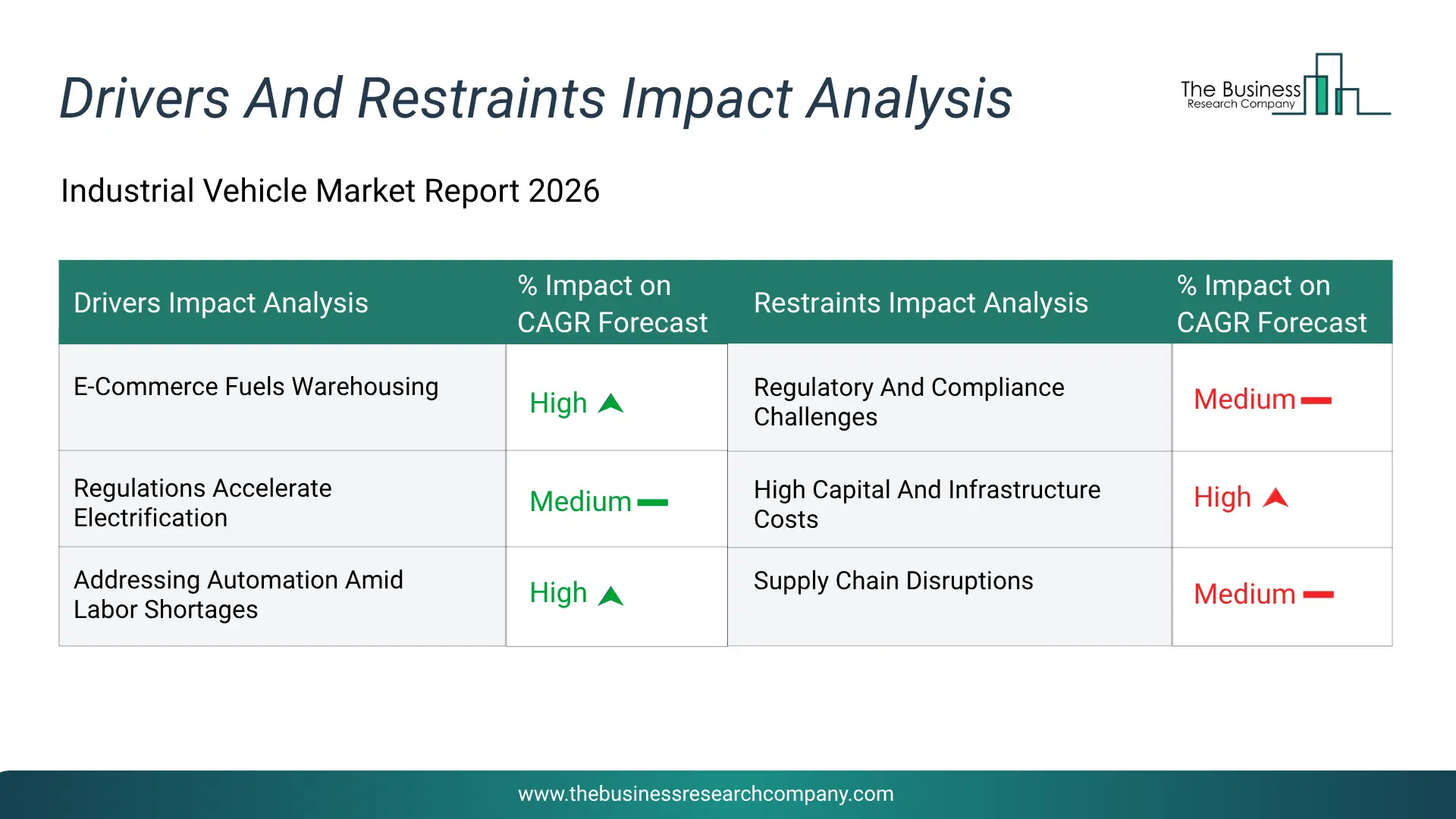
Infographic Chart Showing Key Market Drivers Analysis And Restraints For Industrial Vehicle Market
The chart presents an impact analysis of key drivers and restraints, quantifying their relative influence on the market's growth rate and helping assess the balance between growth enablers and limiting factors. This chart offers a high-level perspective; the full report contains more detailed insights.
How Will The Drivers Impact Growth In The Global Industrial Vehicle Market?
• E-Commerce Fuels Warehousing (High) – During the forecast period, e-commerce fuels warehousing is expected to become a key growth driver for the industrial vehicle market by 2030. The rapid expansion of online retail is increasing demand for large-scale warehouses, fulfillment centers, and advanced distribution facilities. Rising order volumes and faster delivery requirements are encouraging companies to adopt efficient material handling solutions such as forklifts, tow tractors, and automated vehicles to improve inventory movement and shipment operations. Businesses are focusing on warehouse productivity, storage optimization, and faster supply chain processes through advanced industrial equipment deployment. This continued expansion of e-commerce logistics is reinforcing strong market growth. • Regulations Accelerate Electrification (Medium) – During the forecast period, regulations accelerate electrification is expected to emerge as a major factor driving the expansion of the industrial vehicle market by 2030. Increasing emission regulations and sustainability targets are encouraging industries to transition from conventional fuel-powered vehicles to electric industrial fleets. Electric industrial vehicles support lower carbon emissions, reduced operating costs, and improved compliance with environmental standards. Government incentives, cleaner energy policies, and improvements in battery performance are further increasing adoption of electrified equipment across warehouses and manufacturing facilities. • Addressing Automation Amid Labor Shortages (High) – During the forecast period, addressing automation amid labor shortages is expected to act as a key growth catalyst for the industrial vehicle market by 2030. Growing workforce limitations and increasing labor costs across industrial operations are encouraging companies to invest in automated material handling technologies. Autonomous forklifts, robotic transport vehicles, and intelligent industrial equipment help improve productivity, operational accuracy, and workplace safety while reducing dependency on manual processes. Increasing demand for reliable and efficient operations is driving the adoption of automation-enabled industrial vehicles globally.How Will The Restraints Impact Growth In The Global Industrial Vehicle Market?
• Regulatory And Compliance Challenges (High) – During the forecast period, regulatory and compliance challenges act as a significant restraint on the industrial vehicle market because manufacturers and end users must adhere to strict safety, environmental, and operational standards. Compliance with evolving regulations often requires substantial investments in vehicle redesign, testing, certification, and documentation processes. These additional requirements can increase production costs and extend product development timelines. Companies operating across multiple regions may face varying regulatory frameworks, creating complexity in fleet management and procurement decisions. Frequent updates to emission and workplace safety regulations can also necessitate costly equipment upgrades. Smaller businesses may struggle to absorb these expenses, limiting adoption rates. As a result, regulatory and compliance burdens can slow market expansion and create barriers for industry participants. • High Capital And Infrastructure Costs (Medium) – During the forecast period, high capital and infrastructure costs restrain the growth of the industrial vehicle market by increasing the financial burden associated with purchasing and deploying advanced equipment. Industrial vehicles, particularly electric and automated models, often require substantial upfront investments compared to conventional alternatives. In addition to vehicle acquisition costs, businesses may need to invest in charging stations, warehouse modifications, software systems, and maintenance infrastructure. These expenses can discourage small and medium-sized enterprises from upgrading or expanding their fleets. Long payback periods may further delay investment decisions, especially during periods of economic uncertainty. Organizations with limited capital budgets often prioritize other operational expenditures over equipment modernization. Consequently, high capital and infrastructure requirements remain a key obstacle to broader industrial vehicle market adoption. • Supply Chain Disruptions (High) – During the forecast period, supply chain disruptions can act as a significant restraint on the industrial vehicle market by delaying production schedules and increasing manufacturing costs. Industrial vehicle manufacturers rely on a complex global supply chain for critical components such as semiconductors, batteries, electric drivetrains, hydraulic systems, and specialized steel. Disruptions caused by geopolitical tensions, trade restrictions, transportation bottlenecks, or shortages of key materials can lead to extended lead times and reduced production capacity. These challenges may also result in higher procurement costs and delayed deliveries to end users, affecting fleet expansion and replacement plans. Manufacturers may face difficulties in maintaining inventory levels and fulfilling customer orders on time, reducing overall operational efficiency. Consequently, persistent supply chain disruptions can hinder production, limit market growth, and create uncertainty across the industrial vehicle industry.Key Players In The Global Industrial Vehicle Market
Major companies operating in the industrial vehicle market report include Toyota Industries Corporation, KION Group AG, Jungheinrich AG, Mitsubishi Logisnext Co. Ltd., Crown Equipment Corporation, Hyster-Yale Materials Handling Inc., Doosan Corporation, Anhui Heli Co. Ltd., Komatsu Ltd., Clark Material Handling Company, Hyundai Heavy Industries Co. Ltd., Lonking Holdings Limited, Godrej & Boyce Manufacturing Company Limited, Hangcha Group Co. Ltd., BYD Company Limited, Manitou Group, TCM Corporation, UniCarriers Corporation, Kalmar Global, Liebherr Group, Terex Corporation, SANY Group, JCB Ltd., Caterpillar Inc., XCMG Group, Sumitomo Heavy Industries Ltd., Merlo S.p.A., Bobcat Company, Haulotte Group, Kubota Corporation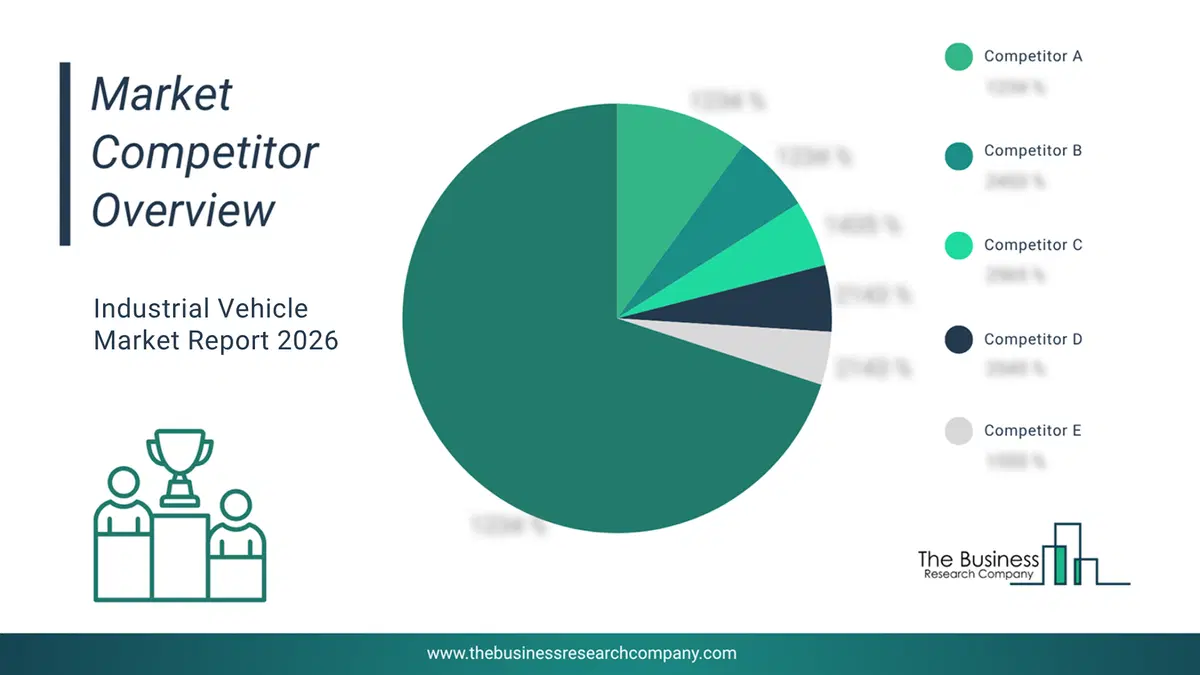
This chart is for illustrative purposes; the full report includes a detailed competitor analysis and comprehensive overview of the top 10 companies in the market.
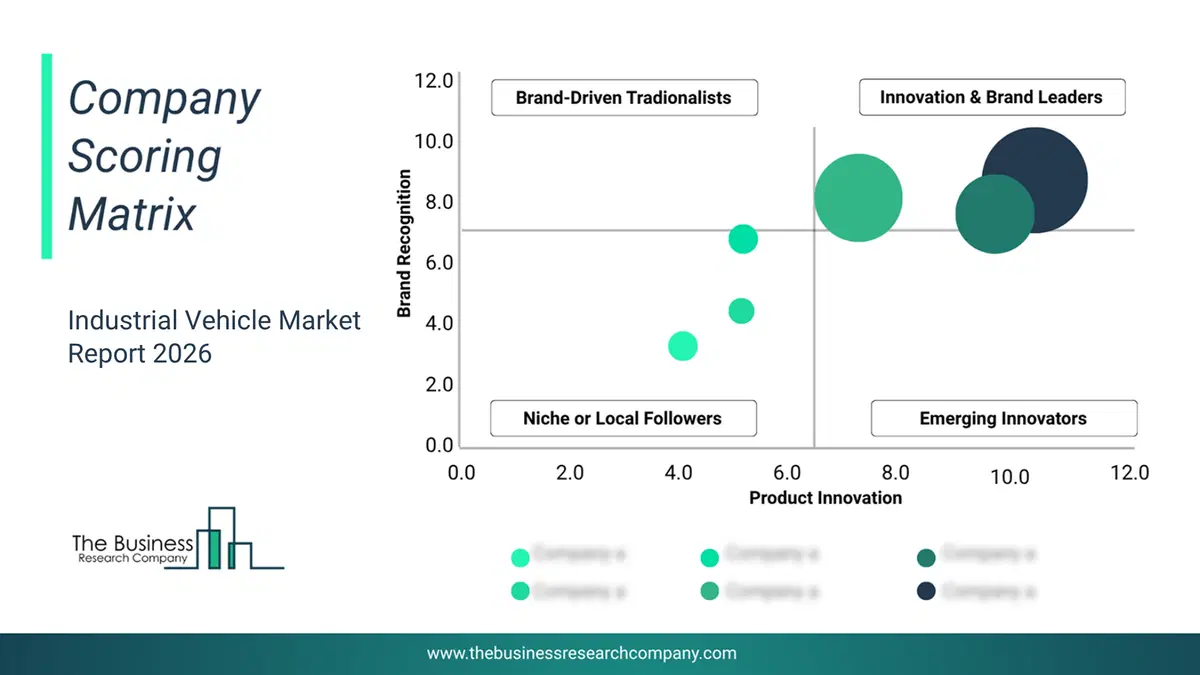
This chart maps companies by product innovation and brand strength, with bubble size indicating relative revenue, helping identify market leaders, challengers, and niche players. This is an illustrative chart; the full report provides a complete and accurate competitive analysis.
Global Industrial Vehicle Market Trends and Insights
Major companies operating in the industrial vehicle market are focusing on developing innovative products, such as Li-ion battery–powered electric counterbalance forklifts, to meet the rising demand for decarbonisation, lower total cost of ownership, greater uptime, and electrification of logistics and warehousing operations. Li-ion electric counterbalance forklifts use lithium-ion battery packs integrated into an otherwise conventional electric lift-truck platform. For instance, in February 2024, KION North America Corporation, a US-based material-handling equipment company, launched the Linde Series 1293, a new line of electric counterbalance forklifts designed around Linde Li-ION battery technology to serve 4,000–5,000 lb capacity segments. The Linde Series 1293 is composed of a compact electric counterbalance chassis with integrated Li-ION battery packs and Linde’s proven drive and hydraulic systems; it functions as a direct replacement for internal-combustion and older lead-acid electric trucks in warehousing, distribution and light industrial applications, offering features such as fast charging capability, high torque electric drive, ergonomic operator controls and simplified service access; unique benefits include reduced downtime from battery changes, predictable charging cycles, lower energy costs and suitability for multi-shift operations without swapping batteries.What Are Latest Mergers And Acquisitions In The Industrial Vehicle Market?
In July 2024, Imperial Auto Industries Ltd., an India-based manufacturer of fluid transmission products, acquired Metallwerk Biebighäuser GmbH for an undisclosed amount. As a result of the acquisition, the company aims to expand its product portfolio, enhance its market position, and access new opportunities within the industrial vehicle components sector. Metallwerk Biebighäuser GmbH is a Germany-based company that specializes in manufacturing gears, gearboxes, and transmissions for industrial vehicles.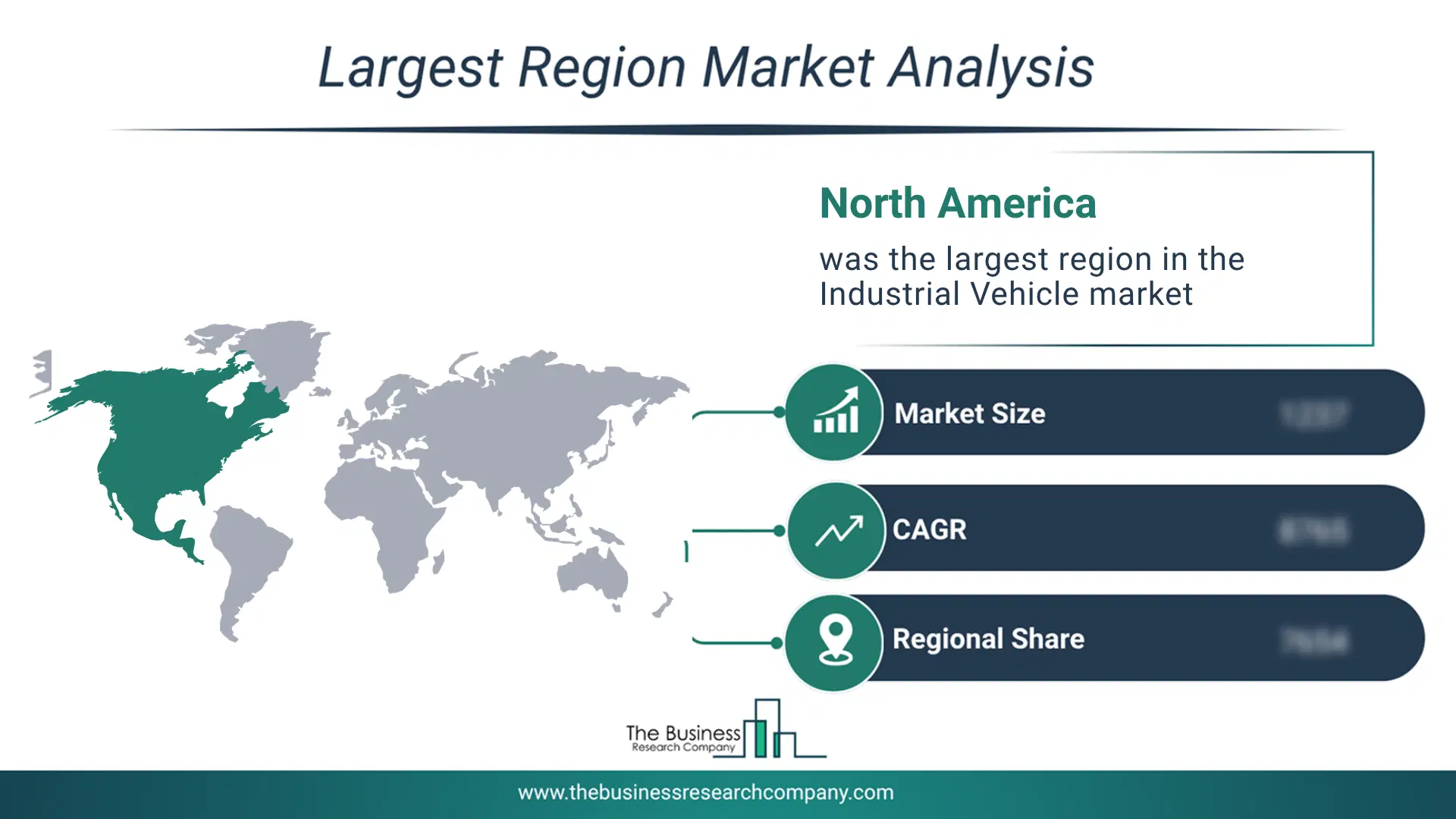
Regional Outlook
North America was the largest region in the industrial vehicle market in 2025. Asia-Pacific is expected to be the fastest-growing region in the forecast period. The regions covered in this market report include Asia-Pacific, South East Asia, Western Europe, Eastern Europe, North America, South America, Middle East, Africa. The countries covered in this market report include Australia, Brazil, China, France, Germany, India, Indonesia, Japan, Taiwan, Russia, South Korea, UK, USA, Canada, Italy, SpainWhat Defines the Industrial Vehicle Market?
The industrial vehicle market consists of sales of excavators, dump trucks, and industrial sweepers and scrubbers. Values in this market are ‘factory gate’ values, that is, the value of goods sold by the manufacturers or creators of the goods, whether to other entities (including downstream manufacturers, wholesalers, distributors, and retailers) or directly to end customers. The value of goods in this market includes related services sold by the creators of the goods.How is Market Value Defined and Measured?
The market value is defined as the revenues that enterprises gain from the sale of goods and/or services within the specified market and geography through sales, grants, or donations in terms of the currency (in USD unless otherwise specified). The revenues for a specified geography are consumption values that are revenues generated by organizations in the specified geography within the market, irrespective of where they are produced. It does not include revenues from resales along the supply chain, either further along the supply chain or as part of other products.
This chart presents market attractiveness based on a quantitative evaluation of growth, competition, strategic alignment, and risk, offering a clear view of opportunity areas for decision-making. This chart is for illustrative purposes; the full report contains the complete analysis.

This chart highlights the Total Addressable Market (TAM) by estimating the maximum revenue opportunity using an assumption-driven approach, supporting strategic planning and opportunity sizing across markets. The chart is illustrative; the full report provides a more comprehensive analysis.
What Key Data and Analysis Are Included in the Industrial Vehicle Market Report 2026?
The industrial vehicle market research report is one of a series of new reports from The Business Research Company that provides market statistics, including industry global market size, regional shares, competitors with the market share, detailed market segments, market trends and opportunities, and any further data you may need to thrive in the industrial vehicle industry. The market research report delivers a complete perspective of everything you need, with an in-depth analysis of the current and future state of the industry.Industrial Vehicle Market Report Forecast Analysis
| Report Attribute | Details |
|---|---|
| Market Size Value In 2026 | $52.55 billion |
| Revenue Forecast In 2030 | $66.41 billion |
| Growth Rate | CAGR of 4.9% from 2026 to 2030 |
| Base Year For Estimation | 2025 |
| Actual Estimates/Historical Data | 2020-2025 |
| Forecast Period | 2026 - 2030 |
| Market Representation | Revenue in USD Billion and CAGR from 2026 to 2030 |
| Segments Covered | Product Type, Drive Type, Level of Autonomy, Application |
| Regional Scope | Asia-Pacific, Western Europe, Eastern Europe, North America, South America, Middle East, Africa |
| Country Scope | The countries covered in the report are Australia, Brazil, China, France, Germany, India, ... |
| Key Companies Profiled | Toyota Industries Corporation, KION Group AG, Jungheinrich AG, Mitsubishi Logisnext Co. Ltd., Crown Equipment Corporation, Hyster-Yale Materials Handling Inc., Doosan Corporation, Anhui Heli Co. Ltd., Komatsu Ltd., Clark Material Handling Company, Hyundai Heavy Industries Co. Ltd., Lonking Holdings Limited, Godrej & Boyce Manufacturing Company Limited, Hangcha Group Co. Ltd., BYD Company Limited, Manitou Group, TCM Corporation, UniCarriers Corporation, Kalmar Global, Liebherr Group, Terex Corporation, SANY Group, JCB Ltd., Caterpillar Inc., XCMG Group, Sumitomo Heavy Industries Ltd., Merlo S.p.A., Bobcat Company, Haulotte Group, Kubota Corporation |
| Customization Scope | Request for Customization |
| Pricing And Purchase Options | Explore Purchase Options |