
Information Technology (IT) And Telecom Optoelectronics Market Report 2026
Global Outlook – By Device Type (Light Emitting Diodes, Laser Diodes, Photodiodes Or Photodetectors, Image Sensors, Optocouplers), By Material (Silicon, Gallium Arsenide, Indium Phosphide, Silicon Germanium, Gallium Nitride), By Data Rate (Sub 10G, 10G To 40G, 100G To 400G, Above 400G), By Application (Fiber Optic Communication, Data Centers, Telecommunications Networks, Cloud Computing Infrastructure, High Performance Computing, Optical Interconnects), By End User (Telecommunications Service Providers, Cloud And Hyperscale Data Center Operators, Enterprise And Information Technology Service Providers, Network Equipment Manufacturers, Consumer Electronics Manufacturers, Industrial And Smart Infrastructure Operators) – Market Size, Trends, Strategies, and Forecast to 2030
Information Technology (IT) And Telecom Optoelectronics Market Overview
• Information Technology (IT) And Telecom Optoelectronics market size has reached to $7.41 billion in 2025 • Expected to grow to $10.28 billion in 2030 at a compound annual growth rate (CAGR) of 6.7% • Growth Driver: Expansion Of 5G Infrastructure Driving The Market Growth Due To Increasing Demand For High-Speed And Low-Latency Connectivity • Market Trend: High-Density Pluggable Optical Modules Advancing Scalable And Energy-Efficient Data Center Connectivity • Asia-Pacific was the largest region and fastest growing region.What Is Covered Under Information Technology (IT) And Telecom Optoelectronics Market?
Information technology (IT) and telecom optoelectronics refer to optoelectronic components and devices that generate, transmit, detect, and process optical signals for information technology and telecommunications applications. These technologies convert electrical signals into optical signals and vice versa, enabling high-speed data transmission, low signal loss, and reliable communication across optical networks. They support advanced communication infrastructure by improving bandwidth, transmission efficiency, and network performance. The main device types of information technology (IT) and telecom optoelectronics include light emitting diodes, laser diodes, photodiodes or photodetectors, image sensors, and optocouplers. Light emitting diodes refer to semiconductor devices that emit light when electric current passes through them and are used for optical signaling, illumination, and display applications. These devices are made from silicon, gallium arsenide, indium phosphide, silicon germanium, and gallium nitride, with data rates ranging from sub 10G, 10G to 40G, 100G to 400G, and above 400G. They find application in fiber optic communication, data centers, telecommunications networks, cloud computing infrastructure, high performance computing, and optical interconnects, serving end users including telecommunications service providers, cloud and hyperscale data center operators, enterprise and information technology service providers, network equipment manufacturers, consumer electronics manufacturers, and industrial and smart infrastructure operators.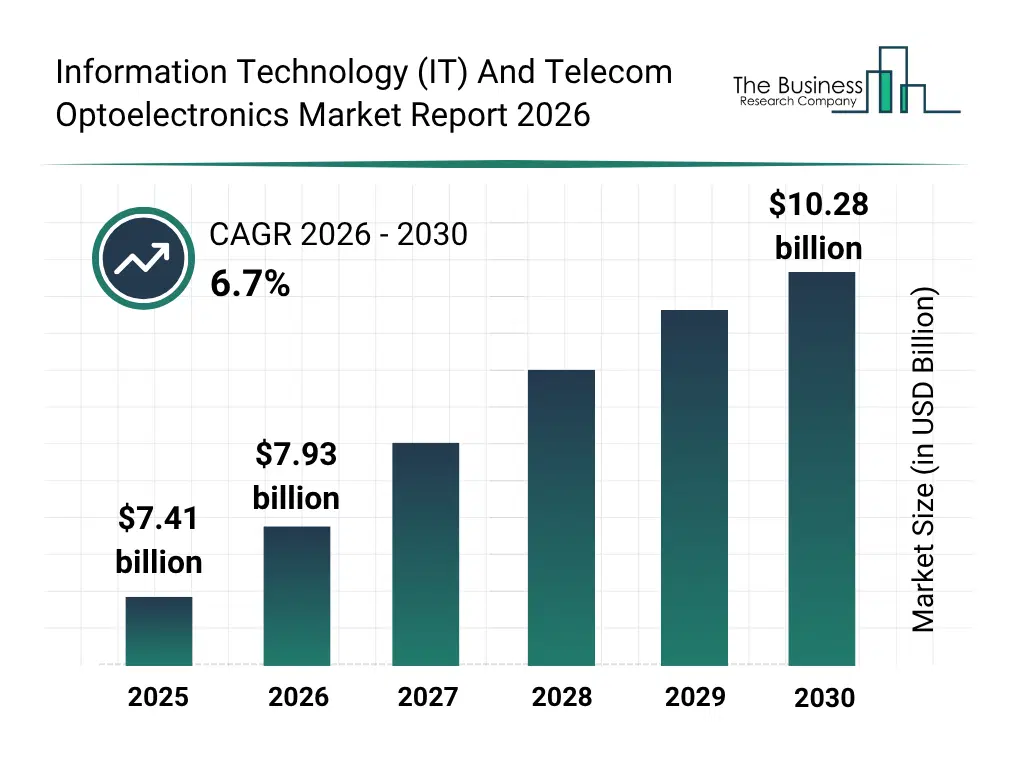
What Is The Information Technology (IT) And Telecom Optoelectronics Market Size and Share 2026?
The information technology (IT) and telecom optoelectronics market size has grown strongly in recent years. It will grow from $7.41 billion in 2025 to $7.93 billion in 2026 at a compound annual growth rate (CAGR) of 7.1%. The growth in the historic period can be attributed to increasing internet and data traffic, rising deployment of fiber optic networks, growing adoption of cloud computing infrastructure, increasing data center capacity requirements, rising demand for high-speed telecommunications connectivity.What Is The Information Technology (IT) And Telecom Optoelectronics Market Growth Forecast?
The information technology (IT) and telecom optoelectronics market size is expected to see strong growth in the next few years. It will grow to $10.28 billion in 2030 at a compound annual growth rate (CAGR) of 6.7%. The growth in the forecast period can be attributed to increasing demand for ultra-high-speed data transmission, rising deployment of 400G and above optical networks, growing expansion of hyperscale data centers, increasing adoption of optical interconnects in high performance computing, rising need for higher network bandwidth and transmission efficiency. Major trends in the forecast period include increasing adoption of high-speed optical transceivers, rising demand for higher-density optical interconnects, growing integration of silicon photonics technologies, increasing development of energy-efficient optoelectronic components, rising demand for advanced optical signal detection technologies.
Global Information Technology (IT) And Telecom Optoelectronics Market Segmentation
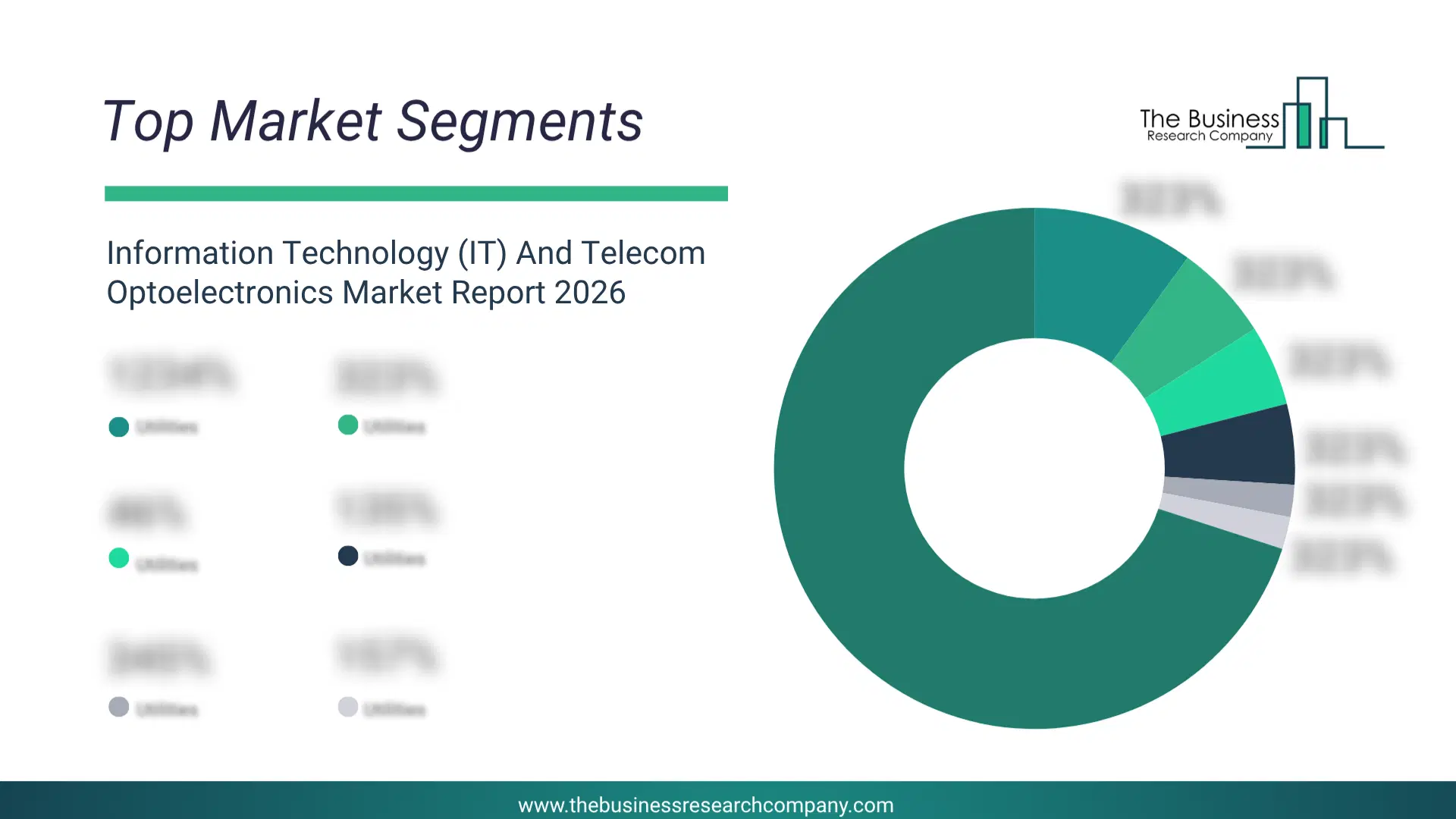
1) By Device Type: Light Emitting Diodes, Laser Diodes, Photodiodes Or Photodetectors, Image Sensors, Optocouplers 2) By Material: Silicon, Gallium Arsenide, Indium Phosphide, Silicon Germanium, Gallium Nitride 3) By Data Rate: Sub 10G, 10G To 40G, 100G To 400G, Above 400G 4) By Application: Fiber Optic Communication, Data Centers, Telecommunications Networks, Cloud Computing Infrastructure, High Performance Computing, Optical Interconnects 5) By End User: Telecommunications Service Providers, Cloud And Hyperscale Data Center Operators, Enterprise And Information Technology Service Providers, Network Equipment Manufacturers, Consumer Electronics Manufacturers, Industrial And Smart Infrastructure Operators Subsegments: 1) By Light Emitting Diodes: Visible Light Emitting Diodes, Infrared Light Emitting Diodes, Ultraviolet Light Emitting Diodes, High Power Light Emitting Diodes, Surface Mount Light Emitting Diodes 2) By Laser Diodes: Fabry Perot Laser Diodes, Distributed Feedback Laser Diodes, Vertical Cavity Surface Emitting Laser Diodes, Distributed Bragg Reflector Laser Diodes, Quantum Cascade Laser Diodes 3) By Photodiodes Or Photodetectors: Positive Intrinsic Negative Photodiodes, Avalanche Photodiodes, Schottky Photodiodes, Silicon Photodiodes, Indium Gallium Arsenide Photodiodes 4) By Image Sensors: Complementary Metal Oxide Semiconductor Image Sensors, Charge Coupled Device Image Sensors, Backside Illuminated Image Sensors, Global Shutter Image Sensors, Time Of Flight Image Sensors 5) By Optocouplers: Transistor Output Optocouplers, Darlington Output Optocouplers, Triac Output Optocouplers, Logic Gate Output Optocouplers, High Speed OptocouplersWhat Is The Driver Of The Information Technology (IT) And Telecom Optoelectronics Market?
The expansion of 5G infrastructure is expected to propel the growth of the information technology (IT) and telecom optoelectronics market going forward. 5G infrastructure refers to the network of physical and digital components such as small cells, base stations, antennas, fiber optic systems, and core network equipment that enable the delivery of fifth-generation wireless communication services. The 5G infrastructure is rising due to the increasing demand for faster data speeds as modern applications such as video streaming, cloud computing, and real-time communication require significantly higher bandwidth and low latency to function efficiently. The deployment of 5G networks bridges information technology (IT) and telecom optoelectronics by combining advanced computing with optical communication technologies to provide high-speed, low-latency, and reliable connectivity for next-generation digital applications. For instance, in November 2024, according to the Global mobile Suppliers Association (GSA), a UK-based non-governmental organization, 5G standalone (SA) ecosystem devices reached 2,112 announced devices with claimed support by the end of September 2024, representing a 39.7% increase from 1,511 devices at the end of September 2023. Therefore, the expansion of 5G infrastructure is driving the growth of the information technology (IT) and telecom optoelectronics industry.Key Players In The Global Information Technology (IT) And Telecom Optoelectronics Market
Major companies operating in the information technology (IT) and telecom optoelectronics market are Hamamatsu Photonics K.K., NVIDIA Corporation, Broadcom Inc., Cisco Systems Inc., Intel Corporation, Sumitomo Electric Industries Ltd., NEC Corporation, Fujitsu Limited, Amphenol Corporation, Nokia Corporation, Corning Incorporated, Marvell Technology Inc., Ciena Corporation, Lumentum Holdings Inc., VIAVI Solutions Inc., MACOM Technology Solutions Holdings Inc., Semtech Corporation, Accelink Technologies Co. Ltd., Eoptolink Technology Inc. Ltd., Furukawa Electric Co. Ltd.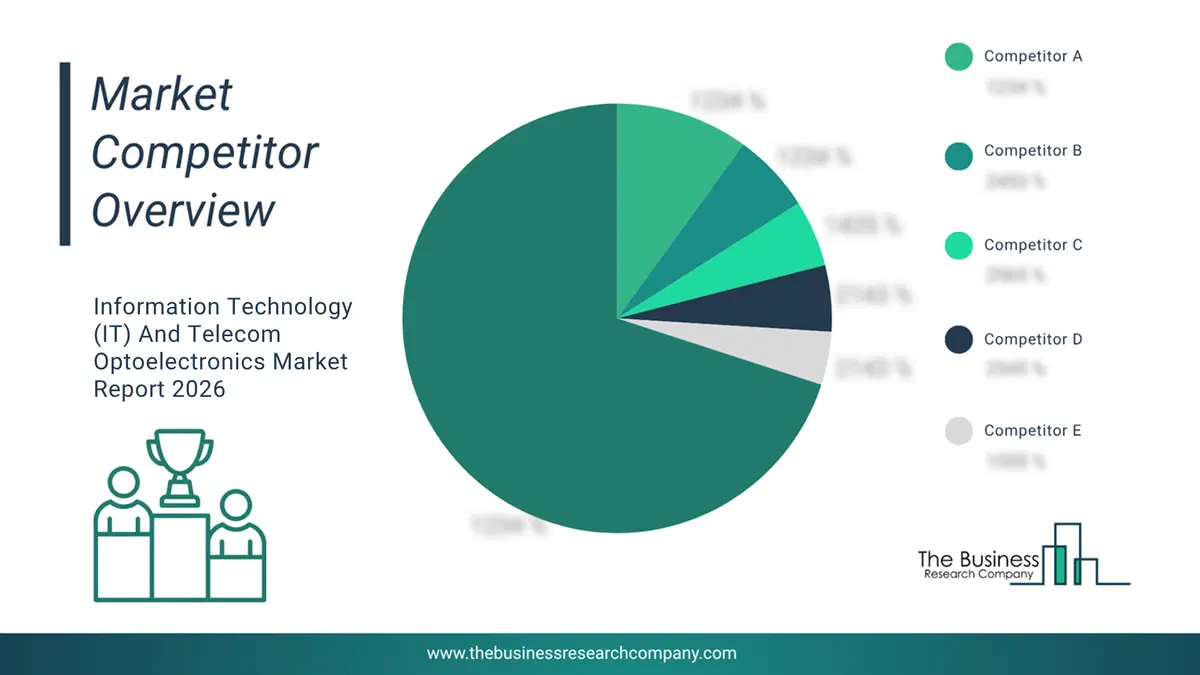
This chart is for illustrative purposes; the full report includes a detailed competitor analysis and comprehensive overview of the top 10 companies in the market.
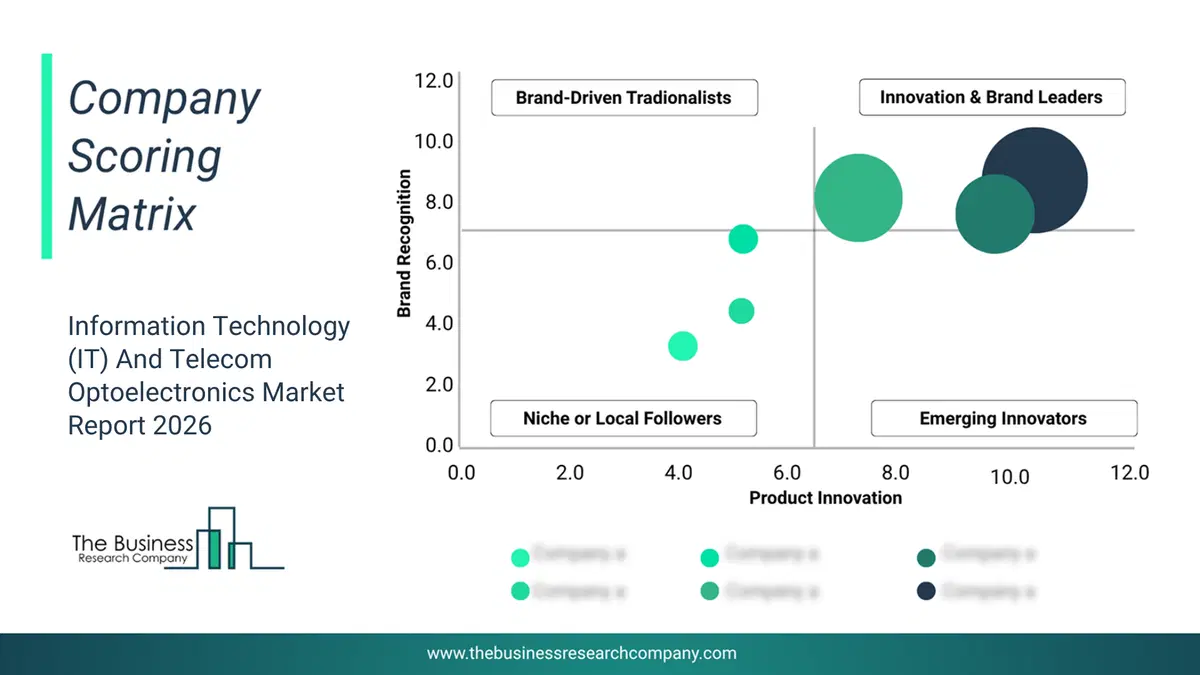
This chart maps companies by product innovation and brand strength, with bubble size indicating relative revenue, helping identify market leaders, challengers, and niche players. This is an illustrative chart; the full report provides a complete and accurate competitive analysis.
Global Information Technology (IT) And Telecom Optoelectronics Market Trends and Insights
Major companies operating in the information technology (IT) and telecom optoelectronics market are focusing on developing innovative products such as, high-density pluggable optical modules to enhance data transmission efficiency and scalability in hyperscale data center and AI networking applications in a single line. High-density pluggable optical modules are compact, hot-swappable transceiver devices that pack multiple high-capacity optical channels into a single module to maximize port density and bandwidth in data center and telecom network equipment. For instance, in September 2024, Source Photonics Inc., a US-based optical communication technology company, launched its complete 1.6T and 800G PAM4 transceiver family at ECOC 2024 in Frankfurt, introducing a broad portfolio of optical modules, active optical cables (AOC), and direct attach cables (DAC) designed for next-generation data center networking. The product lineup includes 1.6T DR8 and 2xFR4 modules, as well as 800G SR8, DR8, FR4, and LR4 solutions supporting single-lambda 100G and 200G PAM4 technology, enabling higher bandwidth density and improved energy efficiency. Additionally, these transceivers support advanced cooling compatibility, backward interoperability with existing 400G systems, and extended reach up to 10 km over single-mode fiber, making them suitable for AI cluster scaling and hyperscale infrastructure upgrades.What Are Latest Mergers And Acquisitions In The Information Technology (IT) And Telecom Optoelectronics Market?
In November 2023, Lumentum Holdings Inc., a US-based technology company, acquired Cloud Light Technology for $750 million. With this acquisition, Lumentum aims to strengthen its high-speed optical interconnect portfolio and expand its presence in the rapidly growing data center and AI networking markets through enhanced scale and transceiver capabilities. Cloud Light Technology Limited is a China-based provider of high-speed optical transceivers, optical interconnect modules, and data center connectivity solutions for telecom and hyperscale infrastructure applications.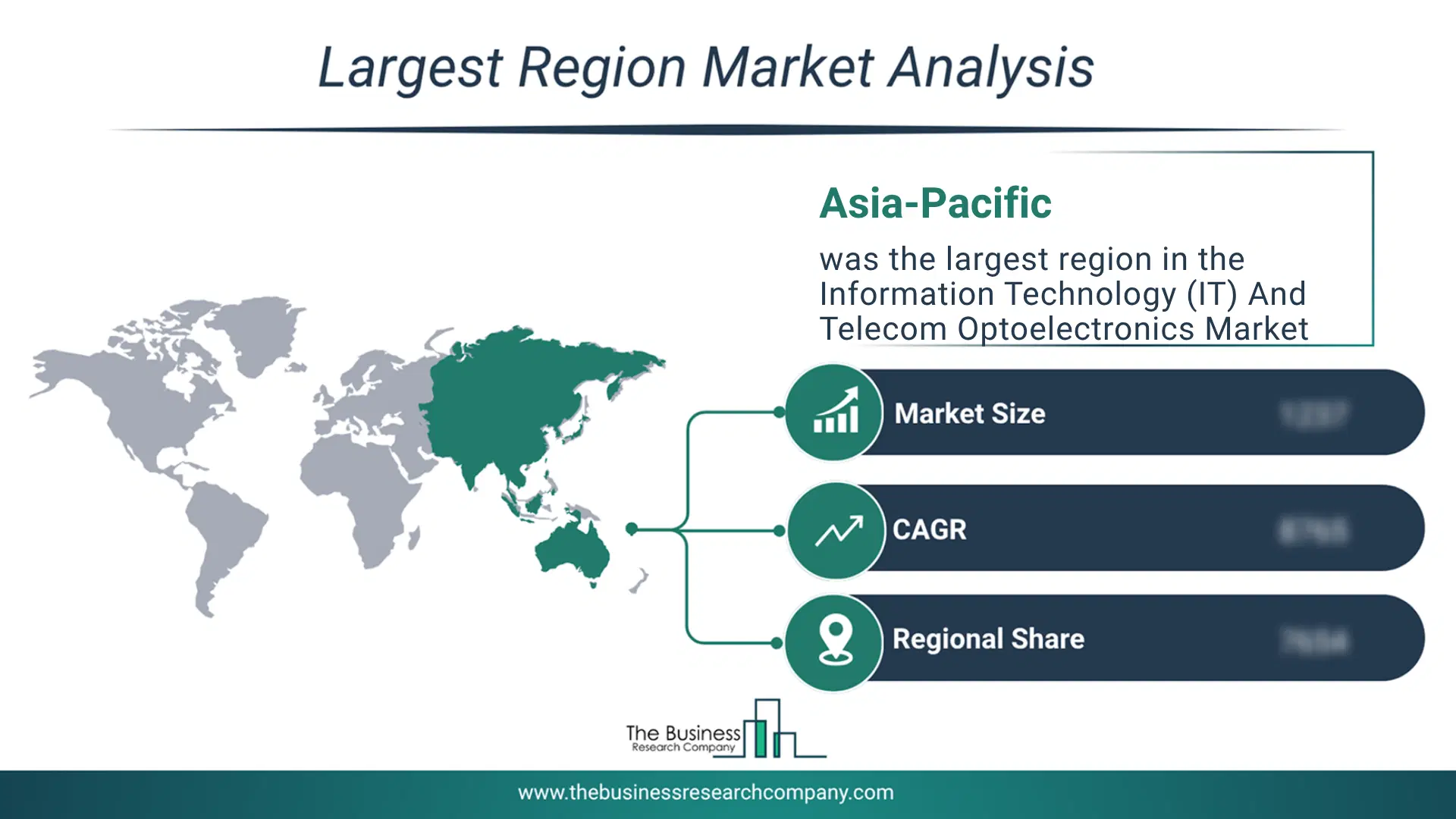
Regional Insights
Asia-Pacific was the largest region in the information technology (IT) and telecom optoelectronics market in 2025. Asia-Pacific is expected to be the fastest-growing region in the forecast period. The regions covered in this market report are Asia-Pacific, South East Asia, Western Europe, Eastern Europe, North America, South America, Middle East, Africa. The countries covered in this market report are Australia, Brazil, China, France, Germany, India, Indonesia, Japan, Taiwan, Russia, South Korea, UK, USA, Canada, Italy, Spain.What Defines the Information Technology (IT) And Telecom Optoelectronics Market?
The information technology (IT) and telecom optoelectronics market consists of sales of optical transceivers, optical amplifiers, optical modulators, optical switches, wavelength division multiplexing (WDM) components, and fiber optic connectors. Values in this market are ‘factory gate’ values, that is, the value of goods sold by the manufacturers or creators of the goods, whether to other entities (including downstream manufacturers, wholesalers, distributors, and retailers) or directly to end customers. The value of goods in this market includes related services sold by the creators of the goods.How is Market Value Defined and Measured?
The market value is defined as the revenues that enterprises gain from the sale of goods and/or services within the specified market and geography through sales, grants, or donations in terms of the currency (in USD unless otherwise specified). The revenues for a specified geography are consumption values that are revenues generated by organizations in the specified geography within the market, irrespective of where they are produced. It does not include revenues from resales along the supply chain, either further along the supply chain or as part of other products.
This chart presents market attractiveness based on a quantitative evaluation of growth, competition, strategic alignment, and risk, offering a clear view of opportunity areas for decision-making. This chart is for illustrative purposes; the full report contains the complete analysis.

This chart highlights the Total Addressable Market (TAM) by estimating the maximum revenue opportunity using an assumption-driven approach, supporting strategic planning and opportunity sizing across markets. The chart is illustrative; the full report provides a more comprehensive analysis.
What Key Data and Analysis Are Included in the Information Technology (IT) And Telecom Optoelectronics Market Report 2026?
The information technology (it) and telecom optoelectronics market research report is one of a series of new reports from The Business Research Company that provides market statistics, including industry global market size, regional shares, competitors with the market share, detailed market segments, market trends and opportunities, and any further data you may need to thrive in the information technology (it) and telecom optoelectronics industry. The market research report delivers a complete perspective of everything you need, with an in-depth analysis of the current and future state of the industry.Information Technology (IT) And Telecom Optoelectronics Market Report Forecast Analysis
| Report Attribute | Details |
|---|---|
| Market Size Value In 2026 | $7.93 billion |
| Revenue Forecast In 2030 | $10.28 billion |
| Growth Rate | CAGR of 6.7% from 2026 to 2030 |
| Base Year For Estimation | 2025 |
| Actual Estimates/Historical Data | 2020-2025 |
| Forecast Period | 2026 - 2030 |
| Market Representation | Revenue in USD Billion and CAGR from 2026 to 2030 |
| Segments Covered | Device Type, Material, Data Rate, Application, End User |
| Regional Scope | Asia-Pacific, Western Europe, Eastern Europe, North America, South America, Middle East, Africa |
| Country Scope | The countries covered in the report are Australia, Brazil, China, France, Germany, India, Indonesia, Japan, Taiwan, Russia, South Korea, UK, USA, Canada, Italy, Spain. |
| Key Companies Profiled | Hamamatsu Photonics K.K., NVIDIA Corporation, Broadcom Inc., Cisco Systems Inc., Intel Corporation, Sumitomo Electric Industries Ltd., NEC Corporation, Fujitsu Limited, Amphenol Corporation, Nokia Corporation, Corning Incorporated, Marvell Technology Inc., Ciena Corporation, Lumentum Holdings Inc., VIAVI Solutions Inc., MACOM Technology Solutions Holdings Inc., Semtech Corporation, Accelink Technologies Co. Ltd., Eoptolink Technology Inc. Ltd., Furukawa Electric Co. Ltd. |
| Customization Scope | Request for Customization |
| Pricing And Purchase Options | Explore Purchase Options |