
Infrared Drying For Foods Market Report 2026
Global Outlook – By Technology (Near-Infrared, Far-Infrared, Medium-Infrared), By Equipment Type (Batch, Continuous, Tunnel, Cabinet, Other Types), By Capacity (Small Capacity, Medium Capacity, Large Capacity), By Application (Fruits And Vegetables, Meat And Seafood, Dairy Products, Bakery and Confectionery, Grains And Cereals, Other Applications), By End-User (Food Processing Companies, Food Service, Other End-Users) – Market Size, Trends, Strategies, and Forecast to 2035
Infrared Drying For Foods Market Overview
• Infrared Drying For Foods market size has reached to $1.11 billion in 2025 • Expected to grow to $1.74 billion in 2030 at a compound annual growth rate (CAGR) of 9.4% • Growth Driver: The Increasing Demand For Processed Foods Driving The Growth Of The Market Due To Changing Consumer Lifestyles And Busy Work Schedules • North America was the largest region in 2025 and Asia-Pacific is the fastest growing region.
What Is Covered Under Infrared Drying For Foods Market?
Infrared drying for foods is a food processing technology that uses infrared radiation to transfer heat directly to the surface of food, enabling quick and efficient moisture removal without significantly heating the surrounding air. This method accelerates the drying process compared to traditional hot-air drying while maintaining product quality. It is primarily used to enhance drying efficiency, preserve color, flavor, and nutrients, and reduce energy consumption in processing foods. The main technologies of infrared drying for foods include near-infrared, far-infrared, and medium-infrared. Near-infrared technology uses shorter wavelength infrared radiation to penetrate food products, enabling rapid and uniform drying while preserving quality. Multiple equipment types include batch, continuous, tunnel, cabinet, and others, with different capacities including small capacity, medium capacity, and large capacity, and various applications include fruits and vegetables, meat and seafood, dairy products, bakery and confectionery, and grains and cereals, and they are used by several end users such as food processing companies, food service, and others.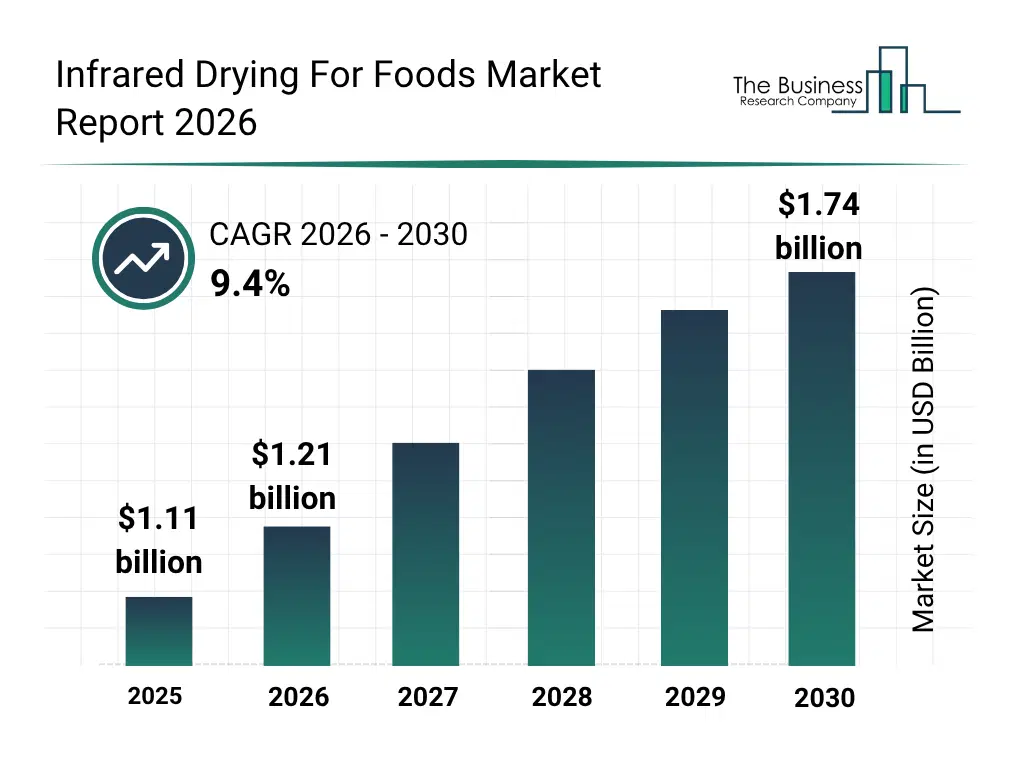
What Is The Infrared Drying For Foods Market Size and Share 2026?
The infrared drying for foods market size has grown strongly in recent years. It will grow from $1.11 billion in 2025 to $1.21 billion in 2026 at a compound annual growth rate (CAGR) of 9.1%. The growth in the historic period can be attributed to high energy consumption of conventional drying methods, increasing demand for processed foods, adoption of industrial drying equipment, growing awareness of food quality preservation, expansion of food processing industries in asia-pacific.What Is The Infrared Drying For Foods Market Growth Forecast?
The infrared drying for foods market size is expected to see strong growth in the next few years. It will grow to $1.74 billion by 2030 at a compound annual growth rate (CAGR) of 9.4%. The growth in the forecast period can be attributed to rising focus on energy-efficient and sustainable drying technologies, increasing investment in smart food processing equipment, demand for higher throughput continuous drying systems, adoption of ai and automation in drying processes, expansion of infrared drying applications to new food segments. Major trends in the forecast period include increasing adoption of infrared drying technology in food processing, rising demand for energy-efficient drying solutions, expansion of infrared drying applications across fruits, vegetables, and grains, growing focus on retaining nutritional value and product quality, integration of automated and continuous drying systems.Global Infrared Drying For Foods Market Segmentation
1) By Technology: Near-Infrared, Far-Infrared, Medium-Infrared 2) By Equipment Type: Batch, Continuous, Tunnel, Cabinet, Other Types 3) By Capacity: Small Capacity, Medium Capacity, Large Capacity 4) By Application: Fruits And Vegetables, Meat And Seafood, Dairy Products, Bakery and Confectionery, Grains And Cereals, Other Applications 5) By End-User: Food Processing Companies, Food Service, Other End-Users Subsegments: 1) By Near-Infrared: Short Wave Near Infrared, Medium Wave Near Infrared, Long Wave Near Infrared, Pulsed Near Infrared 2) By Far-Infrared: Ceramic Far Infrared, Quartz Far Infrared, Carbon Far Infrared, Tungsten Far Infrared 3) By Medium-Infrared: Filtered Medium Infrared, Broad Spectrum Medium Infrared, Lamp Based Medium Infrared, Gas Medium InfraredWhat Are The Drivers Of The Infrared Drying For Foods Market?
The increasing demand for processed foods is expected to propel the growth of the infrared drying for foods market going forward. Processed foods refer to foods that have been altered from their natural state to enhance shelf life, safety, or convenience, including products such as ready-to-eat meals, snack items, and beverage products. Increasing demand for processed foods is primarily due to changing consumer lifestyles and busy work schedules that encourage the consumption of convenient and ready-to-eat food products. Infrared drying for foods enhances processed food production by enabling faster, energy-efficient moisture removal, improving product quality, extending shelf life, and increasing overall manufacturing efficiency. For instance, in July 2025, according to Agriculture and Agri-Food Canada (AAFC), a Canada-based government department for agriculture and food-related products, in 2024, exports of processed food and beverage products from Canada reached $59.8 billion, representing a 3.8% increase compared to 2023. Therefore, the increasing demand for processed foods is driving the growth of infrared drying for the food market. The increasing awareness of food waste reduction is expected to propel the growth of the infrared drying for foods market going forward. Awareness of food waste reduction refers to the understanding and recognition of the importance of minimizing food loss and waste at all stages of production, distribution, and consumption to improve sustainability and resource efficiency. Increasing awareness of food waste reduction is primarily due to rising food insecurity, as more people and organizations recognize the need to conserve food to ensure access for those facing shortages. Infrared drying for foods helps reduce food waste by quickly removing moisture, extending shelf life, and preserving the nutritional quality of perishable products. For instance, in July 2025, according to the National Environment Agency, a Singapore-based statutory board, the total amount of food waste generated increased from 2023 to 784,000 tons in 2024, while the recycling rate for food waste remained at 18%. Therefore, the increasing awareness of food waste reduction is driving the growth of the infrared drying for food industry. The growth in sustainability and environmental concerns is expected to propel the growth of the infrared drying for foods market going forward. Sustainability and environmental concerns refer to awareness and efforts to use natural resources responsibly and minimize negative impacts on the environment, such as promoting natural and organic products, to ensure ecological balance and long-term well-being. Growth in sustainability and environmental concerns is primarily driven by the increasing awareness of climate change, as individuals, businesses, and governments recognize the urgent need to reduce environmental impact and adopt eco-friendly practices. Infrared drying for foods promotes sustainability and addresses environmental concerns by reducing energy consumption, minimizing food waste, and lowering greenhouse gas emissions compared to conventional drying methods. For instance, in November 2025, according to the Government Department of Climate Change, Energy, Environment and Water, an Australia-based government agency, the Australian Parliament passed reforms to the Environment Protection and Biodiversity Conservation (EPBC) Act, strengthening national environmental protection standards. The reforms introduced clearer, legally enforceable rules for development approvals and biodiversity conservation, ensuring that economic development aligns more closely with long-term environmental sustainability goals. Therefore, the growth in sustainability and environmental concerns is driving the growth of the infrared drying for the food market.Key Players In The Global Infrared Drying For Foods Market
Major companies operating in the infrared drying for foods market are GEA Group AG, Bühler Group, Heat and Control Inc., Glenro Inc., Kerone Engineering Solutions Ltd., Craftolite Solutions Private Limited, Heat One Technology, Genex Tech Industries LLP, Pratham Engineering, Tsung Hsing Food Machinery Co Ltd, Indofab Industries, Infrared Heating Technologies LLC, Infron Heating Solutions Private Limited, Püschner GmbH + Co. KG, Technovative Systems Private Limited, Umrao Automation Pvt. Ltd., Kreyenborg Gmbh And Co. KG, Maan Global Industries Pvt. Ltd, Preetha Enterprises, TOE ENGINEERING PROJECTS PVT.LTD.Regional Insights
North America was the largest region in the infrared drying for foods market in 2025. Asia-Pacific is expected to be the fastest-growing region in the forecast period. The regions covered in this market report are Asia-Pacific, South East Asia, Western Europe, Eastern Europe, North America, South America, Middle East, Africa. The countries covered in this market report are Australia, Brazil, China, France, Germany, India, Indonesia, Japan, Taiwan, Russia, South Korea, UK, USA, Canada, Italy, Spain.What Defines the Infrared Drying For Foods Market?
The infrared drying for the food market consists of revenues earned by entities by providing services such as food dehydration and preservation, customized drying solutions, installation and maintenance of infrared drying equipment, pilot-scale testing and trials, and quality control and monitoring services. The market value includes the value of related goods sold by the service provider or included within the service offering. The infrared drying for the food market also includes sales of infrared food dryers, infrared fruit and vegetable dryers, infrared grain dryers, and infrared seafood dryers. Values in this market are ‘factory gate’ values; that is, the value of goods sold by the manufacturers or creators of the goods, whether to other entities (including downstream manufacturers, wholesalers, distributors, and retailers) or directly to end customers. The value of goods in this market includes related services sold by the creators of the goods.How is Market Value Defined and Measured?
The market value is defined as the revenues that enterprises gain from the sale of goods and/or services within the specified market and geography through sales, grants, or donations in terms of the currency (in USD unless otherwise specified). The revenues for a specified geography are consumption values that are revenues generated by organizations in the specified geography within the market, irrespective of where they are produced. It does not include revenues from resales along the supply chain, either further along the supply chain or as part of other products.What Key Data and Analysis Are Included in the Infrared Drying For Foods Market Report 2026?
The infrared drying for foods market research report is one of a series of new reports from The Business Research Company that provides market statistics, including industry global market size, regional shares, competitors with the market share, detailed market segments, market trends and opportunities, and any further data you may need to thrive in the infrared drying for foods industry. The market research report delivers a complete perspective of everything you need, with an in-depth analysis of the current and future state of the industry.Infrared Drying For Foods Market Report Forecast Analysis
| Report Attribute | Details |
|---|---|
| Market Size Value In 2026 | $1.21 billion |
| Revenue Forecast In 2035 | $1.74 billion |
| Growth Rate | CAGR of 9.1% from 2026 to 2035 |
| Base Year For Estimation | 2025 |
| Actual Estimates/Historical Data | 2020-2025 |
| Forecast Period | 2026 - 2030 - 2035 |
| Market Representation | Revenue in USD Billion and CAGR from 2026 to 2035 |
| Segments Covered | Technology, Equipment Type, Capacity, Application, End-User |
| Regional Scope | Asia-Pacific, Western Europe, Eastern Europe, North America, South America, Middle East, Africa |
| Country Scope | The countries covered in the report are Australia, Brazil, China, France, Germany, India, ... |
| Key Companies Profiled | GEA Group AG, Bühler Group, Heat and Control Inc., Glenro Inc., Kerone Engineering Solutions Ltd., Craftolite Solutions Private Limited, Heat One Technology, Genex Tech Industries LLP, Pratham Engineering, Tsung Hsing Food Machinery Co Ltd, Indofab Industries, Infrared Heating Technologies LLC, Infron Heating Solutions Private Limited, Püschner GmbH + Co. KG, Technovative Systems Private Limited, Umrao Automation Pvt. Ltd., Kreyenborg Gmbh And Co. KG, Maan Global Industries Pvt. Ltd, Preetha Enterprises, TOE ENGINEERING PROJECTS PVT.LTD. |
| Customization Scope | Request for Customization |
| Pricing And Purchase Options | Explore Purchase Options |