

Infrared (IR) Viewers Market Report 2026
Global Outlook – By Type Of Infrared Viewers (Handheld Infrared Viewers, Portable Infrared Viewers, Fixed Infrared Viewers, Wearable Infrared Viewers), By Technology (Cooled Infrared (IR) Sensors, Uncooled Infrared (IR) Sensors, Shortwave Infrared (SWIR), Longwave Infrared (LWIR)), By Application (Military And Defense, Industrial, Medical, Research And Development, Other Applications), By Distribution Channel (Online Sales, Offline Sales), By End User (Telecommunications, Healthcare, Construction, Aerospace And Defense, Manufacturing) – Market Size, Trends, Strategies, and Forecast to 2030
Infrared (IR) Viewers Market Overview
• Infrared (IR) Viewers market size has reached to $1.42 billion in 2025 • Expected to grow to $2.26 billion in 2030 at a compound annual growth rate (CAGR) of 9.7% • Growth Driver: Rise In Security Threats Driving The Market Growth Due To Increasing Demand For Surveillance Solutions • Market Trend: Advancements In Mid-Wave Infrared (MWIR) Technology Influencing The Market Growth • North America was the largest region in 2025 and Asia-Pacific is the fastest growing region.What Is Covered Under Infrared (IR) Viewers Market?
Infrared (IR) viewers are optical devices designed to detect and visualize infrared radiation, typically in the near-infrared (NIR) spectrum, which is invisible to the human eye. These viewers convert IR radiation into visible images, enabling users to observe heat signatures or IR-emitting sources in various applications such as night vision, laser alignment, fiber optic inspection, and surveillance. The main types of infrared (IR) viewers include handheld infrared viewers, portable infrared viewers, fixed infrared viewers, and wearable infrared viewers. A handheld IR viewer is a compact, portable device that detects infrared radiation to visualize heat for quick inspections and thermal analysis. It uses various technologies such as cooled infrared (IR) sensors, uncooled infrared (IR) sensors, shortwave infrared (SWIR), and longwave infrared (LWIR). These devices are used in a range of applications, including military and defense, industrial, medical, research and development, and others. They are distributed through various channels, including online and offline sales, and are used by different end users including telecommunications, healthcare, construction, aerospace and defense, and manufacturing industries.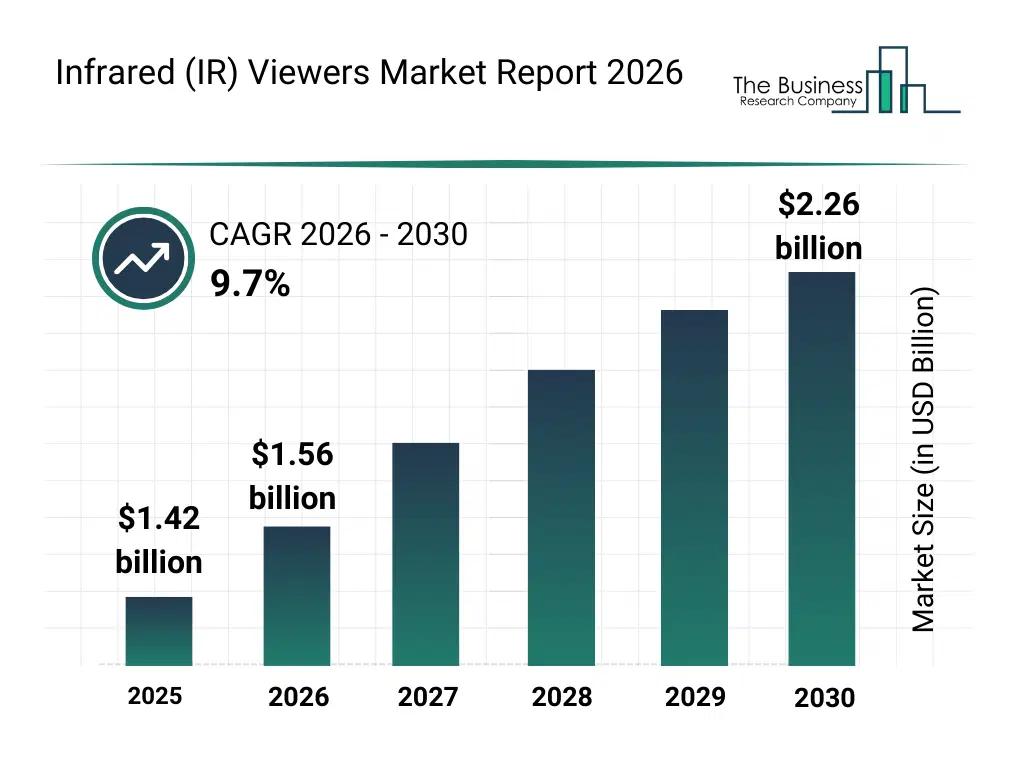
What Is The Infrared (IR) Viewers Market Size and Share 2026?
The infrared (ir) viewers market size has grown strongly in recent years. It will grow from $1.42 billion in 2025 to $1.56 billion in 2026 at a compound annual growth rate (CAGR) of 9.9%. The growth in the historic period can be attributed to expansion of military night surveillance programs, rising use of infrared systems in industrial maintenance, increased adoption in fiber optic inspection, growth of defense modernization initiatives, availability of compact infrared sensor technologies.What Is The Infrared (IR) Viewers Market Growth Forecast?
The infrared (ir) viewers market size is expected to see strong growth in the next few years. It will grow to $2.26 billion in 2030 at a compound annual growth rate (CAGR) of 9.7%. The growth in the forecast period can be attributed to increasing demand for advanced situational awareness tools, rising integration of ai-based image enhancement, expansion of infrared applications in healthcare diagnostics, growing investments in smart surveillance systems, increasing demand for portable inspection devices. Major trends in the forecast period include increasing adoption of wearable infrared viewing devices, rising demand for high-resolution thermal imaging, growing use of ir viewers in industrial inspection, expansion of night vision and surveillance applications, enhanced integration with digital imaging platforms.
Global Infrared (IR) Viewers Market Segmentation
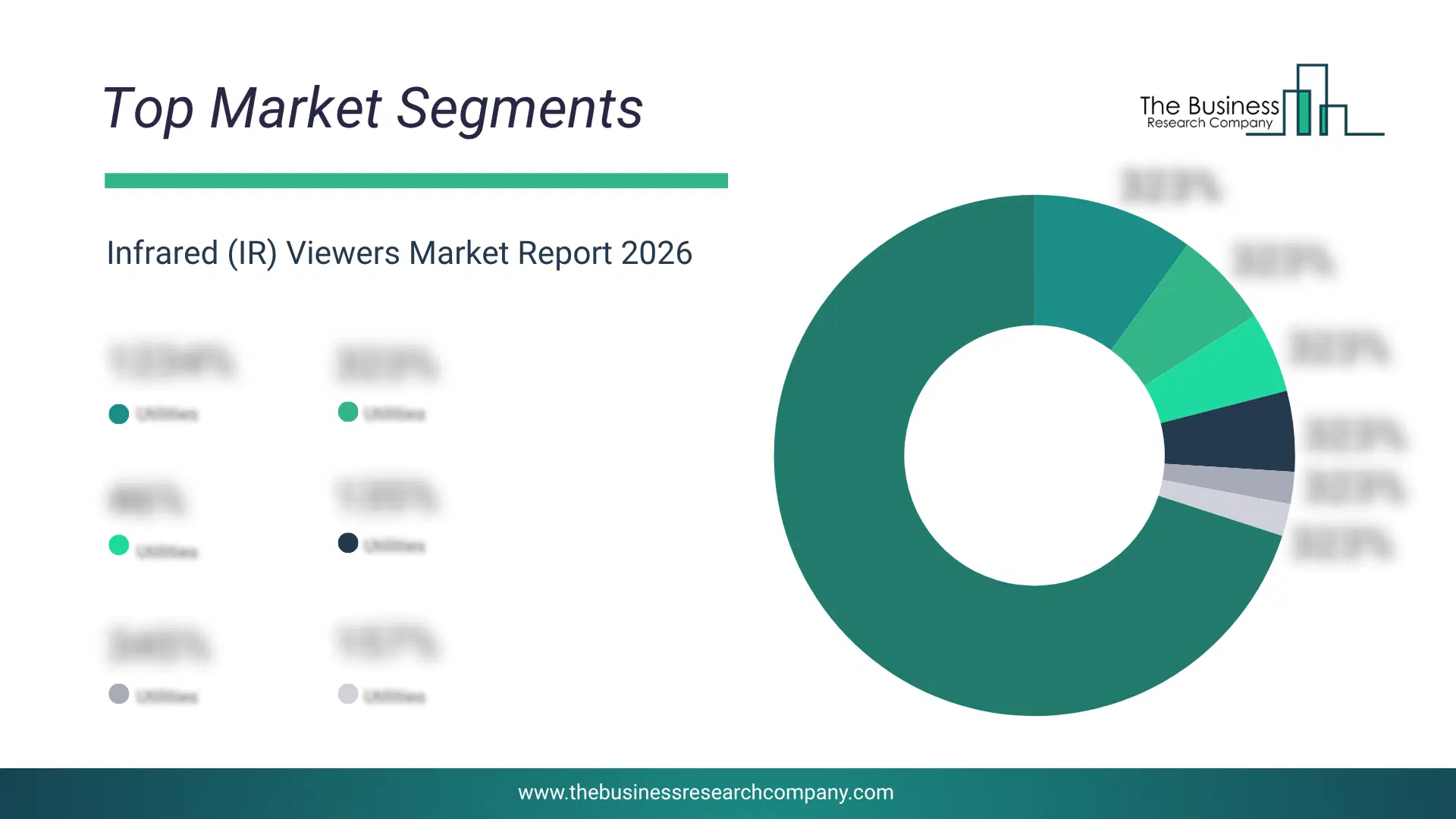
1) By Type Of Infrared Viewers: Handheld Infrared Viewers, Portable Infrared Viewers, Fixed Infrared Viewers, Wearable Infrared Viewers 2) By Technology: Cooled Infrared (IR) Sensors, Uncooled Infrared (IR) Sensors, Shortwave Infrared (SWIR), Longwave Infrared (LWIR) 3) By Application: Military And Defense, Industrial, Medical, Research And Development, Other Applications 4) By Distribution Channel: Online Sales, Offline Sales 5) By End User: Telecommunications, Healthcare, Construction, Aerospace And Defense, Manufacturing Subsegments: 1) By Handheld Infrared (IR) Viewers: Monocular Infrared Viewers, Binocular Infrared Viewers, Smartphone-Compatible Infrared Viewers, Pistol Grip Infrared Viewers 2) By Portable Infrared (IR) Viewers: Tripod-Mounted Infrared Viewers, Backpack-Integrated Infrared Viewers, Battery-Operated Infrared Viewers, Foldable Or Compact Portable Infrared Viewers 3) By Fixed Infrared (IR) Viewers: Wall-Mounted Infrared Viewers, Ceiling-Mounted Infrared Viewers, Pole-Mounted Infrared Viewers, Integrated Surveillance System Infrared Viewers 4) By Wearable Infrared (IR) Viewers: Head-Mounted Infrared Viewers, Helmet-Mounted Infrared Viewers, Eyewear Or Goggle-Type Infrared Viewers, Augmented Reality (AR) Or Virtual Reality (VR) Integrated Infrared ViewersWhat Is The Driver Of The Infrared (IR) Viewers Market?
The rise in security threats is expected to propel the growth of the infrared (IR) viewers market going forward. Security threats refer to potential risks or actions that can harm individuals, organizations, or national safety through violence, espionage, or sabotage. Security threats are rising due to increasing digitalization, which expands the attack surface for cybercriminals while outpacing the implementation of robust cybersecurity measures. Heightened security concerns increase demand for advanced imaging technologies capable of detecting threats in low-visibility or nighttime conditions. For instance, in January 2025, according to the Office for National Statistics (ONS), a UK-based government agency, in September 2024, approximately 9.5 million incidents of headline crime were recorded in England and Wales, representing a 12% rise compared to 8.5 million incidents in the previous year. Additionally, police-recorded crimes totaled 6.7 million in the same period. Therefore, the rising crime rates are driving the demand for IR viewers and surveillance solutions.Key Players In The Global Infrared (IR) Viewers Market
Major companies operating in the infrared (ir) viewers market are Fluke corporation, Teledyne FLIR LLC, Wuhan Guide Sensmart Tech Co. Ltd., Nippon Avionics Co. Ltd., Lumasense Technologies Inc, Exergen Corporation, Optris Gmbh, Thermoteknix Systems Limited, IRay Technology Co. Ltd, Viper Imaging LLC, Testo SE & Co. KGaA, SatIR Europe, Process Sensors Corporation, ULIRvision Technology Co. Ltd., Workswell s.r.o., Wuhan JOHO Technology Co. Ltd., DIAS Infrared GmbH, InfraTec GmbH Infrarotsensorik und Messtechnik, VisionTIR S.L., NEC Avio Infrared Technologies Co. Ltd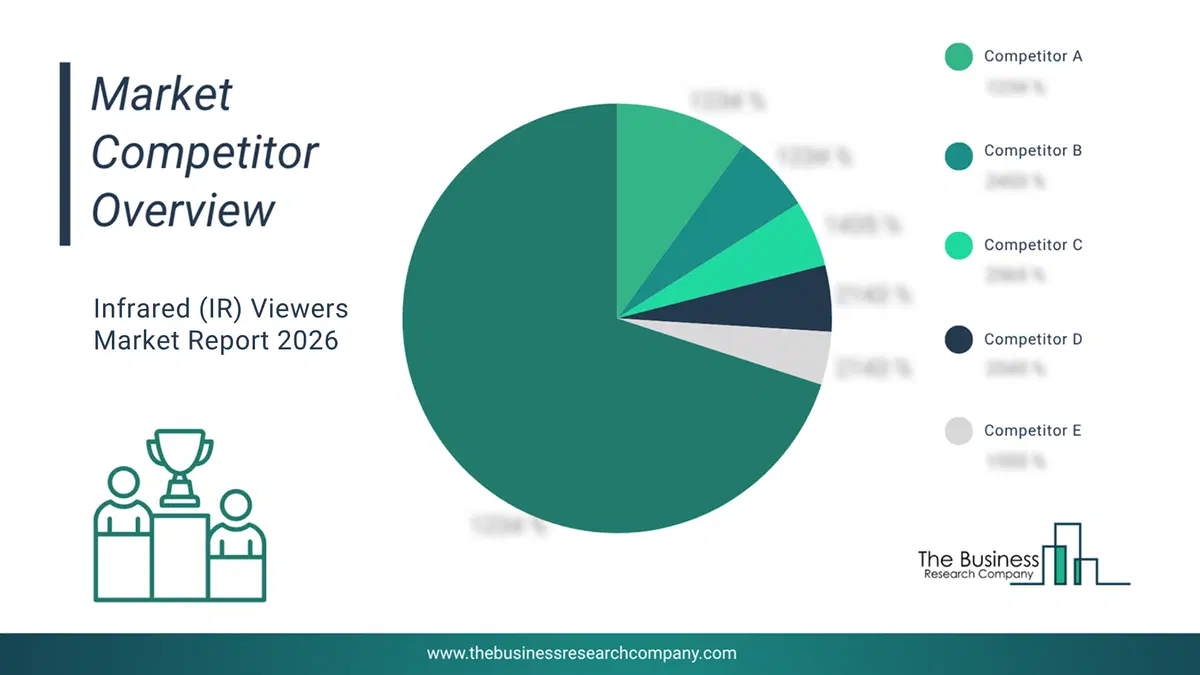
This chart is for illustrative purposes; the full report includes a detailed competitor analysis and comprehensive overview of the top 10 companies in the market.
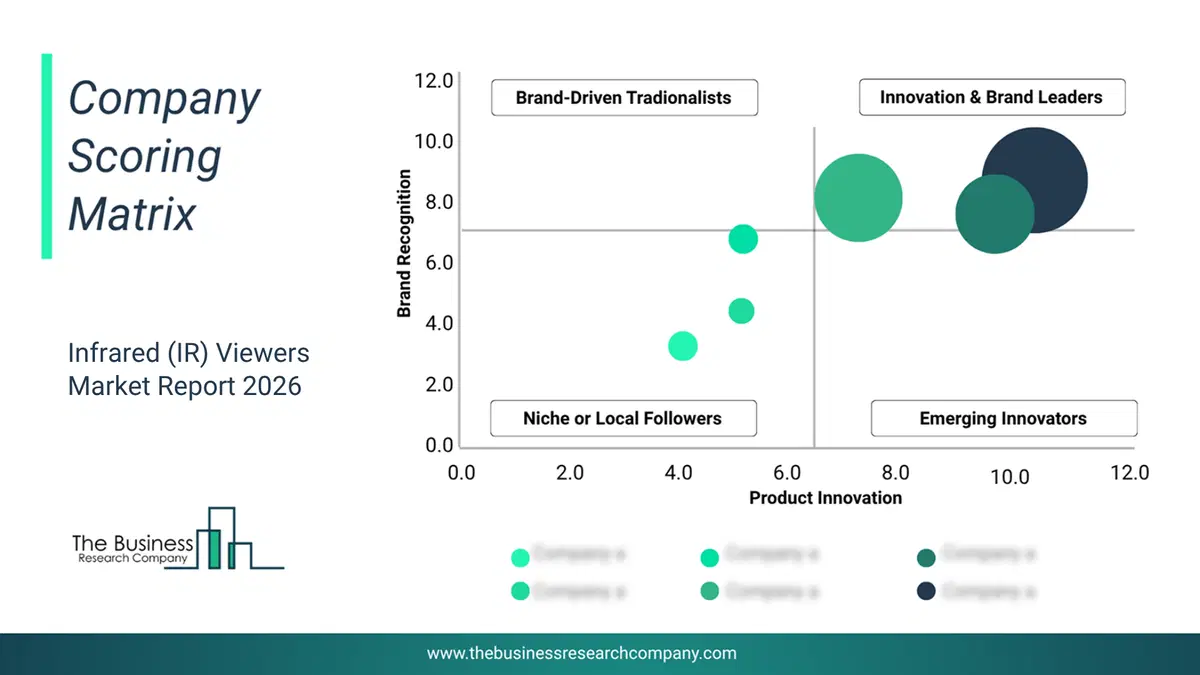
This chart maps companies by product innovation and brand strength, with bubble size indicating relative revenue, helping identify market leaders, challengers, and niche players. This is an illustrative chart; the full report provides a complete and accurate competitive analysis.
Global Infrared (IR) Viewers Market Trends and Insights
Major companies operating in the infrared (IR) viewers market are focusing on developing innovative products such as mid-wave infrared (MWIR) cameras to enhance image clarity and detection in challenging environments. Mid-wave infrared (MWIR) cameras are imaging devices that detect infrared radiation in the 3–5 micrometer wavelength range, allowing them to capture thermal images even in total darkness or through smoke and haze. For instance, in November 2023, Sierra-Olympia Technologies, Inc., a US-based manufacturing company, launched the Ventus Compact MK2, a next-generation mid-wave infrared (MWIR) camera designed for integration into space-constrained platforms such as drones, handheld devices, and other low-SWaP (Size, Weight, and Power) applications. The camera features a 19–275 mm continuous zoom optic with one-touch autofocus, advanced image processing capabilities such as electronic image stabilization, de-noising, linear histogram AGC, and a unified software architecture for easier system integration. This innovation enhances image clarity and detection performance in challenging environments such as total darkness, smoke, or haze, making it ideal for defense, surveillance, and search and rescue missions.What Are Latest Mergers And Acquisitions In The Infrared (IR) Viewers Market?
In January 2024, Sierra-Olympia Technologies Inc., a US-based provider of advanced infrared imaging systems, partnered with Jenoptik AG. With this partnership, Sierra-Olympia Technologies and Jenoptik aim to expand the distribution of the Evidir radiometric long-wave infrared thermal imaging camera by leveraging Sierra-Olympia’s market reach and integration expertise to support applications such as security, drone integration, and transportation safety. Jenoptik AG is a Germany-based company specializing in photonics and optical technologies.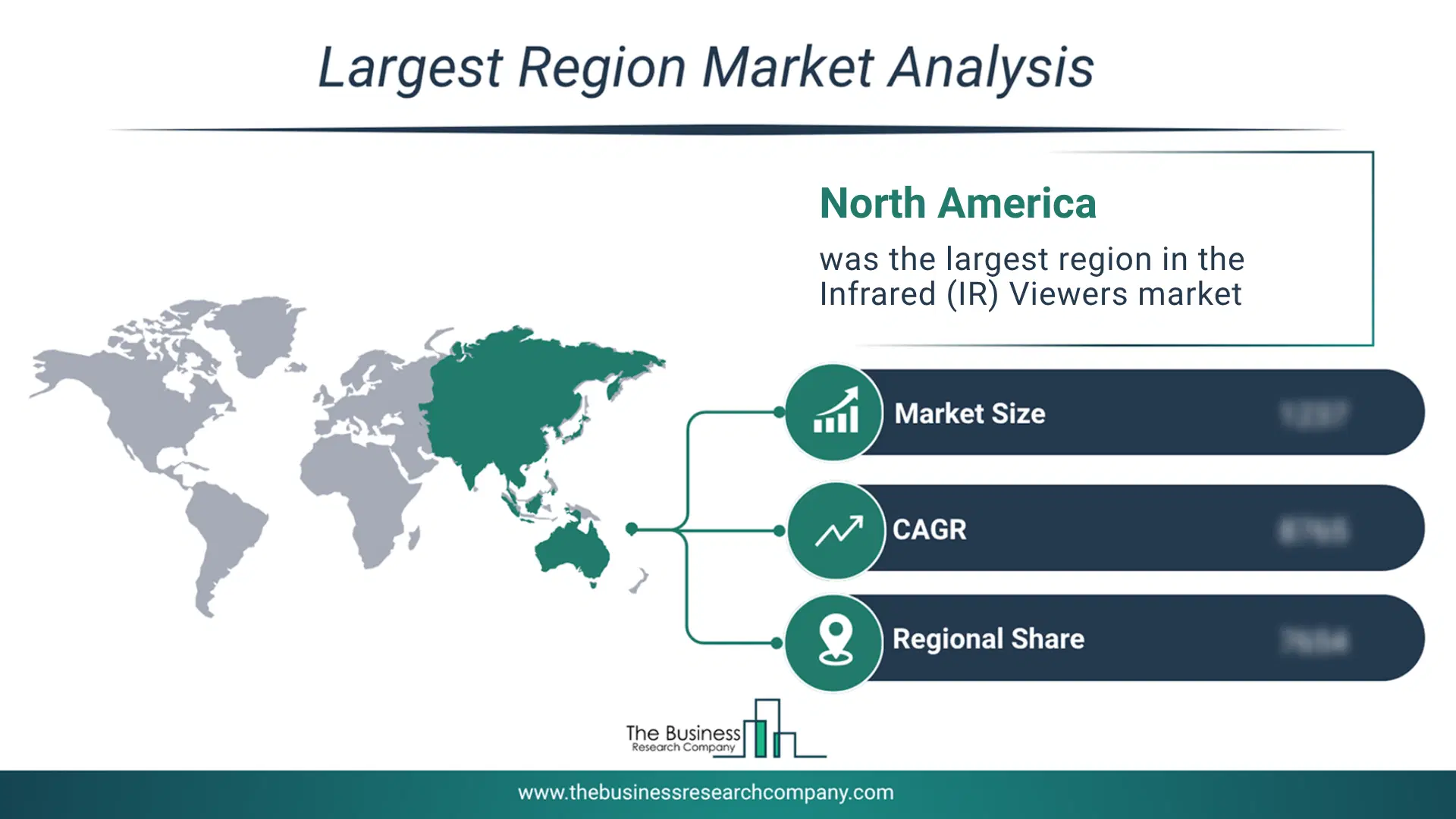
Regional Outlook
North America was the largest region in the infrared (IR) viewers market in 2025. Asia-Pacific is expected to be the fastest-growing region in the forecast period. The regions covered in this market report are Asia-Pacific, South East Asia, Western Europe, Eastern Europe, North America, South America, Middle East and Africa. The countries covered in this market report are Australia, Brazil, China, France, Germany, India, Indonesia, Japan, Taiwan, Russia, South Korea, UK, USA, Italy, Spain, CanadaWhat Defines the Infrared (IR) Viewers Market?
The infrared (IR) viewers market consists of revenues earned by entities by providing services such as thermal imaging and surveillance, inspection and maintenance, research and development support, training and technical support, customization and integration, and leasing and rental services. The market value includes the value of related goods sold by the service provider or included within the service offering. The infrared (IR) viewers market also includes sales of monocular and binocular infrared viewers, fixed infrared viewer systems, vehicle-mounted infrared viewers, and helmet-mounted infrared viewers. Values in this market are ‘factory gate’ values, that is, the value of goods sold by the manufacturers or creators of the goods, whether to other entities (including downstream manufacturers, wholesalers, distributors, and retailers) or directly to end customers. The value of goods in this market includes related services sold by the creators of the goods.How is Market Value Defined and Measured?
The market value is defined as the revenues that enterprises gain from the sale of goods and/or services within the specified market and geography through sales, grants, or donations in terms of the currency (in USD unless otherwise specified). The revenues for a specified geography are consumption values that are revenues generated by organizations in the specified geography within the market, irrespective of where they are produced. It does not include revenues from resales along the supply chain, either further along the supply chain or as part of other products.
This chart presents market attractiveness based on a quantitative evaluation of growth, competition, strategic alignment, and risk, offering a clear view of opportunity areas for decision-making. This chart is for illustrative purposes; the full report contains the complete analysis.

This chart highlights the Total Addressable Market (TAM) by estimating the maximum revenue opportunity using an assumption-driven approach, supporting strategic planning and opportunity sizing across markets. The chart is illustrative; the full report provides a more comprehensive analysis.
What Key Data and Analysis Are Included in the Infrared (IR) Viewers Market Report 2026?
The infrared (ir) viewers market research report is one of a series of new reports from The Business Research Company that provides market statistics, including industry global market size, regional shares, competitors with the market share, detailed market segments, market trends and opportunities, and any further data you may need to thrive in the infrared (ir) viewers industry. The market research report delivers a complete perspective of everything you need, with an in-depth analysis of the current and future state of the industry.Infrared (IR) Viewers Market Report Forecast Analysis
| Report Attribute | Details |
|---|---|
| Market Size Value In 2026 | $1.56 billion |
| Revenue Forecast In 2030 | $2.26 billion |
| Growth Rate | CAGR of 9.9% from 2026 to 2030 |
| Base Year For Estimation | 2025 |
| Actual Estimates/Historical Data | 2020-2025 |
| Forecast Period | 2026 - 2030 |
| Market Representation | Revenue in USD Billion and CAGR from 2026 to 2030 |
| Segments Covered | Type Of Infrared Viewers, Technology, Application, Distribution Channel, End User |
| Regional Scope | Asia-Pacific, Western Europe, Eastern Europe, North America, South America, Middle East, Africa |
| Country Scope | The countries covered in the report are Australia, Brazil, China, France, Germany, India, Indonesia, Japan, Taiwan, Russia, South Korea, UK, USA, Canada, Italy, Spain. |
| Key Companies Profiled | Fluke corporation, Teledyne FLIR LLC, Wuhan Guide Sensmart Tech Co. Ltd., Nippon Avionics Co. Ltd., Lumasense Technologies Inc, Exergen Corporation, Optris Gmbh, Thermoteknix Systems Limited, IRay Technology Co. Ltd, Viper Imaging LLC, Testo SE & Co. KGaA, SatIR Europe, Process Sensors Corporation, ULIRvision Technology Co. Ltd., Workswell s.r.o., Wuhan JOHO Technology Co. Ltd., DIAS Infrared GmbH, InfraTec GmbH Infrarotsensorik und Messtechnik, VisionTIR S.L., NEC Avio Infrared Technologies Co. Ltd |
| Customization Scope | Request for Customization |
| Pricing And Purchase Options | Explore Purchase Options |