
Infrared Night Vision Goggles Market Report 2026
Global Outlook – By Product Type (Intensified Night Vision Goggles, Thermal Imaging Goggles, Digital Night Vision Goggles, Multispectral Goggles), By Technology (First Generation (Gen – , Second Generation (Gen ,, Third Generation (Gen ,, Fourth Generation (Gen ,), By Price Range (Economical (Under $500), Mid-Range ($500 - $1,500), High-End ($1,500 and above)), By Application (Military And Defense, Law Enforcement And Security, Aerospace And Aviation, Hunting And Outdoor Activities, Surveillance And Reconnaissance), By End-User (Government And Military Personnel, Security Agencies, Outdoor Enthusiasts, Commercial Users, Research And Development Institutions) – Market Size, Trends, Strategies, and Forecast to 2030
Infrared Night Vision Goggles Market Overview
• Infrared Night Vision Goggles market size has reached to $3.46 billion in 2025 • Expected to grow to $4.47 billion in 2030 at a compound annual growth rate (CAGR) of 5.2% • Growth Driver: Surge In Security And Surveillance Fueling The Growth Of The Market Due To Rising Urban Safety Concerns And Advanced Monitoring Demands • Market Trend: Advancements In Night Vision Technology Drive Enhanced Operational Capabilities • North America was the largest region in 2025 and Asia-Pacific is the fastest growing region.What Is Covered Under Infrared Night Vision Goggles Market?
Infrared night vision goggles refer to optical devices that enhance visibility in low-light or no-light environments by detecting infrared radiation and converting it into a visible image. These goggles typically use thermal imaging or image intensification technology to provide real-time visual output for military, law enforcement, surveillance, and civilian applications. The main product types of infrared night vision goggles include intensified night vision goggles, thermal imaging goggles, digital night vision goggles, and multispectral goggles. Intensified night vision goggles refer to optical devices that amplify existing light (such as moonlight or starlight) using image intensifier tubes to enable vision in low-light conditions. The multiple technologies are first generation (gen 1), second generation (gen 2), third generation (gen 3), and fourth generation (gen 4), with price ranges given as economical (under $500), mid-range ($500-$1,500), and high-end ($1,500 and above). The various applications are military and defense, law enforcement and security, aerospace and aviation, hunting and outdoor activities, and surveillance and reconnaissance, and they are used by several end-users, such as government and military personnel, security agencies, outdoor enthusiasts, commercial users, and research and development institutions.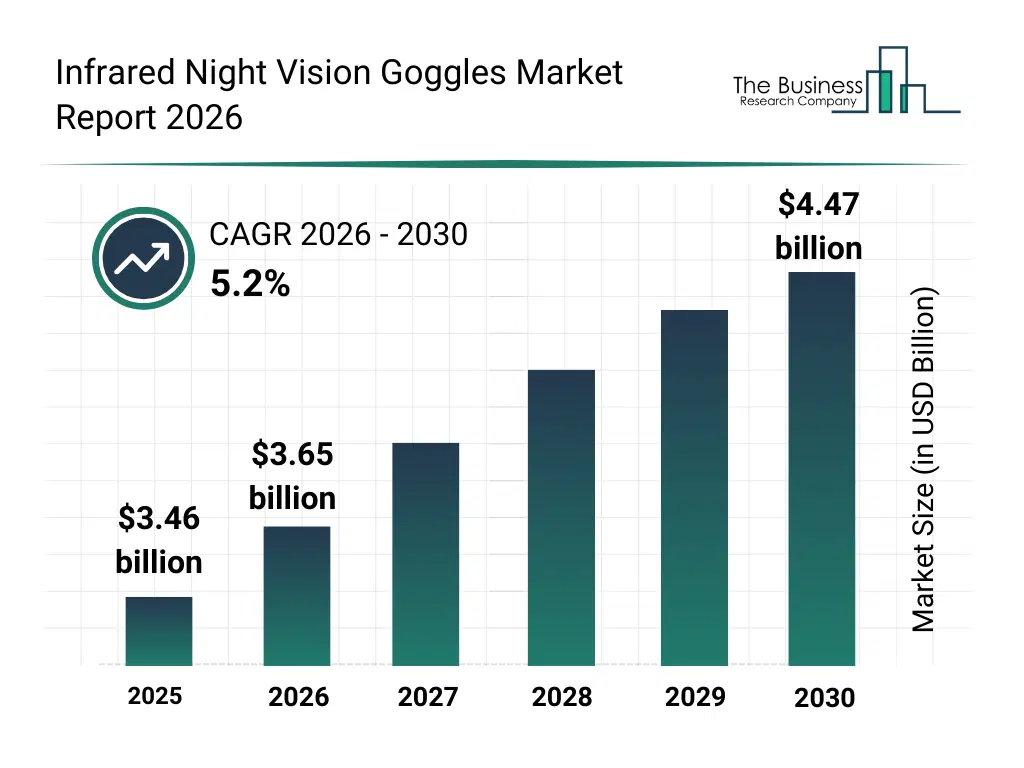
What Is The Infrared Night Vision Goggles Market Size and Share 2026?
The infrared night vision goggles market size has grown strongly in recent years. It will grow from $3.46 billion in 2025 to $3.65 billion in 2026 at a compound annual growth rate (CAGR) of 5.5%. The growth in the historic period can be attributed to increasing military adoption of infrared-based night operations equipment, development of early uncooled thermal imaging technologies, growth in law-enforcement demand for low-light surveillance tools, advancements in ccd sensor performance for improved image clarity, expansion of defense modernization programs incorporating night-vision systems.What Is The Infrared Night Vision Goggles Market Growth Forecast?
The infrared night vision goggles market size is expected to see strong growth in the next few years. It will grow to $4.47 billion in 2030 at a compound annual growth rate (CAGR) of 5.2%. The growth in the forecast period can be attributed to rising demand for lightweight and ergonomic night-vision goggles, increasing integration of tri-spectrum imaging for enhanced situational awareness, growth in border security and critical-infrastructure surveillance needs, technological advancements enabling higher-resolution thermal imaging, expanding civilian and commercial applications such as outdoor safety and search-and-rescue operations. Major trends in the forecast period include growing adoption of multispectral and tri-spectrum night vision systems, rising demand for compact, lightweight, and ruggedized infrared goggles, increased integration of uncooled thermal sensors to reduce costs, advancements in ccd/cmos sensor-based digital night vision technology, expanding civilian and outdoor applications for low-light visibility tools.
Global Infrared Night Vision Goggles Market Segmentation
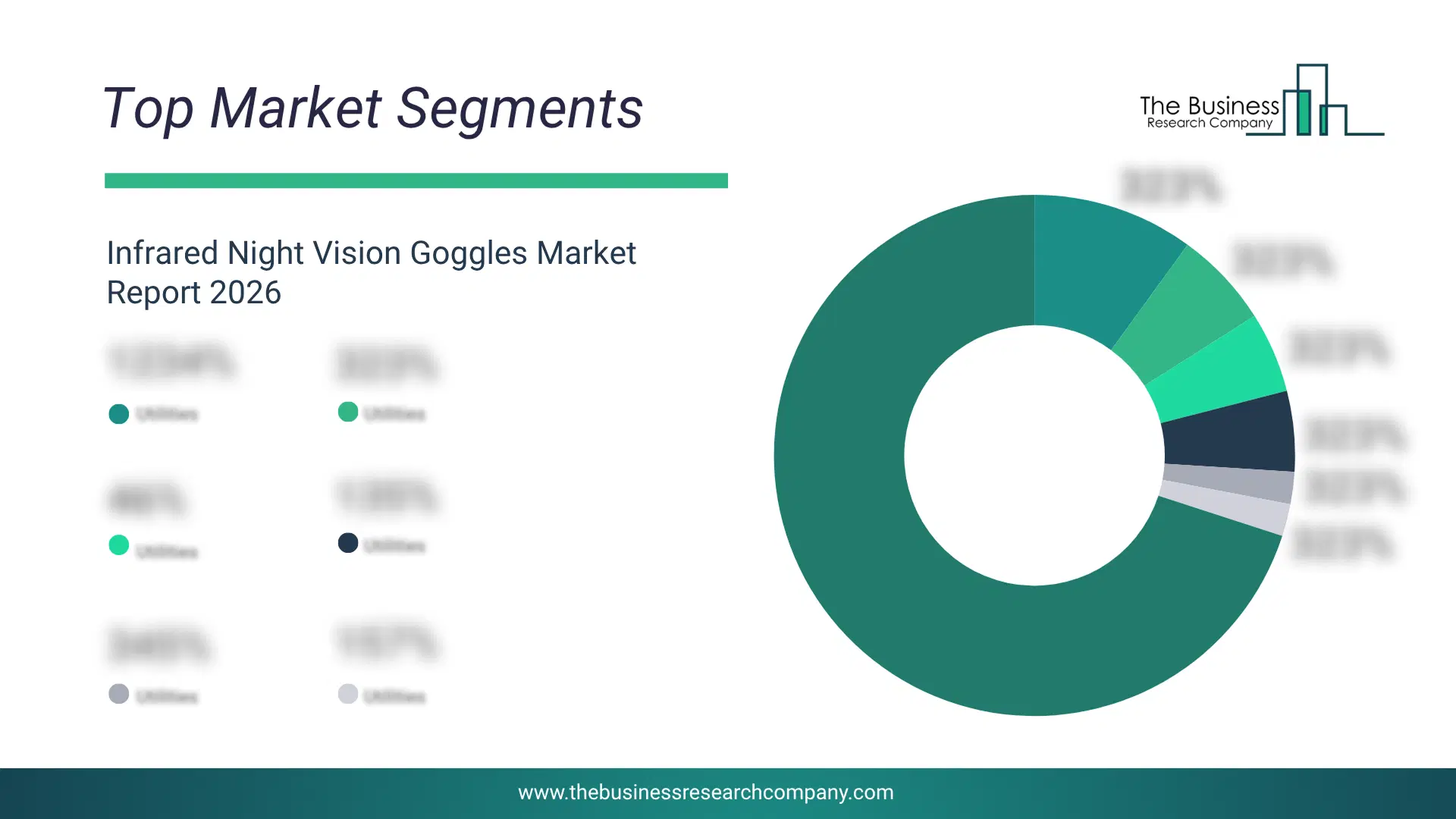
1) By Product Type: Intensified Night Vision Goggles, Thermal Imaging Goggles, Digital Night Vision Goggles, Multispectral Goggles 2) By Technology: First Generation (Gen 1), Second Generation (Gen 2), Third Generation (Gen 3), Fourth Generation (Gen 4) 3) By Price Range: Economical (Under $500), Mid-Range ($500 - $1,500), High-End ($1,500 and above) 4) By Application: Military And Defense, Law Enforcement And Security, Aerospace And Aviation, Hunting And Outdoor Activities, Surveillance And Reconnaissance 5) By End-User: Government And Military Personnel, Security Agencies, Outdoor Enthusiasts, Commercial Users, Research And Development Institutions Subsegments: 1) By Intensified Night Vision Goggles: Generation 1 (Gen 1), Generation 2 (Gen 2), Generation 3 (Gen 3), Generation 4 (Gen 4) 2) By Thermal Imaging Goggles: Cooled Thermal Imaging Goggles, Uncooled Thermal Imaging Goggles 3) By Digital Night Vision Goggles: Complementary Metal-Oxide-Semiconductor (CMOS) Sensor-based Goggles, Charge-Coupled Device (CCD) Sensor-based Goggles 4) By Multispectral Goggles: Dual-Spectrum Goggles, Tri-Spectrum Goggles, Hyperspectral GogglesWhat Is Driver Of The Infrared Night Vision Goggles Market?
The increasing security and surveillance needs are expected to propel the growth of the infrared night vision goggles market going forward. Security and surveillance refer to the systems and practices used to monitor, protect, and ensure the safety of people, property, and information. The rise in security and surveillance needs is due to the increasing urban safety concerns, as higher crime rates and public safety threats push authorities to adopt more advanced monitoring systems. Infrared night vision goggles enhance security and surveillance by allowing personnel to detect and monitor activities in complete darkness, improving visibility in low-light or nighttime conditions where standard cameras or human sight are ineffective. For instance, in September 2024, according to IronmongeryDirect, a UK-based online retailer specializing in ironmongery, 64% of UK local authorities increased surveillance, with 50 councils doubling their CCTV and the average rising to 391 cameras per council. Furthermore, for instance, in January 2024, Comparitech, a UK-based software company, reported that cities average 11 cameras per 1,000 people, with Atlanta leading at over 124 per 1,000. Therefore, the increasing security and surveillance needs are driving the growth of the infrared night vision goggles industry.Key Players In The Global Infrared Night Vision Goggles Market
Major companies operating in the infrared night vision goggles market are Raytheon Technologies Corporation, Northrop Grumman Corporation, BAE Systems plc, Thales Group, L3Harris Technologies Inc., Elbit Systems Ltd., Leonardo DRS Inc., Hensoldt AG, Orpha Optics Technology Co. Ltd., Excelitas Technologies Corp., FLIR Systems Inc., ATN Corporation, Bushnell Corporation, Newcon Optik, American Technologies Network Corp., Night Vision Devices Inc., Armasight Inc., Firefield, LUNA OPTICS, Dedal-NV.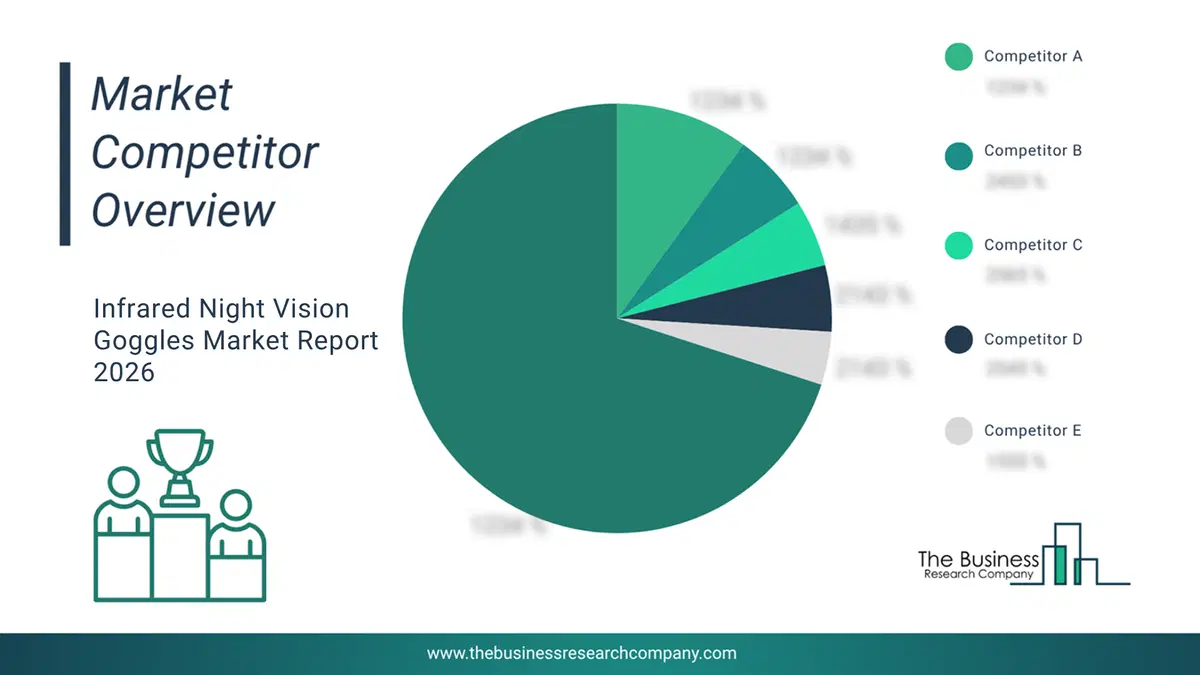
This chart is for illustrative purposes; the full report includes a detailed competitor analysis and comprehensive overview of the top 10 companies in the market.
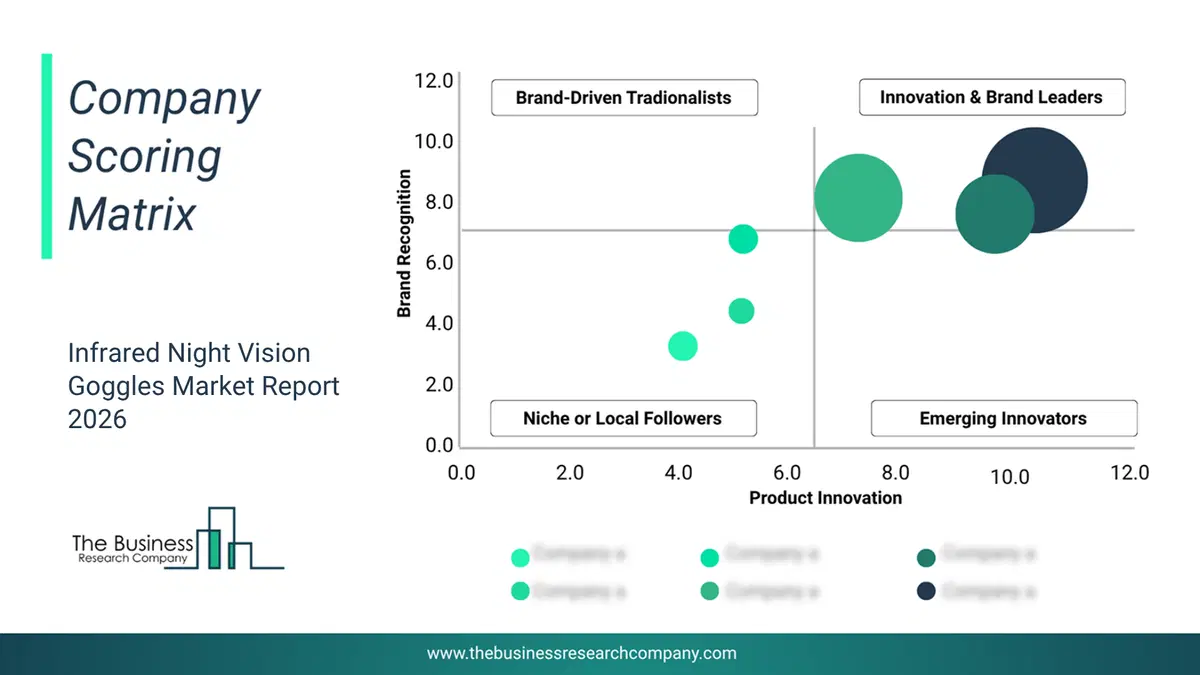
This chart maps companies by product innovation and brand strength, with bubble size indicating relative revenue, helping identify market leaders, challengers, and niche players. This is an illustrative chart; the full report provides a complete and accurate competitive analysis.
Global Infrared Night Vision Goggles Market Trends and Insights
Major companies operating in the infrared night vision goggles market are focused on advanced solutions, such as revolutionary night vision solutions, to enhance image clarity, extend detection ranges, improve durability in harsh environments, and integrate augmented reality features for superior situational awareness and real-time data connectivity. Revolutionary night vision solutions refer to cutting-edge technologies that significantly improve visibility, detection, and user experience in low-light or no-light conditions. For instance, in September 2023, Thermoteknix Systems Ltd., a UK-based optical products manufacturer, introduced the FNVG-AR, a lightweight fused binocular night vision goggle combining advanced 16 mm white phosphor tubes with a high-resolution thermal imager. This innovative device features optical sensor fusion and is uniquely ITAR-free, making it widely accessible. It integrates smoothly with battle management systems to provide live blue force tracking, navigation data, and real-time video from ISR or targeting assets. The FNVG-AR significantly boosts situational awareness for dismounted soldiers while minimizing exposure and detection risks. This launch represents a major advancement in night vision technology for military applications.What Are Latest Mergers And Acquisitions In The Infrared Night Vision Goggles Market? Force Ordnance Partners With Theon Sensors To Boost ADF’s Night Vision And Thermal Imaging Capabilities
In August 2024, Force Ordnance, an Australia-based defense technology company, partnered with Theon Sensors S.A. to provide cutting-edge optical systems to the Australian Defense Force, focusing on the Dismounted Combat Program. This collaboration is designed to boost Australia’s sovereign defense capabilities, especially in night vision and thermal imaging technologies. Theon Sensors S.A. is a Greece-based manufacturer of advanced night vision and thermal imaging systems, including infrared night vision goggles.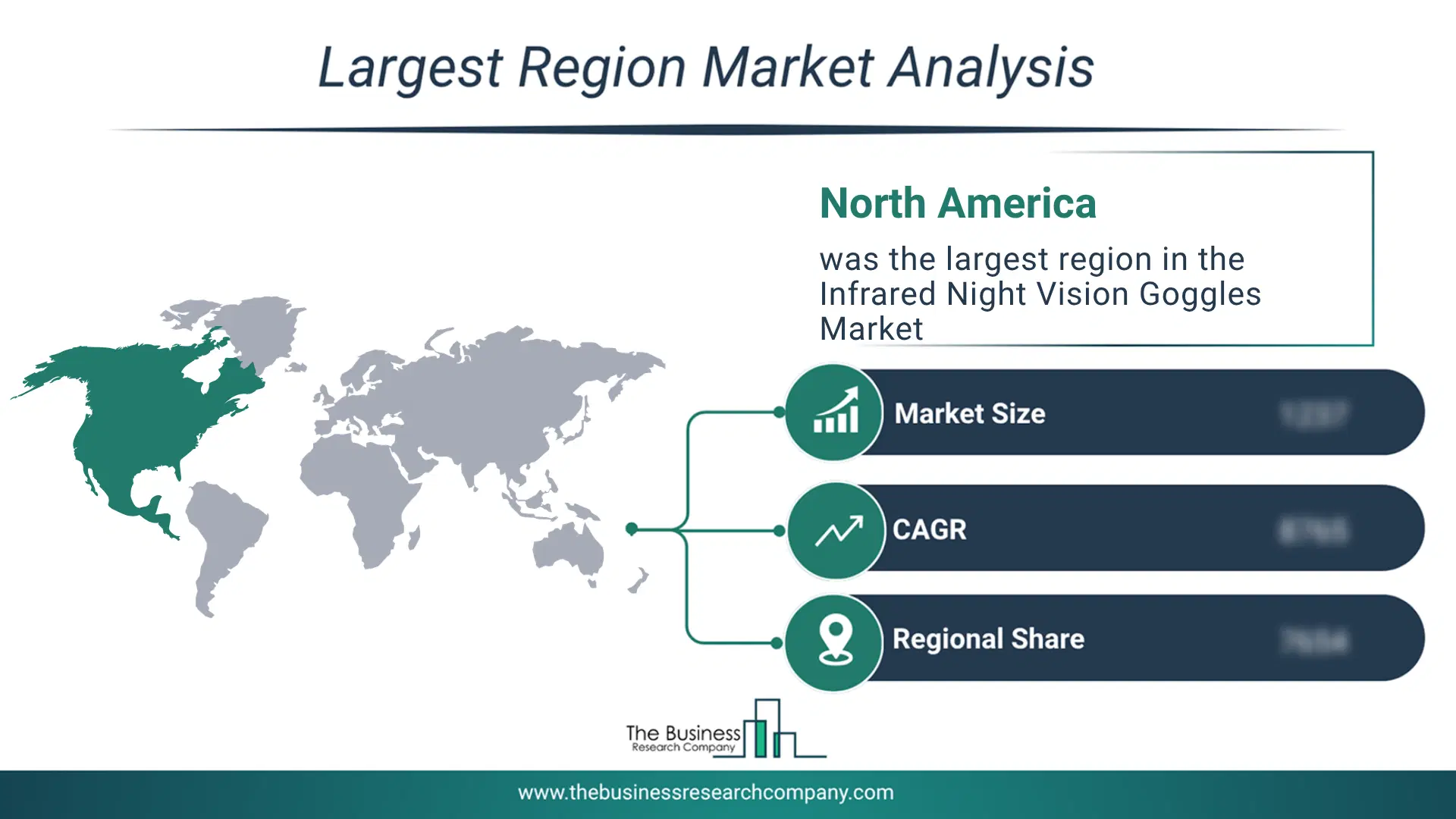
Regional Insights
North America was the largest region in the infrared night vision goggles market in 2025. Asia-Pacific is expected to be the fastest-growing region in the forecast period. The regions covered in this market report are Asia-Pacific, South East Asia, Western Europe, Eastern Europe, North America, South America, Middle East, Africa. The countries covered in this market report are Australia, Brazil, China, France, Germany, India, Indonesia, Japan, Taiwan, Russia, South Korea, UK, USA, Canada, Italy, SpainWhat Defines the Infrared Night Vision Goggles Market?
The infrared night vision goggles market consists of sales of uncooled thermal imaging goggles, charge-coupled device (CCD) sensor-based goggles, and tri-spectrum goggles. Values in this market are ‘factory gate’ values, that is the value of goods sold by the manufacturers or creators of the goods, whether to other entities (including downstream manufacturers, wholesalers, distributors and retailers) or directly to end customers. The value of goods in this market includes related services sold by the creators of the goods.How is Market Value Defined and Measured?
The market value is defined as the revenues that enterprises gain from the sale of goods and/or services within the specified market and geography through sales, grants, or donations in terms of the currency (in USD unless otherwise specified). The revenues for a specified geography are consumption values that are revenues generated by organizations in the specified geography within the market, irrespective of where they are produced. It does not include revenues from resales along the supply chain, either further along the supply chain or as part of other products.
This chart presents market attractiveness based on a quantitative evaluation of growth, competition, strategic alignment, and risk, offering a clear view of opportunity areas for decision-making. This chart is for illustrative purposes; the full report contains the complete analysis.

This chart highlights the Total Addressable Market (TAM) by estimating the maximum revenue opportunity using an assumption-driven approach, supporting strategic planning and opportunity sizing across markets. The chart is illustrative; the full report provides a more comprehensive analysis.
What Key Data and Analysis Are Included in the Infrared Night Vision Goggles Market Report 2026?
The infrared night vision goggles market research report is one of a series of new reports from The Business Research Company that provides market statistics, including industry global market size, regional shares, competitors with the market share, detailed market segments, market trends and opportunities, and any further data you may need to thrive in the infrared night vision goggles industry. The market research report delivers a complete perspective of everything you need, with an in-depth analysis of the current and future state of the industry.Infrared Night Vision Goggles Market Report Forecast Analysis
| Report Attribute | Details |
|---|---|
| Market Size Value In 2026 | $3.65 billion |
| Revenue Forecast In 2030 | $4.47 billion |
| Growth Rate | CAGR of 5.2% from 2026 to 2030 |
| Base Year For Estimation | 2025 |
| Actual Estimates/Historical Data | 2020-2025 |
| Forecast Period | 2026 - 2030 |
| Market Representation | Revenue in USD Billion and CAGR from 2026 to 2030 |
| Segments Covered | Product Type, Technology, Price Range, Application, End-User |
| Regional Scope | Asia-Pacific, Western Europe, Eastern Europe, North America, South America, Middle East, Africa |
| Country Scope | The countries covered in the infrared night vision goggles market report are Australia, Brazil, China, France, Germany, India, Indonesia, Japan, Taiwan, Russia, South Korea, UK, USA, Canada, Italy, Spain |
| Key Companies Profiled | Raytheon Technologies Corporation, Northrop Grumman Corporation, BAE Systems plc, Thales Group, L3Harris Technologies Inc., Elbit Systems Ltd., Leonardo DRS Inc., Hensoldt AG, Orpha Optics Technology Co. Ltd., Excelitas Technologies Corp., FLIR Systems Inc., ATN Corporation, Bushnell Corporation, Newcon Optik, American Technologies Network Corp., Night Vision Devices Inc., Armasight Inc., Firefield, LUNA OPTICS, Dedal-NV. |
| Customization Scope | Request for Customization |
| Pricing And Purchase Options | Explore Purchase Options |