
Infrastructure Construction Market Report 2026
Global Outlook – By Type (Transportation Infrastructure, Energy And Utilities Infrastructure, Water And Waste Management Infrastructure), By Material (Concrete, Steel, Wood, Other Materials), By Construction Method (Traditional Construction, Design-Build, Construction Management At Risk (CMAR), Integrated Project Delivery (IPD), Prefabrication), By Technology Adoption (Conventional Methods, Building Information Modeling (BIM), Smart Construction Technologies, Green Building Technologies, Drones And Robotics), By End-User Sector (Public Sector, Private Sector, Industrial Sector, Commercial Sector, Residential Sector) – Market Size, Trends, Strategies, and Forecast to 2030
Infrastructure Construction Market Overview
• Infrastructure Construction market size has reached to $3561.32 billion in 2025 • Expected to grow to $4284.14 billion in 2030 at a compound annual growth rate (CAGR) of 3.7% • Growth Driver: Increasing Government Investments In Infrastructure Development Driving The Market Growth Due To Rising Urbanization And Economic Development Needs • Market Trend: Advancements In High-Tech Construction Equipment Boost Efficiency, Safety, And Sustainability • North America was the largest region and fastest growing region.Market Gains By 2030 – Top Opportunities By Segment
Market Gain identifies the most promising market opportunities by highlighting the segments or products expected to generate the highest incremental revenue growth over the next five years.
What Is Covered Under Infrastructure Construction Market?
Infrastructure construction is the comprehensive process of planning, designing, and developing essential physical structures and systems that support the functioning of a society or organization. It includes the creation of transportation networks such as roads, bridges, and railways, as well as critical utilities like water supply, sewage systems, energy grids, and communication facilities. This process integrates not only physical construction but also adherence to engineering standards, sustainability, safety, and long-term durability, ensuring resilient and efficient infrastructure. The main types of infrastructure construction are transportation infrastructure, energy and utilities infrastructure, and water and waste management infrastructure. Transportation infrastructure refers to the network of physical systems designed and maintained to enable the efficient movement of people and goods. It utilizes various materials such as concrete, steel, wood, and others, and is executed using construction methods including traditional construction, design-build, construction management at risk (CMAR), integrated project delivery (IPD), and prefabrication. Technology adoption in infrastructure construction includes conventional methods, building information modeling (BIM), smart construction technologies, green building technologies, and drones and robotics, and serves end-user sectors across the public sector, private sector, industrial sector, commercial sector, and residential sector.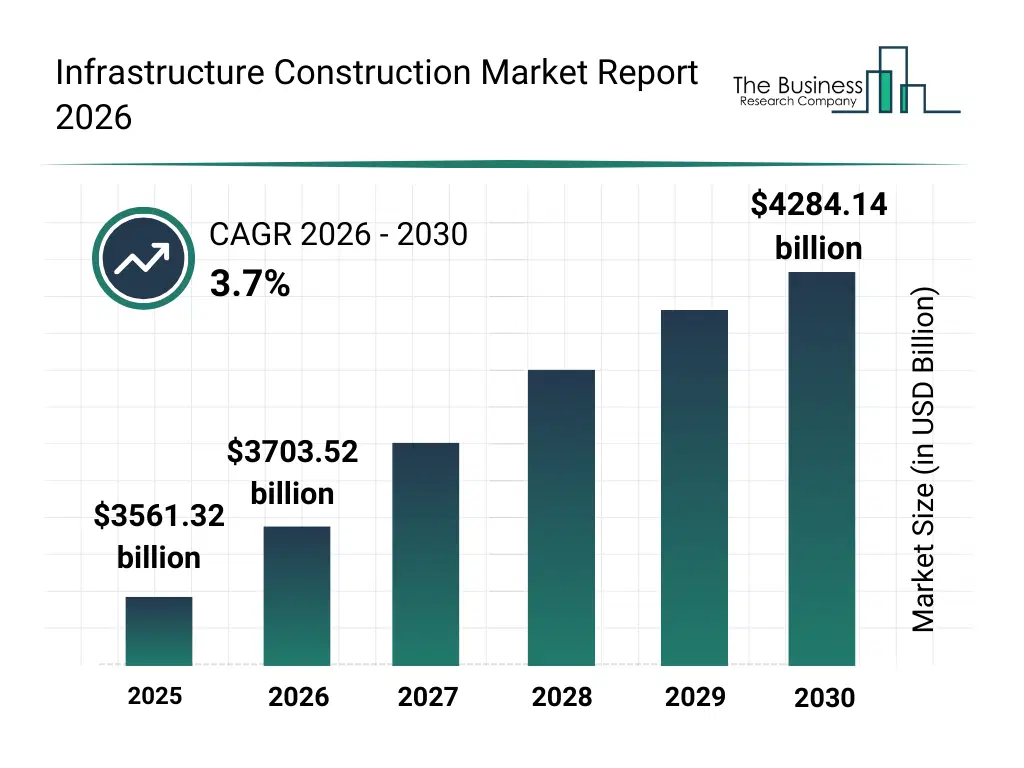
What Is The Infrastructure Construction Market Size and Share 2026?
The infrastructure construction market size has grown steadily in recent years. It will grow from $3561.32 billion in 2025 to $3703.52 billion in 2026 at a compound annual growth rate (CAGR) of 4.0%. The growth in the historic period can be attributed to rising urbanization and population growth, increased government infrastructure spending, growing private sector investment in industrial and commercial facilities, development of transportation networks, rising adoption of conventional construction techniques.What Is The Infrastructure Construction Market Growth Forecast?
The infrastructure construction market size is expected to see steady growth in the next few years. It will grow to $4284.14 billion in 2030 at a compound annual growth rate (CAGR) of 3.7%. The growth in the forecast period can be attributed to increasing adoption of smart construction technologies, integration of green building and sustainable methods, growth in modular and prefabricated infrastructure, rising use of BIM and digital planning tools, expansion of automated and robotic construction processes. Major trends in the forecast period include deployment of smart infrastructure monitoring systems, adoption of AI-driven project planning tools, integration of modular infrastructure solutions, expansion of IOT-connected utilities and transportation networks, implementation of predictive maintenance and analytics.
Global Infrastructure Construction Market Segmentation
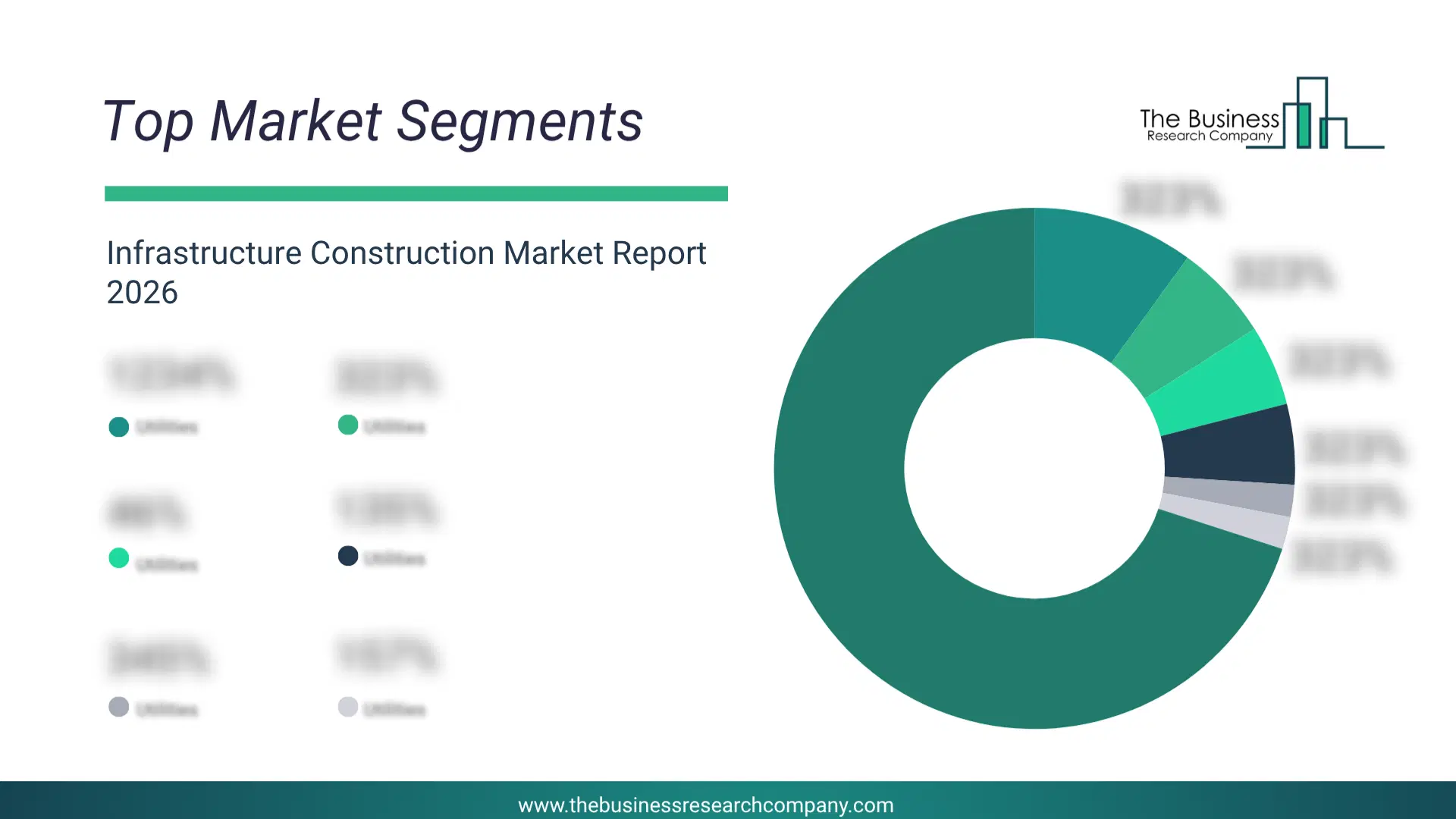
1) By Type: Transportation Infrastructure, Energy And Utilities Infrastructure, Water And Waste Management Infrastructure 2) By Material: Concrete, Steel, Wood, Other Materials 3) By Construction Method: Traditional Construction, Design-Build, Construction Management At Risk (CMAR), Integrated Project Delivery (IPD), Prefabrication 4) By Technology Adoption: Conventional Methods, Building Information Modeling (BIM), Smart Construction Technologies, Green Building Technologies, Drones And Robotics 5) By End-User Sector: Public Sector, Private Sector, Industrial Sector, Commercial Sector, Residential Sector Subsegments: 1) By Transportation Infrastructure: Roads And Highways Construction, Bridges And Tunnels Construction, Railways Construction, Airports And Ports Construction 2) By Energy And Utilities Infrastructure: Power Plants Construction, Renewable Energy Infrastructure, Oil And Gas Pipelines, Electricity Transmission And Distribution Networks 3) By Water And Waste Management Infrastructure: Dams And Reservoirs Construction, Sewage And Wastewater Treatment Facilities, Water Supply Systems, Waste Management And Recycling Facilities The top segments in the infrastructure construction market will be: • Energy And Utilities Infrastructure will reach $2182.14 Billion by 2030. • Transportation Infrastructure will reach $1298.43 Billion by 2030. • Water And Waste Management Infrastructure will reach $949.15 Billion by 2030.What Is The Driver Of The Infrastructure Construction Market?
The increasing government investments in infrastructure development are expected to propel the growth of the infrastructure construction market going forward. The rising government investments in infrastructure are mainly due to the need to modernize aging infrastructure systems, as outdated facilities in developed nations require significant renovation and replacement to meet current safety standards and support economic growth. Government investments support infrastructure construction by providing the necessary funding, resources, and policy backing that enable the planning, development, and timely completion of projects, while also attracting private sector participation and ensuring long-term maintenance and sustainability. For instance, in July 2025, according to the Office for National Statistics (ONS), a UK-based government department, total general government investment in infrastructure increased by 2.2% to $38.54 billion (£28.9 billion) at current prices in 2024, compared with 2023. Therefore, the increasing government investments in infrastructure development are driving the growth of the infrastructure construction industry.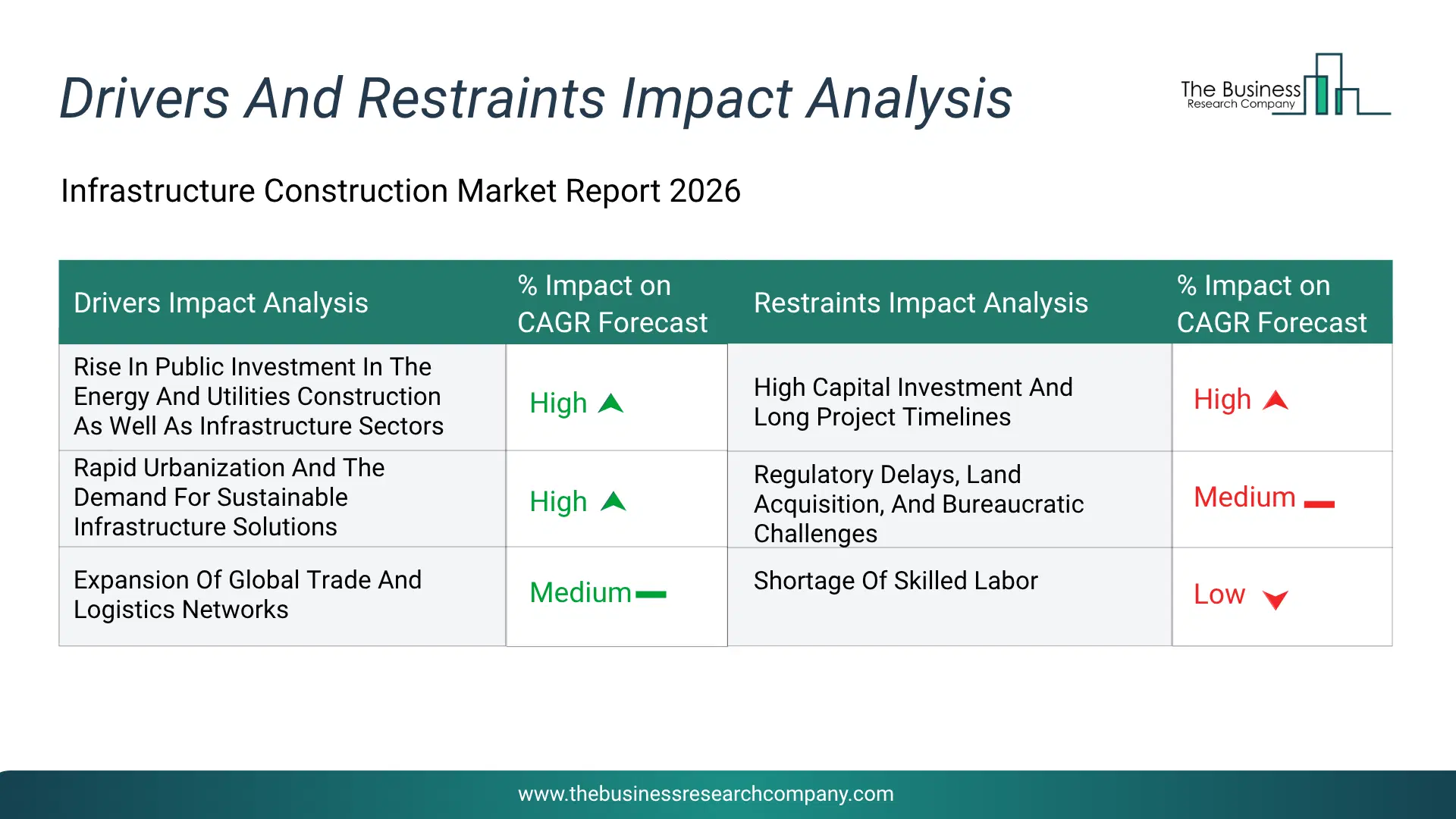
Infographic Chart Showing Key Market Drivers Analysis And Restraints For Infrastructure Construction Market
The chart presents an impact analysis of key drivers and restraints, quantifying their relative influence on the market's growth rate and helping assess the balance between growth enablers and limiting factors. This chart offers a high-level perspective; the full report contains more detailed insights.
How Will The Drivers Impact Growth In The Global Infrastructure Construction Market?
• Rise In Public Investment In The Energy And Utilities Construction As Well As Infrastructure Sectors (High) – During the forecast period, the rise in public investment in the energy and utilities construction as well as infrastructure sectors is expected to become a key growth driver for the infrastructure construction market by 2030. Rise in public investment in energy, utilities, and infrastructure projects serves as a major growth driver for the infrastructure construction market. Governments worldwide are allocating larger budgets toward transportation networks, power generation facilities, water treatment systems, and public utilities. These investments create substantial opportunities for construction companies, engineering firms, and material suppliers. Public funding accelerates the execution of large-scale projects that improve national infrastructure capacity. It also stimulates private sector participation through public-private partnerships and long-term development programs. Increased spending on modernization and expansion projects boosts demand for construction equipment and skilled labor. • Rapid Urbanization And The Demand For Sustainable Infrastructure Solutions (High) – During the forecast period, the rapid urbanization and the demand for sustainable infrastructure solutions is expected to emerge as a major factor driving the expansion of the infrastructure construction market by 2030. Rapid urbanization is significantly driving the growth of the infrastructure construction market as cities expand to accommodate growing populations. Increasing migration toward urban areas creates demand for roads, bridges, public transportation systems, housing developments, and utility networks. Governments and developers are investing in modern infrastructure to support economic activities and improve living standards. At the same time, there is rising demand for sustainable infrastructure that minimizes environmental impact and promotes resource efficiency. Green buildings, smart city projects, and energy-efficient transportation systems are becoming essential components of urban development. This trend encourages the adoption of innovative construction technologies and materials. • Expansion Of Global Trade And Logistics Networks (Medium) – During the forecast period, the expansion of global trade and logistics networks is expected to act as a key growth catalyst for the infrastructure construction market by 2030. Expansion of global trade and logistics networks acts as a strong driver for the infrastructure construction market by increasing the need for efficient transportation and distribution facilities. Growing international trade volumes require the development of ports, airports, railways, highways, and logistics hubs. Businesses depend on modern infrastructure to ensure smooth movement of goods across regions and countries. Governments are investing in connectivity projects to strengthen supply chains and enhance economic competitiveness. The growth of e-commerce and cross-border trade further increases demand for warehousing and transportation infrastructure. Construction companies benefit from large-scale projects aimed at improving logistics efficiency and reducing transit times.How Will The Restraints Impact Growth In The Global Infrastructure Construction Market?
• High Capital Investment And Long Project Timelines (High) – During the forecast period, the high capital investment requirements and long project timelines act as significant restraints on the infrastructure construction market. Large-scale infrastructure projects require substantial financial resources for planning, design, land development, materials, equipment, and labor. Securing funding can be challenging, particularly in developing regions where budget constraints and financing limitations exist. Additionally, infrastructure projects often take several years to complete, delaying revenue generation and increasing financial risks for investors and contractors. Extended construction periods also expose projects to inflation, material price fluctuations, and changing market conditions. These factors can reduce project viability and discourage new investments. As a result, high upfront costs and lengthy development cycles can slow overall market growth. • Regulatory Delays, Land Acquisition, And Bureaucratic Challenges (High) – During the forecast period, the regulatory delays, land acquisition issues, and bureaucratic challenges represent major obstacles for the infrastructure construction market. Infrastructure projects typically require multiple approvals, environmental clearances, and compliance with various government regulations before construction can begin. Lengthy approval processes often delay project execution and increase administrative costs. Land acquisition can also become complex due to ownership disputes, compensation negotiations, and community opposition. Bureaucratic inefficiencies may further slow decision-making and project implementation. These delays can lead to cost overruns, contractual complications, and uncertainty for investors and developers. Consequently, regulatory and administrative challenges can significantly hinder the timely growth and expansion of the infrastructure construction market. • Shortage Of Skilled Labor (Medium) – During the forecast period, the shortage of skilled labor acts as a significant restraint on the infrastructure construction market by limiting the availability of qualified workers required for complex construction projects. Increasing demand for specialized engineers, project managers, equipment operators, and skilled tradespeople often exceeds the available workforce in many regions. Labor shortages can lead to project delays, reduced productivity, and higher wage costs for contractors. Insufficient skilled personnel may also affect construction quality and increase the likelihood of safety incidents and rework. Companies are often required to invest heavily in workforce training and recruitment to address talent gaps. These additional costs and operational challenges reduce overall project efficiency. As a result, the shortage of skilled labor hinders the growth and timely execution of infrastructure construction projects.Key Players In The Global Infrastructure Construction Market
Major companies operating in the infrastructure construction market are China State Construction Engineering Corporation Ltd., China Communications Construction Company Limited, Power Construction Corporation of China, Vinci SA, Bouygues Construction SA, Hochtief AG, Hyundai Engineering & Construction Co. Ltd., Larsen & Toubro Limited, Kajima Corporation, Kiewit Corporation, Bechtel Corporation, Skanska AB, Obayashi Corporation, Fluor Corporation, Shimizu Corporation, Balfour Beatty plc, Ferrovial S.A., Laing O’Rourke Group Ltd., ACS Actividades de Construcción y Servicios S.A., Technip Energies N.V.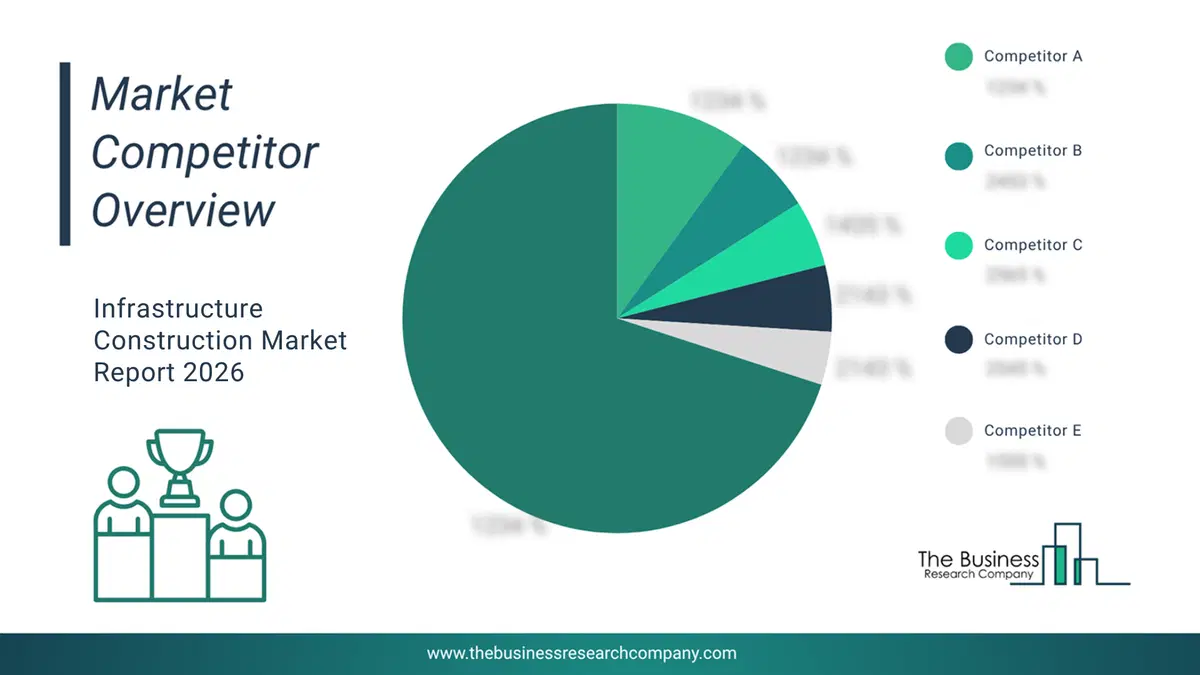
This chart is for illustrative purposes; the full report includes a detailed competitor analysis and comprehensive overview of the top 10 companies in the market.
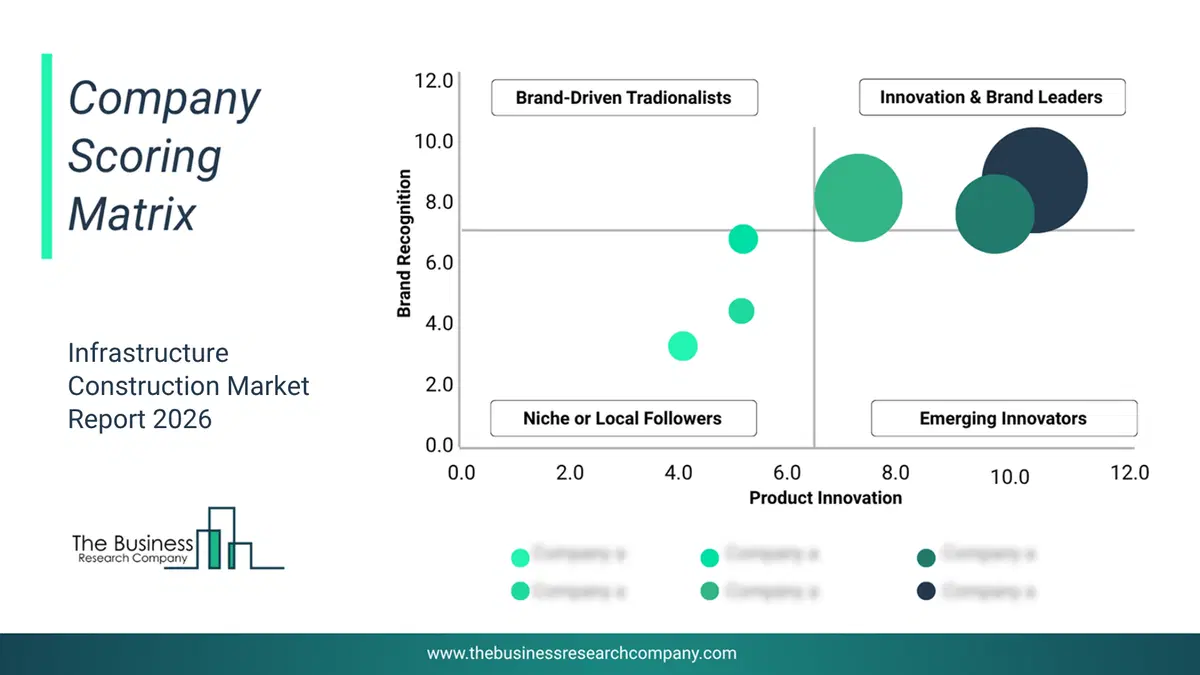
This chart maps companies by product innovation and brand strength, with bubble size indicating relative revenue, helping identify market leaders, challengers, and niche players. This is an illustrative chart; the full report provides a complete and accurate competitive analysis.
Global Infrastructure Construction Market Trends and Insights
Major companies operating in the infrastructure construction market are focusing on developing innovative products such as high-tech construction equipment to improve efficiency, productivity, and safety on worksites. High-tech construction equipment refers to machinery equipped with advanced technologies such as automation, telematics, and intelligent engines, designed to boost productivity, enhance operator safety, reduce fuel consumption, and enable real-time monitoring for more efficient project management. For instance, in January 2025, CASE India, an India-based machinery manufacturing company, unveiled seven new construction equipment models at the Bharat Construction Equipment Expo, including two advanced vibratory compactors and five versatile machines. Powered by the in-house F28 engine, compliant with Bharat Stage CEV V emission norms, these models offer enhanced fuel efficiency and productivity. Integrated with the myCASE Construction smart telematics platform, they enable real-time monitoring, fuel tracking, usage analysis, and remote troubleshooting, ensuring optimal performance and minimal downtime.What Are Latest Mergers And Acquisitions In The Infrastructure Construction Market?
In November 2024, Parsons Corporation, a US-based technology and infrastructure company, acquired BCC Engineering, LLC for $230 million. With this acquisition, Parsons aims to strengthen its position as an infrastructure leader and expand its reach in the Southeastern United States, enhancing its capabilities in transportation, civil, and structural engineering while positioning the company to capitalize on federal infrastructure funding opportunities under the Infrastructure Investment and Jobs Act. BCC Engineering LLC is a US-based construction engineering company that specializes in providing infrastructure construction services.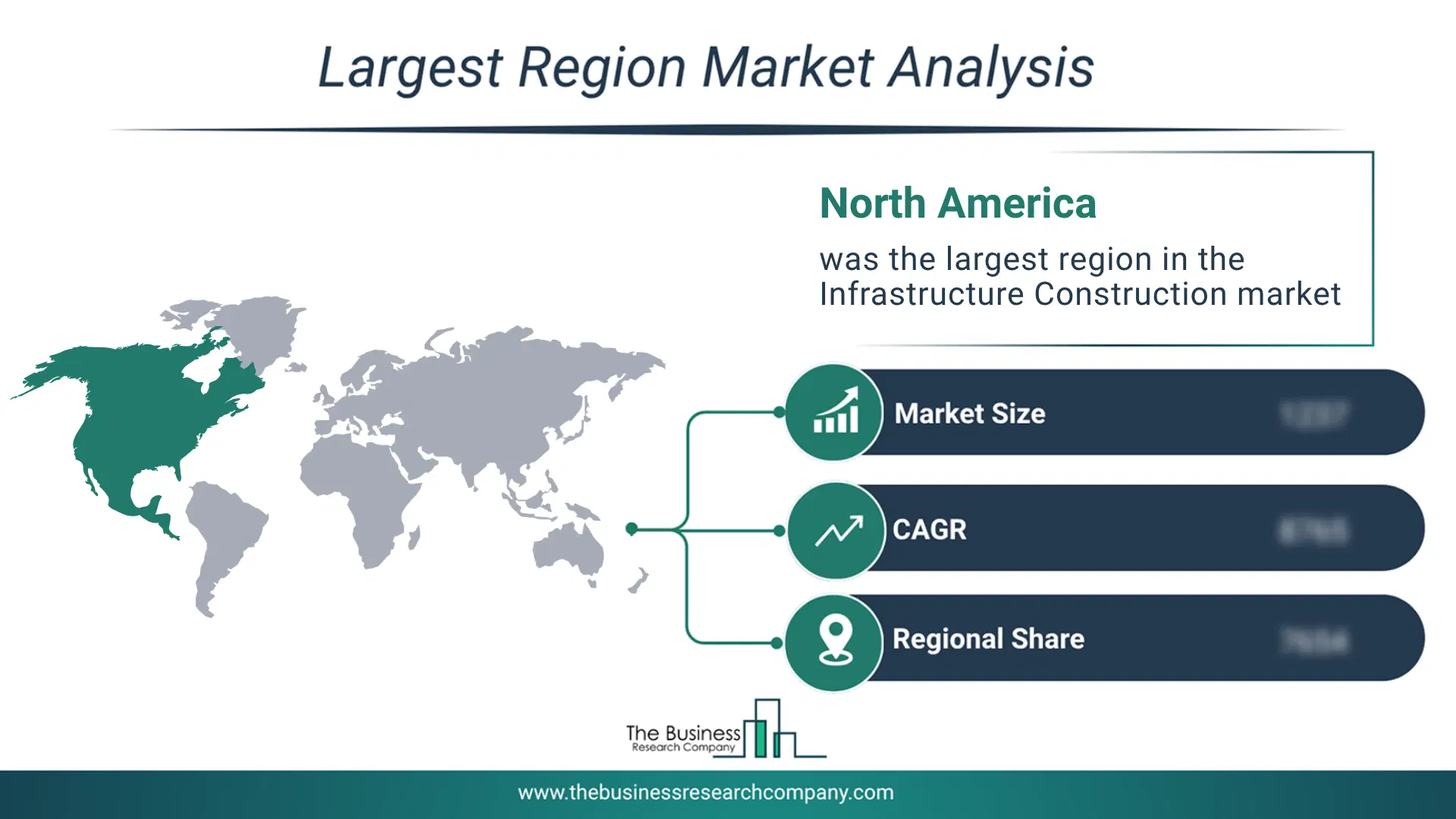
Regional Insights
North America was the largest region in the infrastructure construction market in 2025. Asia-Pacific is expected to be the fastest-growing region in the forecast period. The regions covered in this market report are Asia-Pacific, South East Asia, Western Europe, Eastern Europe, North America, South America, Middle East, Africa. The countries covered in this market report are Australia, Brazil, China, France, Germany, India, Indonesia, Japan, Taiwan, Russia, South Korea, UK, USA, Canada, Italy, Spain.What Defines the Infrastructure Construction Market?
The infrastructure construction market includes revenues earned by providing services such as project management, surveying and geotechnical services, environmental and regulatory compliance, equipment and material supply, rehabilitation and maintenance, and operations management of completed infrastructure. The market value includes the value of related goods sold by the service provider or included within the service offering. Only goods and services traded between entities or sold to end consumers are included.How is Market Value Defined and Measured?
The market value is defined as the revenues that enterprises gain from the sale of goods and/or services within the specified market and geography through sales, grants, or donations in terms of the currency (in USD unless otherwise specified). The revenues for a specified geography are consumption values that are revenues generated by organizations in the specified geography within the market, irrespective of where they are produced. It does not include revenues from resales along the supply chain, either further along the supply chain or as part of other products.
This chart presents market attractiveness based on a quantitative evaluation of growth, competition, strategic alignment, and risk, offering a clear view of opportunity areas for decision-making. This chart is for illustrative purposes; the full report contains the complete analysis.

This chart highlights the Total Addressable Market (TAM) by estimating the maximum revenue opportunity using an assumption-driven approach, supporting strategic planning and opportunity sizing across markets. The chart is illustrative; the full report provides a more comprehensive analysis.
What Key Data and Analysis Are Included in theInfrastructure Construction Market Report 2026?
The infrastructure construction market research report is one of a series of new reports from The Business Research Company that provides market statistics, including industry global market size, regional shares, competitors with the market share, detailed market segments, market trends and opportunities, and any further data you may need to thrive in the infrastructure construction industry. The market research report delivers a complete perspective of everything you need, with an in-depth analysis of the current and future state of the industry.Infrastructure Construction Market Report Forecast Analysis
| Report Attribute | Details |
|---|---|
| Market Size Value In 2026 | $3703.52 billion |
| Revenue Forecast In 2030 | $4284.14 billion |
| Growth Rate | CAGR of 4.0% from 2026 to 2030 |
| Base Year For Estimation | 2025 |
| Actual Estimates/Historical Data | 2020-2025 |
| Forecast Period | 2026 - 2030 |
| Market Representation | Revenue in USD Billion and CAGR from 2026 to 2030 |
| Segments Covered | Type, Material, Construction Method, Technology Adoption, End-User Sector |
| Regional Scope | Asia-Pacific, Western Europe, Eastern Europe, North America, South America, Middle East, Africa |
| Country Scope | The countries covered in the report are Australia, Brazil, China, France, Germany, India, ... |
| Key Companies Profiled | China State Construction Engineering Corporation Ltd., China Communications Construction Company Limited, Power Construction Corporation of China, Vinci SA, Bouygues Construction SA, Hochtief AG, Hyundai Engineering & Construction Co. Ltd., Larsen & Toubro Limited, Kajima Corporation, Kiewit Corporation, Bechtel Corporation, Skanska AB, Obayashi Corporation, Fluor Corporation, Shimizu Corporation, Balfour Beatty plc, Ferrovial S.A., Laing O’Rourke Group Ltd., ACS Actividades de Construcción y Servicios S.A., Technip Energies N.V. |
| Customization Scope | Request for Customization |
| Pricing And Purchase Options | Explore Purchase Options |