
Infrastructure Resilience Digital Twin Market Report 2026
Global Outlook – By Component (Software, Hardware, Services), By Deployment Mode (On-Premises, Cloud), By Application (Disaster Management, Asset Management, Risk Assessment, Urban Planning, Other Applications), By End-User (Government, Utilities, Transportation, Energy And Power, Construction, Other End-Users) – Market Size, Trends, Strategies, and Forecast to 2030
Infrastructure Resilience Digital Twin Market Overview
• Infrastructure Resilience Digital Twin market size has reached to $2.49 billion in 2025 • Expected to grow to $8.71 billion in 2030 at a compound annual growth rate (CAGR) of 28.5% • Growth Driver: Rising Climate-Related Natural Disasters Fueling The Growth Of The Market Due To Increasing Operational Risks And Demand For Real-Time Monitoring • Market Trend: Integration Of Digital Twins With Disaster Management Platforms • North America was the largest region in 2025 and Asia-Pacific is the fastest growing region.What Is Covered Under Infrastructure Resilience Digital Twin Market?
Infrastructure resilience digital twin is a technology-enabled solution that uses real-time data, simulation models, and advanced analytics to create virtual replicas of physical infrastructure assets such as bridges, power grids, transportation networks, water systems, and smart cities. It helps to enhance infrastructure reliability, predict potential failures, optimize maintenance strategies, and strengthen resilience against natural disasters, cyber threats, and operational disruptions. It also improves decision-making through scenario analysis, reduces downtime, supports sustainability initiatives, and accelerates digital transformation across critical infrastructure sectors. The main components of infrastructure resilience digital twin market include software, hardware, and services. Software refers to simulation and analytics platforms that create digital replicas of infrastructure assets to assess resilience and risk scenarios. These are deployed through on-premises and cloud modes for applications including disaster management, asset management, risk assessment, urban planning, and other applications. These are adopted by government, utilities, transportation, energy and power, construction, and other end-users.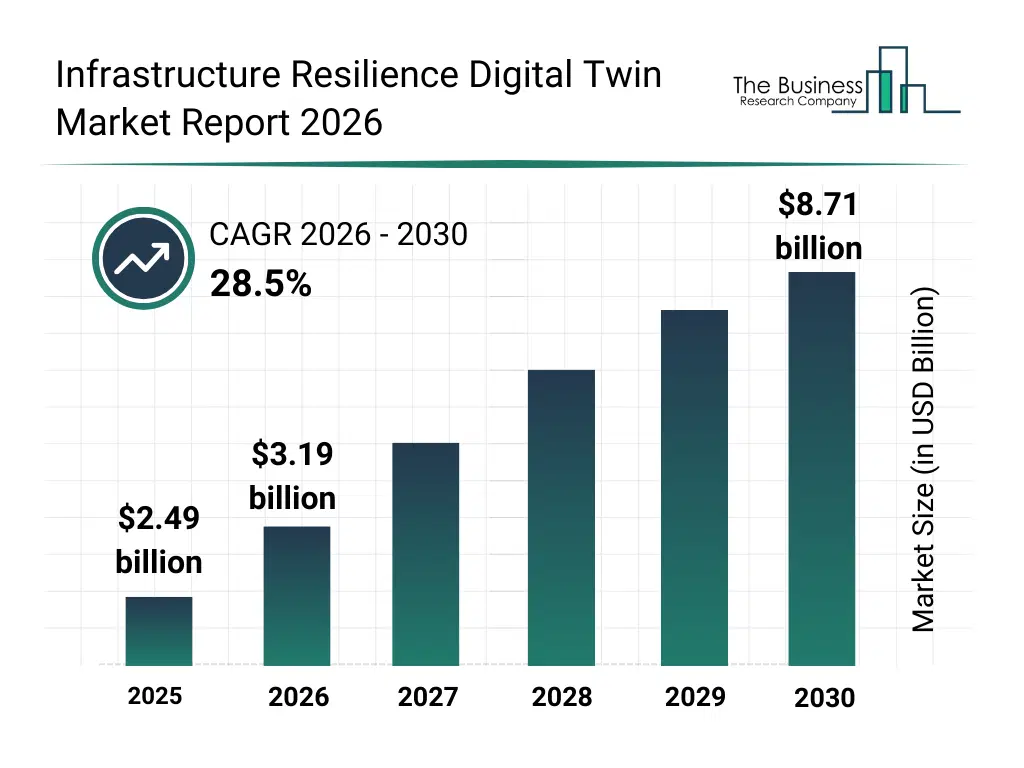
What Is The Infrastructure Resilience Digital Twin Market Size and Share 2026?
The infrastructure resilience digital twin market size has grown exponentially in recent years. It will grow from $2.49 billion in 2025 to $3.19 billion in 2026 at a compound annual growth rate (CAGR) of 28.3%. The growth in the historic period can be attributed to rising urbanization and infrastructure development, increasing frequency of natural disasters, growing adoption of smart city initiatives, need for operational efficiency in utilities and transportation, technological advancements in sensors and data acquisition.What Is The Infrastructure Resilience Digital Twin Market Growth Forecast?
The infrastructure resilience digital twin market size is expected to see exponential growth in the next few years. It will grow to $8.71 billion in 2030 at a compound annual growth rate (CAGR) of 28.5%. The growth in the forecast period can be attributed to increasing government investment in resilient infrastructure, growing adoption of ai-driven analytics, expansion of cloud-based infrastructure monitoring, rising demand for predictive maintenance solutions, integration with edge computing and real-time data processing. Major trends in the forecast period include growing adoption of predictive maintenance analytics, increasing use of simulation-based planning tools, rising integration with cloud and iot platforms, expansion of real-time monitoring and visualization dashboards, growing focus on infrastructure risk assessment and resilience planning.
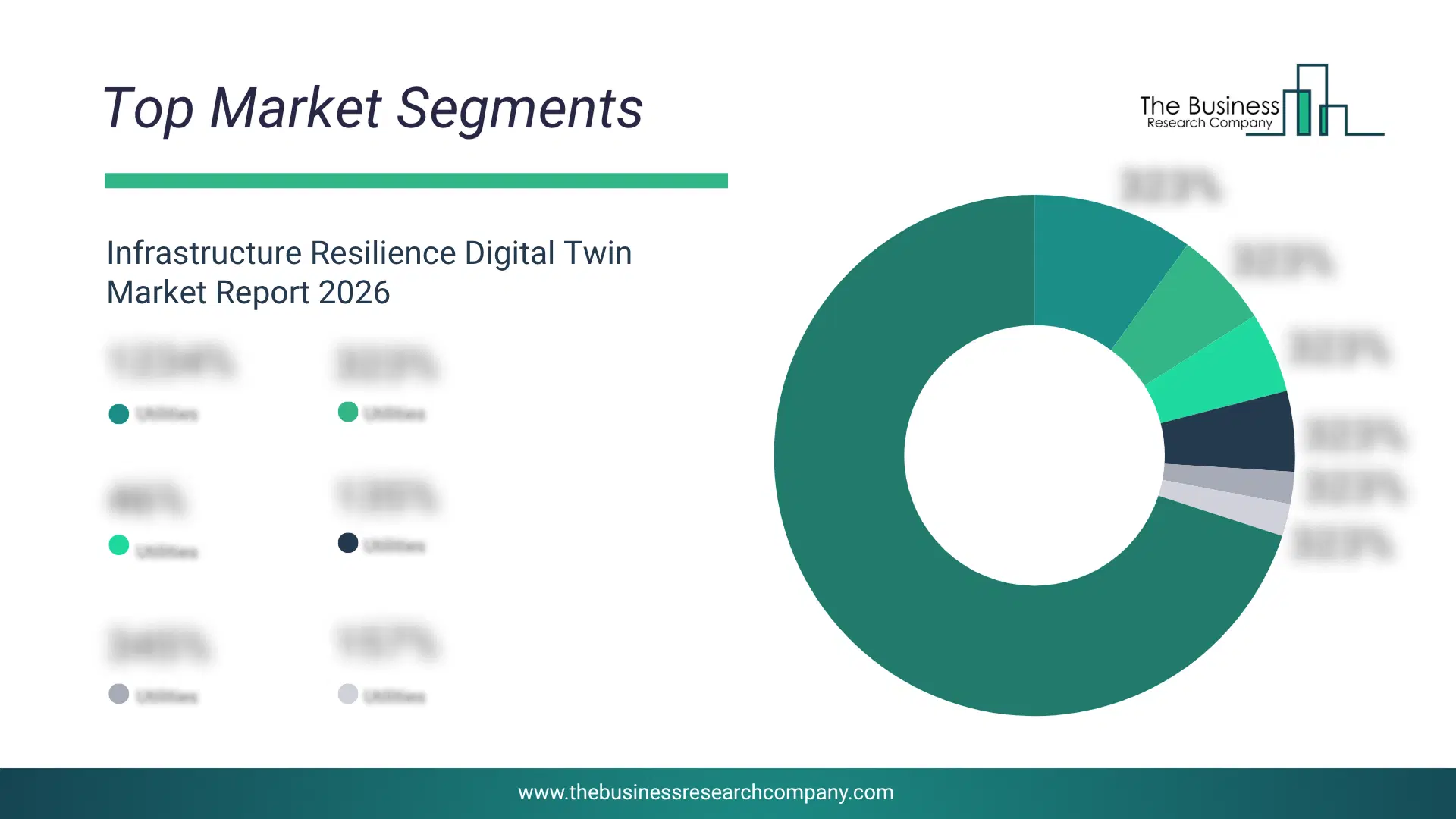
Global Infrastructure Resilience Digital Twin Market Segmentation
1) By Component: Software, Hardware, Services 2) By Deployment Mode: On-Premises, Cloud 3) By Application: Disaster Management, Asset Management, Risk Assessment, Urban Planning, Other Applications 4) By End-User: Government, Utilities, Transportation, Energy And Power, Construction, Other End-Users Subsegments: 1) By Software: Simulation And Scenario Modeling Platforms, Advanced Analytics And Visualization Platforms, Artificial Intelligence Driven Risk Prediction Software, Geospatial Mapping And Spatial Analysis Platforms, Infrastructure Performance Monitoring Software 2) By Hardware: Environmental And Structural Sensors, Real Time Data Acquisition Devices, Edge Computing Processing Units, Communication And Data Transmission Equipment, Infrastructure Monitoring Hardware 3) By Services: Consulting And Advisory Services, System Integration And Deployment Services, Maintenance And Technical Support Services, Training And Capacity Building Services, Managed Infrastructure Resilience ServicesWhat Is The Driver Of The Infrastructure Resilience Digital Twin Market?
The rising frequency of climate-related natural disasters is expected to propel the growth of the infrastructure resilience digital twin market going forward. Natural disasters refer to extreme weather-driven events such as floods, storms, droughts, and heatwaves that disrupt infrastructure systems and increase operational risks. The frequency of climate-related natural disasters is increasing due to the accelerating global temperature rise that intensifies weather variability and hazard severity. Infrastructure resilience digital twins help address the rising frequency of climate-related natural disasters by providing real-time simulation, monitoring, and predictive analysis of critical assets, making them ideal for cities, utilities, and industrial facilities. They reduce risk exposure and response times while improving decision-making and maintenance planning, enhancing overall infrastructure safety and disaster preparedness. For instance, in April 2025, according to the United Nations Office for Disaster Risk Reduction, a Switzerland-based UN disaster agency, around 393 disasters were reported worldwide, collectively causing 16,753 deaths, affecting over 167 million people, and resulting in nearly US$242 billion in economic damages. Therefore, the rising frequency of climate-related natural disasters is driving the growth of the infrastructure resilience digital twin industry.Key Players In The Global Infrastructure Resilience Digital Twin Market
Major companies operating in the infrastructure resilience digital twin market are Siemens AG, International Business Machines Corporation, Oracle Corporation, Schneider Electric SE, Honeywell International Inc., Dassault Systèmes SE, Hexagon AB, Autodesk Incorporated, Kongsberg Digital AS, DJI Enterprise Technology Corporation, Trimble Inc., Ansys Incorporated, Parametric Technology Corporation, Esri International Incorporated, Bentley Systems Incorporated, Neara Limited, Willow Technology Corporation, Cityzenith LLC, Sensemetrics Inc., and Optelos Inc.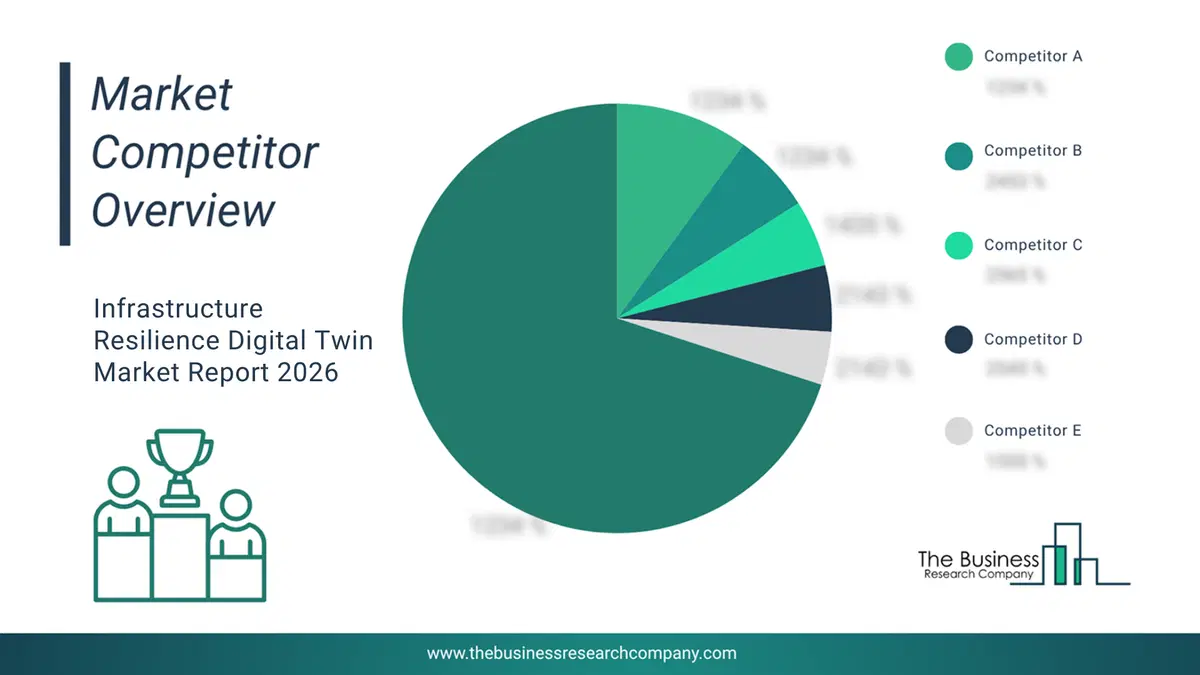
This chart is for illustrative purposes; the full report includes a detailed competitor analysis and comprehensive overview of the top 10 companies in the market.
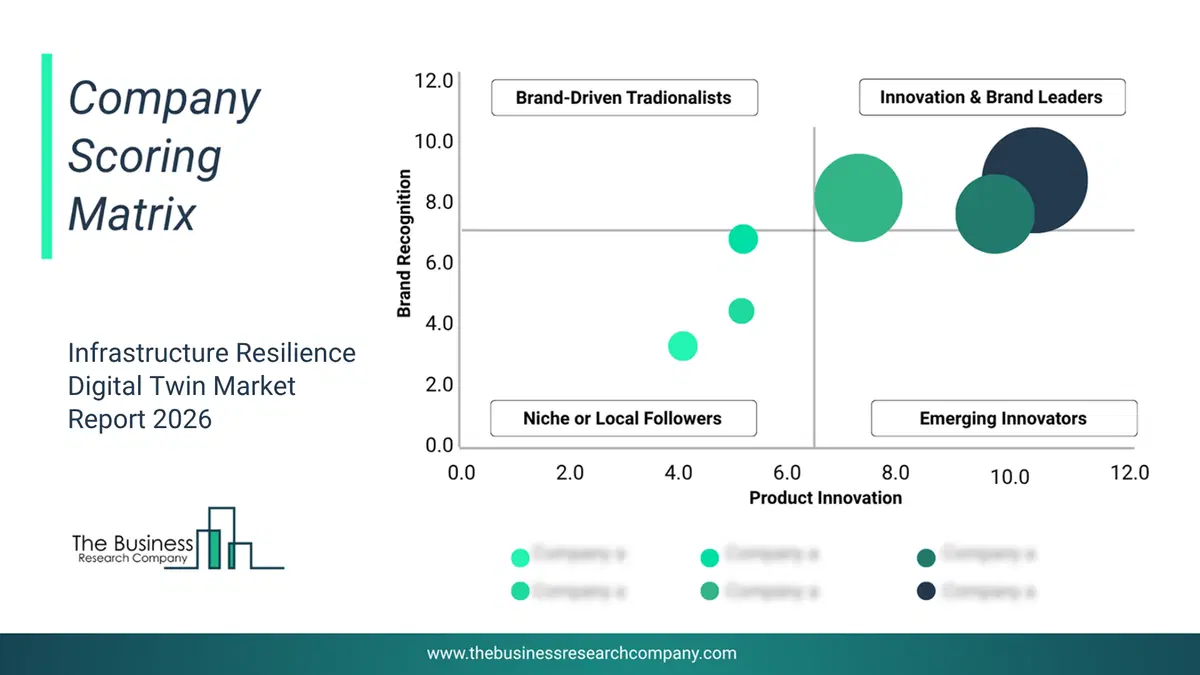
This chart maps companies by product innovation and brand strength, with bubble size indicating relative revenue, helping identify market leaders, challengers, and niche players. This is an illustrative chart; the full report provides a complete and accurate competitive analysis.
Global Infrastructure Resilience Digital Twin Market Trends and Insights
Major companies operating in the infrastructure resilience digital twin market are focusing on integrating geospatial and building information modeling data to enhance collaboration, improve decision-making, and increase operational efficiency. Geospatial and building information modeling data together provide a digital twin that shows both an asset’s location and environment, as well as its 3D design, materials, and operational performance, enabling better monitoring, simulation, and decision-making. For instance, in February 2024, Esri, a US-based geographic information systems company, introduced enhanced ArcGIS GeoBIM capabilities. The update enables integration of digital twin infrastructure models with real-time geospatial data, supports scenario analysis for hazard impacts, and improves collaboration between emergency managers and infrastructure planners. This integration strengthens infrastructure resilience planning and operational response through unified, data-driven decision-making.What Are Latest Mergers And Acquisitions In The Infrastructure Resilience Digital Twin Market?
In March 2023, Bentley Systems Inc., a US-based provider of infrastructure engineering software and digital twin platforms, acquired Blyncsy Inc. for an undisclosed amount. With this acquisition, Bentley Systems aims to strengthen its infrastructure resilience digital twin offerings by integrating Blyncsy's AI-powered traffic signal optimization technology, enabling real-time predictive analytics for transportation networks to improve operational performance and disaster recovery. Blyncsy Inc. is a US-based AI-powered infrastructure analytics and digital twin solutions company specializing in transportation asset monitoring and infrastructure resilience.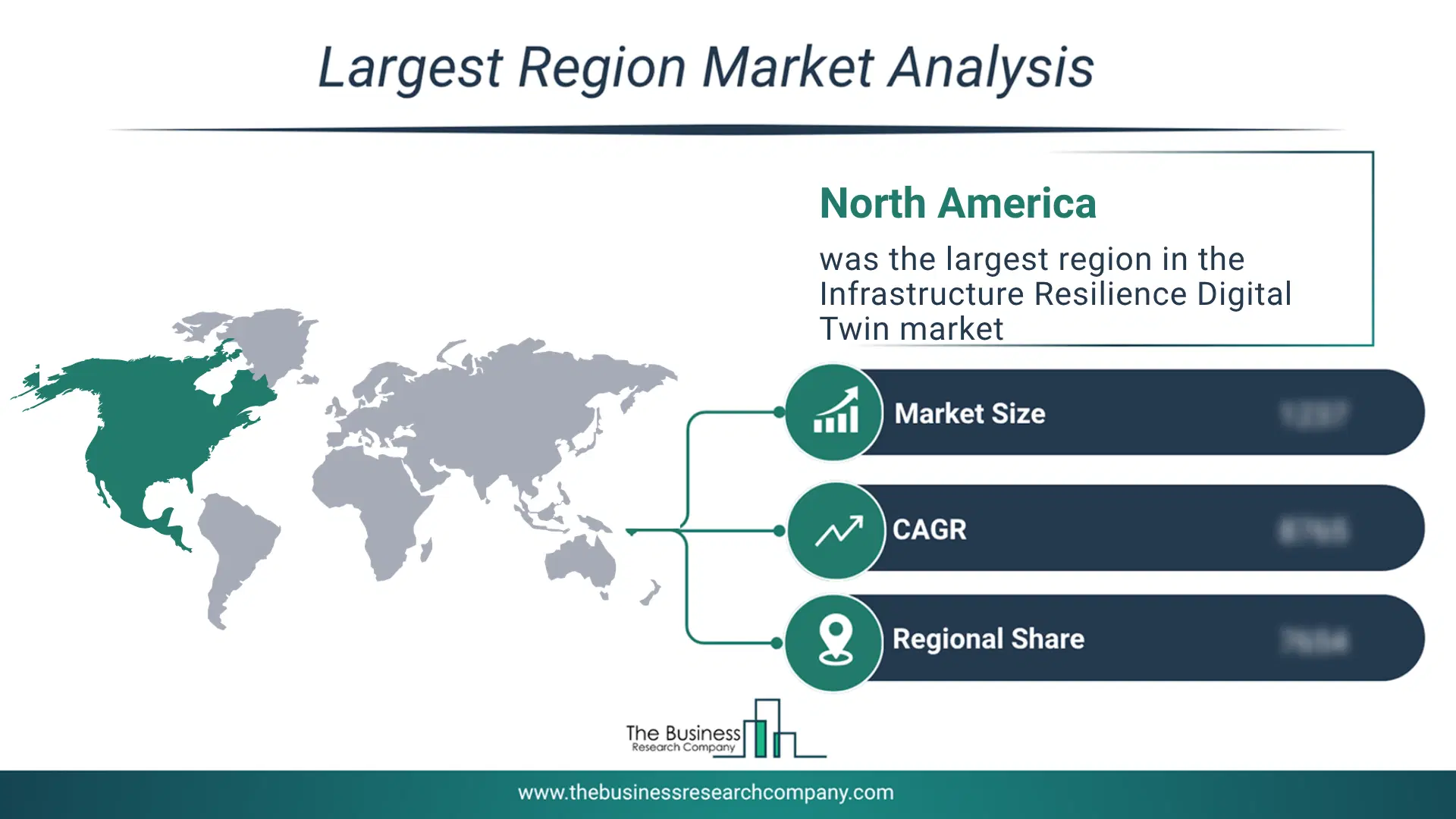
Regional Insights
North America was the largest region in the infrastructure resilience digital twin market in 2025. Asia-Pacific is expected to be the fastest-growing region in the forecast period. The regions covered in this market report are Asia-Pacific, South East Asia, Western Europe, Eastern Europe, North America, South America, Middle East, Africa. The countries covered in this market report are Australia, Brazil, China, France, Germany, India, Indonesia, Japan, Taiwan, Russia, South Korea, UK, USA, Canada, Italy, Spain.What Defines the Infrastructure Resilience Digital Twin Market?
The infrastructure resilience digital twin market consists of revenues earned by entities by providing services such as real-time monitoring, predictive maintenance analytics, risk assessment modeling, simulation-based planning, and integration with IoT and cloud platforms. The market value includes the value of related goods sold by the service provider or included within the service offering. The infrastructure resilience digital twin market includes sales of digital twin software platforms, simulation engines, data integration tools, AI-driven analytics modules, visualization dashboards, and secure connectivity solutions. Values in this market are ‘factory gate’ values, that is, the value of goods sold by the developers or creators of the solutions, whether to other entities (including system integrators, infrastructure operators, government agencies, and enterprises) or directly to end users. The value of goods in this market includes related services sold by the creators of the solutions.How is Market Value Defined and Measured?
The market value is defined as the revenues that enterprises gain from the sale of goods and/or services within the specified market and geography through sales, grants, or donations in terms of the currency (in USD unless otherwise specified). The revenues for a specified geography are consumption values that are revenues generated by organizations in the specified geography within the market, irrespective of where they are produced. It does not include revenues from resales along the supply chain, either further along the supply chain or as part of other products.
This chart presents market attractiveness based on a quantitative evaluation of growth, competition, strategic alignment, and risk, offering a clear view of opportunity areas for decision-making. This chart is for illustrative purposes; the full report contains the complete analysis.

This chart highlights the Total Addressable Market (TAM) by estimating the maximum revenue opportunity using an assumption-driven approach, supporting strategic planning and opportunity sizing across markets. The chart is illustrative; the full report provides a more comprehensive analysis.
What Key Data and Analysis Are Included in the Infrastructure Resilience Digital Twin Market Report 2026?
The infrastructure resilience digital twin market research report is one of a series of new reports from The Business Research Company that provides infrastructure resilience digital twin market statistics, including infrastructure resilience digital twin industry global market size, regional shares, competitors with a infrastructure resilience digital twin market share, detailed infrastructure resilience digital twin market segments, market trends and opportunities, and any further data you may need to thrive in the infrastructure resilience digital twin industry. This infrastructure resilience digital twin market research report delivers a complete perspective of everything you need, with an in-depth analysis of the current and future scenario of the industry.Infrastructure Resilience Digital Twin Market Report Forecast Analysis
| Report Attribute | Details |
|---|---|
| Market Size Value In 2026 | $3.19 billion |
| Revenue Forecast In 2030 | $8.71 billion |
| Growth Rate | CAGR of 28.5% from 2026 to 2030 |
| Base Year For Estimation | 2025 |
| Actual Estimates/Historical Data | 2020-2025 |
| Forecast Period | 2026 - 2030 |
| Market Representation | Revenue in USD Billion and CAGR from 2026 to 2030 |
| Segments Covered | Component, Deployment Mode, Application, End-User |
| Regional Scope | Asia-Pacific, Western Europe, Eastern Europe, North America, South America, Middle East, Africa |
| Country Scope | The Countries Covered In This Market Report Are Australia, Brazil, China, France, Germany, India, Indonesia, Japan, Taiwan, Russia, South Korea, Uk, Usa, Canada, Italy, Spain. |
| Key Companies Profiled | Siemens AG, International Business Machines Corporation, Oracle Corporation, Schneider Electric SE, Honeywell International Inc., Dassault Systèmes SE, Hexagon AB, Autodesk Incorporated, Kongsberg Digital AS, DJI Enterprise Technology Corporation, Trimble Inc., Ansys Incorporated, Parametric Technology Corporation, Esri International Incorporated, Bentley Systems Incorporated, Neara Limited, Willow Technology Corporation, Cityzenith LLC, Sensemetrics Inc., and Optelos Inc. |
| Customization Scope | Request for Customization |
| Pricing And Purchase Options | Explore Purchase Options |