

Inkjet Printers Market Report 2026
Global Outlook – By Type (Multifunctional Printers, Desktop Printers, Large Format Printers, Inkjet Press, Industrial Inkjet Printers, Textile Printers, Other Types), By Technology (Continuous Inkjet, Drop On Demand, UV Inkjet, Other Technologies), By Application (Packaging And Labeling, Publishing, Advertising, Textile Printing, Photo Printing, Other Applications), By End User (Consumer, Education, Industrial, Textile, Pharmaceutical, Other End Users) – Market Size, Trends, Strategies, and Forecast to 2030
Inkjet Printers Market Overview
• Inkjet Printers market size has reached to $50.39 billion in 2025 • Expected to grow to $68.54 billion in 2030 at a compound annual growth rate (CAGR) of 6.5% • Growth Driver: Rise Of Advertising Industry To Drive Market Growth • Market Trend: Technological Advancements Driving Innovation In Inkjet Printers Market • North America was the largest region in 2025 and Asia-Pacific is the fastest growing region.Market Gains By 2030 – Top Opportunities By Segment
Market Gain identifies the most promising market opportunities by highlighting the segments or products expected to generate the highest incremental revenue growth over the next five years.
What Is Covered Under Inkjet Printers Market?
An inkjet printer is a type of printer that uses small droplets of ink to create text, images, or graphics on paper or other printable materials. It works by propelling tiny droplets of ink onto the printing surface through a print head containing numerous nozzles. Inkjet printers have various uses and are commonly used for document printing, marketing materials, and personal and home use. The main types of inkjet printers are multifunctional printers, desktop printers, large format printers, inkjet presses, industrial inkjet printers, textile printers, and others. A multifunctional printer, also known as an all-in-one printer, is a device that combines the functionality of multiple office machines into a single device and is used for printing, scanning, copying, faxing, and document management. They are integrated with different technologies such as continuous inkjet, drop-on-demand, UV inkjet, and others used in various applications such as packaging and labeling, publishing, advertising, textile printing, photo printing, and others by end-user industries including consumer, education, industrial, textile, pharmaceutical, and others.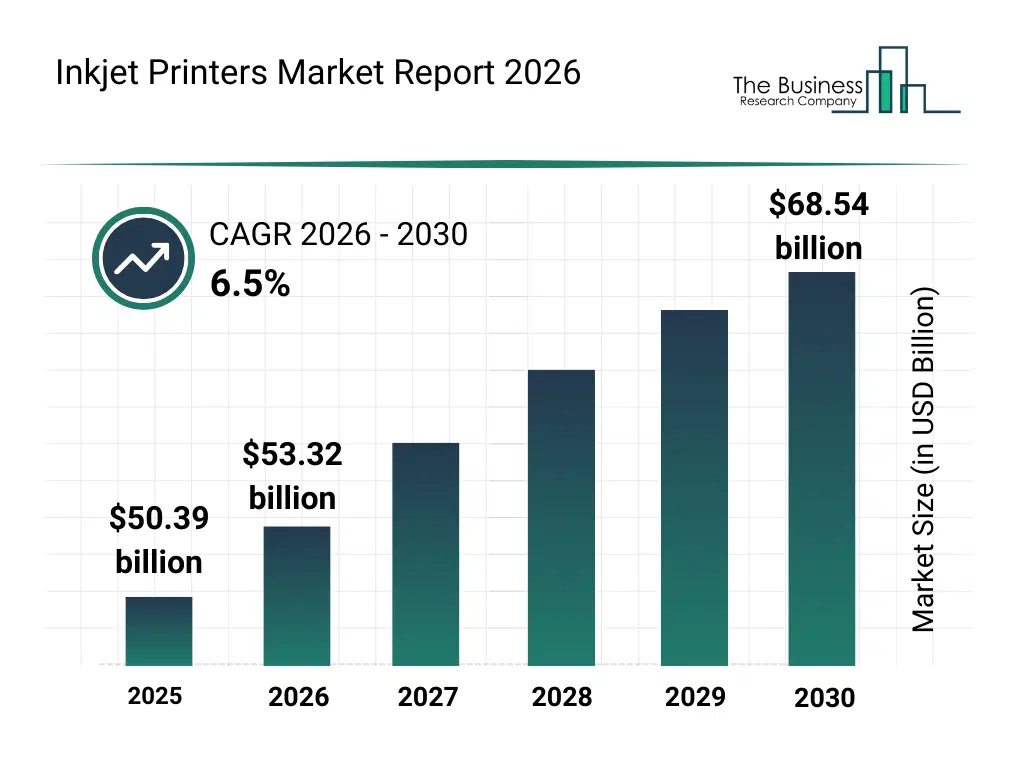
What Is The Inkjet Printers Market Size and Share 2026?
The inkjet printers market size has grown strongly in recent years. It will grow from $50.39 billion in 2025 to $53.32 billion in 2026 at a compound annual growth rate (CAGR) of 5.8%. The growth in the historic period can be attributed to expansion of office and home printing, growth of advertising materials, demand for color printing, reliance on traditional printers, affordability of inkjet technology.What Is The Inkjet Printers Market Growth Forecast?
The inkjet printers market size is expected to see strong growth in the next few years. It will grow to $68.54 billion in 2030 at a compound annual growth rate (CAGR) of 6.5%. The growth in the forecast period can be attributed to digital content personalization, packaging and labeling growth, eco-friendly printing demand, smart device integration, growth of textile printing. Major trends in the forecast period include growth of high-resolution printing, rising demand for large format printing, expansion of industrial inkjet applications, shift toward eco-friendly inks, adoption of wireless and smart printers.
Global Inkjet Printers Market Segmentation
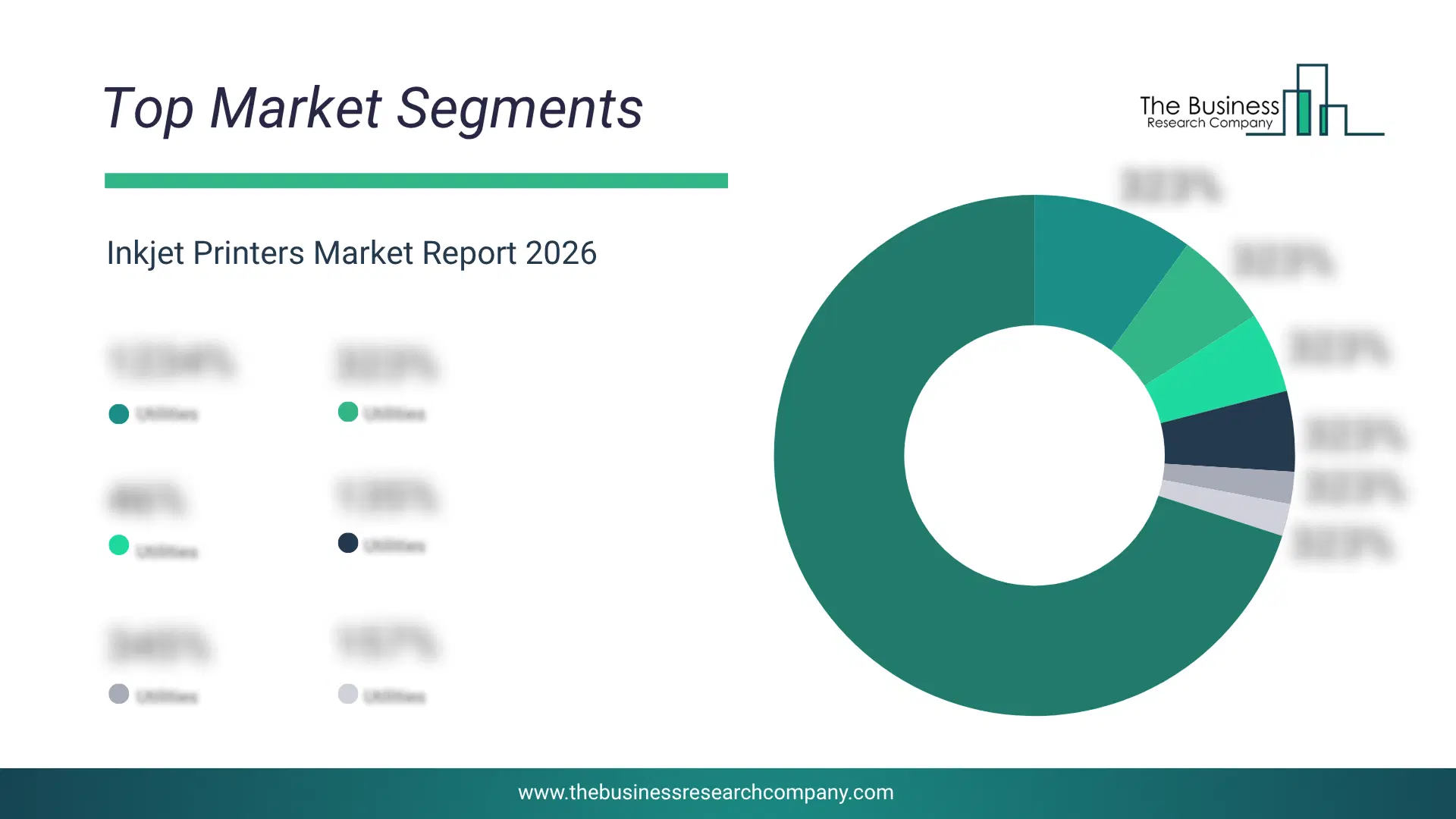
1) By Type: Multifunctional Printers, Desktop Printers, Large Format Printers, Inkjet Press, Industrial Inkjet Printers, Textile Printers, Other Types 2) By Technology: Continuous Inkjet, Drop On Demand, UV Inkjet, Other Technologies 3) By Application: Packaging And Labeling, Publishing, Advertising, Textile Printing, Photo Printing, Other Applications 4) By End User: Consumer, Education, Industrial, Textile, Pharmaceutical, Other End Users Subsegments: 1) By Multifunctional Printers: All-In-One Printers, Wireless Multifunction Printers 2) By Desktop Printers: Personal Inkjet Printers, Home Office Inkjet Printers 3) By Large Format Printers: Wide-Format Printers, Super-Wide Format Printers 4) By Inkjet Press: Digital Inkjet Presses For Commercial Printing, Production Inkjet Presses 5) By Industrial Inkjet Printers: Inkjet Printers For Packaging, Inkjet Printers For Labeling 6) By Textile Printers: Direct-To-Fabric Printers, Sublimation Inkjet Printers 7) By Other Types: Photo Inkjet Printers, Specialty Inkjet Printers The top segments in the inkjet printers market will be: • Multifunctional Printers will reach $19.33 Billion by 2030. • Industrial Inkjet Printers will reach $15.11 Billion by 2030. • Large Format Printers will reach $10.99 Billion by 2030. • Desktop Printers will reach $8.65 Billion by 2030. • Textile Printers will reach $6.61 Billion by 2030.What Is The Driver Of The Inkjet Printers Market?
The expansion of the advertising industry is expected to propel the growth of the inkjet printers market going forward. The advertising industry refers to the sector that encompasses activities related to creating, planning, executing, and managing promotional campaigns and messages to reach and persuade target audiences. Inkjet printers play a significant role in the advertising industry by facilitating the production of various advertising materials. Inkjet printers offer several benefits that make them valuable tools for advertising agencies. For instance, in September 2024, according to Publift, an Ireland-based advertising services company, the United States hosts one of the most profitable advertising industries globally, with an estimated ad expenditure nearing $300 billion in 2023. The U.S. market significantly outpaces rivals like China and Japan. Digital advertising made up 67% of total global ad revenue in 2022, a figure expected to rise to 70% by 2025. In the U.S., digital advertising accounted for 61% of the market in 2022. Therefore, the expansion of the advertising industry is driving the growth of the inkjet printer industry.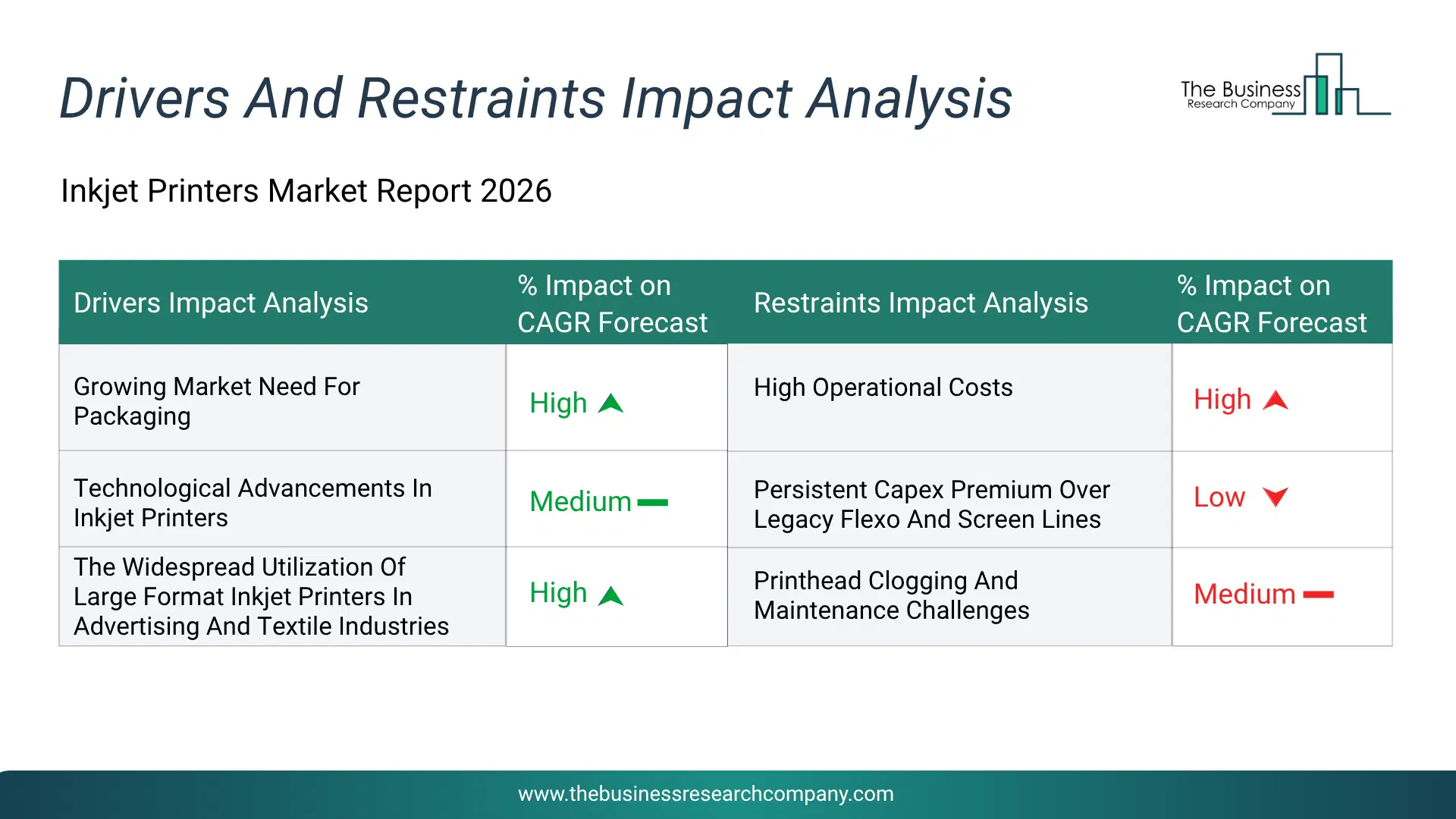
Infographic Chart Showing Key Market Drivers Analysis And Restraints For Inkjet Printers Market
The chart presents an impact analysis of key drivers and restraints, quantifying their relative influence on the market's growth rate and helping assess the balance between growth enablers and limiting factors. This chart offers a high-level perspective; the full report contains more detailed insights.
How Will The Drivers Impact Growth In The Global Inkjet Printers Market?
• Growing Market Need For Packaging (High) – During the forecast period, the growing market need for packaging is expected to become a key growth driver for the inkjet printers market by 2030. Growing market need for packaging is a major driver of the Inkjet Printers Market because packaging manufacturers require high-quality, flexible, and cost-effective printing solutions. Inkjet printers enable fast customization of labels, barcodes, batch numbers, and packaging designs without the need for complex printing plates. The rapid expansion of e-commerce and consumer goods industries has increased the demand for attractive and informative packaging. Inkjet technology supports short production runs and variable data printing, making it ideal for modern packaging requirements. Companies can quickly adapt packaging designs to meet changing consumer preferences and regulatory standards. Additionally, the ability to print on diverse packaging materials enhances operational flexibility. • Technological Advancements In Inkjet Printers (Medium) – During the forecast period, the technological advancements in inkjet printers are expected to emerge as a major factor driving the expansion of the inkjet printers market by 2030. Technological advancements in inkjet printers are driving market growth by improving printing speed, precision, and overall efficiency. Modern inkjet systems offer enhanced printhead technology, better ink formulations, and higher-resolution output, making them suitable for a wide range of applications. Continuous innovation has reduced maintenance requirements and increased printer reliability, encouraging wider adoption among businesses. Advanced software integration allows seamless workflow management and automation of printing processes. Improvements in eco-friendly inks and energy-efficient designs also support sustainability goals for organizations. These developments help businesses achieve superior print quality while controlling operational costs. • The Widespread Utilization Of Large Format Inkjet Printers In Advertising And Textile Industries (High) – During the forecast period, the widespread utilization of large format inkjet printers in advertising and textile industries is expected to act as a key growth catalyst for the inkjet printers market by 2030. The widespread utilization of large format inkjet printers in advertising and textile industries significantly contributes to market expansion. Advertising companies rely on large-format printers to produce banners, posters, vehicle wraps, and promotional displays with vibrant colors and sharp graphics. In the textile sector, inkjet technology enables high-quality digital fabric printing with greater design flexibility and faster production cycles. Businesses can efficiently create customized and short-run products without extensive setup costs. The growing demand for personalized advertising campaigns and fashion products further supports adoption. Large-format inkjet printers also reduce material waste and improve production efficiency compared to traditional printing methods.How Will The Restraints Impact Growth In The Global Inkjet Printers Market?
• High Operational Costs (High) – During the forecast period, the high Operational Costs act as a significant restraint on the Inkjet Printers Market because businesses must continuously spend on inks, printheads, maintenance, and system servicing. Industrial-grade inks and replacement components can be expensive, increasing the total cost of ownership over time. Companies with high-volume printing requirements may find operational expenses higher than some conventional printing technologies. Frequent maintenance and calibration are often necessary to ensure consistent print quality and avoid production disruptions. Rising energy and material costs further add to the financial burden on end users. Small and budget-conscious organizations may hesitate to invest in or expand inkjet printing operations due to these recurring expenses. As a result, high operating costs can limit market adoption and slow overall industry growth. • Persistent Capex Premium Over Legacy Flexo And Screen Lines (Medium) – During the forecast period, the persistent capex premium over legacy flexo and screen lines restrains the inkjet printers market by creating a higher initial investment barrier for businesses. Advanced inkjet printing systems often require substantial capital expenditure for equipment acquisition, installation, and workflow integration. Many manufacturers continue using existing flexographic and screen-printing lines because they have already recovered much of their investment costs. The higher upfront cost of transitioning to inkjet technology can discourage companies from upgrading their production facilities. This challenge is particularly significant for small and medium-sized enterprises with limited capital budgets. Decision-makers may delay modernization projects until a clear return on investment is demonstrated. Consequently, the premium capital cost compared to traditional printing systems can slow the pace of market penetration and technology adoption. • Printhead Clogging And Maintenance Challenges (High) – During the forecast period, the printhead clogging and maintenance challenges restrain the growth of the Inkjet Printers market by affecting printing efficiency, productivity, and output quality. Inkjet printheads are susceptible to clogging due to dried ink, contaminants, or irregular printer usage, leading to inconsistent print quality and production interruptions. Frequent cleaning, calibration, and printhead replacement increase maintenance costs and machine downtime. Industrial users operating high-volume printing environments may experience reduced operational efficiency when maintenance requirements become frequent. The need for specialized servicing and genuine replacement components further increases the total cost of ownership. These operational challenges can discourage businesses from adopting inkjet printing technology for demanding production applications. Consequently, printhead maintenance issues act as a significant restraint on the growth of the Inkjet Printers market.Key Players In The Global Inkjet Printers Market
Major companies operating in the inkjet printers market are HP Inc., Videojet Technologies Inc., Canon Inc., Fujifilm Holdings Corporation, Kyocera Corporation, Ricoh Company Ltd., Seiko Epson Corporation, Xerox Holdings Corporation, Konica Minolta Business Solutions India Private Limited, Brother Industries Ltd., Screen Holdings Co. Ltd., Agfa-Gevaert N.V., EFI (Electronics For Imaging) Inc., Markem-Imaje Corporation, Domino Printing Sciences plc, Xaar plc, Mimaki Engineering Co. Ltd, Roland DG Corporation, Kornit Digital Ltd., Inkjet Inc., Pannier Corporation, Durst Phototechnik AG, Mutoh Holdings Co. Ltd, Control Print Ltd., Colordyne Technologies LLC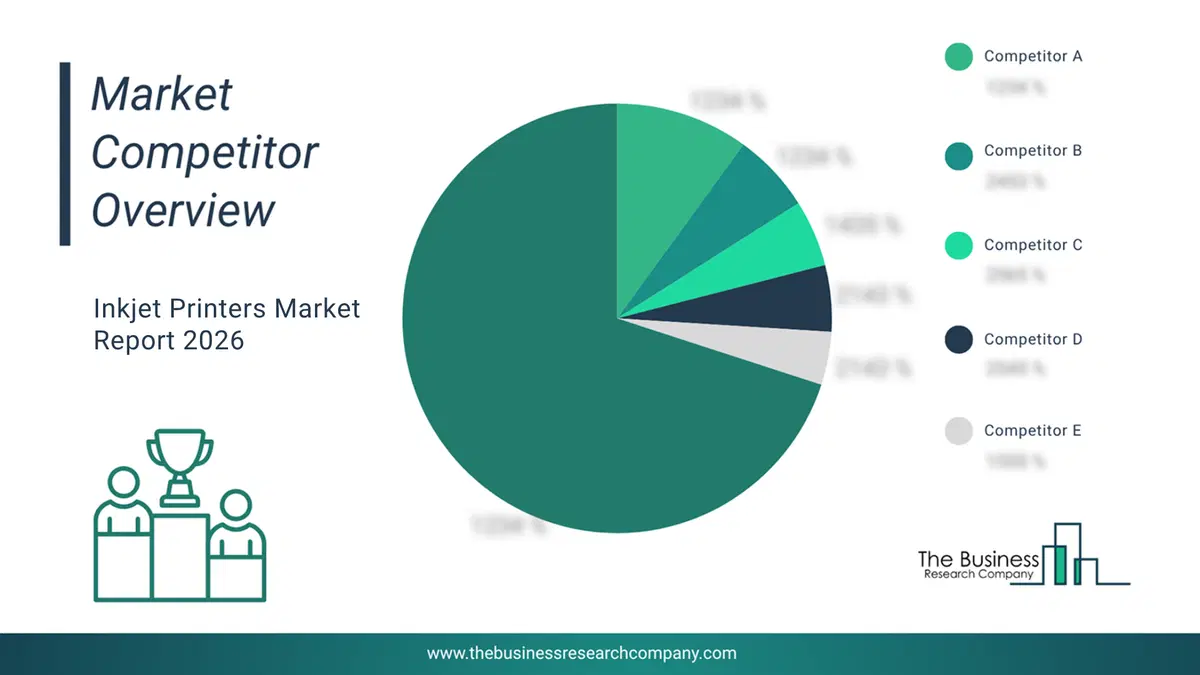
This chart is for illustrative purposes; the full report includes a detailed competitor analysis and comprehensive overview of the top 10 companies in the market.
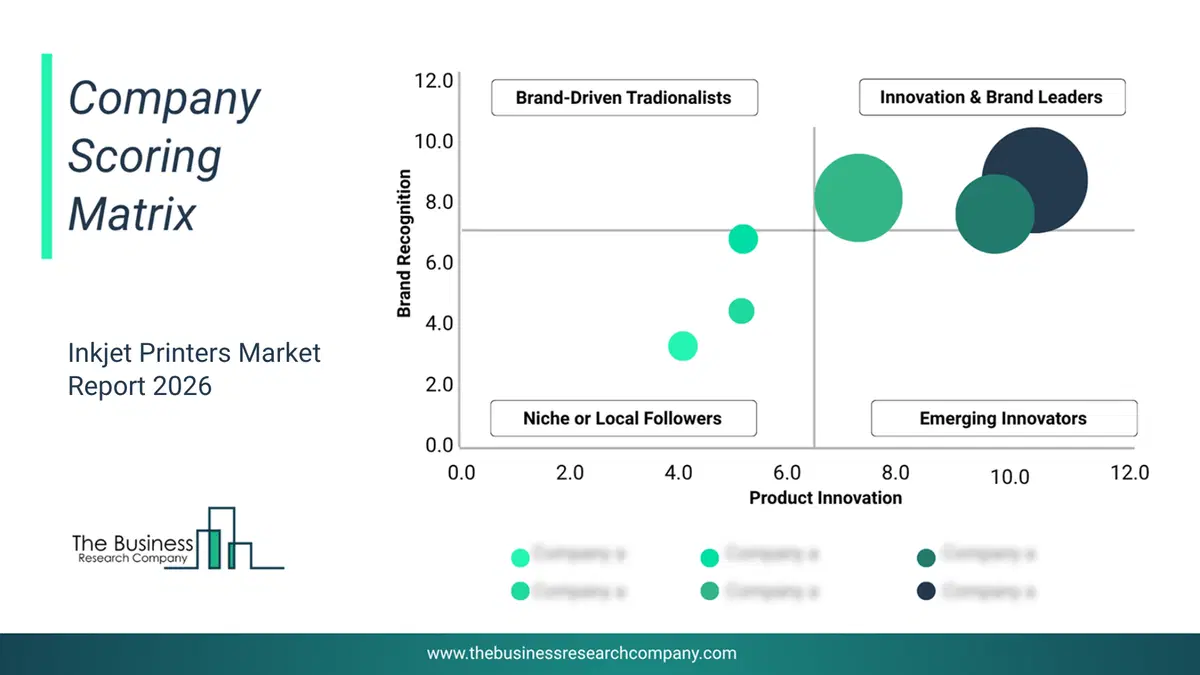
This chart maps companies by product innovation and brand strength, with bubble size indicating relative revenue, helping identify market leaders, challengers, and niche players. This is an illustrative chart; the full report provides a complete and accurate competitive analysis.
Global Inkjet Printers Market Trends and Insights
Major companies operating in the inkjet printers market are focusing on developing innovative solutions, such as direct-to-film (DTF) printing technology, to meet the rising demand for high-quality color output, improved production efficiency, and reduced maintenance requirements. DTF inkjet systems allow direct printing onto film for later transfer to textiles, offering greater versatility and smoother workflow compared with traditional screen printing or heat-transfer methods that require more steps and labor. For instance, in February 2023, Mimaki Engineering Co. Ltd., a Japan-based inkjet printer manufacturing company, launched the TxF150-75, its first direct-to-film (DTF) technology inkjet printer. It involves a built-in ink circulation system and degassed ink pack design technologies, including the nozzle check unit and nozzle recovery system, ensuring that operations run smoothly with little need for intervention. With its full-color printing capabilities, the technology can also produce eye-catching graphics.What Are Latest Mergers And Acquisitions In The Inkjet Printers Market?
In April 2023, Kyocera Corporation, a Japan-based provider of electronics, office equipment, and industrial printing solutions, acquired NIXKA S.A.S. for full ownership. With this acquisition, Kyocera aims to expand its presence in the commercial and industrial inkjet printing market by integrating NIXKA’s complete print engine solutions with its advanced printhead technology, enhancing its product portfolio, technological capabilities, and ability to offer turnkey printing solutions. NIXKA S.A.S., a France-based manufacturer of high-efficiency inkjet print engines and systems.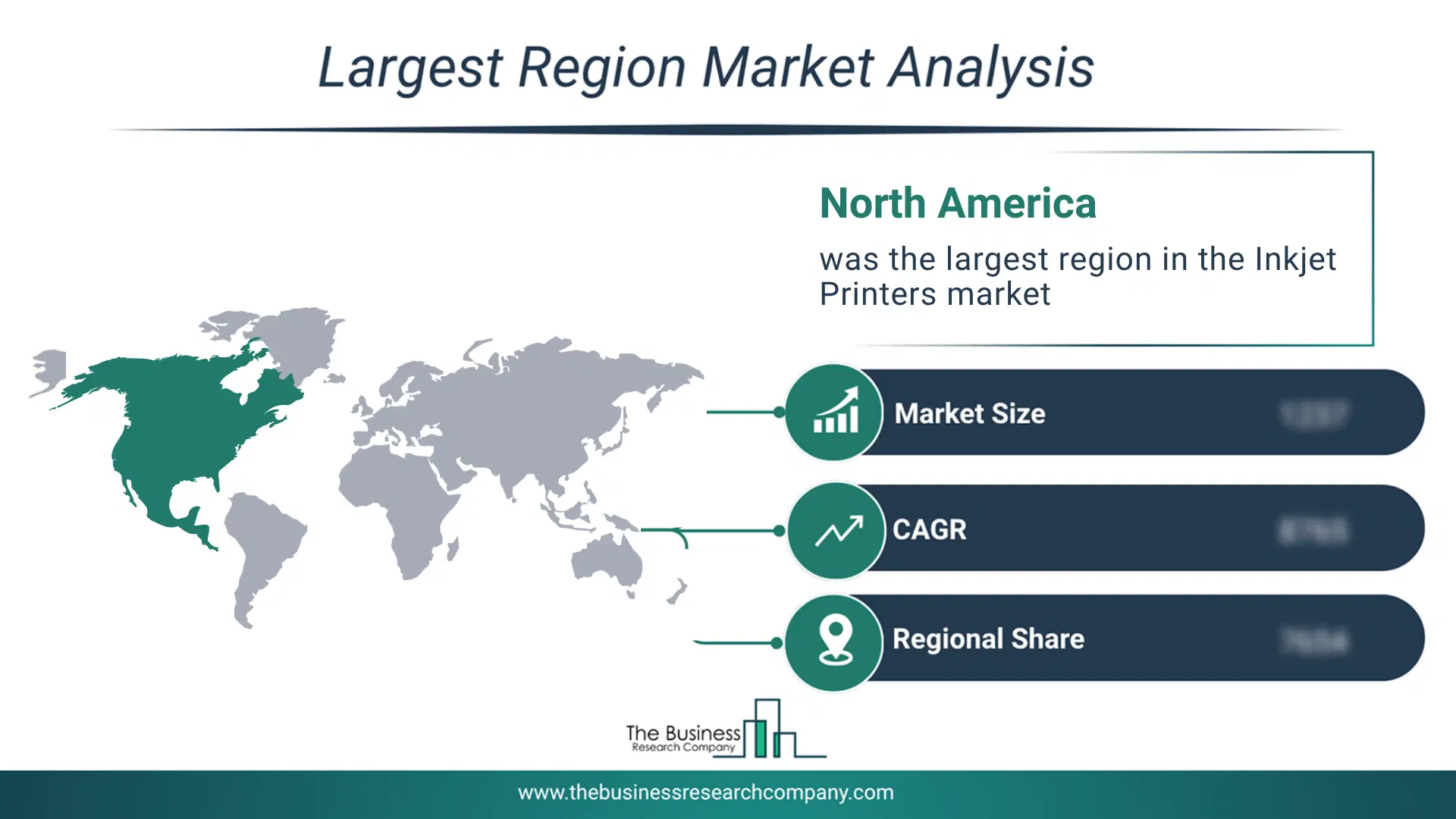
Regional Outlook
North America was the largest region in the inkjet printers market in 2025. Asia Pacific is expected to be the fastest-growing region in the forecast period. The regions covered in this market report are Asia-Pacific, South East Asia, Western Europe, Eastern Europe, North America, South America, Middle East, Africa The countries covered in this market report are Australia, Brazil, China, France, Germany, India, Indonesia, Japan, Taiwan, Russia, South Korea, UK, USA, Canada, Italy, Spain.What Defines the Inkjet Printers Market?
The inkjet printers market consists of sales of portable inkjet printers and handheld inkjet printers. Values in this market are ‘factory gate’ values, that is the value of goods sold by the manufacturers or creators of the goods, whether to other entities (including downstream manufacturers, wholesalers, distributors, and retailers) or directly to end customers. The value of goods in this market includes related services sold by the creators of the goods.How is Market Value Defined and Measured?
The market value is defined as the revenues that enterprises gain from the sale of goods and/or services within the specified market and geography through sales, grants, or donations in terms of the currency (in USD unless otherwise specified). The revenues for a specified geography are consumption values that are revenues generated by organizations in the specified geography within the market, irrespective of where they are produced. It does not include revenues from resales along the supply chain, either further along the supply chain or as part of other products.
This chart presents market attractiveness based on a quantitative evaluation of growth, competition, strategic alignment, and risk, offering a clear view of opportunity areas for decision-making. This chart is for illustrative purposes; the full report contains the complete analysis.

This chart highlights the Total Addressable Market (TAM) by estimating the maximum revenue opportunity using an assumption-driven approach, supporting strategic planning and opportunity sizing across markets. The chart is illustrative; the full report provides a more comprehensive analysis.
What Key Data and Analysis Are Included in the Inkjet Printers Market Report 2026?
The inkjet printers market research report is one of a series of new reports from The Business Research Company that provides market statistics, including industry global market size, regional shares, competitors with the market share, detailed market segments, market trends and opportunities, and any further data you may need to thrive in the inkjet printers industry. The market research report delivers a complete perspective of everything you need, with an in-depth analysis of the current and future state of the industry.Inkjet Printers Market Report Forecast Analysis
| Report Attribute | Details |
|---|---|
| Market Size Value In 2026 | $53.32 billion |
| Revenue Forecast In 2030 | $68.54 billion |
| Growth Rate | CAGR of 5.8% from 2026 to 2030 |
| Base Year For Estimation | 2025 |
| Actual Estimates/Historical Data | 2020-2025 |
| Forecast Period | 2026 - 2030 |
| Market Representation | Revenue in USD Billion and CAGR from 2026 to 2030 |
| Segments Covered | Type, Technology, Application, End User |
| Regional Scope | Asia-Pacific, Western Europe, Eastern Europe, North America, South America, Middle East, Africa |
| Country Scope | The countries covered in the report are Australia, Brazil, China, France, Germany, India, ... |
| Key Companies Profiled | HP Inc., Videojet Technologies Inc., Canon Inc., Fujifilm Holdings Corporation, Kyocera Corporation, Ricoh Company Ltd., Seiko Epson Corporation, Xerox Holdings Corporation, Konica Minolta Business Solutions India Private Limited, Brother Industries Ltd., Screen Holdings Co. Ltd., Agfa-Gevaert N.V., EFI (Electronics For Imaging) Inc., Markem-Imaje Corporation, Domino Printing Sciences plc, Xaar plc, Mimaki Engineering Co. Ltd, Roland DG Corporation, Kornit Digital Ltd., Inkjet Inc., Pannier Corporation, Durst Phototechnik AG, Mutoh Holdings Co. Ltd, Control Print Ltd., Colordyne Technologies LLC |
| Customization Scope | Request for Customization |
| Pricing And Purchase Options | Explore Purchase Options |