
Inorganic Ceramic Membrane Module Market Report 2026
Global Outlook – By Type (Ceramic Membrane Filter, Ceramic Membrane Reactor, Ceramic Membrane Sensor), By Module Type Or Configuration (Multichannel Or Tubular, Flat Sheet, Hollow Fiber, Other Module Type Or Configurations), By Technology (Microfiltration, Ultrafiltration, Nanofiltration, Other Technologies), By Material Type (Alumina, Zirconia (Zirconium Oxide), Silicon Carbide, Titania, Silica, Other Material Types), By Application (Water Treatment Plant, Food and Beverage Industry, Pharmaceutical Industry, Electronics Industry) – Market Size, Trends, Strategies, and Forecast to 2030
Inorganic Ceramic Membrane Module Market Overview
• Inorganic Ceramic Membrane Module market size has reached to $1.42 billion in 2025 • Expected to grow to $2.17 billion in 2030 at a compound annual growth rate (CAGR) of 8.8% • Growth Driver: Rising Demand For Industrial Wastewater Treatment Fueling The Growth Of The Market Due To Increasing Need For Efficient Filtration And Regulatory Compliance • Market Trend: Advanced Inorganic Ultrafiltration Systems Reduce Operational Costs And Waste • Asia-Pacific was the largest region and fastest growing region.What Is Covered Under Inorganic Ceramic Membrane Module Market?
An inorganic ceramic membrane module is a filtration device made from durable ceramic materials designed to separate particles, contaminants, and microorganisms from liquids or gases. It offers high chemical, thermal, and mechanical stability, making it suitable for harsh operating conditions where polymer membranes may fail. The module efficiently supports processes such as water treatment, gas separation, and industrial fluid purification. The main types of the inorganic ceramic membrane module include ceramic membrane filters, ceramic membrane reactors, and ceramic membrane sensors. Ceramic membrane filters are advanced filtration units made from inorganic materials designed to separate particles and contaminants from liquids or gases, offering high chemical, thermal, and mechanical stability for industrial applications. Different module types or configurations include multichannel or tubular, flat sheet, hollow fiber, and others. Multiple technologies include microfiltration, ultrafiltration, nanofiltration, and others. Various material types are alumina, zirconia (zirconium oxide), silicon carbide, titania, and silica, and they are used by several applications such as water treatment plants, food and beverage industry, pharmaceutical industry, and electronics industry.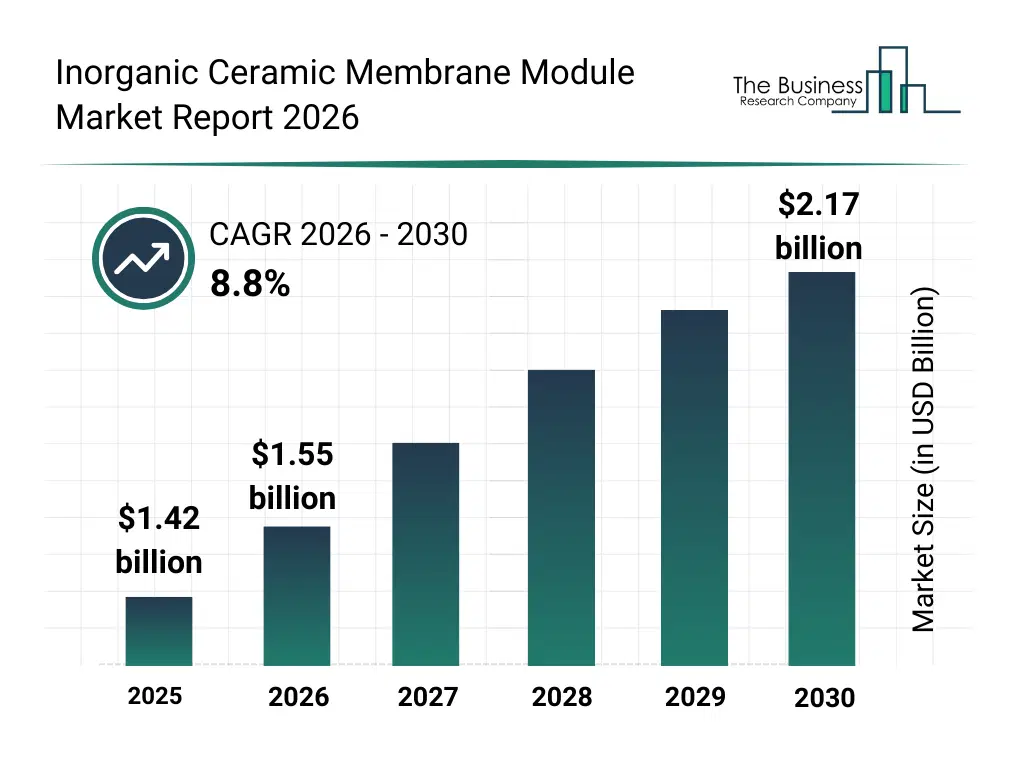
What Is The Inorganic Ceramic Membrane Module Market Size and Share 2026?
The inorganic ceramic membrane module market size has grown strongly in recent years. It will grow from $1.42 billion in 2025 to $1.55 billion in 2026 at a compound annual growth rate (CAGR) of 9.0%. The growth in the historic period can be attributed to increasing regulatory pressure on wastewater discharge, growing demand for durable and chemical-resistant filtration systems, rising adoption in food and beverage filtration, expanding use in pharmaceutical purification, and increasing industrial shift from polymeric to ceramic membranes.What Is The Inorganic Ceramic Membrane Module Market Growth Forecast?
The inorganic ceramic membrane module market size is expected to see strong growth in the next few years. It will grow to $2.17 billion in 2030 at a compound annual growth rate (CAGR) of 8.8%. The growth in the forecast period can be attributed to increasing demand for ultrapure water in electronics, growing focus on industrial water reuse, rising adoption of ceramic membrane reactors, expanding investments in decentralized water treatment, and increasing pharmaceutical and biotech production. Major trends in the forecast period include technological advancements in membrane materials, innovations in ceramic membrane reactor designs, developments in low-cost production methods, research and development in high-flux ceramic membranes, and advancements in nanostructured ceramic coatings.
Global Inorganic Ceramic Membrane Module Market Segmentation
1) By Type: Ceramic Membrane Filter, Ceramic Membrane Reactor, Ceramic Membrane Sensor 2) By Module Type Or Configuration: Multichannel Or Tubular, Flat Sheet, Hollow Fiber, Other Module Type Or Configurations 3) By Technology: Microfiltration, Ultrafiltration, Nanofiltration, Other Technologies 4) By Material Type: Alumina, Zirconia (Zirconium Oxide), Silicon Carbide, Titania, Silica, Other Material Types 5) By Application: Water Treatment Plant, Food and Beverage Industry, Pharmaceutical Industry, Electronics Industry Subsegments: 1) By Ceramic Membrane Filter: Microfiltration, Ultrafiltration, Nanofiltration, Crossflow Filtration, Dead-End Filtration 2) By Ceramic Membrane Reactor: Catalytic Membrane Reactors, Bioreactors, Photocatalytic Membrane Reactors, Hydrogen Separation Reactors, Oxidation Membrane Reactors 3) By Ceramic Membrane Sensor: Gas Sensing Sensors, Pressure Sensing Sensors, Temperature Sensing Sensors, Chemical Sensing Sensors, Humidity Sensing SensorsWhat Is The Driver Of The Inorganic Ceramic Membrane Module Market?
The rising demand for industrial wastewater treatment is expected to propel the growth of the inorganic ceramic membrane module market going forward. Industrial wastewater treatment refers to the processes used by manufacturing, chemical, pharmaceutical, food processing, and other industrial sectors to remove contaminants, suspended solids, heavy metals, and harmful pollutants from wastewater before it is discharged or reused. The rise in industrial wastewater treatment demand is due to stringent environmental regulations requiring industries to minimize pollution and comply with water discharge standards. Inorganic ceramic membrane modules help address industrial wastewater treatment demand by providing high durability, chemical resistance, thermal stability, and superior filtration performance, enabling industries to achieve higher purification efficiency and long-term operational reliability. For instance, in May 2025, according to Imperial College London, a UK-based public research university, English water companies discharged untreated sewage for 3.614 million hours in 2024, slightly above the 3.606 million hours recorded in 2023, after spills had already more than doubled in 2023 compared to 1.75 million hours in 2022, emphasizing the critical need for wastewater treatment. Therefore, the rising demand for industrial wastewater treatment is driving the growth of the inorganic ceramic membrane module industry.Key Players In The Global Inorganic Ceramic Membrane Module Market
Major companies operating in the inorganic ceramic membrane module market are GEA Group Aktiengesellschaft, Meidensha Corporation, METAWATER Co. Ltd., Aquatech International LLC, Sterlitech Corporation, Pall Corporation, JIUWU Hi-Tech Membrane Technology Co. Ltd., Nanostone Water Inc., TAMI Industries, Berghof Membranes B.V., Aquabrane Water Technologies Private Limited, Alsys Group SAS, CERAFILTEC GmbH, Blufox Ecoventures LLP, Atech Innovations GmbH, Membracon UK Ltd., Ceraflo Pte Ltd., Atech Innovations GmbH, Inopor GmbH, Pervatech B.V.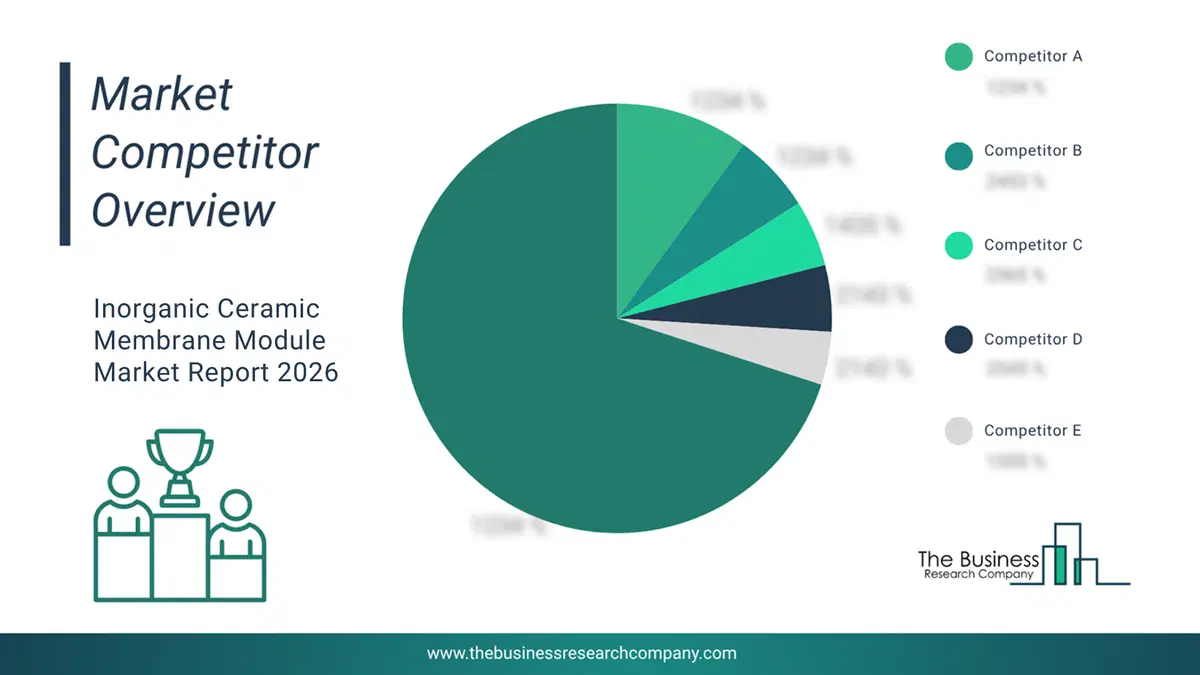
This chart is for illustrative purposes; the full report includes a detailed competitor analysis and comprehensive overview of the top 10 companies in the market.
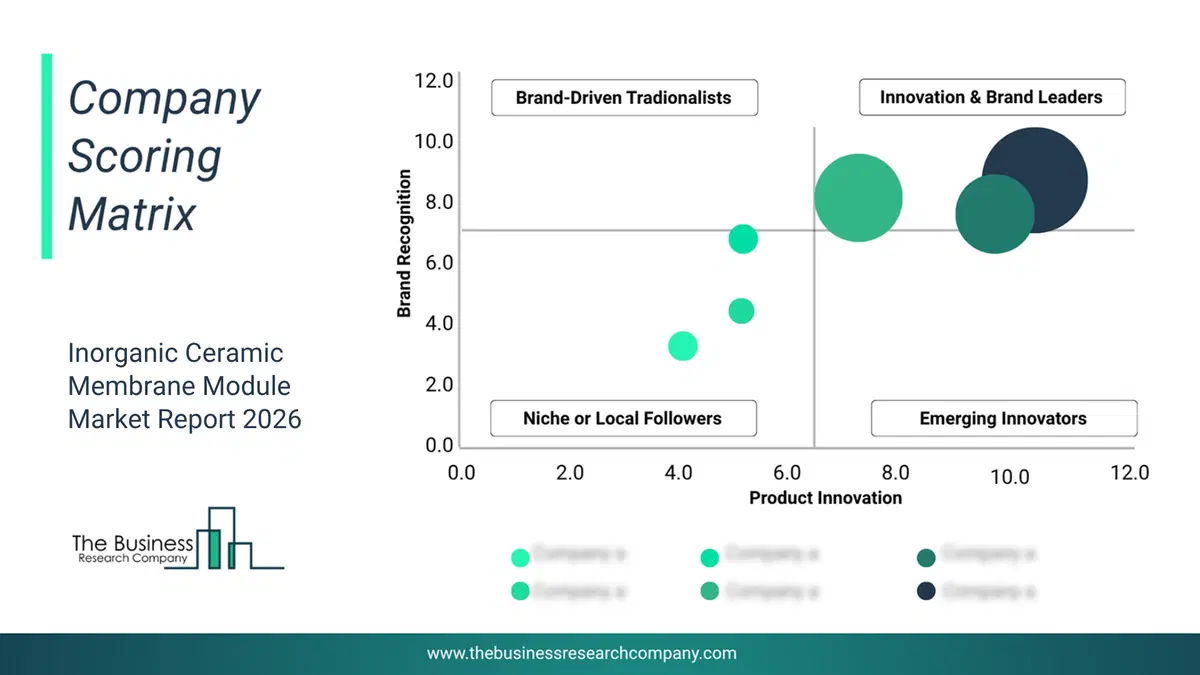
This chart maps companies by product innovation and brand strength, with bubble size indicating relative revenue, helping identify market leaders, challengers, and niche players. This is an illustrative chart; the full report provides a complete and accurate competitive analysis.
Global Inorganic Ceramic Membrane Module Market Trends and Insights
Major companies operating in the inorganic ceramic membrane module market are focusing on developing advanced products, such as high-selectivity filtration systems, to boost efficiency, enhance reliability, and reduce operational costs and waste. High-selectivity filtration systems refer to advanced ceramic membrane technologies that precisely separate challenging contaminants from process streams, enabling water reuse and resource recovery. For instance, in May 2025, Nanostone Water Inc., a US-based manufacturer of ceramic membrane filtration systems, launched the CUFshield PLUS. It is an advanced inorganic ceramic ultrafiltration (CUF) module designed specifically to solve the semiconductor industry's most difficult wastewater challenges, such as handling abrasive CMP slurries and complex chemistries. It features an enhanced, highly durable membrane material and a robust module construction that provides superior resistance to extreme pH, oxidants, and mechanical abrasion, drastically reducing membrane replacement frequency and downtime.What Are Latest Mergers And Acquisitions In The Inorganic Ceramic Membrane Module Market?
In July 2025, Nanostone Water Inc., a US-based company specializing in advanced ceramic ultrafiltration technology, merged with Solecta Inc. to form Acuriant Technologies Inc. Through this merger, Acuriant Technologies will combine Nanostone’s ceramic membrane expertise with Solecta’s polymeric membrane solutions to deliver enhanced filtration performance, robustness, and efficiency across industrial, municipal, and food and beverage applications. Solecta Inc. is a US-based company specializing in the design and manufacture of polymeric membrane technologies for water and wastewater treatment.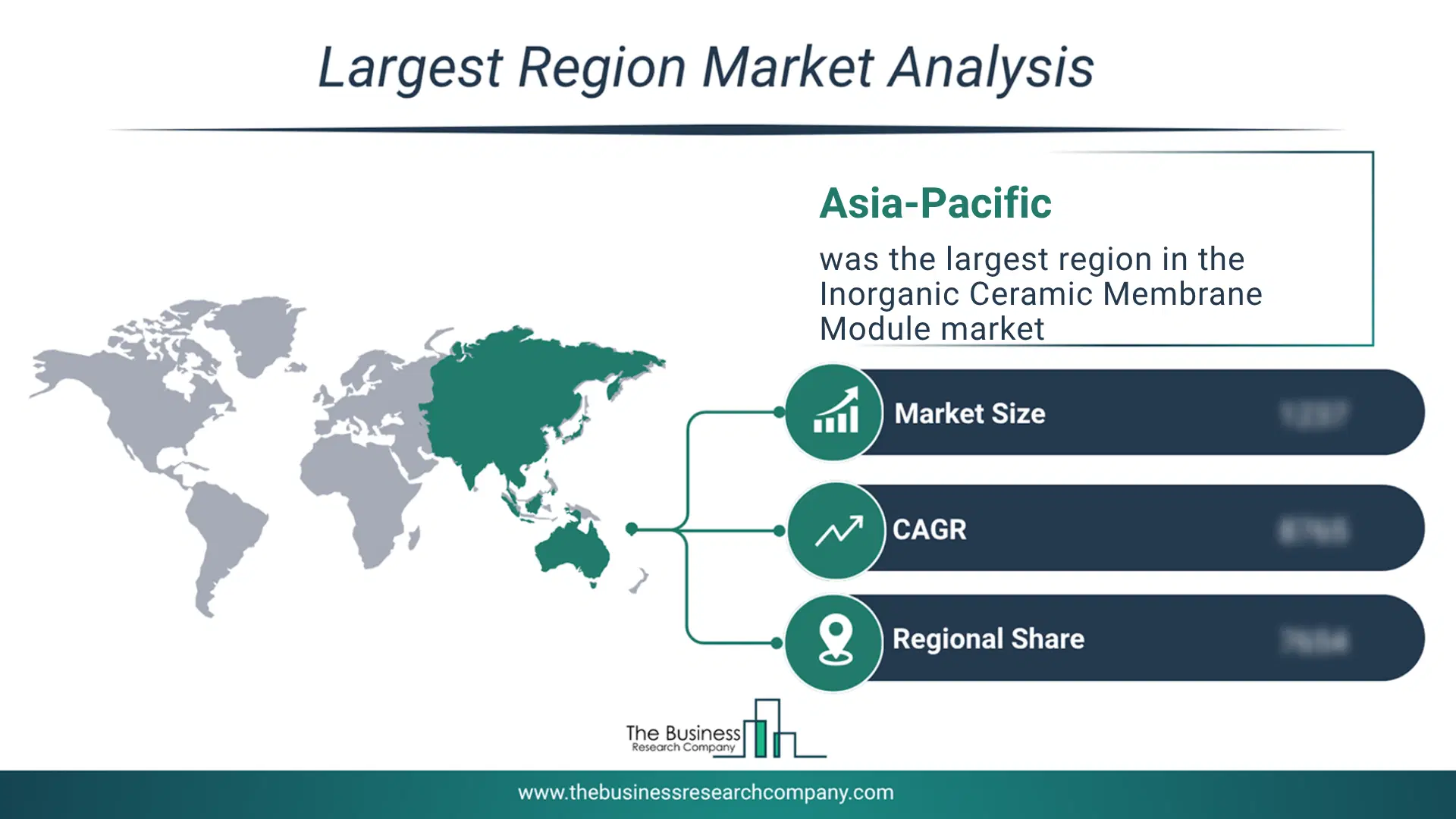
Regional Insights
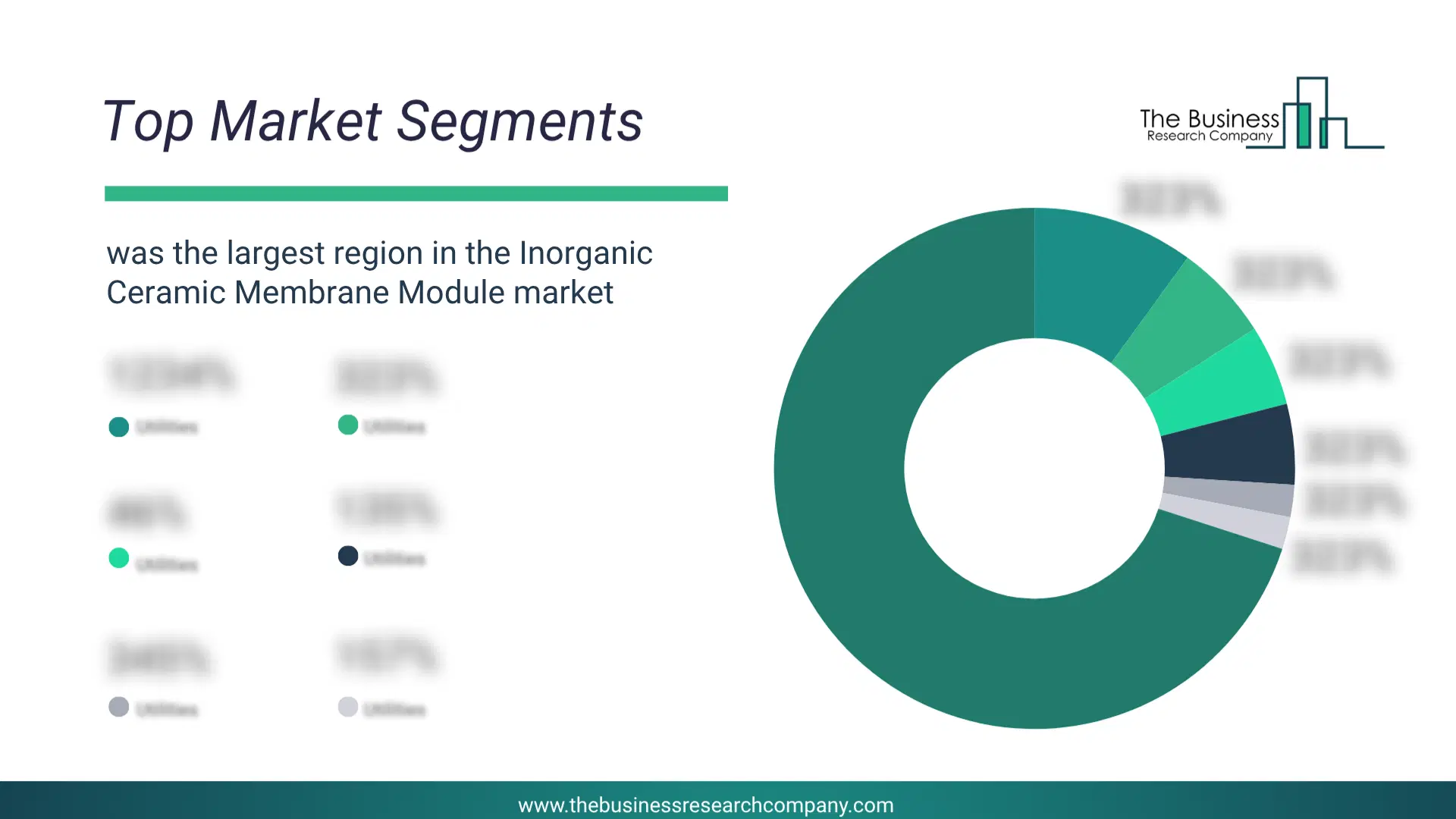
Asia-Pacific was the largest region in the inorganic ceramic membrane module market in 2025. Asia-Pacific is expected to be the fastest-growing region in the forecast period. The regions covered in this market report are Asia-Pacific, South East Asia, Western Europe, Eastern Europe, North America, South America, Middle East, Africa. The countries covered in this market report are Australia, Brazil, China, France, Germany, India, Indonesia, Japan, Taiwan, Russia, South Korea, UK, USA, Canada, Italy, Spain.What Defines the Inorganic Ceramic Membrane Module Market?
The inorganic ceramic membrane module market consists of sales of ceramic membrane module, ceramic membrane element, ceramic membrane housing, ceramic membrane cartridge, ceramic membrane support tube, ceramic membrane plate, and ceramic membrane sealing components. Values in this market are ‘factory gate’ values, meaning the value of goods sold by the manufacturers or creators of the goods, whether to other entities (including downstream manufacturers, wholesalers, distributors, and retailers) or directly to end customers. The value of goods in this market includes related services sold by the creators of the goods.How is Market Value Defined and Measured?
The market value is defined as the revenues that enterprises gain from the sale of goods and/or services within the specified market and geography through sales, grants, or donations in terms of the currency (in USD unless otherwise specified). The revenues for a specified geography are consumption values that are revenues generated by organizations in the specified geography within the market, irrespective of where they are produced. It does not include revenues from resales along the supply chain, either further along the supply chain or as part of other products.
This chart presents market attractiveness based on a quantitative evaluation of growth, competition, strategic alignment, and risk, offering a clear view of opportunity areas for decision-making. This chart is for illustrative purposes; the full report contains the complete analysis.

This chart highlights the Total Addressable Market (TAM) by estimating the maximum revenue opportunity using an assumption-driven approach, supporting strategic planning and opportunity sizing across markets. The chart is illustrative; the full report provides a more comprehensive analysis.
What Key Data and Analysis Are Included in the Inorganic Ceramic Membrane Module Market Report 2026?
The inorganic ceramic membrane module market research report is one of a series of new reports from The Business Research Company that provides market statistics, including industry global market size, regional shares, competitors with the market share, detailed market segments, market trends and opportunities, and any further data you may need to thrive in the inorganic ceramic membrane module industry. The market research report delivers a complete perspective of everything you need, with an in-depth analysis of the current and future state of the industry.Inorganic Ceramic Membrane Module Market Report Forecast Analysis
| Report Attribute | Details |
|---|---|
| Market Size Value In 2026 | $1.55 billion |
| Revenue Forecast In 2030 | $2.17 billion |
| Growth Rate | CAGR of 9.0% from 2026 to 2030 |
| Base Year For Estimation | 2025 |
| Actual Estimates/Historical Data | 2020-2025 |
| Forecast Period | 2026 - 2030 |
| Market Representation | Revenue in USD Billion and CAGR from 2026 to 2030 |
| Segments Covered | Type, Module Type Or Configuration, Technology, Material Type, Application |
| Regional Scope | Asia-Pacific, Western Europe, Eastern Europe, North America, South America, Middle East, Africa |
| Country Scope | The countries covered in this market report are Australia, Brazil, China, France, Germany, India, Indonesia, Japan, Taiwan, Russia, South Korea, UK, USA, Canada, Italy, Spain |
| Key Companies Profiled | GEA Group Aktiengesellschaft, Meidensha Corporation, METAWATER Co. Ltd., Aquatech International LLC, Sterlitech Corporation, Pall Corporation, JIUWU Hi-Tech Membrane Technology Co. Ltd., Nanostone Water Inc., TAMI Industries, Berghof Membranes B.V., Aquabrane Water Technologies Private Limited, Alsys Group SAS, CERAFILTEC GmbH, Blufox Ecoventures LLP, Atech Innovations GmbH, Membracon UK Ltd., Ceraflo Pte Ltd., Atech Innovations GmbH, Inopor GmbH, Pervatech B.V. |
| Customization Scope | Request for Customization |
| Pricing And Purchase Options | Explore Purchase Options |