
Instant Diagnostic Imaging Market Report 2026
Global Outlook – By Component (Imaging Systems, Software, Services), By Technology (Digital Imaging, Artificial Intelligence Enabled Imaging, Point Of Care Imaging, Portable And Handheld Imaging, Wireless Imaging Systems, Cloud Based Imaging And Teleradiology), By Application (Emergency And Trauma Care, Critical Care, Cardiology, Oncology, Neurology, Orthopedics, Obstetrics And Gynecology, Other Applications), By End User (Hospitals, Diagnostic Imaging Centers, Ambulatory Surgical Centers, Specialty Clinics, Military And Defense Healthcare, Home Healthcare, Other End Users) – Market Size, Trends, Strategies, and Forecast to 2030
Instant Diagnostic Imaging Market Report 2026 Market Overview
• Instant Diagnostic Imaging Market Report 2026 market size has reached to $3.65 billion in 2025 • Expected to grow to $5.28 billion in 2030 at a compound annual growth rate (CAGR) of 7.7% • Growth Driver: Increasing Demand For Rapid Point-Of-Care Diagnostics Fueling Growth Due To The Need For Faster Clinical Decision-Making • Market Trend: Advancements In Artificial Intelligence-Enabled Imaging Accelerating Real-Time Clinical Decision-Making • North America was the largest region in 2025 and Asia-Pacific is the fastest growing region.What Is Covered Under Instant Diagnostic Imaging Market?
Instant diagnostic imaging refers to medical imaging technologies and workflows that enable the rapid acquisition, processing, and display of diagnostic-quality images at or near the point of care. By utilizing advanced digital detectors, AI-assisted image processing, and automated data transmission, these systems eliminate delays associated with conventional imaging workflows, enabling clinicians to make timely diagnostic and treatment decisions in emergency departments. The main components of instant diagnostic imaging include imaging systems, software, and services. Imaging systems refer to medical imaging devices designed to capture and deliver diagnostic images rapidly, enabling timely clinical assessment and treatment decisions across various healthcare settings. These solutions utilize technologies such as digital imaging, artificial intelligence enabled imaging, point of care imaging, portable and handheld imaging, wireless imaging systems, and cloud based imaging and teleradiology. The various applications involved are emergency and trauma care, critical care, cardiology, oncology, neurology, orthopedics, obstetrics and gynecology, and others and they are utilized by end users including hospitals, diagnostic imaging centers, ambulatory surgical centers, specialty clinics, military and defense healthcare, home healthcare, and others.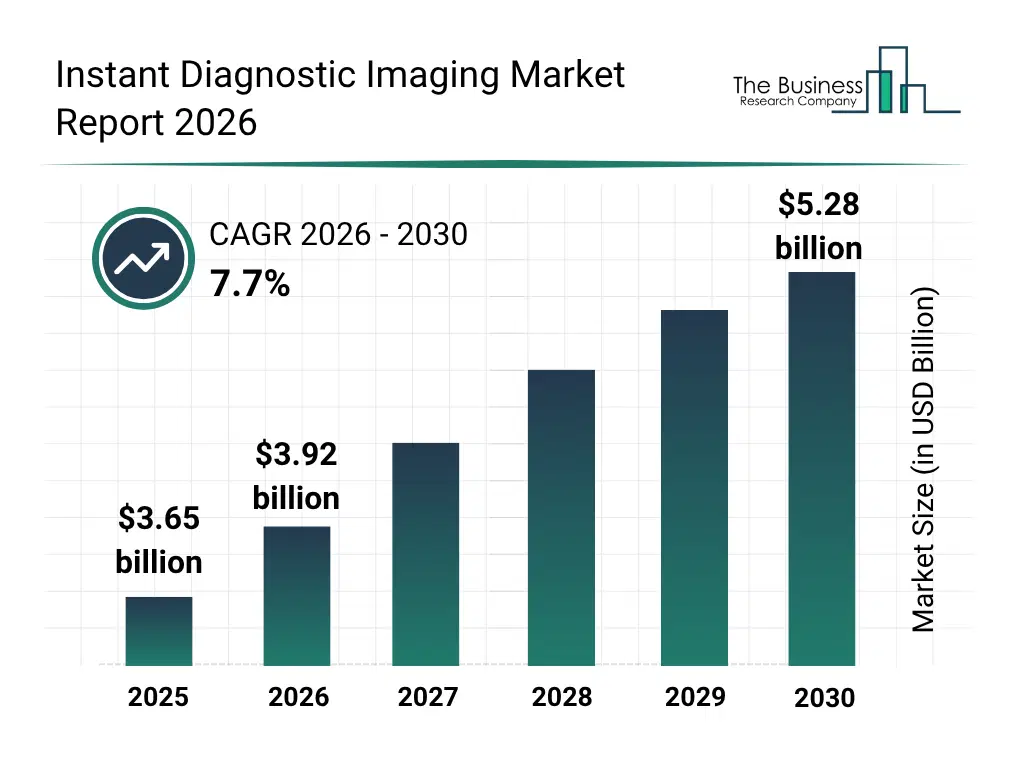
What Is The Instant Diagnostic Imaging Market Size and Share 2026?
The instant diagnostic imaging market size has grown strongly in recent years. It will grow from $3.65 billion in 2025 to $3.92 billion in 2026 at a compound annual growth rate (CAGR) of 7.5%. The growth in the historic period can be attributed to increasing demand for faster emergency diagnostics, rising adoption of digital imaging technologies, growing need for improved clinical decision-making in critical care, increasing healthcare infrastructure development, rising utilization of advanced imaging modalities in hospitals.What Is The Instant Diagnostic Imaging Market Growth Forecast?
The instant diagnostic imaging market size is expected to see strong growth in the next few years. It will grow to $5.28 billion in 2030 at a compound annual growth rate (CAGR) of 7.7%. The growth in the forecast period can be attributed to increasing adoption of AI-enabled diagnostic imaging solutions, growing expansion of point-of-care imaging applications, rising demand for portable and wireless imaging systems, increasing integration of cloud-based teleradiology platforms, growing focus on reducing diagnostic turnaround time in healthcare. Major trends in the forecast period include increasing adoption of point-of-care imaging systems for rapid clinical decision-making, growing integration of ai-assisted image processing for faster diagnostic interpretation, rising demand for portable and handheld imaging solutions in emergency care settings, increasing deployment of cloud-based imaging workflows for real-time data access, growing preference for automated imaging systems to reduce diagnostic turnaround time.
Global Instant Diagnostic Imaging Market Segmentation
1) By Component: Imaging Systems, Software, Services 2) By Technology: Digital Imaging, Artificial Intelligence Enabled Imaging, Point Of Care Imaging, Portable And Handheld Imaging, Wireless Imaging Systems, Cloud Based Imaging And Teleradiology 3) By Application: Emergency And Trauma Care, Critical Care, Cardiology, Oncology, Neurology, Orthopedics, Obstetrics And Gynecology, Other Applications 4) By End User: Hospitals, Diagnostic Imaging Centers, Ambulatory Surgical Centers, Specialty Clinics, Military And Defense Healthcare, Home Healthcare, Other End Users Subsegments: 1) By Imaging Systems: Fixed Imaging Systems, Portable Imaging Systems, Mobile Imaging Systems, Handheld Imaging Systems, Hybrid Imaging Systems 2) By Software: Image Acquisition Software, Image Processing Software, Image Analysis Software, Visualization Software, Reporting And Workflow Management Software, Artificial Intelligence Diagnostic Software, Cloud Imaging Software 3) By Services: Installation Services, Maintenance Services, Repair Services, Training And Education Services, Consulting Services, Remote Monitoring Services, Technical Support ServicesWhat Is The Driver Of The Instant Diagnostic Imaging Market?
The increasing demand for rapid point-of-care diagnostics is expected to propel the growth of the instant diagnostic imaging market going forward. Rapid point-of-care diagnostics are medical tests and imaging procedures performed at or near the patient care location to deliver immediate diagnostic results and support timely clinical decisions. The demand for rapid point-of-care diagnostics is increasing due to the growing emphasis on early disease detection and faster clinical intervention. Instant diagnostic imaging enables healthcare providers to acquire and interpret medical images immediately, supporting rapid diagnosis and timely treatment decisions at the point of care. For instance, in October 2024, according to the World Health Organization, a Switzerland-based public health organization, 48% (3.9 million) of the 8.2 million people newly diagnosed with tuberculosis in 2023 were initially tested using a World Health Organization-recommended rapid diagnostic test, compared with 47% of the 7.5 million people diagnosed in 2022, demonstrating the increasing adoption of rapid diagnostic technologies worldwide. Therefore, the increasing demand for rapid point-of-care diagnostics is driving the growth of the instant diagnostic imaging industry.Key Players In The Global Instant Diagnostic Imaging Market
Major companies operating in the instant diagnostic imaging market report are Siemens Healthineers AG, GE HealthCare Technologies Inc., Koninklijke Philips N.V., FUJIFILM Holdings Corporation, Canon Inc., Mindray Medical International Limited, Samsung Medison Co. Ltd., Hologic Inc., Butterfly Network Inc., United Imaging Healthcare Co. Ltd., Konica Minolta Healthcare Americas Inc., Carestream Health Inc., Clarius Mobile Health, Esaote S.p.A., Viz.ai, Hyperfine Inc., Ziehm Imaging GmbH, Edan Instruments Inc., Nanox Imaging Ltd., Agfa Radiology Solutions, KA Imaging Inc., Vave Health Inc., ALPINION Medical Systems Co. Ltd., Micro-X Limited, Virtual Radiologic, Teleradiology Solutions, MARS Bioimaging, USARAD Holdings Inc.
This chart is for illustrative purposes; the full report includes a detailed competitor analysis and comprehensive overview of the top 10 companies in the market.
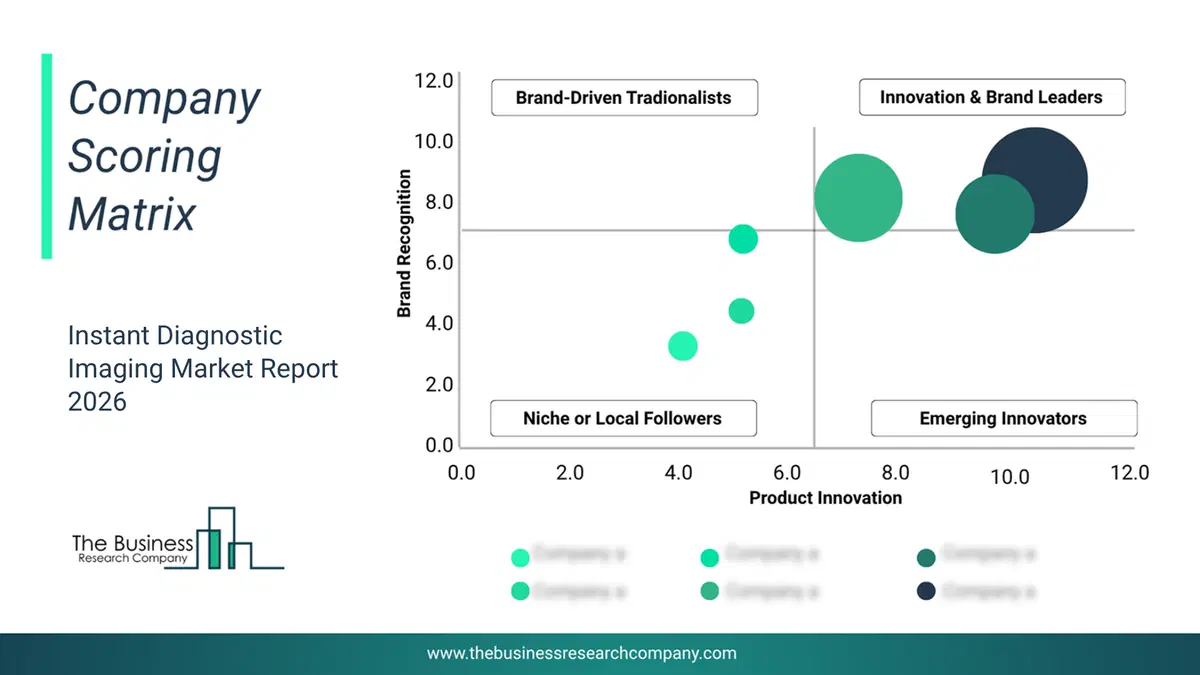
This chart maps companies by product innovation and brand strength, with bubble size indicating relative revenue, helping identify market leaders, challengers, and niche players. This is an illustrative chart; the full report provides a complete and accurate competitive analysis.
Global Instant Diagnostic Imaging Market Trends and Insights
Major companies operating in the instant diagnostic imaging market are focusing on developing instant artificial intelligence-enabled imaging platforms to accelerate diagnostic accuracy and clinical decision-making. Instant artificial intelligence-enabled imaging platforms are advanced imaging solutions that combine medical imaging devices with artificial intelligence algorithms to automatically analyze images, prioritize critical findings, and deliver real-time diagnostic insights for faster patient assessment. For instance, in September 2024, GE HealthCare, a US-based medical technology company, launched Venue Sprint, a portable ultrasound system designed for rapid point-of-care imaging. The system features artificial intelligence-enabled workflow guidance that assists users during image acquisition, wireless connectivity for seamless image sharing and clinical collaboration, and a compact, highly portable design that enables imaging in emergency departments, intensive care units, and remote healthcare settings. These advancements support faster diagnosis and improve workflow efficiency, strengthening innovation across the Instant Diagnostic Imaging market.What Are Latest Mergers And Acquisitions In The Instant Diagnostic Imaging Market?
In January 2025, Hologic Inc., a US-based healthcare technology company, acquired Gynesonics Inc. for $350 million. With this acquisition, Hologic expanded its portfolio of minimally invasive women's health solutions by adding the Sonata System, strengthening its capabilities in treating uterine fibroids and heavy menstrual bleeding while broadening treatment options for gynecologic surgeons worldwide. Gynesonics Inc. is a US-based healthcare technology company that develops ultrasound-guided imaging platforms that provide real-time visualization and immediate anatomical assessment during minimally invasive procedures.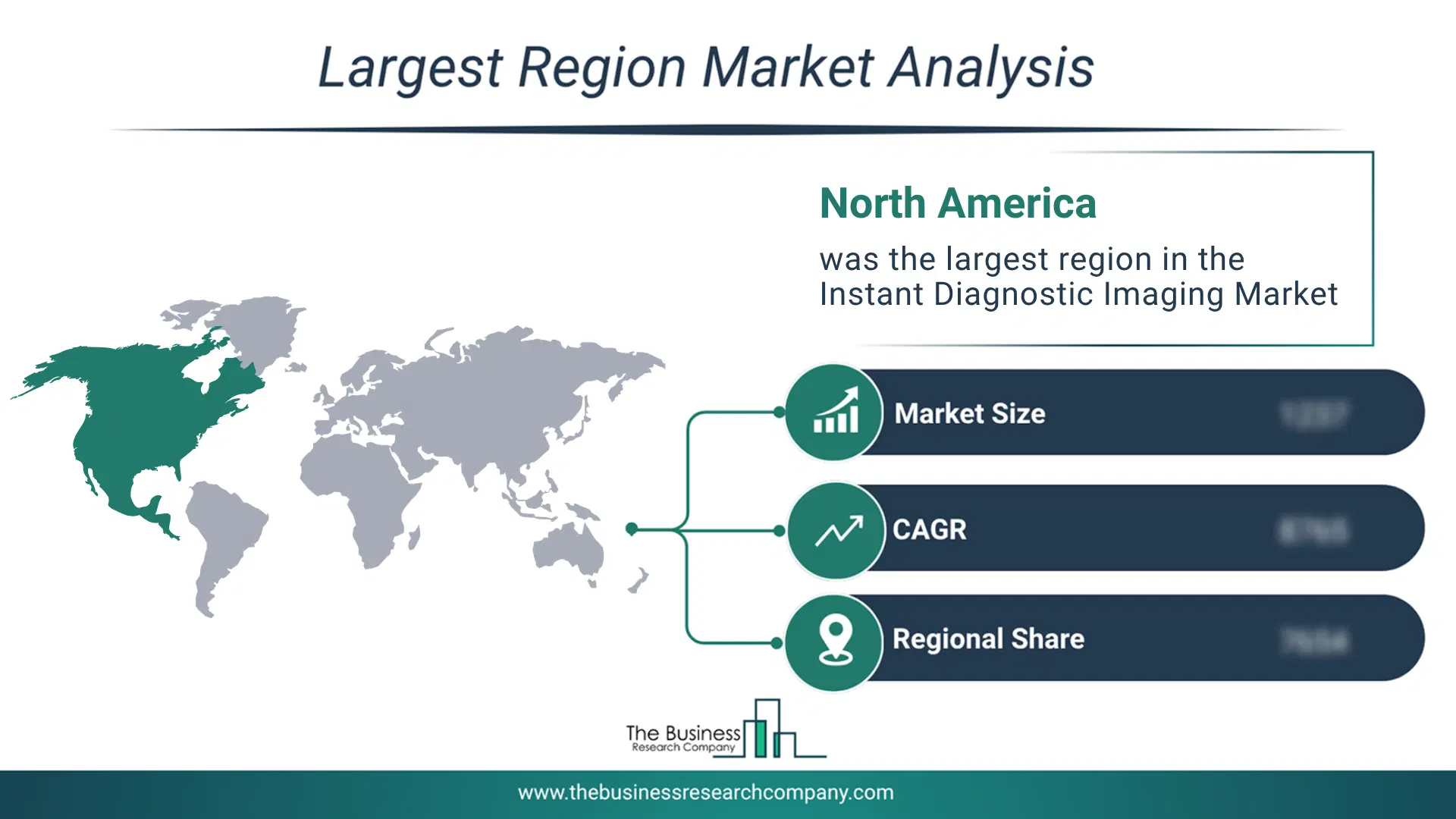
Regional Outlook
North America was the largest region in the instant diagnostic imaging market in 2025. Asia-Pacific is expected to be the fastest-growing region in the forecast period. The regions covered in this market report are Asia-Pacific, South East Asia, Western Europe, Eastern Europe, North America, South America, Middle East, Africa. The countries covered in this market report are Australia, Brazil, China, France, Germany, India, Indonesia, Japan, Taiwan, Russia, South Korea, UK, USA, Canada, Italy, Spain.What Defines the Instant Diagnostic Imaging Market?
The instant diagnostic imaging market consists of revenues earned by entities by providing services such as diagnostic imaging services, point-of-care imaging services, and mobile imaging services and teleradiology services. The market value includes the value of related goods sold by the service provider or included within the service offering. The instant diagnostic imaging market also includes sales of portable X-ray systems, handheld ultrasound devices, mobile CT scanners, digital radiography systems, point-of-care ultrasound devices. Values in this market are ‘factory gate’ values, that is the value of goods sold by the manufacturers or creators of the goods, whether to other entities (including downstream manufacturers, wholesalers, distributors and retailers) or directly to end customers. The value of goods in this market includes related services sold by the creators of the goods.How is Market Value Defined and Measured?
The market value is defined as the revenues that enterprises gain from the sale of goods and/or services within the specified market and geography through sales, grants, or donations in terms of the currency (in USD unless otherwise specified). The revenues for a specified geography are consumption values that are revenues generated by organizations in the specified geography within the market, irrespective of where they are produced. It does not include revenues from resales along the supply chain, either further along the supply chain or as part of other products.
This chart presents market attractiveness based on a quantitative evaluation of growth, competition, strategic alignment, and risk, offering a clear view of opportunity areas for decision-making. This chart is for illustrative purposes; the full report contains the complete analysis.

This chart highlights the Total Addressable Market (TAM) by estimating the maximum revenue opportunity using an assumption-driven approach, supporting strategic planning and opportunity sizing across markets. The chart is illustrative; the full report provides a more comprehensive analysis.
What Key Data and Analysis Are Included in the Instant Diagnostic Imaging Market Report 2026?
The instant diagnostic imaging market research report is one of a series of new reports from The Business Research Company that provides market statistics, including industry global market size, regional shares, competitors with the market share, detailed market segments, market trends and opportunities, and any further data you may need to thrive in the instant diagnostic imaging industry. The market research report delivers a complete perspective of everything you need, with an in-depth analysis of the current and future state of the industry.Instant Diagnostic Imaging Market Report Forecast Analysis
| Report Attribute | Details |
|---|---|
| Market Size Value In 2026 | $3.92 billion |
| Revenue Forecast In 2030 | $5.28 billion |
| Growth Rate | CAGR of 7.7% from 2026 to 2030 |
| Base Year For Estimation | 2025 |
| Actual Estimates/Historical Data | 2020-2025 |
| Forecast Period | 2026 - 2030 |
| Market Representation | Revenue in USD Billion and CAGR from 2026 to 2030 |
| Segments Covered | Component, Technology, Application, End User |
| Regional Scope | Asia-Pacific, Western Europe, Eastern Europe, North America, South America, Middle East, Africa |
| Country Scope | The countries covered in the report are Australia, Brazil, China, France, Germany, India, Indonesia, Japan, Taiwan, Russia, South Korea, UK, USA, Canada, Italy, Spain. |
| Key Companies Profiled | Siemens Healthineers AG, GE HealthCare Technologies Inc., Koninklijke Philips N.V., FUJIFILM Holdings Corporation, Canon Inc., Mindray Medical International Limited, Samsung Medison Co. Ltd., Hologic Inc., Butterfly Network Inc., United Imaging Healthcare Co. Ltd., Konica Minolta Healthcare Americas Inc., Carestream Health Inc., Clarius Mobile Health, Esaote S.p.A., Viz.ai, Hyperfine Inc., Ziehm Imaging GmbH, Edan Instruments Inc., Nanox Imaging Ltd., Agfa Radiology Solutions, KA Imaging Inc., Vave Health Inc., ALPINION Medical Systems Co. Ltd., Micro-X Limited, Virtual Radiologic, Teleradiology Solutions, MARS Bioimaging, USARAD Holdings Inc. |
| Customization Scope | Request for Customization |
| Pricing And Purchase Options | Explore Purchase Options |