
Institutional Buildings Market Report 2026
Global Outlook – By Type (Residential, Non-Residential), By Construction Type (New Construction, Renovation), By Building Type (Smart Buildings, Traditional Buildings), By Application (Owned, Rental), By End User (Private, Public ) – Market Size, Trends, Strategies, and Forecast to 2030
Institutional Buildings Market Overview
• Institutional Buildings market size has reached to $1163.33 billion in 2025 • Expected to grow to $1397.85 billion in 2030 at a compound annual growth rate (CAGR) of 3.9% • Growth Driver: Increasing Government Expenditure Fuels Growth In The Institutional Buildings Market • Market Trend: Advancements In Sustainable And Energy-Efficient Construction Solutions • Asia-Pacific was the largest region and fastest growing region.What Is Covered Under Institutional Buildings Market?
An institutional building refers to a structure designed to serve a public or community purpose, such as education, healthcare, government, or cultural activities. These buildings include schools, hospitals, libraries, and government offices. They are typically large, functional spaces meant to accommodate specific institutional needs. The main types of institutional buildings include residential and non-residential. Residential buildings refers to the building which are designed for housing purposes. Different construction types include new construction and renovation. Various building types are smart buildings and traditional buildings. Various applications involved are owned and rental, and they are used by several end users such as private and public.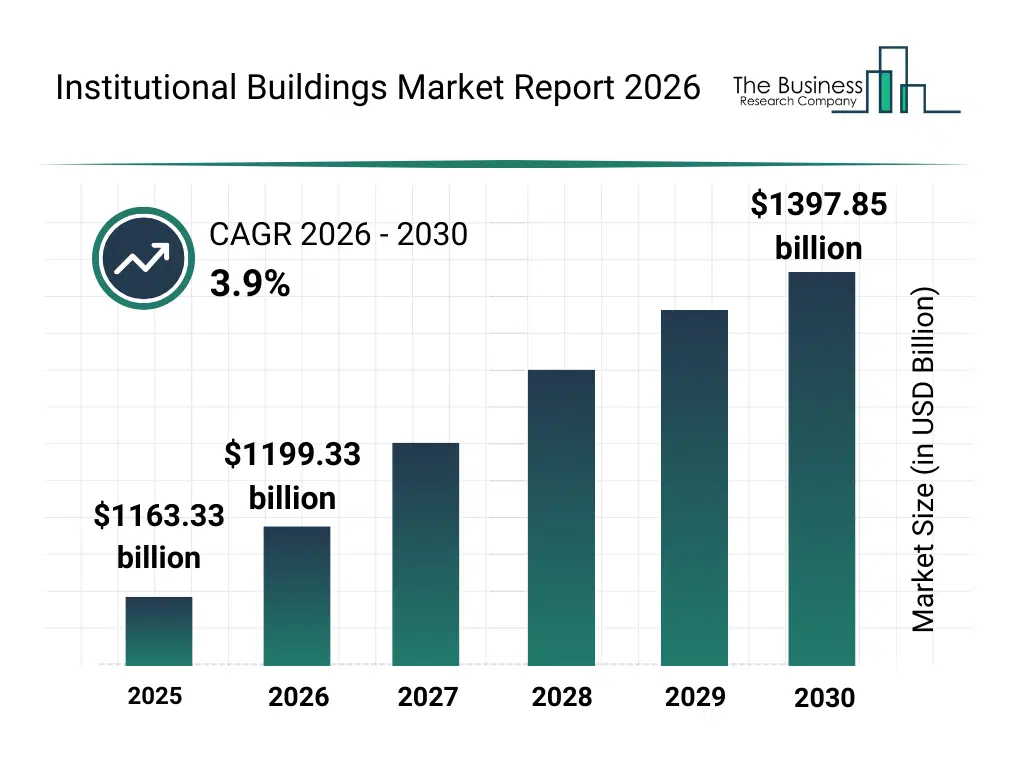
What Is The Institutional Buildings Market Size and Share 2026?
The institutional buildings market size has grown steadily in recent years. It will grow from $1163.33 billion in 2025 to $1199.33 billion in 2026 at a compound annual growth rate (CAGR) of 3.1%. The growth in the historic period can be attributed to growth in public infrastructure funding, increasing demand for educational and healthcare capacity, reliance on traditional construction approaches, expansion of community service institutions, rising need for large functional buildings.What Is The Institutional Buildings Market Growth Forecast?
The institutional buildings market size is expected to see steady growth in the next few years. It will grow to $1397.85 billion in 2030 at a compound annual growth rate (CAGR) of 3.9%. The growth in the forecast period can be attributed to growing adoption of smart institutional facilities, rising focus on sustainability in public buildings, increasing investment in modernization of aging structures, expanding need for healthcare and senior-care infrastructure, greater emphasis on resilient community facilities. Major trends in the forecast period include increasing development of educational and healthcare facilities, growing demand for large-scale community service buildings, rising emphasis on renovation of aged institutional structures, expansion of purpose-built dormitories and convents, higher demand for functional, compliance-focused building designs.
Global Institutional Buildings Market Segmentation
1) By Type: Residential, Non-Residential 2) By Construction Type: New Construction, Renovation 3) By Building Type: Smart Buildings, Traditional Buildings 4) By Application: Owned, Rental 5) By End User: Private, Public Subsegments: 1) By Residential: Senior Living Facilities 2) By Non-Residential: Educational Buildings, Healthcare Facilities, Government Buildings, Recreational FacilitiesWhat Is The Driver Of The Institutional Buildings Market?
The increasing government expenditure is expected to boost the growth of the institutional buildings market going forward. Government expenditure refers to the capital that the government spends on various goods and services. Government buildings such as government hospitals and government schools benefit from the increasing government expenditure, aiding in the development of various infrastructural requirements such as institutional buildings. For instance,in August 2024, according to the Office for National Statistics, a UK-based government department, the central government's total expenditure in July 2024 was $136.4 billion (£107.4 billion), which is $4.45 billion (£3.5 billion) higher than in July 2023. This $4.45 billion (£3.5 billion) rise in spending accounts for the overall increase. Therefore, the increasing government expenditure is driving the growth of the institutional buildings industry.Key Players In The Global Institutional Buildings Market
Major companies operating in the institutional buildings market are China State Construction Engineering Co. Ltd., Shanghai Construction Group Co. Ltd., Clark Construction Group LLC, The Whiting-Turner Contracting Company, Turner Construction Company, Balfour Beatty plc, Greenland Holdings Corp. Ltd., Obayashi Corporation, Daiwa Real Estate Co. Ltd., HOCHTIEF Aktiengesellschaft, Vinci S.A., Bouygues SA, Kajima U.S.A. Inc., Bechtel Corporation, Skanska AB, The Metallurgical Corp of China, Actividades de Construccion y Servicios SA, Tutor Perini Corp., Parsons Corp., AECOM Inc., Jacobs Solutions Inc., WSP Global Inc., HNTB Corp., STV Group Inc., Fluor Corporation, Kiewit Corporation, PCL Construction Enterprises Inc., McCarthy Holdings Inc., The Boldt Company, The Weitz Company, Mortenson Construction, Gilbane Building Company, JE Dunn Construction Group Inc., Hensel Phelps Construction Co., Barton Malow Company, Ryan Companies US Inc., Skender Construction, The Beck Group, Sundt Construction Inc., Brasfield & Gorrie LLC, DPR Construction, Gray Construction, Hoffman Construction Company, Holder Construction Company, Messer Construction Co., Pepper Construction Group LLC, Robins & Morton LLC
This chart is for illustrative purposes; the full report includes a detailed competitor analysis and comprehensive overview of the top 10 companies in the market.
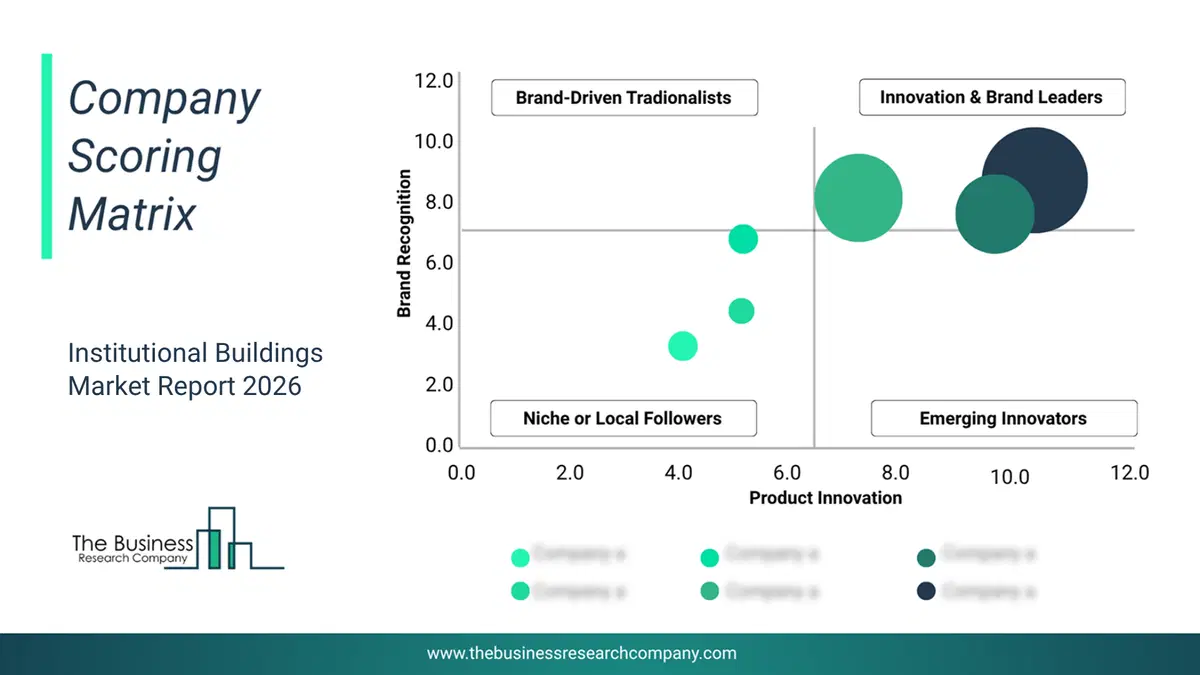
This chart maps companies by product innovation and brand strength, with bubble size indicating relative revenue, helping identify market leaders, challengers, and niche players. This is an illustrative chart; the full report provides a complete and accurate competitive analysis.
Global Institutional Buildings Market Trends and Insights
Major companies operating in the institutional building market are focusing on developing advanced innovations such as energy-saving ceiling panels with phase change material (PCM) technology to enhance operational efficiency, reduce energy consumption, improve indoor environmental quality (IEQ), and provide versatile acoustic solutions for educational and healthcare facilities. Energy-saving phase change material ceiling panels refer to building materials that integrate phase change technology with mineral fiber or similar substrates to regulate indoor temperature passively, reducing heating and cooling demands while maintaining thermal comfort and sound performance. For instance, in November 2024, Armstrong World Industries, a US-based ceiling and wall solutions manufacturer, launched the school zone fine fissured templok energy-saving ceiling panels, part of its expanded Templok portfolio. The panels combine phase change material technology with total acoustics performance, enabling up to 15% energy savings, enhanced speech privacy, mold- and mildew-resistant surfaces, and flexible floor plan integration, representing a modern approach to creating sustainable, comfortable, and efficient institutional building environments.What Are Latest Mergers And Acquisitions In The Institutional Buildings Market?
In September 2025, Nisus Finance Services Co. Limited, an India-based financial service company, acquired a majority stake in New Consolidated Construction Company Ltd. for an undisclosed amount. With this acquisition, Nisus Finance Services Co. Limited aims to strengthen and expand its urban infrastructure platform, diversify revenue streams, enhance developer relationships, and leverage NCCCL’s proven project delivery capabilities to capitalize on India’s infrastructure growth. New Consolidated Construction Company Ltd. is an India-based engineering company that offers institutional buildings.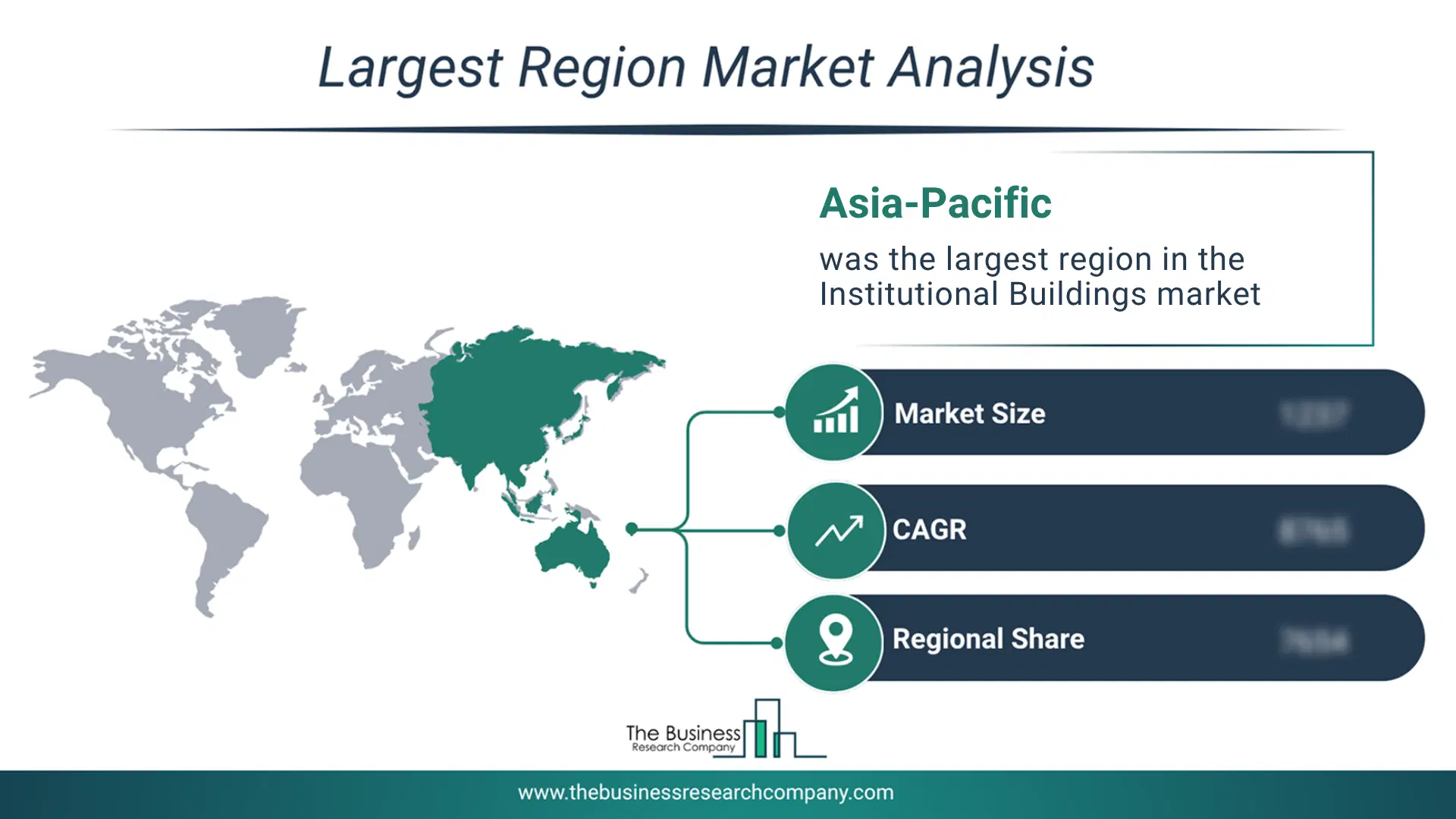
Regional Insights
Asia-Pacific was the largest region in the institutional buildings market in 2025. The regions covered in this market report are Asia-Pacific, South East Asia, Western Europe, Eastern Europe, North America, South America, Middle East, Africa. The countries covered in this market report are Australia, Brazil, China, France, Germany, India, Indonesia, Japan, Taiwan, Russia, South Korea, UK, USA, Canada, Italy, Spain.What Defines the Institutional Buildings Market?
The institutional buildings market includes revenues earned by entities by constructing convents, hospitals, and school dormitories. The market value includes the value of related goods sold by the service provider or included within the service offering. Only goods and services traded between entities or sold to end consumers are included.How is Market Value Defined and Measured?
The market value is defined as the revenues that enterprises gain from the sale of goods and/or services within the specified market and geography through sales, grants, or donations in terms of the currency (in USD unless otherwise specified). The revenues for a specified geography are consumption values that are revenues generated by organizations in the specified geography within the market, irrespective of where they are produced. It does not include revenues from resales along the supply chain, either further along the supply chain or as part of other products.
This chart presents market attractiveness based on a quantitative evaluation of growth, competition, strategic alignment, and risk, offering a clear view of opportunity areas for decision-making. This chart is for illustrative purposes; the full report contains the complete analysis.

This chart highlights the Total Addressable Market (TAM) by estimating the maximum revenue opportunity using an assumption-driven approach, supporting strategic planning and opportunity sizing across markets. The chart is illustrative; the full report provides a more comprehensive analysis.
What Key Data and Analysis Are Included in theInstitutional Buildings Market Report 2026?
The institutional buildings market research report is one of a series of new reports from The Business Research Company that provides market statistics, including industry global market size, regional shares, competitors with the market share, detailed market segments, market trends and opportunities, and any further data you may need to thrive in the institutional buildings industry. The market research report delivers a complete perspective of everything you need, with an in-depth analysis of the current and future state of the industry.Institutional Buildings Market Report Forecast Analysis
| Report Attribute | Details |
|---|---|
| Market Size Value In 2026 | $1199.33 billion |
| Revenue Forecast In 2030 | $1397.85 billion |
| Growth Rate | CAGR of 3.1% from 2026 to 2030 |
| Base Year For Estimation | 2025 |
| Actual Estimates/Historical Data | 2020-2025 |
| Forecast Period | 2026 - 2030 |
| Market Representation | Revenue in USD Billion and CAGR from 2026 to 2030 |
| Segments Covered | Type, Construction Type, Building Type, Application, End User |
| Regional Scope | Asia-Pacific, Western Europe, Eastern Europe, North America, South America, Middle East, Africa |
| Country Scope | The countries covered in this market report are Australia, Brazil, China, France, Germany, India, Indonesia, Japan, Taiwan, Russia, South Korea, UK, USA, Canada, Italy, Spain |
| Key Companies Profiled | China State Construction Engineering Co. Ltd., Shanghai Construction Group Co. Ltd., Clark Construction Group LLC, The Whiting-Turner Contracting Company, Turner Construction Company, Balfour Beatty plc, Greenland Holdings Corp. Ltd., Obayashi Corporation, Daiwa Real Estate Co. Ltd., HOCHTIEF Aktiengesellschaft, Vinci S.A., Bouygues SA, Kajima U.S.A. Inc., Bechtel Corporation, Skanska AB, The Metallurgical Corp of China, Actividades de Construccion y Servicios SA, Tutor Perini Corp., Parsons Corp., AECOM Inc., Jacobs Solutions Inc., WSP Global Inc., HNTB Corp., STV Group Inc., Fluor Corporation, Kiewit Corporation, PCL Construction Enterprises Inc., McCarthy Holdings Inc., The Boldt Company, The Weitz Company, Mortenson Construction, Gilbane Building Company, JE Dunn Construction Group Inc., Hensel Phelps Construction Co., Barton Malow Company, Ryan Companies US Inc., Skender Construction, The Beck Group, Sundt Construction Inc., Brasfield & Gorrie LLC, DPR Construction, Gray Construction, Hoffman Construction Company, Holder Construction Company, Messer Construction Co., Pepper Construction Group LLC, Robins & Morton LLC |
| Customization Scope | Request for Customization |
| Pricing And Purchase Options | Explore Purchase Options |