

Integrated Delivery Networks Market Report 2026
Global Outlook – By Type (Vertical Integration, Horizontal Integration), By Characteristics (Provider Alignment, Continuum Of Care, Clinical Integration, Regional Presence), By Application (Acute Care Hospitals, Primary Care, Long-Term Health, Specialty Clinics, Other Applications) – Market Size, Trends, Strategies, and Forecast to 2030
Integrated Delivery Networks Market Overview
• Integrated Delivery Networks market size has reached to $30.81 billion in 2025 • Expected to grow to $51 billion in 2030 at a compound annual growth rate (CAGR) of 10.3% • Growth Driver: Increasing Adoption Of Cloud Computing In The Healthcare Sector Drives Growth In The Integrated Delivery Network Market • Market Trend: Innovations In Integrated Delivery Networks: Enhancing Care Through Digital Health Solutions • North America was the largest region in 2025 and Asia-Pacific is the fastest growing region.What Is Covered Under Integrated Delivery Networks Market?
Integrated delivery networks (IDNs) refer to the systems of healthcare providers and organizations that offer a coordinated range of services to a defined population. It delivers high-quality, cost-effective care by integrating various healthcare services, including primary care, specialty care, hospital services, and sometimes post-acute care and wellness programs. The main types of integrated delivery networks are vertical integration and horizontal integration. Vertical integration is the merging of healthcare services at different stages of patient care, including primary care and specialized treatment, into one organization. The various characteristics include provider alignment, continuum of care, clinical integration, regional presence, and reimbursement for different applications such as acute care hospitals, primary care, long-term health, specialty clinics, and others.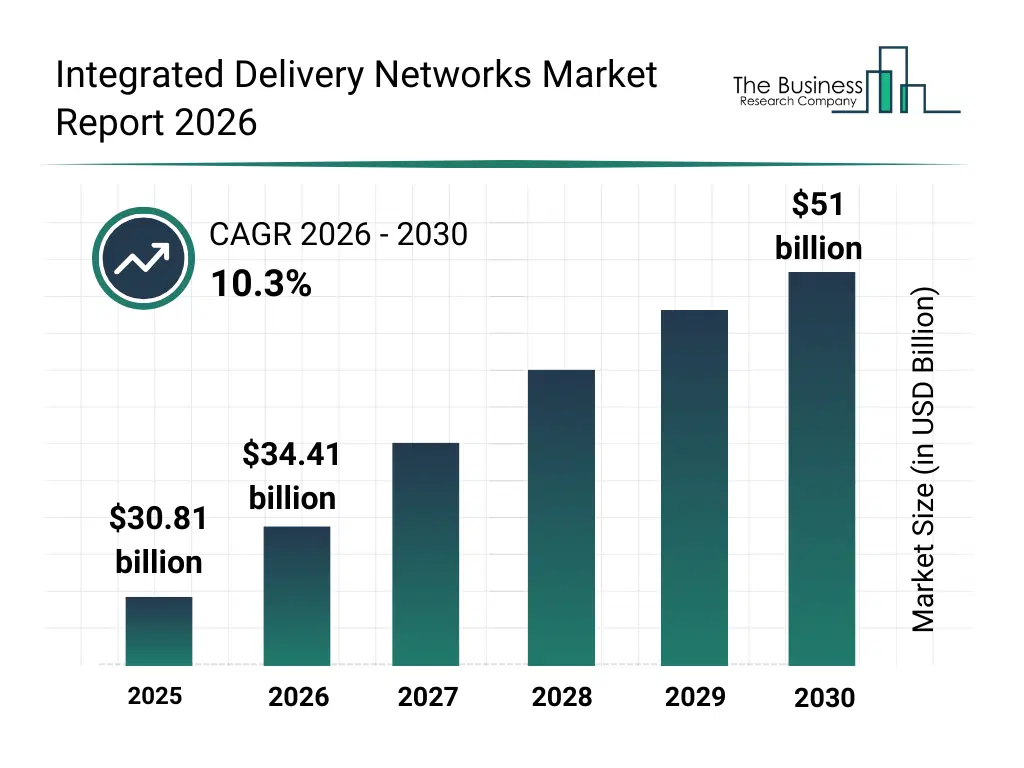
What Is The Integrated Delivery Networks Market Size and Share 2026?
The integrated delivery networks market size has grown rapidly in recent years. It will grow from $30.81 billion in 2025 to $34.41 billion in 2026 at a compound annual growth rate (CAGR) of 11.7%. The growth in the historic period can be attributed to consolidation of healthcare provider networks, expansion of hospital systems, rising healthcare cost pressures, increased focus on coordinated patient care, adoption of electronic health records across providers.What Is The Integrated Delivery Networks Market Growth Forecast?
The integrated delivery networks market size is expected to see rapid growth in the next few years. It will grow to $51 billion in 2030 at a compound annual growth rate (CAGR) of 10.3%. The growth in the forecast period can be attributed to increasing investments in digital health infrastructure, rising demand for outcome-based reimbursement models, expansion of remote and virtual care integration, growing emphasis on preventive healthcare delivery, increasing use of analytics in care coordination. Major trends in the forecast period include increasing adoption of integrated care delivery models, rising use of data-driven population health management, growing integration of clinical and administrative systems, expansion of value-based care frameworks, enhanced coordination across care continuums.
Global Integrated Delivery Networks Market Segmentation
1) By Type: Vertical Integration, Horizontal Integration 2) By Characteristics: Provider Alignment, Continuum Of Care, Clinical Integration, Regional Presence 3) By Application: Acute Care Hospitals, Primary Care, Long-Term Health, Specialty Clinics, Other Applications Subsegments: 1) By Vertical Integration: Hospital-Based Vertical Integration, Physician Group Vertical Integration, Integrated Health Systems 2) By Horizontal Integration: Multi-Hospital Systems, Regional Healthcare NetworksWhat Is The Driver Of The Integrated Delivery Networks Market?
The increasing adoption of cloud computing in the healthcare sector is expected to propel the growth of the integrated delivery network market going forward. Cloud computing refers to delivering computing services, including servers, storage, databases, networking, software, and more, over the internet ( the cloud). The adoption of cloud computing in healthcare is rising due to the need for affordable data storage, remote access to patient information, better data security, and improved provider collaboration. Cloud adoption helps integrate healthcare systems by facilitating data sharing, improving care coordination, boosting patient outcomes, and cutting costs through efficient processes. For instance, in November 2023, according to GHX, a US-based software-as-a-service company, it's expected that almost 70% of all US hospitals and health systems will adopt cloud-based supply chain management by 2026. Around 45% have already switched to cloud technologies for this purpose, with many more expected to follow in the next two years. Therefore, the increasing adoption of cloud computing in the healthcare sector is driving the growth of the integrated delivery network industry.Key Players In The Global Integrated Delivery Networks Market
Major companies operating in the integrated delivery networks market are CommonSpirit Health, Ascension Health, Trinity Health, Tenet Healthcare Corporation, Mass General Brigham Incorporated, Mayo Clinic Health System, Sutter Health, Bon Secours Mercy Health, Banner Health, Advocate Health, Northwell Health, Geisinger Health, NewYork-Presbyterian Hospital, Adventist Health, Cleveland Clinic, Intermountain Health, Kaiser Permanente, HCA Healthcare, Providence Health & Services, UPMC (University of Pittsburgh Medical Center), Johns Hopkins Health System
This chart is for illustrative purposes; the full report includes a detailed competitor analysis and comprehensive overview of the top 10 companies in the market.
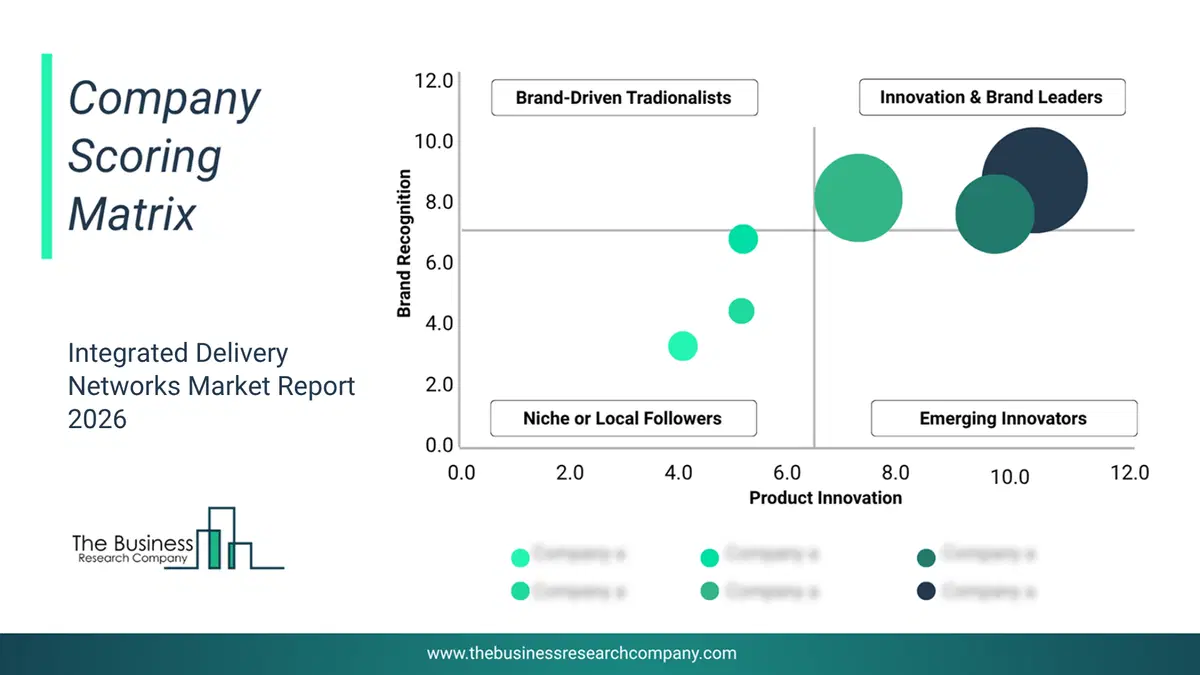
This chart maps companies by product innovation and brand strength, with bubble size indicating relative revenue, helping identify market leaders, challengers, and niche players. This is an illustrative chart; the full report provides a complete and accurate competitive analysis.
Global Integrated Delivery Networks Market Trends and Insights
Major companies operating in the integrated delivery network market are focusing on developing new solutions, such as real-world data (RWD) solutions, to enhance patient care and outcomes. Real-world data (RWD) solutions refer to systems and tools that collect, aggregate, and analyze data generated from everyday healthcare experiences, such as electronic health records (EHRs), claims and billing data, patient-generated data (e.g., from wearable devices), and disease registries. For instance, in April 2024, OMNY Health, a US-based biotechnology research company, launched a new suite of real-world data (RWD) solutions tailored for gastroenterology research in partnership with leading community-based GI practices across the United States. This initiative integrates data from over 5,000 GI providers, serving more than 10 million patients, into OMNY's extensive research network, which now encompasses around 380,000 providers, impacting approximately 75 million patients. The solutions leverage de-identified electronic health records (EHRs) to offer insights into patient demographics, treatment patterns, disease severity, and the influence of social determinants on healthcare decisions, ultimately aiming to enhance research and improve patient outcomes in gastroenterology.What Are Latest Mergers And Acquisitions In The Integrated Delivery Networks Market?
In January 2024, General Catalyst, a US-based venture capital firm, acquired Summa Health for an undisclosed amount. With this acquisition, Suma Health became a part of Health Assurance Transformation Corp., a recently launched general catalyst healthcare segment. This acquisition aims to drive near-term benefits and long-term transformation by enhancing value-based care, expanding access, and leveraging new revenue streams, resources, and technologies. Summa Health is a US-based integrated delivery system offering valued care through a network of hospitals.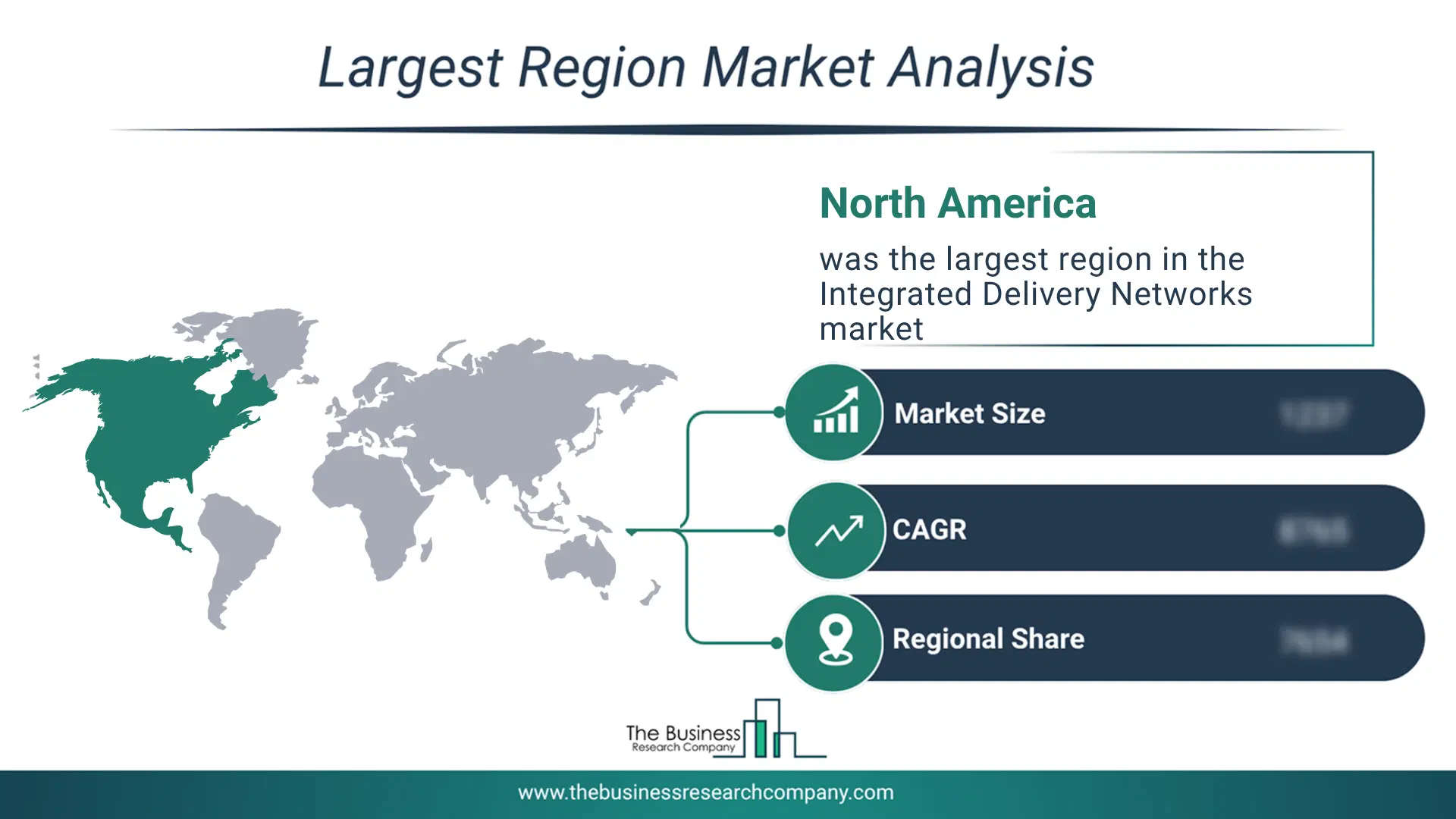
Regional Insights
North America was the largest region in the integrated delivery networks market in 2025. Asia-Pacific is expected to be the fastest-growing region in the forecast period. The regions covered in this market report are Asia-Pacific, South East Asia, Western Europe, Eastern Europe, North America, South America, Middle East, Africa. The countries covered in this market report are Australia, Brazil, China, France, Germany, India, Indonesia, Japan, Taiwan, Russia, South Korea, UK, USA, Canada, Italy, Spain.What Defines the Integrated Delivery Networks Market?
The integrated delivery networks market includes revenues earned by entities through hospital-centric integrated delivery networks, physician-led integrated delivery networks, geographically based integrated delivery networks, and academic medical center integrated delivery networks. The market value includes the value of related goods sold by the service provider or included within the service offering. Only goods and services traded between entities or sold to end consumers are included.How is Market Value Defined and Measured?
The market value is defined as the revenues that enterprises gain from the sale of goods and/or services within the specified market and geography through sales, grants, or donations in terms of the currency (in USD unless otherwise specified). The revenues for a specified geography are consumption values that are revenues generated by organizations in the specified geography within the market, irrespective of where they are produced. It does not include revenues from resales along the supply chain, either further along the supply chain or as part of other products.
This chart presents market attractiveness based on a quantitative evaluation of growth, competition, strategic alignment, and risk, offering a clear view of opportunity areas for decision-making. This chart is for illustrative purposes; the full report contains the complete analysis.

This chart highlights the Total Addressable Market (TAM) by estimating the maximum revenue opportunity using an assumption-driven approach, supporting strategic planning and opportunity sizing across markets. The chart is illustrative; the full report provides a more comprehensive analysis.
What Key Data and Analysis Are Included in the Integrated Delivery Networks Market Report 2026?
The integrated delivery networks market research report is one of a series of new reports from The Business Research Company that provides market statistics, including industry global market size, regional shares, competitors with the market share, detailed market segments, market trends and opportunities, and any further data you may need to thrive in the integrated delivery networks industry. The market research report delivers a complete perspective of everything you need, with an in-depth analysis of the current and future state of the industry.Integrated Delivery Networks Market Report Forecast Analysis
| Report Attribute | Details |
|---|---|
| Market Size Value In 2026 | $34.41 billion |
| Revenue Forecast In 2030 | $51 billion |
| Growth Rate | CAGR of 10.3% from 2026 to 2030 |
| Base Year For Estimation | 2025 |
| Actual Estimates/Historical Data | 2020-2025 |
| Forecast Period | 2026 - 2030 |
| Market Representation | Revenue in USD Billion and CAGR from 2026 to 2030 |
| Segments Covered | Type, Characteristics, Application |
| Regional Scope | Asia-Pacific, Western Europe, Eastern Europe, North America, South America, Middle East, Africa |
| Country Scope | The Countries Covered In This Market Report Are Australia, Brazil, China, France, Germany, India, Indonesia, Japan, Taiwan, Russia, South Korea, Uk, Usa, Canada, Italy, Spain. |
| Key Companies Profiled | CommonSpirit Health, Ascension Health, Trinity Health, Tenet Healthcare Corporation, Mass General Brigham Incorporated, Mayo Clinic Health System, Sutter Health, Bon Secours Mercy Health, Banner Health, Advocate Health, Northwell Health, Geisinger Health, NewYork-Presbyterian Hospital, Adventist Health, Cleveland Clinic, Intermountain Health, Kaiser Permanente, HCA Healthcare, Providence Health & Services, UPMC (University of Pittsburgh Medical Center), Johns Hopkins Health System |
| Customization Scope | Request for Customization |
| Pricing And Purchase Options | Explore Purchase Options |