

Integrated Visual Augmentation System Market Report 2026
Global Outlook – By Component Type (Displays, Sensors, Software, Controllers), By Product (Helmet-Mounted Display, Night Vision Device), By Technology (Augmented Reality (AR), Mixed Reality (MR), Thermal And Low-Light Imaging, Other Technologies), By Application (Situational Awareness, Navigation And Mapping, Target Acquisition And Engagement, Other Applications), By End Use (Defense, Homeland Security And Border Protection) – Market Size, Trends, Strategies, and Forecast to 2030
Integrated Visual Augmentation System Market Overview
• Integrated Visual Augmentation System market size has reached to $3.96 billion in 2025 • Expected to grow to $7.45 billion in 2030 at a compound annual growth rate (CAGR) of 13.4% • Growth Driver: Increasing Defense Modernization Programs Fueling The Growth Of The Market Due To Rising Geopolitical Tensions And Strategic Military Upgrades • Market Trend: Innovative Optical Technologies Enhance Soldier Vision And Battlefield Awareness • North America was the largest region in 2025 and Asia-Pacific is the fastest growing region.What Is Covered Under Integrated Visual Augmentation System Market?
Integrated visual augmentation system (IVAS) is a military-grade, head-mounted display system developed for soldiers that combines augmented reality (AR), night vision, thermal imaging, and navigation tools into a single device, enhancing situational awareness, target acquisition, and mission planning. The main purpose of this system is to improve soldier performance and decision-making on the battlefield through real-time data visualization and communication. The main component types of an integrated visual augmentation system are displays, sensors, software, and controllers. Displays refer to visual output devices or systems that present data, images, or information to users, typically through screens or projection technologies. It is categorized by product into helmet-mounted displays and night vision devices and utilizes technologies such as augmented reality (AR), mixed reality (MR), virtual reality (VR), thermal imaging, low-light imaging, and others. It finds applications in situational awareness, navigation and mapping, training and simulation, target acquisition and engagement, and others, serving a range of end users, including the defense, commercial, education, and healthcare sectors.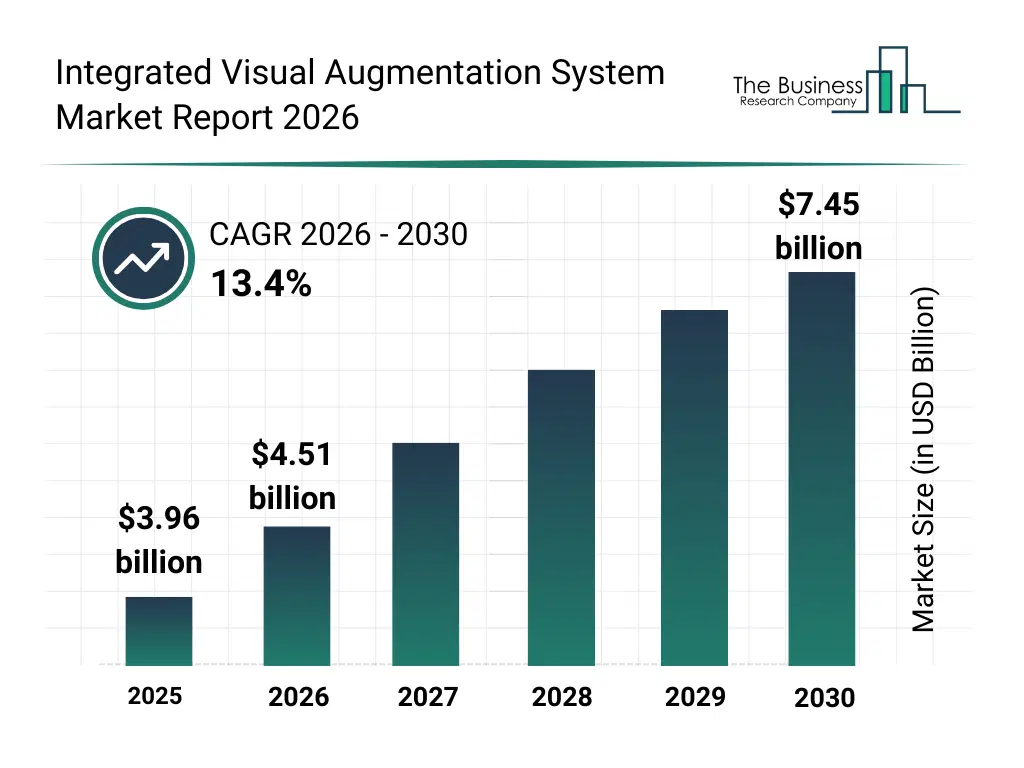
What Is The Integrated Visual Augmentation System Market Size and Share 2026?
The integrated visual augmentation system market size has grown rapidly in recent years. It will grow from $3.96 billion in 2025 to $4.51 billion in 2026 at a compound annual growth rate (CAGR) of 13.9%. The growth in the historic period can be attributed to modernization of soldier equipment, demand for battlefield awareness, defense digitization programs, night combat requirements, tactical communication needs.What Is The Integrated Visual Augmentation System Market Growth Forecast?
The integrated visual augmentation system market size is expected to see rapid growth in the next few years. It will grow to $7.45 billion in 2030 at a compound annual growth rate (CAGR) of 13.4%. The growth in the forecast period can be attributed to increased defense spending, adoption of smart soldier programs, AI based threat detection, integration with autonomous systems, demand for real time command systems. Major trends in the forecast period include integration of ar with night vision, enhanced soldier situational awareness, multi sensor data fusion systems, lightweight wearable military displays, real time battlefield data visualization.Tariff Impact On Integrated Visual Augmentation System Market
Tariffs have influenced the integrated visual augmentation system market by increasing costs of advanced optics, sensors, semiconductors, and display modules. These impacts are most significant in defense procurement programs in North America and Europe. Procurement timelines have been affected. At the same time, tariffs are supporting domestic defense manufacturing.
Global Integrated Visual Augmentation System Market Segmentation
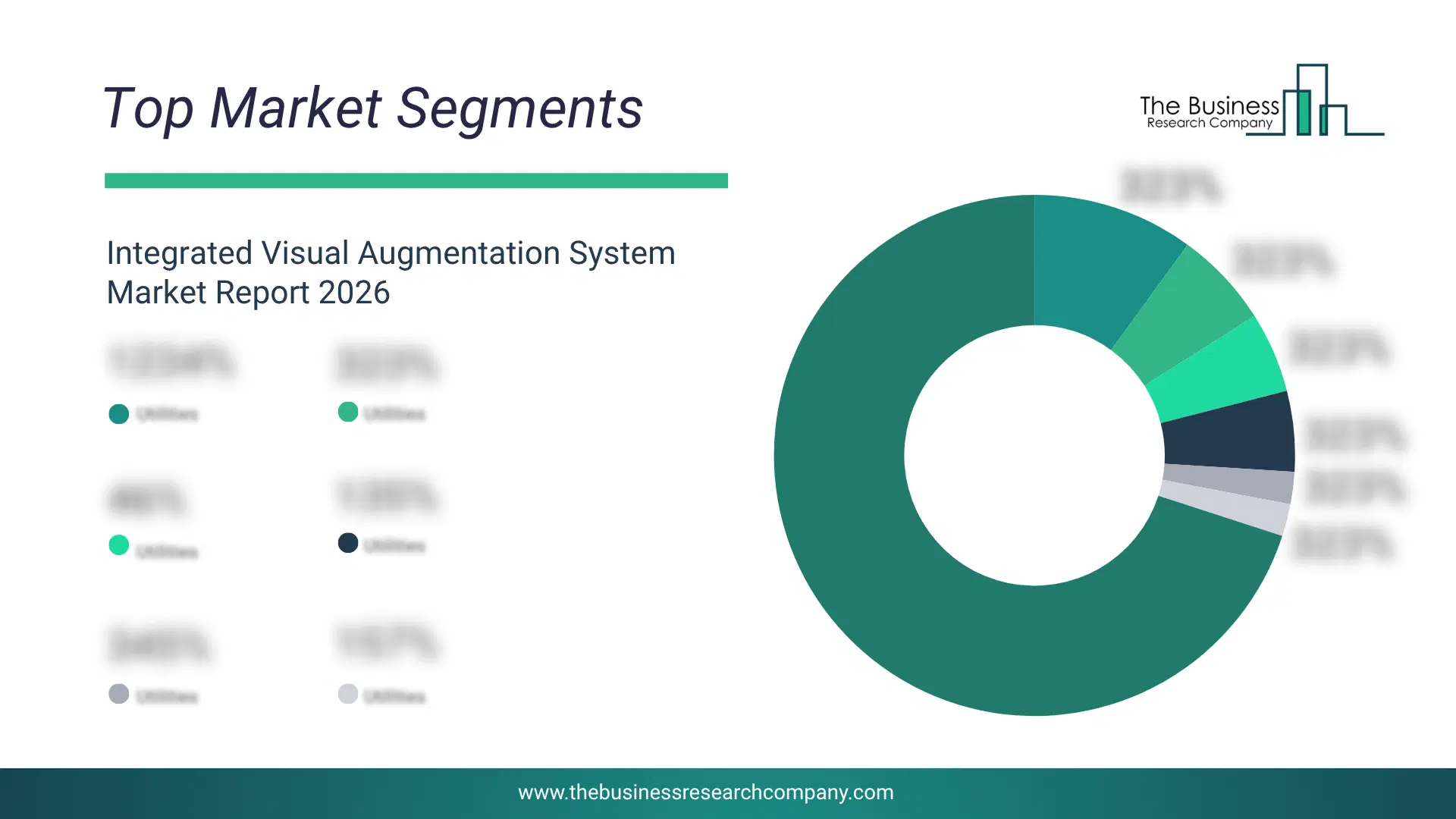
1) By Component Type: Displays, Sensors, Software, Controllers 2) By Product: Helmet-Mounted Display, Night Vision Device 3) By Technology: Augmented Reality (AR), Mixed Reality (MR), Thermal And Low-Light Imaging, Other Technologies 4) By Application: Situational Awareness, Navigation And Mapping, Target Acquisition And Engagement, Other Applications 5) By End Use: Defense, Homeland Security And Border Protection Subsegments: 1) By Displays: Head-Mounted Displays (HMDs), Augmented Reality (AR) Lenses, Retinal Projection Displays 2) By Sensors: Environmental Sensors, Motion And Position Sensors, Eye-Tracking Sensors, Thermal And Night Vision Sensors 3) By Software: Augmented Reality Software, Target Recognition And Tracking Algorithms, Navigation And Mapping Software, Simulation And Training Modules 4) By Controllers: Wearable Input Devices, Gesture Recognition Controllers, Voice Command Interfaces, Tactile Feedback DevicesWhat Is The Driver Of The Integrated Visual Augmentation System Market?
The increasing defense modernization programs are expected to propel the growth of the integrated visual augmentation system market going forward. Defense modernization programs refer to structured initiatives undertaken by a nation's military to upgrade and enhance its capabilities through the adoption of advanced technologies, improved infrastructure, and updated equipment and systems. The increasing defense modernization programs are primarily driven by rising geopolitical tensions as nations seek to strengthen military capabilities and maintain strategic superiority. The integrated visual augmentation system enhances defense modernization programs by providing advanced augmented reality capabilities, improving soldier situational awareness, and decision-making. It supports mission effectiveness through real-time data, sensor integration, and seamless communication on the battlefield. For instance, in March 2023, according to the European Security and Defence College, a Belgium-based autonomous institution, in 2030, the ongoing US Army modernization program is set to field 35 new future force systems, forming the core of more than 500 development, acquisition, or upgrade initiatives underway. Therefore, the increasing defense modernization programs are driving the growth of the integrated visual augmentation system industry.Key Players In The Global Integrated Visual Augmentation System Market
Major companies operating in the integrated visual augmentation system market are Microsoft Corporation, RTX Corporation, Lockheed Martin Corporation, BAE Systems plc, Thales Group, CACI International Inc., Elbit Systems Ltd., ASELSAN Elektronik Sanayi ve Ticaret A.Ş., Gentex Corporation, Anduril Industries Inc., FLIR Systems Inc., Magic Leap Inc., Kopin Corporation, RealWear Inc., Thermoteknix Systems Ltd., Optex Systems Inc., InVeris Training Solutions Inc., Vuzix Corporation, Rivet Industries LLC, InfivR Labs Pvt. Ltd.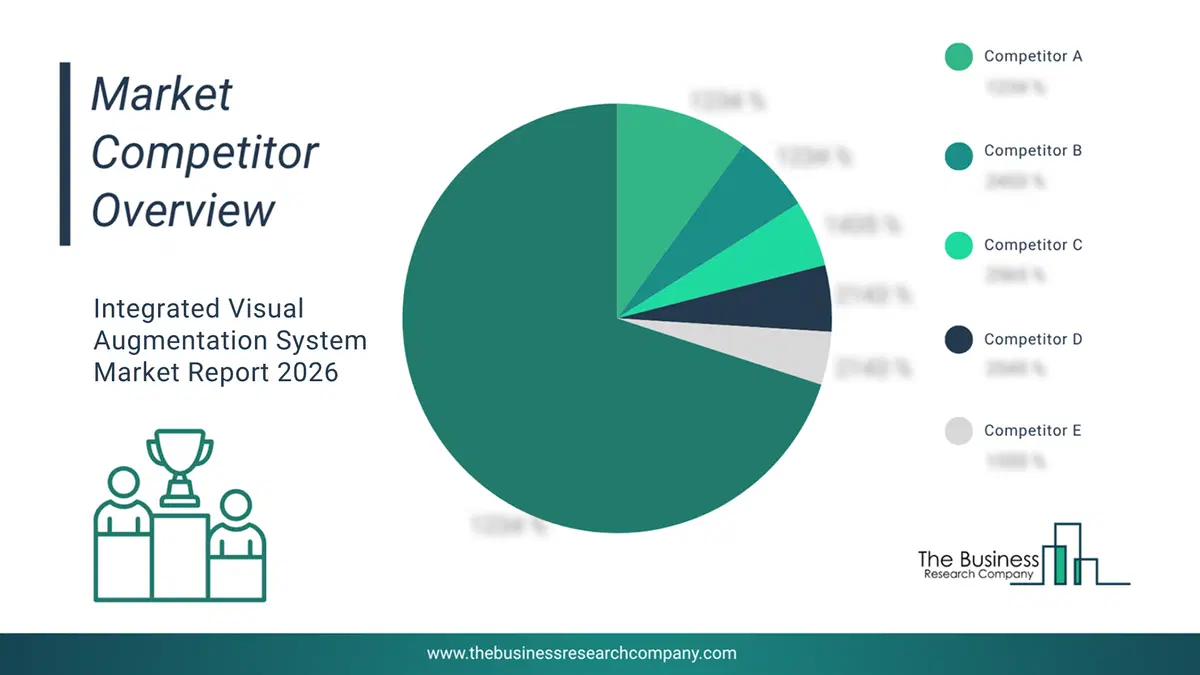
This chart is for illustrative purposes; the full report includes a detailed competitor analysis and comprehensive overview of the top 10 companies in the market.
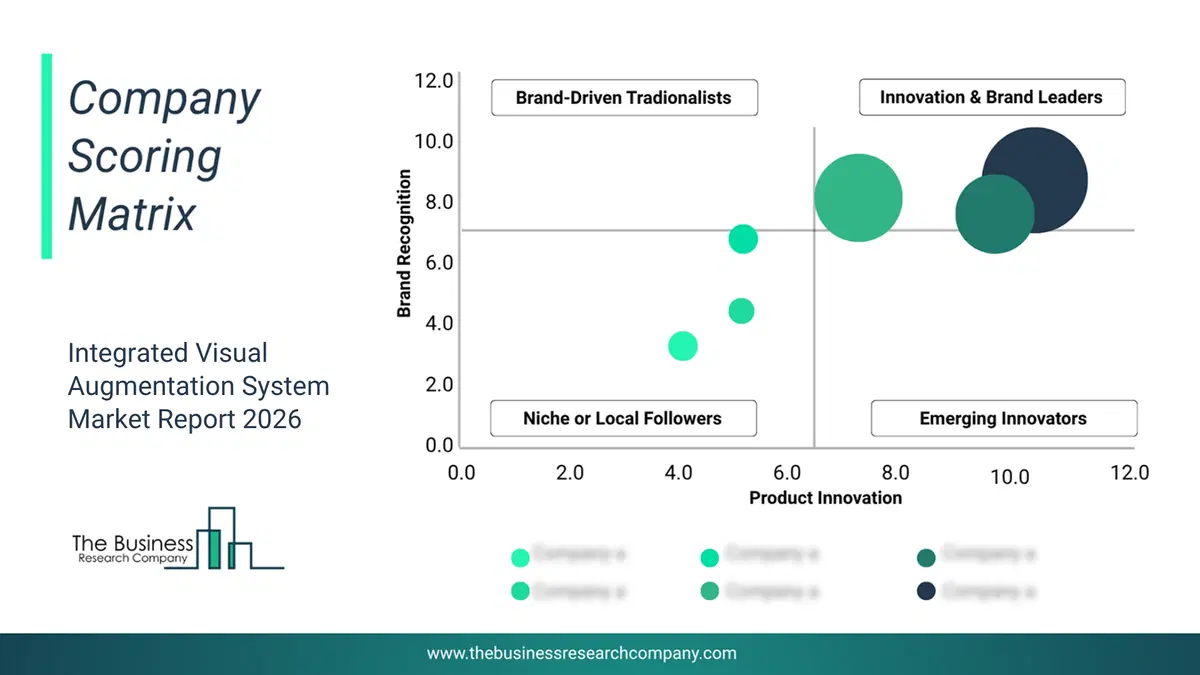
This chart maps companies by product innovation and brand strength, with bubble size indicating relative revenue, helping identify market leaders, challengers, and niche players. This is an illustrative chart; the full report provides a complete and accurate competitive analysis.
Global Integrated Visual Augmentation System Market Trends and Insights
Major companies operating in the integrated visual augmentation system (IVAS) market are focusing on developing innovative solutions, such as advanced optical filter assemblies, to enhance visual clarity, sensor performance, and augmented reality (AR) integration in combat. Advanced optical filter assemblies are specialized components that improve image clarity, sensor accuracy, and augmented reality (AR) display performance in varying light conditions. For instance, in April 2024, Optex Systems Inc., a US-based defense optics manufacturer, announced its support for the Integrated Visual Augmentation System (IVAS) Filter Assembly, a next-generation optical component developed specifically for military-grade augmented reality systems. The IVAS filter assembly includes precision-engineered coatings that enable selective light filtering, high-impact durability, and environmental resistance. Its integration supports AR-enabled headsets used by the U.S. Army, ensuring clearer battlefield vision in varying light and weather conditions while maintaining compatibility with thermal imaging and head-up display overlays.What Are Latest Mergers And Acquisitions In The Integrated Visual Augmentation System Market?
In February 2025, Anduril Industries Inc., a US-based defense technology company, partnered with Microsoft Corporation to support the advancement of the U.S. Army’s integrated visual augmentation system (IVAS) program. This partnership aims to accelerate and scale the IVAS program by combining Anduril’s defense manufacturing and AI capabilities with Microsoft’s cloud and software expertise, ensuring faster delivery, improved performance, and enhanced soldier effectiveness. Microsoft Corporation is a US-based technology company involved in the development of the integrated visual augmentation system.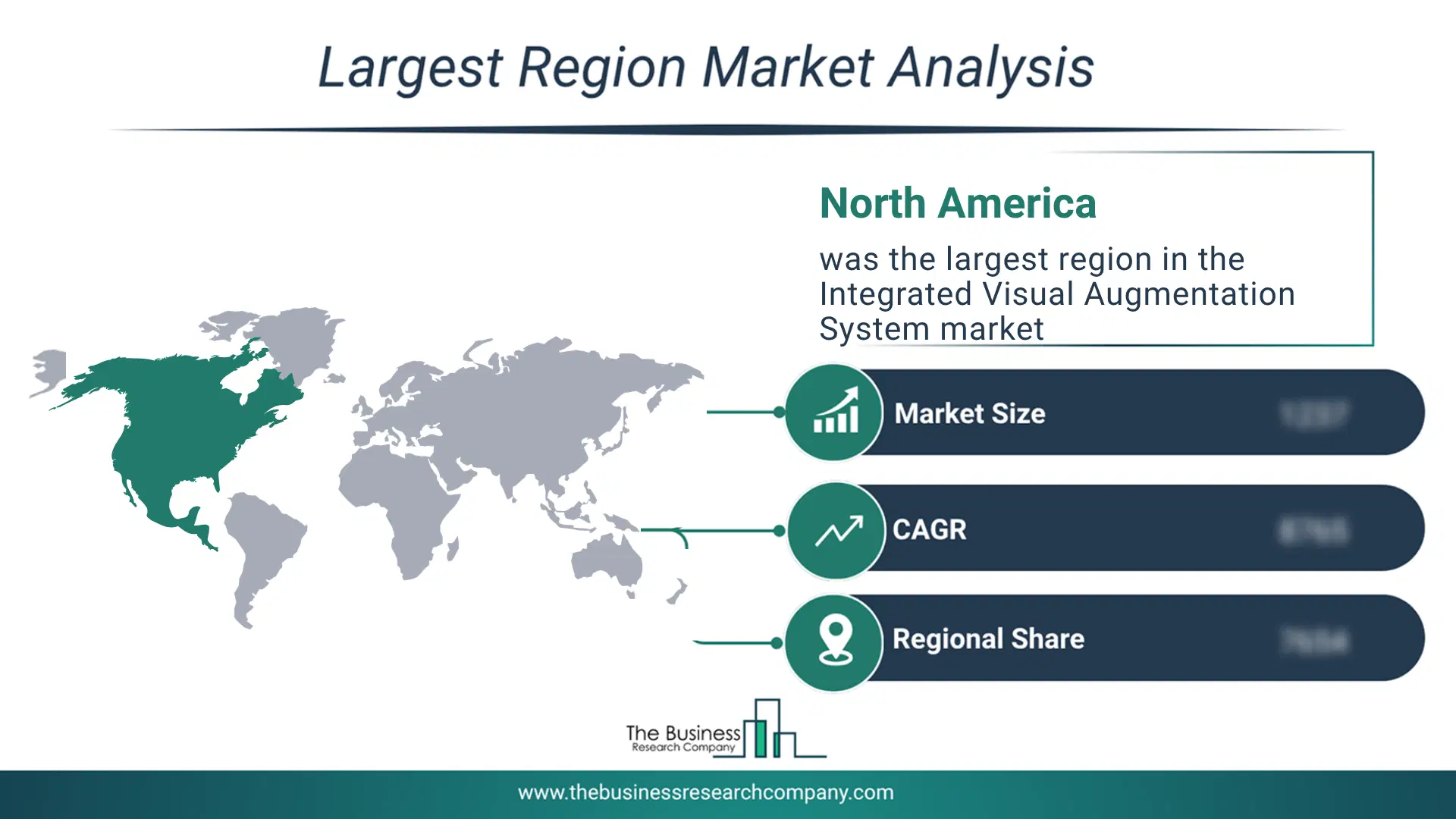
Regional Outlook
North America was the largest region in the integrated visual augmentation system market in 2025. Asia-Pacific is expected to be the fastest-growing region in the forecast period. The regions covered in this market report are Asia-Pacific, South East Asia, Western Europe, Eastern Europe, North America, South America, Middle East, Africa The countries covered in this market report are Australia, Brazil, China, France, Germany, India, Indonesia, Japan, Taiwan, Russia, South Korea, UK, USA, Canada, Italy, Spain.What Defines the Integrated Visual Augmentation System Market?
The integrated visual augmentation system market consists of revenues earned by entities by providing services such as augmented reality (AR) integration services, sensor fusion and data processing, simulation and training support, system maintenance and upgrades, and cloud and edge computing support. The market value includes the value of related goods sold by the service provider or included within the service offering. The integrated visual augmentation system market also includes sales of body worn compute packs, thermal imaging cameras, augmented navigation aids, and heads-up display (HUD) software interfaces. Values in this market are ‘factory gate’ values, that is, the value of goods sold by the manufacturers or creators of the goods, whether to other entities (including downstream manufacturers, wholesalers, distributors, and retailers) or directly to end customers. The value of goods in this market includes related services sold by the creators of the goods.How is Market Value Defined and Measured?
The market value is defined as the revenues that enterprises gain from the sale of goods and/or services within the specified market and geography through sales, grants, or donations in terms of the currency (in USD unless otherwise specified). The revenues for a specified geography are consumption values that are revenues generated by organizations in the specified geography within the market, irrespective of where they are produced. It does not include revenues from resales along the supply chain, either further along the supply chain or as part of other products.
This chart presents market attractiveness based on a quantitative evaluation of growth, competition, strategic alignment, and risk, offering a clear view of opportunity areas for decision-making. This chart is for illustrative purposes; the full report contains the complete analysis.

This chart highlights the Total Addressable Market (TAM) by estimating the maximum revenue opportunity using an assumption-driven approach, supporting strategic planning and opportunity sizing across markets. The chart is illustrative; the full report provides a more comprehensive analysis.
What Key Data and Analysis Are Included in the Integrated Visual Augmentation System Market Report 2026?
The integrated visual augmentation system market research report is one of a series of new reports from The Business Research Company that provides market statistics, including industry global market size, regional shares, competitors with the market share, detailed market segments, market trends and opportunities, and any further data you may need to thrive in the integrated visual augmentation system industry. The market research report delivers a complete perspective of everything you need, with an in-depth analysis of the current and future state of the industry.Integrated Visual Augmentation System Market Report Forecast Analysis
| Report Attribute | Details |
|---|---|
| Market Size Value In 2026 | $4.51 billion |
| Revenue Forecast In 2030 | $7.45 billion |
| Growth Rate | CAGR of 13.4% from 2026 to 2030 |
| Base Year For Estimation | 2025 |
| Actual Estimates/Historical Data | 2020-2025 |
| Forecast Period | 2026 - 2030 |
| Market Representation | Revenue in USD Billion and CAGR from 2026 to 2030 |
| Segments Covered | Component Type, Product, Technology, Application, End Use |
| Regional Scope | Asia-Pacific, Western Europe, Eastern Europe, North America, South America, Middle East, Africa |
| Key Companies Profiled | Microsoft Corporation, RTX Corporation, Lockheed Martin Corporation, BAE Systems plc, Thales Group, CACI International Inc., Elbit Systems Ltd., ASELSAN Elektronik Sanayi ve Ticaret A.Ş., Gentex Corporation, Anduril Industries Inc., FLIR Systems Inc., Magic Leap Inc., Kopin Corporation, RealWear Inc., Thermoteknix Systems Ltd., Optex Systems Inc., InVeris Training Solutions Inc., Vuzix Corporation, Rivet Industries LLC, InfivR Labs Pvt. Ltd. |
| Customization Scope | Request for Customization |
| Pricing And Purchase Options | Explore Purchase Options |