

Intelligent Battery Sensor Market Report 2026
Global Outlook – By Sensor Type (Hall Effect Sensors, Shunt Based Sensors), By Technology Type (Local Interconnect Network, Controller Area Network, Other Interfaces), By Battery Type (Lithium Ion Batteries, Lead Acid Batteries, Nickel Metal Hydride Batteries, Other Battery Types), By Applications (State Of Charge Tracking, State Of Health Monitoring, Battery Management System Integration, Regenerative Energy And Power Optimization, Start Stop And Idle Reduction Functions, Miscellaneous Applications), By End Use Industry (Automotive, Marine, Aerospace, Industrial Power, Other End Use Industries) – Market Size, Trends, Strategies, and Forecast to 2035
Intelligent Battery Sensor Market Overview
• Intelligent Battery Sensor market size has reached to $5.77 billion in 2025 • Expected to grow to $10.36 billion in 2030 at a compound annual growth rate (CAGR) of 12.4% • Growth Driver: Growing Prevalence Of Electric Vehicles (Evs) Driving The Growth Of The Market Due To Increasing Need For Real-time Battery Monitoring And Performance Optimization • Market Trend: Next-Generation Intelligent Battery Sensors Enabling Real-Time Battery Optimization • North America was the largest region in 2025 and Asia-Pacific is the fastest growing region.What Is Covered Under Intelligent Battery Sensor Market?
Intelligent battery sensor is an electronic device that monitors the condition and performance of a vehicle’s battery in real time. It measures parameters such as voltage, current, temperature, and state of charge to ensure optimal battery operation. Intelligent battery sensor helps improve battery life, enhance energy efficiency, and support the reliable functioning of electrical systems. The main sensor types of intelligent battery sensor include hall effect sensors and shunt based sensors. Hall effect sensors refer to electronic sensing devices used to measure current flow in batteries by detecting magnetic fields generated by electrical current, enabling accurate monitoring of battery performance parameters. The technology framework includes local interconnect network, controller area network, and other interfaces and they are categorized by battery type such as lithium ion batteries, lead acid batteries, nickel metal hydride batteries, and other battery types. They find application in state of charge tracking, state of health monitoring, battery management system integration, regenerative energy and power optimization, start stop and idle reduction functions, and miscellaneous applications, serving end users including automotive, marine, aerospace, industrial power, and other end use industries.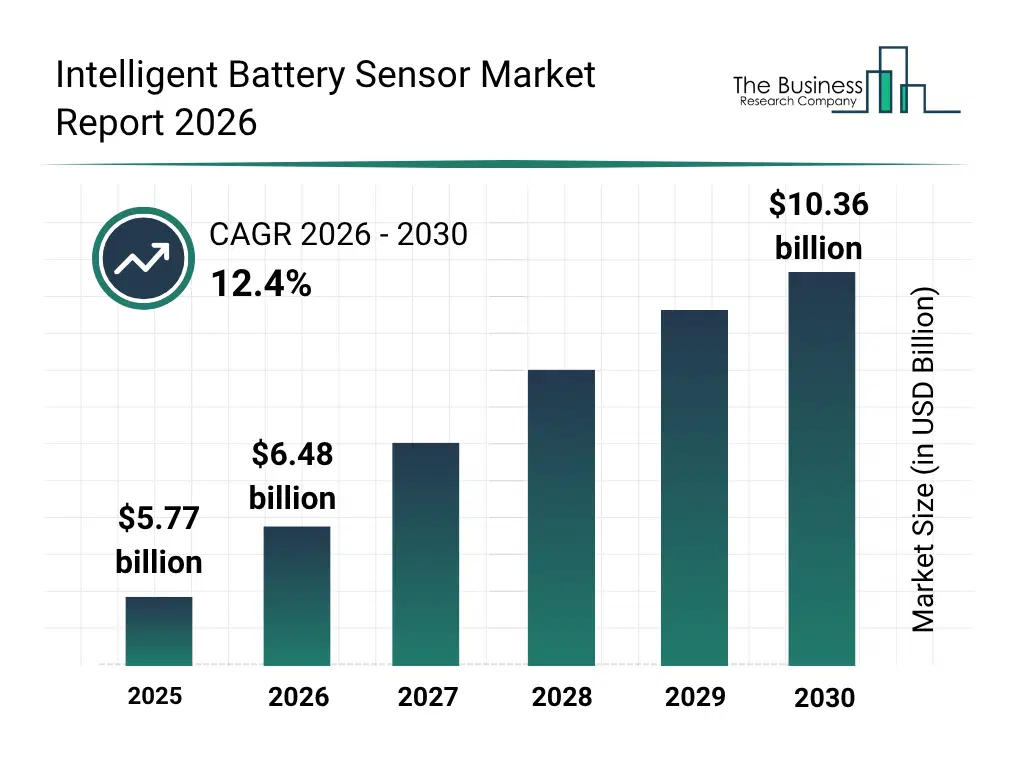
What Is The Intelligent Battery Sensor Market Size and Share 2026?
The intelligent battery sensor market size has grown rapidly in recent years.It will grow from $5.77 billion in 2025 to $6.48 billion in 2026 at a compound annual growth rate (CAGR) of 12.2%. The growth in the historic period can be attributed to limited real-time battery monitoring systems, high battery failure rates in conventional vehicles, low adoption of smart sensors in automotive batteries, reliance on manual battery diagnostics, lack of integration with vehicle energy management systems.What Is The Intelligent Battery Sensor Market Growth Forecast?
The intelligent battery sensor market size is expected to see rapid growth in the next few years.It will grow to $10.36 billion by 2030 at a compound annual growth rate (CAGR) of 12.4%. The growth in the forecast period can be attributed to rapid expansion of electric vehicle adoption, increasing demand for predictive battery maintenance systems, integration of smart sensors in battery management systems, growth of connected and software-defined vehicles, rising focus on energy efficiency and battery lifespan optimization.Major trends in the forecast period include real-time battery health monitoring integration in electric vehicles, predictive battery failure analytics using sensor data, enhanced regenerative braking optimization through battery sensing, smart energy management in start-stop vehicle systems, advanced thermal monitoring for vehicle battery efficiency.
Global Intelligent Battery Sensor Market Segmentation
1) By Sensor Type: Hall Effect Sensors, Shunt Based Sensors 2) By Technology Type: Local Interconnect Network, Controller Area Network, Other Interfaces 3) By Battery Type: Lithium Ion Batteries, Lead Acid Batteries, Nickel Metal Hydride Batteries, Other Battery Types 4) By Applications: State Of Charge Tracking, State Of Health Monitoring, Battery Management System Integration, Regenerative Energy And Power Optimization, Start Stop And Idle Reduction Functions, Miscellaneous Applications 5) By End Use Industry: Automotive, Marine, Aerospace, Industrial Power, Other End Use Industries Subsegments: 1) By Hall Effect Sensors: Open Loop Hall Effect Sensors, Closed Loop Compensated Hall Effect Sensors, Linear Hall Effect Current Sensors, Integrated Hall Effect Battery Monitoring Integrated Circuits, Magnetic Field Based Position And Current Sensors For Battery Management System 2) By Shunt Based Sensors: Low Side Shunt Current Sensors, High Side Shunt Current Sensors, Integrated Shunt Based Battery Monitoring Integrated Circuits, Precision Resistor Based Current Sensing Modules, Digital Shunt Based Battery Monitoring SystemsWhat Is The Driver Of The Intelligent Battery Sensor Market?
The growing prevalence of electric vehicles (EVs) is expected to propel the growth of the intelligent battery sensor industry going forward.Electric vehicles (EVs) are vehicles powered fully or partially by electric motors using electricity stored in rechargeable batteries instead of relying solely on internal combustion engines.The rise in electric vehicles is driven by environmental sustainability, as they produce lower greenhouse gas emissions and reduce dependence on fossil fuels.The intelligent battery sensor helps electric vehicles by continuously monitoring battery performance, voltage, current, and temperature to optimize energy usage, extend battery life, and ensure safe and reliable operation.For instance, in May 2025, according to the International Energy Agency, a France-based intergovernmental organization, electric vehicle sales surpassed 4 million units in the first quarter of 2025, representing a 35% year-over-year increase compared to the same period in 2024.Therefore, the growing prevalence of electric vehicles (EVs) is driving the growth of the intelligent battery sensor industry.Key Players In The Global Intelligent Battery Sensor Market
Major companies operating in the intelligent battery sensor market are Robert Bosch GmbH, Panasonic Corporation, DENSO Corporation, Continental AG, Honeywell International Inc., Texas Instruments Inc., Infineon Technologies AG, STMicroelectronics N. V., TDK Corporation, TE Connectivity Ltd., NXP Semiconductors N. V., Analog Devices Inc., Murata Manufacturing Co. Ltd., Renesas Electronics Corporation, ON Semiconductor Corporation, Vishay Intertechnology Inc., Littelfuse Inc., Allegro Microsystems LLC, Melexis NV, Midtronics Inc.Global Intelligent Battery Sensor Market Trends and Insights
Major companies operating in the intelligent battery sensor market are focusing on developing adaptive energy and charging optimization to enhance battery efficiency, extend lifespan, and ensure safe and reliable performance in electric vehicles and industrial applications. Adaptive energy and charging optimization is the capability of a battery sensor to automatically adjust charging current and power limits in real time based on temperature and battery conditions to maximize efficiency and extend battery life. For instance, in January 2026, FORVIA HELLA, a Germany-based automotive technology supplier specializing in lighting, electronics, and intelligent vehicle systems, launched its next-generation Intelligent Battery Sensor (IBS) in China, designed as a critical monitoring component for start-stop systems and 12V low-voltage power networks. The new IBS leverages high-precision real-time monitoring to track voltage, current, and temperature, enabling accurate calculation of the battery’s State of Charge (SoC) and State of Health (SoH) while also providing predictive maintenance to detect potential battery issues before failures occur. With adaptive energy and charging optimization, the sensor adjusts cold-start current and power limits at high temperatures to extend battery life and improve energy utilization efficiency. The product features a modular design for flexible integration, functional safety compliance upgradable from ASIL B to ASIL C, and a wide operating range from 6V to 18V, ±1500A current, and -40°C to 125°C temperature tolerance, ensuring reliable performance across diverse vehicle conditions.What Are Latest Mergers And Acquisitions In The Intelligent Battery Sensor Market?
In February 2026, Infineon Technologies AG, a Germany-based semiconductor manufacturer, acquired the non-optical analog and mixed-signal sensor portfolio from ams OSRAM for $671 million (€570 million). Through this acquisition, Infineon aims to strengthen its position in automotive and industrial sensor markets, expand its product portfolio in medical applications, and drive profitable growth through complementary technologies and future synergies. ams OSRAM is an Austria-based sensor and photonics company specializing in optical and non-optical sensing solutions which include battery sensors, specifically for automotive battery management systems.Regional Insights
North America was the largest region in the intelligent battery sensor market in 2025. Asia-Pacific is expected to be the fastest-growing region in the forecast period. The regions covered in this market report are Asia-Pacific, South East Asia, Western Europe, Eastern Europe, North America, South America, Middle East and Africa. The countries covered in this market report are Australia, Brazil, China, France, Germany, India, Indonesia, Japan, Taiwan, Russia, South Korea, UK, USA, Canada, Italy, Spain.What Defines the Intelligent Battery Sensor Market?
The intelligent battery sensor market consists of sales of voltage sensors, current sensors, combined sensors, active intelligent battery sensors, and battery terminal-mounted sensors. Values in this market are ‘factory gate’ values, that is, the value of goods sold by the manufacturers or creators of the goods, whether to other entities (including downstream manufacturers, wholesalers, distributors, and retailers) or directly to end customers. The value of goods in this market includes related services sold by the creators of the goods.What is the Market Assessment and Strategic Outlook for the Intelligent Battery Sensor Industry?
The intelligent battery sensor market research report is one of a series of new reports from The Business Research Company that provides market statistics, including industry global market size, regional shares, competitors with the market share, detailed market segments, market trends and opportunities, and any further data you may need to thrive in the intelligent battery sensor industry. The market research report delivers a complete perspective of everything you need, with an in-depth analysis of the current and future state of the industry.What is the Market Assessment and Strategic Outlook for the Intelligent Battery Sensor Market Report 2026?
The intelligent battery sensor market research report is one of a series of new reports from The Business Research Company that provides intelligent battery sensor market statistics, including intelligent battery sensor industry global market size, regional shares, competitors with a intelligent battery sensor market share, detailed intelligent battery sensor market segments, market trends and opportunities, and any further data you may need to thrive in the intelligent battery sensor industry. This intelligent battery sensor market research report delivers a complete perspective of everything you need, with an in-depth analysis of the current and future scenario of the industry.Intelligent Battery Sensor Market Report Forecast Analysis
| Report Attribute | Details |
|---|---|
| Market Size Value In 2026 | $6.48 billion |
| Revenue Forecast In 2035 | $10.36 billion |
| Growth Rate | CAGR of 12.4% from 2026 to 2035 |
| Base Year For Estimation | 2025 |
| Actual Estimates/Historical Data | 2020-2025 |
| Forecast Period | 2026 - 2030 - 2035 |
| Market Representation | Revenue in USD Billion and CAGR from 2026 to 2035 |
| Segments Covered | Sensor Type, Technology Type, Battery Type, Applications, End Use Industry |
| Regional Scope | Asia-Pacific, Western Europe, Eastern Europe, North America, South America, Middle East, Africa |
| Country Scope | The countries covered in the report are Australia, Brazil, China, France, Germany, India, Indonesia, Japan, Taiwan, Russia, South Korea, UK, USA, Canada, Italy, Spain. |
| Key Companies Profiled | Robert Bosch GmbH, Panasonic Corporation, DENSO Corporation, Continental AG, Honeywell International Inc., Texas Instruments Inc., Infineon Technologies AG, STMicroelectronics N. V., TDK Corporation, TE Connectivity Ltd., NXP Semiconductors N. V., Analog Devices Inc., Murata Manufacturing Co. Ltd., Renesas Electronics Corporation, ON Semiconductor Corporation, Vishay Intertechnology Inc., Littelfuse Inc., Allegro Microsystems LLC, Melexis NV, Midtronics Inc. |
| Customization Scope | Request for Customization |
| Pricing And Purchase Options | Explore Purchase Options |