
Intelligent Building Automation Technologies Market Report 2026
Global Outlook – By Type (Hardware, Software, Service), By Communication Technology (Wired Technology, Wireless Technology), By Application (Residential, Commercial) – Market Size, Trends, Strategies, and Forecast to 2030
Intelligent Building Automation Technologies Market Overview
• Intelligent Building Automation Technologies market size has reached to $97.66 billion in 2025 • Expected to grow to $164.92 billion in 2030 at a compound annual growth rate (CAGR) of 11.1% • Growth Driver: Energy-Efficient Projects Fueling Growth In The Intelligent Building Automation Technologies Market • Market Trend: Increasing Focus On Product Innovations To Provide Reliable Services To Their Customers • North America was the largest region in 2025 and Asia-Pacific is the fastest growing region.What Is Covered Under Intelligent Building Automation Technologies Market?
Intelligent building automation technologies (IBAT) refer to a software and hardware network that controls and monitors the environment of a building facility. It creates an atmosphere that is efficient, comfortable, and convenient by addressing basic demands such as structure, system, service, and management, and optimizing their interrelationship. The intelligent building automation technologies are used for a faster, easier, and more convenient interface. The major types of intelligent building automation technologies are hardware, software, and services. Hardware refers to any actual physical objects that are part of a computer system. The various communication technologies include wired technology and wireless technology. The major applications are residential, commercial, and industrial.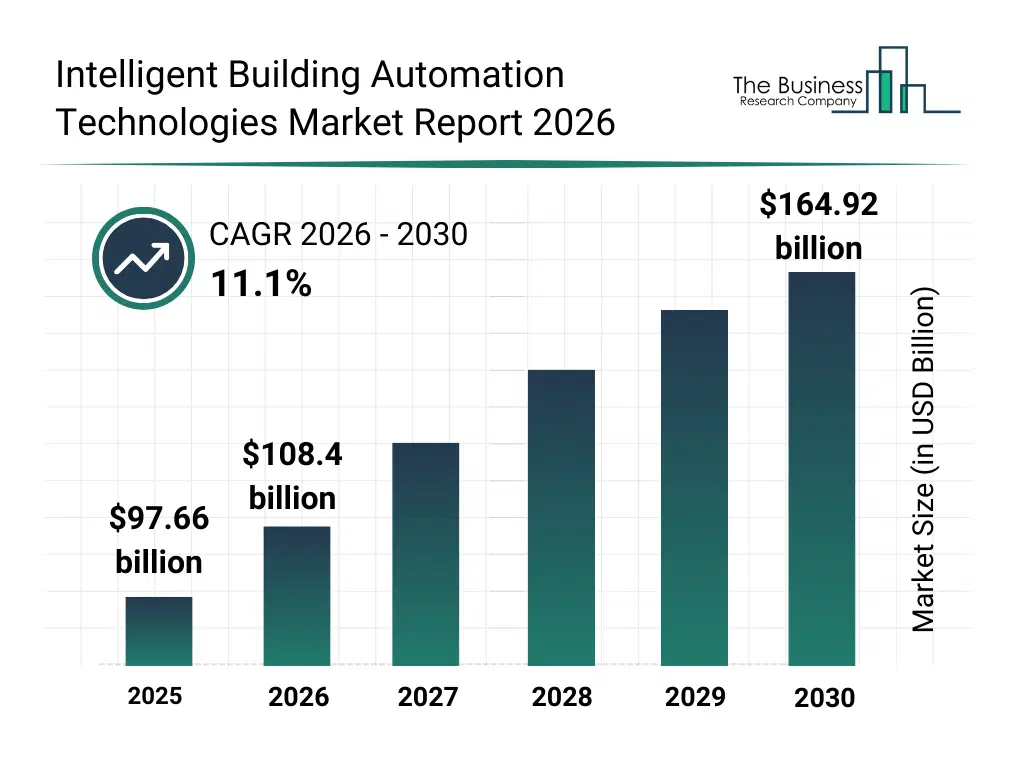
What Is The Intelligent Building Automation Technologies Market Size and Share 2026?
The intelligent building automation technologies market size has grown rapidly in recent years. It will grow from $97.66 billion in 2025 to $108.4 billion in 2026 at a compound annual growth rate (CAGR) of 11.0%. The growth in the historic period can be attributed to increasing urban infrastructure development, rising demand for centralized building monitoring, adoption of early building automation systems, expansion of commercial real estate projects, growing focus on operational efficiency.What Is The Intelligent Building Automation Technologies Market Growth Forecast?
The intelligent building automation technologies market size is expected to see rapid growth in the next few years. It will grow to $164.92 billion in 2030 at a compound annual growth rate (CAGR) of 11.1%. The growth in the forecast period can be attributed to increasing investments in smart city projects, rising demand for energy-efficient buildings, expansion of AI-driven building analytics, growing adoption of cloud-based automation platforms, increasing regulatory focus on sustainable buildings. Major trends in the forecast period include increasing adoption of integrated building management systems, rising deployment of smart sensors and actuators, growing use of energy optimization platforms, expansion of centralized building control interfaces, enhanced focus on occupant comfort and safety.
Global Intelligent Building Automation Technologies Market Segmentation
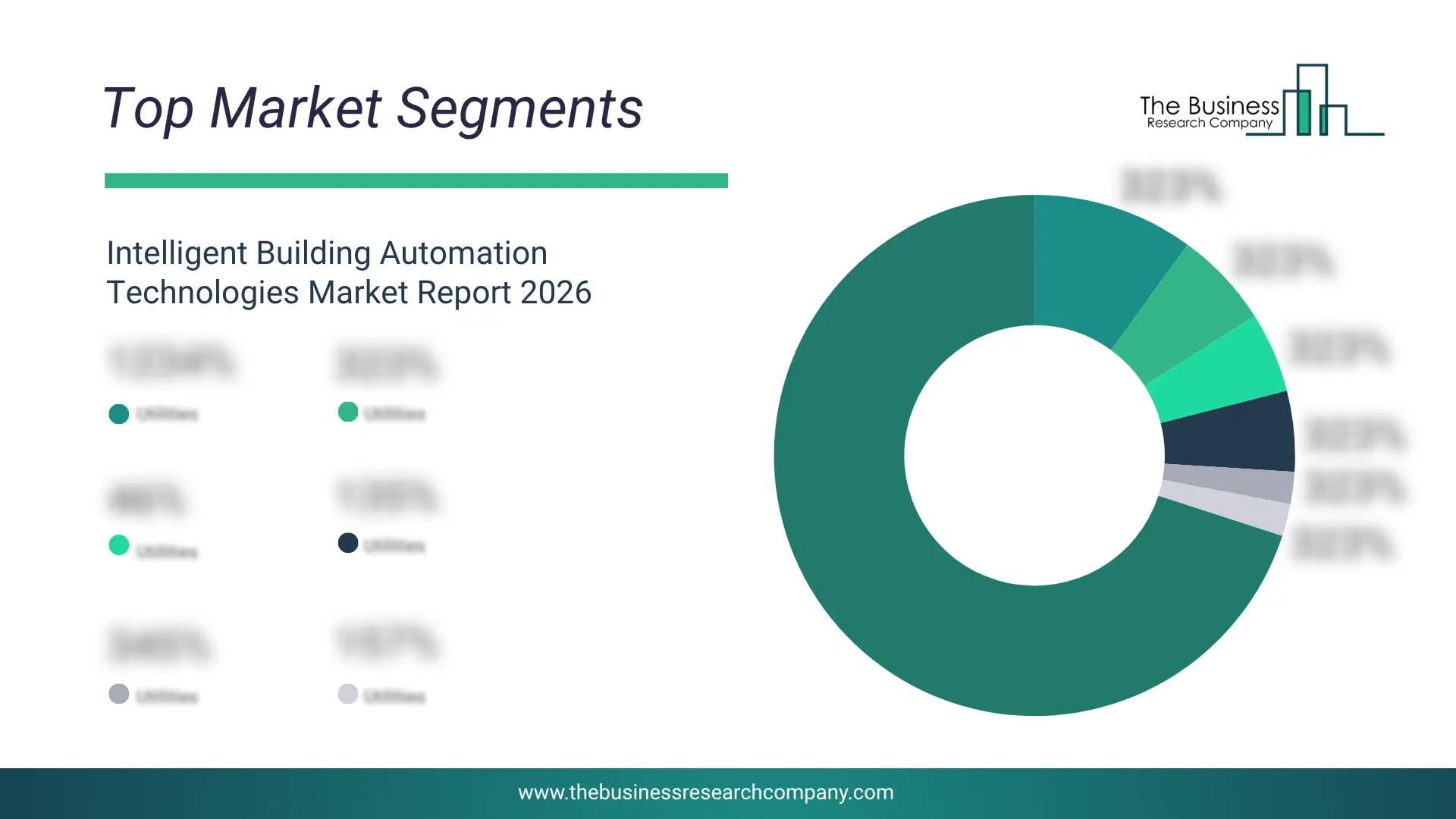
1) By Type: Hardware, Software, Service 2) By Communication Technology: Wired Technology, Wireless Technology 3) By Application: Residential, Commercial Subsegments: 1) By Hardware: Sensors And Actuators, Controllers, Networking Equipment, Security Systems 2) By Software: Building Management Systems (BMS), Energy Management Software, Analytics And Monitoring Software 3) By Service: Installation And Integration Services, Maintenance And Support Services, Consulting ServicesWhat Is The Driver Of The Intelligent Building Automation Technologies Market?
Increasing energy-efficient projects are expected to propel the growth of the intelligent building automation technologies market going forward. Energy-efficient projects refer to a structure that maximises resource efficiency while maintaining comfortable living conditions within the home with the least amount of energy possible. Intelligent building automation solutions help energy-efficient projects by reducing energy consumption by 10% to 25%, making the buildings highly energy efficient. For instance, in May 2024, according to IEA, the estimated rate of progress in energy intensity for 2023, a key measure of the energy efficiency of the global economy, is expected to drop to 1.3%, down from a stronger 2% last year. This decline in energy intensity improvement is largely due to a rise in energy demand of 1.7% in 2023, compared to 1.3% the previous year. Therefore, increasing energy-efficient projects are driving the intelligent building automation technologies industry growth.Key Players In The Global Intelligent Building Automation Technologies Market
Major companies operating in the intelligent building automation technologies market are Asea Brown Boveri Ltd.; Azbil Corporation; Eaton Corporation plc; General Electric Company; Siemens Building Technologies Inc.; Schneider Electric SE; Honeywell International Inc.; Hubbell Incorporated; Rockwell Automation Inc.; Samsung Electronics Co. Ltd.; Delta Controls Inc.; Panasonic Corporation; Robert Bosch GmbH; Cisco Systems Inc.; Trane Technologies plc; Lutron Electronics Co. Inc.; Johnson Controls International plc; Emerson Electric Co.; Mitsubishi Electric Corporation; Hitachi Ltd.; Huawei Technologies Co. Ltd.; Crestron Electronics LLC; Legrand SA; Distech Controls Inc.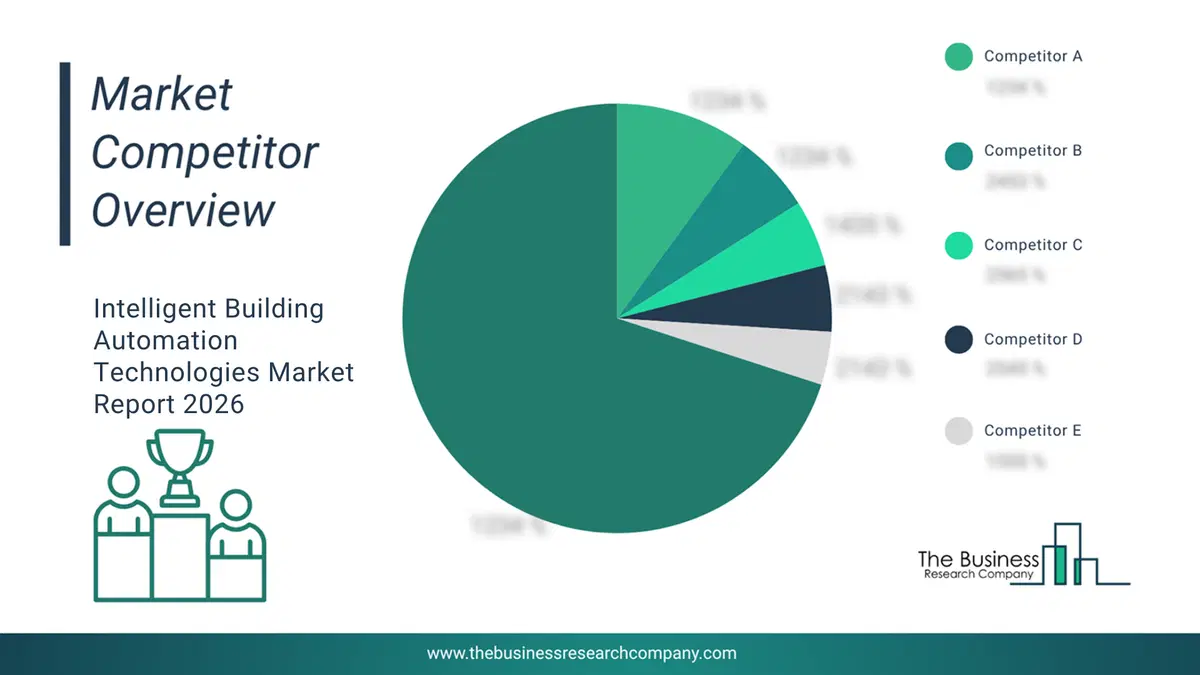
This chart is for illustrative purposes; the full report includes a detailed competitor analysis and comprehensive overview of the top 10 companies in the market.
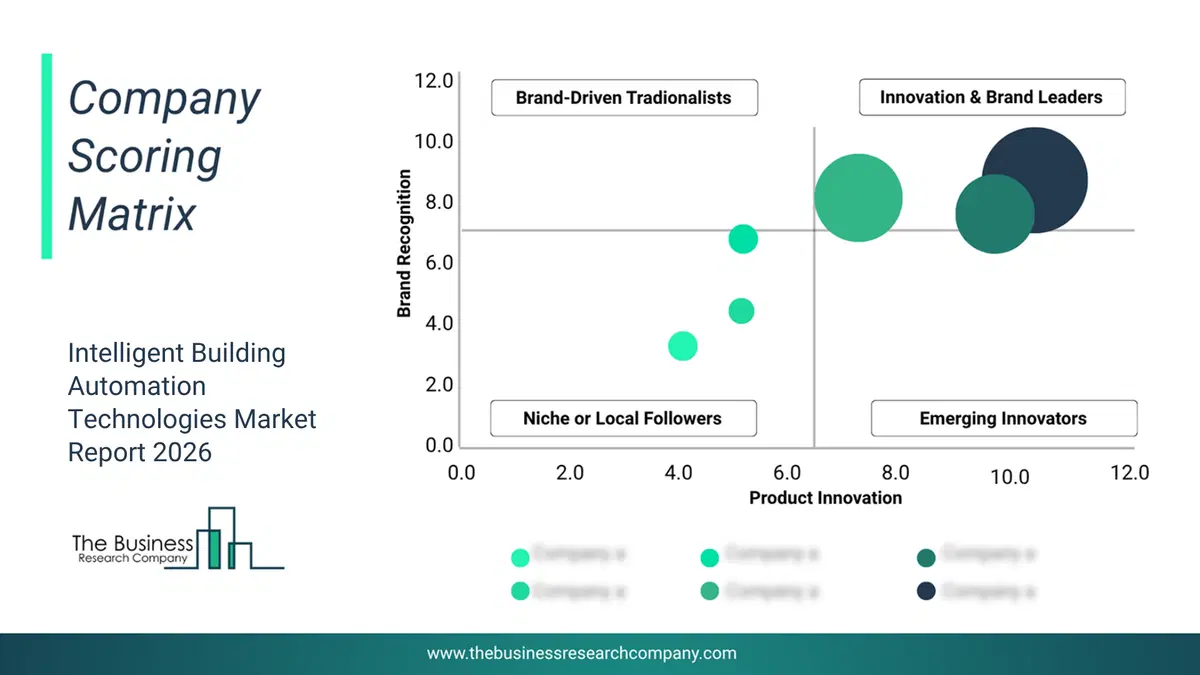
This chart maps companies by product innovation and brand strength, with bubble size indicating relative revenue, helping identify market leaders, challengers, and niche players. This is an illustrative chart; the full report provides a complete and accurate competitive analysis.
Global Intelligent Building Automation Technologies Market Trends and Insights
Major companies operating in the intelligent building automation technology market are focusing on innovative products, such as the connect box to drive revenues in their market. Connect box is an IoT building management solution that runs on the cloud, connects all devices with a few clicks, and allows interaction with pre-existing cloud apps, building automation systems, and building management systems (BMS). For instance, in March 2023, Siemens Smart Infrastructure, a Switzerland-based company specializing in solutions for intelligent building technology, energy management, and infrastructure, launched connect box. With connect box, users can complete all of their daily building management duties from a single location using a cloud-based interface no additional software or gateway is needed. Connect box provides simple online access through a smartphone or desktop. Plug-and-play installation makes setup quick and simple, requiring no technical knowledge on the part of system integrators, technicians, or facility managers to set up, configure, and run the system. Connect box provides two models for licensing. While the on-premise license makes it simple for customers to incorporate data gathered from wired and IoT devices into an already-existing automation system, building management system, or external cloud, the cloud license lets users save their building data in the connect box online database. both versions are updated wirelessly and are maintained remotely.What Are Latest Mergers And Acquisitions In The Intelligent Building Automation Technologies Market?
In June 2024, Honeywell International Inc., a US-based technology and automation firm, acquired Carrier Global Corporation for US $4.95 billion. Through this acquisition, Honeywell aims to strengthen its building automation and security portfolio by integrating Carrier’s Global Access Solutions, expanding its software offerings, accelerating innovation in cloud-based services, and driving higher sales and recurring revenue growth. Carrier Global Corporation is a US-based company that provides healthy, safe, sustainable and intelligent building and cold chain solutions.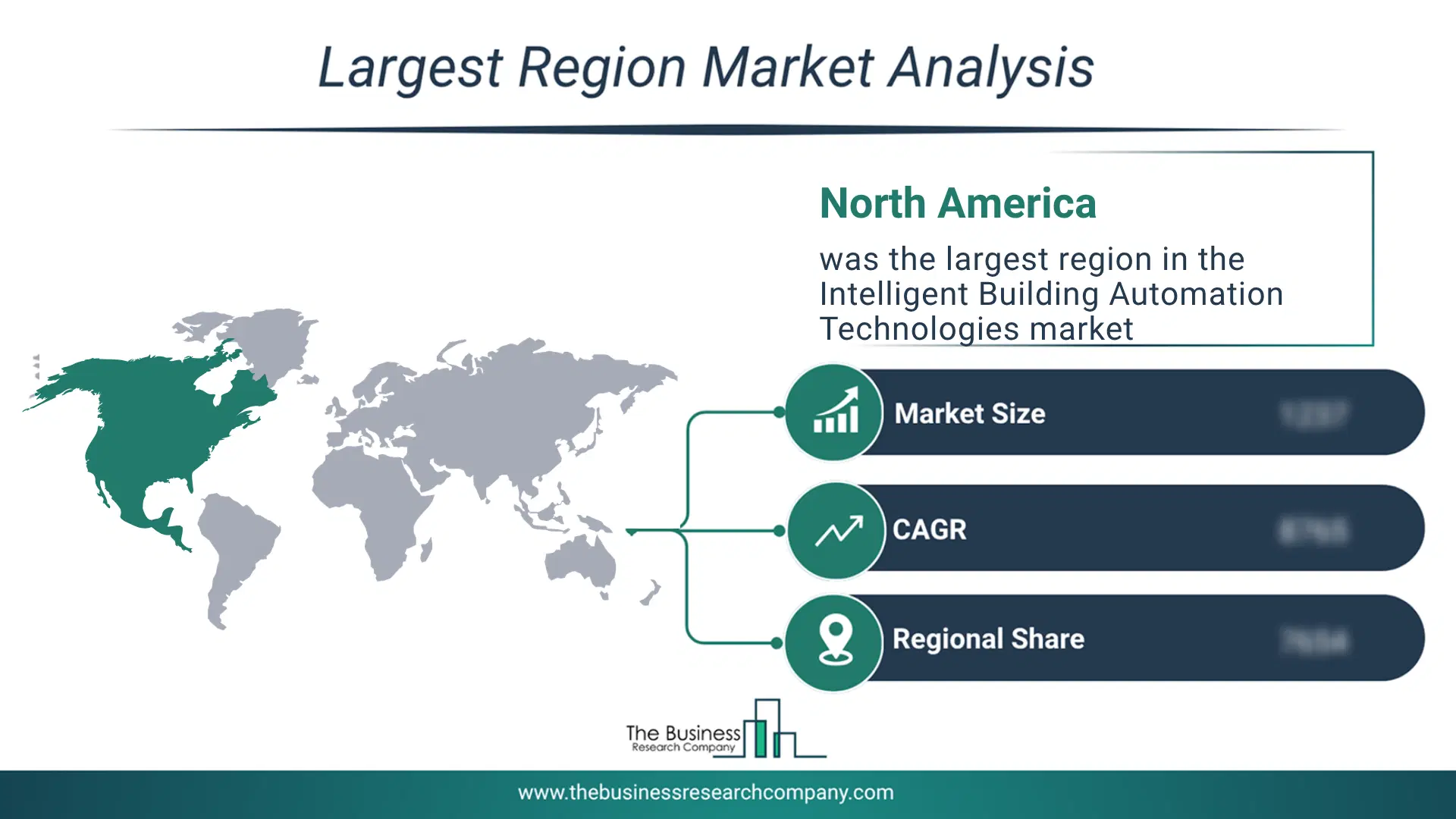
Regional Insights
North America was the largest region in the intelligent building automation technologies market in 2025.>Asia-Pacific is expected to be the fastest-growing region in the forecast period. The regions covered in this market report are Asia-Pacific, South East Asia, Western Europe, Eastern Europe, North America, South America, Middle East, Africa. The countries covered in this market report are Australia, Brazil, China, France, Germany, India, Indonesia, Japan, Taiwan, Russia, South Korea, UK, USA, Canada, Italy, SpainWhat Defines the Intelligent Building Automation Technologies Market?
The intelligent building automation technologies market consists of revenues earned by entities by providing life safety systems and security systems. Values in this market are ‘factory gate’ values, that is the value of goods sold by the manufacturers or creators of the goods, whether to other entities (including downstream manufacturers, wholesalers, distributors, and retailers) or directly to end customers. The value of goods in this market includes related services sold by the creators of the goods.How is Market Value Defined and Measured?
The market value is defined as the revenues that enterprises gain from the sale of goods and/or services within the specified market and geography through sales, grants, or donations in terms of the currency (in USD unless otherwise specified). The revenues for a specified geography are consumption values that are revenues generated by organizations in the specified geography within the market, irrespective of where they are produced. It does not include revenues from resales along the supply chain, either further along the supply chain or as part of other products.
This chart presents market attractiveness based on a quantitative evaluation of growth, competition, strategic alignment, and risk, offering a clear view of opportunity areas for decision-making. This chart is for illustrative purposes; the full report contains the complete analysis.

This chart highlights the Total Addressable Market (TAM) by estimating the maximum revenue opportunity using an assumption-driven approach, supporting strategic planning and opportunity sizing across markets. The chart is illustrative; the full report provides a more comprehensive analysis.
What Key Data and Analysis Are Included in the Intelligent Building Automation Technologies Market Report 2026?
The intelligent building automation technologies market research report is one of a series of new reports from The Business Research Company that provides market statistics, including industry global market size, regional shares, competitors with the market share, detailed market segments, market trends and opportunities, and any further data you may need to thrive in the intelligent building automation technologies industry. The market research report delivers a complete perspective of everything you need, with an in-depth analysis of the current and future state of the industry.Intelligent Building Automation Technologies Market Report Forecast Analysis
| Report Attribute | Details |
|---|---|
| Market Size Value In 2026 | $108.4 billion |
| Revenue Forecast In 2030 | $164.92 billion |
| Growth Rate | CAGR of 11.1% from 2026 to 2030 |
| Base Year For Estimation | 2025 |
| Actual Estimates/Historical Data | 2020-2025 |
| Forecast Period | 2026 - 2030 |
| Market Representation | Revenue in USD Billion and CAGR from 2026 to 2030 |
| Segments Covered | Type, Communication Technology, Application |
| Regional Scope | Asia-Pacific, Western Europe, Eastern Europe, North America, South America, Middle East, Africa |
| Country Scope | The Countries Covered In This Market Report Are Australia, Brazil, China, France, Germany, India, Indonesia, Japan, Taiwan, Russia, South Korea, Uk, Usa, Canada, Italy, Spain. |
| Key Companies Profiled | Asea Brown Boveri Ltd., Azbil Corporation, Eaton Corporation plc, General Electric Company, Siemens Building Technologies Inc., Schneider Electric SE, Honeywell International Inc., Hubbell Incorporated, Rockwell Automation Inc., Samsung Electronics Co. Ltd., Delta Controls Inc., Panasonic Corporation, Robert Bosch GmbH, Cisco Systems Inc., Trane Technologies plc, Lutron Electronics Co. Inc., Johnson Controls International plc, Emerson Electric Co., Mitsubishi Electric Corporation, Hitachi Ltd., Huawei Technologies Co. Ltd., Crestron Electronics LLC, Legrand SA, Distech Controls Inc. |
| Customization Scope | Request for Customization |
| Pricing And Purchase Options | Explore Purchase Options |