

Intelligent Infrastructure Monitoring Market Report 2026
Global Outlook – By Component (Hardware, Software, Services), By Deployment (On-Premises, Cloud, Hybrid), By Technology Type (Artificial Intelligence And Machine Learning, Internet Of Things, Digital Twin, Edge Computing, Big Data Analytics, Computer Vision), By Application (Predictive Maintenance, Remote Asset Monitoring, Anomaly Detection, Performance Optimization, Safety And Risk Management), By Industry Vertical (Energy And Utilities, Transportation And Logistics, Manufacturing, Telecommunications, Oil And Gas, Smart Cities, Healthcare, Commercial Buildings, Mining, Other Industry Verticals) – Market Size, Trends, Strategies, and Forecast to 2030
Intelligent Infrastructure Monitoring Market Overview
• Intelligent Infrastructure Monitoring market size has reached to $9.32 billion in 2025 • Expected to grow to $19.58 billion in 2030 at a compound annual growth rate (CAGR) of 15.9% • Growth Driver: The Rising Investments In Smart City And Infrastructure Development Driving The Growth Of The Market Due To Rapid Urbanization • Market Trend: Advancements In Subsea Asset Integrity Management Through Intelligent Monitoring Technologies • North America was the largest region in 2025 and Asia-Pacific is the fastest growing region.What Is Covered Under Intelligent Infrastructure Monitoring Market?
Intelligent infrastructure monitoring refers to the integration of advanced monitoring systems and connected technologies to collect, analyze, and evaluate real-time data on the condition, performance, and operational status of infrastructure assets. It enables early fault detection, predictive maintenance, and improved asset management by enhancing visibility, safety, and efficiency across critical infrastructure networks. The main components of intelligent infrastructure monitoring include hardware, software, and services. Hardware refers to physical monitoring devices, sensors, communication equipment, and computing infrastructure used to collect and transmit real-time data from infrastructure assets. These solutions are deployed through on-premises, cloud, and hybrid models and incorporate technologies such as artificial intelligence and machine learning, Internet of Things, digital twin, edge computing, big data analytics, and computer vision. They find application in predictive maintenance, remote asset monitoring, anomaly detection, performance optimization, and safety and risk management, serving industry verticals across energy and utilities, transportation and logistics, manufacturing, telecommunications, oil and gas, smart cities, healthcare, commercial buildings, mining, and others.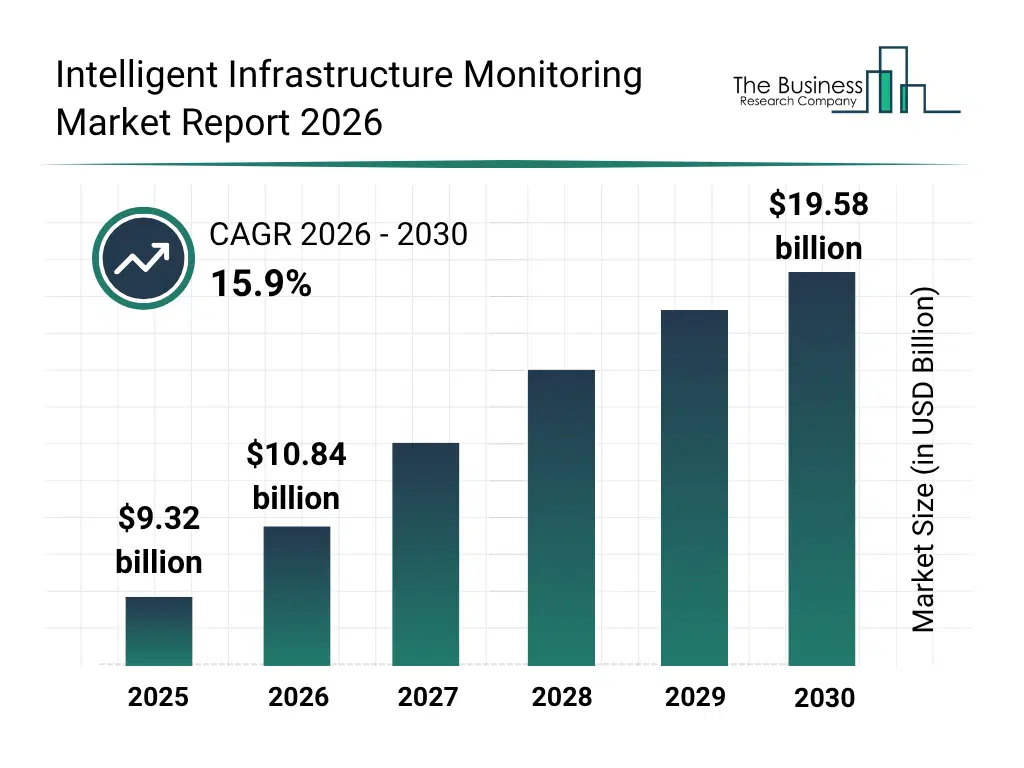
What Is The Intelligent Infrastructure Monitoring Market Size and Share 2026?
The intelligent infrastructure monitoring market size has grown rapidly in recent years. It will grow from $9.32 billion in 2025 to $10.84 billion in 2026 at a compound annual growth rate (CAGR) of 16.3%. The growth in the historic period can be attributed to increasing infrastructure asset deterioration, rising need for infrastructure condition visibility, growing infrastructure maintenance requirements, increasing infrastructure safety concerns, rising investments in critical infrastructure modernization.What Is The Intelligent Infrastructure Monitoring Market Growth Forecast?
The intelligent infrastructure monitoring market size is expected to see rapid growth in the next few years. It will grow to $19.58 billion in 2030 at a compound annual growth rate (CAGR) of 15.9%. The growth in the forecast period can be attributed to increasing demand for predictive infrastructure maintenance, rising need for early fault detection, growing deployment of remote asset monitoring solutions, increasing focus on infrastructure lifecycle optimization, rising requirements for real-time infrastructure performance management. Major trends in the forecast period include increasing deployment of real-time infrastructure monitoring systems, rising adoption of predictive asset maintenance solutions, growing use of automated anomaly detection technologies, increasing integration of multimodal infrastructure sensing technologies, rising demand for centralized asset condition monitoring platforms.
Global Intelligent Infrastructure Monitoring Market Segmentation
1) By Component: Hardware, Software, Services 2) By Deployment: On-Premises, Cloud, Hybrid 3) By Technology Type: Artificial Intelligence And Machine Learning, Internet Of Things, Digital Twin, Edge Computing, Big Data Analytics, Computer Vision 4) By Application: Predictive Maintenance, Remote Asset Monitoring, Anomaly Detection, Performance Optimization, Safety And Risk Management 5) By Industry Vertical: Energy And Utilities, Transportation And Logistics, Manufacturing, Telecommunications, Oil And Gas, Smart Cities, Healthcare, Commercial Buildings, Mining, Other Industry Verticals Subsegments: 1) By Hardware: Sensors And Monitoring Devices, Cameras And Imaging Systems, Communication Devices 2) By Software: Data Analytics Software, Asset Management Software, Monitoring And Visualization Platforms 3) By Services: Installation And Integration Services, Maintenance And Support Services, Consulting And Advisory ServicesWhat Is The Driver Of The Intelligent Infrastructure Monitoring Market?
The rising investments in smart city and infrastructure development is expected to propel the growth of the intelligent infrastructure monitoring market going forward. Smart city and infrastructure development refers to the planning, construction, modernization, and integration of urban infrastructure using digital technologies, data analytics, and connected systems to improve the efficiency, sustainability, resilience, and quality of public services and city operations. Rising investments in smart city and infrastructure development are due to rapid urbanization, as expanding urban populations require modern, connected, and sustainable infrastructure to efficiently manage transportation, utilities, public safety, and other essential city services. Investments in smart city and infrastructure development are driving the adoption of intelligent infrastructure monitoring solutions by enabling the deployment of advanced sensors, IoT networks, AI-driven analytics, and real-time data platforms to improve asset management, predictive maintenance, and operational efficiency. For instance, in April 2026, according to Patent Professional Corporation, a US-based technology-forward law firm, global IoT infrastructure spending for smart cities increased from $130 billion in 2023 to $200 billion by 2025, representing an annual growth rate of approximately 25%. Therefore, the rising investments in smart city and infrastructure development is driving the growth of the intelligent infrastructure monitoring industry.Key Players In The Global Intelligent Infrastructure Monitoring Market
Major companies operating in the intelligent infrastructure monitoring market are Westinghouse Air Brake Technologies Corporation, Campbell Scientific Inc., Trimble Inc., Bentley Systems Incorporated, COWI A/S, SGS SA, MISTRAS Group Inc., Intellisense Systems Inc., Vivacity Labs Limited, GEOKON Inc., Kistler Holding AG, Sanrachna Prahari Private Limited, Gantner Instruments GmbH, Sensera Systems Inc., Monnit Corporation, GeoSIG Ltd., RIEGL Laser Measurement Systems GmbH, FPrimeC Solutions Inc., Satelytics Inc., SODAQ B.V.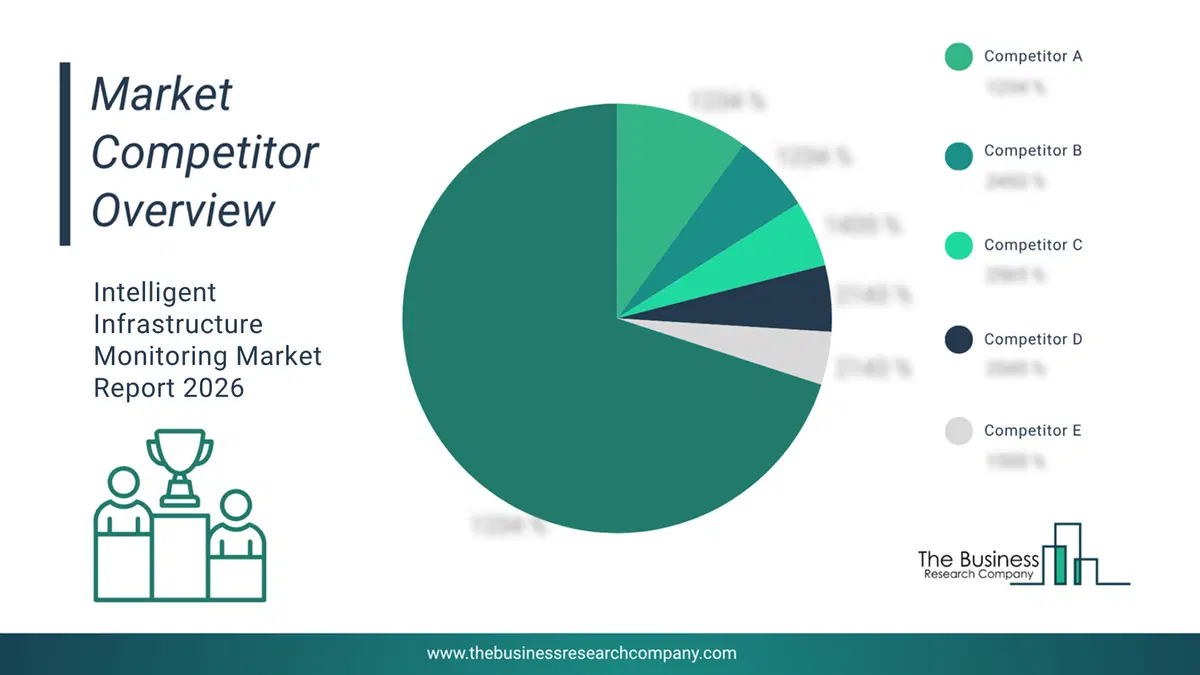
This chart is for illustrative purposes; the full report includes a detailed competitor analysis and comprehensive overview of the top 10 companies in the market.
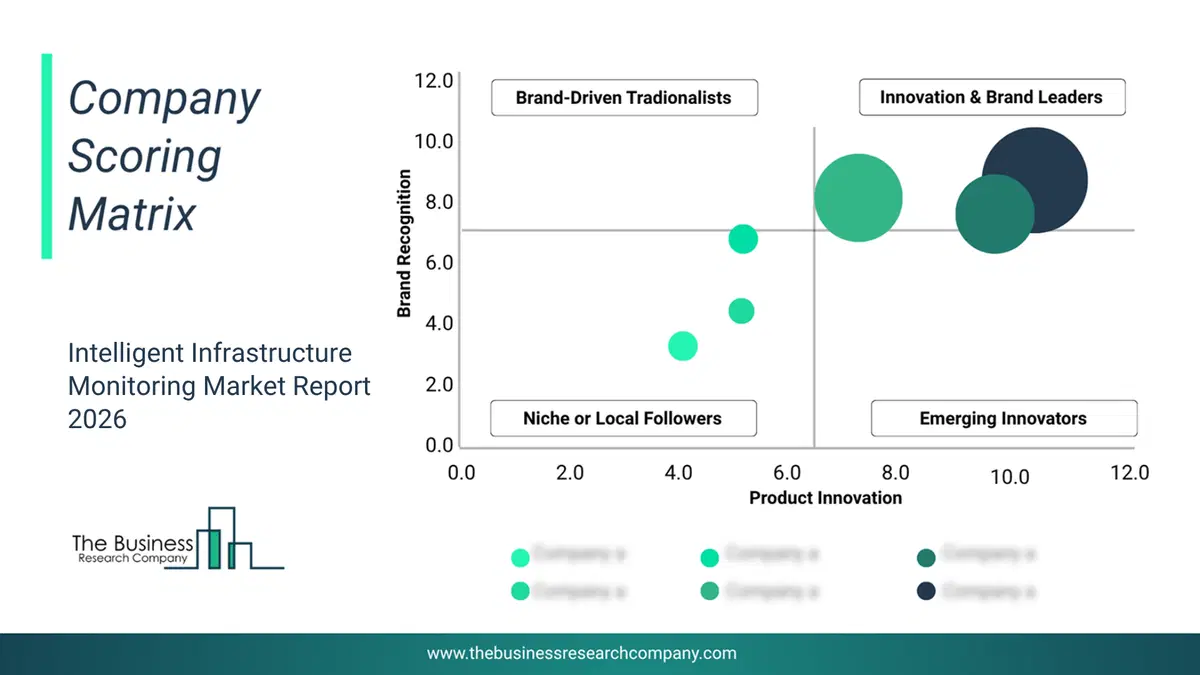
This chart maps companies by product innovation and brand strength, with bubble size indicating relative revenue, helping identify market leaders, challengers, and niche players. This is an illustrative chart; the full report provides a complete and accurate competitive analysis.
Global Intelligent Infrastructure Monitoring Market Trends and Insights
Major companies operating in the intelligent infrastructure monitoring market are focusing on developing innovative solutions, such as intelligent subsea monitoring systems, to enhance real-time asset visibility, predictive maintenance capabilities, operational safety, and infrastructure integrity management across critical infrastructure networks. Intelligent subsea monitoring systems are advanced solutions that integrate sensors, wireless communication technologies, data analytics, and automated monitoring capabilities to continuously track the condition, movement, and performance of underwater assets. For instance, in March 2026, Sonardyne International Ltd., a UK-based underwater technology company, launched Observer, an innovative intelligent subsea monitoring system designed for real-time integrity intelligence management of subsea infrastructure across the offshore energy industry. Observer combines high- and low-frequency motion and position monitoring technologies with built-in analytics and wireless communications to deliver continuous insights into subsea asset behavior. The system enables operators to monitor critical infrastructure conditions, including pipeline expansion and contraction, vortex-induced vibration, and environmental loading impacts. It integrates advanced sensing capabilities with automated data processing to identify emerging integrity issues before they lead to failures. Observer supports offshore energy operators by improving asset performance visibility, reducing reliance on costly inspection campaigns, and enabling data-driven maintenance decisions.What Are Latest Mergers And Acquisitions In The Intelligent Infrastructure Monitoring Market?
In May 2025, Virtana Inc., a US-based enterprise software company, acquired Zenoss for an undisclosed amount. With this acquisition, Virtana aims to enhance its observability capabilities by combining Zenoss’ AI-powered event intelligence and service-centric monitoring with Virtana’s deep infrastructure visibility to deliver a unified platform for hybrid and multi-cloud environments. Zenoss Inc. is a US-based provider of intelligent infrastructure monitoring solutions that integrate full-stack monitoring with AIOps for predictive insights and automated root-cause analysis.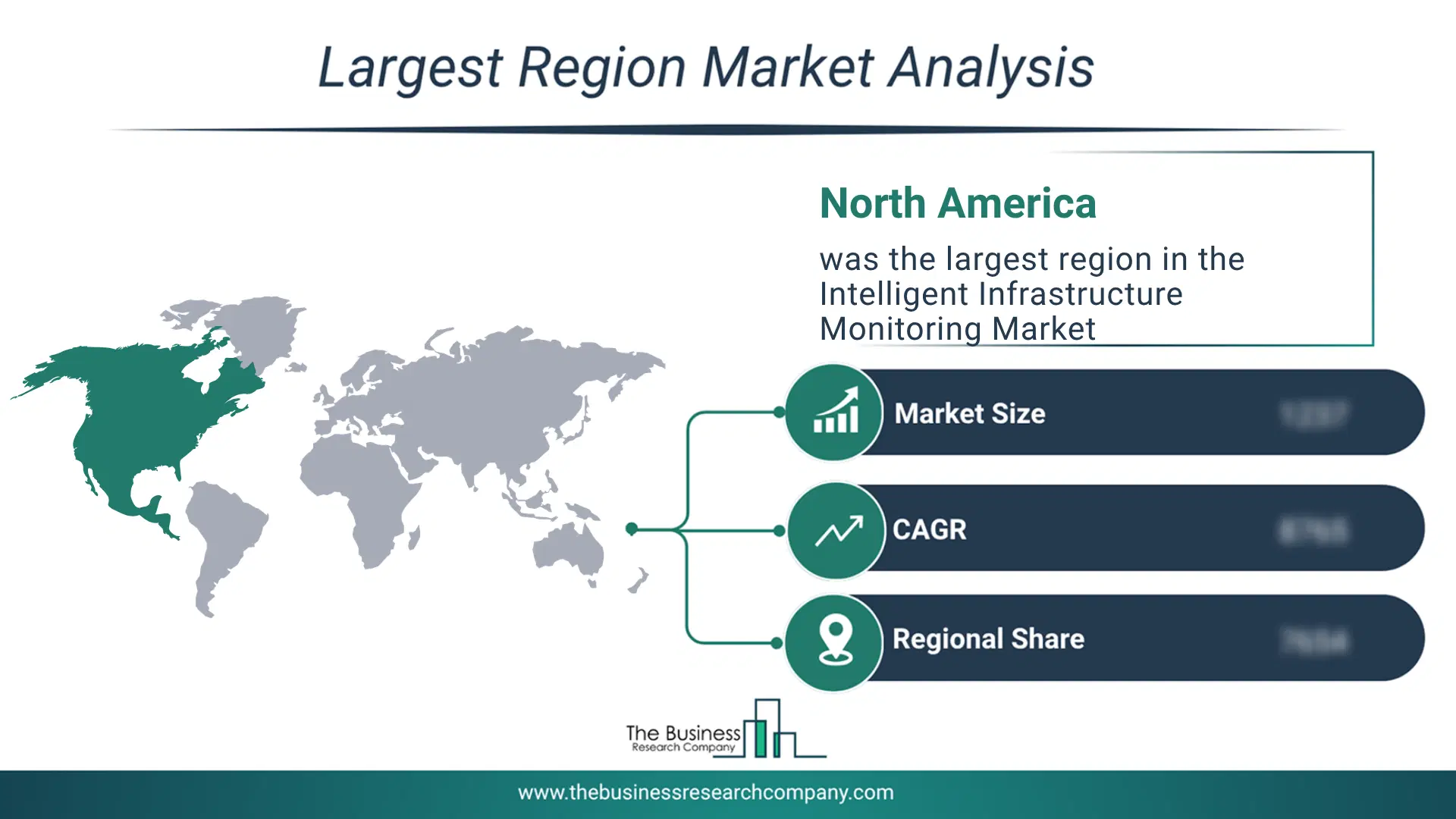
Regional Insights
North America was the largest region in the intelligent infrastructure monitoring market in 2025. Asia-Pacific is expected to be the fastest-growing region in the forecast period. The regions covered in this market report are Asia-Pacific, South East Asia, Western Europe, Eastern Europe, North America, South America, Middle East, Africa. The countries covered in this market report are Australia, Brazil, China, France, Germany, India, Indonesia, Japan, Taiwan, Russia, South Korea, UK, USA, Canada, Italy, Spain.What Defines the Intelligent Infrastructure Monitoring Market?
The intelligent infrastructure monitoring market consists of revenues earned by entities by providing services such as real-time infrastructure monitoring services, predictive maintenance and condition monitoring services, remote asset monitoring and management services, data analytics and performance optimization services, and structural health monitoring and inspection services. The market value includes the value of related goods sold by the service provider or included within the service offering. The intelligent infrastructure monitoring market also includes sales of smart sensors and monitoring devices, internet of things enabled monitoring systems, and edge computing devices. Values in this market are ‘factory gate’ values, that is the value of goods sold by the manufacturers or creators of the goods, whether to other entities (including downstream manufacturers, wholesalers, distributors and retailers) or directly to end customers. The value of goods in this market includes related services sold by the creators of the goods.How is Market Value Defined and Measured?
The market value is defined as the revenues that enterprises gain from the sale of goods and/or services within the specified market and geography through sales, grants, or donations in terms of the currency (in USD unless otherwise specified). The revenues for a specified geography are consumption values that are revenues generated by organizations in the specified geography within the market, irrespective of where they are produced. It does not include revenues from resales along the supply chain, either further along the supply chain or as part of other products.
This chart presents market attractiveness based on a quantitative evaluation of growth, competition, strategic alignment, and risk, offering a clear view of opportunity areas for decision-making. This chart is for illustrative purposes; the full report contains the complete analysis.

This chart highlights the Total Addressable Market (TAM) by estimating the maximum revenue opportunity using an assumption-driven approach, supporting strategic planning and opportunity sizing across markets. The chart is illustrative; the full report provides a more comprehensive analysis.
What Key Data and Analysis Are Included in the Intelligent Infrastructure Monitoring Market Report 2026?
The intelligent infrastructure monitoring market research report is one of a series of new reports from The Business Research Company that provides market statistics, including industry global market size, regional shares, competitors with the market share, detailed market segments, market trends and opportunities, and any further data you may need to thrive in the intelligent infrastructure monitoring industry. The market research report delivers a complete perspective of everything you need, with an in-depth analysis of the current and future state of the industry.Intelligent Infrastructure Monitoring Market Report Forecast Analysis
| Report Attribute | Details |
|---|---|
| Market Size Value In 2026 | $10.84 billion |
| Revenue Forecast In 2030 | $19.58 billion |
| Growth Rate | CAGR of 15.9% from 2026 to 2030 |
| Base Year For Estimation | 2025 |
| Actual Estimates/Historical Data | 2020-2025 |
| Forecast Period | 2026 - 2030 |
| Market Representation | Revenue in USD Billion and CAGR from 2026 to 2030 |
| Segments Covered | Component, Deployment, Technology Type, Application, Industry Vertical |
| Regional Scope | Asia-Pacific, Western Europe, Eastern Europe, North America, South America, Middle East, Africa |
| Country Scope | The countries covered in the report are Australia, Brazil, China, France, Germany, India, Indonesia, Japan, Taiwan, Russia, South Korea, UK, USA, Canada, Italy, Spain. |
| Key Companies Profiled | Westinghouse Air Brake Technologies Corporation, Campbell Scientific Inc., Trimble Inc., Bentley Systems Incorporated, COWI A/S, SGS SA, MISTRAS Group Inc., Intellisense Systems Inc., Vivacity Labs Limited, GEOKON Inc., Kistler Holding AG, Sanrachna Prahari Private Limited, Gantner Instruments GmbH, Sensera Systems Inc., Monnit Corporation, GeoSIG Ltd., RIEGL Laser Measurement Systems GmbH, FPrimeC Solutions Inc., Satelytics Inc., SODAQ B.V. |
| Customization Scope | Request for Customization |
| Pricing And Purchase Options | Explore Purchase Options |