
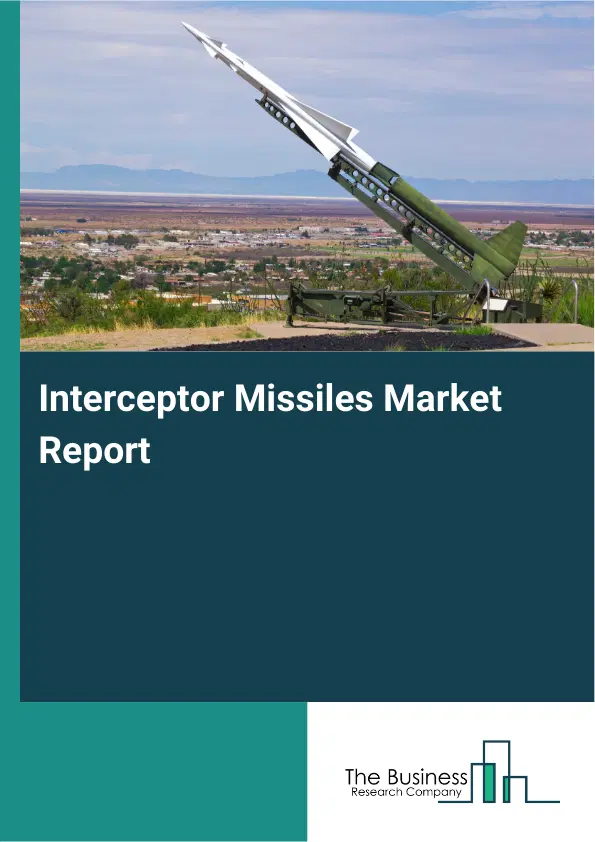
Interceptor Missiles Market Report 2026
Global Outlook – By Type (Surface To Air, Air To Air, Water To Air), By Component (Global Positioning System, Radar Homing, Infrared, Semi-Active Lasers, Inertial Navigation System, Other Components), By Range (Short-Range Interceptor Missiles, Medium-Range Interceptor Missiles, Long-Range Interceptor Missiles), By Technology (Terminal High Altitude Area Defense, Patriot Advanced Capability-3, Standard Missile-3, Hq-19, Hq-9, Iron Dome, Fd-2000, Patriot-Gem-T, Aegis Ashore, Aster), By Application (Ballistic Missiles, Cruise Missiles, Aircraft) – Market Size, Trends, Strategies, and Forecast to 2030
Interceptor Missiles Market Overview
• Interceptor Missiles market size has reached to $9.89 billion in 2025 • Expected to grow to $13.54 billion in 2030 at a compound annual growth rate (CAGR) of 6.4% • Growth Driver: Increasing Defense Budgets Fueling The Growth Of The Market Due To Rising Geopolitical Tensions And Enhanced Military Investments • Market Trend: Advancements In Hypersonic Missile Interceptors With Rafael’s Sky Sonic • North America was the largest region in 2025 and Asia-Pacific is the fastest growing region.What Is Covered Under Interceptor Missiles Market?
Interceptor missiles are specialized missiles designed to detect, track, and destroy incoming enemy missiles or airborne threats before they reach their targets. Their primary purpose is to provide a defensive shield by neutralizing ballistic missiles, aircraft, or other projectiles in mid-flight, thereby protecting strategic assets and civilian areas. The main types of interceptor missiles are surface-to-air, air-to-air, and water-to-air. Surface-to-air missiles are designed to be launched from ground-based platforms to intercept and destroy aerial threats such as enemy aircraft and incoming missiles. These missiles incorporate various components, including global positioning systems, radar homing, infrared sensors, semi-active laser guidance, inertial navigation systems, and others, and are available in a wide range, such as short-range, medium-range, and long-range interceptor missiles. The technologies utilized include terminal high altitude area defense (THAAD), patriot advanced capability-3 (PAC-3), standard missile-3 (SM-3), HQ-19, HQ-9, Iron Dome, FD-2000, Patriot GEM-T, Aegis Ashore, and Aster and find applications in ballistic missiles, cruise missiles, and aircraft.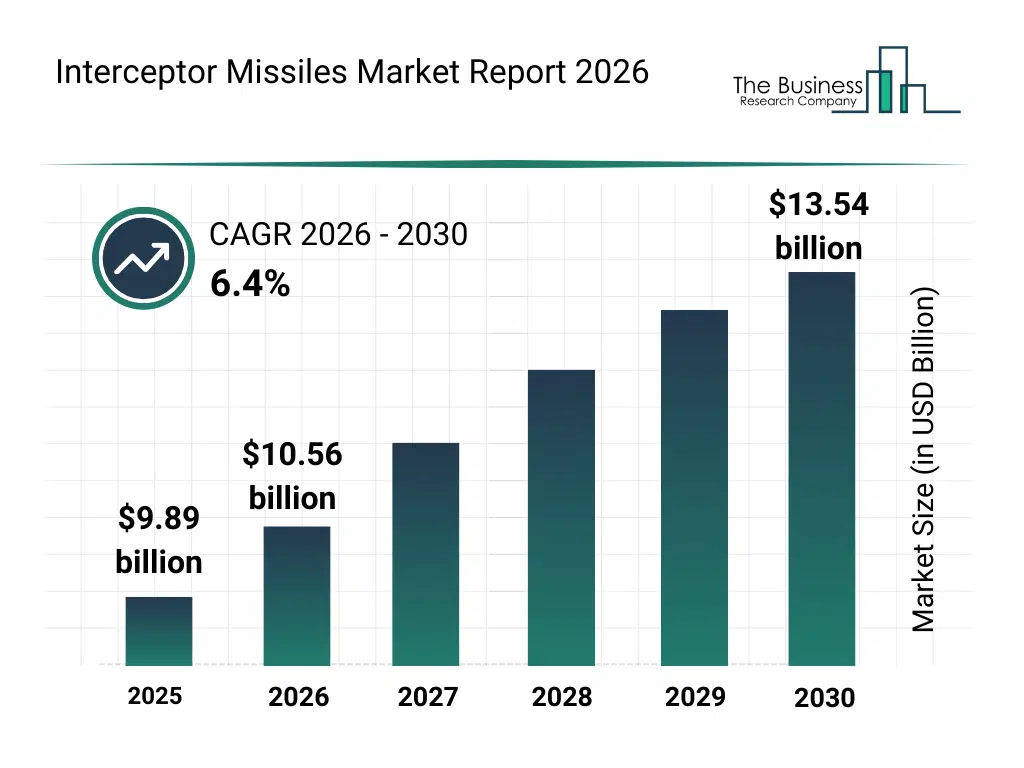
What Is The Interceptor Missiles Market Size and Share 2026?
The interceptor missiles market size has grown strongly in recent years. It will grow from $9.89 billion in 2025 to $10.56 billion in 2026 at a compound annual growth rate (CAGR) of 6.8%. The growth in the historic period can be attributed to ballistic missile threats emergence, cold war defense modernization, radar and sensor advancements, strategic military alliances, conventional warfare escalation.What Is The Interceptor Missiles Market Growth Forecast?
The interceptor missiles market size is expected to see strong growth in the next few years. It will grow to $13.54 billion in 2030 at a compound annual growth rate (CAGR) of 6.4%. The growth in the forecast period can be attributed to rising geopolitical tensions, demand for multi-layered missile defense, advancements in hypersonic interception technologies, adoption of AI-enabled targeting systems, expansion of defense budgets in asia-pacific. Major trends in the forecast period include advanced guidance and targeting systems, missile interception network integration, hypersonic threat countermeasures, modular and multi-layered defense solutions, miniaturization of interceptor missiles.
Global Interceptor Missiles Market Segmentation
1) By Type: Surface To Air, Air To Air, Water To Air 2) By Component: Global Positioning System, Radar Homing, Infrared, Semi-Active Lasers, Inertial Navigation System, Other Components 3) By Range: Short-Range Interceptor Missiles, Medium-Range Interceptor Missiles, Long-Range Interceptor Missiles 4) By Technology: Terminal High Altitude Area Defense, Patriot Advanced Capability-3, Standard Missile-3, Hq-19, Hq-9, Iron Dome, Fd-2000, Patriot-Gem-T, Aegis Ashore, Aster 5) By Application: Ballistic Missiles, Cruise Missiles, Aircraft Subsegments: 1) By Surface To Air: Long-Range Interceptor Missiles, Tactical Interceptor Systems, Medium-Range Interceptor Missiles, Short-Range Interceptor Missiles 2) By Air To Air: Short-Range Air-To-Air Missiles (Sraam), Beyond Visual Range Missiles (Bvraam), Medium-Range Air-To-Air Missiles (Mraam) 3) By Water To Air: Submarine-Launched Interceptor Missiles, Naval Close-In Weapon System (Ciws)-Based Interceptors, Ship-Based Vertical Launch Interceptor SystemsWhat Is The Driver Of The Interceptor Missiles Market?
The increasing defense budgets are expected to propel the growth of the interceptor missiles market going forward. Defense budgets refer to the financial resources allocated by a government to fund its military operations, personnel, equipment, and defense infrastructure. The increasing defense budgets are driven by rising geopolitical tensions due to escalating conflicts and regional security challenges worldwide. Defense budgets enhance interceptor missiles by providing increased funding for advanced research and development, enabling the production of more sophisticated and effective missile defense systems. They improve national security by supporting the deployment and modernization of interceptor technologies to counter emerging threats. For instance, in April 2024, according to the Stockholm International Peace Research Institute (SIPRI), a Sweden-based non-government organization, global military spending reached $2,443 billion in 2023, marking a 6.8% increase compared to 2022. Therefore, the increasing defense budgets are driving the growth of the interceptor missiles industry.What Is The Driver Of The Interceptor Missiles Market?
The rising terrorist threats are expected to propel the growth of the interceptor missiles market going forward. Terrorist threats are warnings or indications of planned acts of violence intended to cause fear and advance extremist objectives. The increasing terrorist threats often result from political instability, which creates opportunities for extremist groups to grow and carry out attacks. Interceptor missiles address terrorist threats by providing rapid and precise neutralization of incoming hostile projectiles, enhancing national security. They reduce the risk of damage and casualties by intercepting attacks before impact, improving defense readiness, and improving public safety. For instance, in March 2025, according to the Home Office, a UK-based government agency, in 2024, there were 248 terrorism-related arrests in Great Britain, 25 more than in 2023, an 11% increase. Therefore, the rising terrorist threats are driving the growth of the interceptor missiles industry.Key Players In The Global Interceptor Missiles Market
Major companies operating in the interceptor missiles market are The Boeing Company, Raytheon Technologies Corporation, Lockheed Martin Corporation, China Aerospace Science and Technology Corporation, Northrop Grumman Corporation, Mitsubishi Heavy Industries Ltd., L3Harris Technologies Inc., Thales Group, Elbit Systems Ltd, Israel Aerospace Industries Ltd., Hanwha Aerospace Co. Ltd., MBDA, Diehl Defence GmbH & Co. KG, Saab AB, Rafael Advanced Defense Systems Ltd., Kongsberg Defence & Aerospace AS, Aselsan, LIG Nex1 Co. Ltd., Roketsan A.S., Denel Dynamics, Bharat Dynamics Limited, BlueHalo LLC.
This chart is for illustrative purposes; the full report includes a detailed competitor analysis and comprehensive overview of the top 10 companies in the market.
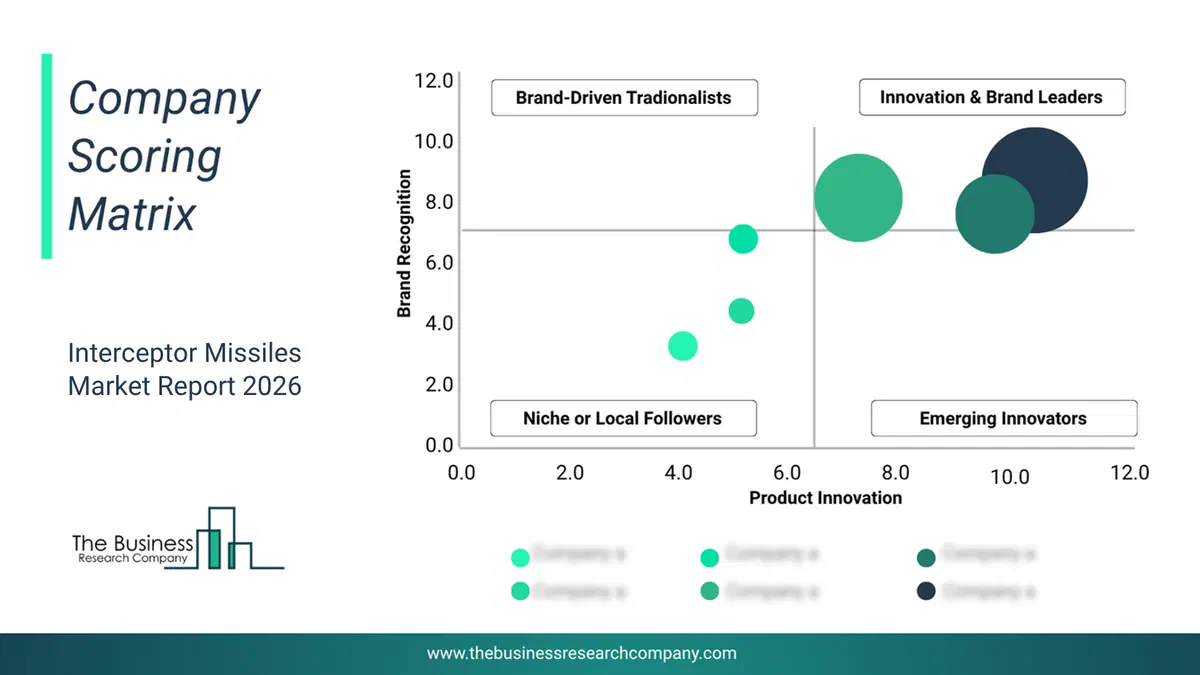
This chart maps companies by product innovation and brand strength, with bubble size indicating relative revenue, helping identify market leaders, challengers, and niche players. This is an illustrative chart; the full report provides a complete and accurate competitive analysis.
Global Interceptor Missiles Market Trends and Insights
Major companies operating in the interceptor missiles market are focusing on developing advanced products, such as hypersonic missile interceptors, to counter high-speed threats and improve defense effectiveness. A hypersonic interceptor missile is designed to detect and destroy incoming hypersonic threats traveling above Mach 5 using advanced guidance and high-speed maneuverability. For instance, in June 2023, Rafael Advanced Defense Systems, an Israeli-based defense technology company, launched a Sky Sonic, a hypersonic missile interceptor. It is designed to neutralize hypersonic missiles with exceptional maneuverability and high-speed precision, providing unmatched defense against threats traveling at five to ten times the speed of sound. Its main advantage is the ability to intercept highly maneuverable, hard-to-track hypersonic threats with advanced stealth and accuracy. Sky Sonic features cutting-edge sensors and advanced propulsion systems that enable it to detect and engage fast, evasive targets in the upper atmosphere.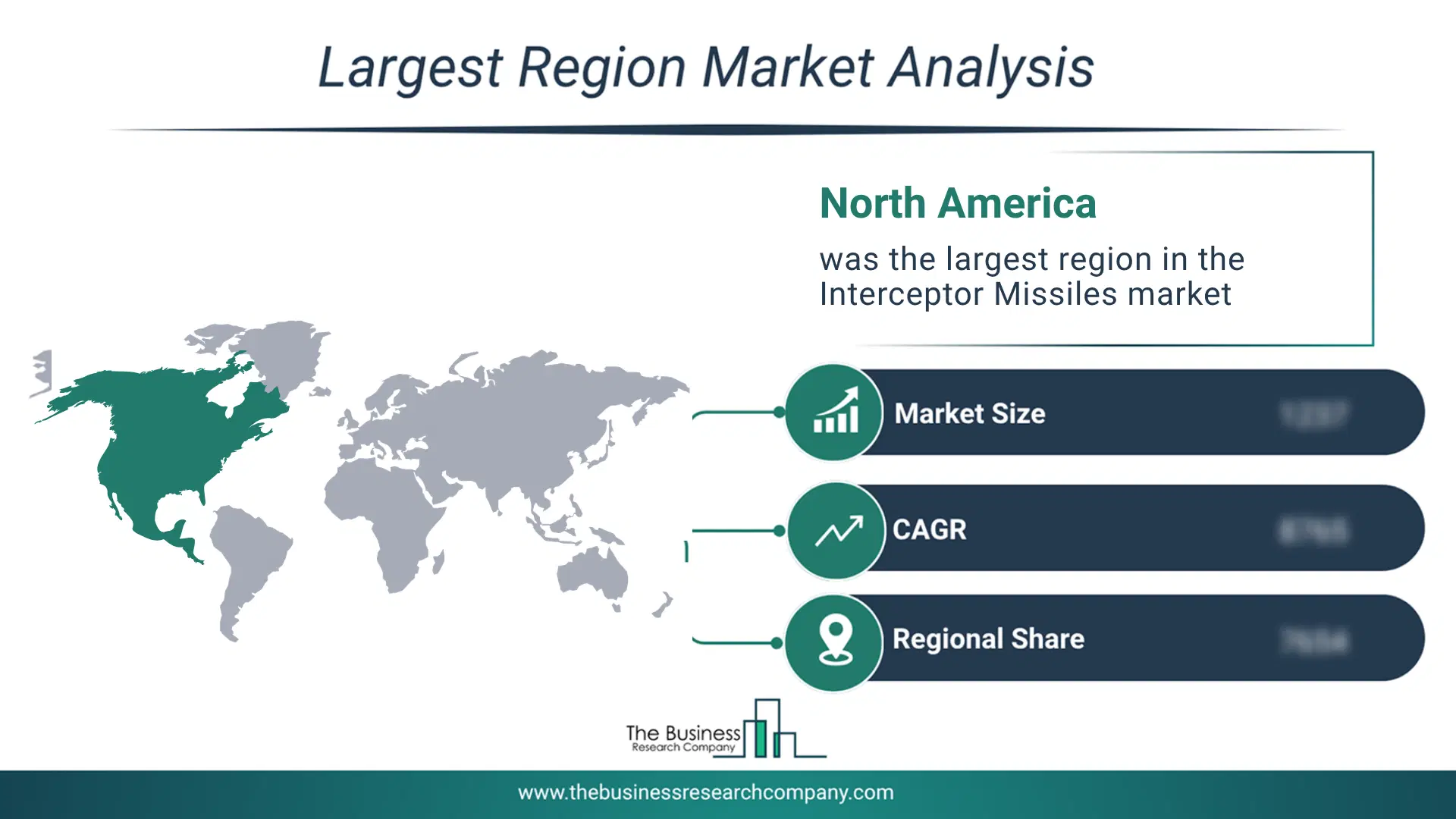
Regional Outlook
North America was the largest region in the interceptor missiles market in 2025. Asia-Pacific is expected to be the fastest-growing region in the forecast period. The regions covered in this market report are Asia-Pacific, South East Asia, Western Europe, Eastern Europe, North America, South America, Middle East and Africa. The countries covered in this market report are Australia; Brazil; China; France; Germany; India; Indonesia; Japan; Taiwan; Russia; South Korea; UK; USA; Canada; Italy; Spain.What Defines the Interceptor Missiles Market?
The interceptor missiles market consists of revenues earned by entities by providing services such as missile system integration, maintenance and repair, software upgrades, testing and evaluation, operator training, and lifecycle support for interceptor missile systems. The market value includes the value of related goods sold by the service provider or included within the service offering. The interceptor missile market also includes sales of kill vehicles, launch systems, guidance and control systems, tracking and surveillance radars, and associated command and control infrastructure. Values in this market are ‘factory gate’ values, that is the value of goods sold by the manufacturers or creators of the goods, whether to other entities (including downstream manufacturers, wholesalers, distributors and retailers) or directly to end customers. The value of goods in this market includes related services sold by the creators of the goods.How is Market Value Defined and Measured?
The market value is defined as the revenues that enterprises gain from the sale of goods and/or services within the specified market and geography through sales, grants, or donations in terms of the currency (in USD unless otherwise specified). The revenues for a specified geography are consumption values that are revenues generated by organizations in the specified geography within the market, irrespective of where they are produced. It does not include revenues from resales along the supply chain, either further along the supply chain or as part of other products.
This chart presents market attractiveness based on a quantitative evaluation of growth, competition, strategic alignment, and risk, offering a clear view of opportunity areas for decision-making. This chart is for illustrative purposes; the full report contains the complete analysis.

This chart highlights the Total Addressable Market (TAM) by estimating the maximum revenue opportunity using an assumption-driven approach, supporting strategic planning and opportunity sizing across markets. The chart is illustrative; the full report provides a more comprehensive analysis.
What Key Data and Analysis Are Included in the Interceptor Missiles Market Report 2026?
The interceptor missiles market research report is one of a series of new reports from The Business Research Company that provides market statistics, including industry global market size, regional shares, competitors with the market share, detailed market segments, market trends and opportunities, and any further data you may need to thrive in the interceptor missiles industry. The market research report delivers a complete perspective of everything you need, with an in-depth analysis of the current and future state of the industry.Interceptor Missiles Market Report Forecast Analysis
| Report Attribute | Details |
|---|---|
| Market Size Value In 2026 | $2.77 billion |
| Revenue Forecast In 2030 | $3.43 billion |
| Growth Rate | CAGR of 5.5% from 2026 to 2030 |
| Base Year For Estimation | 2025 |
| Actual Estimates/Historical Data | 2020-2025 |
| Forecast Period | 2026 - 2030 |
| Market Representation | Revenue in USD Billion and CAGR from 2026 to 2030 |
| Segments Covered | Type, Component, Range, Technology, Application |
| Regional Scope | Asia-Pacific, Western Europe, Eastern Europe, North America, South America, Middle East, Africa |
| Country Scope | The countries covered in the report are Australia, Brazil, China, France, Germany, India, Indonesia, Japan, Taiwan, Russia, South Korea, UK, USA, Canada, Italy, Spain. |
| Key Companies Profiled | The Boeing Company, Raytheon Technologies Corporation, Lockheed Martin Corporation, China Aerospace Science and Technology Corporation, Northrop Grumman Corporation, Mitsubishi Heavy Industries Ltd., L3Harris Technologies Inc., Thales Group, Elbit Systems Ltd, Israel Aerospace Industries Ltd., Hanwha Aerospace Co. Ltd., MBDA, Diehl Defence GmbH & Co. KG, Saab AB, Rafael Advanced Defense Systems Ltd., Kongsberg Defence & Aerospace AS, Aselsan, LIG Nex1 Co. Ltd., Roketsan A.S., Denel Dynamics, Bharat Dynamics Limited, BlueHalo LLC. |
| Customization Scope | Request for Customization |
| Pricing And Purchase Options | Explore Purchase Options |