
Intercontinental Ballistic Missile Market Report 2026
Global Outlook – By Type (Land-Based Intercontinental Ballistic Missiles, Submarine-Launched Intercontinental Ballistic Missiles, Air-Launched Intercontinental Ballistic Missiles), By Propulsion Type (Solid Propulsion, Liquid Propulsion, Advanced Hybrid Propulsion Systems), By Payload (Single Warhead, Multiple Independently Targetable Reentry Vehicles (MIRV), Maneuverable Reentry Vehicles (MaRVs)), By Application (Ocean Military Defense, Land Military Defense, Strategic Deterrence Operations) – Market Size, Trends, Strategies, and Forecast to 2030
Intercontinental Ballistic Missile Market Overview
• Intercontinental Ballistic Missile market size has reached to $12.02 billion in 2025 • Expected to grow to $16.49 billion in 2030 at a compound annual growth rate (CAGR) of 6.6% • Growth Driver: Surge In Missile Manufacturing Fueling The Growth Of The Market Due To Increasing Defense Budgets And Technological Advancements • Market Trend: Land-Based Intercontinental Ballistic Missiles For Long-Range Strategic Deterrence • North America was the largest region in 2025 and Asia-Pacific is the fastest growing region.Market Gains By 2030 – Top Opportunities By Segment
Market Gain identifies the most promising market opportunities by highlighting the segments or products expected to generate the highest incremental revenue growth over the next five years.
What Is Covered Under Intercontinental Ballistic Missile Market?
An intercontinental ballistic missile (ICBM) is a long-range missile designed to travel extremely long distances, typically exceeding 5,500 kilometers, by following a high-arching ballistic trajectory that takes it into space before re-entering the atmosphere to reach its target. It is built with advanced propulsion and navigation technologies, enabling it to cover intercontinental distances with remarkable speed and precision, making it a highly sophisticated strategic weapon. The main types of the intercontinental ballistic missile market include land-based intercontinental ballistic missiles, submarine-launched intercontinental ballistic missiles, and air-launched intercontinental ballistic missiles. Land-based intercontinental ballistic missiles refer to long-range strategic missile systems deployed from fortified ground-based silos or mobile land platforms, designed to deliver high-precision nuclear or conventional payloads across intercontinental distances while ensuring rapid launch capability, strong deterrence value, and sustained operational readiness under stringent military defense frameworks. The propulsion types used in these missiles include solid propulsion, liquid propulsion, and advanced hybrid propulsion systems. The key payload categories include single warhead, multiple independently targetable reentry vehicles (MIRV), and maneuverable reentry vehicles (MaRVs). The applications include ocean military defense, land military defense, and strategic deterrence operations.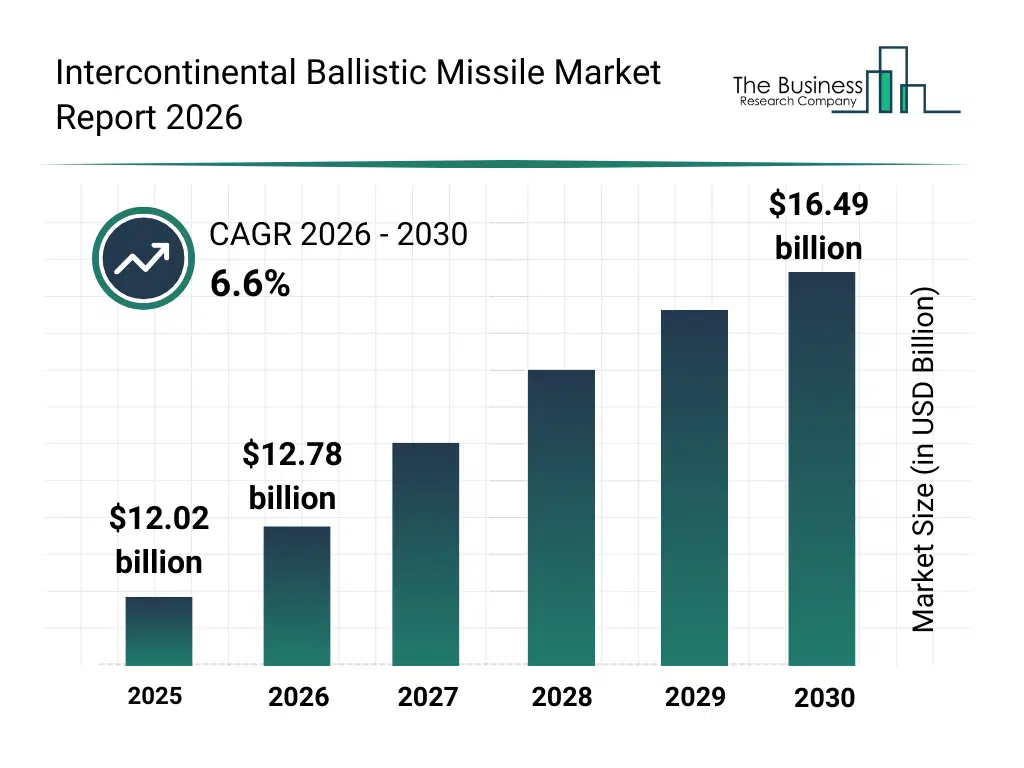
What Is The Intercontinental Ballistic Missile Market Size and Share 2026?
The intercontinental ballistic missile market size has grown strongly in recent years. It will grow from $12.02 billion in 2025 to $12.78 billion in 2026 at a compound annual growth rate (CAGR) of 6.3%. The growth in the historic period can be attributed to cold war-era nuclear deterrence programs, advancements in long-range propulsion systems, development of precision guidance technologies, growth in strategic defense budgets, adoption of advanced reentry vehicle designs.What Is The Intercontinental Ballistic Missile Market Growth Forecast?
The intercontinental ballistic missile market size is expected to see strong growth in the next few years. It will grow to $16.49 billion in 2030 at a compound annual growth rate (CAGR) of 6.6%. The growth in the forecast period can be attributed to modernization of existing missile systems, integration with hypersonic technologies, adoption of enhanced stealth and countermeasure capabilities, expansion in missile defense compatibility, development of multi-warhead and flexible payload systems. Major trends in the forecast period include increasing development of next-generation guidance and navigation systems, growing focus on hypersonic icbm capabilities, expansion of hardened and mobile missile launch platforms, rising adoption of advanced propulsion technologies, strengthening emphasis on nuclear modernization programs.
Global Intercontinental Ballistic Missile Market Segmentation
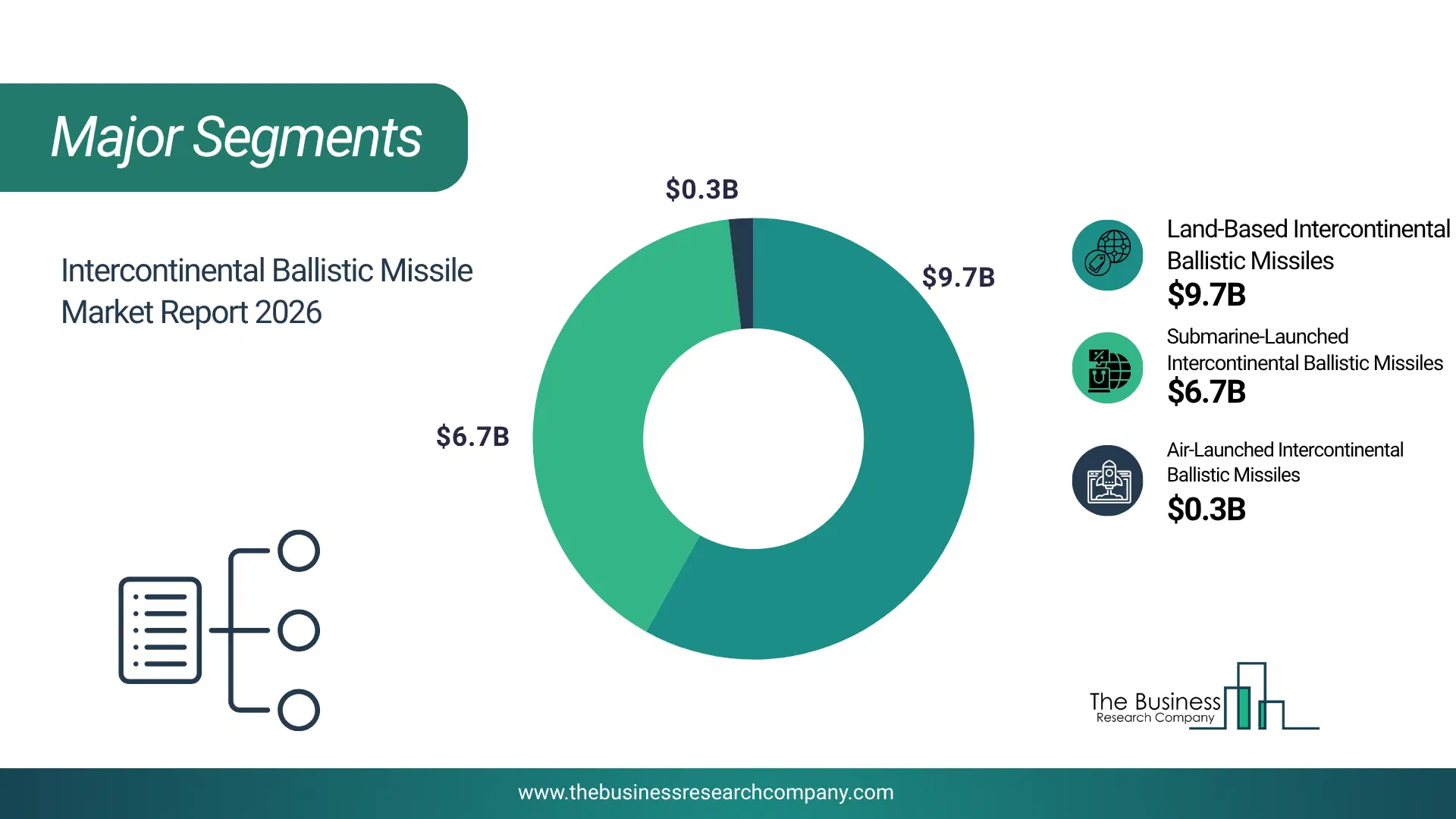
1) By Type: Land-Based Intercontinental Ballistic Missiles, Submarine-Launched Intercontinental Ballistic Missiles, Air-Launched Intercontinental Ballistic Missiles 2) By Propulsion Type: Solid Propulsion, Liquid Propulsion, Advanced Hybrid Propulsion Systems 3) By Payload: Single Warhead, Multiple Independently Targetable Reentry Vehicles (MIRV), Maneuverable Reentry Vehicles (MaRVs) 5) By Application: Ocean Military Defense, Land Military Defense, Strategic Deterrence Operations Subsegments: 1) By Land-Based Intercontinental Ballistic Missiles: Silo-Based ICBMs, Road-Mobile ICBMs, Rail-Mobile ICBMs 2) By Submarine-Launched Intercontinental Ballistic Missiles: Vertical Launch Tube ICBMs, Cold-Launch SLBMs, Hot-Launch SLBMs 3) By Air-Launched Intercontinental Ballistic Missiles: Air-Dropped Boosted ICBMs, Air-Launched Rocket-Assisted ICBMs The top segments in the intercontinental ballistic missile market will be: • Land-Based Intercontinental Ballistic Missiles will reach $9.6 billion by 2030. • Submarine-Launched Intercontinental Ballistic Missiles will reach $6.68 billion by 2030. • Air-Launched Intercontinental Ballistic Missiles will reach $0.21 billion by 2030.What Is Driver Of The Intercontinental Ballistic Missile Market?
The expansion of missile manufacturing is expected to propel the growth of the intercontinental ballistic missile market going forward. Missile manufacturing is the process of designing, producing, and assembling missiles, including their engines, guidance systems, and warheads, to create fully functional weapons for defense or military purposes. Missile manufacturing is rising due to increasing defense budgets, as countries are allocating more funds to strengthen their military capabilities and enhance national security. Expansion of missile manufacturing strengthens intercontinental ballistic missile capabilities by enhancing the production of advanced propulsion systems, guidance technologies, and warhead integration, ensuring greater reliability, range, and precision in strategic long-range deterrence. For instance, in July 2025, according to Deloitte (Energy and Industrials), a UK-based multinational professional services network, the U.S. Department of Defense’s procurement and research and development budget for missiles and munitions surged 340% to $30.6 billion in FY2024, signalling continued growth in the global solid rocket market. Therefore, expansion of missile manufacturing is driving the growth of the Intercontinental Ballistic Missile industry.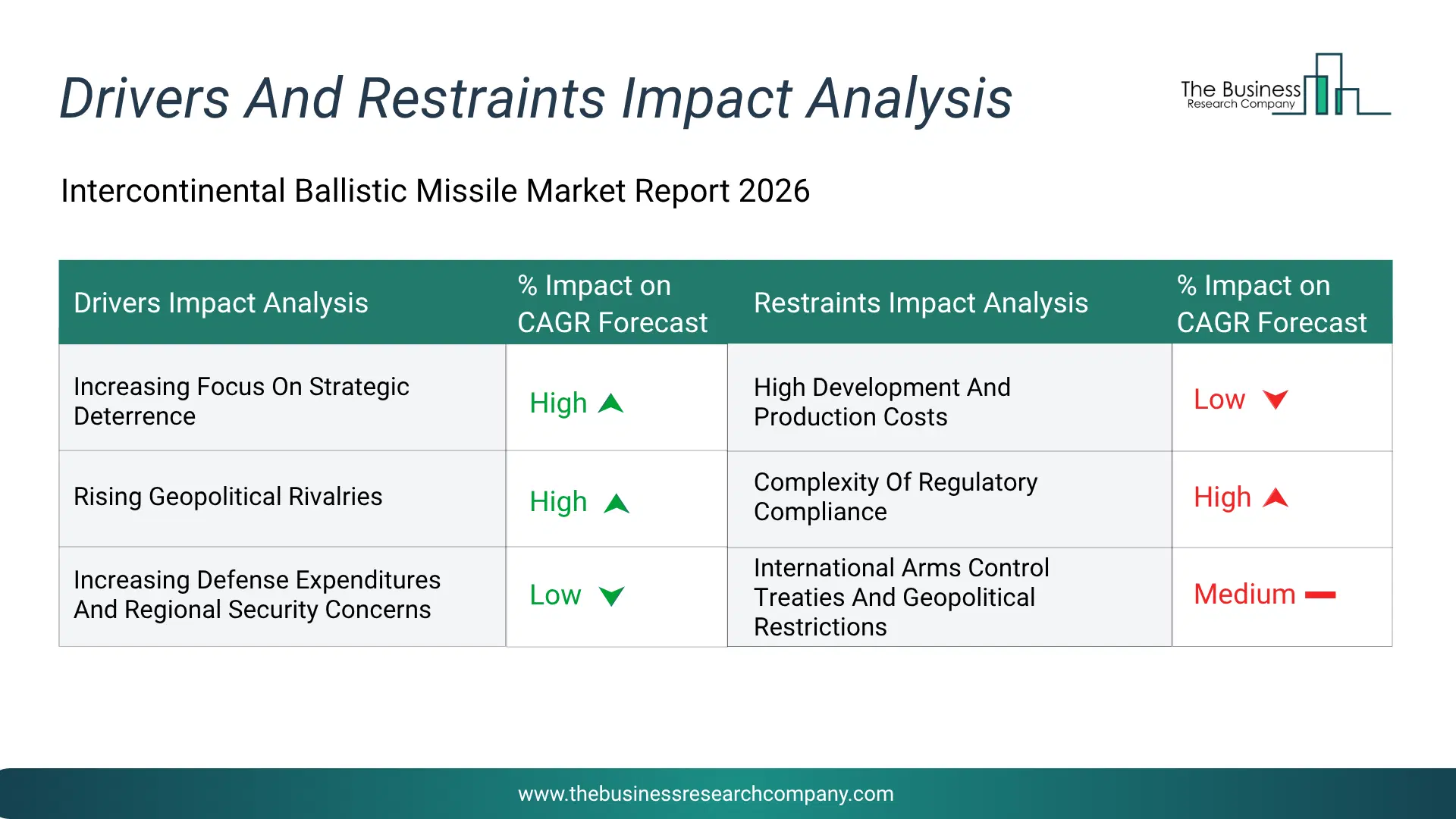
Infographic Chart Showing Key Market Drivers Analysis And Restraints For Intercontinental Ballistic Missile Market
The chart presents an impact analysis of key drivers and restraints, quantifying their relative influence on the market's growth rate and helping assess the balance between growth enablers and limiting factors. This chart offers a high-level perspective; the full report contains more detailed insights.
How Will The Drivers Impact Growth In The Global Intercontinental Ballistic Missile Market?
• Increasing Focus On Strategic Deterrence (High) – During the forecast period, the increasing focus on strategic deterrence is expected to become a key growth driver for the intercontinental ballistic missile market by 2030. Icbms serve as a powerful deterrent, signaling that a country can respond effectively to any nuclear or strategic threat. Rising geopolitical tensions and the pursuit of a robust defense posture encourage countries to invest in advanced missile technologies. This includes improving range, accuracy, and survivability of icbms to ensure a reliable second-strike capability. Consequently, governments allocate significant resources to research, development, and modernization of missile systems. • Rising Geopolitical Rivalries (High) – During the forecast period, the rising geopolitical rivalries are expected to emerge as a major factor driving the expansion of the intercontinental ballistic missile market by 2030. As nations compete for military superiority, they invest in long-range missile systems to ensure they can respond to threats globally. Icbms provide a credible second-strike capability, strengthening national security amid uncertainty. Increased defense budgets in rival nations further boost demand for missile development and modernization programs. • Increasing Defense Expenditures And Regional Security Concerns (Low) – During the forecast period, the increasing defense expenditures and regional security concerns are expected to act as a key growth catalyst for the intercontinental ballistic missile market by 2030. Heightened geopolitical tensions and threats from rival nations push governments to enhance their nuclear deterrence and long-range strike options. Increased budgets allow for research, development, and deployment of advanced icbms with greater accuracy, range, and survivability. These investments ensure national security, strengthen deterrence strategies, and maintain a technological edge over potential adversaries.How Will The Restraints Impact Growth In The Global Intercontinental Ballistic Missile Market?
• High Development And Production Costs (Low) – During the forecast period, the high development and production costs restrain the intercontinental ballistic missile (icbm) market because these missiles require advanced propulsion systems, precision guidance technologies, and robust warhead delivery mechanisms, all of which are extremely expensive. Research, testing, and manufacturing involve sophisticated materials, specialized facilities, and highly skilled personnel, driving up costs further. Additionally, long development timelines and stringent safety regulations increase financial risks for governments or defense contractors. • Complexity Of Regulatory Compliance (High) – During the forecast period, the complexity of regulatory compliance restrains the intercontinental ballistic missile (icbm) market because developing, testing, and deploying icbms involves navigating a dense web of international treaties, export controls, and national defense regulations. These rules vary by country and often require lengthy approvals, strict reporting, and security clearances. Non-compliance can result in severe legal penalties, trade restrictions, or diplomatic conflicts. This slows down development timelines, increases costs, and limits participation to only highly capable and compliant organizations. • International Arms Control Treaties And Geopolitical Restrictions (Medium) – During the forecast period, the international arms control treaties and geopolitical restrictions act as a restraint for the intercontinental ballistic missile (icbm) market by limiting the development, testing, and deployment of such systems across several countries. Agreements like non-proliferation frameworks and bilateral missile limitation treaties impose strict constraints on production and range capabilities. Additionally, geopolitical tensions often lead to export restrictions and sanctions that prevent technology transfer and collaboration. These limitations reduce market expansion opportunities and confine development to a small number of nations with advanced defense capabilities.Key Players In The Global Intercontinental Ballistic Missile Market
Major companies operating in the intercontinental ballistic missile market are Lockheed Martin Corporation, The Boeing Company, Raytheon Technologies Inc., China Aerospace Science and Technology Corporation (CASC), L3Harris Technologies Inc., Northrop Grumman Corporation, ArianeGroup, Israel Aerospace Industries, General Dynamics Corporation, Bharat Dynamics Limited (BDL), NPO Mashinostroyeniya, Moscow Institute of Thermal Technology (MITT), Roscosmos State Corporation, China Academy of Space Technology (CAST), State Rocket Center Makeyev (Makeyev Rocket Design Bureau)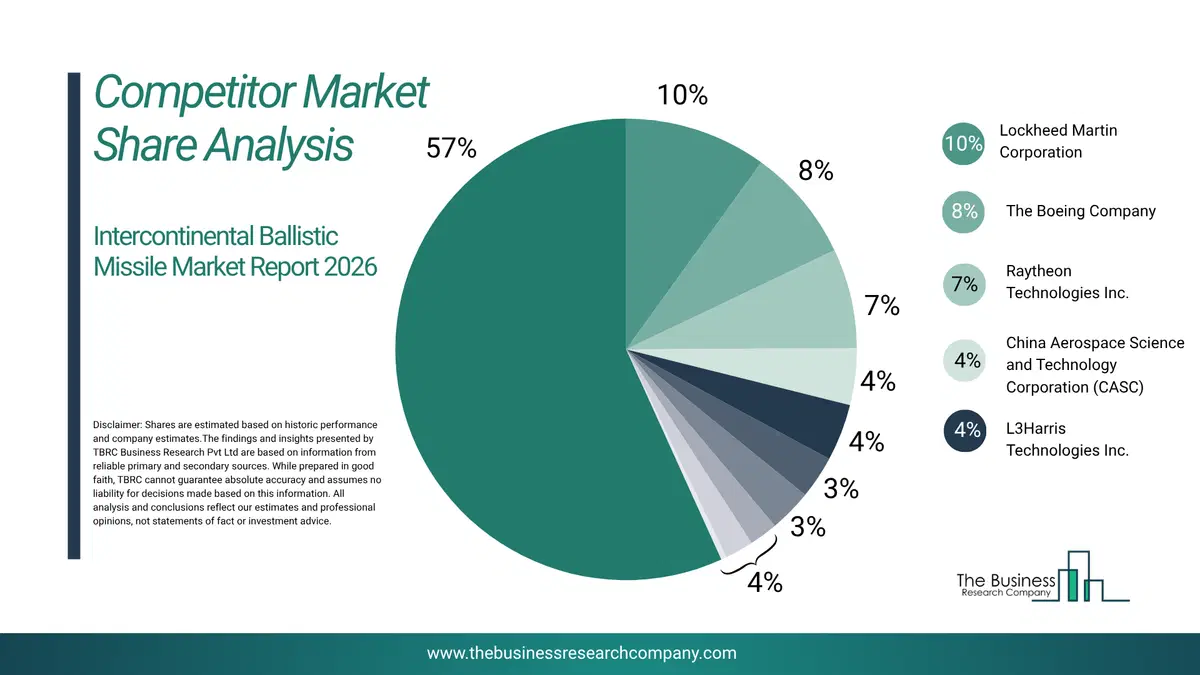
This chart is for illustrative purposes; the full report includes a detailed competitor analysis and comprehensive overview of the top 10 companies in the market.
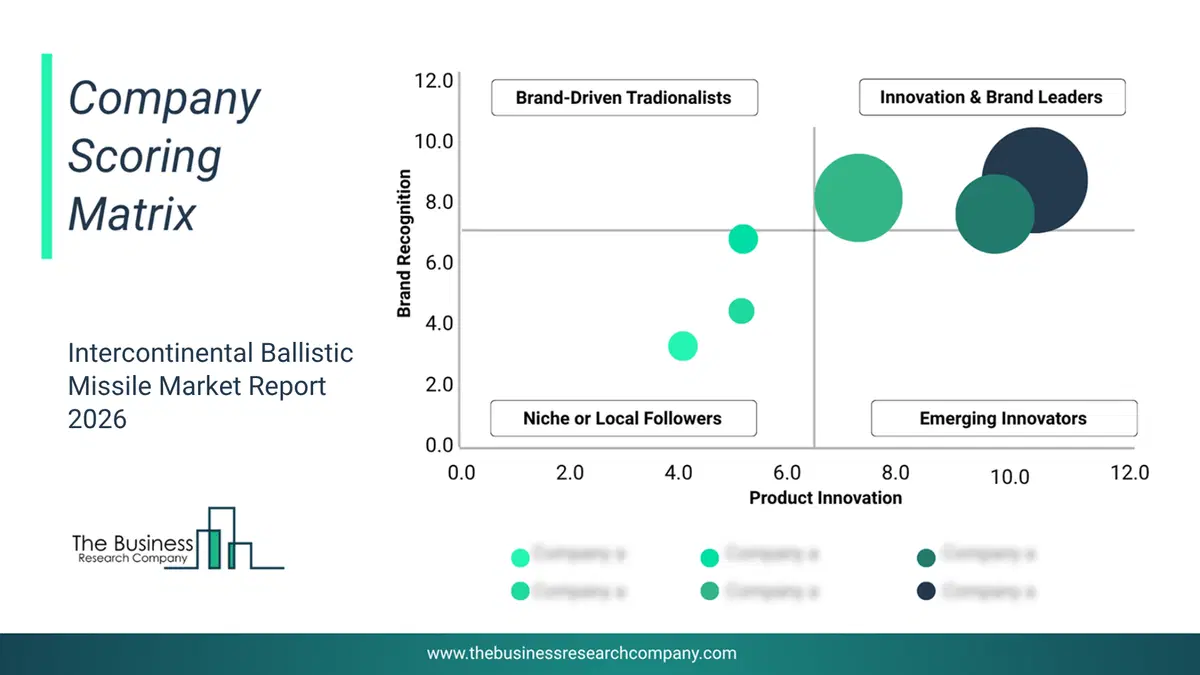
This chart maps companies by product innovation and brand strength, with bubble size indicating relative revenue, helping identify market leaders, challengers, and niche players. This is an illustrative chart; the full report provides a complete and accurate competitive analysis.
Global Intercontinental Ballistic Missile Market Trends and Insights
Major companies operating in the intercontinental ballistic missile market are focusing on developing innovative solutions, such as land-based intercontinental ballistic missiles, to enhance strategic deterrence and improve rapid response capabilities. Land-based intercontinental ballistic missiles refer to long-range missiles launched from land platforms that can deliver warheads across continents with high precision for strategic deterrence. For instance, in May 2025, the United States Air Force, a US-based government department, launched its second unarmed Minuteman III, a land-based intercontinental ballistic missile (ICBM) used as a strategic nuclear deterrent. It is a three-stage, solid-fuel missile standing about 18.2 meters tall, weighing roughly 79,432 pounds, and capable of traveling over 6,000 miles at speeds of approximately 15,000 mph. Originally designed to carry up to three nuclear warheads, current versions are configured to carry a single warhead in compliance with arms control agreements. The missile is housed in hardened underground silos and is supported by a network of launch control centers and airborne launch control systems to ensure readiness and command reliability.What Are Latest Mergers And Acquisitions In The Intercontinental Ballistic Missile Market? Cyber Innovation Center, Afgsc, And Stottler Henke Partner To Enhance Icbm Operations With Ai Solutions
In May 2025, the Cyber Innovation Center (CIC), a US-based research foundation, partnered with the U.S. Air Force Global Strike Command (AFGSC) and contracted with Stottler Henke Associates to refine software supporting missileers in managing intercontinental ballistic missile (ICBM) operations. This partnership aims to rapidly develop and implement innovative technology solutions by connecting government, industry, academia, and military stakeholders to close critical technology gaps and enhance warfighter capabilities. Stottler Henke Associates Inc. is a US-based software development company that specializes in AI-based scheduling, decision support, and training systems.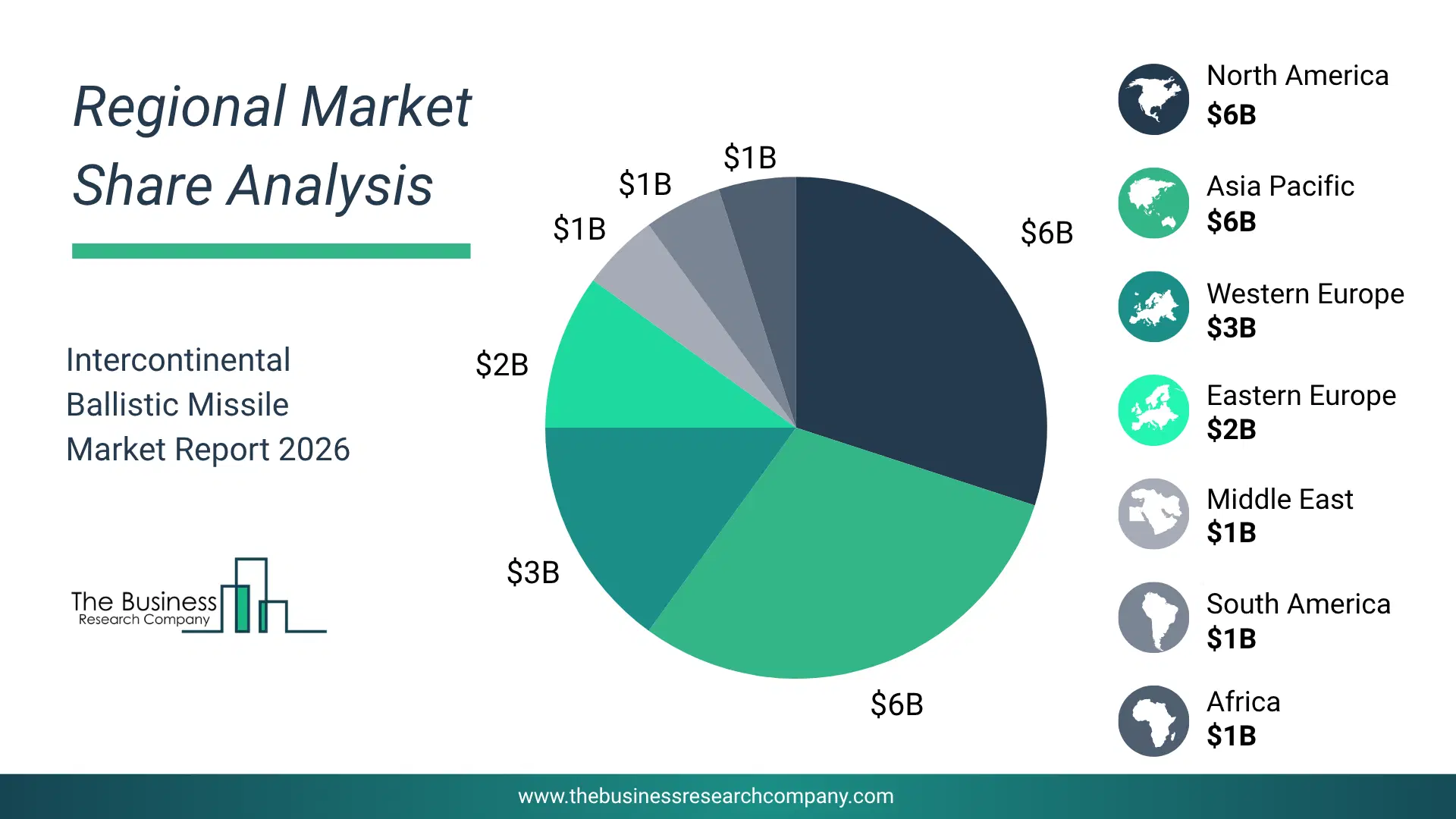
Regional Insights
North America was the largest region in the intercontinental ballistic missile market in 2025. Asia-Pacific is expected to be the fastest-growing region in the forecast period. The regions covered in this market report are Asia-Pacific, South East Asia, Western Europe, Eastern Europe, North America, South America, Middle East, Africa. The countries covered in this market report are Australia, Brazil, China, France, Germany, India, Indonesia, Japan, Taiwan, Russia, South Korea, UK, USA, Canada, Italy, SpainWhat Defines the Intercontinental Ballistic Missile Market?
The intercontinental ballistic missile market consists of sales of missile launch systems, guidance systems, propulsion systems, reentry vehicles, warheads, command and control systems, and fuzes and arming mechanisms. Values in this market are factory gate values, that is, the value of goods sold by the manufacturers or creators of the goods, whether to other entities (including downstream manufacturers, wholesalers, distributors, and retailers) or directly to end customers.How is Market Value Defined and Measured?
The market value is defined as the revenues that enterprises gain from the sale of goods and/or services within the specified market and geography through sales, grants, or donations in terms of the currency (in USD unless otherwise specified). The revenues for a specified geography are consumption values that are revenues generated by organizations in the specified geography within the market, irrespective of where they are produced. It does not include revenues from resales along the supply chain, either further along the supply chain or as part of other products.
This chart presents market attractiveness based on a quantitative evaluation of growth, competition, strategic alignment, and risk, offering a clear view of opportunity areas for decision-making. This chart is for illustrative purposes; the full report contains the complete analysis.

This chart highlights the Total Addressable Market (TAM) by estimating the maximum revenue opportunity using an assumption-driven approach, supporting strategic planning and opportunity sizing across markets. The chart is illustrative; the full report provides a more comprehensive analysis.
What Key Data and Analysis Are Included in the Intercontinental Ballistic Missile Market Report 2026?
The intercontinental ballistic missile market research report is one of a series of new reports from The Business Research Company that provides market statistics, including industry global market size, regional shares, competitors with the market share, detailed market segments, market trends and opportunities, and any further data you may need to thrive in the intercontinental ballistic missile industry. The market research report delivers a complete perspective of everything you need, with an in-depth analysis of the current and future state of the industry.Intercontinental Ballistic Missile Market Report Forecast Analysis
| Report Attribute | Details |
|---|---|
| Market Size Value In 2026 | $12.78 billion |
| Revenue Forecast In 2030 | $16.49 billion |
| Growth Rate | CAGR of 6.6% from 2026 to 2030 |
| Base Year For Estimation | 2025 |
| Actual Estimates/Historical Data | 2020-2025 |
| Forecast Period | 2026 - 2030 |
| Market Representation | Revenue in USD Billion and CAGR from 2026 to 2030 |
| Segments Covered | Type, Propulsion Type, Payload, Application |
| Regional Scope | Asia-Pacific, Western Europe, Eastern Europe, North America, South America, Middle East, Africa |
| Country Scope | The countries covered in the report are Australia, Brazil, China, France, Germany, India, ... |
| Key Companies Profiled | Lockheed Martin Corporation, The Boeing Company, Raytheon Technologies Inc., China Aerospace Science and Technology Corporation (CASC), L3Harris Technologies Inc., Northrop Grumman Corporation, ArianeGroup, Israel Aerospace Industries, General Dynamics Corporation, Bharat Dynamics Limited (BDL), NPO Mashinostroyeniya, Moscow Institute of Thermal Technology (MITT), Roscosmos State Corporation, China Academy of Space Technology (CAST), State Rocket Center Makeyev (Makeyev Rocket Design Bureau) |
| Customization Scope | Request for Customization |
| Pricing And Purchase Options | Explore Purchase Options |