
Internal Neuromodulation Devices Market 2026
By Type (Spinal Cord Stimulator, Deep Brain Stimulator, Sacral Nerve Stimulator, Vagus Nerve Stimulator, Gastric Neuro Stimulator), By Biomaterial (Metallic Biomaterials, Polymeric Biomaterials, Ceramic Biomaterials), By Application (Failed Back Surgery Syndrome, Parkinson's Disease, Urinary Incontinence, Epilepsy, Gastroparesis), By End-User (Into Hospitals, Clinics, Home Healthcare, Community Healthcare), And By Region, Opportunities And Strategies – Global Forecast To 2035
Internal Neuromodulation Devices Market Definition
Internal neuromodulation devices are implantable medical devices designed to deliver targeted electrical or chemical stimulation to specific nerves, spinal pathways, or brain regions, thereby modulating abnormal neural activity. These devices are placed inside the body to treat chronic pain, movement disorders, epilepsy, and other neurological or physiological conditions. The primary purpose of internal neuromodulation devices is to restore or regulate neural function in patients with conditions that do not respond adequately to conventional therapies. The internal neuromodulation devices market consists of sales, by entities (organizations, sole traders, or partnerships), of implantable medical devices such as electrodes, leads, and receivers that deliver targeted electrical stimulation to specific areas of the nervous system.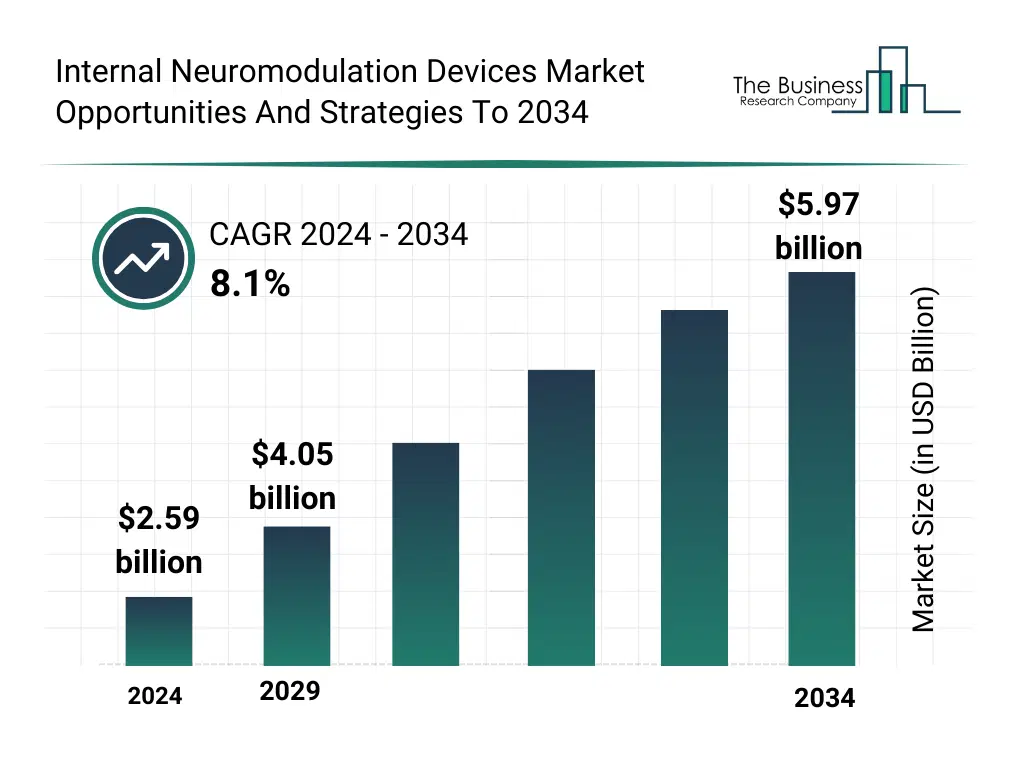
Internal Neuromodulation Devices Market Size
The global internal neuromodulation devices market reached a value of nearly $2,594.6 million in 2024, having grown at a compound annual growth rate (CAGR) of 6.3% since 2019. The market is expected to grow from $2,594.6 million in 2024 to $4,046.6 million in 2029 at a rate of 9.3%. The market is then expected to grow at a CAGR of 8.1% from 2029 and reach $5,966.7 million in 2034 Growth in the historic period resulted from rising prevalence of chronic pain disorders, growing incidence of neurological and psychiatric indications, rising preference for minimally invasive and non-pharmacological therapies and rising use of ambulatory neuromodulation screening trials. Factors that negatively affected growth in the historic period were high procedure and implantation costs and surgical risks and post-operative complications. Going forward, integration of digital health and remote monitoring, increasing investments by medical device companies, rising deployment in early-stage parkinson’s and movement disorders and rising government support for neurological health programs will drive the growth. Factor that could hinder the growth of the internal neuromodulation devices market in the future include stringent regulatory approval requirements, shortage of skilled specialists and impact of trade war and tariff.Internal Neuromodulation Devices Market Drivers
The key drivers of the internal neuromodulation devices market include: Integration Of Digital Health And Remote Monitoring Integration of digital health and remote monitoring are accelerating the adoption of internal neuromodulation devices as a cost-effective and sustainable energy source. Digital ecosystems allow clinicians to remotely track device performance, stimulation effectiveness, patient symptom changes, and biomarker trends, enabling more responsive and personalized therapy adjustments. This reduces the burden of in-person follow-ups and expands access for patients in remote or underserved regions, making neuromodulation therapy more scalable across healthcare systems. Remote device management also improves long-term adherence, as stimulation adjustments can be made proactively based on real-time data rather than waiting for clinical deterioration. Additionally, digital platforms increase the value proposition for providers and payers by enabling better outcomes tracking, reducing complications from poorly optimized programming, and supporting evidence-driven therapy pathways. The integration of digital health and remote monitoring growth contribution during the forecast period in 2024 is 1.8%.Internal Neuromodulation Devices Market Restraints
The key restraints on the internal neuromodulation devices market include: High Stringent Regulatory Approval Requirements The stringent regulatory approval requirements a significant barrier to market expansion. Establishing and maintaining internal neuromodulation devices plants requires substantial investment in infrastructure, including anaerobic digesters, gas upgrading systems, and storage facilities. Growth affected by stringent regulatory approval requirements during the forecast period in 2024 is -2.0%.Internal Neuromodulation Devices Market Trends
Major trends shaping the internal neuromodulation devices market include: Focus On MRI-Compatible VNS Platforms For Epilepsy And New Indications Major companies in the internal neuromodulation devices market are increasingly emphasizing the development and regulatory introduction of implantable Vagus Nerve Stimulation System (VNS) platforms that are MRI (magnetic resonance imaging)-compatible and cleared for newer therapeutic indications beyond classic epilepsy or depression. This trend aims to make VNS therapy more patient-friendly, by enabling safe access to MRI imaging when needed, and by expanding the use of VNS for chronic neurological or inflammatory diseases. For example, in August 2025, SetPoint Medical, a US-based company develops bioelectronic therapies, newly developed implantable VNS device, SetPoint System, was approved by the US Food and Drug Administration (FDA) for use in adults with moderate-to-severe Rheumatoid Arthritis (RA) who had failed conventional therapies. This represents a meaningful expansion of clinical use for VNS beyond neurological disorders. This shows how VNS technology is evolving, not just on the hardware front (implantable, MRI-compatible), but also in therapeutic positioning, aligning neuromodulation with chronic disease management beyond neurology. Development Of Fully Implantable, Wireless SNM Systems For Incontinence Therapy Companies in the internal neuromodulation devices market are shifting toward fully implantable and wireless sacral nerve modulation (SNM) systems, designed to treat urinary incontinence, overactive bladder (OAB), and related pelvic floor disorders, in a way that eliminates the need for bulky implanted batteries or frequent surgical replacements. These innovations aim to improve patient comfort, reduce complication risks (battery pocket issues or generator-related infections), simplify implantation, and make the therapy more acceptable and convenient, especially for long-term use. In June 2025, Neuspera Medical, a US-based company developing minimally invasive, implantable medical device, received FDA (food and drug administration) approval for its miniaturized, wireless, battery-free iSNM (integrated sacral neuromodulation) system for urinary urge incontinence. The implant pairs with an external charging disc, eliminating bulk and battery-related complications while maintaining clinical outcomes comparable to conventional SNM devices. By reducing invasiveness and long-term maintenance burdens, this next-generation design advances the shift toward fully implantable, patient-friendly wireless SNM therapy.Opportunities And Recommendations In The Internal Neuromodulation Devices Market
Opportunities – The top opportunities in the internal neuromodulation devices market segmented by type will arise in the spinal cord stimulator segment, which will gain $541.8 million of global annual sales by 2029. The top opportunities in the internal neuromodulation devices market segmented by biomaterials will arise in the metallic biomaterials segment, which will gain $736.0 million of global annual sales by 2029. The top opportunities in the internal neuromodulation devices market segmented by application will arise in the failed back surgery syndrome segment, which will gain $549.6 million of global annual sales by 2029. The top opportunities in the internal neuromodulation devices market segmented by end user will arise in the hospitals segment, which will gain $885.8 million of global annual sales by 2029. The internal neuromodulation devices market size will gain the most in the USA at $265.3 million. Recommendations- To take advantage of the opportunities, The Business Research Company recommends the internal neuromodulation devices companies to focus on MRI-compatible VNS platforms and indication expansion, focus on fully implantable and wireless SNM systems, focus on closed-loop and AI-enabled implantable systems, focus on directional lead integration in DBS systems, focus on MRI-conditional gastric neurostimulation for refractory gastroparesis, focus on deep brain stimulation expansion, focus on polymeric biomaterials adoption, expand in emerging markets, continue to focus on developed markets, focus on value-based and segmented pricing discipline, focus on evidence-led clinical promotion, focus on segmented and compliant market outreach, focus on parkinson’s disease neuromodulation, focus on home healthcare neuromodulation delivery.
Internal Neuromodulation Devices Market Segmentation
The internal neuromodulation devices market is segmented by technology type, by biomaterial, by application, and by end-user.By Technology Type–
The internal neuromodulation devices market is segmented by technology type into:
- a) Spinal Cord Stimulator
- b) Deep Brain Stimulator
- b) Sacral Brain Stimulator
- b) Vagus Brain Stimulator
- b) Gastric Neuro Stimulator
By Biomateria –
The internal neuromodulation devices market is segmented by biomaterial into:
- a) Metallic Biomaterials
- b) Polymeric Biomaterials
- c) Ceramic Biomaterials
By Application–
The internal neuromodulation devices market is segmented by application into:
- a) Failed Back Surgery Syndrome
- b) Parkinson's Disease
- c) Urinary Incontinence
- c) Epilepsy
- c) Gastroparesis
By End-User–
The internal neuromodulation devices market is segmented by end-user into:
- a) Hospitals
- b) Clinics
- c) Home Healthcare
- c) Community Healthcare
By Geography - The internal neuromodulation devices market is segmented by geography into:
- • China
- • India
- • Japan
- • Australia
- • Indonesia
- • South Korea
- • USA
- • Canada
- • Brazil
- • France
- • Germany
- • UK
- • Italy
- • Spain
- • Russia
-
o Asia Pacific
o Africa