
Internet Of Nano Things Market Report 2026
Global Outlook – By Product (Nano Phones, Nano Cameras, Nano Processors, Nanosensors, Nano Power System, Nano Memory Cards, Nano Antennas And Receivers, Other Products), By Network Architecture (Nano-Nodes, Nano-Routers, Nano-Micro Interface Devices, Gateway), By Communication Type (Short Distance, Long Distance), By End User (Healthcare, Logistics, Defense And Aerospace, Manufacturing, Energy And Power, Retail, Other End Users) – Market Size, Trends, Strategies, and Forecast to 2030
Internet Of Nano Things Market Overview
• Internet Of Nano Things market size has reached to $28.04 billion in 2025 • Expected to grow to $81.84 billion in 2030 at a compound annual growth rate (CAGR) of 23.9% • Growth Driver: iot Adoption Propelling The Internet Of Nano Things Market • Market Trend: Expansion Of IoT Coverage Through 5G NB-IoT Satellite Connectivity Transforming Remote Communication And Applications • North America was the largest region in 2025.What Is Covered Under Internet Of Nano Things Market?
The Internet of Nano Things (IoNT) refers to a network of interconnected nanoscale devices, sensors, and machines that are connected to the Internet and communicate with each other to perform various tasks. The devices and sensors in IoNT are typically very small, often with dimensions of less than 100 nanometers, and can be embedded into everyday objects and materials. The main types of internet of nano things are nano phones, nano cameras, nano processors, nano sensors, nano power systems, nano memory cards, nanoantenna’s and receivers, and other products. A nano phone is a mobile phone that uses a nano SIM that is smaller in size than a conventional (2FF) cell phone SIM card or micro-SIM (3FF) card. They are developed using network architectures such as nano-nodes, nano-routers, nano-micro-interface devices, and gateways with communication technologies including short- and long-distance. They are used by healthcare, logistics, defense and aerospace, manufacturing, energy and power, retail, and other end users.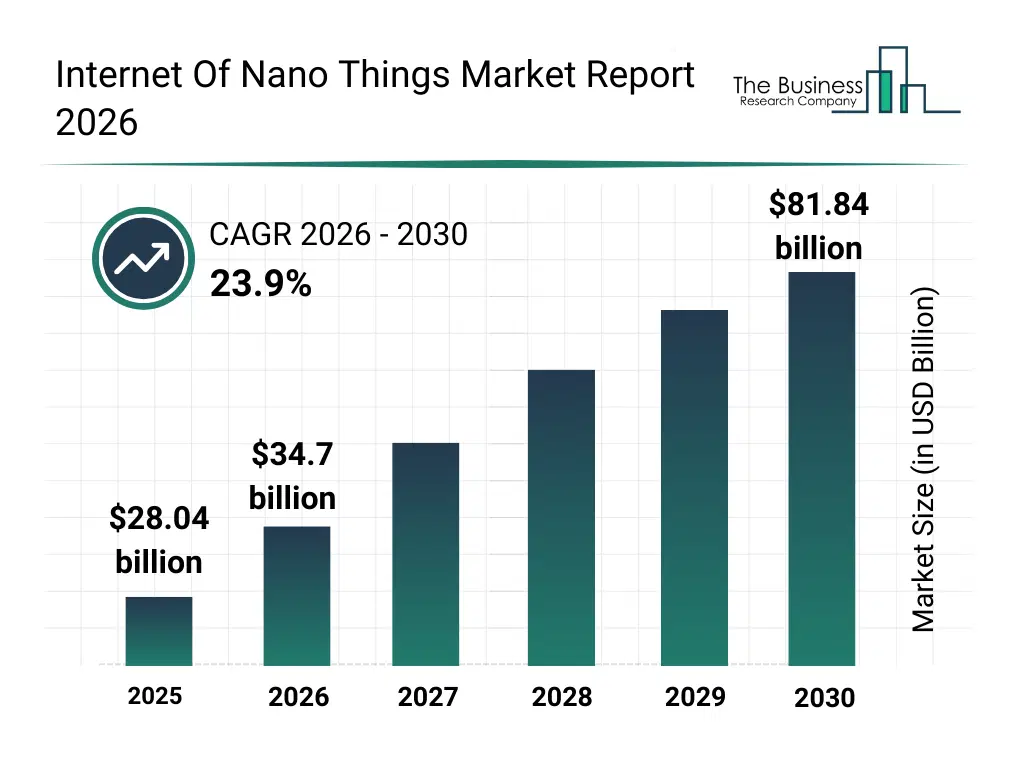
What Is The Internet Of Nano Things Market Size and Share 2026?
The internet of nano things market size has grown exponentially in recent years. It will grow from $28.04 billion in 2025 to $34.7 billion in 2026 at a compound annual growth rate (CAGR) of 23.7%. The growth in the historic period can be attributed to advancements in nanotechnology research, early adoption of nanosensors in healthcare, government funding for nano research, growth of precision medicine, increasing demand for miniaturized devices.What Is The Internet Of Nano Things Market Growth Forecast?
The internet of nano things market size is expected to see exponential growth in the next few years. It will grow to $81.84 billion in 2030 at a compound annual growth rate (CAGR) of 23.9%. The growth in the forecast period can be attributed to integration of nanotechnology with iot platforms, rising demand for real time health monitoring, expansion of nano enabled industrial automation, increased defense and aerospace applications, advancements in nano power systems. Major trends in the forecast period include nano sensor networks, biomedical nano devices, nano communication systems, energy efficient nano devices, nano scale data processing.
Global Internet Of Nano Things Market Segmentation
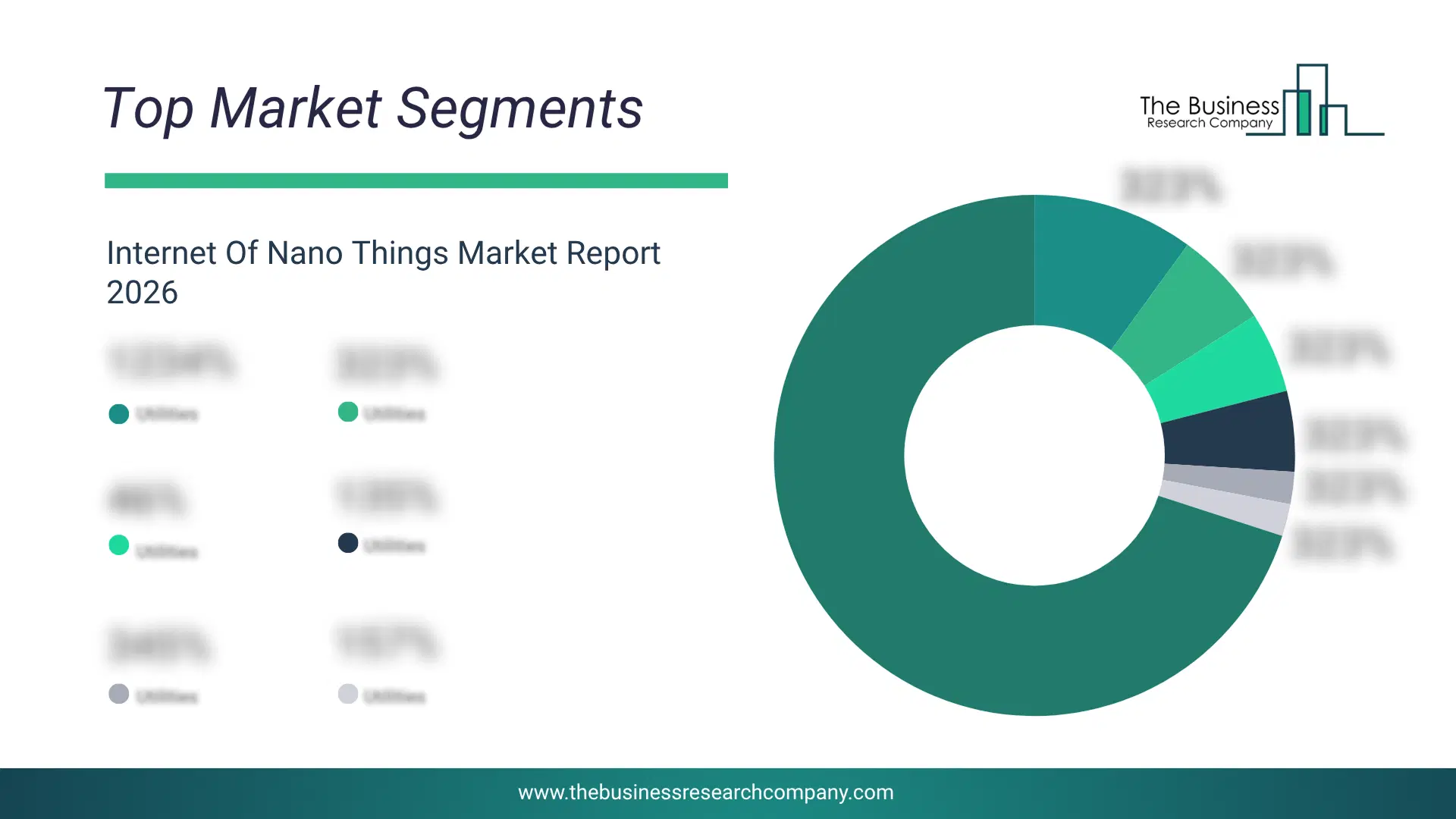
1) By Product: Nano Phones, Nano Cameras, Nano Processors, Nanosensors, Nano Power System, Nano Memory Cards, Nano Antennas And Receivers, Other Products 2) By Network Architecture: Nano-Nodes, Nano-Routers, Nano-Micro Interface Devices, Gateway 3) By Communication Type: Short Distance, Long Distance 4) By End User: Healthcare, Logistics, Defense And Aerospace, Manufacturing, Energy And Power, Retail, Other End Users Subsegments: 1) By Nano Phones: Smart Nano Phones, Basic Nano Phones 2) By Nano Cameras: High-Resolution Nano Cameras, Low-Light Nano Cameras 3) By Nano Processors: Low-Power Nano Processors, High-Performance Nano Processors 4) By Nanosensors: Chemical Nanosensors, Biological Nanosensors, Physical Nanosensors 5) By Nano Power System: Nano Energy Harvesters, Nano Batteries 6) By Nano Memory Cards: Nano SD Cards, Nano MicroSD Cards 7) By Nano Antennas And Receivers: Nano Antennas, Nano Receivers 8) By Other Products: Nano Actuators, Nano DronesWhat Is The Driver Of The Internet Of Nano Things Market?
Increasing adoption of IoT is expected to propel the growth of the internet of nano things market going forward. The Internet of Things (IoT) refers to a network of interconnected physical devices, vehicles, appliances, and other objects embedded with sensors, software, and connectivity, enabling them to collect and exchange data. The adoption and expansion of IoT infrastructure and principles can significantly augment the capabilities and potential applications of the internet of nano things, facilitating the development of more sophisticated and precise systems operating at the nanoscale. For instance, in March 2023, according to Exploding Topics, a US-based online platform that provides insights into emerging and trending topics, by 2030, it is anticipated that there will be 25.4 billion IoT devices. Therefore, increasing adoption of IoT drives the internet of nano things industry.Key Players In The Global Internet Of Nano Things Market
Major companies operating in the internet of nano things market are Cisco Systems Inc.; IBM Corporation; Siemens AG; Intel Corporation; Qualcomm Technologies Inc.; Juniper Networks Inc.; Nokia Corporation; Robert Bosch GmbH; Bruker Corporation; Agilent Technologies Inc.; Infineon Technologies AG; Huawei Technologies Co Ltd; Alcatel-Lucent SA; Texas Instruments Inc.; Analog Devices Inc.; STMicroelectronics N.V.; NXP Semiconductors N.V.; TE Connectivity Ltd.; Broadcom Inc.; Renesas Electronics Corporation; Atmel Corporation; Cypress Semiconductor Corporation; Microchip Technology Inc.; Maxim Integrated Products Inc.; ON Semiconductor Corporation; ARM Holdings plc; Marvell Technology Group Ltd.; MediaTek Inc.; Murata Manufacturing Co Ltd; TDK Corporation; Fujitsu Limited; Toshiba Corporation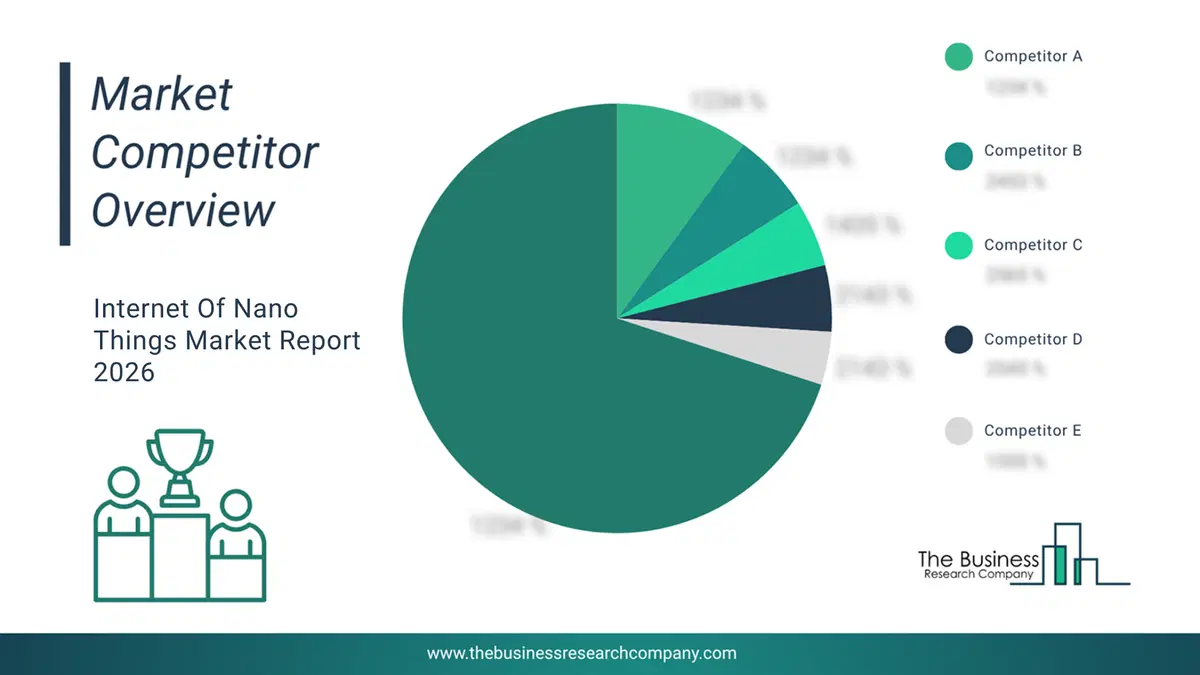
This chart is for illustrative purposes; the full report includes a detailed competitor analysis and comprehensive overview of the top 10 companies in the market.
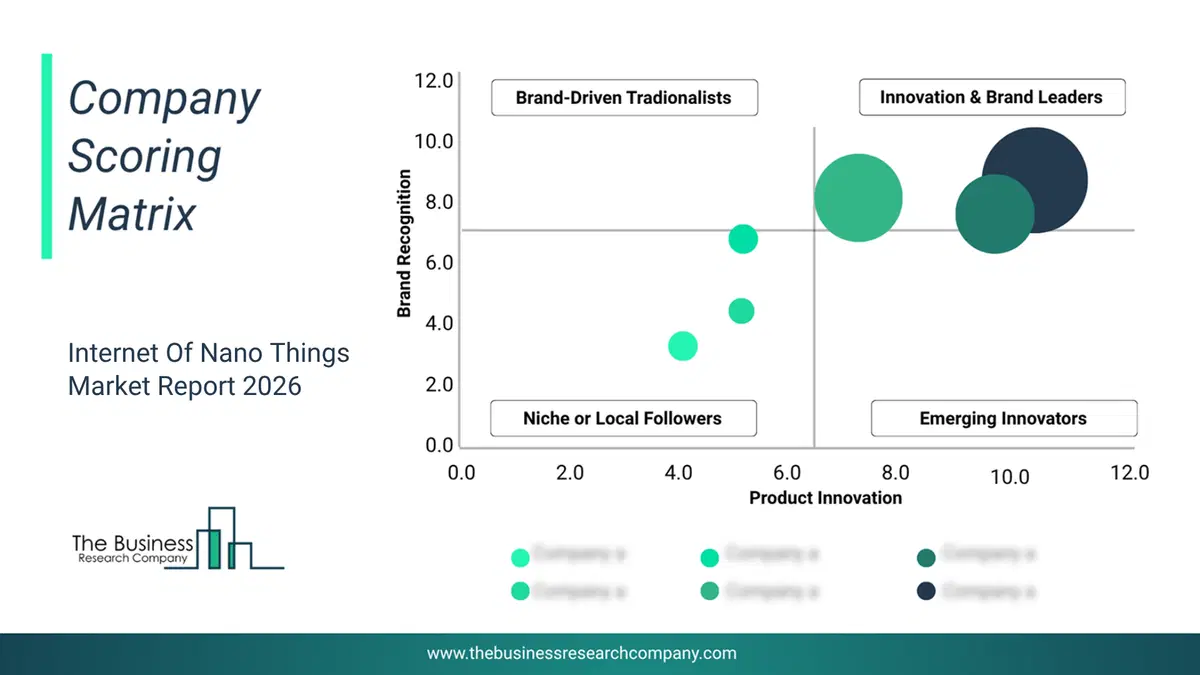
This chart maps companies by product innovation and brand strength, with bubble size indicating relative revenue, helping identify market leaders, challengers, and niche players. This is an illustrative chart; the full report provides a complete and accurate competitive analysis.
Global Internet Of Nano Things Market Trends and Insights
Major companies operating in the internet of things market are developing 5G NB-IoT satellite connectivity to expand IoT coverage in remote and rural areas, enabling seamless, low-power, and wide-area network communication for connected devices. 5G NB-IoT satellite connectivity enhances the Internet of Things (IoT) by extending coverage to remote areas, enabling efficient low-power communication for reliable long-distance data transmission, and supporting diverse applications such as asset tracking and environmental monitoring, thus significantly broadening the impact of IoT solutions. For instance, in August 2024, Sateliot, a Spain-based satellite telecommunications company, launched new satellites that offer global IoT connectivity, connecting over eight million devices in sectors such as agriculture and logistics. These satellites feature advancements from previous models and utilize patented store-and-forward technology, fully adopting GSMA and 3GPP standards. Their significance in the internet of things market is in ensuring 100% planet coverage, positioning Sateliot to transform the IoT landscape and promote widespread adoption of IoT solutions across industries.What Are Latest Mergers And Acquisitions In The Internet Of Nano Things Market?
In January 2023, Semtech Corporation, a US-based semiconductor company that designs and manufactures analog and mixed-signal semiconductors, including components for the Internet of Things (IoT), acquired Sierra Wireless Inc. for $1.2 billion. Through this acquisition, Semtech aims to combine the low-power benefits of LoRa with the high-bandwidth capabilities of cellular technology to create a new leader in cloud-to-chip systems for the Internet of Things (IoT). The goal is to establish a stronger presence in the IoT market. Sierra Wireless, Inc. is a Canada-based provider of Internet of Nano Things (IoNT) solutions, including cellular modules, gateways, routers, and cloud services.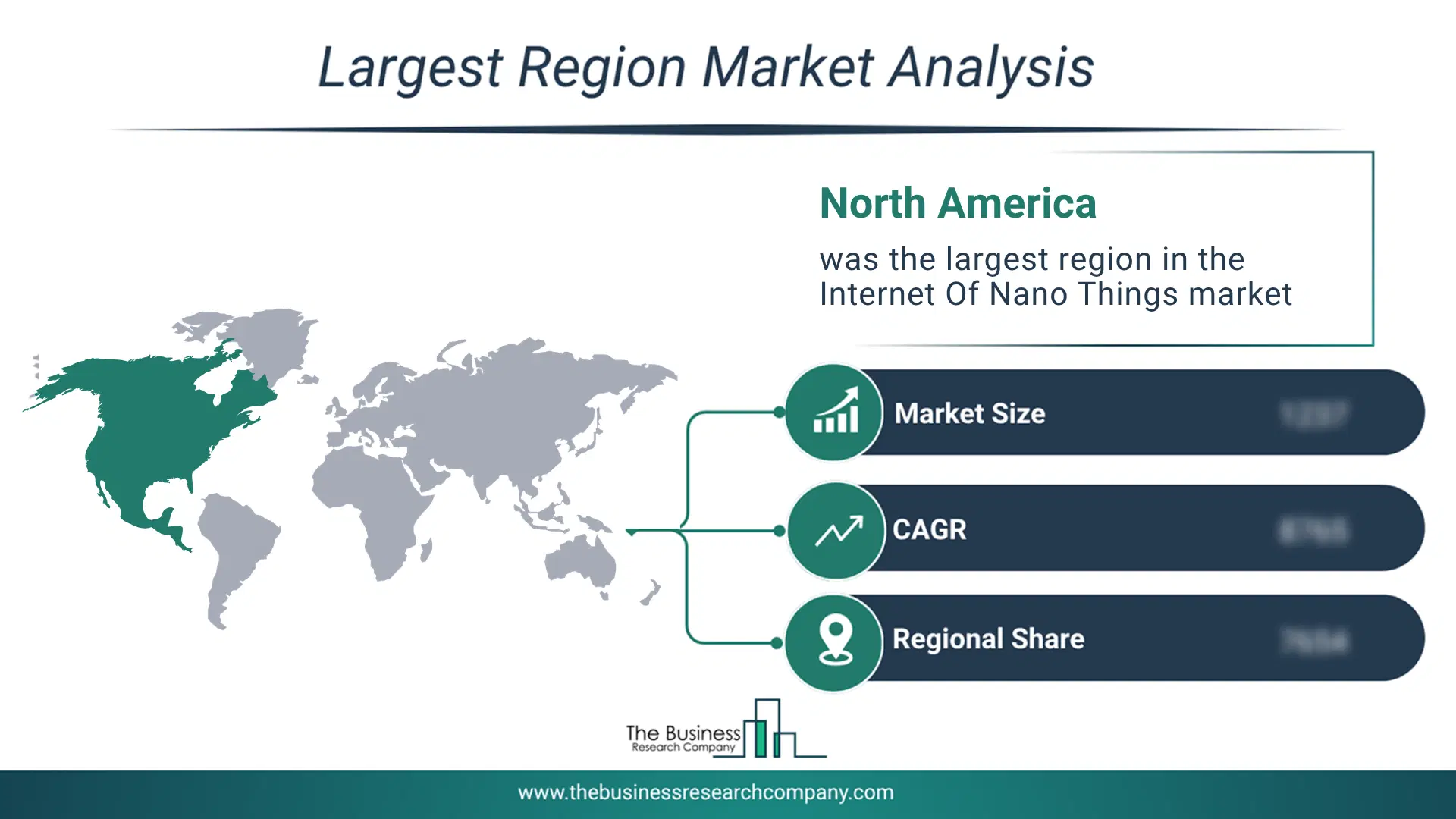
Regional Insights
North America was the largest region in the internet of nano things market in 2025. Asia-Pacific is expected to be the fastest-growing region in the global internet of nano things market during the forecast period. The regions covered in this market report are Asia-Pacific, South East Asia, Western Europe, Eastern Europe, North America, South America, Middle East, Africa. The countries covered in this market report are Australia, Brazil, China, France, Germany, India, Indonesia, Japan, Taiwan, Russia, South Korea, UK, USA, Canada, Italy, SpainWhat Defines the Internet Of Nano Things Market?
The internet of nano things market consists of revenues earned by entities by providing services such as caching, data delivery, and energy consumption. The market value includes the value of related goods sold by the service provider or included within the service offering. The Internet of Nano Things market also includes sales of nano robots, nanopore sequencing systems, and nanostructured materials which are used in providing Internet of Nano Things services. Values in this market are ‘factory gate’ values, that is the value of goods sold by the manufacturers or creators of the goods, whether to other entities (including downstream manufacturers, wholesalers, distributors and retailers) or directly to end customers. The value of goods in this market includes related services sold by the creators of the goods.How is Market Value Defined and Measured?
The market value is defined as the revenues that enterprises gain from the sale of goods and/or services within the specified market and geography through sales, grants, or donations in terms of the currency (in USD unless otherwise specified). The revenues for a specified geography are consumption values that are revenues generated by organizations in the specified geography within the market, irrespective of where they are produced. It does not include revenues from resales along the supply chain, either further along the supply chain or as part of other products.
This chart presents market attractiveness based on a quantitative evaluation of growth, competition, strategic alignment, and risk, offering a clear view of opportunity areas for decision-making. This chart is for illustrative purposes; the full report contains the complete analysis.

This chart highlights the Total Addressable Market (TAM) by estimating the maximum revenue opportunity using an assumption-driven approach, supporting strategic planning and opportunity sizing across markets. The chart is illustrative; the full report provides a more comprehensive analysis.
What Key Data and Analysis Are Included in the Internet Of Nano Things Market Report 2026?
The internet of nano things market research report is one of a series of new reports from The Business Research Company that provides market statistics, including industry global market size, regional shares, competitors with the market share, detailed market segments, market trends and opportunities, and any further data you may need to thrive in the internet of nano things industry. The market research report delivers a complete perspective of everything you need, with an in-depth analysis of the current and future state of the industry.Internet Of Nano Things Market Report Forecast Analysis
| Report Attribute | Details |
|---|---|
| Market Size Value In 2026 | $34.7 billion |
| Revenue Forecast In 2030 | $81.84 billion |
| Growth Rate | CAGR of 23.9% from 2026 to 2030 |
| Base Year For Estimation | 2025 |
| Actual Estimates/Historical Data | 2020-2025 |
| Forecast Period | 2026 - 2030 |
| Market Representation | Revenue in USD Billion and CAGR from 2026 to 2030 |
| Segments Covered | Product, Network Architecture, Communication Type, End User |
| Regional Scope | Asia-Pacific, Western Europe, Eastern Europe, North America, South America, Middle East, Africa |
| Country Scope | The Countries Covered In This Market Report Are Australia, Brazil, China, France, Germany, India, Indonesia, Japan, Taiwan, Russia, South Korea, Uk, Usa, Canada, Italy, Spain. |
| Key Companies Profiled | Cisco Systems Inc., IBM Corporation, Siemens AG, Intel Corporation, Qualcomm Technologies Inc., Juniper Networks Inc., Nokia Corporation, Robert Bosch GmbH, Bruker Corporation, Agilent Technologies Inc., Infineon Technologies AG, Huawei Technologies Co Ltd, Alcatel-Lucent SA, Texas Instruments Inc., Analog Devices Inc., STMicroelectronics N.V., NXP Semiconductors N.V., TE Connectivity Ltd., Broadcom Inc., Renesas Electronics Corporation, Atmel Corporation, Cypress Semiconductor Corporation, Microchip Technology Inc., Maxim Integrated Products Inc., ON Semiconductor Corporation, ARM Holdings plc, Marvell Technology Group Ltd., MediaTek Inc., Murata Manufacturing Co Ltd, TDK Corporation, Fujitsu Limited, Toshiba Corporation |
| Customization Scope | Request for Customization |
| Pricing And Purchase Options | Explore Purchase Options |