
Internet Of Things (IoT) Connectivity Policy Control Market Report 2026
Global Outlook – By Component (Software, Hardware, Services), By Connectivity Type (Cellular, Wi-Fi, Low-Power Wide-Area Network (LPWAN), Satellite), By Deployment Mode (On-Premises, Cloud), By Application (Smart Cities, Industrial Internet Of Things (IoT), Healthcare, Automotive, Energy And Utilities), By End-User (Enterprises, Telecom Operators, Government) – Market Size, Trends, Strategies, and Forecast to 2030
Internet Of Things (IoT) Connectivity Policy Control Market Overview
• Internet Of Things (IoT) Connectivity Policy Control market size has reached to $3.12 billion in 2025 • Expected to grow to $6.96 billion in 2030 at a compound annual growth rate (CAGR) of 17.5% • Growth Driver: Surge In Adoption Of The Internet Of Things Fueling The Growth Of The Market Due To Enhanced Connectivity, Automation, And Secure Device Management • Market Trend: Advancements In IoT Connectivity Policy Control Strengthen Device Governance And Network Security • North America was the largest region in 2025 and Asia-Pacific is the fastest growing region.What Is Covered Under Internet Of Things (IoT) Connectivity Policy Control Market?
Internet of things (IoT) connectivity policy control is a technology framework that manages, monitors, and governs how internet of things (IoT) devices connect and communicate across networks. It enables centralized control over device authentication, access permissions, bandwidth usage, and data routing based on predefined policies. It helps to ensure secure, reliable, and efficient connectivity for large-scale internet of things (IoT) deployments while optimizing network performance and operational costs. The main components of Internet of Things connectivity policy control include software, hardware, and services. Software refers to platforms that enable enterprises to manage, monitor, and enforce connectivity policies for Internet of Things devices, ensuring secure and efficient network usage. These solutions support connectivity types such as cellular, Wi-Fi, low-power wide-area networks, and satellite connections. They can be deployed through on-premises environments or cloud-based platforms, depending on organizational requirements. The various applications involved are smart cities, industrial Internet of Things, healthcare, automotive, and energy and utilities, and they are utilized by end users such as enterprises, telecom operators, and government organizations.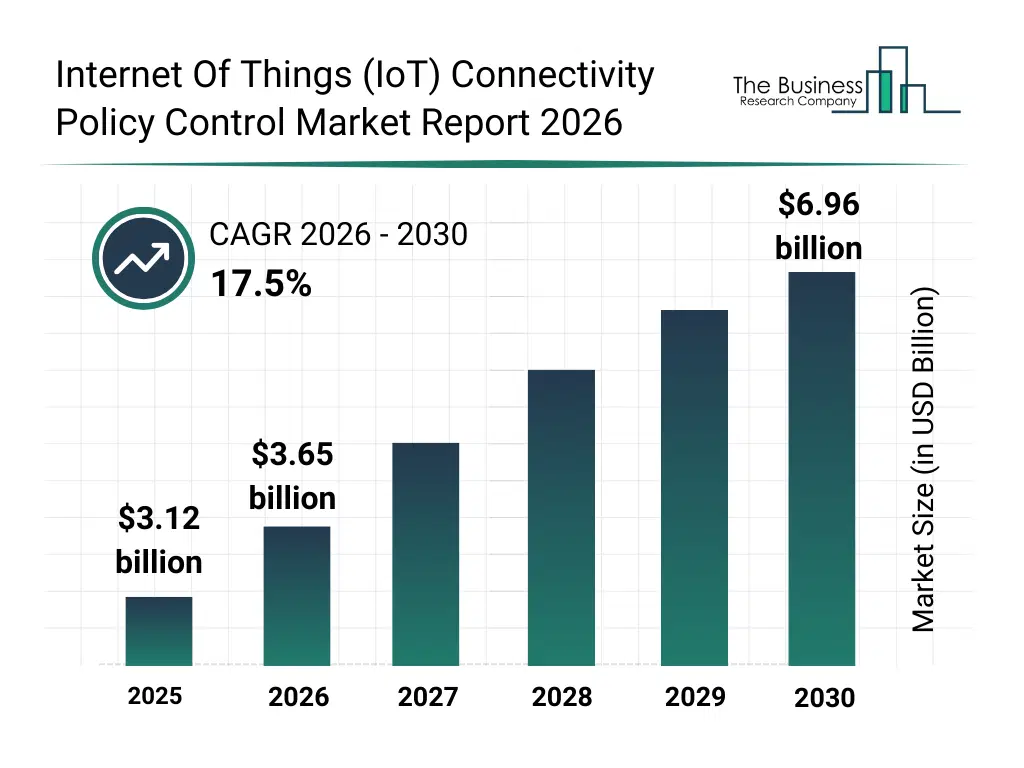
What Is The Internet Of Things (IoT) Connectivity Policy Control Market Size and Share 2026?
The internet of things (iot) connectivity policy control market size has grown rapidly in recent years. It will grow from $3.12 billion in 2025 to $3.65 billion in 2026 at a compound annual growth rate (CAGR) of 17.3%. The growth in the historic period can be attributed to increasing deployment of iot devices, rising need for secure network connectivity, adoption of cloud and edge computing solutions, demand for centralized device management, growing industrial iot initiatives.What Is The Internet Of Things (IoT) Connectivity Policy Control Market Growth Forecast?
The internet of things (iot) connectivity policy control market size is expected to see rapid growth in the next few years. It will grow to $6.96 billion in 2030 at a compound annual growth rate (CAGR) of 17.5%. The growth in the forecast period can be attributed to expansion of smart city projects, growth in industrial internet of things (iiot), increasing telecom operator investments in iot networks, adoption of ai-driven connectivity control, rising demand for integrated software-hardware iot solutions. Major trends in the forecast period include centralized iot policy enforcement, device authentication and security management, network usage monitoring and analytics, billing and subscription management, connectivity optimization and resource allocation.
Global Internet Of Things (IoT) Connectivity Policy Control Market Segmentation
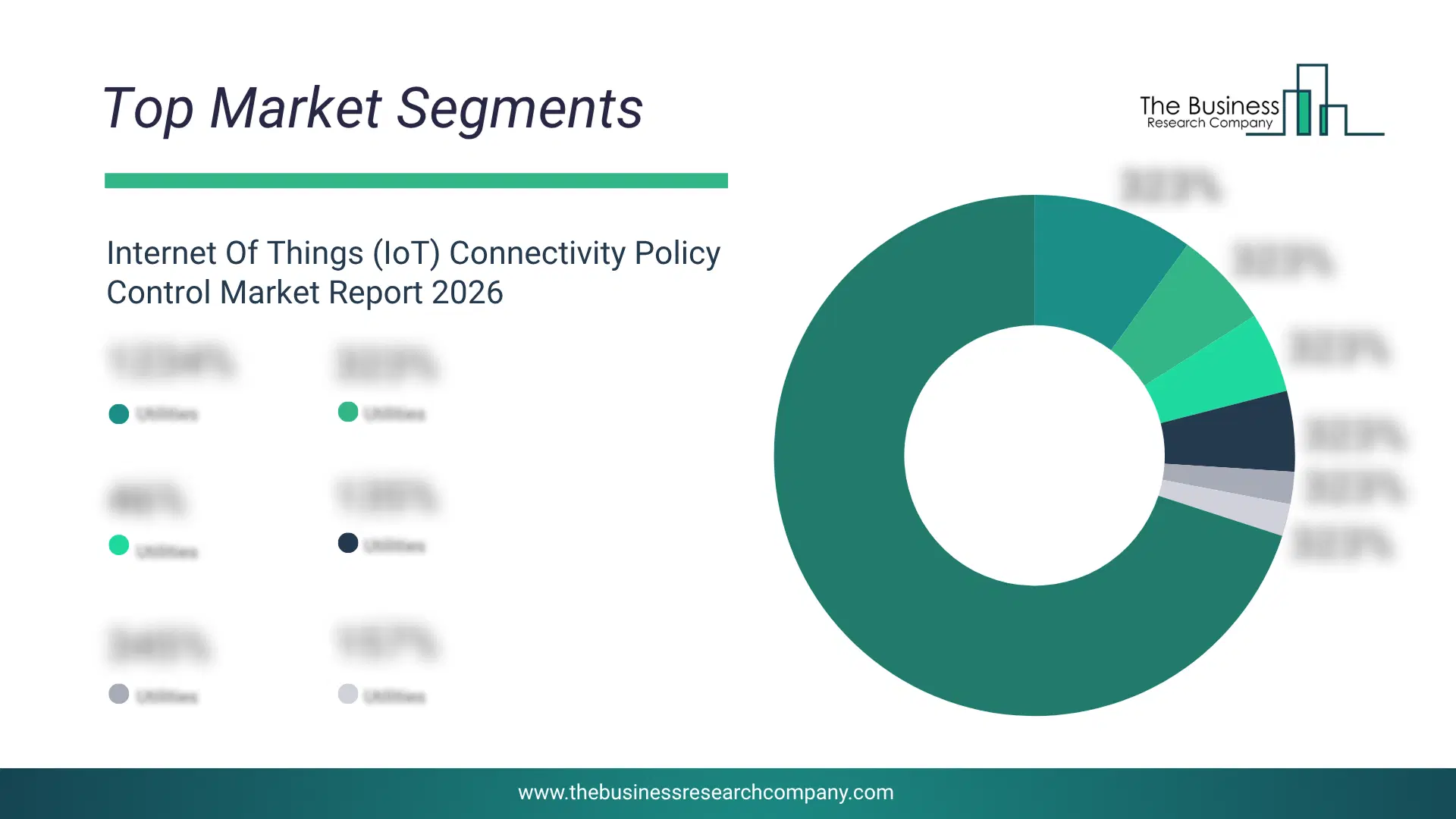
1) By Component: Software, Hardware, Services 2) By Connectivity Type: Cellular, Wi-Fi, Low-Power Wide-Area Network (LPWAN), Satellite 3) By Deployment Mode: On-Premises, Cloud 4) By Application: Smart Cities, Industrial Internet Of Things (IoT), Healthcare, Automotive, Energy And Utilities 5) By End-User: Enterprises, Telecom Operators, Government Subsegments: 1) By Software: Policy Management Software, Connectivity Control Software, Network Access Control Software, Data Usage Monitoring Software 2) By Hardware: Network Gateways, Edge Computing Devices, Connectivity Routers, Security Appliances 3) By Services: Consulting Services, Implementation Services, Managed Services, Support And Maintenance ServicesWhat Is The Driver Of The Internet Of Things (IoT) Connectivity Policy Control Market?
The increasing data traffic is expected to propel the growth of the Internet of Things (IoT) connectivity policy control market going forward. Data traffic refers to the volume of digital information transmitted across networks, including uploads, downloads, and streaming activities. The rising data traffic is largely driven by the proliferation of connected devices and bandwidth-intensive applications, as millions of IoT devices, smartphones, and smart home systems continuously generate and exchange massive amounts of data across networks. The growing volume of data traffic boosts demand for IoT connectivity policy control solutions, as they are essential for managing network resources, ensuring quality of service, and maintaining efficient data flow across increasingly congested networks. For instance, in June 2024, according to a report by Ericsson, a Sweden-based telecommunications company, from the fourth quarter of 2023 to the first quarter of 2024, mobile network data traffic experienced a quarter-on-quarter growth of approximately 6 percent. The total global mobile network data traffic for the month reached 145 exabytes (EB). Therefore, increasing data traffic is driving the growth of the Internet of Things (IoT) connectivity policy control industry.Key Players In The Global Internet Of Things (IoT) Connectivity Policy Control Market
Major companies operating in the internet of things (iot) connectivity policy control market are American Telephone and Telegraph Incorporated, Huawei Technologies Company, Limited, Cisco Systems Incorporated, Oracle Corporation, Vodafone Group Public Limited Company, Hewlett Packard Enterprise Company, Telefonaktiebolaget LM Ericsson, Nokia Corporation, Zhongxing Telecommunication Equipment Corporation, Telenor Connexion Aktiebolag, Amdocs Limited, Mavenir Systems Incorporated, Semtech Corporation, Comarch Spółka Akcyjna, Telit Cinterion, KORE Wireless Group Incorporated, 1NCE Gesellschaft mit beschränkter Haftung, Aeris Communications Incorporated, Enea Aktiebolag, and Alepo Technologies Incorporated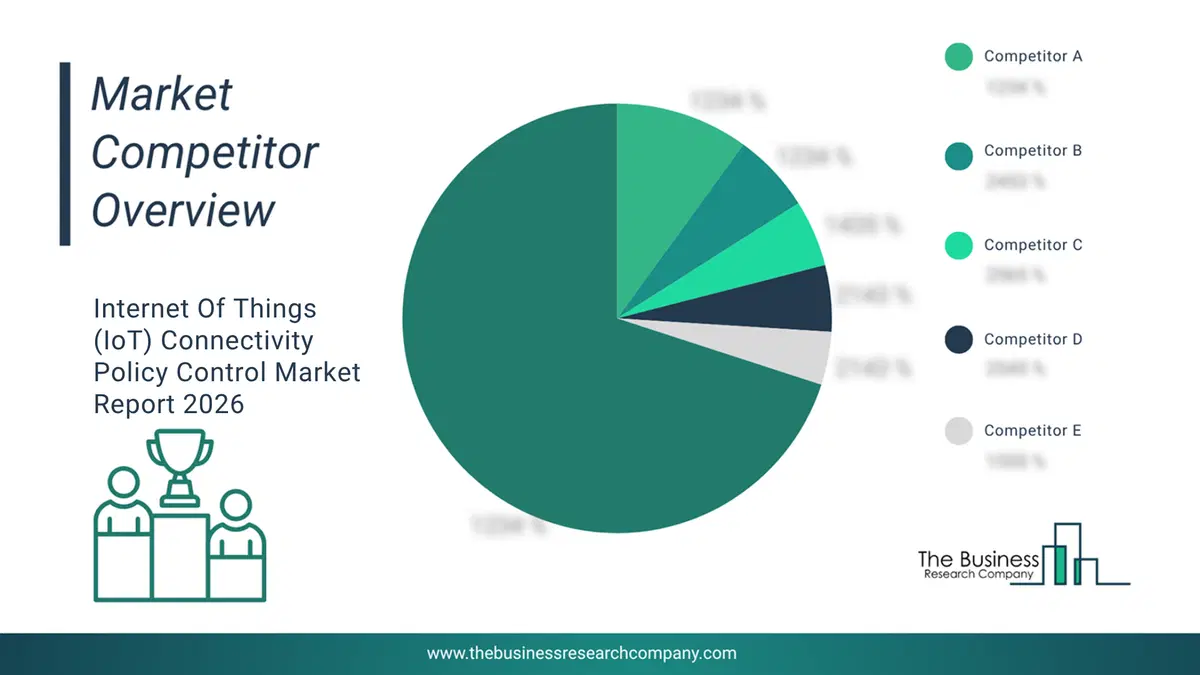
This chart is for illustrative purposes; the full report includes a detailed competitor analysis and comprehensive overview of the top 10 companies in the market.
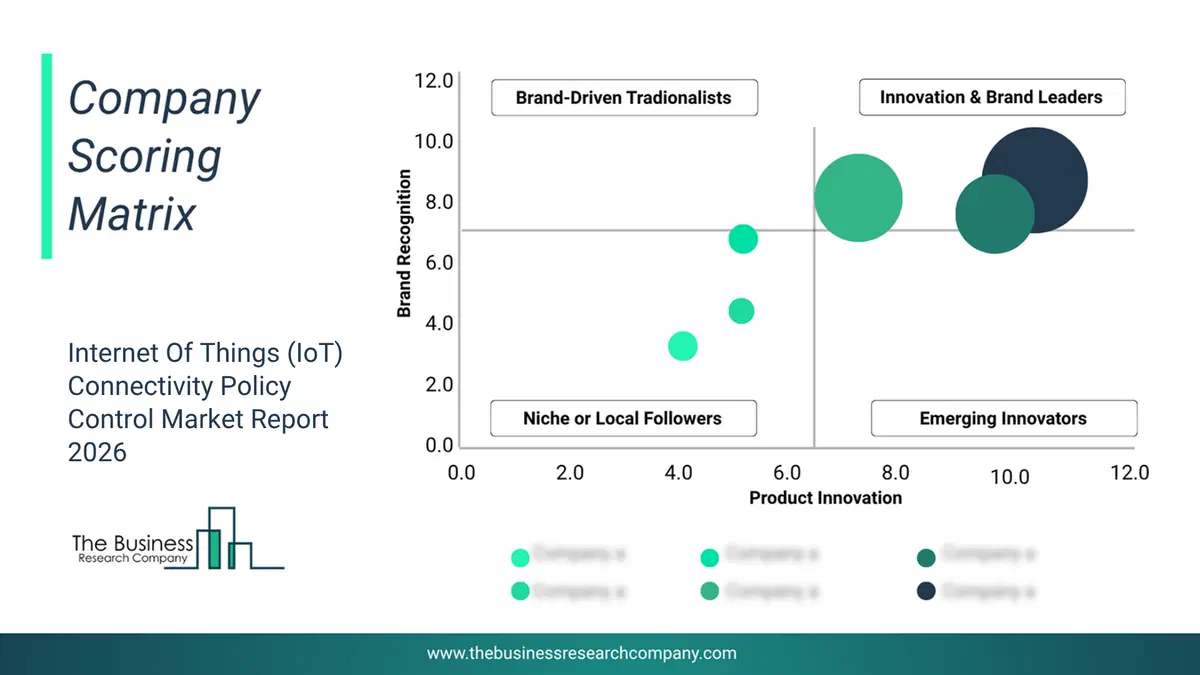
This chart maps companies by product innovation and brand strength, with bubble size indicating relative revenue, helping identify market leaders, challengers, and niche players. This is an illustrative chart; the full report provides a complete and accurate competitive analysis.
Global Internet Of Things (IoT) Connectivity Policy Control Market Trends and Insights
Major companies operating in the internet of things (IoT) connectivity policy control market are focusing on developing advanced solutions, such as automated policy enforcement, to enhance network management, improve device compliance, and streamline connectivity control across IoT ecosystems. Automated policy enforcement refers to a technological feature that enables real-time monitoring and regulation of connected devices according to predefined rules, helping prioritize critical communications and reduce security risks. For instance, in October 2025, SealSQ Corp, a Switzerland-based IoT security company, unveiled Quantum Shield QS7001 at the QAI 2025 Conference in New York. The solution integrates advanced analytics and AI-driven policy management to provide seamless device connectivity control, ensuring secure onboarding, continuous monitoring, and automated compliance reporting across diverse IoT networks. These capabilities help organizations optimize network efficiency, reduce operational risks, and strengthen overall IoT security governance.What Are Latest Mergers And Acquisitions In The Internet Of Things (IoT) Connectivity Policy Control Market?
In August 2025, Soracom, Inc., a Japan-based internet service company that provides IoT connectivity control, partnered with Intelisys to empower scalable and policy-driven IoT connectivity through seamless cellular network control. The partnership aims to expand IoT connectivity policy control by enabling advanced cellular connectivity, efficient device management, and optimized network performance for scalable IoT deployments. Intelisys is a US-based technology services distributor that enables access to IoT solutions through partner providers, including policy-driven IoT connectivity management.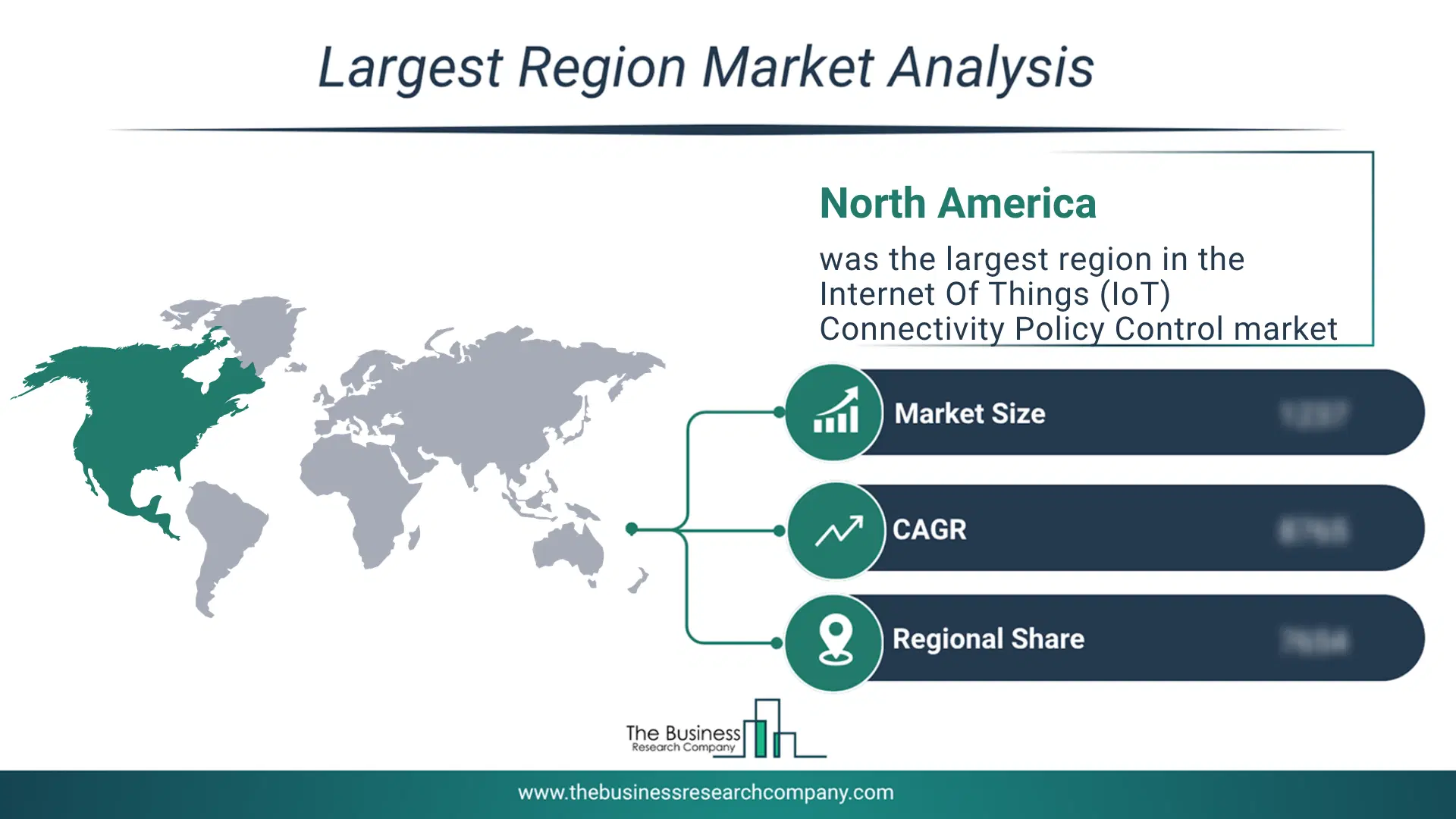
Regional Outlook
North America was the largest region in the internet of things (IoT) connectivity policy control in 2025. Asia-Pacific is expected to be the fastest-growing region in the forecast period. The regions covered in this market report are Asia-Pacific, South East Asia, Western Europe, Eastern Europe, North America, South America, Middle East, Africa. The countries covered in this market report are Australia, Brazil, China, France, Germany, India, Indonesia, Japan, Taiwan, Russia, South Korea, UK, USA, Canada, Italy, Spain.What Defines the Internet Of Things (IoT) Connectivity Policy Control Market?
The internet of things (IoT) connectivity policy control market consists of revenues earned by entities by providing services such as internet of things (IoT) connectivity management, policy enforcement and rule-based control, device authentication and security management, network usage monitoring and analytics, and billing and subscription management. The market value includes the value of related goods sold by the service provider or included within the service offering. The internet of things (IoT) connectivity policy control market also includes sales of policy control software platforms, internet of things (IoT) connectivity management platforms, network policy servers, subscriber and device management solutions, and analytics and reporting tools. Values in this market are ‘factory gate’ values, that is, the value of goods sold by the manufacturers or creators of the goods, whether to other entities (including downstream manufacturers, wholesalers, distributors, and retailers) or directly to end customers. The value of goods in this market includes related services sold by the creators of the goods.How is Market Value Defined and Measured?
The market value is defined as the revenues that enterprises gain from the sale of goods and/or services within the specified market and geography through sales, grants, or donations in terms of the currency (in USD unless otherwise specified). The revenues for a specified geography are consumption values that are revenues generated by organizations in the specified geography within the market, irrespective of where they are produced. It does not include revenues from resales along the supply chain, either further along the supply chain or as part of other products.
This chart presents market attractiveness based on a quantitative evaluation of growth, competition, strategic alignment, and risk, offering a clear view of opportunity areas for decision-making. This chart is for illustrative purposes; the full report contains the complete analysis.

This chart highlights the Total Addressable Market (TAM) by estimating the maximum revenue opportunity using an assumption-driven approach, supporting strategic planning and opportunity sizing across markets. The chart is illustrative; the full report provides a more comprehensive analysis.
What Key Data and Analysis Are Included in the Internet Of Things (IoT) Connectivity Policy Control Market Report 2026?
The internet of things (iot) connectivity policy control market research report is one of a series of new reports from The Business Research Company that provides market statistics, including industry global market size, regional shares, competitors with the market share, detailed market segments, market trends and opportunities, and any further data you may need to thrive in the internet of things (iot) connectivity policy control industry. The market research report delivers a complete perspective of everything you need, with an in-depth analysis of the current and future state of the industry.Internet Of Things (IoT) Connectivity Policy Control Market Report Forecast Analysis
| Report Attribute | Details |
|---|---|
| Market Size Value In 2026 | $3.65 billion |
| Revenue Forecast In 2030 | $6.96 billion |
| Growth Rate | CAGR of 17.5% from 2026 to 2030 |
| Base Year For Estimation | 2025 |
| Actual Estimates/Historical Data | 2020-2025 |
| Forecast Period | 2026 - 2030 |
| Market Representation | Revenue in USD Billion and CAGR from 2026 to 2030 |
| Segments Covered | Component, Connectivity Type, Deployment Mode, Application, End-User |
| Regional Scope | Asia-Pacific, Western Europe, Eastern Europe, North America, South America, Middle East, Africa |
| Country Scope | The Countries Covered In This Market Report Are Australia, Brazil, China, France, Germany, India, Indonesia, Japan, Taiwan, Russia, South Korea, Uk, Usa, Canada, Italy, Spain. |
| Key Companies Profiled | American Telephone and Telegraph Incorporated, Huawei Technologies Company, Limited, Cisco Systems Incorporated, Oracle Corporation, Vodafone Group Public Limited Company, Hewlett Packard Enterprise Company, Telefonaktiebolaget LM Ericsson, Nokia Corporation, Zhongxing Telecommunication Equipment Corporation, Telenor Connexion Aktiebolag, Amdocs Limited, Mavenir Systems Incorporated, Semtech Corporation, Comarch Spółka Akcyjna, Telit Cinterion, KORE Wireless Group Incorporated, 1NCE Gesellschaft mit beschränkter Haftung, Aeris Communications Incorporated, Enea Aktiebolag, and Alepo Technologies Incorporated |
| Customization Scope | Request for Customization |
| Pricing And Purchase Options | Explore Purchase Options |