
Internet Of Things (IoT)-Enabled Chemical Locker Market Report 2026
Global Outlook – By Component (Hardware, Software, Services), By Product Type (Smart Chemical Lockers, Automated Chemical Lockers, Modular Chemical Lockers), By Connectivity (Wireless Fidelity (Wi-Fi), Bluetooth, Cellular, Other Connectivity), By Deployment Mode (On-Premises, Cloud-Based), By End-User (Chemical Industry, Healthcare, Education, Research Institutes, Other End-Users) – Market Size, Trends, Strategies, and Forecast to 2030
Internet Of Things (IoT)-Enabled Chemical Locker Market Overview
• Internet Of Things (IoT)-Enabled Chemical Locker market size has reached to $0.83 billion in 2025 • Expected to grow to $1.68 billion in 2030 at a compound annual growth rate (CAGR) of 15.1% • Growth Driver: Increasing Emphasis On Chemical Safety In Workplaces Fueling The Growth Of The Market Due To Stricter Regulatory Standards • North America was the largest region and fastest growing region.What Is Covered Under Internet Of Things (IoT)-Enabled Chemical Locker Market?
Internet of things (IoT)-enabled chemical locker is a smart storage system equipped with internet of things (IoT) technology, allowing real-time monitoring, tracking, and control of chemicals. Its primary goal is to ensure safe and secure storage of hazardous substances while maintaining compliance with regulatory standards. It also provides automated access control, alerts for leaks or unauthorized access, optimizes inventory management, enhances workplace safety, and supports operational efficiency in chemical handling environments. The main components of internet of things (IoT)-enabled chemical lockers include hardware, software, and services. Hardware refers to smart locker systems equipped with sensors, locks, and control units that enable secure storage and monitoring of chemicals, while integrating connectivity and automation features. These lockers are available in product types such as smart chemical lockers, automated chemical lockers, and modular chemical lockers, with connectivity options including wireless fidelity (wi-fi), bluetooth, cellular, and other methods. They are deployed through on-premises and cloud-based modes and are used by end-users in the chemical industry, healthcare, education, research institutes, and other sectors.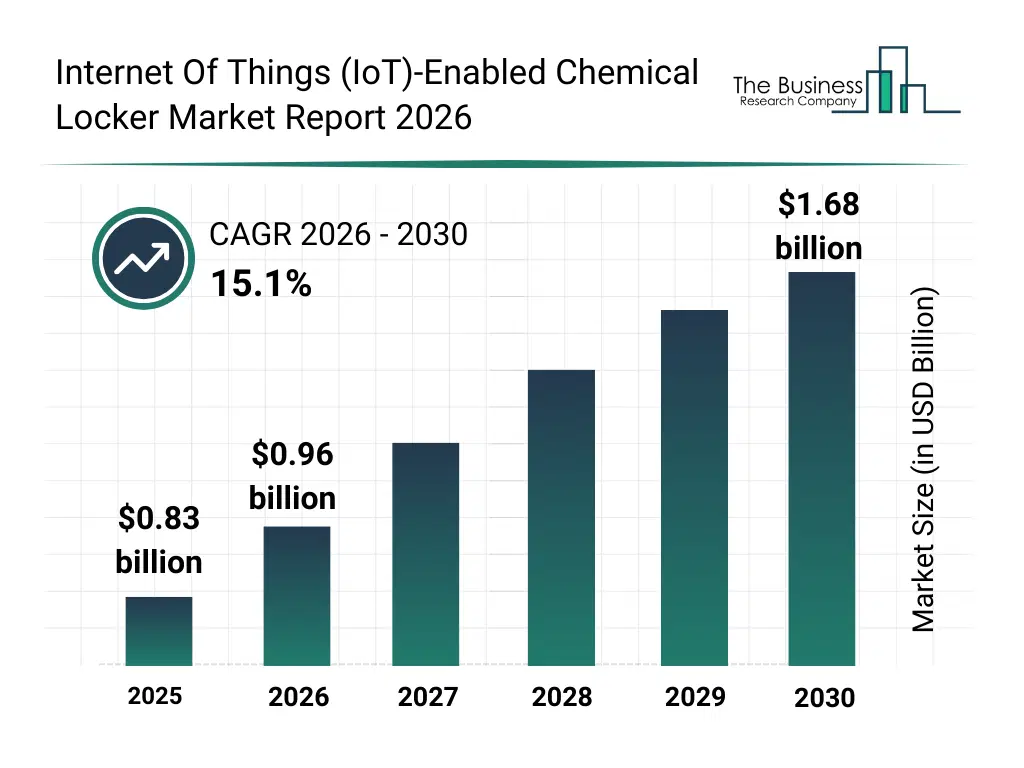
What Is The Internet Of Things (IoT)-Enabled Chemical Locker Market Size and Share 2026?
The internet of things (iot)-enabled chemical locker market size has grown rapidly in recent years. It will grow from $0.83 billion in 2025 to $0.96 billion in 2026 at a compound annual growth rate (CAGR) of 15.4%. The growth in the historic period can be attributed to chemical safety regulations, incidents of hazardous material mishandling, manual inventory limitations, growth of industrial laboratories, demand for controlled chemical access.What Is The Internet Of Things (IoT)-Enabled Chemical Locker Market Growth Forecast?
The internet of things (iot)-enabled chemical locker market size is expected to see rapid growth in the next few years. It will grow to $1.68 billion in 2030 at a compound annual growth rate (CAGR) of 15.1%. The growth in the forecast period can be attributed to smart factory adoption, stricter regulatory enforcement, digital safety management systems, industrial iot investments, cloud based monitoring expansion. Major trends in the forecast period include rising adoption of smart chemical storage systems, increasing focus on workplace safety compliance, expansion of real time chemical monitoring, growing demand for automated access control, integration of inventory management platforms.
Global Internet Of Things (IoT)-Enabled Chemical Locker Market Segmentation
1) By Component: Hardware, Software, Services 2) By Product Type: Smart Chemical Lockers, Automated Chemical Lockers, Modular Chemical Lockers 3) By Connectivity: Wireless Fidelity (Wi-Fi), Bluetooth, Cellular, Other Connectivity 4) By Deployment Mode: On-Premises, Cloud-Based 5) By End-User: Chemical Industry, Healthcare, Education, Research Institutes, Other End-Users Subsegments: 1) By Hardware: Locking Mechanism, Sensors, Controllers, Display Panels, Communication Modules, Power Supply Units 2) By Software: Access Management Software, Inventory Management Software, Monitoring And Analytics Software, Mobile Applications, Cloud Platform Integration 3) By Services: Installation And Commissioning, Maintenance And Support, Software Updates And Upgrades, Remote Monitoring Services, Training And ConsultingWhat Are The Drivers Of The Internet Of Things (IoT)-Enabled Chemical Locker Market?
The increasing emphasis on chemical safety in workplaces is expected to propel the growth of the internet of things (IoT)-enabled chemical locker market. Chemical safety is a critical component of workplace safety, ensuring that hazardous substances are stored, accessed, and managed in compliance with regulatory standards. Stricter enforcement of regulations, along with rising concerns about chemical-related accidents. IoT-enabled chemical lockers enhance compliance and safety by providing real-time monitoring, automated alerts, controlled access, and usage tracking that reduce human error and improve oversight. For instance, according to the Occupational Safety and Health Administration, a US-based federal agency, every year, chemical exposures cause around 190,000 illnesses and 50,000 fatalities among workers. Therefore, the increasing emphasis on chemical safety in workplaces is driving the growth of the internet of things (IoT)-enabled chemical locker industry. The rising industrialization is expected to propel the growth of the internet of things (IoT)-enabled chemical locker market going forward. Industrialization is the process of transforming an economy from primarily agricultural to one based on the manufacturing of goods, driven by the development of industries, infrastructure, and technological advancements. Industrialization is increasing due to the growing demand for mass production of goods driven by expanding global populations and urbanization. IoT-enabled chemical lockers enhance industrialization by improving chemical safety, inventory management, and regulatory compliance in large-scale manufacturing and industrial operations. For instance, according to Trading Economics, a US-based platform that provides reliable economic data, indicators, and forecasts for markets, industrial output in Saudi Arabia grew 6.5% year-on-year in July 2025, accelerating from a revised 6.1% growth recorded in June. Therefore, the rising industrialization is driving the growth of the internet of things (IoT)-enabled chemical locker industry. The rising adoption of cloud platforms is expected to propel the growth of the internet of things (IoT)-enabled chemical locker market going forward. Cloud platforms are centralized, internet-based computing environments that provide on-demand access to scalable infrastructure, software, data storage, and analytics for deploying and managing applications and services remotely. Cloud platforms are rising as they enable organizations to scale computing resources on demand without large upfront capital investment, allowing faster deployment, lower IT costs, and greater operational flexibility. Cloud platforms benefit IoT-enabled chemical lockers by enabling centralized, real-time monitoring and analytics across multiple locations, allowing organizations to track chemical usage, detect safety risks, and manage compliance more efficiently from a single system. For instance, in September 2025, according to Eurostat, a Luxembourg-based statistical office, 45% of businesses in the EU bought cloud computing services in 2023. Large businesses are more likely to opt for cloud solutions compared with SMEs. In 2023, 78% of large businesses bought cloud services, while SMEs bought 44%. Therefore, the rising adoption of cloud platforms is driving the growth of the internet of things (IoT)-enabled chemical locker industry.Key Players In The Global Internet Of Things (IoT)-Enabled Chemical Locker Market
Major companies operating in the internet of things (iot)-enabled chemical locker market are Honeywell International Inc., Emerson Electric Co., Erlab, DENIOS SE, Benko Products Inc., Godrej Storage Solutions, ASECOS GmbH, U.S. Chemical Storage Inc., Innovative Pharmatech Pvt Ltd., Justrite Manufacturing Co., Securall Products, Traka, Siemens AG, Schneider Electric SE, Rockwell Automation, Inc., Johnson Controls International plc, ABB Ltd., Open Automation Software, Cykeo Information Technology Co. Ltd., Samsara Inc., IoTium Inc., KeyTrak Systems, SmartSense by Digi, Bosch.IO GmbH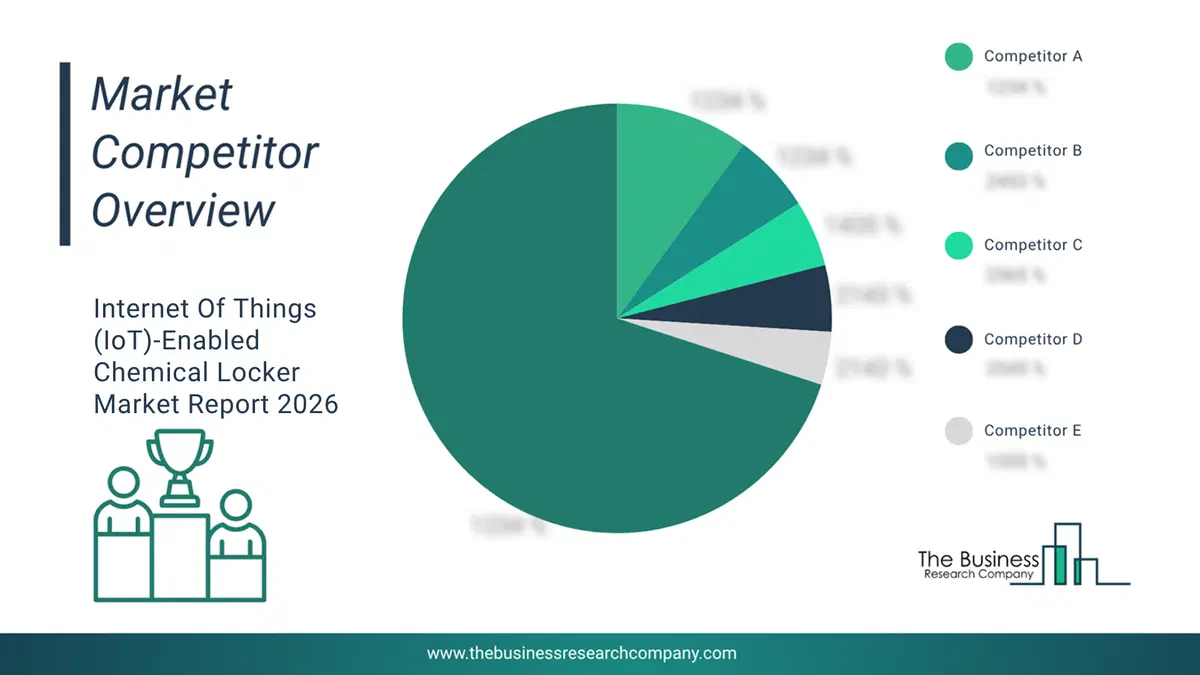
This chart is for illustrative purposes; the full report includes a detailed competitor analysis and comprehensive overview of the top 10 companies in the market.
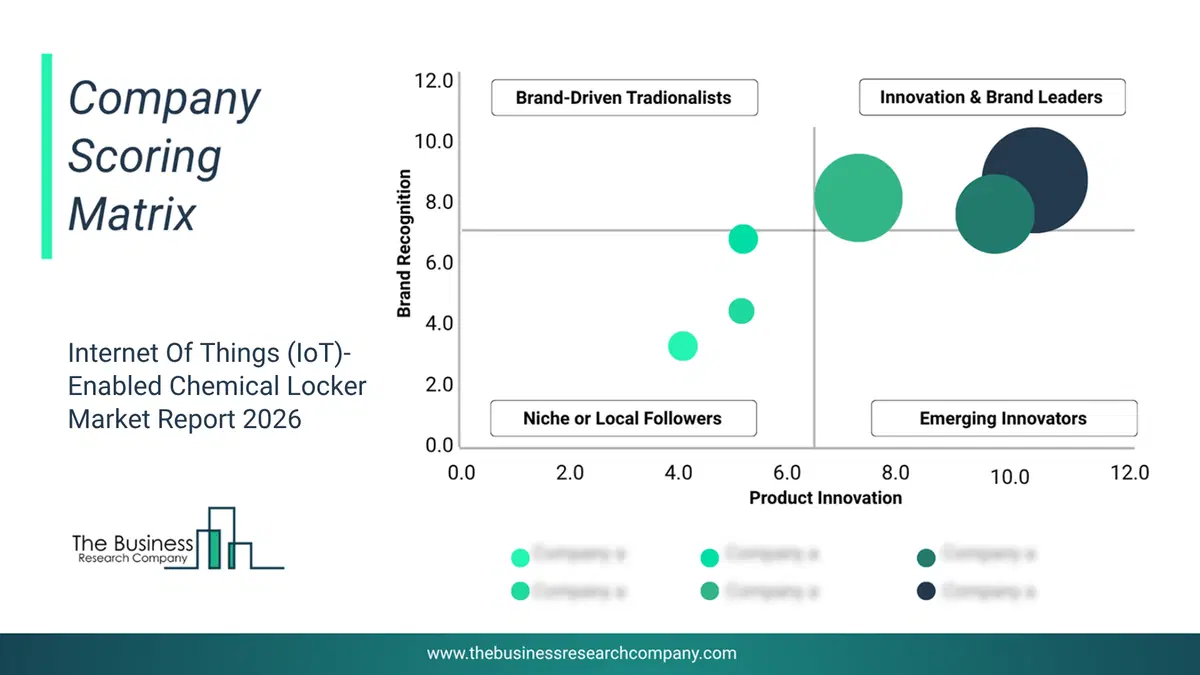
This chart maps companies by product innovation and brand strength, with bubble size indicating relative revenue, helping identify market leaders, challengers, and niche players. This is an illustrative chart; the full report provides a complete and accurate competitive analysis.
Regional Insights
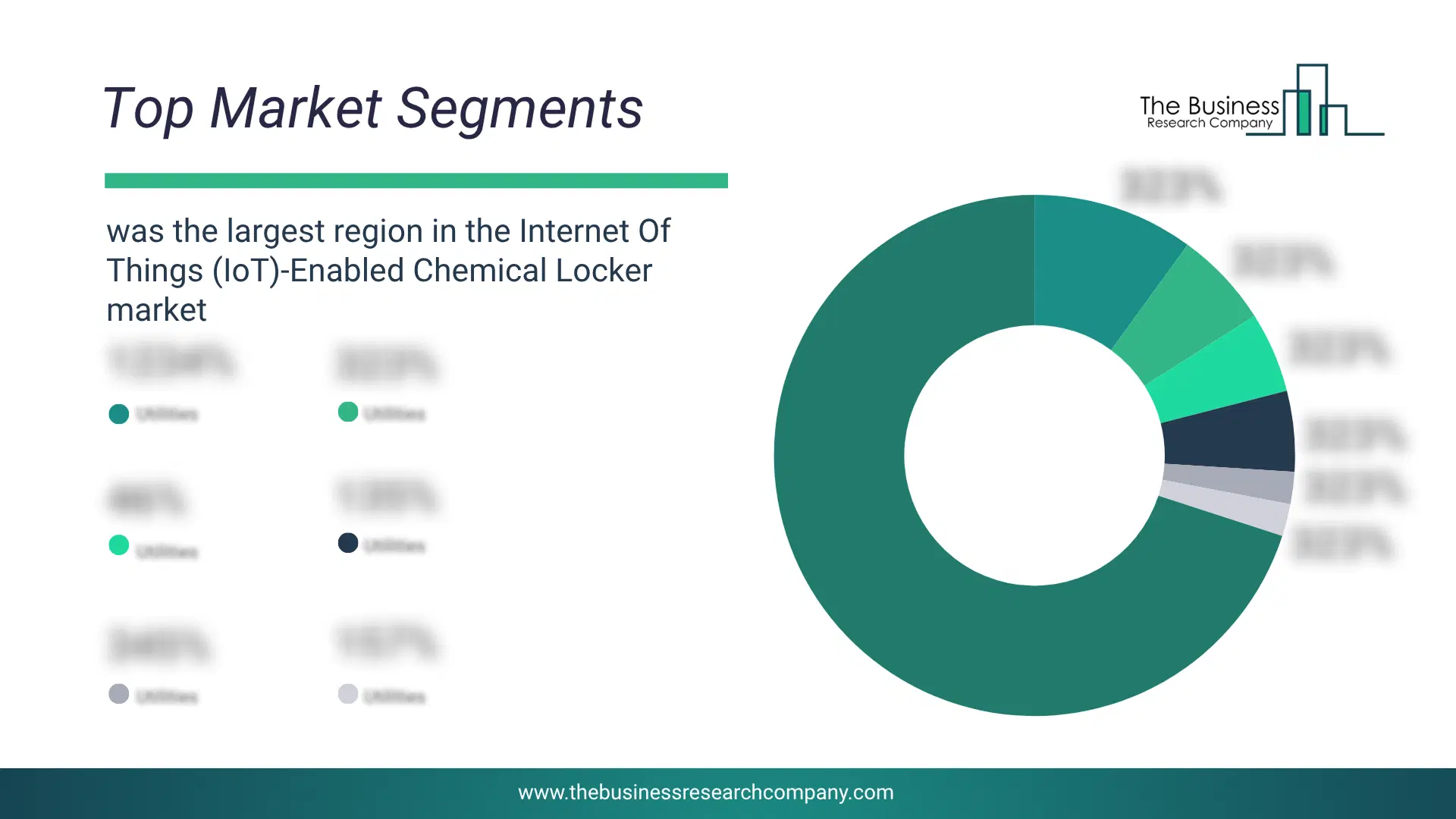
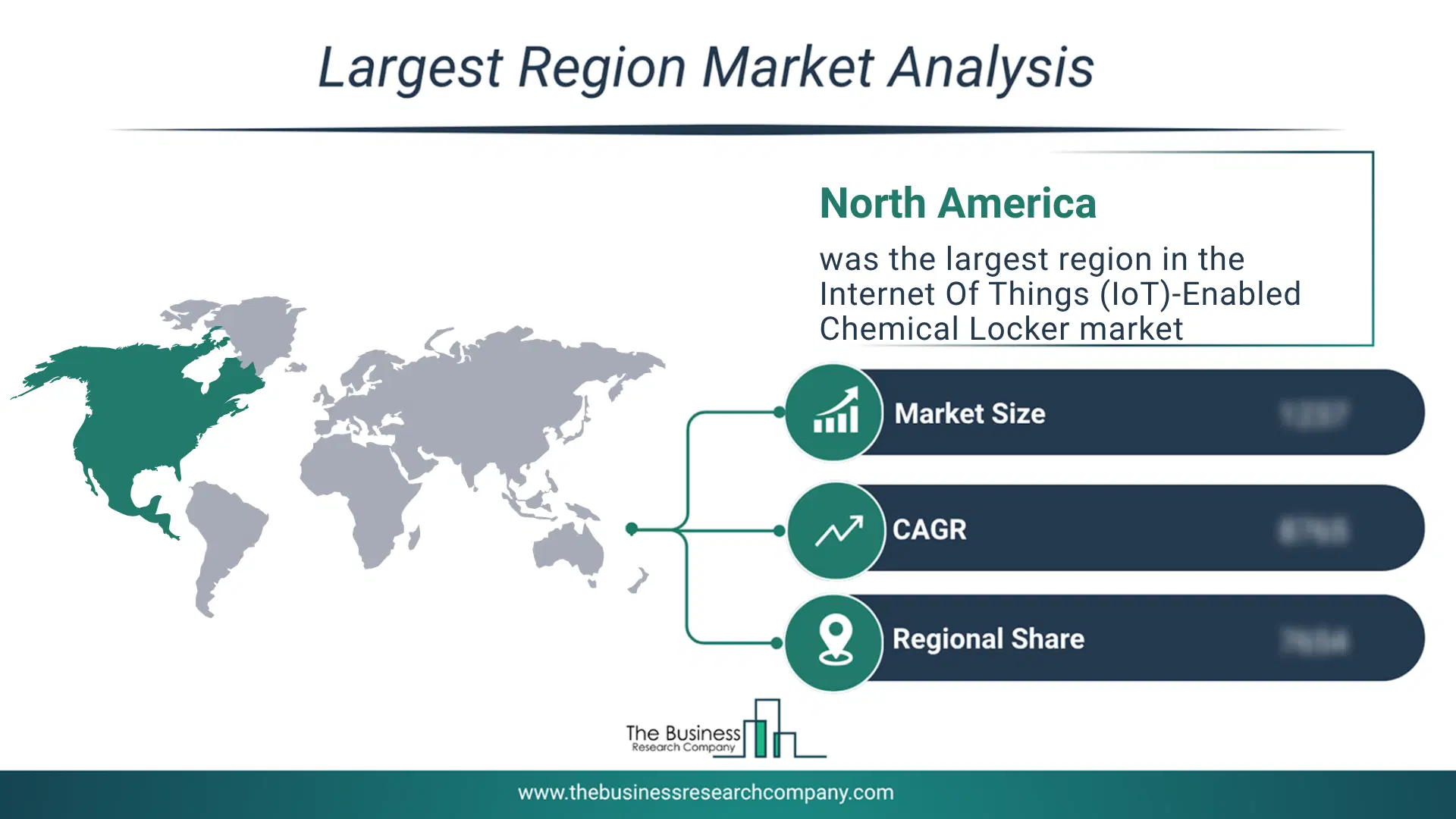
North America was the largest region in the internet of things (IoT)-enabled chemical locker market in 2025. Asia-Pacific is expected to be the fastest-growing region in the forecast period. The regions covered in this market report are Asia-Pacific, South East Asia, Western Europe, Eastern Europe, North America, South America, Middle East, Africa The countries covered in this market report are Australia, Brazil, China, France, Germany, India, Indonesia, Japan, Taiwan, Russia, South Korea, UK, USA, Canada, Italy, SpainWhat Defines the Internet Of Things (IoT)-Enabled Chemical Locker Market?
The internet of things (IoT)-enabled chemical locker market includes revenues earned by entities by providing services such as regulatory compliance support and auditing, maintenance and calibration of smart sensors, alarm and emergency response services, and data analytics and reporting services. The market value includes the value of related goods sold by the service provider or included within the service offering. Only goods and services traded between entities or sold to end consumers are included. The internet of things (IoT)-enabled chemical locker market also includes sales of cloud-based monitoring software, biometric authentication devices, battery backup and power management units, environmental monitoring devices, and smart sensors for temperature, humidity, and gas detection. Values in this market are ‘factory gate’ values; that is, the value of goods sold by the manufacturers or creators of the goods, whether to other entities (including downstream manufacturers, wholesalers, distributors, and retailers) or directly to end customers. The value of goods in this market includes related services sold by the creators of the goods.How is Market Value Defined and Measured?
The market value is defined as the revenues that enterprises gain from the sale of goods and/or services within the specified market and geography through sales, grants, or donations in terms of the currency (in USD unless otherwise specified). The revenues for a specified geography are consumption values that are revenues generated by organizations in the specified geography within the market, irrespective of where they are produced. It does not include revenues from resales along the supply chain, either further along the supply chain or as part of other products.
This chart presents market attractiveness based on a quantitative evaluation of growth, competition, strategic alignment, and risk, offering a clear view of opportunity areas for decision-making. This chart is for illustrative purposes; the full report contains the complete analysis.

This chart highlights the Total Addressable Market (TAM) by estimating the maximum revenue opportunity using an assumption-driven approach, supporting strategic planning and opportunity sizing across markets. The chart is illustrative; the full report provides a more comprehensive analysis.
What Key Data and Analysis Are Included in the Internet Of Things (IoT)-Enabled Chemical Locker Market Report 2026?
The internet of things (iot)-enabled chemical locker market research report is one of a series of new reports from The Business Research Company that provides market statistics, including industry global market size, regional shares, competitors with the market share, detailed market segments, market trends and opportunities, and any further data you may need to thrive in the internet of things (iot)-enabled chemical locker industry. The market research report delivers a complete perspective of everything you need, with an in-depth analysis of the current and future state of the industry.Internet Of Things IoT Enabled Chemical Locker Market Report Forecast Analysis
| Report Attribute | Details |
|---|---|
| Market Size Value In 2026 | $0.96 billion |
| Revenue Forecast In 2030 | $1.68 billion |
| Growth Rate | CAGR of 15.4% from 2026 to 2030 |
| Base Year For Estimation | 2025 |
| Actual Estimates/Historical Data | 2020-2025 |
| Forecast Period | 2026 - 2030 |
| Market Representation | Revenue in USD Billion and CAGR from 2026 to 2030 |
| Segments Covered | Component, Product Type, Connectivity, Deployment Mode, End-User |
| Regional Scope | Asia-Pacific, Western Europe, Eastern Europe, North America, South America, Middle East, Africa |
| Country Scope | The countries covered in this market report are Australia, Brazil, China, France, Germany, India, Indonesia, Japan, Taiwan, Russia, South Korea, UK, USA, Canada, Italy, Spain |
| Key Companies Profiled | Honeywell International Inc., Emerson Electric Co., Erlab, DENIOS SE, Benko Products Inc., Godrej Storage Solutions, ASECOS GmbH, U.S. Chemical Storage Inc., Innovative Pharmatech Pvt Ltd., Justrite Manufacturing Co., Securall Products, Traka, Siemens AG, Schneider Electric SE, Rockwell Automation, Inc., Johnson Controls International plc, ABB Ltd., Open Automation Software, Cykeo Information Technology Co. Ltd., Samsara Inc., IoTium Inc., KeyTrak Systems, SmartSense by Digi, Bosch.IO GmbH |
| Customization Scope | Request for Customization |
| Pricing And Purchase Options | Explore Purchase Options |