

Internet of Things (IoT) In Energy Grid Management Market Report 2026
Global Outlook – By Component (Hardware, Software, Services), By Deployment (On-Premises, Cloud-Based), By Technology (Wired Communication, Wireless Communication), By Application (Smart Meters, Grid Monitoring, Demand Response, Asset Management, Energy Storage Management), By End Users (Utilities, Industrial, Commercial, Residential) – Market Size, Trends, Strategies, and Forecast to 2030
Internet of Things (IoT) In Energy Grid Management Market Overview
• IoT-in-energy-global-market-report" target="_blank">Internet Of Things (IoT) In Energy Grid Management market size has reached to $12.06 billion in 2025 • Expected to grow to $25.76 billion in 2030 at a compound annual growth rate (CAGR) of 16.4% • Growth Driver: The Rise In Adoption Of Renewable Energy Sources Driving The Growth Of Due To Environmental Concerns • Market Trend: Advancements In Grid Automation Enhance Resiliency, Renewable Integration, And Operational Efficiency • North America was the largest region in 2025 and Asia-Pacific is the fastest growing region.Market Gains By 2030 – Top Opportunities By Segment
Market Gain identifies the most promising market opportunities by highlighting the segments or products expected to generate the highest incremental revenue growth over the next five years.
What Is Covered Under Internet of Things (IoT) In Energy Grid Management Market?
Internet of things (IoT) in energy grid management refers to the network of interconnected devices and sensors that collect, transmit, and analyse data across the electricity grid. It enables real time monitoring, control, and optimization of grid operations to improve efficiency, reliability, and flexibility. It helps to enhance grid efficiency, reliability, and real-time control through data-driven insights. The main components of internet of things in energy grid management include hardware, software, and services. Hardware refers to physical devices such as sensors, smart meters, actuators, and communication modules that collect, transmit, and monitor data across the energy grid to optimize performance, efficiency, and reliability. The systems are deployed through on-premises and cloud-based models. The technologies involved include wired communication and wireless communication. The various applications involved are smart meters, grid monitoring, demand response, asset management, and energy storage management and are used by end users such as utilities, industrial organizations, commercial entities, and residential users.
What Is The Internet of Things (IoT) In Energy Grid Management Market Size and Share 2026?
The internet of things (iot) in energy grid management market size has grown rapidly in recent years. It will grow from $12.06 billion in 2025 to $14.02 billion in 2026 at a compound annual growth rate (CAGR) of 16.2%. The growth in the historic period can be attributed to rising adoption of smart meters, increasing energy demand and grid complexity, early deployment of sensor networks, integration of communication modules in grids, initial investment in grid automation.What Is The Internet of Things (IoT) In Energy Grid Management Market Growth Forecast?
The internet of things (iot) in energy grid management market size is expected to see rapid growth in the next few years. It will grow to $25.76 billion in 2030 at a compound annual growth rate (CAGR) of 16.4%. The growth in the forecast period can be attributed to expansion of iot-enabled grid solutions, growing demand for predictive analytics in energy management, adoption of edge computing for real-time control, increasing deployment of renewable energy sources, rising focus on energy efficiency and sustainability initiatives. Major trends in the forecast period include real-time grid monitoring, predictive maintenance services, energy management optimization, asset management and control, remote monitoring and analytics.
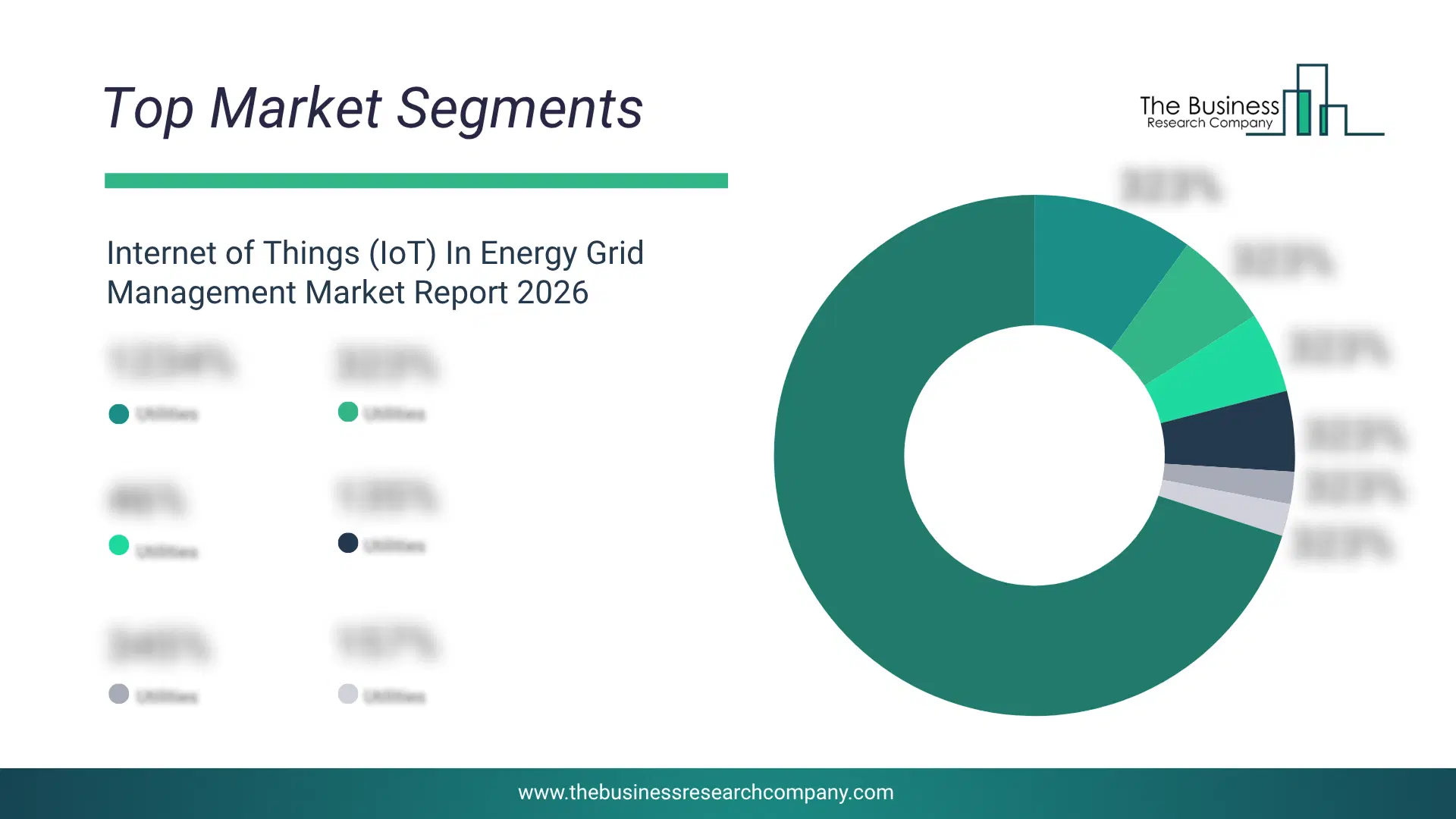
Global Internet of Things (IoT) In Energy Grid Management Market Segmentation
1) By Component: Hardware, Software, Services 2) By Deployment: On-Premises, Cloud-Based 3) By Technology: Wired Communication, Wireless Communication 4) By Application: Smart Meters, Grid Monitoring, Demand Response, Asset Management, Energy Storage Management 5) By End Users: Utilities, Industrial, Commercial, Residential Subsegments: 1) By Hardware: Sensors And Actuators, Smart Meters, Communication Modules, Edge Computing Devices 2) By Software: Grid Management Software, Energy Analytics Software, Device Management Software, Predictive Maintenance Software 3) By Services: Installation And Integration Services, Network Monitoring Services, Maintenance And Support Services, Data Management And Analytics Services The top segments in the internet of things (iot) in energy grid management market will be: • Hardware will reach $13.24 Billion by 2030. • Software will reach $7.43 Billion by 2030. • Services will reach $5.08 Billion by 2030.What Is The Driver Of The Internet of Things (IoT) In Energy Grid Management Market?
The growing adoption of renewable energy sources is expected to propel the growth of the internet of things (IoT) in energy grid management market going forward. Renewable energy sources are natural resources that can be replenished naturally and used to generate energy, such as sunlight, wind, water, and biomass. The growing adoption of renewable energy sources is primarily driven by environmental concerns and climate change, as countries and organizations seek to reduce greenhouse gas emissions, minimize pollution, and transition to sustainable, low-carbon energy systems. The Internet of Things (IoT) in energy grid management enables real-time monitoring and intelligent coordination of energy flows, enhancing the integration, efficiency, and reliability of renewable energy sources like solar and wind. For instance, in December 2024, according to Eurostat, a Luxembourg-based government agency, in 2023, renewable energy represented 24.5% of total energy consumption in the EU, up from 23.0% in 2022. Therefore, the growing adoption of renewable energy sources is driving the growth of the internet of things (IoT) in energy grid management industry.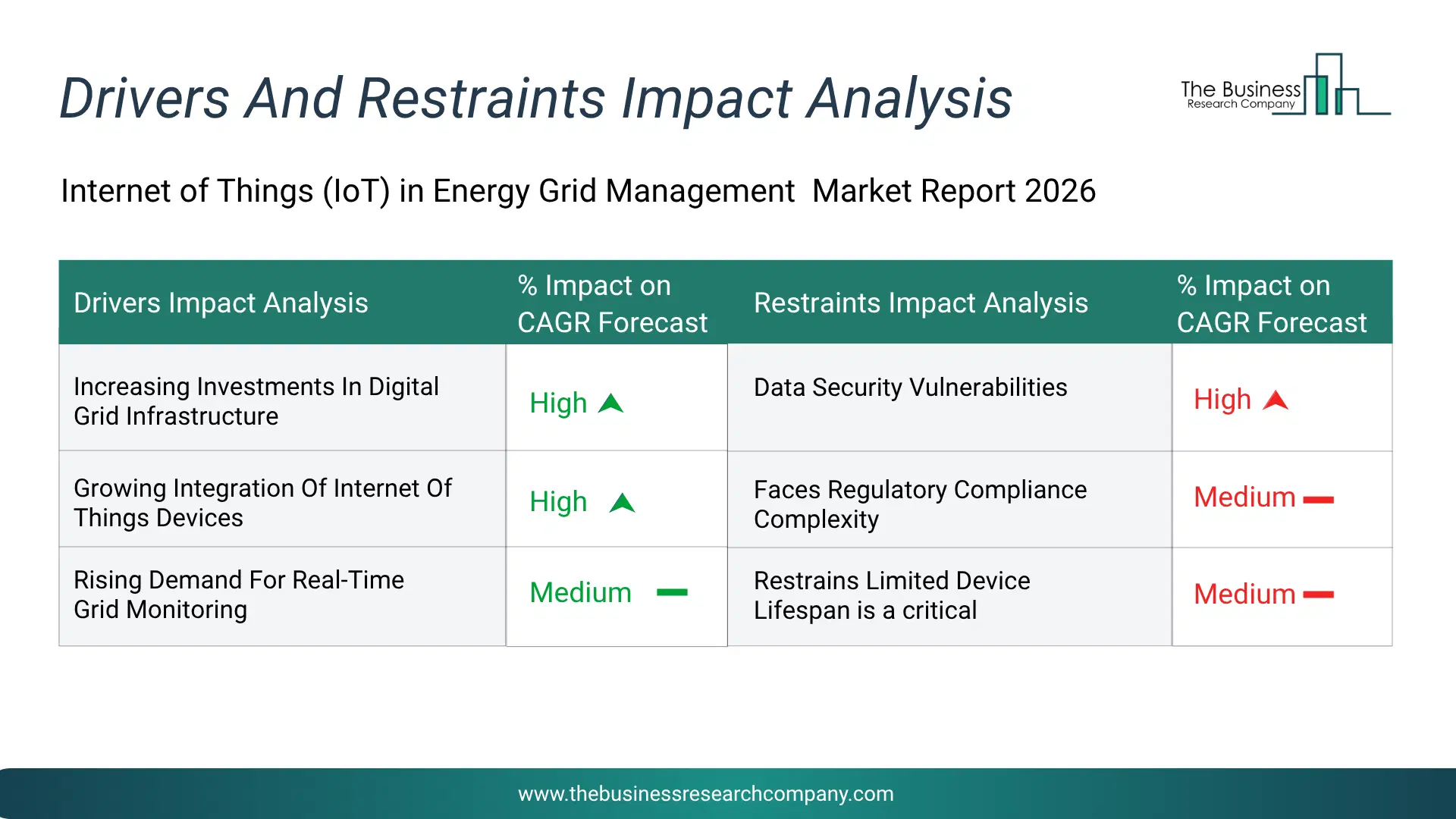
Infographic Chart Showing Key Market Drivers Analysis And Restraints For Internet Of Things (Iot) In Energy Grid Management Market
The chart presents an impact analysis of key drivers and restraints, quantifying their relative influence on the market's growth rate and helping assess the balance between growth enablers and limiting factors. This chart offers a high-level perspective; the full report contains more detailed insights.
How Will The Drivers Impact Growth In The Global Internet of Things (IoT) in Energy Grid Management Market?
• Increasing Investments In Digital Grid Infrastructure (High) – During the forecast period, the increasing investments in digital grid infrastructure are expected to become a key growth driver for the internet of things (IoT) in energy grid management market by 2030. Utilities and grid operators are accelerating capital expenditure toward modernizing legacy transmission and distribution systems with digitally connected infrastructure. These investments enable seamless integration of automation technologies, enhance grid flexibility, and support efficient power flow management across complex networks. Governments and private stakeholders are prioritizing digital grid transformation to ensure energy reliability and sustainability. • Growing Integration Of Internet Of Things Devices (High) – During the forecast period, the growing integration of internet of things devices is expected to emerge as a major factor driving the expansion of the internet of things (IoT) in energy grid management market by 2030. The proliferation of connected sensors, smart controllers, and edge devices across grid networks is enabling enhanced data collection and decentralized intelligence. These IoT-enabled devices facilitate automated fault detection, improve operational efficiency, and support dynamic load balancing across energy systems. The increasing deployment of connected assets across generation, transmission, and distribution layers is strengthening grid responsiveness. • Rising Demand For Real-Time Grid Monitoring (Medium) – During the forecast period, the rising demand for real-time grid monitoring is expected to act as a key growth catalyst for the internet of things (IoT) in energy grid management market by 2030. Energy providers are increasingly adopting advanced monitoring solutions to gain instantaneous insights into grid performance, detect anomalies, and optimize energy distribution. Real-time monitoring supports proactive maintenance strategies, reduces downtime, and enhances overall grid stability in the face of fluctuating energy demand. Additionally, the need for improved situational awareness in increasingly complex energy ecosystems is accelerating adoption.How Will The Restraints Impact Growth In The Global Internet of Things (IoT) in Energy Grid Management Market?
• Data Security Vulnerabilities (High) – During the forecast period, data security vulnerabilities are restricting the growth of the internet of things (IoT) in energy grid management market. Increased connectivity of grid devices and real-time data exchange are exposing systems to cyber threats, unauthorized access, and potential grid disruptions, thereby limiting adoption • Faces Regulatory Compliance Complexity (High) – During the forecast period, regulatory compliance complexity is restricting the growth of the internet of things (IoT) in energy grid management market. Evolving energy regulations, data protection laws, and interoperability standards are creating compliance challenges and increasing operational burden for utilities • Restrains Limited Device Lifespan is a critical (Medium) – During the forecast period, limited device lifespan is restricting the growth of the internet of things (IoT) in energy grid management market. Short operational life of IoT devices, maintenance requirements, and frequent replacements are increasing costs and affecting long-term deployment efficiencyKey Players In The Global Internet of Things (IoT) In Energy Grid Management Market
Major companies operating in the internet of things (iot) in energy grid management market are Microsoft Corporation, Huawei Technologies Co. Ltd., Siemens AG, Hitachi Ltd., International Business Machines Corporation, Cisco Systems Inc., Intel Corporation, General Electric Company, Oracle Corporation, Schneider Electric SE, Mitsubishi Electric Corporation, Honeywell International Inc., Toshiba Corporation, ABB Ltd., Fujitsu Limited, Eaton Corporation Plc, Itron Inc., Landis Gyr AG, Schweitzer Engineering Laboratories Inc., Trilliant Holdings Inc., GridPoint Inc.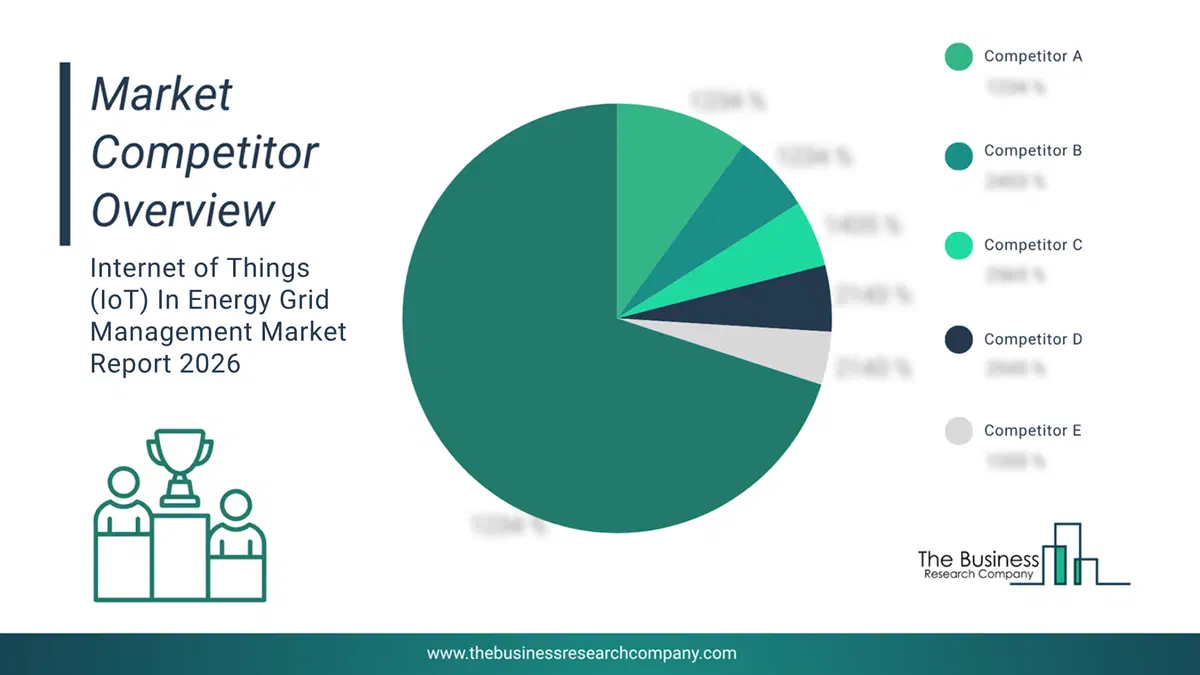
This chart is for illustrative purposes; the full report includes a detailed competitor analysis and comprehensive overview of the top 10 companies in the market.
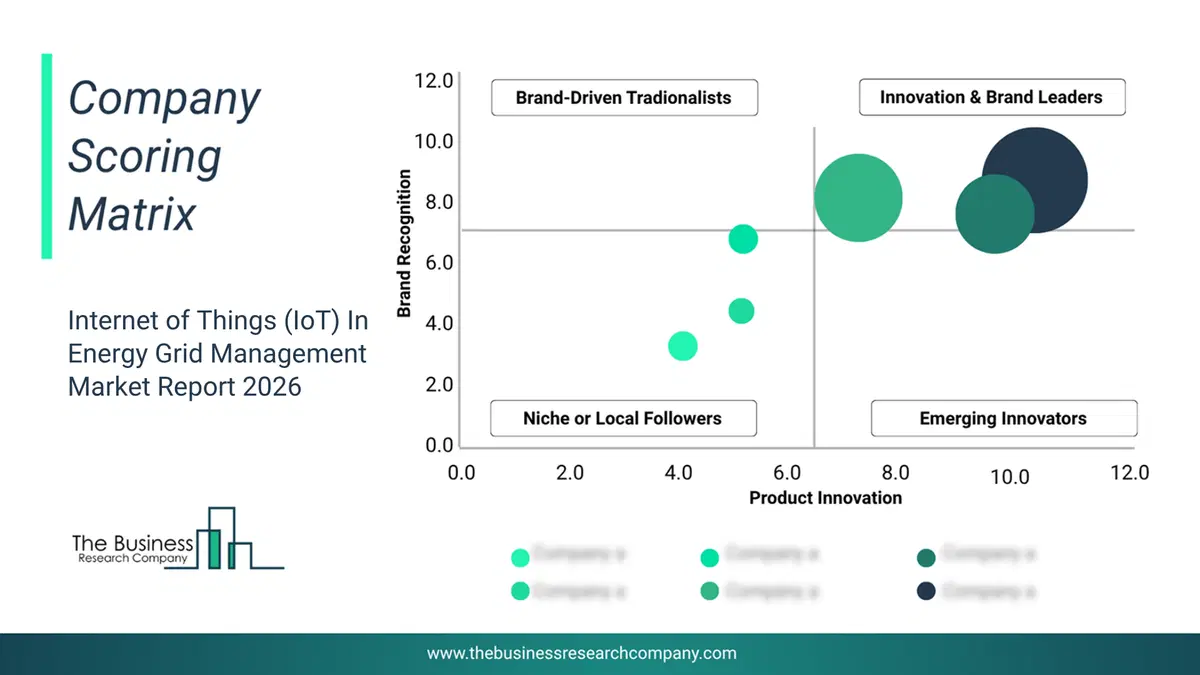
This chart maps companies by product innovation and brand strength, with bubble size indicating relative revenue, helping identify market leaders, challengers, and niche players. This is an illustrative chart; the full report provides a complete and accurate competitive analysis.
Global Internet of Things (IoT) In Energy Grid Management Market Trends and Insights
Major companies operating in the internet of things (IoT) in energy grid management market are focusing on developing digital intelligence platforms, to improve grid resiliency, integrate renewable energy, and optimize operational efficiency. Digital intelligence platforms refer to integrated, AI-powered software ecosystems that unify grid data and operations to enable predictive automation and holistic management. For instance, in March 2025, Schneider Electric SE, a France-based energy management and automation company, launched the One Digital Grid Platform, an AI-powered foundational platform for utility grid modernization. The platform offers unique features, including a hybrid-cloud architecture for real-time insights, predictive analytics for climate risk and asset management, and automated modules for planning, operations, and customer engagement, to enhance intelligence across the entire grid lifecycle. It utilizes an open, interoperable ecosystem to seamlessly integrate mission-critical software and IoT data, providing utilities with actionable intelligence to reduce outage durations by up to 40%, accelerate the interconnection of distributed energy resources like solar and EV chargers by 25%, and cut software deployment time by 60%. The platform integrates easily with existing utility systems and partner solutions, allowing grid operators to access a unified view through scalable analytics, optimize grid performance and flexibility, and enhance security and affordability while preparing for future energy demands.What Are Latest Mergers And Acquisitions In The Internet of Things (IoT) In Energy Grid Management Market?
In March 2025, Bidgely Inc., a US-based AI-driven energy analytics company, acquired Grid4C Inc. for an undisclosed amount. With this acquisition, Bidgely aims to accelerate its growth trajectory by combining patented AI technologies for unprecedented innovation in energy intelligence, grid management, and consumer engagement. Grid4C Inc. is a US-based company that provides Internet of Things (IoT) solutions tailored for energy grid management.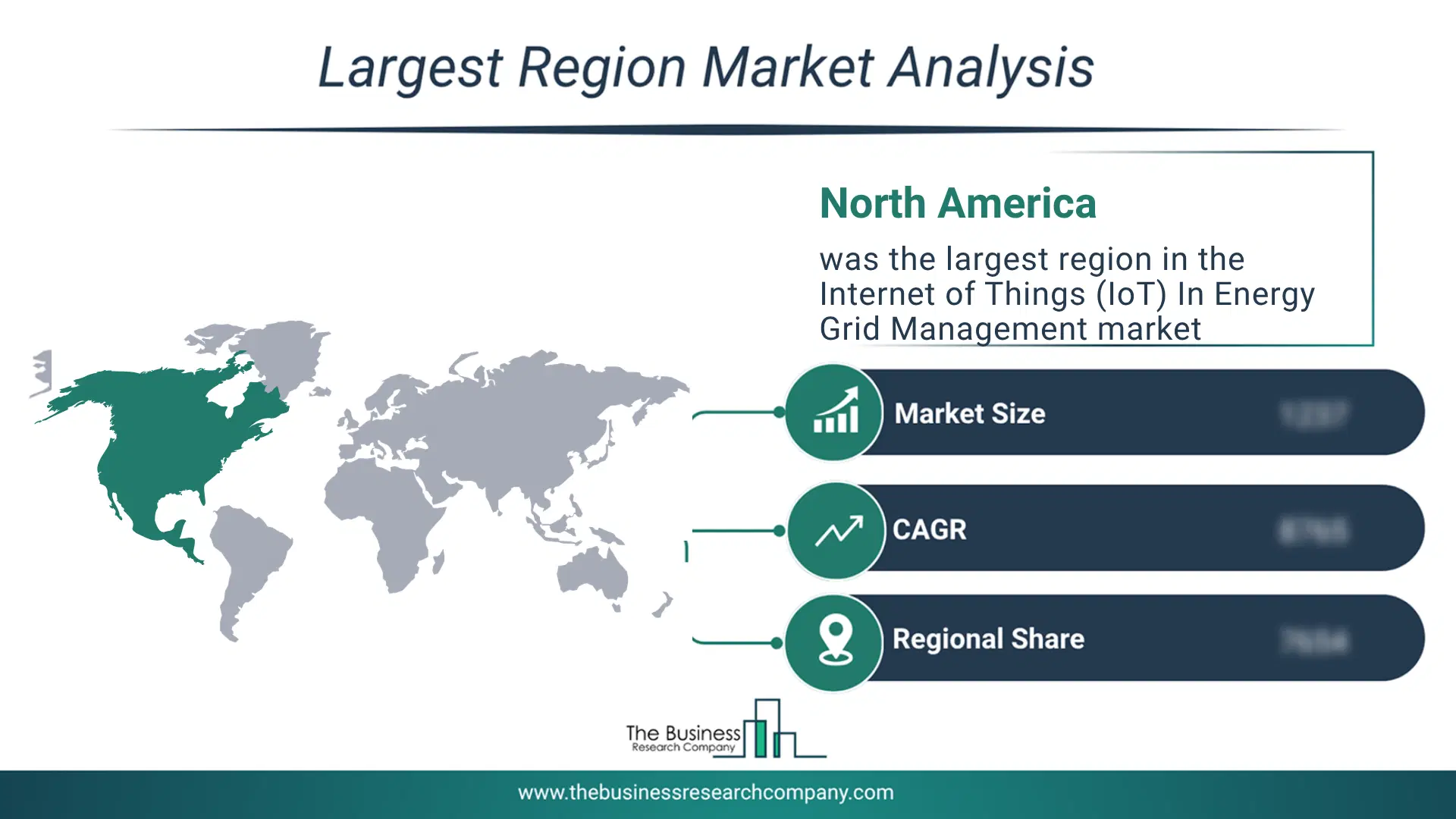
Regional Outlook
North America was the largest region in the internet of things (IoT) in energy grid management in 2025. Asia-Pacific is expected to be the fastest-growing region in the forecast period. The regions covered in this market report are Asia-Pacific, South East Asia, Western Europe, Eastern Europe, North America, South America, Middle East, Africa. The countries covered in this market report are Australia, Brazil, China, France, Germany, India, Indonesia, Japan, Taiwan, Russia, South Korea, UK, USA, Canada, Italy, Spain.What Defines the Internet of Things (IoT) In Energy Grid Management Market?
The internet of things (IoT) in energy grid management market consists of revenues earned by entities by providing services such as internet of things system integration, device installation and commissioning, network connectivity management, data acquisition services, real time grid monitoring, predictive maintenance services, asset management services, energy management services, remote monitoring and control services, cybersecurity services, and analytics and reporting services. The market value includes the value of related goods sold by the service provider or included within the service offering. The internet of things (IoT) in energy grid management market includes sales of smart meters, grid sensors, voltage sensors, current sensors, power quality monitors, remote terminal units, data concentrators, communication modules, edge computing devices, and smart relays. Values in this market are ‘factory gate’ values, that is, the value of goods sold by the manufacturers or creators of the goods, whether to other entities (including downstream manufacturers, wholesalers, distributors, and retailers) or directly to end customers. The value of goods in this market includes related services sold by the creators of the goods.How is Market Value Defined and Measured?
The market value is defined as the revenues that enterprises gain from the sale of goods and/or services within the specified market and geography through sales, grants, or donations in terms of the currency (in USD unless otherwise specified). The revenues for a specified geography are consumption values that are revenues generated by organizations in the specified geography within the market, irrespective of where they are produced. It does not include revenues from resales along the supply chain, either further along the supply chain or as part of other products.
This chart presents market attractiveness based on a quantitative evaluation of growth, competition, strategic alignment, and risk, offering a clear view of opportunity areas for decision-making. This chart is for illustrative purposes; the full report contains the complete analysis.

This chart highlights the Total Addressable Market (TAM) by estimating the maximum revenue opportunity using an assumption-driven approach, supporting strategic planning and opportunity sizing across markets. The chart is illustrative; the full report provides a more comprehensive analysis.
What Key Data and Analysis Are Included in the Internet of Things (IoT) In Energy Grid Management Market Report 2026?
The internet of things (iot) in energy grid management market research report is one of a series of new reports from The Business Research Company that provides market statistics, including industry global market size, regional shares, competitors with the market share, detailed market segments, market trends and opportunities, and any further data you may need to thrive in the internet of things (iot) in energy grid management industry. The market research report delivers a complete perspective of everything you need, with an in-depth analysis of the current and future state of the industry.Internet of Things (IoT) In Energy Grid Management Market Report Forecast Analysis
| Report Attribute | Details |
|---|---|
| Market Size Value In 2026 | $14.02 billion |
| Revenue Forecast In 2030 | $25.76 billion |
| Growth Rate | CAGR of 16.2% from 2026 to 2030 |
| Base Year For Estimation | 2025 |
| Actual Estimates/Historical Data | 2020-2025 |
| Forecast Period | 2026 - 2030 |
| Market Representation | Revenue in USD Billion and CAGR from 2026 to 2030 |
| Segments Covered | Component, Deployment, Technology, Application, End Users |
| Regional Scope | Asia-Pacific, Western Europe, Eastern Europe, North America, South America, Middle East, Africa |
| Country Scope | The countries covered in the report are Australia, Brazil, China, France, Germany, India, Indonesia, Japan, Taiwan, Russia, South Korea, UK, USA, Canada, Italy, Spain. |
| Key Companies Profiled | Microsoft Corporation, Huawei Technologies Co. Ltd., Siemens AG, Hitachi Ltd., International Business Machines Corporation, Cisco Systems Inc., Intel Corporation, General Electric Company, Oracle Corporation, Schneider Electric SE, Mitsubishi Electric Corporation, Honeywell International Inc., Toshiba Corporation, ABB Ltd., Fujitsu Limited, Eaton Corporation Plc, Itron Inc., Landis Gyr AG, Schweitzer Engineering Laboratories Inc., Trilliant Holdings Inc., GridPoint Inc. |
| Customization Scope | Request for Customization |
| Pricing And Purchase Options | Explore Purchase Options |