
Internet Of Things (IoT) Microcontroller Market Report 2026
Global Outlook – By Components ( Processor, Sensor, Connectivity Integrated Circuit, Memory Device, Logic Device, Other Components), By Product ( 8-Bit, 16-Bit, 32-Bit, 64-Bit), By Memory ( External Memory Microcontroller, Embedded Memory Microcontroller), By Application ( Healthcare, Consumer Electronics, Industrial sectors, Automotive Sectors, Banking, Financial Services And Insurance (BFSI), Retail, Automation, Other Applications) – Market Size, Trends, Strategies, and Forecast to 2030
Internet Of Things (IoT) Microcontroller Market Overview
• Internet Of Things (IoT) Microcontroller market size has reached to $6.52 billion in 2025 • Expected to grow to $12.71 billion in 2030 at a compound annual growth rate (CAGR) of 14.2% • Growth Driver: Rising Electronics Industry Demand Fueling Growth Of The Market Due To Expanding Semiconductor Usage • Market Trend: Advancements In Ultra-Low-Power Microcontrollers For Energy-Efficient IoT Devices • North America was the largest region in 2025 and Asia-Pacific is the fastest growing region.What Is Covered Under Internet Of Things (IoT) Microcontroller Market?
An internet of things (IoT) microcontroller is a small, energy-efficient computing unit that enables processing and communication within connected device networks. It functions as the core element in IoT systems by handling data operations and supporting network connectivity, allowing smooth interaction between digital platforms and physical environments. The main components of an internet of things (IoT) microcontroller include a processor, sensor, connectivity integrated circuit, memory device, logic device, and others. Processor refers to the central processing unit (CPU) of a computer or microcontroller that executes instructions, performs calculations, and manages data flow within a system. It includes products such as 8-bit, 16-bit, 32-bit, and 64-bit microcontrollers and memories, including external memory microcontrollers and embedded memory microcontrollers. It finds applications in healthcare, consumer electronics, industrial sectors, automotive sectors, banking, financial services and insurance (BFSI), retail, automation, and others.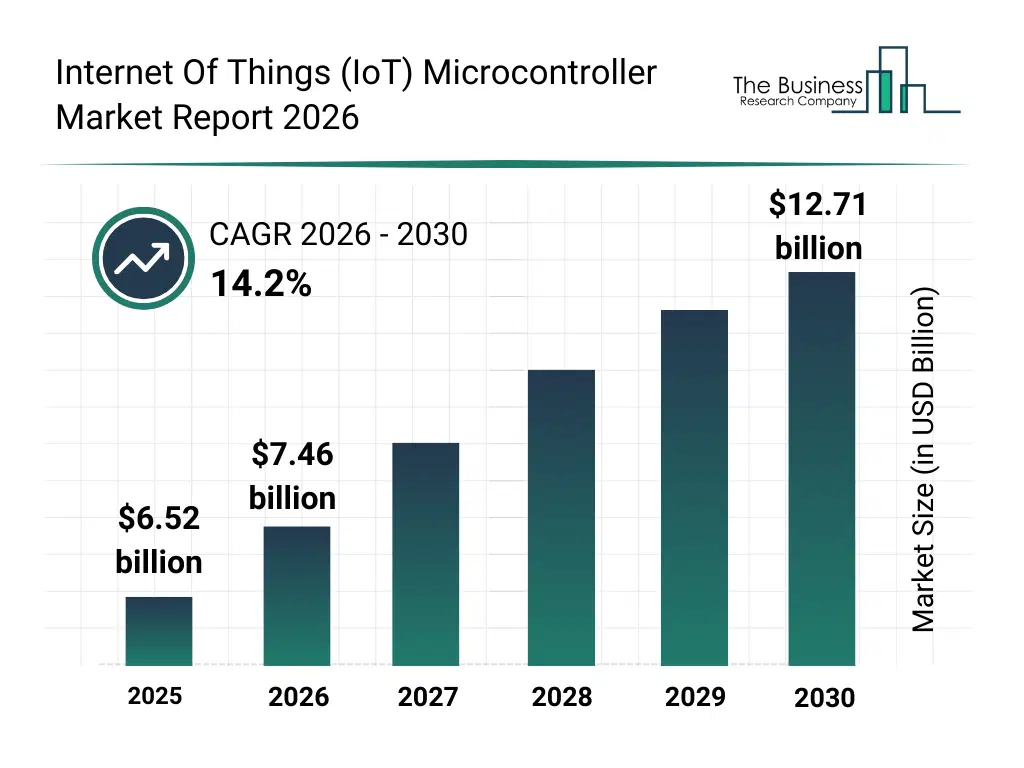
What Is The Internet Of Things (IoT) Microcontroller Market Size 2026 And Growth Rate?
The internet of things (iot) microcontroller market size has grown rapidly in recent years. It will grow from $6.52 billion in 2025 to $7.46 billion in 2026 at a compound annual growth rate (CAGR) of 14.4%. The growth in the historic period can be attributed to rise in smart device adoption, growth in connected consumer electronics, increased industrial automation, demand for wearable technology, early adoption of wireless communication, improvements in low-power microcontroller design, advancements in embedded systems, growth of home automation, increased use in automotive electronics, development of cloud-based IoT platforms.What Is The Internet Of Things (IoT) Microcontroller Market Growth Forecast?
The internet of things (iot) microcontroller market size is expected to see rapid growth in the next few years. It will grow to $12.71 billion in 2030 at a compound annual growth rate (CAGR) of 14.2%. The growth in the forecast period can be attributed to expansion of smart cities, adoption of ai-driven iot solutions, growth in industrial iot deployment, increase in connected automotive applications, advancements in edge computing, growth of healthcare iot devices, expansion of 5g connectivity, rising demand for energy-efficient solutions, integration with blockchain for security, adoption in precision agriculture. Major trends in the forecast period include energy-efficient microcontrollers, low-power edge computing, wireless connectivity optimization, miniaturized device integration, real-time data processing.
Global Internet Of Things (IoT) Microcontroller Market Segmentation
1) By Components: Processor, Sensor, Connectivity Integrated Circuit, Memory Device, Logic Device, Other Components 2) By Product: 8-Bit, 16-Bit, 32-Bit, 64-Bit 3) By Memory: External Memory Microcontroller, Embedded Memory Microcontroller 4) By Application: Healthcare, Consumer Electronics, Industrial sectors, Automotive Sectors, Banking, Financial Services And Insurance (BFSI), Retail, Automation, Other Applications Subsegments: 1) By Processor: Microcontroller Unit, Digital Signal Processor, Application Processor, Microprocessor 2) By Sensor: Temperature Sensor, Pressure Sensor, Motion Sensor, Optical Sensor 3) By Connectivity Integrated Circuit: Bluetooth Module, Wi-Fi Module, Zigbee Module, Cellular Module 4) By Memory Device: Static Random Access Memory, Dynamic Random Access Memory, Flash Memory, Read Only Memory 5) By Logic Device: Field Programmable Gate Array, Application Specific Integrated Circuit, Programmable Logic Device, Standard Logic Device 6) By Other Components: Power Management Integrated Circuit, Clock Generator, Voltage Regulator, Interface ControllerWhat Is The Driver Of The Internet Of Things (IoT) Microcontroller Market?
The increasing demand for the electronics industry is expected to propel the growth of the internet of things (IoT) microcontroller market going forward. The electronics industry refers to the sector that designs, manufactures, and sells electronic components and devices used in consumer products, industrial systems, and advanced technologies across various sectors. The growing expansion of electronics manufacturing is due to the increasing global demand for semiconductors, particularly due to their rising use in technologies such as artificial intelligence, electric vehicles, and consumer electronics. IoT microcontrollers enable the electronics industry to develop smart, connected devices by combining processing, connectivity, and control in compact chips, supporting real-time data exchange, automation, and advanced functionalities. For instance, in July 2024, according to the Semiconductor Industry Association, a US-based trade association, global semiconductor industry sales reached $49.1 billion in May 2024, marking a 19.3% increase from $41.2 billion in May 2023 and a 4.1% rise from $47.2 billion recorded in April 2024. Therefore, the increasing demand for the electronics industry is driving the growth of the internet of things (IoT) microcontroller industry.Key Players In The Global Internet Of Things (IoT) Microcontroller Market
Major companies operating in the internet of things (iot) microcontroller market are Intel Corporation, Qualcomm Technologies Inc., Broadcom Inc., Advanced Micro Devices Inc., Texas Instruments Inc., MediaTek Inc., STMicroelectronics N.V., Infineon Technologies AG, NXP Semiconductors N.V., Analog Devices Inc., Renesas Electronics Corporation, Microchip Technology Incorporated, ON Semiconductor Corporation, Realtek Semiconductor Corporation, Nuvoton Technology Corporation, Silicon Laboratories, Nordic Semiconductor ASA, ELAN Microelectronics Corporation, Espressif Systems ShanghAI Co. Ltd., China Micro Semiconductor Co. Ltd., Holtek Semiconductor Inc., CML Microsystems Plc, Segger Microcontroller Systems GmbH.
This chart is for illustrative purposes; the full report includes a detailed competitor analysis and comprehensive overview of the top 10 companies in the market.
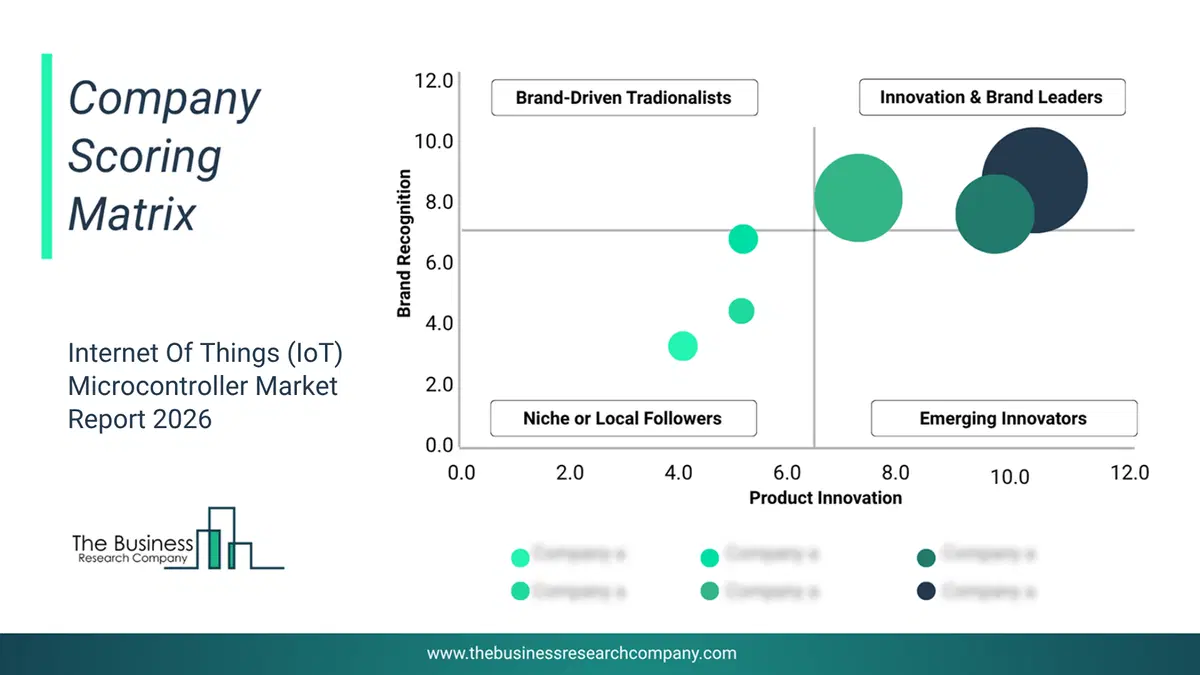
This chart maps companies by product innovation and brand strength, with bubble size indicating relative revenue, helping identify market leaders, challengers, and niche players. This is an illustrative chart; the full report provides a complete and accurate competitive analysis.
Global Internet Of Things (IoT) Microcontroller Market Trends and Insights
Major companies operating in the internet of things (IoT) microcontroller market are focusing on developing technologically advanced solutions, such as ultra-low-power microcontrollers, to enhance energy efficiency, extend battery life in connected devices, and support complex IoT applications across industries like smart homes, healthcare, and industrial automation. Ultra-low-power microcontrollers are microcontroller units designed to operate with minimal energy consumption, enabling long-lasting performance in battery-powered or energy-efficient IoT devices. For instance, in March 2025, STMicroelectronics, a Switzerland-based semiconductor company, launched the STM32U3 series of ultra-low-power microcontrollers designed for remote, smart, and sustainable applications, especially targeting IoT devices that need to operate for long periods on limited energy sources such as coin cells or ambient energy harvesting. These MCUs leverage cutting-edge near-threshold chip design and AI-driven adaptive voltage scaling to achieve a market-leading performance-per-watt efficiency, with a Coremark-per-milliwatt score of 117, twice as efficient as the previous STM32U5 series. They operate at extremely low power, with dynamic consumption down to 10 µA/MHz and a stop current of 1.6 µA.What Are Latest Mergers And Acquisitions In The Internet Of Things (IoT) Microcontroller Market?
In October 2024, Qualcomm Inc., a US-based semiconductor company, partnered with STMicroelectronics N.V. to advance the development of next-generation industrial and consumer IoT solutions. This partnership aims to integrate Qualcomm’s AI-powered wireless connectivity technologies with STMicroelectronics’ STM32 microcontroller ecosystem to accelerate development, simplify integration, and enable faster, cost-effective deployment of advanced industrial and consumer IoT solutions enhanced by edge AI. STMicroelectronics N.V. is a Switzerland-based semiconductor company that manufactures internet of things (IoT) microcontrollers.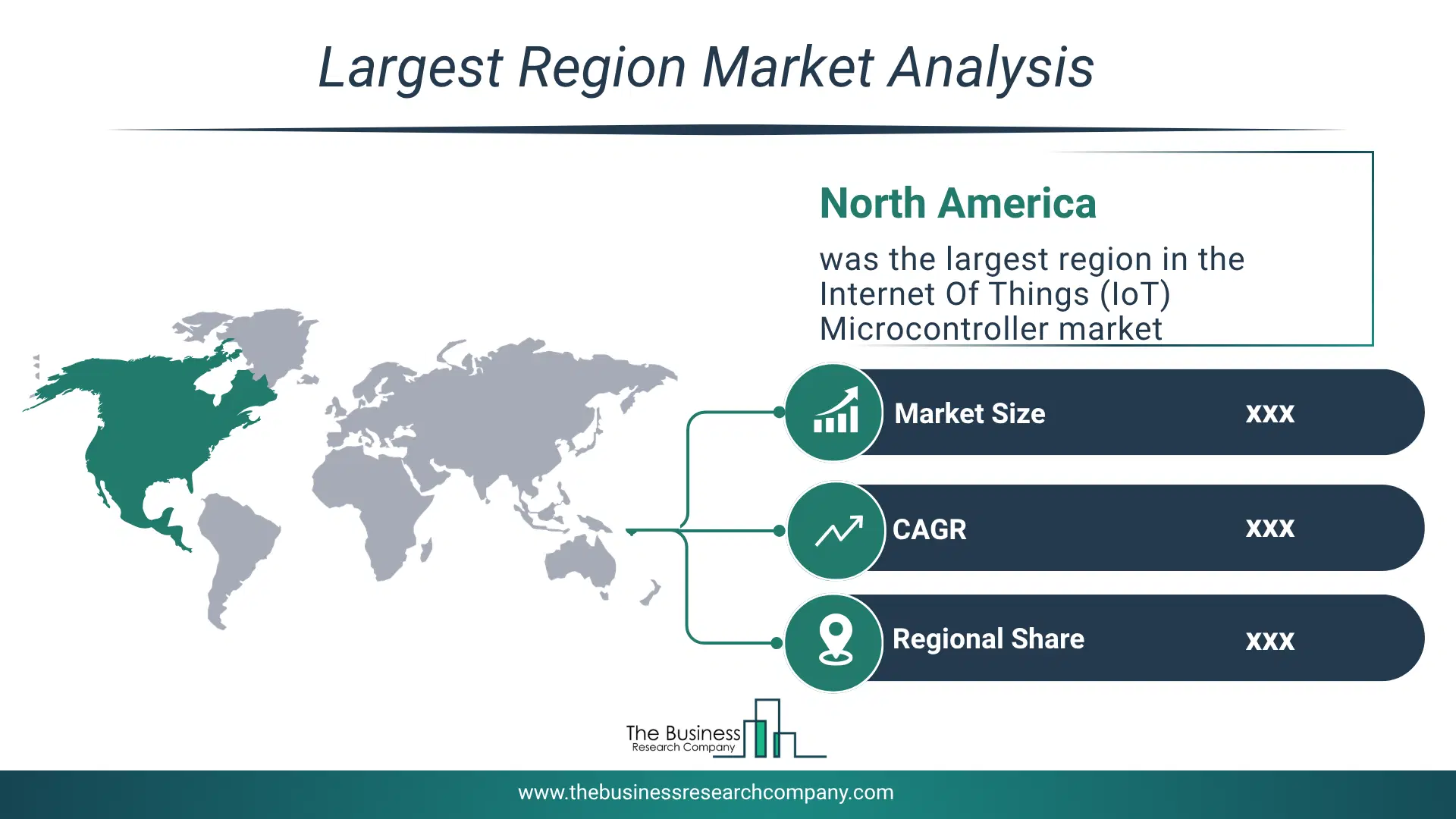
Regional Outlook
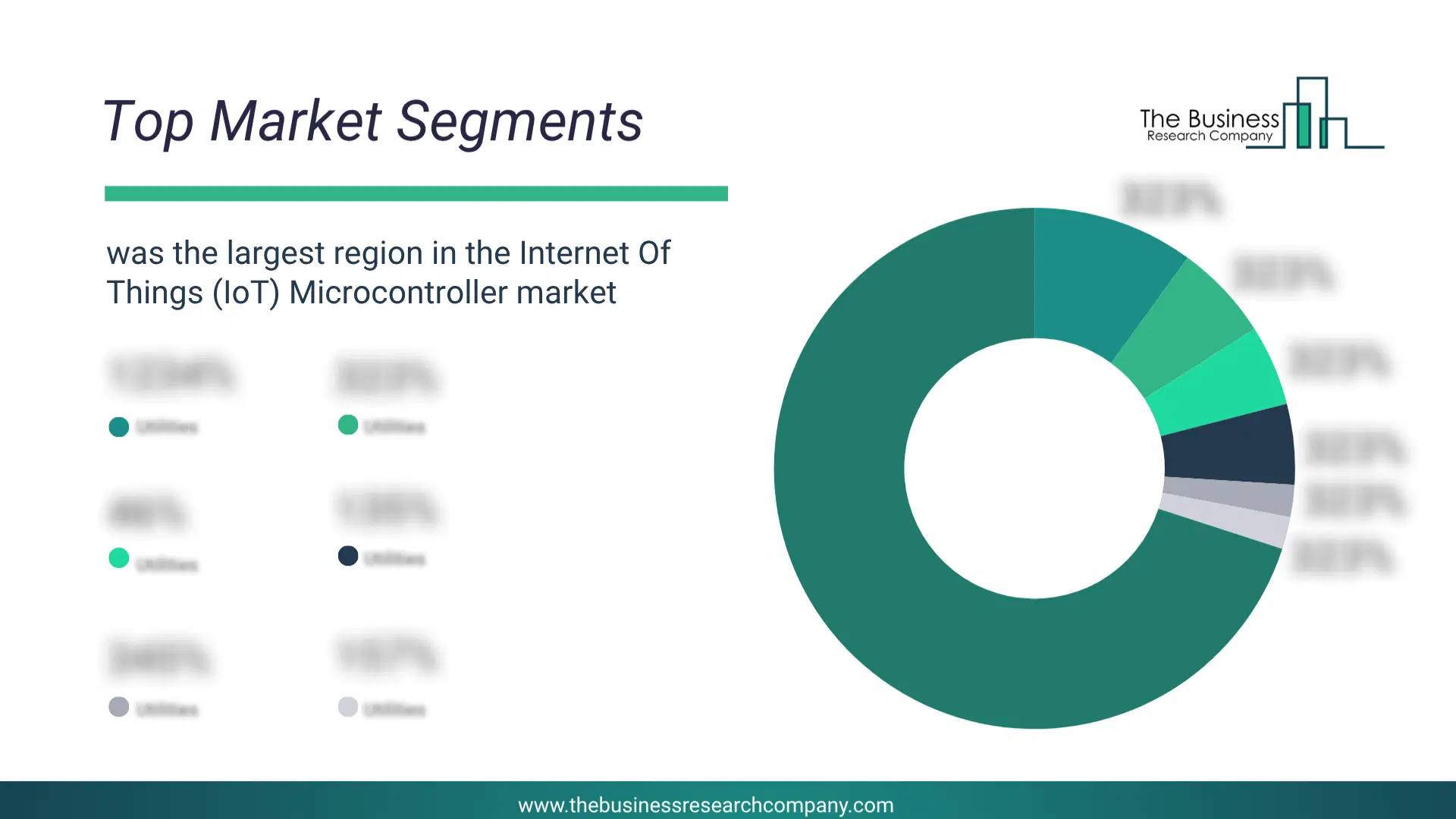
North America was the largest region in the internet of things (IoT) microcontroller market in 2025. Asia-Pacific is expected to be the fastest-growing region in the forecast period. The regions covered in this market report are Asia-Pacific, South East Asia, Western Europe, Eastern Europe, North America, South America, Middle East, Africa. The countries covered in this market report are Australia, Brazil, China, France, Germany, India, Indonesia, Japan, Taiwan, Russia, South Korea, UK, USA, Canada, Italy, Spain.What Defines the Internet Of Things (IoT) Microcontroller Market?
The internet of things (IoT) microcontroller market consists of revenues earned by entities by providing services such as microcontroller design, semiconductor manufacturing, firmware development, internet of things device integration, and wireless connectivity. The market value includes the value of related goods sold by the service provider or included within the service offering. The internet of things (IoT) microcontroller market also includes sales of development kits, power management units, security modules, and communication systems. Values in this market are ‘factory gate’ values, that is, the value of goods sold by the manufacturers or creators of the goods, whether to other entities (including downstream manufacturers, wholesalers, distributors, and retailers) or directly to end customers. The value of goods in this market includes related services sold by the creators of the goods.How is Market Value Defined and Measured?
The market value is defined as the revenues that enterprises gain from the sale of goods and/or services within the specified market and geography through sales, grants, or donations in terms of the currency (in USD unless otherwise specified). The revenues for a specified geography are consumption values that are revenues generated by organizations in the specified geography within the market, irrespective of where they are produced. It does not include revenues from resales along the supply chain, either further along the supply chain or as part of other products.
This chart presents market attractiveness based on a quantitative evaluation of growth, competition, strategic alignment, and risk, offering a clear view of opportunity areas for decision-making. This chart is for illustrative purposes; the full report contains the complete analysis.

This chart highlights the Total Addressable Market (TAM) by estimating the maximum revenue opportunity using an assumption-driven approach, supporting strategic planning and opportunity sizing across markets. The chart is illustrative; the full report provides a more comprehensive analysis.
What Key Data and Analysis Are Included in the Internet Of Things (IoT) Microcontroller Market Report 2026?
The internet of things (iot) microcontroller market research report is one of a series of new reports from The Business Research Company that provides market statistics, including industry global market size, regional shares, competitors with the market share, detailed market segments, market trends and opportunities, and any further data you may need to thrive in the internet of things (iot) microcontroller industry. The market research report delivers a complete perspective of everything you need, with an in-depth analysis of the current and future state of the industry.Internet Of Things (IoT) Microcontroller Market Report Forecast Analysis
| Report Attribute | Details |
|---|---|
| Market Size Value In 2026 | $7.46 billion |
| Revenue Forecast In 2030 | $12.71 billion |
| Growth Rate | CAGR of 14.2% from 2026 to 2030 |
| Base Year For Estimation | 2025 |
| Actual Estimates/Historical Data | 2020-2025 |
| Forecast Period | 2026 - 2030 |
| Market Representation | Revenue in USD Billion and CAGR from 2026 to 2030 |
| Segments Covered | Components, Product, Memory, Application |
| Regional Scope | Asia-Pacific, Western Europe, Eastern Europe, North America, South America, Middle East, Africa |
| Country Scope | The countries covered in the report are Australia, Brazil, China, France, Germany, India, Indonesia, Japan, Taiwan, Russia, South Korea, UK, USA, Canada, Italy, Spain. |
| Key Companies Profiled | Intel Corporation, Qualcomm Technologies Inc., Broadcom Inc., Advanced Micro Devices Inc., Texas Instruments Inc., MediaTek Inc., STMicroelectronics N.V., Infineon Technologies AG, NXP Semiconductors N.V., Analog Devices Inc., Renesas Electronics Corporation, Microchip Technology Incorporated, ON Semiconductor Corporation, Realtek Semiconductor Corporation, Nuvoton Technology Corporation, Silicon Laboratories, Nordic Semiconductor ASA, ELAN Microelectronics Corporation, Espressif Systems ShanghAI Co. Ltd., China Micro Semiconductor Co. Ltd., Holtek Semiconductor Inc., CML Microsystems Plc, Segger Microcontroller Systems GmbH. |
| Customization Scope | Request for Customization |
| Pricing And Purchase Options | Explore Purchase Options |