
Internet of Things (IoT) Node and Gateway Market Report 2026
Global Outlook – By Component (Sensors, Processor, Connectivity IC, Logic Devices, Memory Devices), By Application (Healthcare, Automotive And Transportation, Consumer Electronics, Industrial, Oil And Gas, Other Applications), By End User (Industrial, Consumer) – Market Size, Trends, Strategies, and Forecast to 2030
Internet of Things (IoT) Node and Gateway Market Overview
• Internet of Things (IoT) Node and Gateway market size has reached to $21.12 billion in 2025 • Expected to grow to $80.87 billion in 2030 at a compound annual growth rate (CAGR) of 30.7% • Growth Driver: 5G Technology Driving Growth In The Internet Of Things (IOT) Node And Gateway Market • Market Trend: Low Power Module Series To Provide A Solution For Long-Range IOT Applications • North America was the largest region in 2025.What Is Covered Under Internet of Things (IoT) Node and Gateway Market?
An IoT node and gateway refers to the physical device or technology that performs important tasks such as data security and filtering, connecting devices, and protocol conversion, among others. These devices and software serve as a point of contact for various peripheral systems, including controllers, clouds, devices, and sensors. The main components of the IoT node and gateway market are sensors, processors, connectivity IC, logic devices, and memory devices. Sensors use a gateway-based architecture to connect the nodes to the cloud servers. The different connectivity include ethernet, Wi-fi, Bluetooth, Zigbee, z-wave, and it, hers and is used in healthcare, automotive and transportation, consumer electronics, industrial, BFSI, oil and gas, aerospace and defense, and others. The various sectors include industrial and consumer.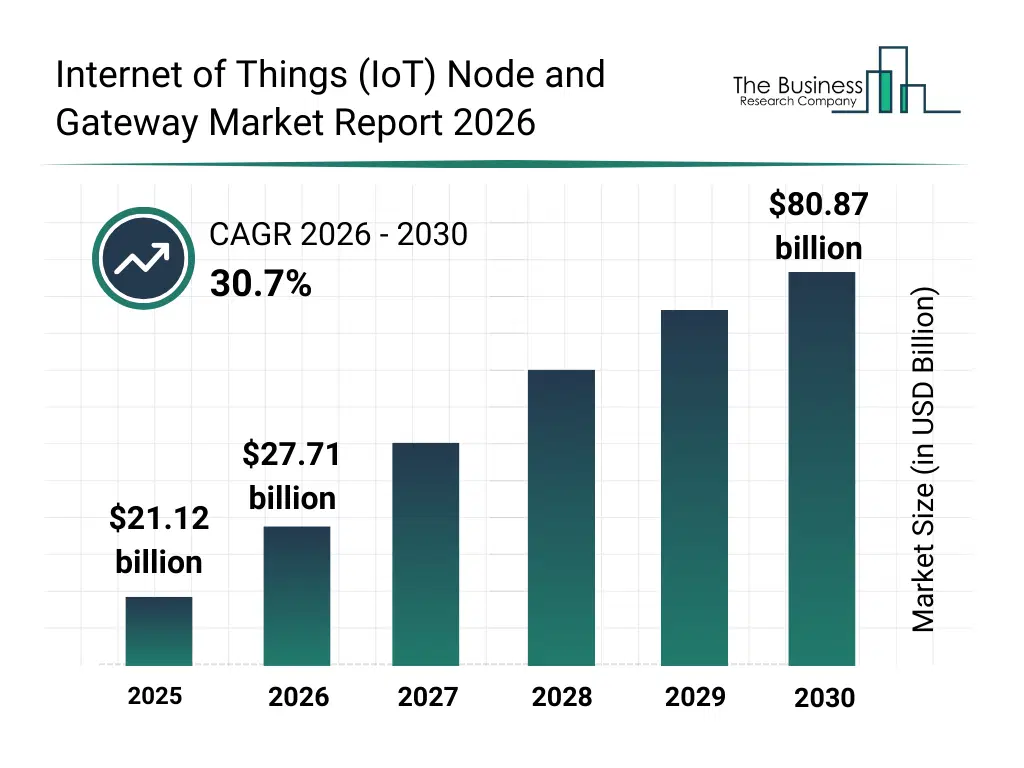
What Is The Internet of Things (IoT) Node and Gateway Market Size and Share 2026?
The internet of things (iot) node and gateway market size has grown exponentially in recent years. It will grow from $21.12 billion in 2025 to $27.71 billion in 2026 at a compound annual growth rate (CAGR) of 31.2%. The growth in the historic period can be attributed to expansion of connected device ecosystems, increasing adoption of wireless sensor networks, growth of industrial automation systems, rising demand for real-time data processing, availability of low-power connectivity modules.What Is The Internet of Things (IoT) Node and Gateway Market Growth Forecast?
The internet of things (iot) node and gateway market size is expected to see exponential growth in the next few years. It will grow to $80.87 billion in 2030 at a compound annual growth rate (CAGR) of 30.7%. The growth in the forecast period can be attributed to increasing adoption of edge computing architectures, rising demand for scalable iot deployments, growing focus on zero-trust security models, expansion of smart infrastructure projects, increasing use of ai-enabled gateway analytics. Major trends in the forecast period include increasing deployment of edge-based iot gateways, rising demand for secure protocol conversion devices, growing integration of multi-connectivity iot nodes, expansion of industrial iot network architectures, enhanced focus on device-level data security.
Global Internet of Things (IoT) Node and Gateway Market Segmentation
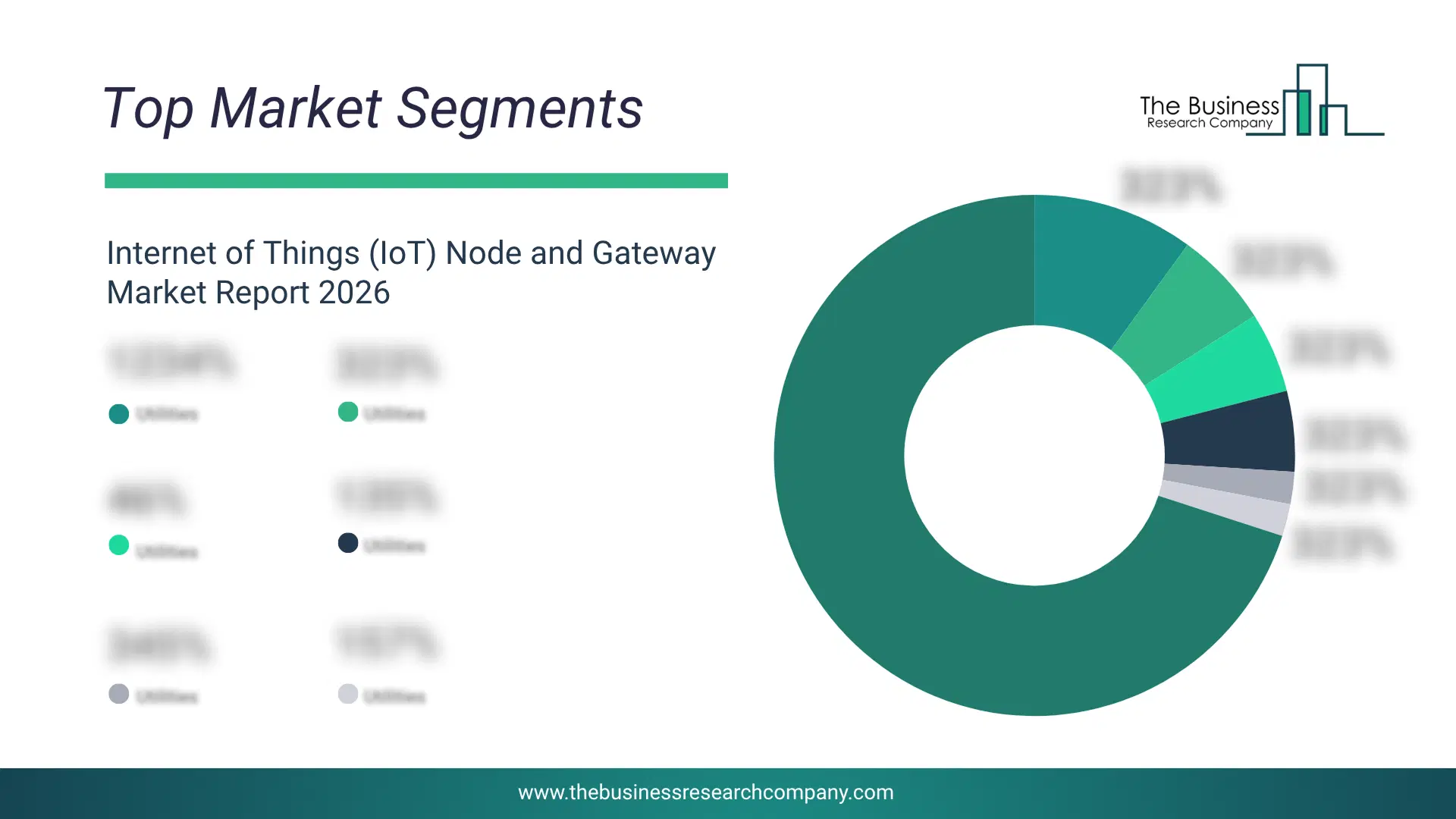
1) By Component: Sensors, Processor, Connectivity IC, Logic Devices, Memory Devices 2) By Application: Healthcare, Automotive And Transportation, Consumer Electronics, Industrial, Oil And Gas, Other Applications 3) By End User: Industrial, Consumer Subsegments: 1) By Sensors: Temperature Sensors, Pressure Sensors, Proximity Sensors, Motion Sensors, Environmental Sensors 2) By Processor: Microcontrollers (MCUs), Microprocessors, Application Processors 3) By Connectivity IC: Wi-Fi Modules, Bluetooth Modules, Zigbee Modules, Cellular Modules, LoRa Modules 4) By Logic Devices: FPGAs (Field-Programmable Gate Arrays), ASICs (Application-Specific Integrated Circuits) 5) By Memory Devices: RAM (Random Access Memory), Flash Memory, EEPROM (Electrically Erasable Programmable Read-Only Memory)What Is The Driver Of The Internet of Things (IoT) Node and Gateway Market?
The emergence of 5G technology is expected to propel the growth of the IoT node and gateway market in the forecast period. 5G enables more stable and faster secure connectivity. 5G's enhanced bandwidth enables more data to be transferred in a given amount of time, and its decreased latency lets data reach its destination faster. These networks provide increased coverage, which supports multiple network topologies, allowing IoT nodes and gateways to communicate easily. For instance, in September 2024, IoT Analytics GmbH, a Germany-based NGO, reported that the number of connected IoT devices reached 16.6 billion by the end of 2023, marking a 15% increase from the previous year. The organisation projects a further 13% growth, bringing the total to 18.8 billion by the end of 2024. Furthermore, the number of connected IoT devices is expected to soar to 40 billion by 2030, reflecting a substantial rise since the last market update in 2023. Therefore, the emergence of 5G technology propels the IoT node and gateway market growth.Key Players In The Global Internet of Things (IoT) Node and Gateway Market
Major companies operating in the internet of things (iot) node and gateway market are Dell Inc.; Advantech Co. Ltd.; TE Connectivity Ltd.; Cisco Systems Inc.; Aaeon Technology Inc.; Microchip Technology Inc.; Nexcom International Co. Ltd.; Helium System Inc.; Samsara Networks Inc.; STMicroelectronics N. V.; Eurotech S. P. A; Adlink Technology Inc.; Mitsubishi Electric Corporation; Lantronix Inc.; NXP Semiconductors N. V; The Hewlett Packard Enterprise Company; Arm Holdings plc; Intel Corporation; Huawei Technologies Co. Ltd.; Texas Instruments Incorporated; Estimote Inc.; Kontron S&T AG; Moxa Inc.; MultiTech Systems Inc.; NimbeLink LLC; Particle Industries Inc.; Red Lion Controls Inc.; Rigado LLC; Sierra Wireless Inc.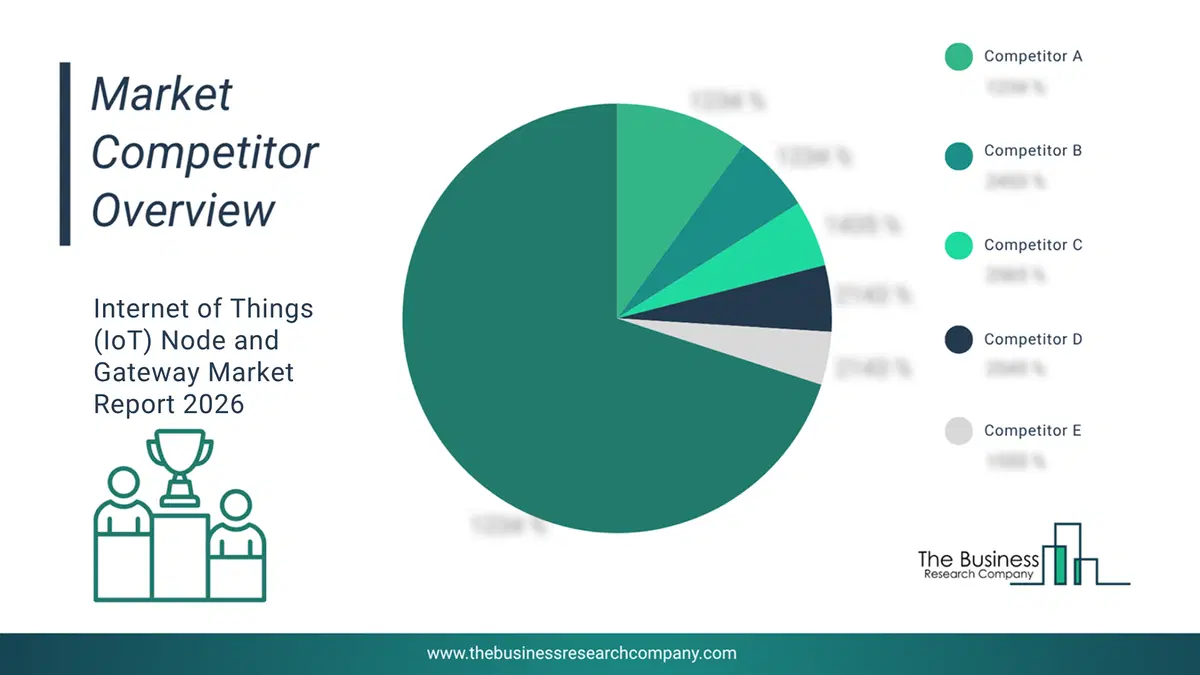
This chart is for illustrative purposes; the full report includes a detailed competitor analysis and comprehensive overview of the top 10 companies in the market.
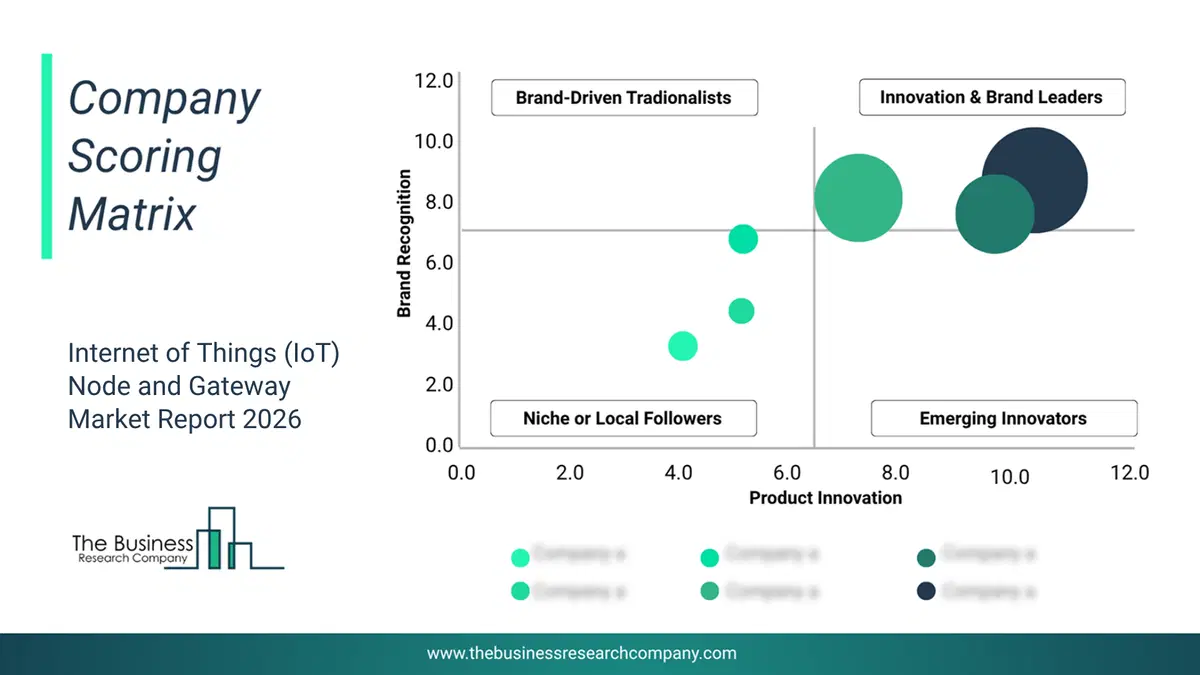
This chart maps companies by product innovation and brand strength, with bubble size indicating relative revenue, helping identify market leaders, challengers, and niche players. This is an illustrative chart; the full report provides a complete and accurate competitive analysis.
Global Internet of Things (IoT) Node and Gateway Market Trends and Insights
Major companies operating in the Internet of Things (IoT) node and gateway market are launching low-power modules to provide a solution for customers seeking low-power, long-range capabilities for long-range IoT applications. A low-power module in the Internet of Things (IoT) refers to a compact device with energy-efficient components that enable wireless communication and data processing for IoT nodes and gateways while consuming minimal power to extend battery life. For instance, in May 2023, Laird Connectivity, a US-based accredited EMC Test Facility specializing in wireless product testing, launched an RM126x series of LoRaWAN modules, offering a low-power, long-range solution for various challenging RF applications. RM126x LoRaWAN module series is a range of low-power, long-range wireless communication modules. They can operate in both hosted and hostless modes and are certified for use in different regions.What Are Latest Mergers And Acquisitions In The Internet of Things (IoT) Node and Gateway Market?
In January 2023, Semtech Corporation, a US-based supplier of analogue and mixed-signal semiconductors, acquired Sierra Wireless for $1.2 billion. Through this acquisition, Semtech Corporation aimed to create a comprehensive IoT platform by combining the strengths of LoRa and cellular technologies. Sierra Wireless is a Canada-based wireless communications equipment designer that provides IoT Gateway series for various industries.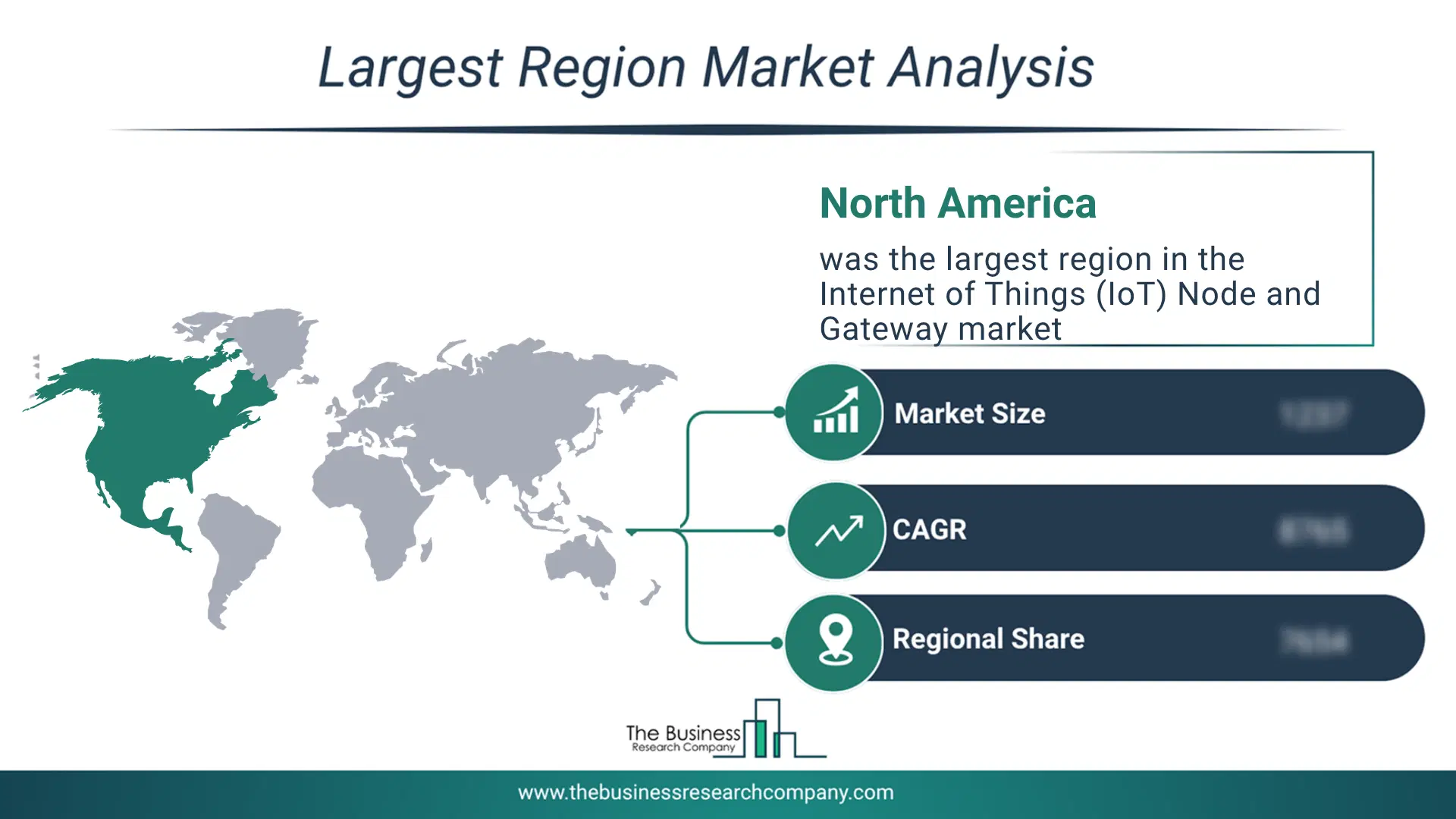
Regional Insights
North America was the largest region in the internet of things (IoT) node and gateway market in 2025. The regions covered in this market report are Asia-Pacific, South East Asia, Western Europe, Eastern Europe, North America, South America, Middle East, Africa. The countries covered in this market report are Australia, Brazil, China, France, Germany, India, Indonesia, Japan, Taiwan, Russia, South Korea, UK, USA, Canada, Italy, SpainWhat Defines the Internet of Things (IoT) Node and Gateway Market?
The internet of things (IoT) node and gateway market consist of sales of IoT node and gateway components that serve as the connection point between the sensors and intelligent devices, cloud and controllers, thus facilitating connections between different data sources and destinations. IoT node and gateway are used to facilitate communication with legacy or non-internet connected devices, data caching, buffering and streaming, pre-processing, cleansing, filtering, and optimization, data visualization, and others. Values in this market are 'factory gate' values, that is the value of goods sold by the manufacturers or creators of the goods, whether to other entities (including downstream manufacturers, wholesalers, distributors and retailers) or directly to end customers. The value of goods in this market includes related services sold by the creators of the goods.How is Market Value Defined and Measured?
The market value is defined as the revenues that enterprises gain from the sale of goods and/or services within the specified market and geography through sales, grants, or donations in terms of the currency (in USD unless otherwise specified). The revenues for a specified geography are consumption values that are revenues generated by organizations in the specified geography within the market, irrespective of where they are produced. It does not include revenues from resales along the supply chain, either further along the supply chain or as part of other products.
This chart presents market attractiveness based on a quantitative evaluation of growth, competition, strategic alignment, and risk, offering a clear view of opportunity areas for decision-making. This chart is for illustrative purposes; the full report contains the complete analysis.

This chart highlights the Total Addressable Market (TAM) by estimating the maximum revenue opportunity using an assumption-driven approach, supporting strategic planning and opportunity sizing across markets. The chart is illustrative; the full report provides a more comprehensive analysis.
What Key Data and Analysis Are Included in the Internet of Things (IoT) Node and Gateway Market Report 2026?
The internet of things (iot) node and gateway market research report is one of a series of new reports from The Business Research Company that provides market statistics, including industry global market size, regional shares, competitors with the market share, detailed market segments, market trends and opportunities, and any further data you may need to thrive in the internet of things (iot) node and gateway industry. The market research report delivers a complete perspective of everything you need, with an in-depth analysis of the current and future state of the industry.Internet of Things (IoT) Node and Gateway Market Report Forecast Analysis
| Report Attribute | Details |
|---|---|
| Market Size Value In 2026 | $27.71 billion |
| Revenue Forecast In 2030 | $80.87 billion |
| Growth Rate | CAGR of 30.7% from 2026 to 2030 |
| Base Year For Estimation | 2025 |
| Actual Estimates/Historical Data | 2020-2025 |
| Forecast Period | 2026 - 2030 |
| Market Representation | Revenue in USD Billion and CAGR from 2026 to 2030 |
| Segments Covered | Component, Application, End User |
| Regional Scope | Asia-Pacific, Western Europe, Eastern Europe, North America, South America, Middle East, Africa |
| Country Scope | The Countries Covered In This Market Report Are Australia, Brazil, China, France, Germany, India, Indonesia, Japan, Taiwan, Russia, South Korea, Uk, Usa, Canada, Italy, Spain. |
| Key Companies Profiled | Dell Inc., Advantech Co. Ltd., TE Connectivity Ltd., Cisco Systems Inc., Aaeon Technology Inc., Microchip Technology Inc., Nexcom International Co. Ltd., Helium System Inc., Samsara Networks Inc., STMicroelectronics N. V., Eurotech S. P. A, Adlink Technology Inc., Mitsubishi Electric Corporation, Lantronix Inc., NXP Semiconductors N. V, The Hewlett Packard Enterprise Company, Arm Holdings plc, Intel Corporation, Huawei Technologies Co. Ltd., Texas Instruments Incorporated, Estimote Inc., Kontron S&T AG, Moxa Inc., MultiTech Systems Inc., NimbeLink LLC, Particle Industries Inc., Red Lion Controls Inc., Rigado LLC, Sierra Wireless Inc. |
| Customization Scope | Request for Customization |
| Pricing And Purchase Options | Explore Purchase Options |