
Internet Of Things (IoT) Precision Agriculture Sensors Market Report 2026
Global Outlook – By Component (Hardware, Software, Services), By Farm Type (Large Farms, Mid Sized Farms, Small Farms), By Connectivity (Long Range Wide Area Network, Cellular, Satellite, Wireless Fidelity And Zigbee), By Application (Field Crop Monitoring, Irrigation Management, Greenhouse Automation, Livestock Management, Precision Spraying And Fertilization), By End Use (Individual Farmers, Agricultural Cooperatives, Research Institutions) – Market Size, Trends, Strategies, and Forecast to 2030
Internet Of Things (IoT) Precision Agriculture Sensors Market Overview
• Internet Of Things (IoT) Precision Agriculture Sensors market size has reached to $5.34 billion in 2025 • Expected to grow to $14.19 billion in 2030 at a compound annual growth rate (CAGR) of 21.5% • Growth Driver: Surge In Crop Productivity Fueling The Growth Of The Market Due To Advanced Farming Technologies Increasing Yield Efficiency • Market Trend: High Precision GNSS Smart Antenna Receivers Improve Positioning Accuracy in IoT Precision Agriculture • North America was the largest region in 2025 and Asia-Pacific is the fastest growing region.What Is Covered Under Internet Of Things (IoT) Precision Agriculture Sensors Market?
Internet of Things (IoT) precision agriculture sensors refer to connected devices that collect real-time data from agricultural environments such as soil, crops, weather, and livestock conditions. These sensors transmit the gathered information through IoT networks to enable continuous monitoring and data-driven insights for improving agricultural efficiency and productivity. Internet of Things (IoT) precision agriculture sensors support optimized decision-making by enabling accurate measurement of environmental and field parameters, reducing resource waste, and enhancing farm management practices. The main components of internet of things (IoT) precision agriculture sensors include hardware, software, and services. Hardware refers to connected sensing devices such as soil, weather, crop, and livestock sensors that collect real-time agricultural data to support precision farming decisions. These solutions are designed for large farms, mid sized farms, and small farms and utilize connectivity technologies including long range wide area network, cellular, satellite, and wireless fidelity and Zigbee. The various applications involved are field crop monitoring, irrigation management, greenhouse automation, livestock management, and precision spraying and fertilization, and they are used by several end uses such as individual farmers, agricultural cooperatives, and research institutions.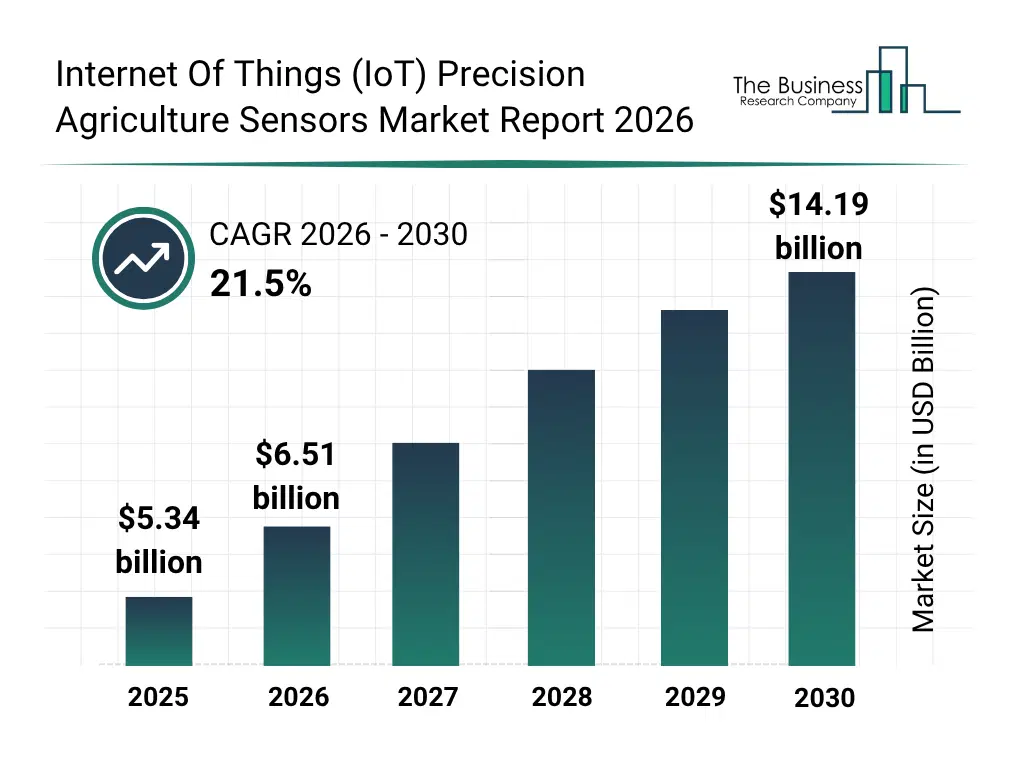
What Is The Internet Of Things (IoT) Precision Agriculture Sensors Market Size and Share 2026?
The internet of things (IOT) precision agriculture sensors market size has grown exponentially in recent years. It will grow from $5.34 billion in 2025 to $6.51 billion in 2026 at a compound annual growth rate (CAGR) of 21.9%. The growth in the historic period can be attributed to growing adoption of precision farming practices, increasing demand for higher crop productivity, rising concerns over water conservation, expansion of smart farming initiatives, government support for digital agriculture.What Is The Internet Of Things (IoT) Precision Agriculture Sensors Market Growth Forecast?
The internet of things (IOT) precision agriculture sensors market size is expected to see exponential growth in the next few years. It will grow to $14.19 billion in 2030 at a compound annual growth rate (CAGR) of 21.5%. The growth in the forecast period can be attributed to increasing adoption of autonomous farming equipment, growing investments in connected agriculture infrastructure, rising demand for climate-resilient farming solutions, expanding deployment of advanced agricultural analytics, increasing need for efficient livestock monitoring. Major trends in the forecast period include increasing adoption of multi-parameter agricultural sensors, growing deployment of real-time farm monitoring systems, rising demand for remote crop and livestock monitoring, expansion of sensor-based precision irrigation solutions, increasing integration of predictive farm management platforms.
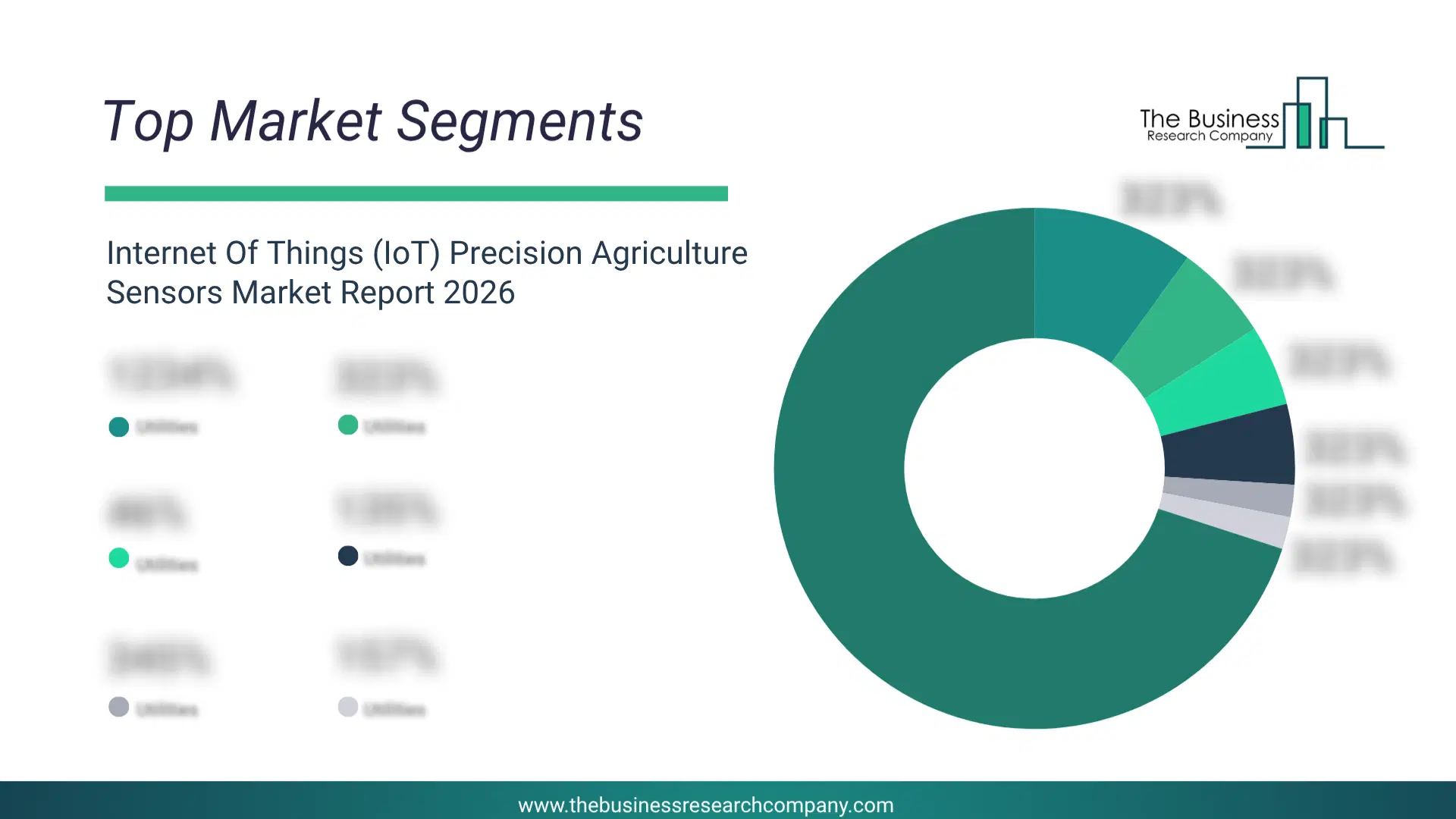
Global Internet Of Things (IoT) Precision Agriculture Sensors Market Segmentation
2) By Farm Type: Large Farms, Mid Sized Farms, Small Farms 3) By Connectivity: Long Range Wide Area Network, Cellular, Satellite, Wireless Fidelity And Zigbee 4) By Application: Field Crop Monitoring, Irrigation Management, Greenhouse Automation, Livestock Management, Precision Spraying And Fertilization 5) By End Use: Individual Farmers, Agricultural Cooperatives, Research Institutions Subsegments: 1) By Hardware: Soil Sensors, Weather Monitoring Stations, Crop Monitoring Sensors, Livestock Monitoring Devices, Irrigation Control Devices, Connectivity Modules 2) By Software: Farm Management Software, Device Management Platforms, Data Analytics Platforms, Predictive Analytics Platforms, Cloud Based Platforms 3) By Services: Installation And Integration Services, Deployment Services, Consulting Services, Training And Education Services, Maintenance And Support Services, Managed ServicesWhat Is The Driver Of The Internet Of Things (IoT) Precision Agriculture Sensors Market?
The increasing crop productivity is expected to propel the growth of the Internet of Things (IoT) precision agriculture sensors market going forward. Crop productivity refers to the amount of agricultural output produced per unit of land over a given period. Increasing crop productivity is driven by the growing adoption of precision agriculture technologies that optimize resource use, improve farming efficiency, and enhance crop yields. Internet of Things (IoT) precision agriculture sensors help crop productivity by continuously monitoring soil moisture, nutrient levels, and weather conditions in real time, enabling farmers to make data-driven decisions that optimize irrigation, fertilization, and crop management for higher yields. For instance, in March 2026, according to the Australian Bureau of Statistics, an Australia-based government department, Australia’s 2024–25 winter broadacre crops totaled 61.1 million tonnes worth $22.5 billion, including 34.8 million tonnes of wheat, an increase of 6.8 million tonnes. Therefore, the increasing crop productivity is driving the growth of the Internet of Things (IoT) precision agriculture sensors industry.Key Players In The Global Internet Of Things (IoT) Precision Agriculture Sensors Market
Major companies operating in the internet of things (iot) precision agriculture sensors market are Semtech Corporation, Phytech Ltd., Ag Leader Technology Inc., xFarm Technologies S.r.l., Semios Technologies Inc., METER Group Inc. USA, Davis Instruments Corporation, CropX Technologies Ltd., Libelium Comunicaciones Distribuidas S.L., Monnit Corporation, PsiBorg Technologies Private Limited, Arable Labs Inc., GroPoint Environmental Systems Ltd., Saturas Ltd., Pycno Ltd., Acclima Inc., AquaSpy Inc., Vegetronix Inc., Sol Chip Ltd., Cynomys S.A.S., Robert Bosch GmbH, Sentek Technologies, Trimble Inc.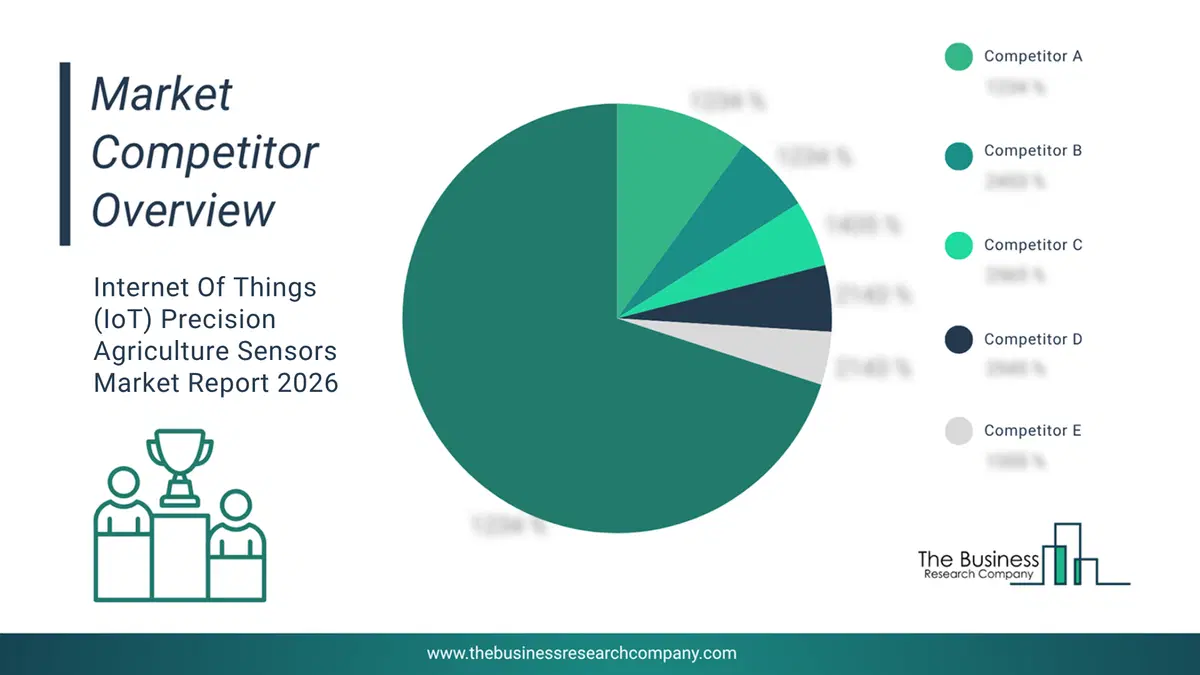
This chart is for illustrative purposes; the full report includes a detailed competitor analysis and comprehensive overview of the top 10 companies in the market.
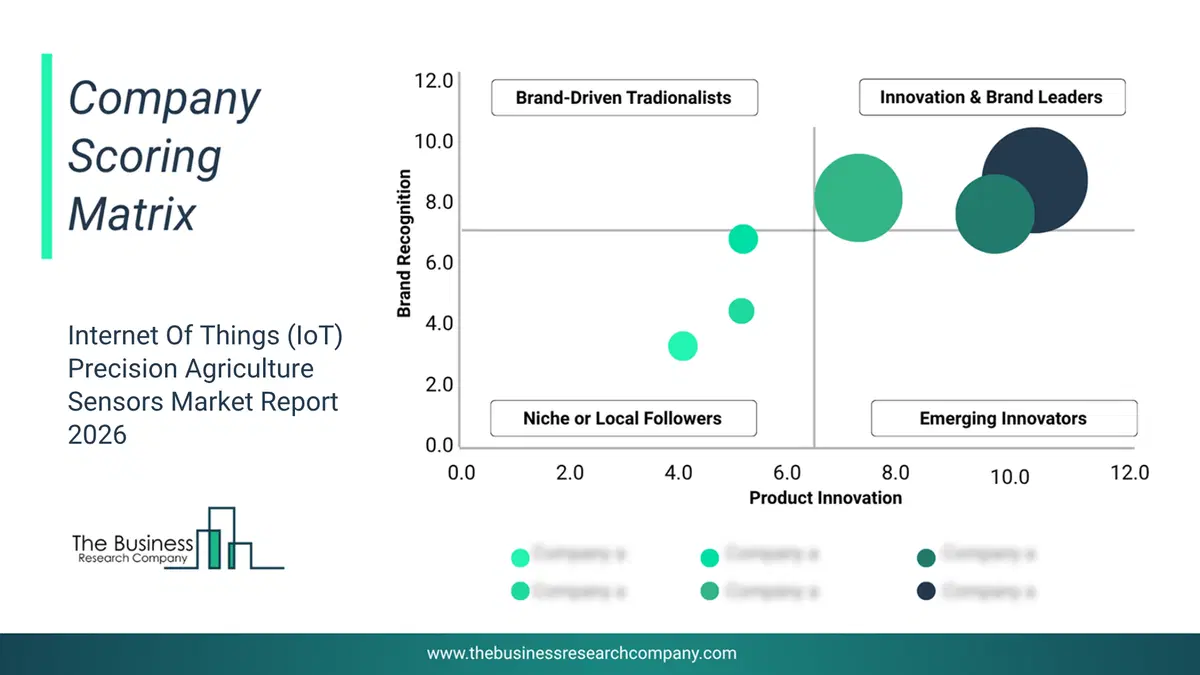
This chart maps companies by product innovation and brand strength, with bubble size indicating relative revenue, helping identify market leaders, challengers, and niche players. This is an illustrative chart; the full report provides a complete and accurate competitive analysis.
Global Internet Of Things (IoT) Precision Agriculture Sensors Market Trends and Insights
Major companies operating in the IoT precision agriculture sensors market are focusing on developing advanced solutions, such as dual-band GNSS smart antenna receivers, to improve positioning accuracy, enable precise field operations, and enhance the performance of connected agricultural equipment. A dual-band GNSS smart antenna receiver is an integrated positioning device that simultaneously receives multiple satellite frequency bands to deliver highly accurate real-time location data for precision farming applications. For instance, in September 2024, Quectel Wireless Solutions, a China-based IoT solutions provider, launched the QLM29H series GNSS smart antenna receiver. The solution combines a dual-band multi-constellation GNSS module with an integrated antenna to provide meter-level autonomous positioning and centimeter-level real-time kinematic (RTK) accuracy. Designed for applications including precision agriculture and tractor steering systems, it simplifies system integration while improving positioning reliability and operational efficiency in smart farming environments.What Are Latest Mergers And Acquisitions In The Internet Of Things (IoT) Precision Agriculture Sensors Market?
In September 2024, CropX Technologies Ltd., an Israel-based agri-tech company, acquired EnGeniousAg LLC for an undisclosed amount. Through this acquisition, CropX strengthened its precision agriculture platform by integrating advanced nitrogen sensing technology, enabling more accurate soil nutrient monitoring, improved fertilizer management, and enhanced data-driven decision-making for farmers. EnGeniousAg LLC is a US-based agricultural technology company that develops advanced nitrogen-sensing solutions for precision agriculture.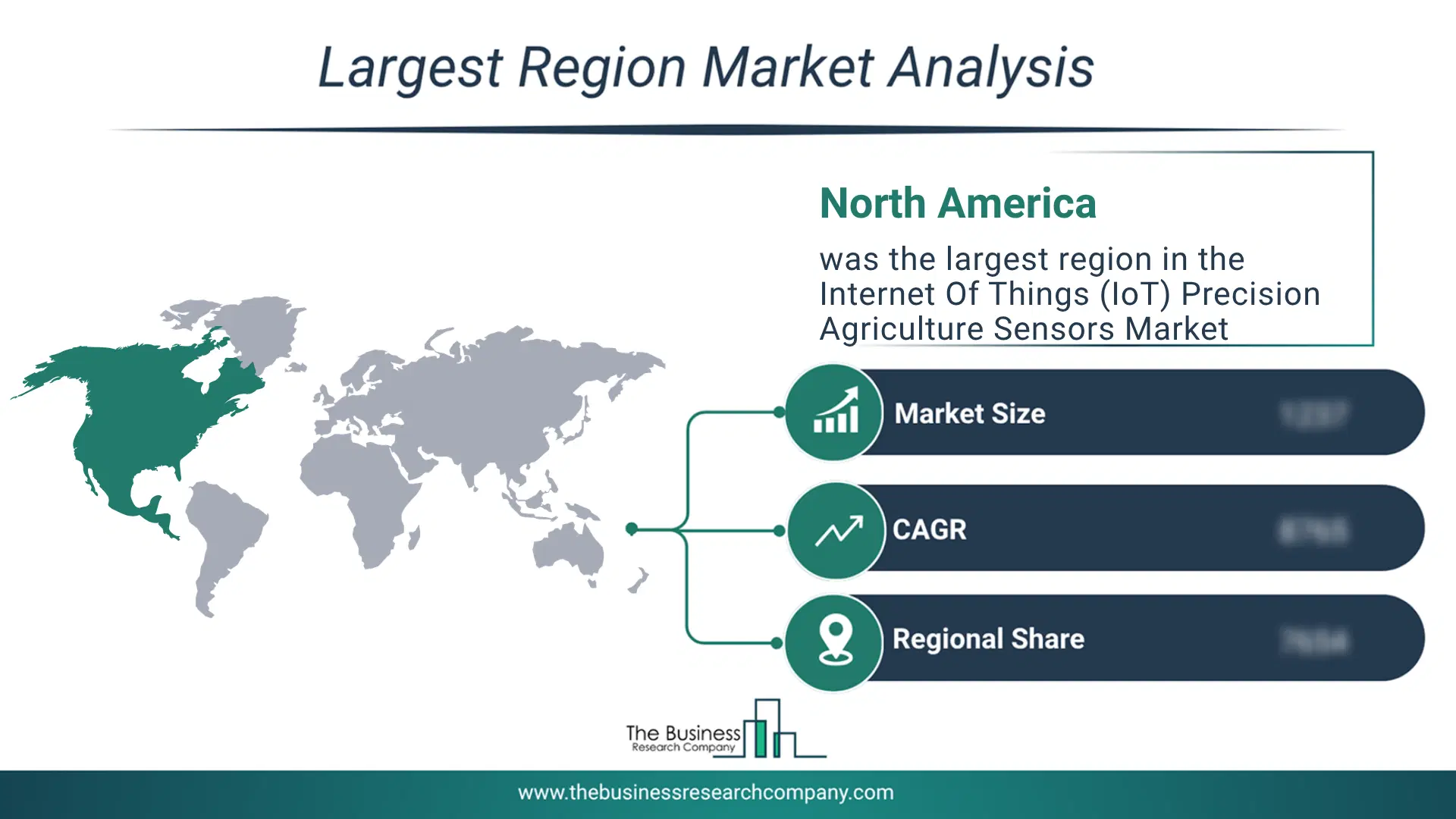
Regional Outlook/Insights
North America was the largest region in the internet of things (IoT) precision agriculture sensors market in 2025. Asia-Pacific is expected to be the fastest-growing region in the forecast period. The regions covered in this market report are Asia-Pacific, South East Asia, Western Europe, Eastern Europe, North America, South America, Middle East, Africa. The countries covered in this market report are Australia, Brazil, China, France, Germany, India, Indonesia, Japan, Taiwan, Russia, South Korea, UK, USA, Canada, Italy, Spain.What Defines the Internet Of Things (IoT) Precision Agriculture Sensors Market?
The Internet of Things (IoT) precision agriculture sensors market consists of revenues earned by entities by providing services such as software as a service (saas) for agriculture, real-time alert services, and agricultural consulting services. The market value includes the value of related goods sold by the service provider or included within the service offering. The Internet of Things (IoT) precision agriculture sensors market also includes sales of gateway devices for data transmission, edge computing devices, and drone-based agricultural sensing systems. Values in this market are ‘factory gate’ values, that is, the value of goods sold by the manufacturers or creators of the goods, whether to other entities (including downstream manufacturers, wholesalers, distributors, and retailers) or directly to end customers. The value of goods in this market includes related services sold by the creators of the goods.How is Market Value Defined and Measured?
The market value is defined as the revenues that enterprises gain from the sale of goods and/or services within the specified market and geography through sales, grants, or donations in terms of the currency (in USD unless otherwise specified). The revenues for a specified geography are consumption values that are revenues generated by organizations in the specified geography within the market, irrespective of where they are produced. It does not include revenues from resales along the supply chain, either further along the supply chain or as part of other products.
This chart presents market attractiveness based on a quantitative evaluation of growth, competition, strategic alignment, and risk, offering a clear view of opportunity areas for decision-making. This chart is for illustrative purposes; the full report contains the complete analysis.

This chart highlights the Total Addressable Market (TAM) by estimating the maximum revenue opportunity using an assumption-driven approach, supporting strategic planning and opportunity sizing across markets. The chart is illustrative; the full report provides a more comprehensive analysis.
What Key Data and Analysis Are Included in the Internet Of Things (IoT) Precision Agriculture Sensors Market Report 2026?
The internet of things (iot) precision agriculture sensors market research report is one of a series of new reports from The Business Research Company that provides internet of things (iot) precision agriculture sensors market statistics, including internet of things (iot) precision agriculture sensors industry global market size, regional shares, competitors with a internet of things (iot) precision agriculture sensors market share, detailed internet of things (iot) precision agriculture sensors market segments, market trends and opportunities, and any further data you may need to thrive in the internet of things (iot) precision agriculture sensors industry. This internet of things (iot) precision agriculture sensors market research report delivers a complete perspective of everything you need, with an in-depth analysis of the current and future scenario of the industry.Internet Of Things (IoT) Precision Agriculture Sensors Market Report Forecast Analysis
| Report Attribute | Details |
|---|---|
| Market Size Value In 2026 | $6.51 billion |
| Revenue Forecast In 2030 | $14.19 billion |
| Growth Rate | CAGR of 21.5% from 2026 to 2030 |
| Base Year For Estimation | 2025 |
| Actual Estimates/Historical Data | 2020-2025 |
| Forecast Period | 2026 - 2030 |
| Market Representation | Revenue in USD Billion and CAGR from 2026 to 2030 |
| Segments Covered | Component, Farm Type, Connectivity, Application, End Use |
| Regional Scope | Asia-Pacific, Western Europe, Eastern Europe, North America, South America, Middle East, Africa |
| Country Scope | The countries covered in the report are Australia, Brazil, China, France, Germany, India, Indonesia, Japan, Taiwan, Russia, South Korea, UK, USA, Canada, Italy, Spain. |
| Key Companies Profiled | Semtech Corporation, Phytech Ltd., Ag Leader Technology Inc., xFarm Technologies S.r.l., Semios Technologies Inc., METER Group Inc. USA, Davis Instruments Corporation, CropX Technologies Ltd., Libelium Comunicaciones Distribuidas S.L., Monnit Corporation, PsiBorg Technologies Private Limited, Arable Labs Inc., GroPoint Environmental Systems Ltd., Saturas Ltd., Pycno Ltd., Acclima Inc., AquaSpy Inc., Vegetronix Inc., Sol Chip Ltd., Cynomys S.A.S., Robert Bosch GmbH, Sentek Technologies, Trimble Inc. |
| Customization Scope | Request for Customization |
| Pricing And Purchase Options | Explore Purchase Options |