
Interstitial Cystitis Drugs Market Report 2026
Global Outlook – By Drugs (Pentosan Polysulfate Sodium, Dimethyl Sulfoxide, Other Drugs), By Type (Oral Therapy, Intravesical Therapy), By Distribution Channel (Hospital Pharmacies, Retail Pharmacies, Online Pharmacies) – Market Size, Trends, Strategies, and Forecast to 2030
Interstitial Cystitis Drugs Market Overview
• Interstitial Cystitis Drugs market size has reached to $1.44 billion in 2025 • Expected to grow to $1.82 billion in 2030 at a compound annual growth rate (CAGR) of 4.8% • Growth Driver: Rising Incidence Of Chronic Diseases Boosts The Interstitial Cystitis Drug Market • North America was the largest region in 2025 and Asia-Pacific is the fastest growing region.What Is Covered Under Interstitial Cystitis Drugs Market?
Interstitial cystitis drugs are medications used to relieve the symptoms of interstitial cystitis, a chronic inflammation of the bladder that causes people to urinate frequently and painfully. It is caused by bladder inflammation, dysfunction of the protective bladder lining, and potential contributions from genetics, autoimmune reactions, and environmental triggers. The main types of interstitial cystitis drugs are pentosan polysulfate sodium, dimethyl sulfoxide, and others. Pentosan polysulfate sodium is a synthetic drug that acts as a mucosal protector and has anti-inflammatory properties. Various types of therapy include oral therapy and intravesical therapy, which are sold through various distribution channels, such as hospital pharmacies, retail pharmacies, and online pharmacies.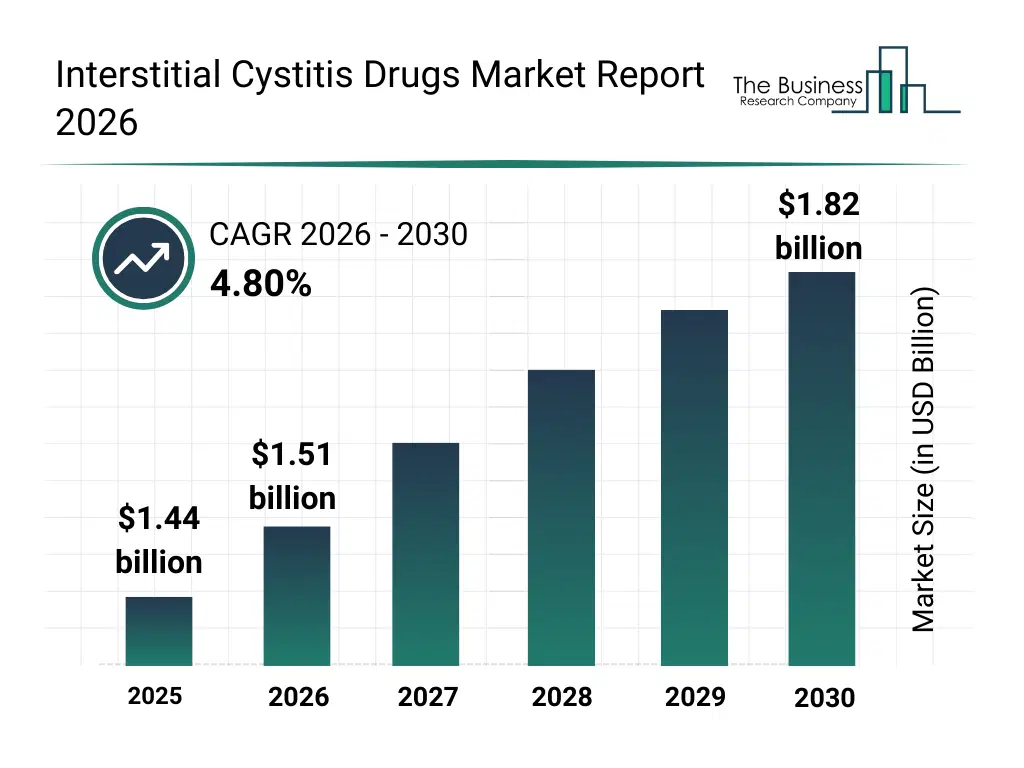
What Is The Interstitial Cystitis Drugs Market Size and Share 2026?
The interstitial cystitis drugs market size has grown steadily in recent years. It will grow from $1.44 billion in 2025 to $1.51 billion in 2026 at a compound annual growth rate (CAGR) of 4.8%. The growth in the historic period can be attributed to limited awareness of ic, reliance on conventional therapies, high prevalence of misdiagnosis, restricted r&d funding, low adoption of intravesical therapy.What Is The Interstitial Cystitis Drugs Market Growth Forecast?
The interstitial cystitis drugs market size is expected to see steady growth in the next few years. It will grow to $1.82 billion in 2030 at a compound annual growth rate (CAGR) of 4.8%. The growth in the forecast period can be attributed to growing adoption of targeted therapies, increasing investment in ic research, rising prevalence of bladder disorders, technological advancements in drug delivery, expansion of healthcare infrastructure. Major trends in the forecast period include personalized treatment approaches, minimally invasive drug delivery, combination therapy development, enhanced bladder lining repair therapies, increased focus on symptom management.
Global Interstitial Cystitis Drugs Market Segmentation
1) By Drugs: Pentosan Polysulfate Sodium, Dimethyl Sulfoxide, Other Drugs 2) By Type: Oral Therapy, Intravesical Therapy 3) By Distribution Channel: Hospital Pharmacies, Retail Pharmacies, Online Pharmacies Subsegments: 1) By Pentosan Polysulfate Sodium: Oral Pentosan Polysulfate Sodium, Injectable Pentosan Polysulfate Sodium 2) By Dimethyl Sulfoxide (DMSO): Intravesical DMSO (Bladder Instillation) 3) By Other Drugs: Amitriptyline, Hydroxyzine, Cimetidine, GabapentinWhat Are The Drivers Of The Interstitial Cystitis Drugs Market?
The rising incidence of chronic diseases is expected to propel the growth of the interstitial cystitis drug market going forward. Chronic diseases refer to long-term health conditions that persist over an extended period, often for a person's lifetime. Cystitis drugs treat urinary tract infections by targeting and eliminating the bacteria responsible for the infection. The drugs eliminate the underlying infection in the urinary tract, alleviating symptoms such as painful urination, frequent urination, and urgency caused by various chronic diseases such as urinary tract infections (UTIs). For instance, in January 2023, according to the National Institute of Health, a US-based public health research agency, urinary tract infections were responsible for over 1 million visits to emergency departments in the US, making them the seventh most common reason for such visits. Of these cases, 22% (220,000) were considered complicated urinary tract infections (UTIs), and around 100,000 patients were admitted to hospitals annually. Therefore, the rising incidence of chronic diseases is driving the growth of the interstitial cystitis drug industry. The increase in pharmaceutical drug production is expected to propel the growth of the interstitial cystitis drug market going forward. Drug production encompasses the manufacturing process of pharmaceutical products, which involves the synthesis, formulation, and packaging of medications designed for therapeutic purposes. Several factors drive the demand for drug production in the pharmaceutical industry, such as the aging population, research and development, health initiatives, and generic drug demand. Drug production enhances treatment options for interstitial cystitis by developing innovative therapies that meet the growing demand for effective medications driven by increased awareness and diagnosis. Improved manufacturing capabilities enable rapid responses to market needs, ensuring patients have access to the latest treatments. For instance, in June 2023, according to the European Federation of Pharmaceutical Industries and Associations (EFPIA), a Belgium-based trade association that represents the pharmaceutical industry in Europe, the total pharmaceutical production in Europe accounted for €390,000 million ($422,803 million) in 2023, up from €363,300 million ($393,857 million) in 2022. Therefore, the rising incidence of chronic diseases is driving the growth of the interstitial cystitis drug industry. The rise in aging population is expected to drive the growth of the interstitial cystitis drug market going forward. An aging population refers to a growing proportion of older individuals within a society due to increased life expectancy and declining birth rates. The aging population is increasing due to advancements in healthcare that have extended life expectancy. Interstitial cystitis drugs help the aging population by reducing chronic bladder pain and improving urinary comfort to enhance daily quality of life. For instance, in January 2024, according to the Population Reference Bureau, a US-based non-profit organization, reported that the number of Americans aged 65 and older is expected to rise from 58 million in 2022 to 82 million by 2050, marking a 47% increase. As a result, this age group’s proportion of the total U.S. population will grow from 17% to 23% during this period. Therefore, the rise in aging population is driving the growth of the interstitial cystitis drug industry.Key Players In The Global Interstitial Cystitis Drugs Market
Major companies operating in the interstitial cystitis drugs market are Pfizer Inc., Johnson & Johnson , Merck & Co. Inc., AbbVie Inc., Bayer AG, Novartis AG, Sanofi SA, GlaxoSmithKline PLC, Eli Lilly and Company, Amgen Inc., Viatris Inc., Teva Pharmaceutical Industries Ltd., Astellas Pharma Inc., Boehringer Ingelheim International GmbH, UCB S.A., Sun Pharmaceutical Industries Ltd., Perrigo Company PLC, Cipla Limited, Ferring B.V., Grunenthal Pharma, Kyorin Pharmaceutical Co. Ltd, Seikagaku Corporation, UroGen Pharma, Alivio Therapeutics, Lipella Pharmaceuticals, GlycoMira Therapeutics Inc.
This chart is for illustrative purposes; the full report includes a detailed competitor analysis and comprehensive overview of the top 10 companies in the market.
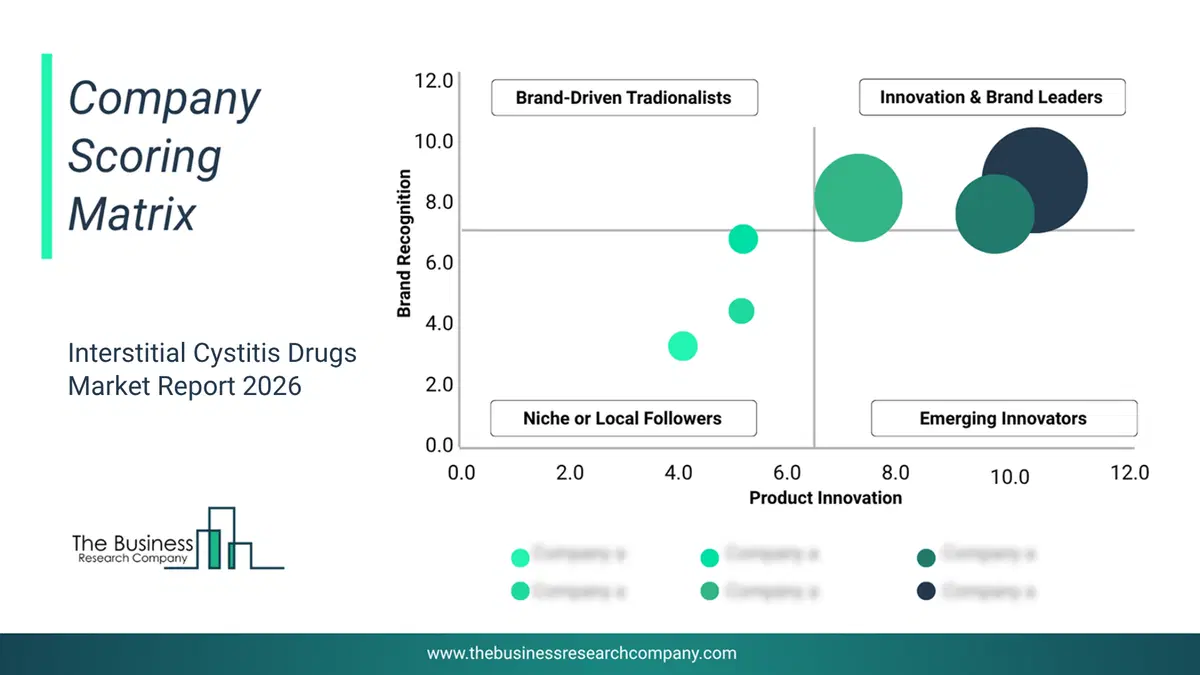
This chart maps companies by product innovation and brand strength, with bubble size indicating relative revenue, helping identify market leaders, challengers, and niche players. This is an illustrative chart; the full report provides a complete and accurate competitive analysis.
Regional Insights
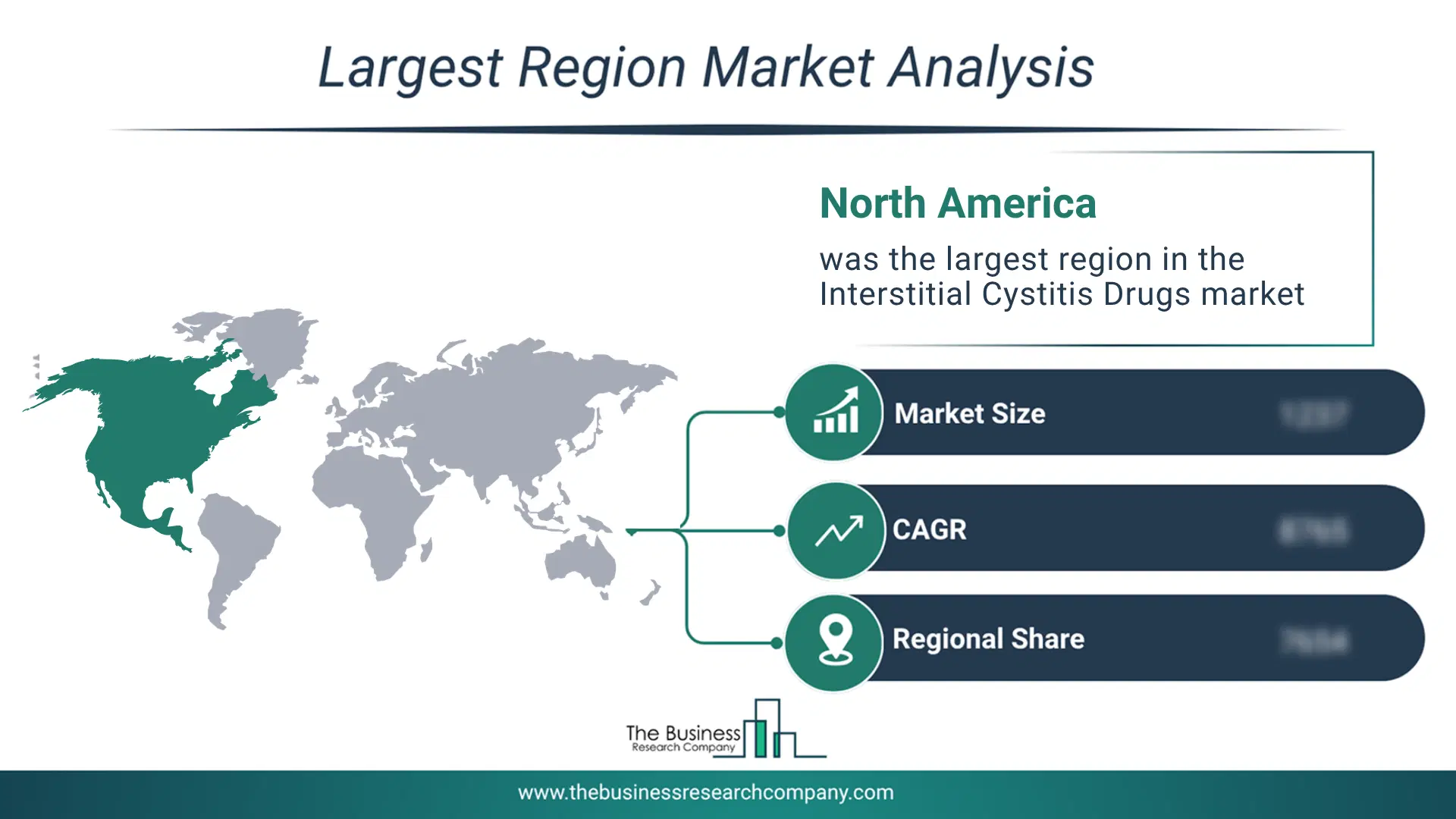
North America was the largest region in the interstitial cystitis drugs market in 2025. Asia-Pacific is expected to be the fastest-growing region in the forecast period. The regions covered in this market report are Asia-Pacific, South East Asia, Western Europe, Eastern Europe, North America, South America, Middle East, Africa. The countries covered in this market report are Australia, Brazil, China, France, Germany, India, Indonesia, Japan, Taiwan, Russia, South Korea, UK, USA, Canada, Italy, Spain.What Defines the Interstitial Cystitis Drugs Market?
The interstitial cystitis drugs market consists of revenues earned by entities by providing physical therapy, topical medications and immunomodulators. The market value includes the value of related goods sold by the service provider or included within the service offering. The interstitial cystitis drugs market also includes of sales of analgesics, pain relievers, oral supplements, and bladder kits. Values in this market are ‘factory gate’ values, that is, the value of goods sold by the manufacturers or creators of the goods, whether to other entities (including downstream manufacturers, wholesalers, distributors, and retailers) or directly to end customers. The value of goods in this market includes related services sold by the creators of the goods.How is Market Value Defined and Measured?
The market value is defined as the revenues that enterprises gain from the sale of goods and/or services within the specified market and geography through sales, grants, or donations in terms of the currency (in USD unless otherwise specified). The revenues for a specified geography are consumption values that are revenues generated by organizations in the specified geography within the market, irrespective of where they are produced. It does not include revenues from resales along the supply chain, either further along the supply chain or as part of other products.
This chart presents market attractiveness based on a quantitative evaluation of growth, competition, strategic alignment, and risk, offering a clear view of opportunity areas for decision-making. This chart is for illustrative purposes; the full report contains the complete analysis.

This chart highlights the Total Addressable Market (TAM) by estimating the maximum revenue opportunity using an assumption-driven approach, supporting strategic planning and opportunity sizing across markets. The chart is illustrative; the full report provides a more comprehensive analysis.
What Key Data and Analysis Are Included in the Interstitial Cystitis Drugs Market Report 2026?
The interstitial cystitis drugs market research report is one of a series of new reports from The Business Research Company that provides market statistics, including industry global market size, regional shares, competitors with the market share, detailed market segments, market trends and opportunities, and any further data you may need to thrive in the interstitial cystitis drugs industry. The market research report delivers a complete perspective of everything you need, with an in-depth analysis of the current and future state of the industry.Interstitial Cystitis Drugs Market Report Forecast Analysis
| Report Attribute | Details |
|---|---|
| Market Size Value In 2026 | $1.51 billion |
| Revenue Forecast In 2030 | $1.82 billion |
| Growth Rate | CAGR of 4.8% from 2026 to 2030 |
| Base Year For Estimation | 2025 |
| Actual Estimates/Historical Data | 2020-2025 |
| Forecast Period | 2026 - 2030 |
| Market Representation | Revenue in USD Billion and CAGR from 2026 to 2030 |
| Segments Covered | Drugs, Type, Distribution Channel |
| Regional Scope | Asia-Pacific, Western Europe, Eastern Europe, North America, South America, Middle East, Africa |
| Country Scope | The countries covered in the report are Australia, Brazil, China, France, Germany, India, Indonesia, Japan, Taiwan, Russia, South Korea, UK, USA, Canada, Italy, Spain. |
| Key Companies Profiled | Pfizer Inc., Johnson & Johnson , Merck & Co. Inc., AbbVie Inc., Bayer AG, Novartis AG, Sanofi SA, GlaxoSmithKline PLC, Eli Lilly and Company, Amgen Inc., Viatris Inc., Teva Pharmaceutical Industries Ltd., Astellas Pharma Inc., Boehringer Ingelheim International GmbH, UCB S.A., Sun Pharmaceutical Industries Ltd., Perrigo Company PLC, Cipla Limited, Ferring B.V., Grunenthal Pharma, Kyorin Pharmaceutical Co. Ltd, Seikagaku Corporation, UroGen Pharma, Alivio Therapeutics, Lipella Pharmaceuticals, GlycoMira Therapeutics Inc. |
| Customization Scope | Request for Customization |
| Pricing And Purchase Options | Explore Purchase Options |