
Intra-Uterine Contraceptive Devices Market Report 2026
Global Outlook – By Product Type (Copper Intrauterine Devices, Hormonal Intrauterine Devices, Bioactive Intrauterine Devices), By Age Group (Fifteen To Twenty Four Years, Twenty Five To Thirty Four Years, Thirty Five To Forty Four Years, Above Forty Four Years), By Distribution Channel (Direct Sales, Online Retail, Wholesale), By Application (Contraception, Treatment Of Menorrhagia, Endometrial Protection), By End User (Hospitals, Gynecology Clinics, Community Healthcare, Other End Users) – Market Size, Trends, Strategies, and Forecast to 2035
Intra-Uterine Contraceptive Devices Market Overview
• Intra-Uterine Contraceptive Devices market size has reached to $3.45 billion in 2025 • Expected to grow to $4.78 billion in 2030 at a compound annual growth rate (CAGR) of 6.8% • Growth Driver: The Rising Awareness About Family Planning Is Driving The Market Due To Increasing Contraceptive Adoption Rates • Market Trend: Next-Generation Hormone-Free Contraceptive Innovation Enhancing Comfort And Effectiveness • North America was the largest region in 2025 and Asia-Pacific is the fastest growing region.What Is Covered Under Intra-Uterine Contraceptive Devices Market?
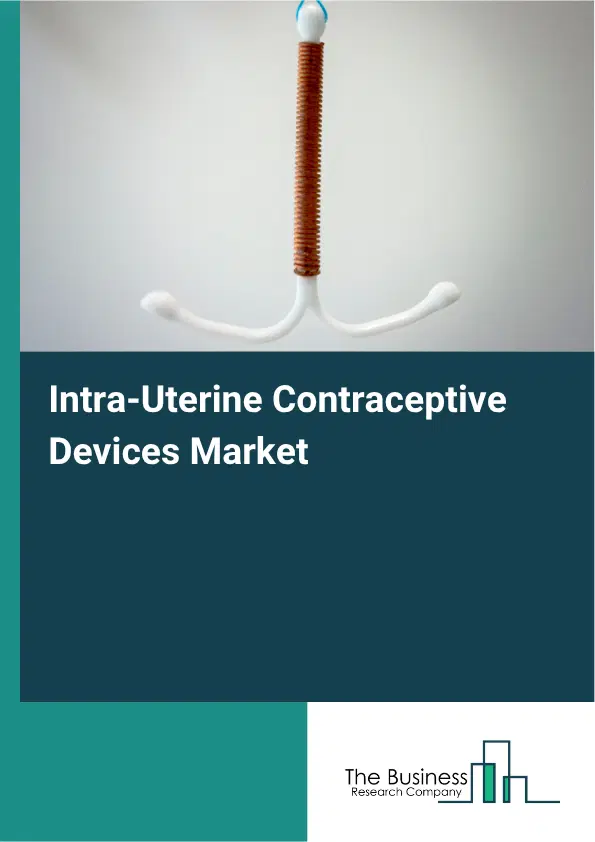
Intrauterine contraceptive devices are small, medically designed structures inserted into the uterine cavity to provide long-acting, reversible prevention of pregnancy by creating a localized physiological environment that impedes fertilization and may alter endometrial receptivity, thereby offering an effective, user-independent contraceptive method with sustained efficacy over an extended duration. They are widely utilized in reproductive health management for family planning, population control strategies, and reducing unintended pregnancies, while also being considered in certain clinical contexts for managing menstrual-related conditions under professional medical supervision. The main product types of intra-uterine contraceptive devices include copper intrauterine devices, hormonal intrauterine devices, and bioactive intrauterine devices. Copper intrauterine devices refer to non-hormonal contraceptive devices that release copper ions to prevent fertilization by creating a hostile environment for sperm within the uterus. These devices are adopted across age groups including fifteen to twenty four years, twenty five to thirty four years, thirty five to forty four years, and above forty four years, and are distributed through direct sales, online retail, and wholesale channels to ensure accessibility and availability. They find application in contraception, treatment of menorrhagia, and endometrial protection, serving end users including hospitals, gynecology clinics, community healthcare, and other end users.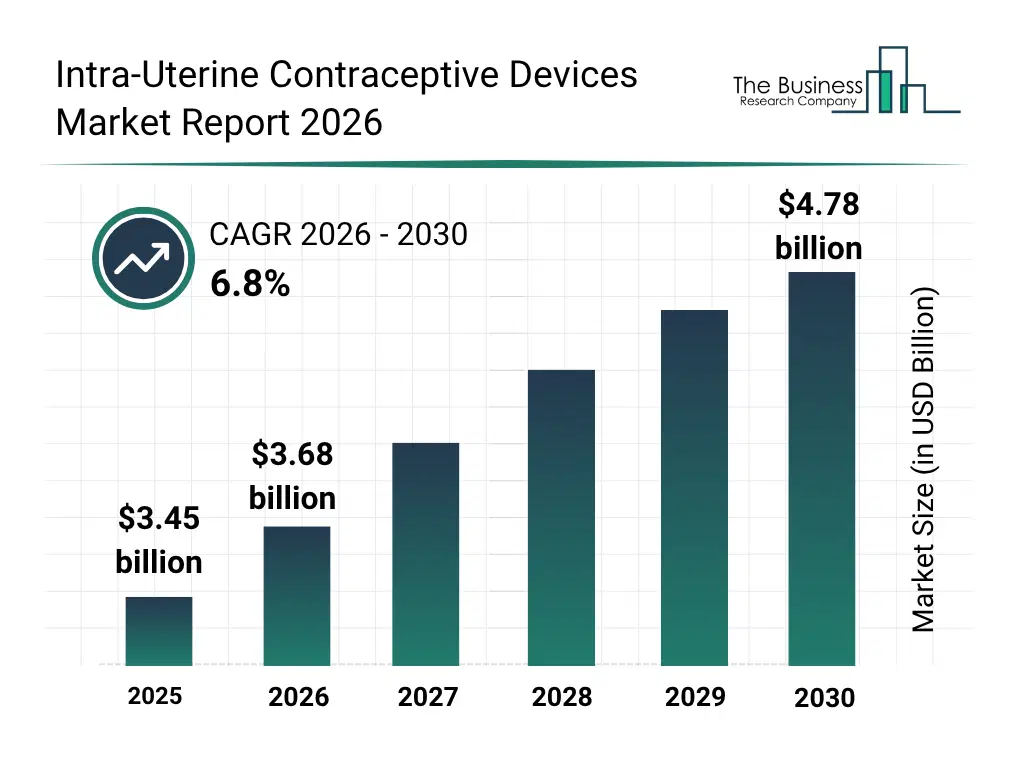
What Is The Intra-Uterine Contraceptive Devices Market Size and Share 2026?
The intra-uterine contraceptive devices market size has grown strongly in recent years.It will grow from $3.45 billion in 2025 to $3.68 billion in 2026 at a compound annual growth rate (CAGR) of 6.5%. The growth in the historic period can be attributed to rising awareness of family planning and contraception adoption, government-led population control and reproductive health programs, increasing access to gynecology clinics and maternal healthcare services, improvement in healthcare infrastructure in developing regions, growing preference for long-acting reversible contraceptive methods.What Is The Intra-Uterine Contraceptive Devices Market Growth Forecast?
The intra-uterine contraceptive devices market size is expected to see strong growth in the next few years.It will grow to $4.78 billion by 2030 at a compound annual growth rate (CAGR) of 6.8%. The growth in the forecast period can be attributed to increasing demand for minimally invasive and user independent contraceptive solutions, expansion of women-centric healthcare awareness campaigns, rising adoption of hormonal and bioactive advanced intrauterine systems, growing focus on reducing unintended pregnancies globally, continuous innovation in biocompatible and drug eluting device technologies.Major trends in the forecast period include robotics assisted intrauterine device insertion procedures, industry 4.0 enabled contraceptive manufacturing automation, iot enabled smart medical device tracking and inventory management, blockchain based contraceptive supply chain traceability systems, electric mobility supported mobile reproductive healthcare outreach services.
Global Intra-Uterine Contraceptive Devices Market Segmentation
1) By Product Type: Copper Intrauterine Devices, Hormonal Intrauterine Devices, Bioactive Intrauterine Devices 2) By Age Group: Fifteen To Twenty Four Years, Twenty Five To Thirty Four Years, Thirty Five To Forty Four Years, Above Forty Four Years 3) By Distribution Channel: Direct Sales, Online Retail, Wholesale 4) By Application: Contraception, Treatment Of Menorrhagia, Endometrial Protection 5) By End User: Hospitals, Gynecology Clinics, Community Healthcare, Other End Users Subsegments: 1) By Copper Intrauterine Devices: Copper T Shaped Devices, Copper Multiload Devices, Copper Frameless Devices 2) By Hormonal Intrauterine Devices: Levonorgestrel Releasing Devices, Low Dose Hormonal Devices, High Dose Hormonal Devices 3) By Bioactive Intrauterine Devices: Silver Ion Releasing Devices, Gold Ion Coated Devices, Drug Eluting Bioactive DevicesWhat Is The Driver Of The Intra-Uterine Contraceptive Devices Market?
The rising awareness about family planning is expected to propel the growth of the intra-uterine contraceptive devices industry going forward.Family planning awareness is the understanding and knowledge among individuals and couples about controlling the number and spacing of children through the use of contraceptive methods.The rise in awareness about family planning is due to expanding public health education campaigns that promote reproductive health and informed contraceptive choices.Intrauterine contraceptive devices help strengthen family planning practices by offering long-term, reliable, and reversible contraception that supports effective pregnancy planning and birth spacing.For instance, in July 2025, according to a report published by the World Health Organization (WHO), a Switzerland-based United Nations (UN) organization, the global uptake of modern contraceptive methods reached approximately 874 million women in 2025, with a further 70 million women expected to gain access to family planning services by 2030, reflecting continued expansion in reproductive healthcare coverage and utilization.Therefore, the rising awareness about family planning is driving the growth of the intra-uterine contraceptive device industry.Key Players In The Global Intra-Uterine Contraceptive Devices Market
Major companies operating in the intra-uterine contraceptive devices market are AbbVie Inc., Bayer AG, Meril Life Sciences Pvt. Ltd., CooperSurgical Inc., Sebela Pharmaceuticals Inc., DKT International Inc., HRA Pharma Inc., Pregna International Limited, Egemen International, Zhejiang Daji Medical Instruments Co. Ltd., Medicines360, SMB Corporation of India, HLL Lifecare Limited, Injeflex Ind And Com Ltda, Gynocare Services Pvt Ltd., Aetos Pharma Pvt Ltd., Eurogine S. L., Mona Lisa N. V., Ocon Medical Ltd., Prosan International B. V.Global Intra-Uterine Contraceptive Devices Market Trends and Insights
Major companies operating in the intra-uterine contraceptive devices market are focusing on developing innovative products, such as hormone-free intrauterine systems to enhance patient comfort and expand non-hormonal contraceptive choices. A hormone-free intrauterine system is a long-acting contraceptive device placed in the uterus that prevents pregnancy using non-hormonal materials, typically copper, to create a spermicidal intrauterine environment. For instance, in February 2025, Sebela Pharmaceuticals Inc., a US-based pharmaceutical company specializing in gastroenterology and women’s health, announced U. S. Food and Drug Administration approval of MIUDELLA. The product utilizes a flexible nitinol frame with a lower copper dose while maintaining high contraceptive effectiveness, supported by a preloaded delivery system designed for ease of insertion. Its introduction is significant as it represents the first hormone-free intrauterine device approval in over four decades in the United States, highlighting renewed innovation in non-hormonal contraceptive technologies.What Are Latest Mergers And Acquisitions In The Intra-Uterine Contraceptive Devices Market?
In April 2024, Aspivix SA, a Switzerland-based medical device company, partnered with Bayer to accelerate the adoption of a novel cervical stabilization device for intrauterine procedures. With this deal, the companies aim to expand market adoption of intrauterine contraceptive devices by improving patient experience during insertion, thereby addressing pain-related barriers and enhancing overall procedural acceptance among both patients and healthcare providers. Bayer AG is a Germany-based provider of pharmaceuticals, women’s health solutions, and contraceptive products, including intrauterine systems, with a strong global presence in reproductive healthcare.Regional Insights
North America was the largest region in the intra-uterine contraceptive devices market in 2025. Asia-Pacific is expected to be the fastest-growing region in the forecast period. The regions covered in this market report are Asia-Pacific, South East Asia, Western Europe, Eastern Europe, North America, South America, Middle East and Africa. The countries covered in this market report are Australia, Brazil, China, France, Germany, India, Indonesia, Japan, Taiwan, Russia, South Korea, UK, USA, Canada, Italy, Spain.What Defines the Intra-Uterine Contraceptive Devices Market?
The intra-uterine contraceptive devices market consists of sales of T-shaped framed devices, frameless intrauterine systems, levonorgestrel-releasing intrauterine systems, and silver-core intrauterine devices. Values in this market are ‘factory gate’ values, that is, the value of goods sold by the manufacturers or creators of the goods, whether to other entities (including downstream manufacturers, wholesalers, distributors, and retailers) or directly to end customers. The value of goods in this market includes related services sold by the creators of the goods.What is the Market Assessment and Strategic Outlook for the Intra-Uterine Contraceptive Devices Industry?
The intra-uterine contraceptive devices market research report is one of a series of new reports from The Business Research Company that provides market statistics, including industry global market size, regional shares, competitors with the market share, detailed market segments, market trends and opportunities, and any further data you may need to thrive in the intra-uterine contraceptive devices industry. The market research report delivers a complete perspective of everything you need, with an in-depth analysis of the current and future state of the industry.What is the Market Assessment and Strategic Outlook for the Intra-Uterine Contraceptive Devices Market Report 2026?
The intra-uterine contraceptive devices market research report is one of a series of new reports from The Business Research Company that provides intra-uterine contraceptive devices market statistics, including intra-uterine contraceptive devices industry global market size, regional shares, competitors with a intra-uterine contraceptive devices market share, detailed intra-uterine contraceptive devices market segments, market trends and opportunities, and any further data you may need to thrive in the intra-uterine contraceptive devices industry. This intra-uterine contraceptive devices market research report delivers a complete perspective of everything you need, with an in-depth analysis of the current and future scenario of the industry.Intra-Uterine Contraceptive Devices Market Report Forecast Analysis
| Report Attribute | Details |
|---|---|
| Market Size Value In 2026 | $3.68 billion |
| Revenue Forecast In 2035 | $4.78 billion |
| Growth Rate | CAGR of 6.8% from 2026 to 2035 |
| Base Year For Estimation | 2025 |
| Actual Estimates/Historical Data | 2020-2025 |
| Forecast Period | 2026 - 2030 - 2035 |
| Market Representation | Revenue in USD Billion and CAGR from 2026 to 2035 |
| Segments Covered | Product Type, Age Group, Distribution Channel, Application, End User |
| Regional Scope | Asia-Pacific, Western Europe, Eastern Europe, North America, South America, Middle East, Africa |
| Country Scope | The countries covered in the report are Australia, Brazil, China, France, Germany, India, Indonesia, Japan, Taiwan, Russia, South Korea, UK, USA, Canada, Italy, Spain. |
| Key Companies Profiled | AbbVie Inc., Bayer AG, Meril Life Sciences Pvt. Ltd., CooperSurgical Inc., Sebela Pharmaceuticals Inc., DKT International Inc., HRA Pharma Inc., Pregna International Limited, Egemen International, Zhejiang Daji Medical Instruments Co. Ltd., Medicines360, SMB Corporation of India, HLL Lifecare Limited, Injeflex Ind And Com Ltda, Gynocare Services Pvt Ltd., Aetos Pharma Pvt Ltd., Eurogine S. L., Mona Lisa N. V., Ocon Medical Ltd., Prosan International B. V. |
| Customization Scope | Request for Customization |
| Pricing And Purchase Options | Explore Purchase Options |