
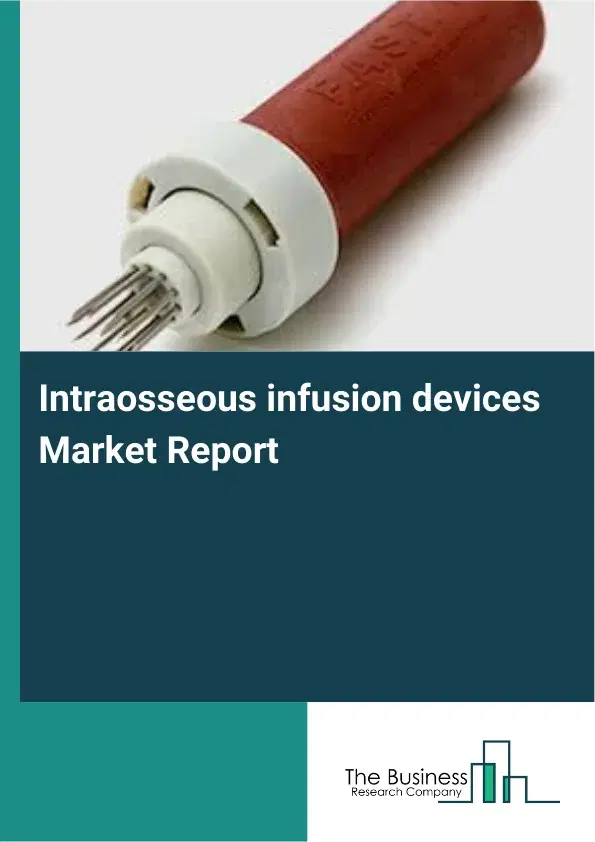
Intraosseous infusion devices Market Report 2026
Global Outlook – By Product (Bone Injection Gun (B.I.G), First Access For Shock And Trauma 1 (FAST–, Easy Intraosseous (EZ-IO), First Access For Shock And Trauma Responder (FASTR), Intraosseous (IO) Needles, Other Products), By Technology (Manual, Automatic), By Route Of Administration (Sternum, Distal And Proximal Tibia, Distal Femur, Calcaneus, Head Of Humerus), By End User (Emergency Medical Services (EMS), Hospitals, Ambulatory Surgical Centers, Cardiac Care Centers) – Market Size, Trends, Strategies, and Forecast to 2030
Intraosseous infusion devices Market Overview
• Intraosseous infusion devices market size has reached to $3.39 billion in 2025 • Expected to grow to $4.71 billion in 2030 at a compound annual growth rate (CAGR) of 6.8% • Growth Driver: The Increasing Burden Of Trauma And Emergency Cases Driving Market Growth Through Rapid Vascular Access Needs • Market Trend: Innovations In Intraosseous Access Technology Enable Rapid Vascular Access In Emergency And Critical Care Settings • North America was the largest region in 2025 and Asia-Pacific is the fastest growing region.What Is Covered Under Intraosseous infusion devices Market?
Intraosseous infusion devices are medical devices used to deliver fluids, blood products, and medications directly into the bone marrow when intravenous access is difficult or impossible. They provide rapid and reliable vascular access in emergency, trauma, and critical care situations. These devices are designed for quick insertion with minimal training and can be used in both pediatric and adult patients. They also ensure consistent drug absorption during shock or cardiac arrest. The main products of intraosseous infusion devices include bone injection gun (B.I.G), first access for shock and trauma 1 (FAST1), easy intraosseous (EZ-IO), first access for shock and trauma responder (FASTR), intraosseous (IO) needles, and other products. Bone injection gun (B.I.G) refers to a spring-loaded or pressure-driven device designed to rapidly insert an intraosseous needle into bone marrow for emergency vascular access when intravenous access is difficult or delayed. The technologies used include manual and automatic mechanisms depending on ease of use and clinical setting. The routes of administration involved are sternum, distal and proximal tibia, distal femur, calcaneus, and head of humerus. The end users of intraosseous infusion devices include emergency medical services (EMS), hospitals, ambulatory surgical centers, and cardiac care centers.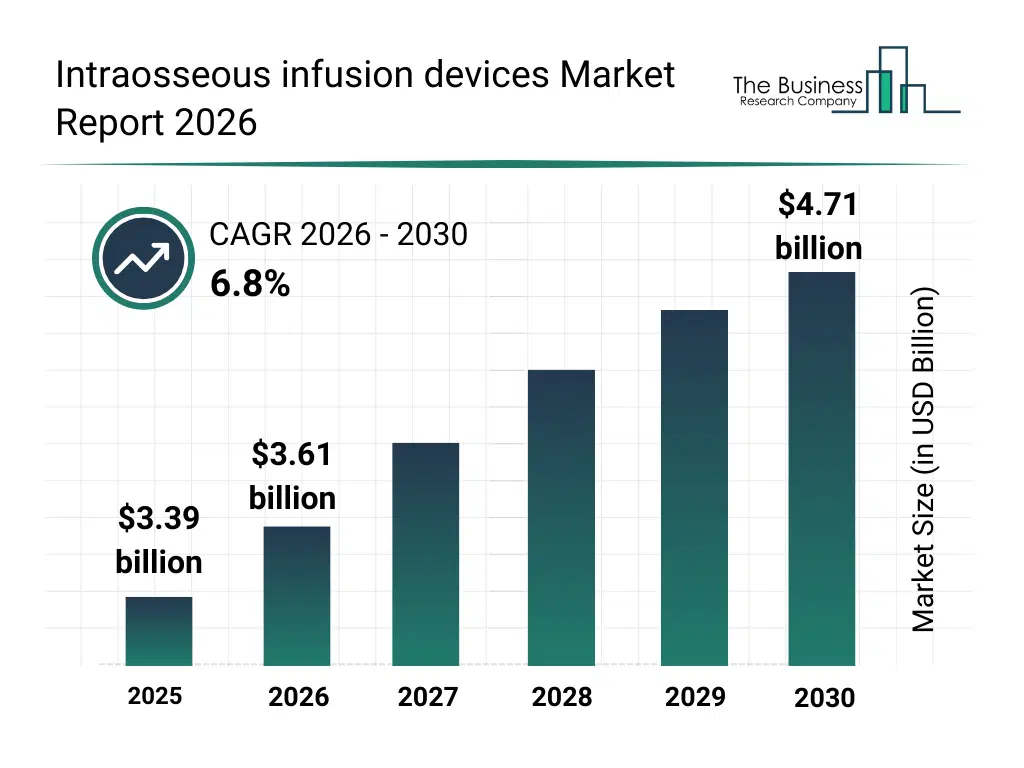
What Is The Intraosseous infusion devices Market Size and Share 2026?
The intraosseous infusion devices market size has grown strongly in recent years. It will grow from $3.39 billion in 2025 to $3.61 billion in 2026 at a compound annual growth rate (CAGR) of 6.6%. The growth in the historic period can be attributed to increasing incidence of trauma and cardiac emergencies, demand for rapid vascular access in hospitals, adoption of manual io devices, growth in emergency medical services (ems), early use of intraosseous needles in pediatric care.What Is The Intraosseous infusion devices Market Growth Forecast?
The intraosseous infusion devices market size is expected to see strong growth in the next few years. It will grow to $4.71 billion in 2030 at a compound annual growth rate (CAGR) of 6.8%. The growth in the forecast period can be attributed to rising adoption of automated io devices, integration of io systems with hospital emergency protocols, expansion of io usage in ambulatory surgical centers, increased investment in training and simulation tools, development of multi-site intraosseous access solutions. Major trends in the forecast period include rapid emergency vascular access, pediatric and adult device adaptation, battery-powered and reusable drivers, single-use and disposable device adoption, training and simulation integration.
Global Intraosseous infusion devices Market Segmentation
1) By Product: Bone Injection Gun (B.I.G), First Access For Shock And Trauma 1 (FAST1), Easy Intraosseous (EZ-IO), First Access For Shock And Trauma Responder (FASTR), Intraosseous (IO) Needles, Other Products 2) By Technology: Manual, Automatic 3) By Route Of Administration: Sternum, Distal And Proximal Tibia, Distal Femur, Calcaneus, Head Of Humerus 4) By End User: Emergency Medical Services (EMS), Hospitals, Ambulatory Surgical Centers, Cardiac Care Centers Subsegments: 1) By Bone Injection Gun (B.I.G): Manual Activation, Spring Loaded Mechanism, Single Use Device, Adult Use Variant 2) By First Access For Shock And Trauma 1 (FAST1): Sternal Access Device, Single Use System, Rapid Vascular Access, Emergency Use Configuration 3) By Easy Intraosseous (EZ-IO): Battery Powered Device, Multiple Needle Sizes, Reusable Driver System, Emergency And Hospital Use 4) By First Access For Shock And Trauma Responder (FASTR): Sternal Insertion System, Prehospital Emergency Use, Single Use Configuration, Rapid Deployment Design 5) By Intraosseous (IO) Needles: Manual Insertion Needles, Powered Insertion Compatible, Pediatric Size Needles, Adult Size Needles 6) By Other Products: Disposable Intraosseous Devices, Training And Simulation Devices, Accessory And Stabilization Kits, Custom Intraosseous SystemsWhat Are The Drivers Of The Intraosseous infusion devices Market?
The growing incidence of trauma and emergency cases is expected to propel the growth of the intraosseous infusion devices market going forward. Trauma and emergency cases refer to medical situations requiring immediate or urgent care due to serious injuries, acute illnesses, or life-threatening conditions that need rapid assessment and intervention. Trauma and emergency cases are increasing as rising road traffic accidents, driven by higher vehicle density and high-speed travel, lead to more severe injuries and emergency admissions. Intraosseous infusion devices allow fast and dependable access to the bloodstream when intravenous access is challenging in trauma or shock cases, ensuring quick administration of fluids and critical drugs, supporting timely and effective emergency care. For instance, in September 2025, according to the National Health Service, a UK-based government health agency, total accident and emergency attendances reached 27.4 million in 2024–25, representing a 4.0 percent increase compared with 2023–24. Therefore, the growing incidence of trauma and emergency cases is driving the growth of the intraosseous infusion devices industry. The growing hospital admissions are expected to propel the growth of the intraosseous infusion devices market going forward. Hospital admissions refer to the formal acceptance of patients into medical facilities for inpatient care and treatment. The rise in hospital admissions is primarily driven by the aging population, as older individuals require more frequent medical interventions and have higher rates of chronic conditions necessitating hospitalization. Increasing hospital admissions drive demand for intraosseous infusion devices, as these tools provide rapid vascular access during emergency situations and critical care scenarios when traditional intravenous access is difficult. For instance, in January 2025, according to the American Hospital Association, a US-based national organization representing hospitals and healthcare networks, total hospital admissions in the United States increased from 33,679,935 in 2022 to 34,426,650 in 2023, reflecting an increase of 746,715 admissions. Therefore, growing hospital admissions are driving the growth of the intraosseous infusion devices industry.Key Players In The Global Intraosseous infusion devices Market
Major companies operating in the intraosseous infusion devices market are Cardinal Health Inc., Medline Industries Inc., Becton Dickinson and Company (BD), B Braun Melsungen AG, ZOLL Medical Corporation, Teleflex Incorporated, Cook Medical LLC, Shandong Weigao Group Co Ltd, Vygon SA, Argon Medical Devices Inc., Life Assist, Istem Medikal, SAM Medical Products, Implox Pty Ltd., BIOPSYBELL S R L (BPB Medica), Medax SRL, Troge Medical GmbH, Taizhou Kindly Medical Devices Co Ltd, PAVmed Inc., and Pyng Medical Corporation
This chart is for illustrative purposes; the full report includes a detailed competitor analysis and comprehensive overview of the top 10 companies in the market.
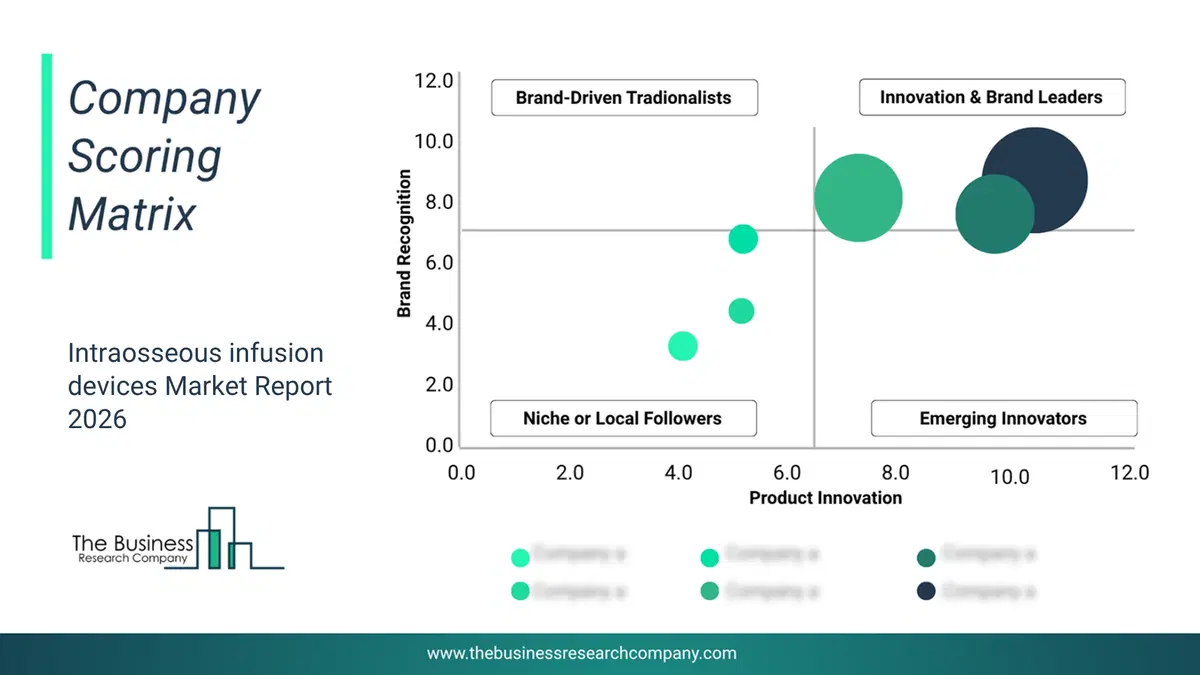
This chart maps companies by product innovation and brand strength, with bubble size indicating relative revenue, helping identify market leaders, challengers, and niche players. This is an illustrative chart; the full report provides a complete and accurate competitive analysis.
Global Intraosseous infusion devices Market Trends and Insights
Major companies operating in the intraosseous infusion devices market are focusing on developing advanced systems, such as rapid vascular access devices, to enable faster and more reliable vascular access during life-threatening emergencies. A rapid vascular access device is a medical device that enables fast entry into the circulatory system to administer fluids, medications, or blood products during emergency and critical care scenarios. It is particularly utilized when traditional intravenous access is challenging, time-consuming, or impractical. For instance, in October 2024, BD, a US-based medical technology company, launched the new BD Intraosseous Vascular Access System, an enhanced intraosseous access system designed to establish vascular access within seconds for critical care situations. The system features improved needle control, rapid insertion capability, and a user-friendly design to support clinicians in high-pressure environments, enhancing procedural efficiency and improving patient outcomes in emergency and acute care settings.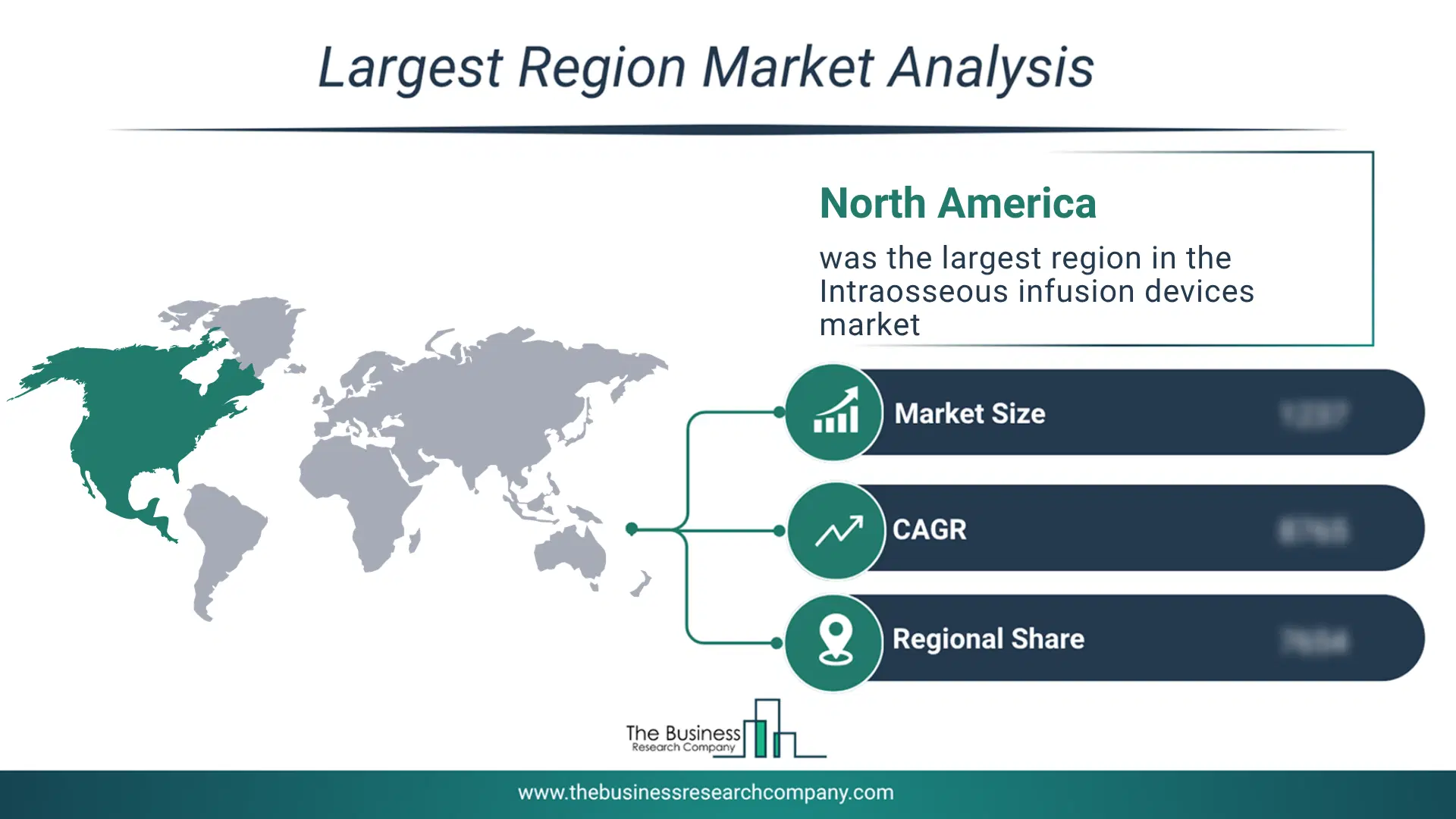
Regional Outlook
North America was the largest region in the intraosseous infusion devices market in 2025. Asia-Pacific is expected to be the fastest-growing region in the forecast period. The regions covered in this market report are Asia-Pacific, South East Asia, Western Europe, Eastern Europe, North America, South America, Middle East, Africa. The countries covered in this market report are Australia, Brazil, China, France, Germany, India, Indonesia, Japan, Taiwan, Russia, South Korea, UK, USA, Canada, Italy, Spain.What Defines the Intraosseous infusion devices Market?
The intraosseous infusion devices market consists of sales of powered intraosseous devices, manual intraosseous devices, intraosseous access kits, needle sets, stabilization devices, extension tubing, and insertion adapters. Values in this market are ‘factory gate’ values, that is, the value of goods sold by the manufacturers or creators of the goods, whether to other entities (including downstream manufacturers, wholesalers, distributors, and retailers) or directly to end customers. The value of goods in this market includes related services sold by the creators of the goods.How is Market Value Defined and Measured?
The market value is defined as the revenues that enterprises gain from the sale of goods and/or services within the specified market and geography through sales, grants, or donations in terms of the currency (in USD unless otherwise specified). The revenues for a specified geography are consumption values that are revenues generated by organizations in the specified geography within the market, irrespective of where they are produced. It does not include revenues from resales along the supply chain, either further along the supply chain or as part of other products.
This chart presents market attractiveness based on a quantitative evaluation of growth, competition, strategic alignment, and risk, offering a clear view of opportunity areas for decision-making. This chart is for illustrative purposes; the full report contains the complete analysis.

This chart highlights the Total Addressable Market (TAM) by estimating the maximum revenue opportunity using an assumption-driven approach, supporting strategic planning and opportunity sizing across markets. The chart is illustrative; the full report provides a more comprehensive analysis.
What Key Data and Analysis Are Included in the Intraosseous infusion devices Market Report 2026?
The intraosseous infusion devices market research report is one of a series of new reports from The Business Research Company that provides market statistics, including industry global market size, regional shares, competitors with the market share, detailed market segments, market trends and opportunities, and any further data you may need to thrive in the intraosseous infusion devices industry. The market research report delivers a complete perspective of everything you need, with an in-depth analysis of the current and future state of the industry.Intraosseous infusion devices Market Report Forecast Analysis
| Report Attribute | Details |
|---|---|
| Market Size Value In 2026 | $3.61 billion |
| Revenue Forecast In 2030 | $4.71 billion |
| Growth Rate | CAGR of 6.8% from 2026 to 2030 |
| Base Year For Estimation | 2025 |
| Actual Estimates/Historical Data | 2020-2025 |
| Forecast Period | 2026 - 2030 |
| Market Representation | Revenue in USD Billion and CAGR from 2026 to 2030 |
| Segments Covered | Product, Technology, Route Of Administration, End User |
| Regional Scope | Asia-Pacific, Western Europe, Eastern Europe, North America, South America, Middle East, Africa |
| Country Scope | The countries covered in the report are Australia, Brazil, China, France, Germany, India, Indonesia, Japan, Taiwan, Russia, South Korea, UK, USA, Canada, Italy, Spain. |
| Key Companies Profiled | Cardinal Health Inc., Medline Industries Inc., Becton Dickinson and Company (BD), B Braun Melsungen AG, ZOLL Medical Corporation, Teleflex Incorporated, Cook Medical LLC, Shandong Weigao Group Co Ltd, Vygon SA, Argon Medical Devices Inc., Life Assist, Istem Medikal, SAM Medical Products, Implox Pty Ltd., BIOPSYBELL S R L (BPB Medica), Medax SRL, Troge Medical GmbH, Taizhou Kindly Medical Devices Co Ltd, PAVmed Inc., and Pyng Medical Corporation |
| Customization Scope | Request for Customization |
| Pricing And Purchase Options | Explore Purchase Options |