
Inventory Supply Chain Finance Market Report 2026
Global Outlook – By Type (Factoring, Financing), By Application (Agricultural Products, Industrial Products, Electronics, Other Applications), By End User (Large Enterprises, Small And Medium-Sized Enterprises) – Market Size, Trends, Strategies, and Forecast to 2030
Inventory Supply Chain Finance Market Overview
• Inventory Supply Chain Finance market size has reached to $9.77 billion in 2025 • Expected to grow to $19.29 billion in 2030 at a compound annual growth rate (CAGR) of 14.5% • Growth Driver: Rise In E-Commerce Fueling The Growth Of The Market Due To Increasing Demand For Efficient Inventory Management And Liquidity Support • North America was the largest region in 2025.What Is Covered Under Inventory Supply Chain Finance Market?
Inventory supply chain finance refers to financial solutions that allow businesses to optimize cash flow by using their inventory as collateral to secure short-term funding. It enables suppliers or buyers to access working capital tied up in stock without needing to sell or move the inventory immediately. Inventory supply chain finance improves liquidity and working capital efficiency by unlocking the value of inventory within the supply chain. The main types of inventory supply chain finance are factoring and financing. Factoring is a financial service where businesses sell their accounts receivable to third parties at a discount to improve cash flow. It finds applications in agricultural products, industrial products, electronics, and others, serving end users, including large enterprises and small and medium-sized enterprises.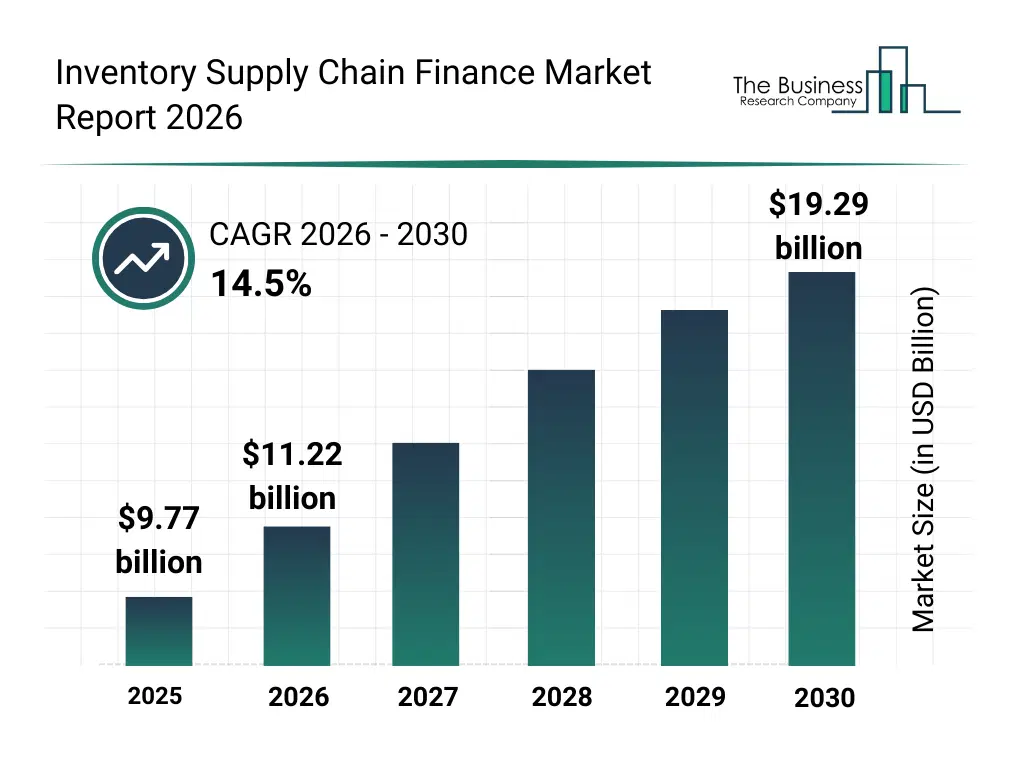
What Is The Inventory Supply Chain Finance Market Size and Share 2026?
The inventory supply chain finance market size has grown rapidly in recent years. It will grow from $9.77 billion in 2025 to $11.22 billion in 2026 at a compound annual growth rate (CAGR) of 14.8%. The growth in the historic period can be attributed to expansion of global trade activities, rising need for short-term liquidity solutions, increased adoption of factoring services, growth of inventory-intensive industries, evolution of structured trade finance instruments.What Is The Inventory Supply Chain Finance Market Growth Forecast?
The inventory supply chain finance market size is expected to see rapid growth in the next few years. It will grow to $19.29 billion in 2030 at a compound annual growth rate (CAGR) of 14.5%. The growth in the forecast period can be attributed to increasing digitization of supply chain finance, rising adoption of blockchain-enabled financing platforms, growing demand from SMEs for flexible funding, expansion of data-driven credit risk assessment, increasing collaboration between banks and fintech providers. Major trends in the forecast period include increasing adoption of inventory-backed financing solutions, rising use of digital collateral management platforms, growing integration of real-time inventory visibility, expansion of asset-based lending models, enhanced focus on working capital optimization.
Global Inventory Supply Chain Finance Market Segmentation
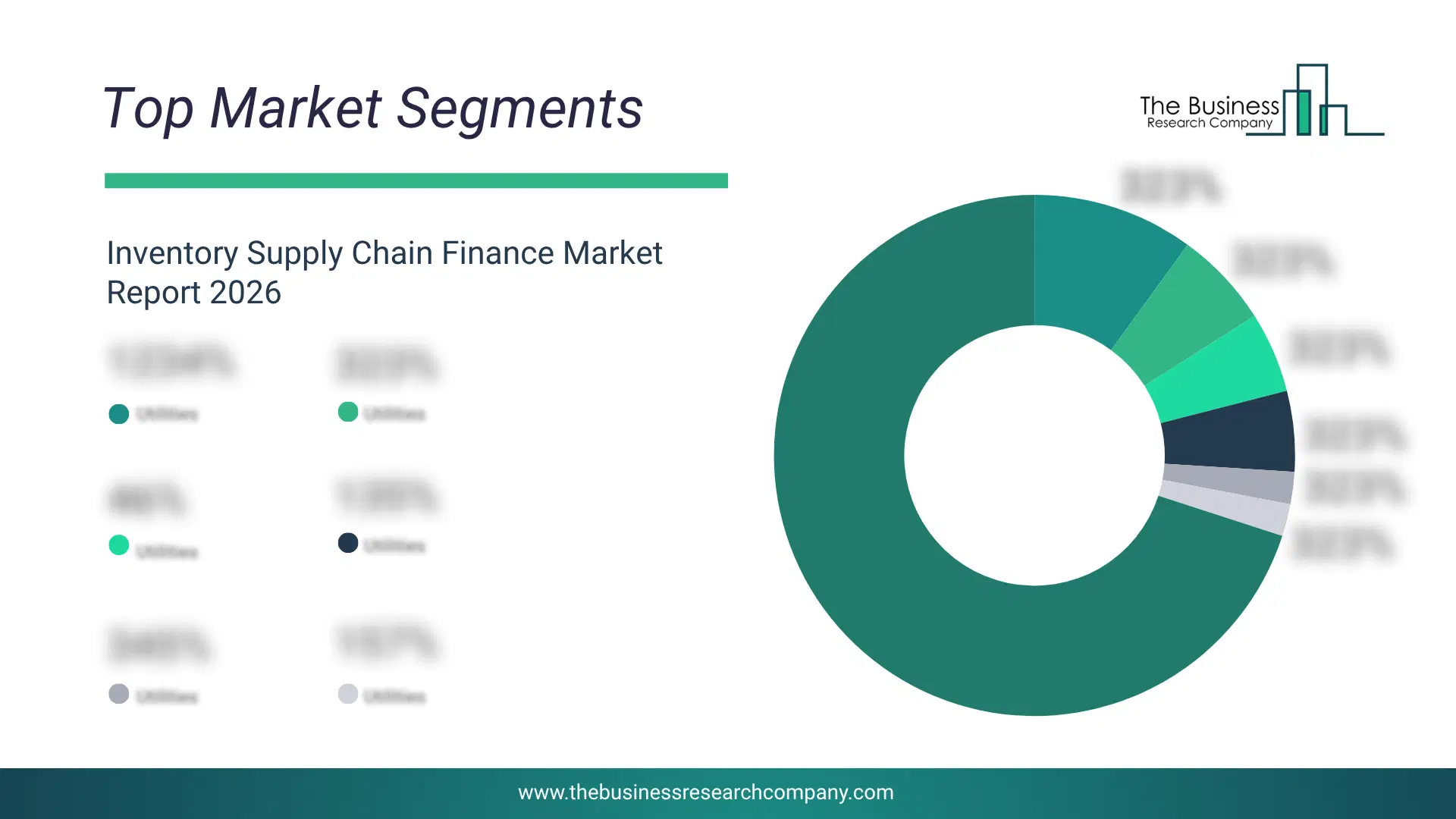
1) By Type: Factoring, Financing 2) By Application: Agricultural Products, Industrial Products, Electronics, Other Applications 3) By End User: Large Enterprises, Small And Medium-Sized Enterprises Subsegments: 1) By Factoring: Recourse Factoring, Non-Recourse Factoring, Domestic Factoring, International Factoring, Disclosed Factoring, Undisclosed Factoring 2) By Financing: Pre-shipment Financing, Post-shipment Financing, Inventory Financing, Reverse Factoring, Dynamic Discounting, Asset-Based LendingWhat Are The Drivers Of The Inventory Supply Chain Finance Market?
The rising e-commerce is expected to propel the growth of the inventory supply chain finance market going forward. E-commerce refers to conducting commercial transactions electronically through the internet. The expansion of e-commerce is rising due to increasing internet penetration, as it provides consumers with reliable online access, enabling convenient shopping anytime and anywhere. Inventory supply chain finance enhances e-commerce ecosystems by unlocking working capital tied up in inventory, enabling faster restocking and improved cash flow. It supports scalable growth by allowing online retailers to meet demand without overextending their finances, boosting operational efficiency. For instance, in February 2025, according to the United States Census Bureau, a US-based government agency, total e-commerce sales in 2024 reached $1,192.6 billion, marking an 8.1% increase compared to 2023. Therefore, the rising e-commerce is driving the growth of the inventory supply chain finance industry. The rising trading volumes are expected to propel the growth of the inventory supply chain finance market going forward. Trading volumes refer to the total number of financial instruments, such as stocks, bonds, or commodities, traded over a specific period. The trading volumes are increasing primarily due to the rise of algorithmic and high-frequency trading, which enables faster and more frequent transactions in financial markets. Rising trading volumes enhance inventory supply chain finance ecosystems by increasing the movement of goods across global supply chains, leading to greater demand for inventory-backed financing. They improve operational liquidity by enabling businesses to unlock capital tied up in stock, supporting faster restocking and more efficient inventory management. For instance, according to the International Capital Market Association (ICMA), a Switzerland-based non-profit trade association, there were 6.01million transactions in Europe’s sovereign bond markets in the first half of 2024, reflecting a 17.2% increase compared to the same period in 2023. Therefore, the rising trading volumes are driving the growth of the inventory supply chain finance industry.Key Players In The Global Inventory Supply Chain Finance Market
Major companies operating in the inventory supply chain finance market are JPMorgan Chase & Co., Bank of America Corporation, Citi Bank Ltd., HSBC Holdings Plc, BNP Paribas, Accenture Plc, Mitsubishi UFJ Financial Group Inc., SAP SE, Royal Bank of Scotland Plc, Standard Chartered Plc, Orbian, Ant Financial, Finastra, Asian Development Bank, Greensill, Tradeshift, Linklogis, Taulia, Oklink, Vayana Network, Capital Float, JD Finance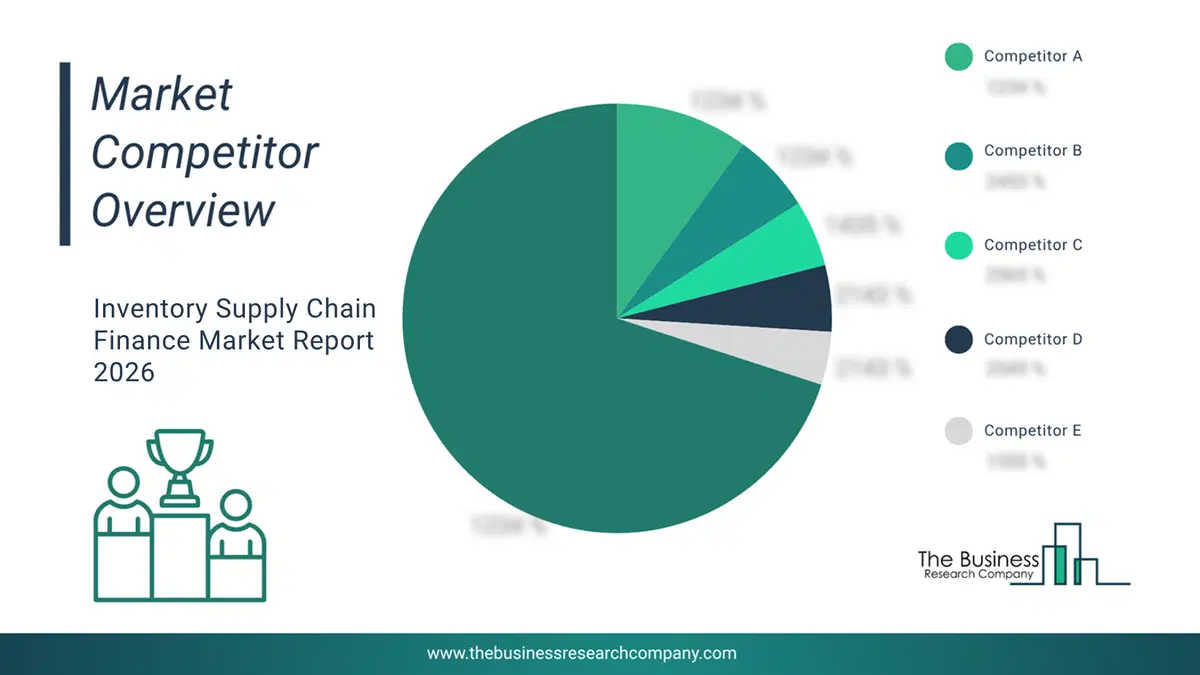
This chart is for illustrative purposes; the full report includes a detailed competitor analysis and comprehensive overview of the top 10 companies in the market.
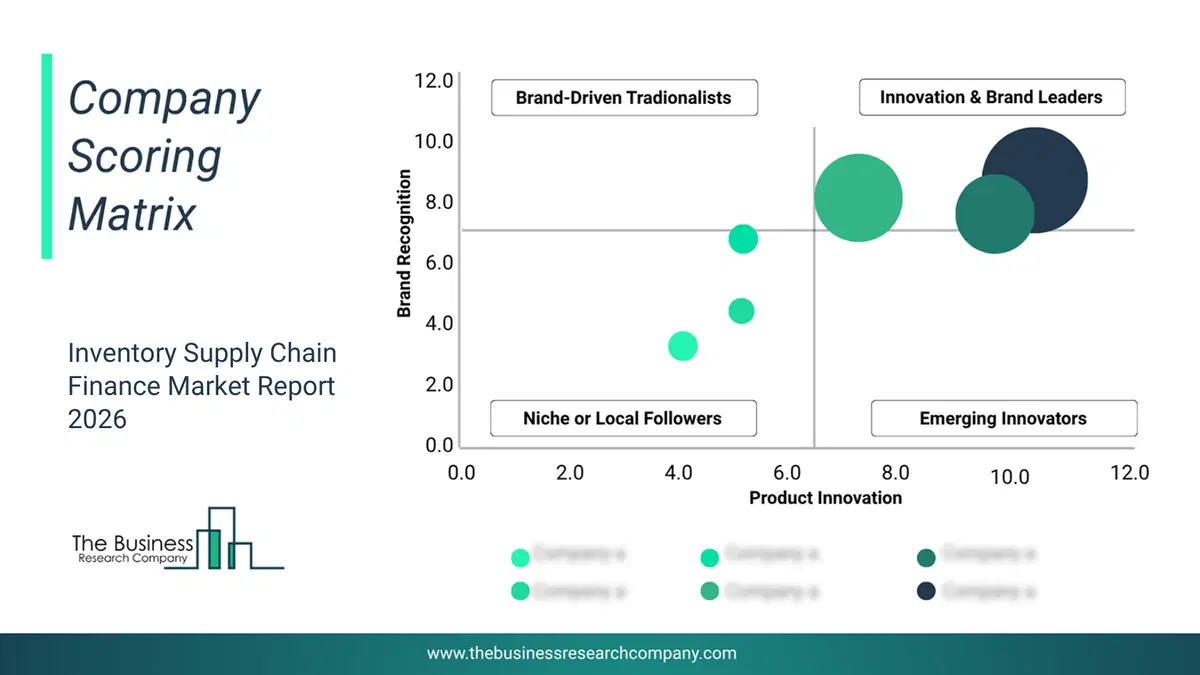
This chart maps companies by product innovation and brand strength, with bubble size indicating relative revenue, helping identify market leaders, challengers, and niche players. This is an illustrative chart; the full report provides a complete and accurate competitive analysis.
What Are Latest Mergers And Acquisitions In The Inventory Supply Chain Finance Market?
In February 2025, Fidelity National Information Services Inc a US-based provider of banking and financial technology company acquired Demica for an undisclosed amount. Through this acquisition, FIS aims to strengthen its inventory supply chain finance offerings by integrating Demica’s payables finance, receivables finance, dynamic discounting, and supply chain finance platforms, enabling corporates and banks to optimize working capital tied to inventory. Demica Limited is a UK-based provider of financial solutions focused on supply chain finance and working capital optimization.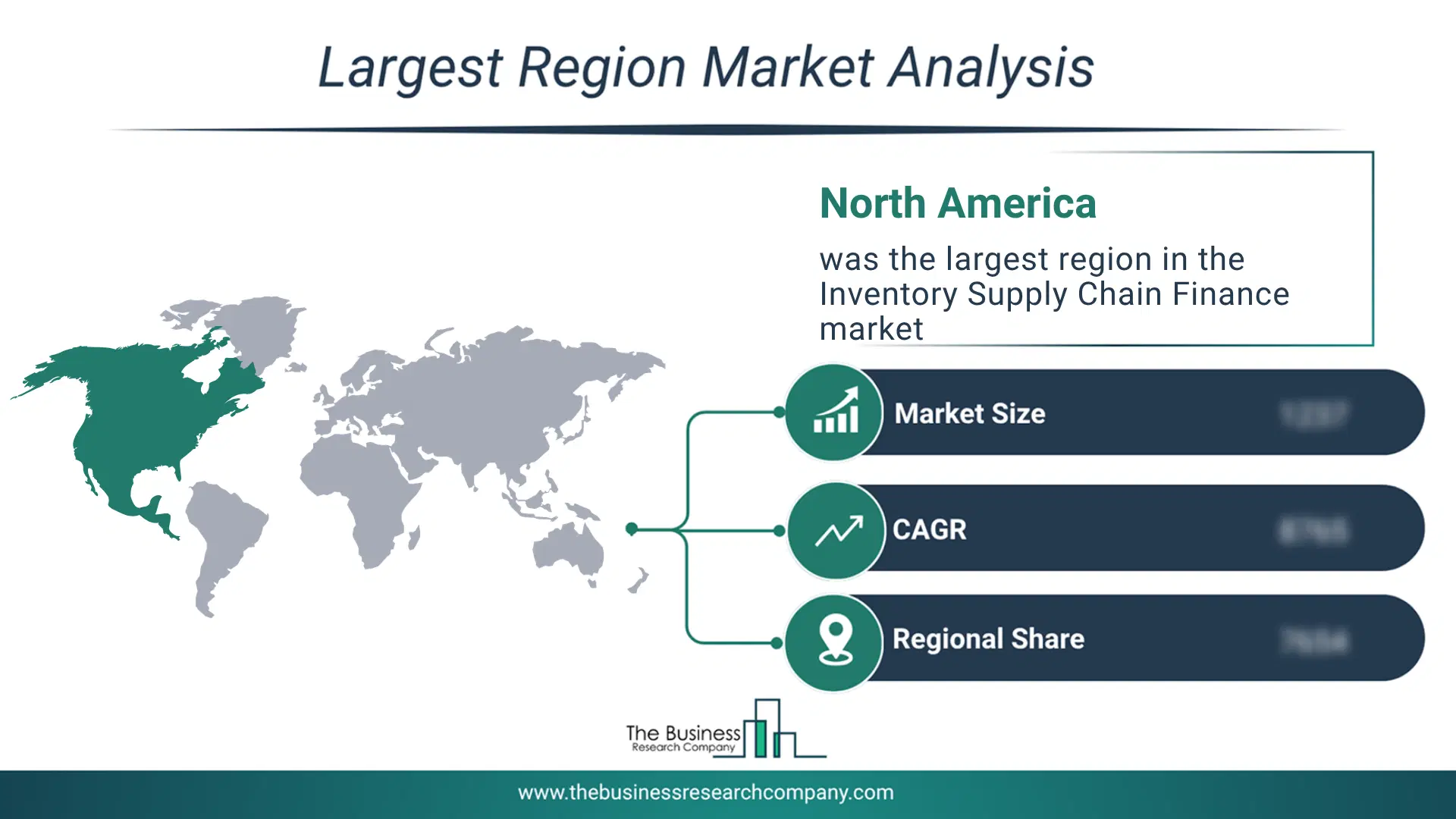
Regional Outlook
North America was the largest region in the inventory supply chain finance market in 2025. The regions covered in this market report are Asia-Pacific, South East Asia, Western Europe, Eastern Europe, North America, South America, Middle East, Africa. The countries covered in this market report are Australia, Brazil, China, France, Germany, India, Indonesia, Japan, Taiwan, Russia, South Korea, UK, USA, Canada, Italy, Spain.What Defines the Inventory Supply Chain Finance Market?
The inventory supply chain finance market includes revenues earned by entities through inventory financing loans, warehouse receipts financing, dynamic discounting, risk assessment, collateral management, and supply chain analytics. The market value includes the value of related goods sold by the service provider or included within the service offering. Only goods and services traded between entities or sold to end consumers are included.How is Market Value Defined and Measured?
The market value is defined as the revenues that enterprises gain from the sale of goods and/or services within the specified market and geography through sales, grants, or donations in terms of the currency (in USD unless otherwise specified). The revenues for a specified geography are consumption values that are revenues generated by organizations in the specified geography within the market, irrespective of where they are produced. It does not include revenues from resales along the supply chain, either further along the supply chain or as part of other products.
This chart presents market attractiveness based on a quantitative evaluation of growth, competition, strategic alignment, and risk, offering a clear view of opportunity areas for decision-making. This chart is for illustrative purposes; the full report contains the complete analysis.

This chart highlights the Total Addressable Market (TAM) by estimating the maximum revenue opportunity using an assumption-driven approach, supporting strategic planning and opportunity sizing across markets. The chart is illustrative; the full report provides a more comprehensive analysis.
What Key Data and Analysis Are Included in the Inventory Supply Chain Finance Market Report 2026?
The inventory supply chain finance market research report is one of a series of new reports from The Business Research Company that provides market statistics, including Market Report 2026?global market size, regional shares, competitors with the market share, detailed market segments, market trends and opportunities, and any further data you may need to thrive in the inventory supply chain finance Market Report 2026? The market research report delivers a complete perspective of everything you need, with an in-depth analysis of the current and future state of the Market Report 2026?Inventory Supply Chain Finance Market Report Forecast Analysis
| Report Attribute | Details |
|---|---|
| Market Size Value In 2026 | $11.22 billion |
| Revenue Forecast In 2030 | $19.29 billion |
| Growth Rate | CAGR of 14.8% from 2026 to 2030 |
| Base Year For Estimation | 2025 |
| Actual Estimates/Historical Data | 2020-2025 |
| Forecast Period | 2026 - 2030 |
| Market Representation | Revenue in USD Billion and CAGR from 2026 to 2030 |
| Segments Covered | Type, Application, End User |
| Regional Scope | Asia-Pacific, Western Europe, Eastern Europe, North America, South America, Middle East, Africa |
| Country Scope | The countries covered in the report are Australia, Brazil, China, France, Germany, India, Indonesia, Japan, Taiwan, Russia, South Korea, UK, USA, Canada, Italy, Spain. |
| Key Companies Profiled | JPMorgan Chase & Co., Bank of America Corporation, Citi Bank Ltd., HSBC Holdings Plc, BNP Paribas, Accenture Plc, Mitsubishi UFJ Financial Group Inc., SAP SE, Royal Bank of Scotland Plc, Standard Chartered Plc, Orbian, Ant Financial, Finastra, Asian Development Bank, Greensill, Tradeshift, Linklogis, Taulia, Oklink, Vayana Network, Capital Float, JD Finance |
| Customization Scope | Request for Customization |
| Pricing And Purchase Options | Explore Purchase Options |