

Invoice Factoring Market Report 2026
Global Outlook – By Type (Recourse Factoring, Non-Recourse Factoring), By Provider (Banks, Non-Banking Financial Companies (NBFCs)), By Enterprise Size (Large Enterprises, Small And Medium-Sized Enterprises), By Application (Domestic, International), By Industry (Construction, Manufacturing, Healthcare, Transportation And Logistics, Energy And Utilities, Information Technology (IT) And Telecom, Staffing, Other Industries) – Market Size, Trends, Strategies, and Forecast to 2030
Invoice Factoring Market Overview
• Invoice Factoring market size has reached to $3461.65 billion in 2025 • Expected to grow to $5955.38 billion in 2030 at a compound annual growth rate (CAGR) of 11.4% • Growth Driver: Rising Demand For Fintech Solutions Drives Growth In The Invoice Factoring Market • Market Trend: Innovative Web-Based Invoice Financing Solution For MSMEs Enhanced Market • Europe was the largest region in 2025 and Asia-Pacific is the fastest growing region.Market Gains By 2030 – Top Opportunities By Segment
Market Gain identifies the most promising market opportunities by highlighting the segments or products expected to generate the highest incremental revenue growth over the next five years.
What Is Covered Under Invoice Factoring Market?
Invoice factoring is a financial transaction and a type of debtor finance in which a business sells its accounts receivable (invoices) to a third party (called a factor) at a discount. This provides the company with immediate cash flow, while the factor is responsible for collecting the outstanding invoice amounts from the business's customers. Invoice factoring is commonly used by businesses to manage cash flow, especially those with long payment cycles or seasonal sales fluctuations. The main types of invoice factoring are recourse factoring and non-recourse factoring. Recourse factoring is a type of invoice factoring where the client business remains responsible for any unpaid invoices by their customers. The various providers include banks, and non-banking financial companies (NBFCs). These are used by various enterprise sizes such as large enterprises, small and medium-sized enterprises, and various applications such as domestic, international, and various industries such as construction, manufacturing, healthcare, transportation and logistics, energy and utilities, information technology (IT), and telecom, staffing, and others.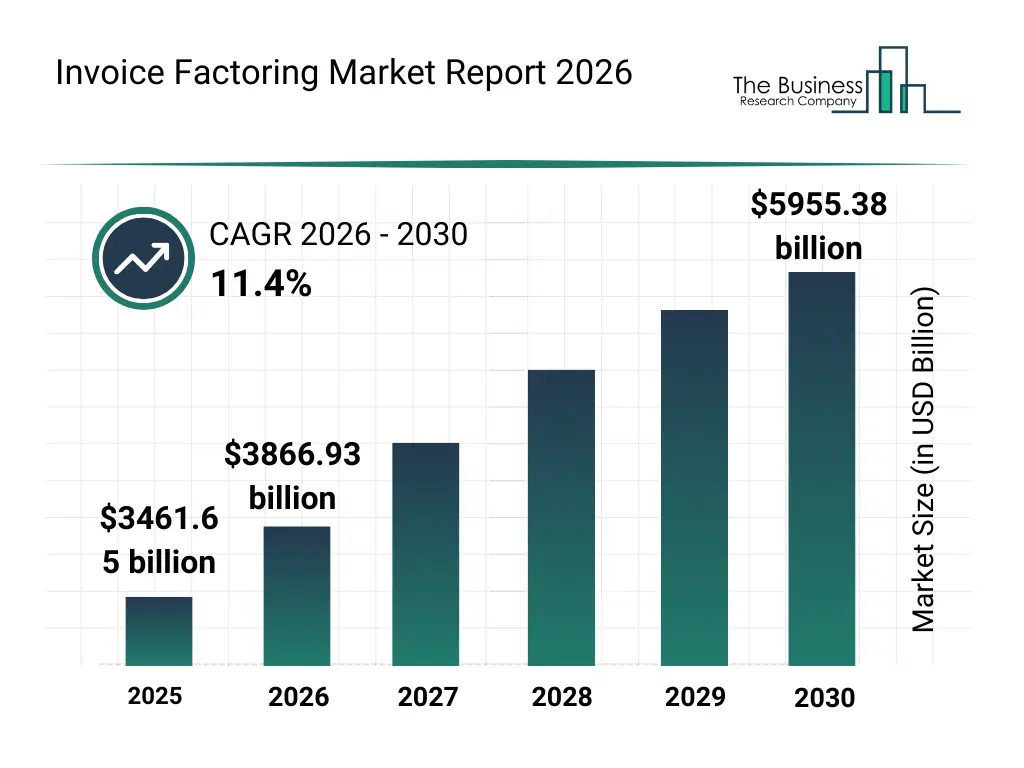
What Is The Invoice Factoring Market Size and Share 2026?
The invoice factoring market size has grown rapidly in recent years. It will grow from $3461.65 billion in 2025 to $3866.93 billion in 2026 at a compound annual growth rate (CAGR) of 11.7%. The growth in the historic period can be attributed to increasing payment cycle durations, limited access to traditional bank credit for SMEs, growth in domestic and cross-border trade, rising need for liquidity management, expansion of non-bank financing options.What Is The Invoice Factoring Market Growth Forecast?
The invoice factoring market size is expected to see rapid growth in the next few years. It will grow to $5955.38 billion in 2030 at a compound annual growth rate (CAGR) of 11.4%. The growth in the forecast period can be attributed to growing adoption of fintech-enabled factoring solutions, increasing demand for real-time cash flow visibility, expansion of international factoring services, rising integration of AI-driven credit analytics, growing acceptance of alternative financing models. Major trends in the forecast period include increasing adoption of digital invoice factoring platforms, rising demand for flexible working capital solutions, growing use of automated credit risk assessment, expansion of sme-focused factoring services, enhanced focus on faster invoice turnaround.
Global Invoice Factoring Market Segmentation
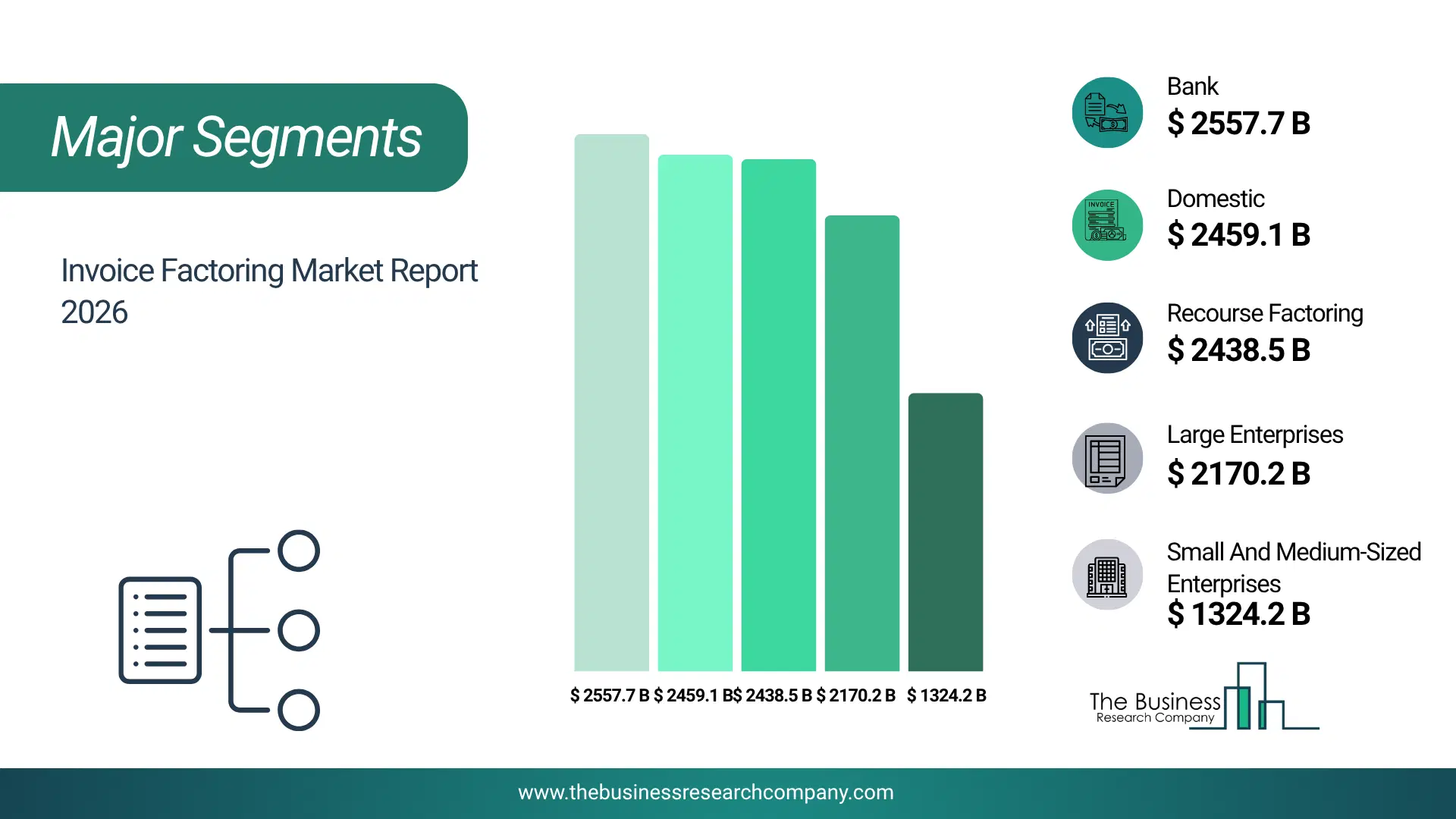
1) By Type: Recourse Factoring, Non-Recourse Factoring 2) By Provider: Banks, Non-Banking Financial Companies (NBFCs) 3) By Enterprise Size: Large Enterprises, Small And Medium-Sized Enterprises 4) By Application: Domestic, International 5) By Industry: Construction, Manufacturing, Healthcare, Transportation And Logistics, Energy And Utilities, Information Technology (IT) And Telecom, Staffing, Other Industries Subsegments: 1) By Recourse Factoring: Standard Recourse Factoring, Selective Recourse Factoring, Spot Factoring, Recourse Factoring With Reserve, Invoice Financing With Recourse 2) By Non-Recourse Factoring: Standard Non-Recourse Factoring, Non-Recourse Factoring With Full Advance, Non-Recourse Factoring With Credit Protection, Non-Recourse Spot Factoring, Non-Recourse Factoring For Startups The top segments in the invoice factoring market will be: • Bank will reach $2557798.45 Million by 2025. • Domestic will reach $2459145.63 Million by 2025. • Recourse Factoring will reach $2438599.48 Million by 2025. • Large Enterprises will reach $2170212.12 Million by 2025. • Small And Medium-Sized Enterprises will reach $1324268.19 Million by 2025.What Is The Driver Of The Invoice Factoring Market?
The increasing demand for fintech solutions is expected to propel the growth of invoice factoring forward. Fintech solutions refer to the application of innovative technologies to enhance and streamline traditional financial services and processes. The increasing fintech solution is due to factors such as changing customer expectations, digital connectivity, dissatisfaction with traditional financial services, and unbundling of financial services. Invoice factoring supports the expansion and innovation of fintech solutions by enhancing cash flow management, integrating advanced technology, diversifying financial services, improving accessibility, streamlining processes, and promoting market growth. For instance, in November 2023, according to the International Financial Trade Administration, a US-based government agency, the FinTech sector in the UK is comprised of over 1,600 firms, a number that is projected to double by 2030. Therefore, the increase in popularity of fintech solutions is driving the growth of the invoice factoring industry.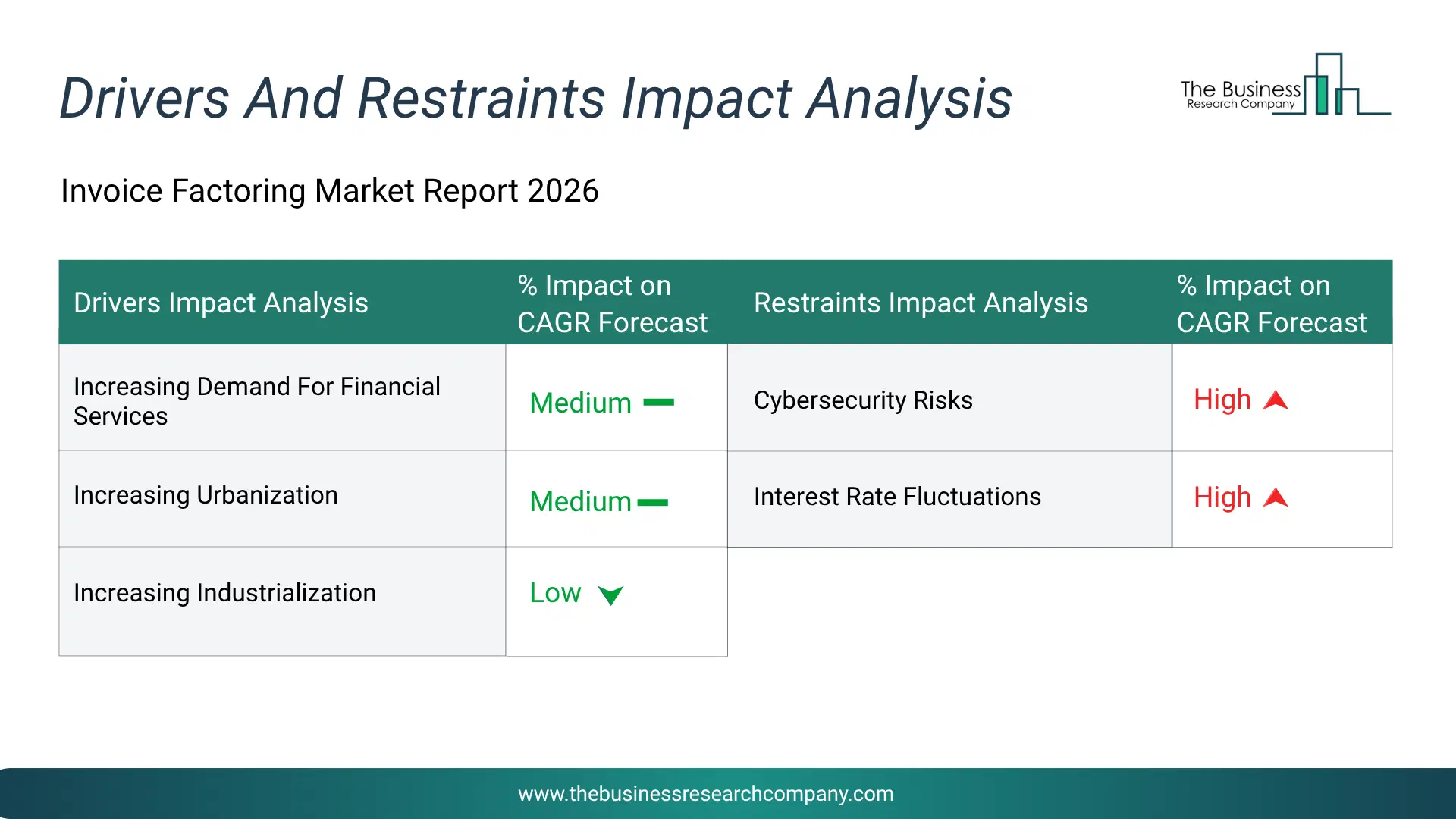
Infographic Chart Showing Key Market Drivers Analysis And Restraints For Invoice Factoring Market
The chart presents an impact analysis of key drivers and restraints, quantifying their relative influence on the market's growth rate and helping assess the balance between growth enablers and limiting factors. This chart offers a high-level perspective; the full report contains more detailed insights.
How Will The Drivers Impact Growth In The Global Invoice Factoring Market?
• Increasing Demand For Financial Services (Medium) – The increasing demand for financial services will become a key driver of growth in the invoice factoring market by 2030. Financial services encompass a broad range of economic activities, including banking, investment, insurance, and lending, that facilitate capital management, wealth creation, and economic growth for individuals and businesses. The demand for financial services arises with a role in managing, safeguarding, and growing wealth for individuals, businesses, and government. As a result, the increasing demand for financial services is anticipated to contributing to a 1.5% annual growth in the market. • Increasing Urbanization (Medium) – The increasing urbanization will emerge as a major factor driving the expansion of the invoice factoring market by 2030. Urbanization is the process of population migration from rural to urban areas, leading to the expansion of cities, increased population density, and the development of infrastructure, industries, and services to support economic, social, and technological growth. Urban areas typically have better access to financial services, including fintech platforms and traditional banking institutions. Consequently, the increasing urbanization capabilities is projected to contributing to a 1.0% annual growth in the market. • Increasing Industrialization (Low) – The increasing industrialization will serve as a key growth catalyst for the invoice factoring market by 2030. Industrialization is the transformation of economies from agrarian-based to manufacturing and industry-driven systems, characterized by technological advancements, large-scale production, and economic growth. The increasing pace of industrialization is driven by advancements in automation, rising global demand for manufactured goods, government policies promoting industrial growth, foreign direct investments, improved infrastructure, access to raw materials, and the expansion of global trade networks. Therefore, this increasing industrialization is projected to supporting to a 0.8% annual growth in the market. • Increase In Government Support (Low) – The increase in government support will become a significant driver contributing to the growth of the invoice factoring market by 2030. Government support refers to financial aid, policy measures, or regulatory assistance provided by the government to individuals, businesses, or industries to promote economic stability, growth, and social welfare. Government support is rising due to economic uncertainties, climate change initiatives, technological advancements, and the need to bolster small businesses and key industries amid global challenges like inflation and supply chain disruptions. Consequently, the increase in government support strategies is projected to contributing to a 0.5% annual growth in the market.How Will The Restraints Impact Growth In The Global Invoice Factoring Market?
• Cybersecurity Risks (Medium) – Cybersecurity Risks will restrict the growth of the Invoice Factoring market during the forecast period. Invoice factoring platforms handle sensitive financial data including client information, invoices, and payment details. Data breaches can result in financial losses, legal liability, and reputational damage. Security concerns about data protection and fraud risks can affect confidence in invoice factoring platforms, limiting adoption and market growth. • Interest Rate Fluctuations (Medium) – Interest Rate Fluctuations will restrict the growth of the Invoice Factoring market during the forecast period. Invoice factoring is sensitive to interest rate changes, affecting the cost of financing and factoring fees. Rising interest rates increase borrowing costs for factoring companies, which may be passed on to clients through higher fees. Interest rate volatility can affect the demand for invoice factoring and the profitability of factoring operations.Key Players In The Global Invoice Factoring Market
Major companies operating in the invoice factoring market are Industrial and Commercial Bank of China Limited (ICBC), Riviera Finance, FundThrough, RTS Financial, Triumph Business Capital, eCapital Corporation, Scale Funding, Universal Funding Corporation, Kapitus, 1st Commercial Credit, Wayflyer, Drip Capital, Factorglobe, OTR Capital, Fundbox Inc., Paragon Financial Group Inc., Accord Financial Corporation, Eagle Business Credit LLC, TBS Factoring Service LLC, Sonovate Limited.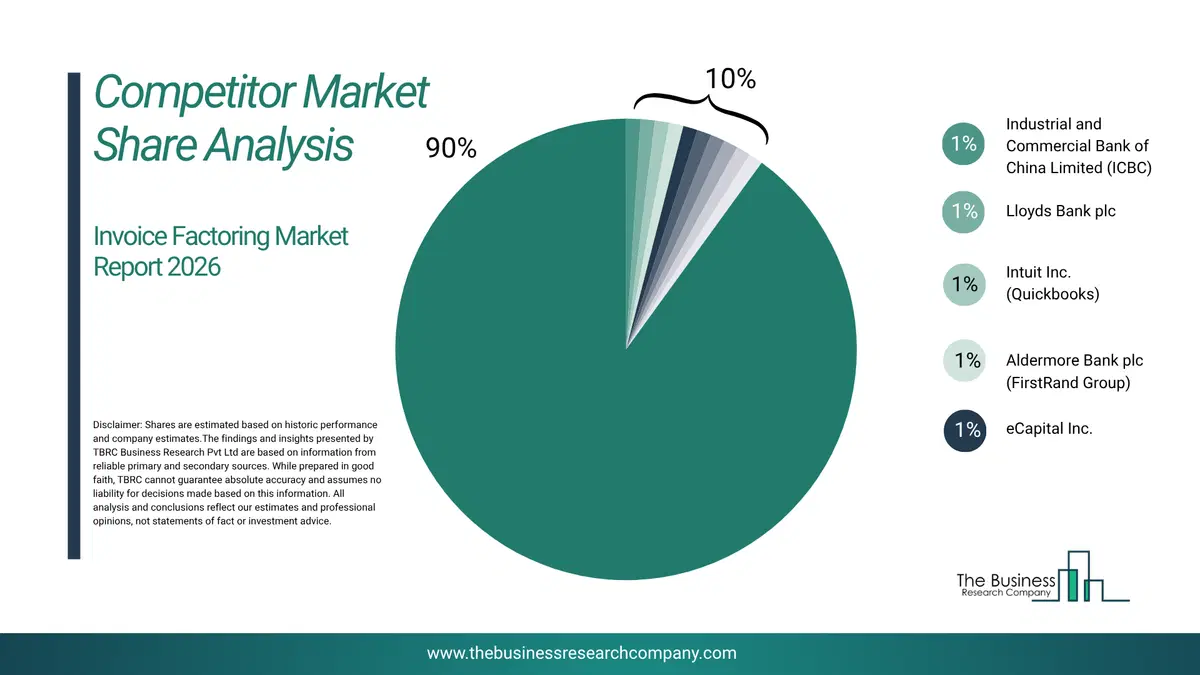
This chart is for illustrative purposes; the full report includes a detailed competitor analysis and comprehensive overview of the top 10 companies in the market.
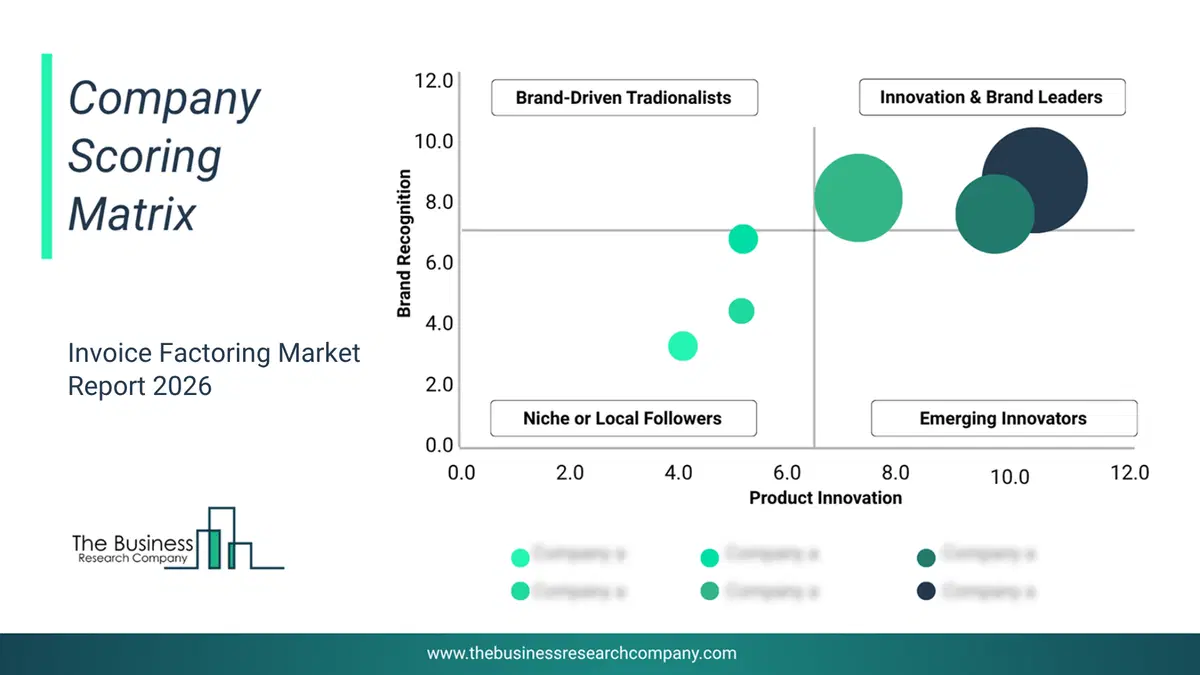
This chart maps companies by product innovation and brand strength, with bubble size indicating relative revenue, helping identify market leaders, challengers, and niche players. This is an illustrative chart; the full report provides a complete and accurate competitive analysis.
Global Invoice Factoring Market Trends and Insights
Major companies operating in the invoice factoring market are focused on developing advanced solutions, such as web-based invoice financing, to offer more flexible, user-friendly platforms for businesses to manage their receivables, improve cash flow, and reduce administrative overhead. A web-based invoice financing solution is a digital platform that allows businesses to obtain financing by leveraging their outstanding invoices, thereby improving cash flow by providing immediate access to funds based on the amounts due from their customers. For instance, in July 2024, the State Bank of India (SBI), an India-based company, launched a Web-Based Invoice Financing Solution. A web-based invoice financing solution streamlines the borrowing process, making it accessible and efficient for businesses looking to leverage their accounts receivable for immediate cash flow needs. SBI aims to address small businesses' liquidity challenges, which often need help accessing formal credit. This initiative is particularly relevant given that many of India's microbusinesses and small and midsize enterprises (SMEs) need more access to financial resources.What Are Latest Mergers And Acquisitions In The Invoice Factoring Market?
In August 2025, Banca Ifis S.p.A., an Italy-based financial services company focused on factoring and specialty finance for SMEs and corporates, acquired illimity Bank S.p.A. for an undisclosed amount. With this acquisition, Banca Ifis aimed to expand its market presence and diversify its service portfolio beyond its core factoring activities by strengthening digital banking, lending, and credit management capabilities for small and medium enterprises in Italy. illimity Bank S.p.A. is an Italy-based banking group that specializes in digital banking, corporate lending, and alternative credit solutions, offering technology-enabled financial services to SMEs and institutional clients.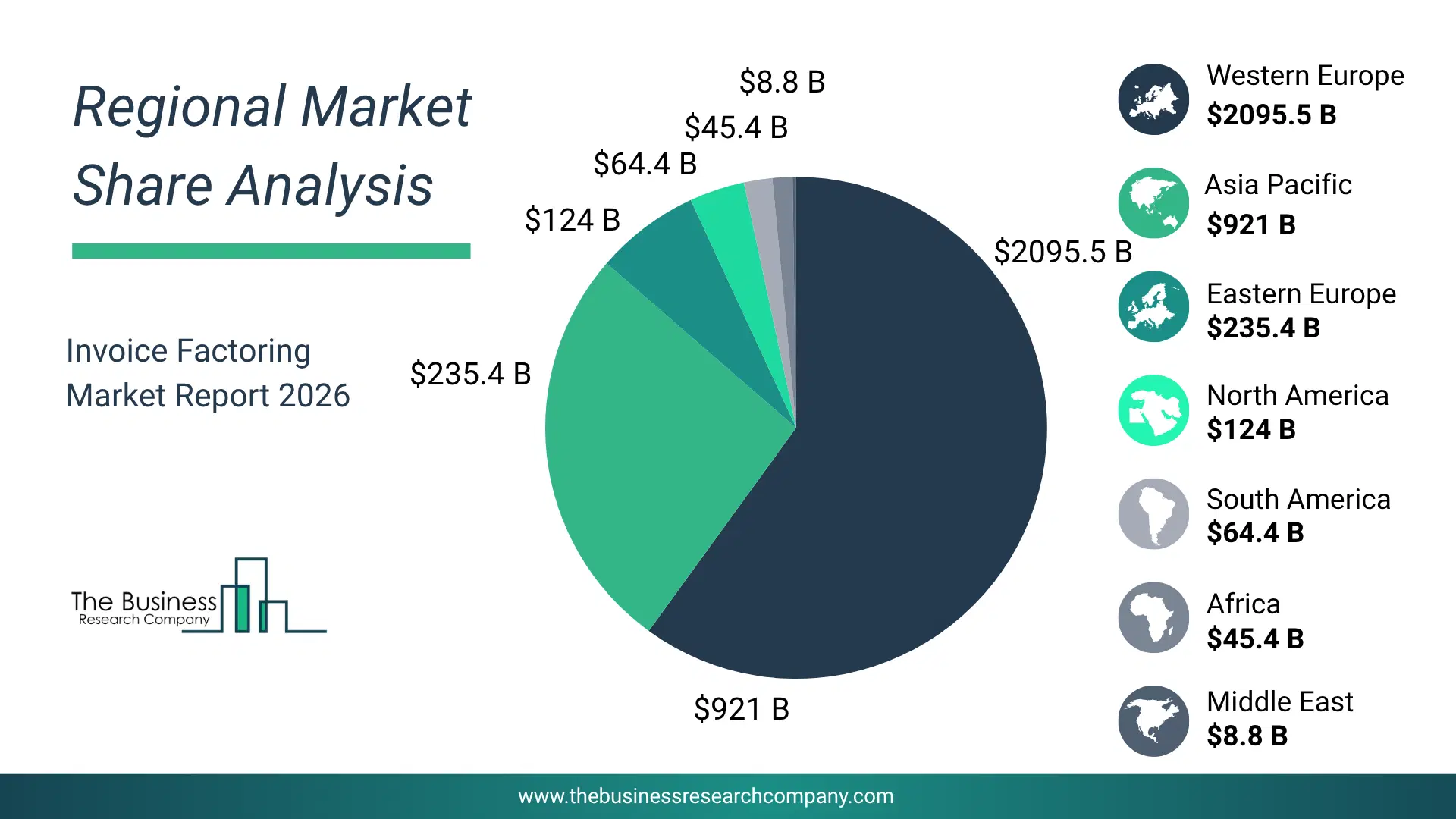
Regional Outlook
Europe was the largest region in the invoice factoring market in 2025. Asia-Pacific is expected to be the fastest-growing region in the forecast period. The regions covered in this market report are Asia-Pacific, South East Asia, Western Europe, Eastern Europe, North America, South America, Middle East, Africa. The countries covered in this market report are Australia, Brazil, China, France, Germany, India, Indonesia, Japan, Taiwan, Russia, South Korea, UK, USA, Canada, Italy, Spain.What Defines the Invoice Factoring Market?
The invoice factoring market includes revenues earned by entities by immediate cash advances, debt collection, industry-specific solutions. The market value includes the value of related goods sold by the service provider or included within the service offering. Only goods and services traded between entities or sold to end consumers are included.How is Market Value Defined and Measured?
The market value is defined as the revenues that enterprises gain from the sale of goods and/or services within the specified market and geography through sales, grants, or donations in terms of the currency (in USD unless otherwise specified). The revenues for a specified geography are consumption values that are revenues generated by organizations in the specified geography within the market, irrespective of where they are produced. It does not include revenues from resales along the supply chain, either further along the supply chain or as part of other products.
This chart presents market attractiveness based on a quantitative evaluation of growth, competition, strategic alignment, and risk, offering a clear view of opportunity areas for decision-making. This chart is for illustrative purposes; the full report contains the complete analysis.

This chart highlights the Total Addressable Market (TAM) by estimating the maximum revenue opportunity using an assumption-driven approach, supporting strategic planning and opportunity sizing across markets. The chart is illustrative; the full report provides a more comprehensive analysis.
What Key Data and Analysis Are Included in the Invoice Factoring Market Report 2026?
The invoice factoring market research report is one of a series of new reports from The Business Research Company that provides market statistics, including Market Report 2026?global market size, regional shares, competitors with the market share, detailed market segments, market trends and opportunities, and any further data you may need to thrive in the invoice factoring Market Report 2026? The market research report delivers a complete perspective of everything you need, with an in-depth analysis of the current and future state of the Market Report 2026?Invoice Factoring Market Report Forecast Analysis
| Report Attribute | Details |
|---|---|
| Market Size Value In 2026 | $3866.93 billion |
| Revenue Forecast In 2030 | $5955.38 billion |
| Growth Rate | CAGR of 11.7% from 2026 to 2030 |
| Base Year For Estimation | 2025 |
| Actual Estimates/Historical Data | 2020-2025 |
| Forecast Period | 2026 - 2030 |
| Market Representation | Revenue in USD Billion and CAGR from 2026 to 2030 |
| Segments Covered | Type, Provider, Enterprise Size, Application, Industry |
| Regional Scope | Asia-Pacific, Western Europe, Eastern Europe, North America, South America, Middle East, Africa |
| Country Scope | The countries covered in the report are Australia, Brazil, China, France, Germany, India, Indonesia, Japan, Taiwan, Russia, South Korea, UK, USA, Canada, Italy, Spain. |
| Key Companies Profiled | Industrial and Commercial Bank of China Limited (ICBC), Riviera Finance, FundThrough, RTS Financial, Triumph Business Capital, eCapital Corporation, Scale Funding, Universal Funding Corporation, Kapitus, 1st Commercial Credit, Wayflyer, Drip Capital, Factorglobe, OTR Capital, Fundbox Inc., Paragon Financial Group Inc., Accord Financial Corporation, Eagle Business Credit LLC, TBS Factoring Service LLC, Sonovate Limited. |
| Customization Scope | Request for Customization |
| Pricing And Purchase Options | Explore Purchase Options |