
Ion Implanter Market Report 2026
Global Outlook – By Product Type Or Energy Range (High Current Implanters, Medium Current Implanters, High Energy Implanters, Low Energy Implanters, Plasma Doping Implanters (PIII) ), By Ion Source Type (Gas Ion Sources, Solid Ion Sources, Plasma Ion Sources), By Mode of Operation Outlook (Manual, Automatic, Semi-Automatic), By Application (Semiconductor Fabrication, Solar Cells Or Photovoltaics, Metal Finishing Or Surface Modification (for hardening, corrosion resistance), Medical And Life Sciences, Other Applications ), By End User Industry Outlook (Electronics, Automotive, Aerospace, Healthcare) – Market Size, Trends, Strategies, and Forecast to 2030
Ion Implanter Market Overview
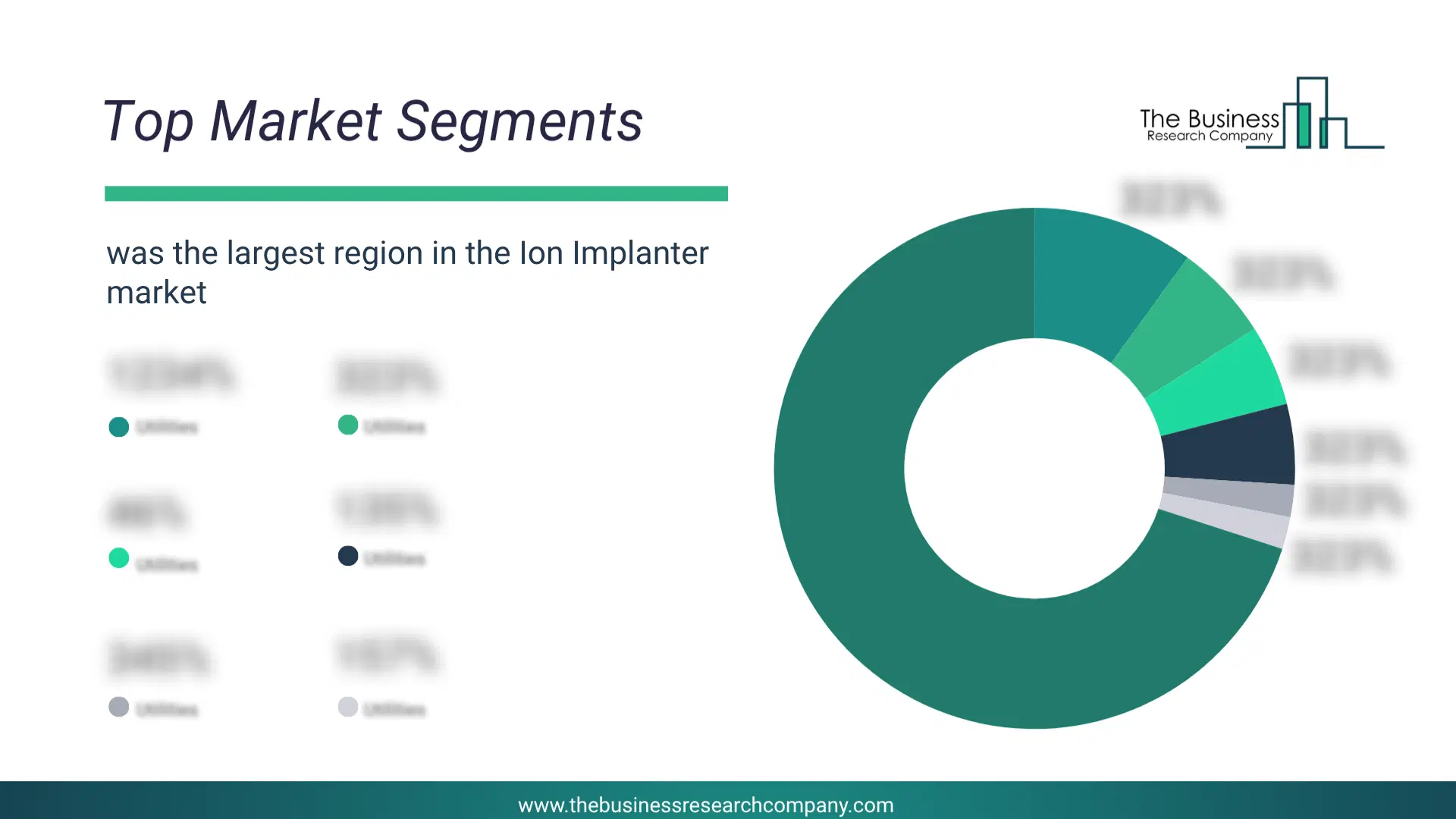
• Ion Implanter market size has reached to $2.18 billion in 2025 • Expected to grow to $2.96 billion in 2030 at a compound annual growth rate (CAGR) of 6.2% • Growth Driver: Growing Semiconductor Industry Demand Driving Growth Of The Market Due To Need For Precise And Efficient Dopant Implantation • Market Trend: Advanced Ion Implant Platforms Support Wide-Bandgap Power Semiconductor Production • Asia-Pacific was the largest region in 2025 and North America is the fastest growing region.What Is Covered Under Ion Implanter Market?
Ion implanter is a specialized semiconductor fabrication machines that accelerate and implant charged ions into silicon wafers to precisely modify their electrical properties. Its purpose is to enable controlled doping, device tuning, and performance optimization in integrated circuit manufacturing across advanced technology nodes. The main product types or energy ranges in the ion implanter market include high current implanters, medium current implanters, high energy implanters, low energy implanters (often specialized for ultra-shallow junctions), and plasma doping implanters (PIII). High current and medium current implanters support standard semiconductor doping processes, high energy implanters enable deep implantation for advanced devices, low energy implanters provide precise ultra-shallow junctions for modern microchips, and plasma doping implanters utilize plasma sources for specialized doping applications. The key ion source types include gas ion sources, solid ion sources (from vaporized solids), and plasma ion sources, providing flexibility in doping materials and processes. The mode of operation includes manual, automatic, and semi-automatic systems, catering to varying levels of automation and process control. The primary applications of ion implanters include semiconductor fabrication (doping ICs and microchips), solar cells or photovoltaics, metal finishing or surface modification (for hardening and corrosion resistance), medical and life sciences, and other applications such as photonics and materials science research. These systems are utilized across several end-user industries such as electronics, automotive, aerospace, and healthcare, supporting precision implantation and advanced material processing.
What Is The Ion Implanter Market Size and Share 2026?
The ion implanters market size has grown strongly in recent years. It will grow from $2.18 billion in 2025 to $2.33 billion in 2026 at a compound annual growth rate (CAGR) of 6.5%. The growth in the historic period can be attributed to increasing demand for integrated circuits, rising consumer electronics penetration, expanding foundry and fabrication capacities, rising automotive electronics content, and increasing government incentives for semiconductor manufacturing.What Is The Ion Implanter Market Growth Forecast?
The ion implanters market size is expected to see strong growth in the next few years. It will grow to $2.96 billion in 2030 at a compound annual growth rate (CAGR) of 6.2%. The growth in the forecast period can be attributed to increasing demand for advanced logic and memory chips, rising adoption of electrification and advanced driver assistance systems in vehicles, growing demand for power semiconductors and discrete devices, increasing fab capacity expansions and greenfield semiconductor plants, and rising replacement demand for aging ion implanter fleets. Major trends in the forecast period include technology advancements in high-current and single-wafer implanter designs, integration of automation and robotics for handling and throughput improvements, development of plasma immersion ion implantation methods and related process innovations, research and development in low-energy implantation techniques for next-generation devices, and innovations in process control and metrology for improved implantation accuracy.
Global Ion Implanter Market Segmentation
1) By Product Type Or Energy Range: High Current Implanters, Medium Current Implanters, High Energy Implanters, Low Energy Implanters, Plasma Doping Implanters (PIII) 2) By Ion Source Type: Gas Ion Sources, Solid Ion Sources, Plasma Ion Sources 3) By Mode of Operation Outlook: Manual, Automatic, Semi-Automatic 4) By Application: Semiconductor Fabrication, Solar Cells Or Photovoltaics, Metal Finishing Or Surface Modification (for hardening, corrosion resistance), Medical And Life Sciences, Other Applications 5) By End User Industry Outlook: Electronics, Automotive, Aerospace, Healthcare Subsegments: 1) By High Current Implanters: High Dose Ion Implantation, Source Drain Ion Implantation, Well And Channel Ion Implantation, Contact Ion Implantation 2) By Medium Current Implanters: Threshold Voltage Adjustment Implantation, Halo Ion Implantation, Well Formation Ion Implantation, Extension Region Ion Implantation 3) By High Energy Implanters: Deep Well Ion Implantation, Buried Layer Ion Implantation, Isolation Structure Ion Implantation, High Penetration Depth Ion Implantation 4) By Low Energy Implanters: Ultra Shallow Junction Ion Implantation, Surface Layer Ion Implantation, Low Penetration Depth Ion Implantation, Precision Dose Ion Implantation 5) By Plasma Doping Implanters: Plasma Immersion Ion Implantation, Plasma Assisted Surface Modification, High Uniformity Plasma Ion Implantation, Low Temperature Plasma Ion ImplantationWhat Is The Driver Of The Ion Implanter Market?
The growing demand from semiconductor industry is expected to propel the growth of the ion implanter market going forward. The semiconductor industry refers to the sector involved in designing, manufacturing, and distributing semiconductor devices used in electronics, automotive, and renewable energy systems. The growing semiconductor industry demand is due to the rapid expansion of electric vehicles, which require high-performance power semiconductors for efficient energy conversion and battery management. Ion implanters enhance semiconductor manufacturing by precisely introducing dopants into silicon wafers, enabling accurate control of electrical properties and device performance. They improve production efficiency by ensuring high precision, uniformity, and scalability in chip fabrication processes. For instance, in February 2025, according to the Semiconductor Industry Association (SIA), a US-based trade association, semiconductor sales reached $627.6 billion in 2024, an increase of 19.1% from $526.8 billion in 2023. Therefore, the growing demand from semiconductor industry is driving the growth of the ion implanter industry.Key Players In The Global Ion Implanter Market
Major companies operating in the ion implanter market are Intevac Inc., Applied Materials Inc., Sumitomo Heavy Industries Ltd., Hitachi High-Technologies Corporation, Axcelis Technologies Inc., Varian Semiconductor Equipment Associates Inc., SEN Corporation, ULVAC Technologies, Kingstone Semiconductor Joint Stock Company, Danfysik A/S, Advanced Ion Beam Technology Inc., Nissin Ion Equipment Co. Ltd., Ion Beam Services S.A., High Voltage Engineering Europa B.V., Ion Technology Solutions Inc., Ionoptika Ltd., Mi2-factory GmbH, Idonus sarl, Helmholtz-associated ion-beam Services, National Electrostatics Corporation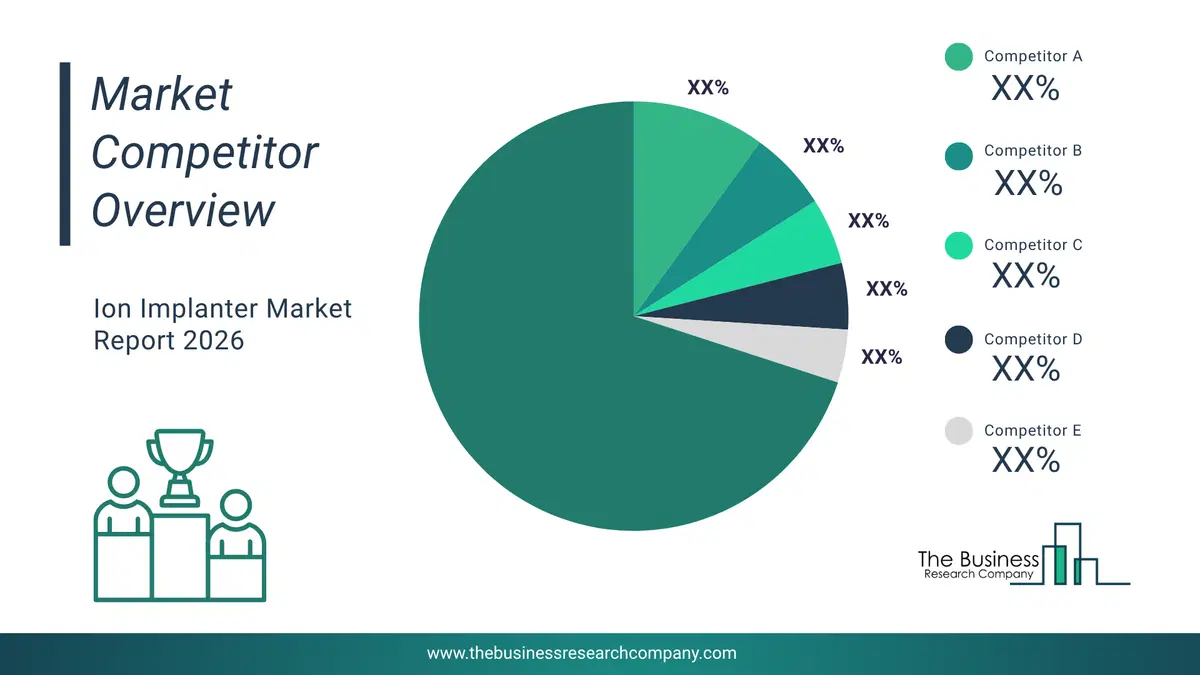
This chart is for illustrative purposes; the full report includes a detailed competitor analysis and comprehensive overview of the top 10 companies in the market.
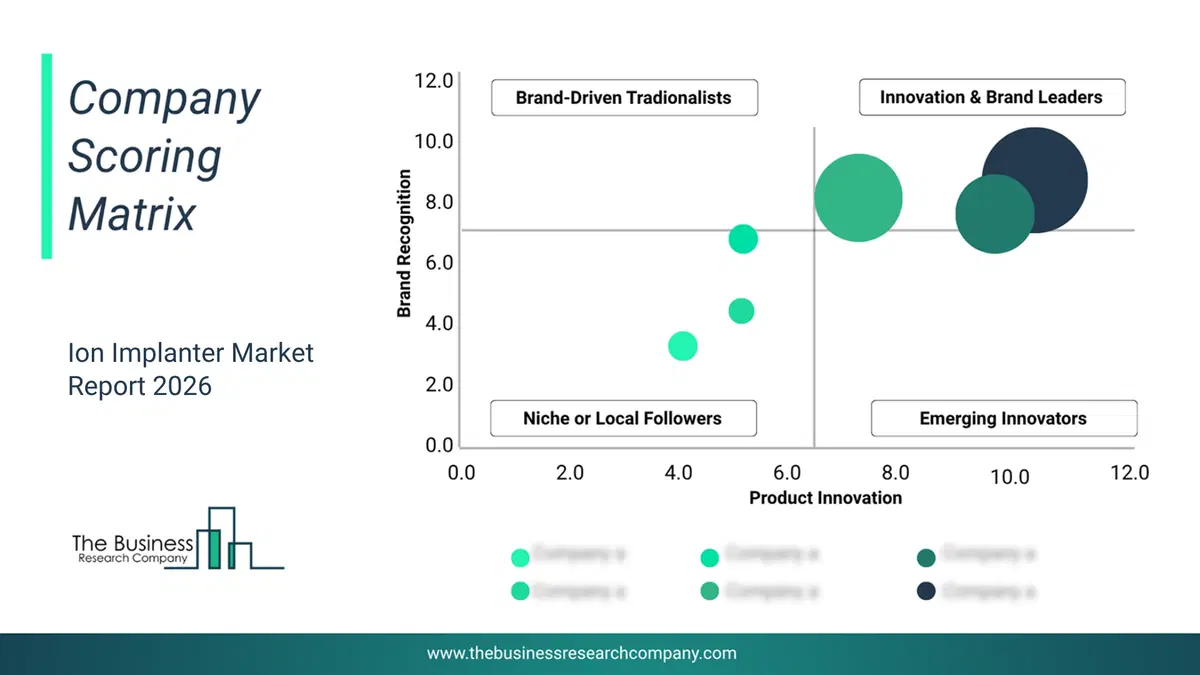
This chart maps companies by product innovation and brand strength, with bubble size indicating relative revenue, helping identify market leaders, challengers, and niche players. This is an illustrative chart; the full report provides a complete and accurate competitive analysis.
Global Ion Implanter Market Trends and Insights
Major companies operating in the ion implanter market are focusing on developing advanced solutions, such as next-generation silicon carbide (SiC) ion implant platforms, to improve dopant precision, increase throughput, and support the rapid expansion of power semiconductor production. SiC ion implant platforms refer to specialized implantation systems engineered to process wide-bandgap materials with high thermal stability and demanding doping requirements, enabling reliable fabrication of power devices used in electric vehicles, renewable energy systems, and high-efficiency industrial applications. For instance, in September 2025, Axcelis Technologies Inc., a US-based semiconductor equipment company, introduced the Purion Power Series+ ion implant platform. This platform features dedicated configurations such as Purion H200+ SiC for high-current medium-energy implants, Purion M+ SiC for medium-current processing, and Purion XE+ / EXE+ SiC for high-energy applications. It supports both 150 mm and 200 mm wafers, handles materials including SiC, Si, GaN, and GaAs, and enables room-temperature, warm, and hot implantation modes to meet device-specific thermal and dopant-activation requirements. These capabilities strengthen manufacturing performance for next-generation power devices and expand production flexibility across a broad spectrum of wide-bandgap applications.What Are Latest Mergers And Acquisitions In The Ion Implanter Market?
In April 2025, Hwatsing Technology Co. Ltd., a China-based semiconductor equipment manufacturer, acquired the remaining equity in Xinyu Semiconductor (Shanghai) Co. Ltd. for approximately $137.6 million (¥1.0045 billion). With this acquisition, Hwatsing Technology aims to strengthen its semiconductor equipment manufacturing capabilities in China, expand its market presence in advanced semiconductor production, and achieve greater control over Xinyu Semiconductor’s operations, technology, and R&D for next-generation chip fabrication. Xinyu Semiconductor (Shanghai) Co. Ltd. is a China-based semiconductor equipment company specializing in ion implanter systems for advanced chip manufacturing.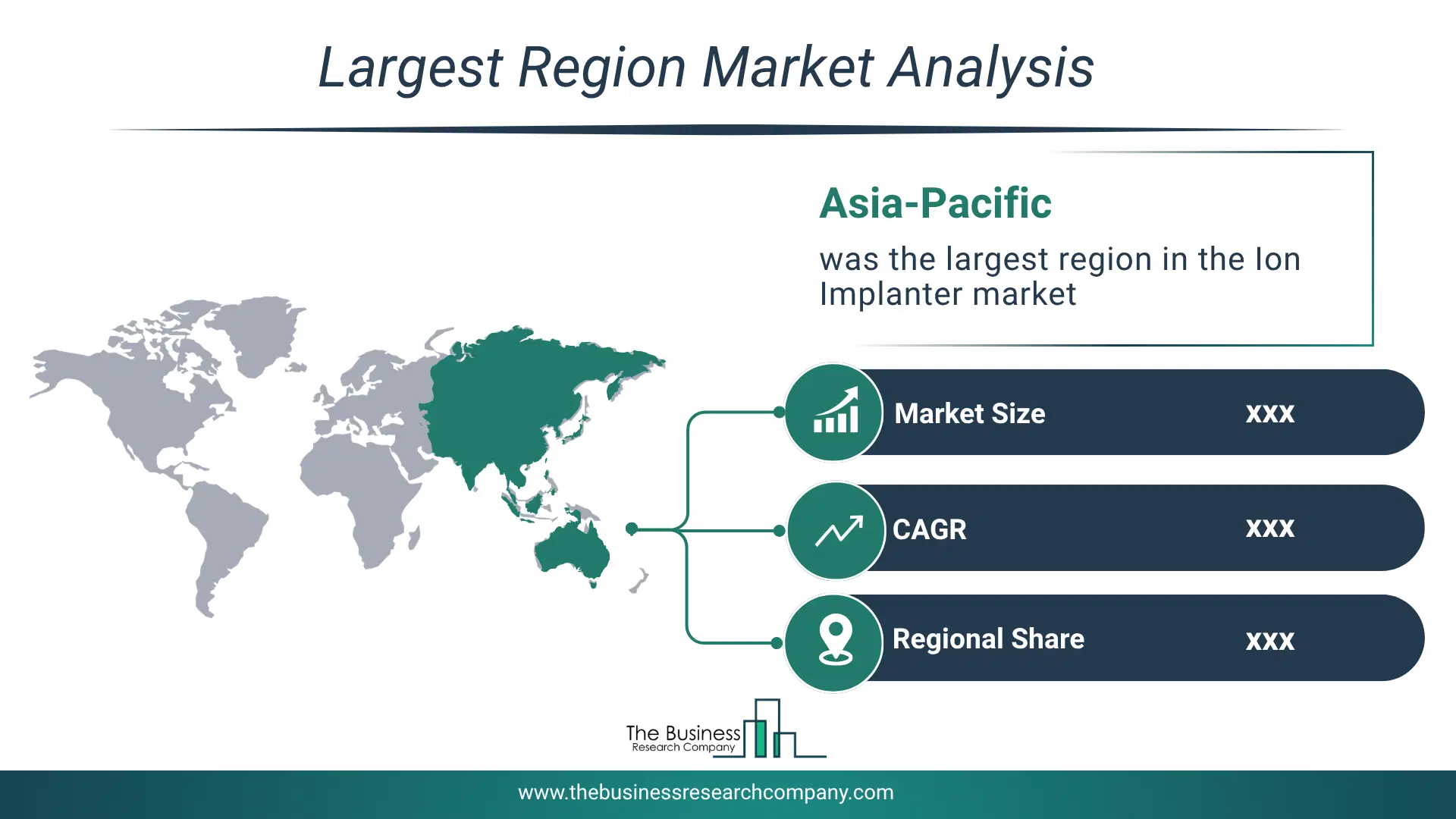
Regional Insights
Asia-Pacific was the largest region in the ion implanters market in 2025. North America is expected to be the fastest-growing region in the forecast period. The regions covered in this market report are Asia-Pacific, South East Asia, Western Europe, Eastern Europe, North America, South America, Middle East, Africa. The countries covered in this market report are Australia, Brazil, China, France, Germany, India, Indonesia, Japan, Taiwan, Russia, South Korea, UK, USA, Canada, Italy, Spain.What Defines the Ion Implanter Market?
The ion implanter market consists of sales of high-energy ion implanters, medium-current ion implanters, high-current ion implanters, low-energy single-wafer ion implanters, plasma immersion ion implantation systems, and implanter automation and wafer handling systems. Values in this market are ‘factory gate’ values, that is the value of goods sold by the manufacturers or creators of the goods, whether to other entities (including downstream manufacturers, wholesalers, distributors and retailers) or directly to end customers. The value of goods in this market includes related services sold by the creators of the goods.How is Market Value Defined and Measured?
The market value is defined as the revenues that enterprises gain from the sale of goods and/or services within the specified market and geography through sales, grants, or donations in terms of the currency (in USD unless otherwise specified). The revenues for a specified geography are consumption values that are revenues generated by organizations in the specified geography within the market, irrespective of where they are produced. It does not include revenues from resales along the supply chain, either further along the supply chain or as part of other products.
This chart presents market attractiveness based on a quantitative evaluation of growth, competition, strategic alignment, and risk, offering a clear view of opportunity areas for decision-making. This chart is for illustrative purposes; the full report contains the complete analysis.

This chart highlights the Total Addressable Market (TAM) by estimating the maximum revenue opportunity using an assumption-driven approach, supporting strategic planning and opportunity sizing across markets. The chart is illustrative; the full report provides a more comprehensive analysis.
What Key Data and Analysis Are Included in the Ion Implanter Market Report 2026?
The ion implanter market research report is one of a series of new reports from The Business Research Company that provides market statistics, including industry global market size, regional shares, competitors with the market share, detailed market segments, market trends and opportunities, and any further data you may need to thrive in the ion implanter industry. The market research report delivers a complete perspective of everything you need, with an in-depth analysis of the current and future state of the industry.Ion Implanter Market Report Forecast Analysis
| Report Attribute | Details |
|---|---|
| Market Size Value In 2026 | $2.33 billion |
| Revenue Forecast In 2030 | $2.96 billion |
| Growth Rate | CAGR of 6.5% from 2026 to 2030 |
| Base Year For Estimation | 2025 |
| Actual Estimates/Historical Data | 2020-2025 |
| Forecast Period | 2026 - 2030 |
| Market Representation | Revenue in USD Billion and CAGR from 2026 to 2030 |
| Segments Covered | Product Type Or Energy Range, Ion Source Type, Mode of Operation Outlook, Application, End User Industry Outlook |
| Regional Scope | Asia-Pacific, Western Europe, Eastern Europe, North America, South America, Middle East, Africa |
| Country Scope | The countries covered in the report are Australia, Brazil, China, France, Germany, India, Indonesia, Japan, Taiwan, Russia, South Korea, UK, USA, Canada, Italy, Spain. |
| Key Companies Profiled | Intevac Inc., Applied Materials Inc., Sumitomo Heavy Industries Ltd., Hitachi High-Technologies Corporation, Axcelis Technologies Inc., Varian Semiconductor Equipment Associates Inc., SEN Corporation, ULVAC Technologies, Kingstone Semiconductor Joint Stock Company, Danfysik A/S, Advanced Ion Beam Technology Inc., Nissin Ion Equipment Co. Ltd., Ion Beam Services S.A., High Voltage Engineering Europa B.V., Ion Technology Solutions Inc., Ionoptika Ltd., Mi2-factory GmbH, Idonus sarl, Helmholtz-associated ion-beam Services, National Electrostatics Corporation |
| Customization Scope | Request for Customization |
| Pricing And Purchase Options | Explore Purchase Options |