
IoT Connectivity Management Platform Market Report 2026
Global Outlook – By Product Type (Cellular, Non-Cellular), By Component (Solution, Services), By Deployment Type (Cloud, On-Premises), By Enterprise Size (Small And Medium-sized Enterprises (SMEs), Large Enterprises), By Application (Automotive, Consumer Electronics, Retail, Energy And Utilities, Finance And Banking, Healthcare, Manufacturing, Other Applications) – Market Size, Trends, Strategies, and Forecast to 2030
IoT Connectivity Management Platform Market Overview
• IoT Connectivity Management Platform market size has reached to $10.16 billion in 2025 • Expected to grow to $25.71 billion in 2030 at a compound annual growth rate (CAGR) of 20.4% • Growth Driver: Adoption Of 5G Connectivity Is Anticipated To Fuel The IOT Connectivity Management Platform Market • Market Trend: Revolutionary IOT Connectivity Management For Enhanced Monitoring • Asia-Pacific was the largest region and fastest growing region.What Is Covered Under IoT Connectivity Management Platform Market?
The IoT connectivity management platform are platforms used in organizations to connect various devices, hardware, software, and connectivity technologies. The IoT connectivity management platform provides access to data and insights for analysis that helps to optimize deploy devices and increase the project success rate. Additionally, the IoT connectivity management platform reduces operational charges and increases the security of various devices connected in organizations. The main product types of IoT connectivity management platforms are cellular and non-cellular. Cellular refers to deploying various connectivity management platforms which use the current cellular network used by smartphones. The cellular IoT connectivity management platform does not require a separate set of networks for operating as it is operational with existing mobile networks. The various components include solutions and services that are deployed over the cloud and on-premises. The several applications include automotive, consumer electronics, retail, energy & utilities, finance & banking, healthcare, manufacturing, and others.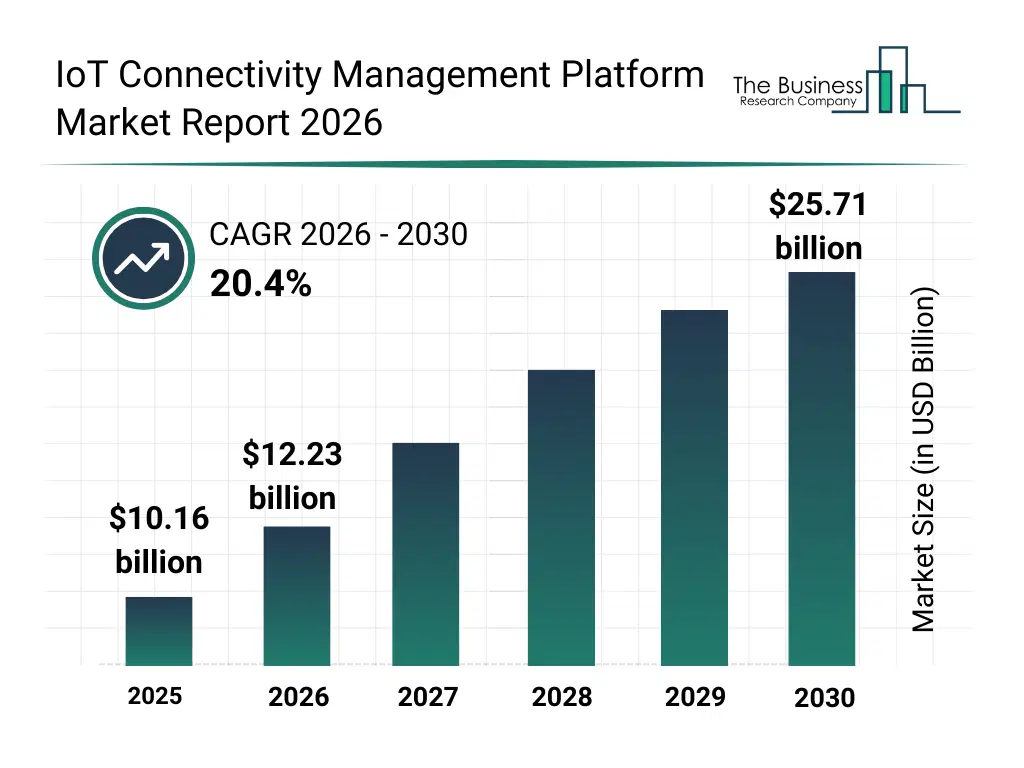
What Is The IoT Connectivity Management Platform Market Size and Share 2026?
The iot connectivity management platform market size has grown exponentially in recent years. It will grow from $10.16 billion in 2025 to $12.23 billion in 2026 at a compound annual growth rate (CAGR) of 20.3%. The growth in the historic period can be attributed to growth in connected device deployments, need for network visibility, complexity of multi connectivity environments, early iot platform adoption, rising operational management costs.What Is The IoT Connectivity Management Platform Market Growth Forecast?
The iot connectivity management platform market size is expected to see exponential growth in the next few years. It will grow to $25.71 billion in 2030 at a compound annual growth rate (CAGR) of 20.4%. The growth in the forecast period can be attributed to 5G and lte m adoption growth, demand for real time connectivity analytics, increasing enterprise scale iot projects, focus on device security management, expansion of global iot deployments. Major trends in the forecast period include centralized device connectivity control, multi network connectivity management, secure iot data transmission, scalable cloud connectivity platforms, operational cost optimization tools.
Global IoT Connectivity Management Platform Market Segmentation
1) By Product Type: Cellular, Non-Cellular 2) By Component: Solution, Services 3) By Deployment Type: Cloud, On-Premises 4) By Enterprise Size: Small And Medium-sized Enterprises (SMEs), Large Enterprises 5) By Application: Automotive, Consumer Electronics, Retail, Energy And Utilities, Finance And Banking, Healthcare, Manufacturing, Other Applications Subsegments: 1) By Cellular: 2G Or 3G Or 4G Or 5G Connectivity, Narrowband IoT (NB-IoT), Long-Term Evolution For Machines (LTE-M) 2) By Non-Cellular: Wi-Fi, Bluetooth, LoRaWAN (Long Range Wide Area Network), Zigbee, Satellite ConnectivityWhat Is The Driver Of The IoT Connectivity Management Platform Market?
The adoption of 5G connectivity is anticipated to fuel the IoT connectivity management platform market. 5G connectivity is the fifth generation of mobile network technology, providing faster internet speeds, lower latency, and increased connectivity for a wide range of devices and applications. The IoT connectivity management platform is used in optimizing and managing diverse and interconnected devices within the advanced 5G connectivity ecosystem. For instance, in April 2023, according to data from 5G Americas, a US-based industry trade organization, in 2022, global 5G wireless connections reached 1.05 billion and are projected to grow to 5.9 billion by the end of 2027. Therefore, the adoption of 5G connectivity is driving the IoT connectivity management platform industry.Key Players In The Global IoT Connectivity Management Platform Market
Major companies operating in the iot connectivity management platform market are Google LLC; Microsoft Corporation; Huawei Technologies Co Ltd.; Amazon Web Services Inc.; China Telecom Corporation Limited; International Business Machines Corporation; China Unicom (Hong Kong) Limited; Cisco Systems Inc.; Oracle Corporation; SAP SE; Hewlett Packard Enterprise Development LP; Telefonaktiebolaget LM Ericsson; Nokia Corporation; ZTE Corporation; Swisscom AG; Proximus Group SA; Vodafone Idea Limited; Tata Communications Limited; PTC Inc.; Software AG; Comarch SA; KORE Group Holdings Inc.; Aeris Communications Inc.; Emnify Ltd.; Truphone Limited; Sierra Wireless Inc.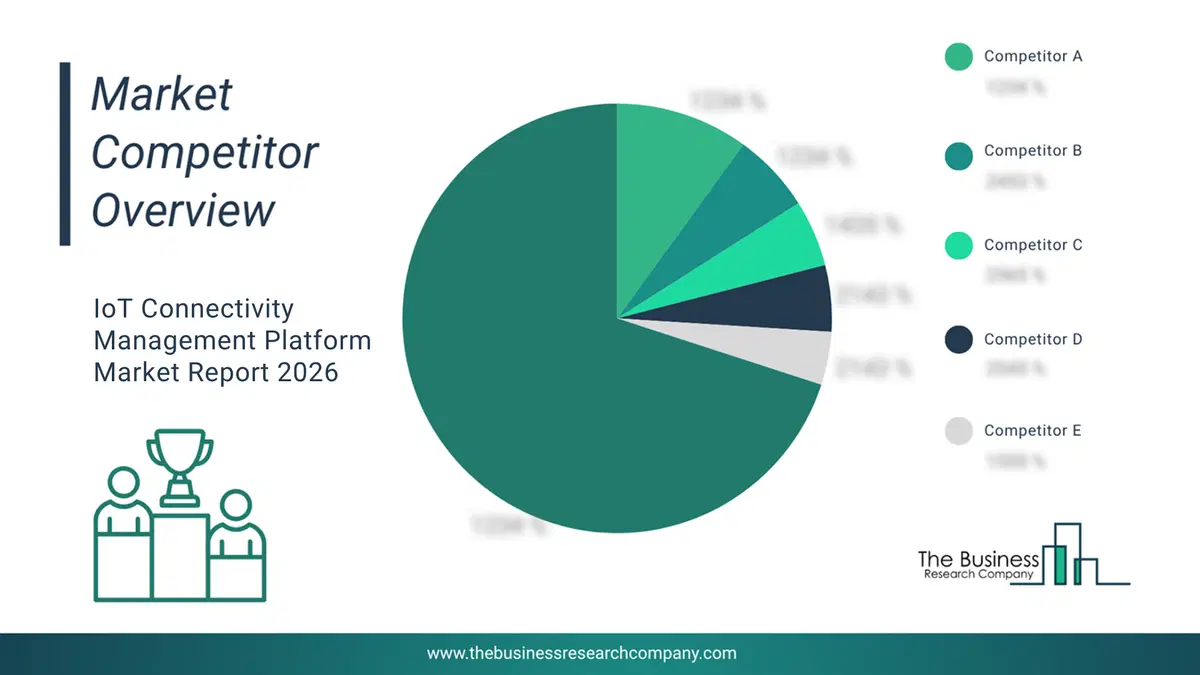
This chart is for illustrative purposes; the full report includes a detailed competitor analysis and comprehensive overview of the top 10 companies in the market.
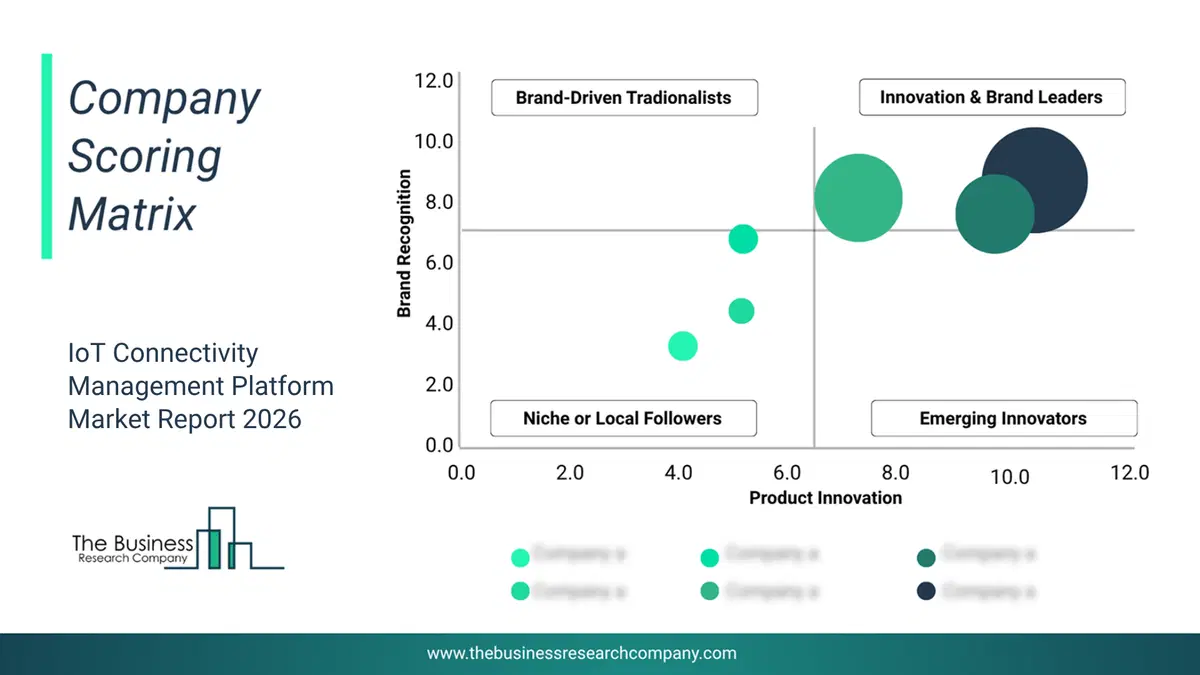
This chart maps companies by product innovation and brand strength, with bubble size indicating relative revenue, helping identify market leaders, challengers, and niche players. This is an illustrative chart; the full report provides a complete and accurate competitive analysis.
Global IoT Connectivity Management Platform Market Trends and Insights
Major companies in the IoT connectivity management platform market is focused on developing revolutionary IoT connectivity management, such as next-gen IoT connectivity management platforms, for enhanced monitoring and to maximize their profits in the market. A next-gen IoT Connectivity Management Platform is an advanced interface designed for monitoring and managing IoT devices and data network connections. For instance, in December 2023, TEAL, a US-based provider of eSIM technology, launched Aurora, its next-gen IoT Connectivity Management Platform (CMP). Aurora offers a comprehensive suite of features, including a Network App Marketplace with access to 3,500+ global data networks. Users can easily install new networks, switch between existing ones, track data consumption, and monitor device status. The platform incorporates key features such as eUICC health data and deeper SMSR data integration, providing insight and control over eSIM capabilities in the field. Aurora allows remote monitoring of TEAL eSIM network utilization and operational status worldwide, enhancing the deployment and management of devices.What Are Latest Mergers And Acquisitions In The IoT Connectivity Management Platform Market?
In March 2023, Aeris Communications Inc., a US-based provider of intelligent IoT connectivity and platform services, acquired Ericsson’s IoT Accelerator and Connected Vehicle Cloud businesses for an undisclosed amount. Through this acquisition, Aeris aims to strengthen its global IoT presence by integrating Ericsson’s advanced connectivity management technologies with its enterprise IoT platform, enhancing solutions for automotive, utilities, and healthcare sectors, and accelerating large-scale IoT device deployments worldwide. Telefonaktiebolaget LM Ericsson is a Sweden-based provides an IoT connectivity management platforms.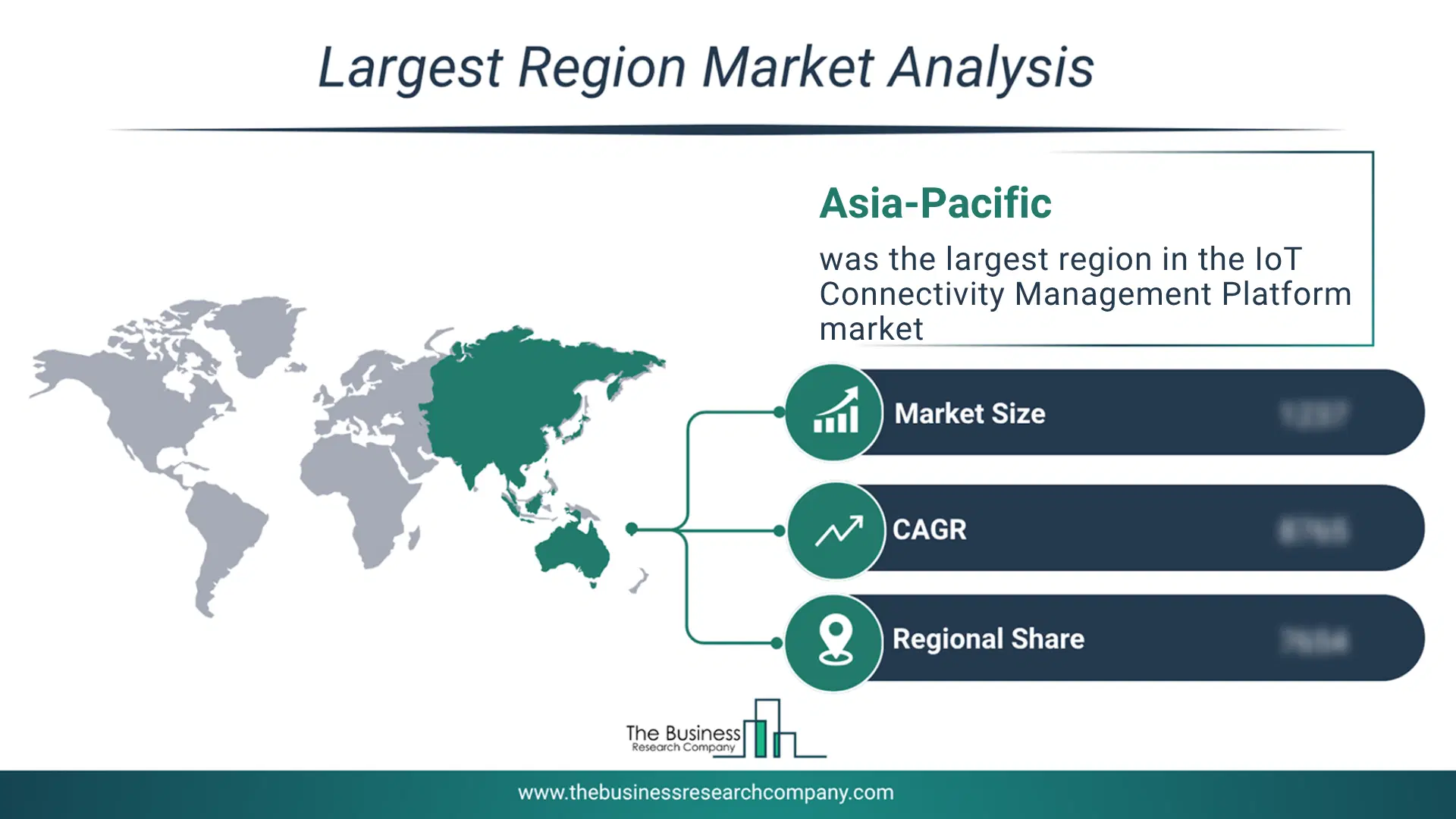
Regional Insights
Asia-Pacific was the largest region in the IoT connectivity management platform market in 2025. Asia-Pacific is expected to be the fastest-growing region in the forecast period. The regions covered in this market report are Asia-Pacific, South East Asia, Western Europe, Eastern Europe, North America, South America, Middle East, Africa. The countries covered in this market report are Australia, Brazil, China, France, Germany, India, Indonesia, Japan, Taiwan, Russia, South Korea, UK, USA, Canada, Italy, SpainWhat Defines the IoT Connectivity Management Platform Market?
The IoT connectivity management platform market consists of revenues earned by entities by providing data security services, application security services and endpoint security services. Values in this market are ‘factory gate’ values, that is the value of goods sold by the manufacturers or creators of the goods, whether to other entities (including downstream manufacturers, wholesalers, distributors, and retailers) or directly to end customers. The value of goods in this market includes related services sold by the creators of the goods.How is Market Value Defined and Measured?
The market value is defined as the revenues that enterprises gain from the sale of goods and/or services within the specified market and geography through sales, grants, or donations in terms of the currency (in USD unless otherwise specified). The revenues for a specified geography are consumption values that are revenues generated by organizations in the specified geography within the market, irrespective of where they are produced. It does not include revenues from resales along the supply chain, either further along the supply chain or as part of other products.
This chart presents market attractiveness based on a quantitative evaluation of growth, competition, strategic alignment, and risk, offering a clear view of opportunity areas for decision-making. This chart is for illustrative purposes; the full report contains the complete analysis.

This chart highlights the Total Addressable Market (TAM) by estimating the maximum revenue opportunity using an assumption-driven approach, supporting strategic planning and opportunity sizing across markets. The chart is illustrative; the full report provides a more comprehensive analysis.
What Key Data and Analysis Are Included in the IoT Connectivity Management Platform Market Report 2026?
The iot connectivity management platform market research report is one of a series of new reports from The Business Research Company that provides market statistics, including industry global market size, regional shares, competitors with the market share, detailed market segments, market trends and opportunities, and any further data you may need to thrive in the iot connectivity management platform industry. The market research report delivers a complete perspective of everything you need, with an in-depth analysis of the current and future state of the industry.IoT Connectivity Management Platform Market Report Forecast Analysis
| Report Attribute | Details |
|---|---|
| Market Size Value In 2026 | $12.23 billion |
| Revenue Forecast In 2030 | $25.71 billion |
| Growth Rate | CAGR of 20.4% from 2026 to 2030 |
| Base Year For Estimation | 2025 |
| Actual Estimates/Historical Data | 2020-2025 |
| Forecast Period | 2026 - 2030 |
| Market Representation | Revenue in USD Billion and CAGR from 2026 to 2030 |
| Segments Covered | Product Type, Component, Deployment Type, Enterprise Size, Application |
| Regional Scope | Asia-Pacific, Western Europe, Eastern Europe, North America, South America, Middle East, Africa |
| Country Scope | The Countries Covered In This Market Report Are Australia, Brazil, China, France, Germany, India, Indonesia, Japan, Taiwan, Russia, South Korea, Uk, Usa, Canada, Italy, Spain. |
| Key Companies Profiled | Google LLC, Microsoft Corporation, Huawei Technologies Co Ltd., Amazon Web Services Inc., China Telecom Corporation Limited, International Business Machines Corporation, China Unicom (Hong Kong) Limited, Cisco Systems Inc., Oracle Corporation, SAP SE, Hewlett Packard Enterprise Development LP, Telefonaktiebolaget LM Ericsson, Nokia Corporation, ZTE Corporation, Swisscom AG, Proximus Group SA, Vodafone Idea Limited, Tata Communications Limited, PTC Inc., Software AG, Comarch SA, KORE Group Holdings Inc., Aeris Communications Inc., Emnify Ltd., Truphone Limited, Sierra Wireless Inc. |
| Customization Scope | Request for Customization |
| Pricing And Purchase Options | Explore Purchase Options |