
IoT Semiconductor Market Report 2026
Global Outlook – By Functional Role ( Internet Of Things Sensors, Internet Of Things Processors, Internet Of Things Chips, Other Types), By Product ( Connectivity Integrated Circuits (ICs), Logic Devices, Memory Devices, Processors, Other Products), By End-User ( Banking, Financial Services, And Insurance, Healthcare, Retail, Manufacturing, Information Technology And Telecommunications, Other End-Users) – Market Size, Trends, Strategies, and Forecast to 2030
IoT Semiconductor Market Overview
• IoT Semiconductor market size has reached to $589.7 billion in 2025 • Expected to grow to $1222.8 billion in 2030 at a compound annual growth rate (CAGR) of 15.7% • Growth Driver: Rising Demand For Connected Devices Driving IoT Semiconductor Growth • Market Trend: Next-Generation Motion Sensor Delivers Precision, Versatility, And On-Device Intelligence For Industrial Applications • North America was the largest region in 2025 and Asia-Pacific is the fastest growing region.What Is Covered Under IoT Semiconductor Market?
IoT semiconductors are specialized chips and integrated circuits designed to enable connectivity, processing, and sensing capabilities in Internet of Things (IoT) devices. These semiconductors include microcontrollers, sensors, wireless communication modules, and power management units, facilitating efficient data collection, transmission, and real-time decision-making in connected ecosystems. The main types of IoT semiconductors are Internet of Things sensors, Internet of Things processors, Internet of Things chips, and other types. Internet of Things (IoT) sensors refer to devices that collect and transmit data from the physical environment to a network, enabling real-time monitoring and control of systems such as smart homes, healthcare, transportation, and industrial applications. These products encompass connectivity integrated circuits (ICs), logic devices, memory devices, processors, and other components. They serve a diverse range of end-users, such as banking, financial services, insurance, healthcare, retail, manufacturing, information technology, and telecommunications, and others.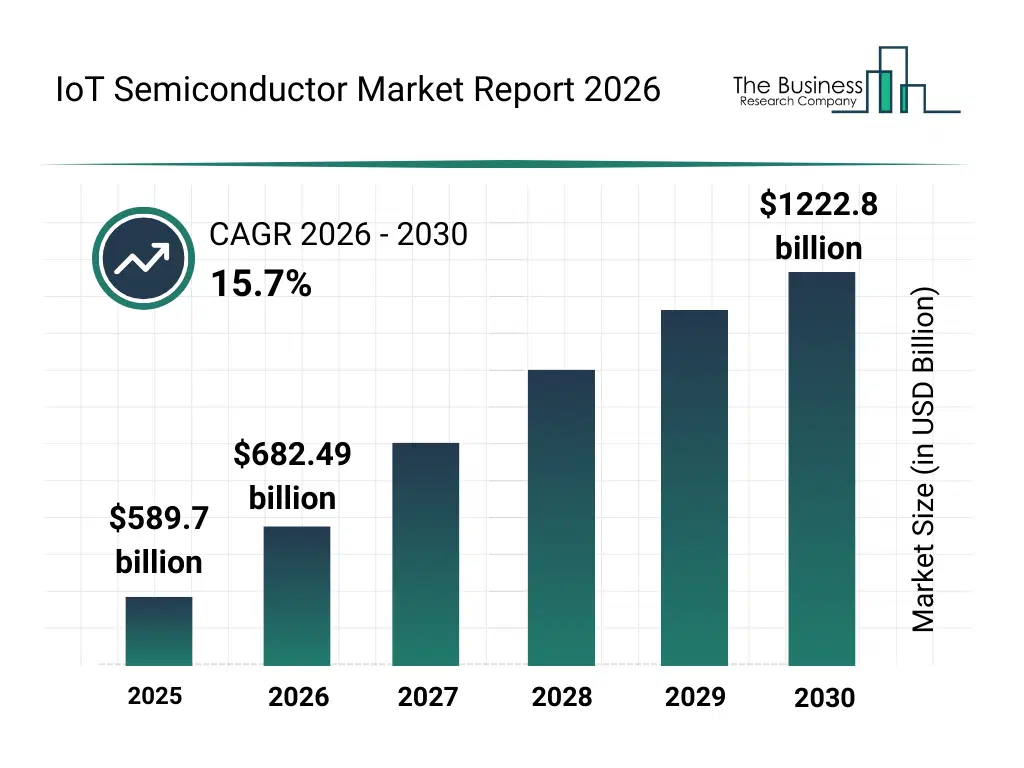
What Is The IoT Semiconductor Market Size 2026 And Growth Rate?
The iot semiconductor market size has grown rapidly in recent years. It will grow from $589.7 billion in 2025 to $682.49 billion in 2026 at a compound annual growth rate (CAGR) of 15.7%. The growth in the historic period can be attributed to growing adoption of smart home devices, increase in wearable technology, rise of industrial automation, improvements in wireless communication standards, demand for healthcare monitoring devices.What Is The IoT Semiconductor Market Growth Forecast?
The iot semiconductor market size is expected to see rapid growth in the next few years. It will grow to $1222.8 billion in 2030 at a compound annual growth rate (CAGR) of 15.7%. The growth in the forecast period can be attributed to expansion of smart cities, growth in connected automotive applications, rising demand for predictive maintenance solutions, integration of AI at the edge, proliferation of environmental monitoring devices. Major trends in the forecast period include low-power and energy-efficient iot semiconductors, miniaturization of chips for compact devices, advanced sensor integration, wireless communication optimization, edge computing and real-time processing.

Global IoT Semiconductor Market Segmentation
1) By Functional Role: Internet Of Things Sensors, Internet Of Things Processors, Internet Of Things Chips, Other Types 2) By Product: Connectivity Integrated Circuits (ICs), Logic Devices, Memory Devices, Processors, Other Products 3) By End-User: Banking, Financial Services, And Insurance, Healthcare, Retail, Manufacturing, Information Technology And Telecommunications, Other End-Users Subsegments: 1) By Internet of Things Sensors: Environmental Sensors, Motion and Position Sensors, Biometric Sensors, Optical Sensors 2) By Internet of Things Processors: Microcontrollers (MCUs), Digital Signal Processors (DSPs), Application Processors, Artificial Intelligence-Optimized Processors 3) By Internet of Things Chips: Wireless Communication Chips, Power Management Chips, Embedded Security Chips, Edge Artificial Intelligence Chips 4) By Other Types: Power Management ICs (PMICs), RF Transceivers & RF Front-End Modules, Connectivity SoCsWhat Is The Driver Of The IoT Semiconductor Market?
The increasing demand for connected devices is expected to propel the growth of the IoT semiconductor market going forward. Connected devices refer to electronic devices that can communicate and exchange data with other devices or networks over the internet or local networks, typically enabling remote monitoring, control, and automation. The increasing demand for connected devices is due to advancements in technology, greater internet connectivity, and the growing need for automation, convenience, and real-time data access across various sectors. IoT semiconductors enable connected devices by providing the essential hardware components, such as sensors, processors, and communication modules, that facilitate seamless data exchange and connectivity between devices and networks. For instance, in February 2023, according to the BuildOps Inc., a US-based software-as-a-service (SaaS) company, IoT-connected devices saw a 25% increase from 2021 to 2022, followed by a 28% increase from 2022 to 2023. Therefore, the increasing demand for connected devices drives the IoT semiconductor industry.Key Players In The Global IoT Semiconductor Market
Major companies operating in the iot semiconductor market are Qualcomm Technologies Inc., NXP Semiconductors N.V., Texas Instruments Inc., STMicroelectronics, Nordic Semiconductor ASA, Infineon Technologies AG, Analog Devices Inc., Renesas Electronics Corporation, Silicon Labs, Semtech Corporation, Ambiq Micro Inc., Sony Semiconductor Solutions Corporation, Skyworks Solutions Inc., Realtek Semiconductor Corporation, ON Semiconductor Corporation, Microchip Technology Inc., Broadcom Inc., Qualitas Semiconductor, Espressif Systems, ARM Ltd., Samsung Electronics Co. Ltd., Taiwan Semiconductor Manufacturing Company Limited, Murata Manufacturing Co. Ltd., Maxim Integrated
This chart is for illustrative purposes; the full report includes a detailed competitor analysis and comprehensive overview of the top 10 companies in the market.

This chart maps companies by product innovation and brand strength, with bubble size indicating relative revenue, helping identify market leaders, challengers, and niche players. This is an illustrative chart; the full report provides a complete and accurate competitive analysis.
Global IoT Semiconductor Market Trends and Insights
Major companies operating in the IoT semiconductor market are focusing on developing innovative products, such as high performance dual range motion sensors to enhance precision and versatility in connected devices. High-performance dual-range motion sensors are advanced sensors that can accurately detect both small and large movements across two measurement ranges, enabling precise motion tracking in a variety of IoT applications. For instance, in June 2025 STMicroelectronics N.V a Switzerland-based semiconductor company launched ISM6HG256X, a cutting-edge three-in-one MEMS motion sensor designed for industrial IoT applications. The sensor integrates edge AI capabilities, including a machine learning core, finite state machine, and adaptive self-configuration, enabling real-time event detection and context-aware sensing directly on the device, thereby reducing power consumption and latency. Engineered for demanding industrial environments, it comes in a compact 2.5 mm × 3 mm package and operates across a wide temperature range of -40°C to 105°C. Its features make it suitable for industrial IoT use cases such as asset tracking, condition monitoring, robotics, and wearable safety devices for workers.What Are Latest Mergers And Acquisitions In The IoT Semiconductor Market?
In March 2025, Trasna Solutions Technologies Limited, an Ireland-based technology company that provides comprehensive, end-to-end solutions for mobile IoT technologies, acquired u-blox's cellular IoT module business for an undisclosed amount. With this acquisition, Trasna aims to enhance its IoT connectivity offerings while allowing u-blox to concentrate on its core positioning business. u-blox Holding is a Switzerland-based semiconductor company that provides semiconductor chips, modules, and IoT services.
Regional Outlook
North America was the largest region in the iot semiconductor market in 2025. Asia-Pacific is expected to be the fastest-growing region in the forecast period. The regions covered in this market report are Asia-Pacific, South East Asia, Western Europe, Eastern Europe, North America, South America, Middle East, Africa. The countries covered in this market report are Australia, Brazil, China, France, Germany, India, Indonesia, Japan, Taiwan, Russia, South Korea, UK, USA, Canada, Italy, Spain.What Defines the IoT Semiconductor Market?
The IoT semiconductor market consists of sales of low-power microcontrollers, wireless communication modules, system-on-chip (SoCs), sensors, and power management ICs. Values in this market are ‘factory gate’ values, meaning the value of goods sold by semiconductor manufacturers, whether to device makers, system integrators, industrial users, or directly to end customers. The value of goods in this market includes related services such as software integration, firmware updates, and security enhancements.How is Market Value Defined and Measured?
The market value is defined as the revenues that enterprises gain from the sale of goods and/or services within the specified market and geography through sales, grants, or donations in terms of the currency (in USD unless otherwise specified). The revenues for a specified geography are consumption values that are revenues generated by organizations in the specified geography within the market, irrespective of where they are produced. It does not include revenues from resales along the supply chain, either further along the supply chain or as part of other products.
This chart presents market attractiveness based on a quantitative evaluation of growth, competition, strategic alignment, and risk, offering a clear view of opportunity areas for decision-making. This chart is for illustrative purposes; the full report contains the complete analysis.

This chart highlights the Total Addressable Market (TAM) by estimating the maximum revenue opportunity using an assumption-driven approach, supporting strategic planning and opportunity sizing across markets. The chart is illustrative; the full report provides a more comprehensive analysis.
What Key Data and Analysis Are Included in the IoT Semiconductor Market Report 2026?
The iot semiconductor market research report is one of a series of new reports from The Business Research Company that provides market statistics, including industry global market size, regional shares, competitors with the market share, detailed market segments, market trends and opportunities, and any further data you may need to thrive in the iot semiconductor industry. The market research report delivers a complete perspective of everything you need, with an in-depth analysis of the current and future state of the industry.IoT Semiconductor Market Report Forecast Analysis
| Report Attribute | Details |
|---|---|
| Market Size Value In 2026 | $682.49 billion |
| Revenue Forecast In 2030 | $1222.8 billion |
| Growth Rate | CAGR of 15.7% from 2026 to 2030 |
| Base Year For Estimation | 2025 |
| Actual Estimates/Historical Data | 2020-2025 |
| Forecast Period | 2026 - 2030 |
| Market Representation | Revenue in USD Billion and CAGR from 2026 to 2030 |
| Segments Covered | Functional Role, Product, End-User |
| Regional Scope | Asia-Pacific, Western Europe, Eastern Europe, North America, South America, Middle East, Africa |
| Country Scope | The countries covered in the report are Australia, Brazil, China, France, Germany, India, Indonesia, Japan, Taiwan, Russia, South Korea, UK, USA, Canada, Italy, Spain. |
| Key Companies Profiled | Qualcomm Technologies Inc., NXP Semiconductors N.V., Texas Instruments Inc., STMicroelectronics, Nordic Semiconductor ASA, Infineon Technologies AG, Analog Devices Inc., Renesas Electronics Corporation, Silicon Labs, Semtech Corporation, Ambiq Micro Inc., Sony Semiconductor Solutions Corporation, Skyworks Solutions Inc., Realtek Semiconductor Corporation, ON Semiconductor Corporation, Microchip Technology Inc., Broadcom Inc., Qualitas Semiconductor, Espressif Systems, ARM Ltd., Samsung Electronics Co. Ltd., Taiwan Semiconductor Manufacturing Company Limited, Murata Manufacturing Co. Ltd., Maxim Integrated |
| Customization Scope | Request for Customization |
| Pricing And Purchase Options | Explore Purchase Options |