

IOT Sensors Market Report 2026
Global Outlook – By Product Type ( Temperature sensors, Pressure sensors, Humidity sensors, Flow sensors, Accelerometers, Magnetometers, Gyroscopes, Inertial sensors, Image sensors, Other Product Types), By Application ( Building Automation, Industrial Application, Automotive Application, Healthcare Application, Retailing And Logistics Application, Security Application, Agriculture Application, Other Applications ), By End-user Industry ( Healthcare, Automotive and Transportation, Manufacturing / Industrial, Other End-Users) – Market Size, Trends, Strategies, and Forecast to 2030
IOT Sensors Market Overview
• IOT Sensors market size has reached to $15.66 billion in 2025 • Expected to grow to $38.03 billion in 2030 at a compound annual growth rate (CAGR) of 19.6% • Growth Driver: Rapid Growth In Global IOT Connections Drives Expansion In The Iot Sensors Market • Market Trend: Adoption Of Bluetooth 6.0 Low-Energy Modules To Enhance IoT Sensor Efficiency And Integration • Asia-Pacific was the largest region in 2025 and North America is the fastest growing region.Market Gains By 2030 – Top Opportunities By Segment
Market Gain identifies the most promising market opportunities by highlighting the segments or products expected to generate the highest incremental revenue growth over the next five years.
What Is Covered Under IOT Sensors Market?
IoT sensors refer to devices that collect data from the physical environment and transmit it to the Internet of Things (IoT) networks for analysis and monitoring. These sensors can measure various parameters, such as temperature, humidity, light, motion, and pressure. By providing real-time data, IoT sensors enable improved decision-making, automation, and efficiency in various systems and processes. The main type of IOT sensors are temperature sensors, pressure sensors, humidity sensors, flow sensors, accelerometers, magnetometers, gyroscopes, inertial sensors, image sensors and others. Temperature sensors help in monitoring the temperature of a ship to log it automatically. The IOT sensors are applied across various areas such as building automation, industrial application, automotive application, healthcare application, retailing & logistics application, security application, agriculture application, other applications and used in healthcare, automotive and transportation, manufacturing/ industrial, others.
What Is The IOT Sensors Market Size 2026 And Growth Rate?
The iot sensors market size has grown rapidly in recent years. It will grow from $15.66 billion in 2025 to $18.57 billion in 2026 at a compound annual growth rate (CAGR) of 18.6%. The growth in the historic period can be attributed to advancements in MEMS technology, early adoption of industrial automation, increasing use of sensors in consumer electronics, rise of basic environmental monitoring solutions, development of low-power wireless communication standards.What Is The IOT Sensors Market Growth Forecast?
The iot sensors market size is expected to see rapid growth in the next few years. It will grow to $38.03 billion in 2030 at a compound annual growth rate (CAGR) of 19.6%. The growth in the forecast period can be attributed to expansion of smart city infrastructure, rapid growth of connected and autonomous systems, increasing demand for predictive maintenance, proliferation of edge iot platforms, rising integration of sensors in healthcare diagnostics. Major trends in the forecast period include IOT-driven multi-parameter sensing integration, cloud-connected real-time sensor analytics, AI-enabled predictive sensing solutions, energy-efficient and sustainable sensor designs, sensor adoption in autonomous and robotic systems.

Global IOT Sensors Market Segmentation
1) By Product Type: Temperature sensors, Pressure sensors, Humidity sensors, Flow sensors, Accelerometers, Magnetometers, Gyroscopes, Inertial sensors, Image sensors, Other Product Types 2) By Application: Building Automation, Industrial Application, Automotive Application, Healthcare Application, Retailing And Logistics Application, Security Application, Agriculture Application, Other Applications 3) By End-user Industry: Healthcare, Automotive and Transportation, Manufacturing / Industrial, Other End-Users Subsegments: 1) By Temperature Sensors: Thermocouples, RTDs (Resistance Temperature Detectors), Thermistors, Infrared Sensors, Bimetallic Sensors 2) By Pressure Sensors: Piezoresistive Pressure Sensors, Capacitive Pressure Sensors, Strain Gauge Pressure Sensors, Optical Pressure Sensors, Resonant Pressure Sensors 3) By Humidity Sensors: Capacitive Humidity Sensors, Resistive Humidity Sensors, Thermal Conductivity Humidity Sensors, Gravimetric Humidity Sensors 4) By Flow Sensors: Electromagnetic Flow Meters, Ultrasonic Flow Meters, Thermal Mass Flow Meters, Coriolis Flow Meters, Differential Pressure Flow Meters 5) By Accelerometers: MEMS Accelerometers, Piezoelectric Accelerometers, Capacitive Accelerometers 6) By Magnetometers: Hall Effect Magnetometers, Anisotropic Magnetoresistive (AMR) Magnetometers, Giant Magnetoresistive (GMR) Magnetometers 7) By Gyroscopes: MEMS Gyroscopes, Fiber Optic Gyroscopes, Ring Laser Gyroscopes, Mechanical Gyroscopes 8) By Inertial Sensors: Inertial Measurement Units (IMUs), Microelectromechanical Systems (MEMS) Sensors, Fiber Optic Gyroscopes 9) By Image Sensors: CMOS Image Sensors, CCD Image Sensors, Infrared Image Sensors 10) By Other Product Types: Gas Sensors, Proximity Sensors, Light Sensors, pH Sensors, Soil Moisture Sensors The top segments in the internet of things (iot) sensors market will be: • Temperature Sensors will reach $7 Billion by 2030. • Pressure Sensors will reach $6 Billion by 2030. • Image Sensors will reach $5 Billion by 2030. • Accelerometers will reach $4 Billion by 2030. • Humidity Sensors will reach $4 Billion by 2030.What Is The Driver Of The IOT Sensors Market?
The increased use of Internet of Things (IoT) devices is expected to drive the growth of the Internet of Things (IoT) sensors market. Internet of Things (IoT) devices, which encompass non-standard computing hardware like sensors, actuators, appliances, or machines, establish wireless connections to networks, facilitating data transmission over the internet or other networks. Internet of Things (IoT) sensors serve as a vital element within Internet of Things (IoT) devices, allowing them to capture data through the detection of environmental changes. For instance, in April 2025, according to Ericsson, a Sweden-based telecommunications company, global IoT connections reached 18.8 billion connections in 2024 and are expected to increase to 43.0 billion connections by 2030. Therefore, the increased use of Internet of Things (IoT) devices will propel the growth of the Internet of Things (IoT) sensors market going forward.
Infographic Chart Showing Key Market Drivers Analysis And Restraints For Iot Sensors Market
The chart presents an impact analysis of key drivers and restraints, quantifying their relative influence on the market's growth rate and helping assess the balance between growth enablers and limiting factors. This chart offers a high-level perspective; the full report contains more detailed insights.
How Will The Drivers Impact Growth In The Global Internet Of Things (IoT) Sensors Market?
• Increasing Adoption Of Connected Devices (Low) – During the forecast period, the increasing adoption of connected devices is expected to become a key growth driver for the internet of things (IoT) sensors market by 2030. The increasing adoption of connected devices is a major driver for the IoT sensors market because every connected device relies on sensors to collect and transmit real-time data. Smart homes, wearable devices, connected vehicles, industrial equipment, and healthcare systems all require multiple sensors to monitor environmental and operational conditions. As the number of internet-enabled devices continues to expand, the demand for accurate and energy-efficient sensors rises accordingly. IoT sensors enable seamless communication between devices and cloud platforms, improving operational visibility and decision-making. Businesses are investing in connected ecosystems to enhance customer experiences and optimize resource utilization, further boosting sensor deployment. • Rising Demand For Automation (Medium) – During the forecast period, the rising demand for automation is expected to emerge as a major factor driving the expansion of the internet of things (IoT) sensors market by 2030. Rising demand for automation is significantly driving the IoT sensors market by increasing the need for continuous monitoring and intelligent control systems. Automated manufacturing plants, warehouses, logistics centers, and smart buildings depend on sensors to collect real-time operational data and support autonomous decision-making. IoT sensors detect changes in temperature, pressure, motion, vibration, and other parameters that enable automated equipment to function efficiently. These sensors improve productivity, reduce operational costs, minimize human intervention, and enhance workplace safety. Industries are increasingly adopting automation to achieve higher efficiency and maintain consistent product quality. • Growing Usage Of IoT Sensors (High) – During the forecast period, the growing usage of IoT sensors is expected to act as a key growth catalyst for the internet of things (IoT) sensors market by 2030. Growing usage of IoT sensors itself acts as a strong market driver by expanding the range of applications across multiple industries. Organizations are integrating advanced sensors into healthcare, transportation, agriculture, smart cities, retail, and energy management systems to obtain real-time operational insights. Continuous improvements in sensor accuracy, miniaturization, wireless connectivity, and energy efficiency are making IoT solutions more practical and cost-effective. The increasing reliance on real-time data supports predictive maintenance, asset tracking, environmental monitoring, and process optimization. As businesses recognize the value of data-driven decision-making, sensor deployment continues to accelerate.How Will The Restraints Impact Growth In The Global Internet Of Things (IoT) Sensors Market?
• Data Privacy And Security-Related Concerns (Low) – During the forecast period, the data privacy and security-related concerns are a major restraint for the IoT sensors market because connected sensors continuously collect, transmit, and store sensitive operational and personal data. Weak encryption, insecure device authentication, and cyberattacks can expose critical information and disrupt connected systems. Organizations are often hesitant to deploy large-scale IoT sensor networks due to concerns over data breaches and regulatory compliance. Maintaining robust cybersecurity requires continuous software updates, monitoring, and investment, increasing operational complexity. Industries such as healthcare, finance, and critical infrastructure face particularly stringent security requirements before adopting IoT solutions. These concerns slow deployment decisions and limit the widespread adoption of IoT sensors across several end-use industries. • High Implementation Costs And Complex Procurement Barriers (Medium) – During the forecast period, the high implementation costs and complex procurement barriers restrain the IoT sensors market by making large-scale deployments financially challenging for many organizations. Beyond purchasing sensors, businesses must invest in communication infrastructure, cloud platforms, integration software, cybersecurity, installation, and ongoing maintenance. Procurement processes are often lengthy because organizations need to evaluate compatibility, reliability, vendor support, and long-term scalability before making purchasing decisions. Small and medium-sized enterprises may delay IoT adoption due to limited budgets and uncertain return on investment. Integration with existing legacy systems further increases project costs and implementation timelines. These financial and operational challenges reduce the pace of IoT sensor adoption, particularly in cost-sensitive markets. • Lack Of Standardized Communication Protocols (High) – During the forecast period, the lack of standardized communication protocols limits the growth of the IoT sensors market by creating interoperability challenges among devices from different manufacturers. IoT ecosystems often rely on multiple communication technologies, making seamless integration difficult and increasing system complexity. Organizations may encounter compatibility issues when expanding or upgrading existing sensor networks, resulting in additional integration costs. The absence of common standards also complicates device management, software updates, and long-term maintenance. Businesses may hesitate to invest in IoT deployments due to concerns about vendor lock-in and future compatibility. As a result, inconsistent communication standards slow large-scale implementation and restrain the broader adoption of IoT sensor solutions across industries.Key Players In The Global IOT Sensors Market
Major companies operating in the iot sensors market are Texas Instruments, TE Connectivity, NXP Semiconductors, STMicroelectronics, TDK Corporation, Honeywell International, Sensata Technologies, Broadcom Inc., Bosch, Analog Devices, Siemens AG, General Electric Company, Monnit Corporation, Murata Manufacturing Co., Ltd., Sensirion AG, Silicon Laboratories Inc., ABB Ltd., Schneider Electric SE, Qualcomm Incorporated, Canon Inc., Skyworks Solutions, Inc., Infineon Technologies AG, Omron Corporation, Intel Corporation
This chart is for illustrative purposes; the full report includes a detailed competitor analysis and comprehensive overview of the top 10 companies in the market.
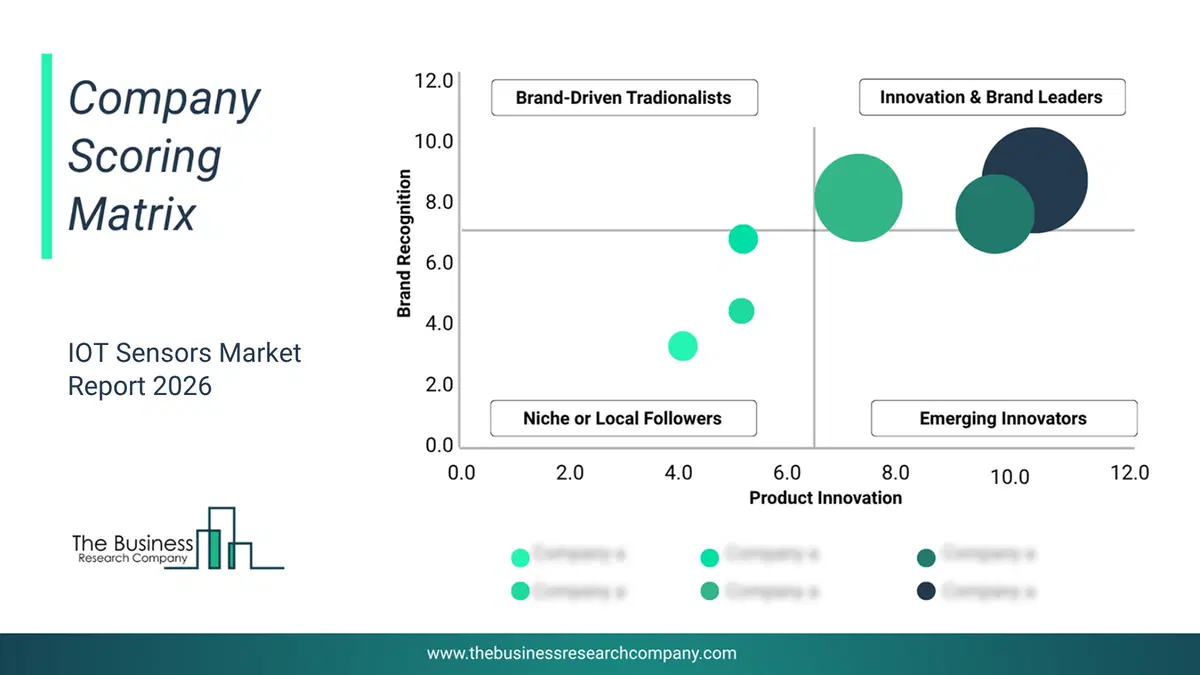
This chart maps companies by product innovation and brand strength, with bubble size indicating relative revenue, helping identify market leaders, challengers, and niche players. This is an illustrative chart; the full report provides a complete and accurate competitive analysis.
Global IOT Sensors Market Trends and Insights
Major companies operating in the IoT sensors market are focusing on adopting Bluetooth 6.0 low-energy system-level modules powered by advanced SoCs to enhance performance, reduce power consumption, and simplify sensor integration. These modules, which combine radio and MCU capabilities, enable ultra-compact, multi-protocol operation with support for Bluetooth 6.0, Thread, Matter, and Zigbee, facilitating the development of smaller, energy-efficient IoT devices with extended battery life. For instance, in September 2025, MinewSemi, a China-based wireless modules company, introduced the ME54BS61 and ME54BS12 Bluetooth 6.0 low-energy modules, both built on Nordic Semiconductor’s nRF54L15 SoC, designed specifically for space-constrained and ultra-low-power IoT endpoints. These modules feature compact package options (ME54BS61 targets 6×6 mm designs), multi-protocol 2.4 GHz connectivity, and enhanced on-module processing powered by an Arm Cortex-M33 core with advanced memory support, enabling local edge processing, reduced power draw, and improved device integration for next-generation IoT sensor applications.What Are Latest Mergers And Acquisitions In The IOT Sensors Market?
In January 2023, Semtech Corporation, a US-based Semiconductor manufacturing company, acquired Sierra Wireless for $1.2 billion. The merger combines Semtech’s LoRa technology, known for its ultra-low power consumption, with Sierra Wireless's expertise in cellular IoT solutions. This integration aims to create a comprehensive cloud-to-chip platform that enhances connectivity solutions across various IoT applications. Sierra Wireless is a Canada-based company, specializes in providing IoT modules that integrate seamlessly with sensors, allowing for efficient data transmission from these devices to cloud platforms.
Regional Outlook
Asia-Pacific was the largest region in the IoT sensors market in 2025. North America was the second-largest region in the IoT sensors market. The regions covered in this market report are Asia-Pacific, South East Asia, Western Europe, Eastern Europe, North America, South America, Middle East, Africa. The countries covered in this market report are Australia, Brazil, China, France, Germany, India, Indonesia, Japan, Taiwan, Russia, South Korea, UK, USA, Canada, Italy, Spain.What Defines the IOT Sensors Market?
The internet of things (IoT) sensors market consists of sales of temperature sensors, pressure sensors, humidity sensors, flow sensors, accelerometers, magnetometers, gyroscopes, and other internet of things (IoT) sensors. Values in this market are factory gate values, that is the value of goods sold by the manufacturers or creators of the goods, whether to other entities (including downstream manufacturers, wholesalers, distributors and retailers) or directly to end customers. The value of goods in this market includes related services sold by the creators of the goods.How is Market Value Defined and Measured?
The market value is defined as the revenues that enterprises gain from the sale of goods and/or services within the specified market and geography through sales, grants, or donations in terms of the currency (in USD unless otherwise specified). The revenues for a specified geography are consumption values that are revenues generated by organizations in the specified geography within the market, irrespective of where they are produced. It does not include revenues from resales along the supply chain, either further along the supply chain or as part of other products.
This chart presents market attractiveness based on a quantitative evaluation of growth, competition, strategic alignment, and risk, offering a clear view of opportunity areas for decision-making. This chart is for illustrative purposes; the full report contains the complete analysis.

This chart highlights the Total Addressable Market (TAM) by estimating the maximum revenue opportunity using an assumption-driven approach, supporting strategic planning and opportunity sizing across markets. The chart is illustrative; the full report provides a more comprehensive analysis.
What Key Data and Analysis Are Included in the IOT Sensors Market Report 2026?
The iot sensors market research report is one of a series of new reports from The Business Research Company that provides market statistics, including industry global market size, regional shares, competitors with the market share, detailed market segments, market trends and opportunities, and any further data you may need to thrive in the iot sensors industry. The market research report delivers a complete perspective of everything you need, with an in-depth analysis of the current and future state of the industry.IOT Sensors Market Report 2026 Market Report Forecast Analysis
| Report Attribute | Details |
|---|---|
| Market Size Value In 2026 | $18.57 billion |
| Revenue Forecast In 2030 | $38.03 billion |
| Growth Rate | CAGR of 19.6% from 2026 to 2030 |
| Base Year For Estimation | 2025 |
| Actual Estimates/Historical Data | 2020-2025 |
| Forecast Period | 2026 - 2030 |
| Market Representation | Revenue in USD Billion and CAGR from 2026 to 2030 |
| Segments Covered | Product Type, Application, End-user Industry |
| Regional Scope | Asia-Pacific, Western Europe, Eastern Europe, North America, South America, Middle East, Africa |
| Country Scope | The countries covered in the report are Australia, Brazil, China, France, Germany, India, Indonesia, Japan, Taiwan, Russia, South Korea, UK, USA, Canada, Italy, Spain. |
| Key Companies Profiled | Texas Instruments, TE Connectivity, NXP Semiconductors, STMicroelectronics, TDK Corporation, Honeywell International, Sensata Technologies, Broadcom Inc., Bosch, Analog Devices, Siemens AG, General Electric Company, Monnit Corporation, Murata Manufacturing Co., Ltd., Sensirion AG, Silicon Laboratories Inc., ABB Ltd., Schneider Electric SE, Qualcomm Incorporated, Canon Inc., Skyworks Solutions, Inc., Infineon Technologies AG, Omron Corporation, Intel Corporation |
| Customization Scope | Request for Customization |
| Pricing And Purchase Options | Explore Purchase Options |