

K12 Education Market Report 2026
Global Outlook – By Type (Public K-12 Education, Private K-12 Education, Online K-12 Education ), By Curriculum (Core Curriculum, Advanced Placement, International Baccalaureate, Vocational Education ), By Spend Analysis (Hardware, Software, Other Spend Analysis), By Deployment Mode (Cloud, On-Premise ), By Application (Pre-Primary School, Primary School, Middle School, High School ) – Market Size, Trends, Strategies, and Forecast to 2030
K12 Education Market Overview
• K12 Education market size has reached to $148.08 billion in 2025 • Expected to grow to $268.12 billion in 2030 at a compound annual growth rate (CAGR) of 12.3% • Growth Driver: Online Learning Revolutionizing K-12 Education Market • Market Trend: Advancements in Personalized Communication Platforms for K–12 Education • North America was the largest region in 2025 and Asia-Pacific is the fastest growing region.What Is Covered Under K12 Education Market?
K–12 education, encompasses the schooling provided from kindergarten through 12th grade. This educational system serves as the foundational phase of formal education for children and adolescents, typically ranging from ages 5 to 18. The primary purpose of K–12 education is to provide a comprehensive foundational education that prepares students for higher education, the workforce, and responsible citizenship. This encompasses the development of essential academic skills, social skills, and personal growth. The main types of K12 education are public K-12 education, private K-12 education and online K-12 education. Public K-12 education refers to the free, publicly funded educational system that provides elementary and secondary schooling from kindergarten through 12th grade. The curriculums are core curriculum, advanced placement, international baccalaureate and vocational education. The spend analysis is hardware, software and other spend analysis. The deployment modes are cloud and on-premise which is applied for pre-primary school, primary school, middle school and high school.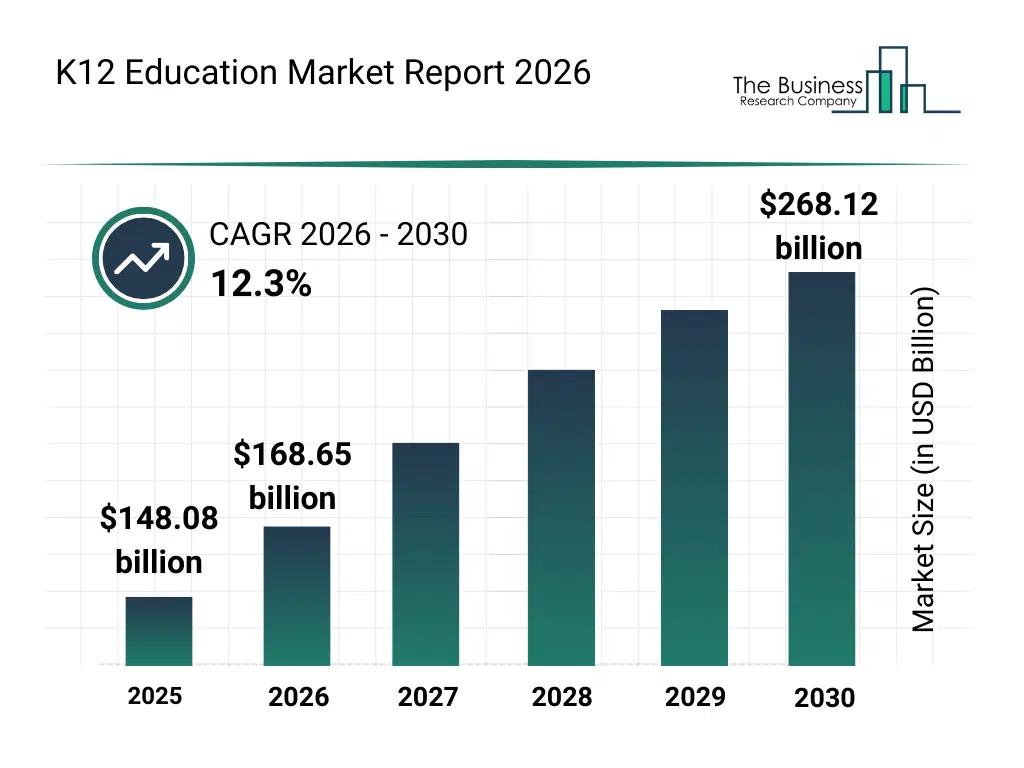
What Is The K12 Education Market Size and Share 2026?
The K12 education market size has grown rapidly in recent years. It will grow from $148.08 billion in 2025 to $168.65 billion in 2026 at a compound annual growth rate (CAGR) of 13.9%. The growth in the historic period can be attributed to expansion of public education systems, government funding for primary education, rising student enrollment rates, standardization of national curricula, increasing teacher workforce demand.What Is The K12 Education Market Growth Forecast?
The K12 education market size is expected to see rapid growth in the next few years. It will grow to $268.12 billion in 2030 at a compound annual growth rate (CAGR) of 12.3%. The growth in the forecast period can be attributed to increasing adoption of digital-first education models, rising investments in edtech infrastructure, expansion of online K-12 programs, growing focus on skill-based learning, increasing use of analytics in education planning. Major trends in the forecast period include increasing adoption of blended learning models, rising integration of digital learning tools, growing focus on personalized education pathways, expansion of virtual and remote classrooms, enhanced emphasis on student data analytics.
Global K12 Education Market Segmentation
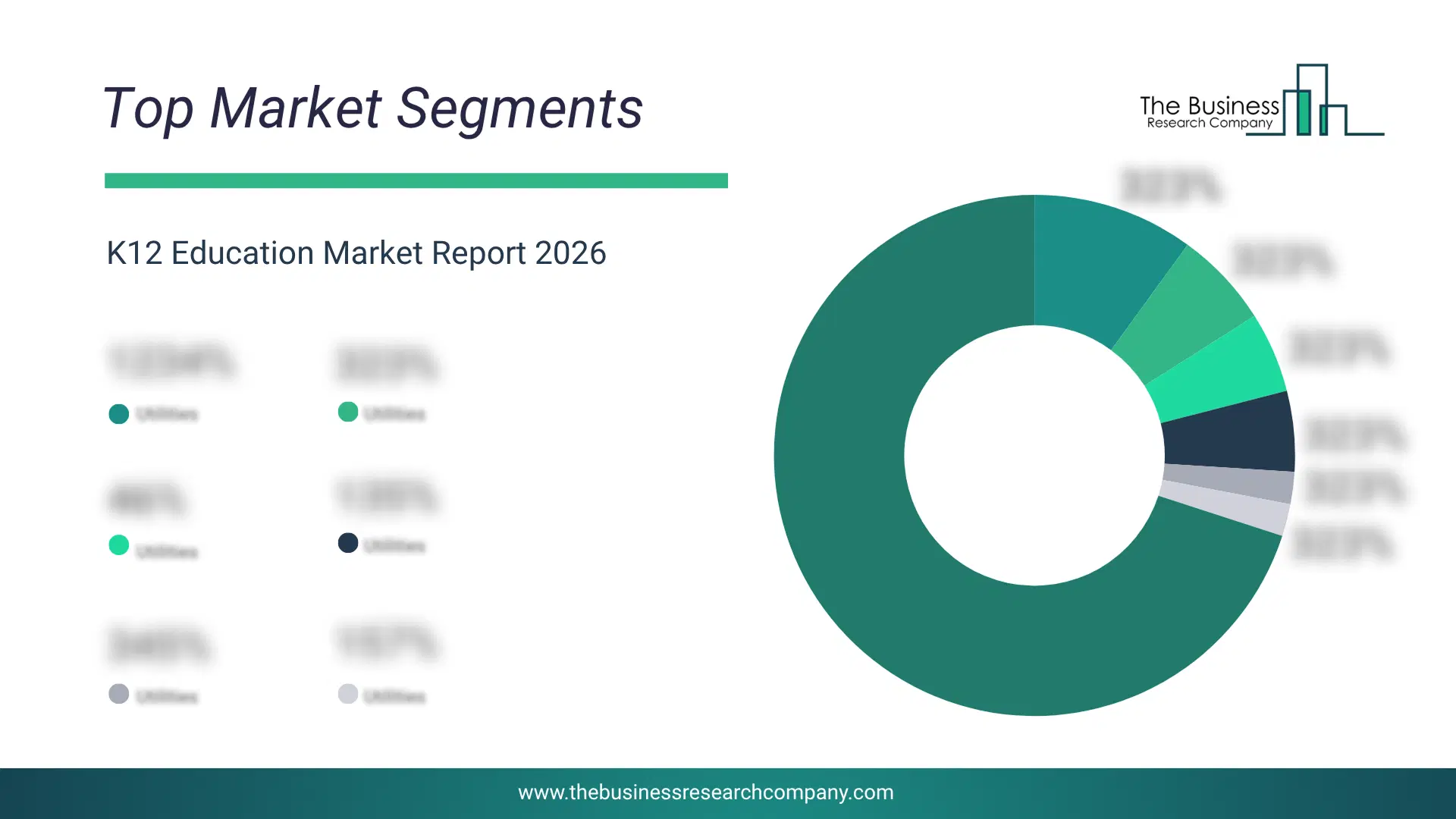
1) By Type: Public K-12 Education, Private K-12 Education, Online K-12 Education 2) By Curriculum: Core Curriculum, Advanced Placement, International Baccalaureate, Vocational Education 3) By Spend Analysis: Hardware, Software, Other Spend Analysis 4) By Deployment Mode: Cloud, On-Premise 5) By Application: Pre-Primary School, Primary School, Middle School, High School Subsegments: 1) By Public K-12 Education: Primary (Elementary) Education, Secondary (Middle And High) Education, Charter Schools, Magnet Schools, Alternative Public Schools 2) By Private K-12 Education: Independent Schools, Religious Schools, Parochial Schools, International Schools, Montessori Schools 3) By Online K-12 Education: Full-Time Online Schools, Blended Learning Programs, Virtual Schools, Homeschooling Platforms, Supplemental Online Education ProgramsWhat Is The Driver Of The K12 Education Market?
The growing popularity of online learning is expected to propel the growth of the K–12 education market going forward. Online learning is a method of education that takes place over the Internet and allows students to access educational materials and participate in learning activities remotely without being physically present in a traditional classroom setting. With the proliferation of high-speed internet access and the ubiquity of digital devices, online learning platforms have become increasingly popular in K–12 education. Online learning for K–12 education offers a flexible and accessible educational option that complements traditional classroom instruction, providing students with diverse learning opportunities tailored to their needs. For instance, in January 2024, according to Eurostat, a Luxembourg-based government agency, in 2023, the percentage of EU users engaging in online education and accessing courses or materials increased by 2 points to reach 30%, up from 28% in 2022. Therefore, the growing popularity of online learning is driving the growth of the K–12 education market.Key Players In The Global K12 Education Market
Major companies operating in the K12 education market are Apple Inc., Alphabet Inc., Samsung Electronics Co. Ltd., Microsoft Corporation, Dell Technologies Inc., Amazon Web Services (AWS), International Business Machines Corporation (IBM), Oracle Corporation, Adobe Inc., Pearson plc, McGraw-Hill Education Inc., Stride Inc. ( K12 Inc.), Cengage Learning Inc. (Cengage Group), TAL Education Group, Blackboard Inc., Coursera Inc., SMART Technologies ULC, D2L Corporation, Finalsite LLC, Tata ClassEdge, Clever Inc., Bettermarks GmbH, Minerva Project Inc.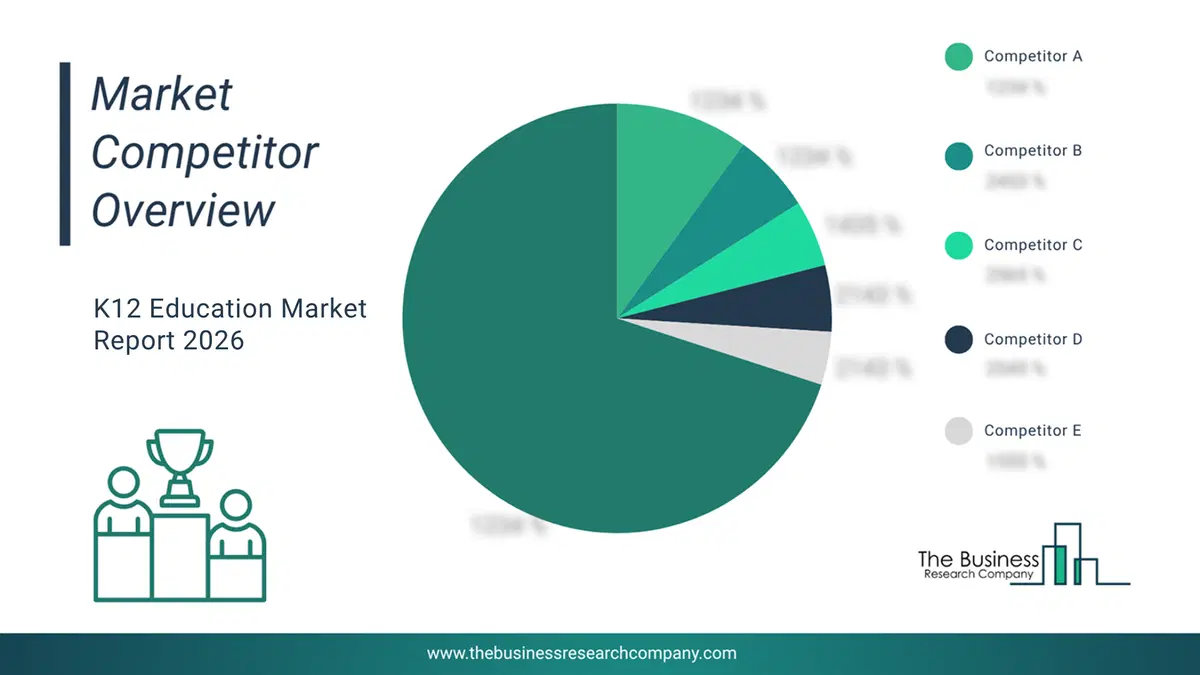
This chart is for illustrative purposes; the full report includes a detailed competitor analysis and comprehensive overview of the top 10 companies in the market.
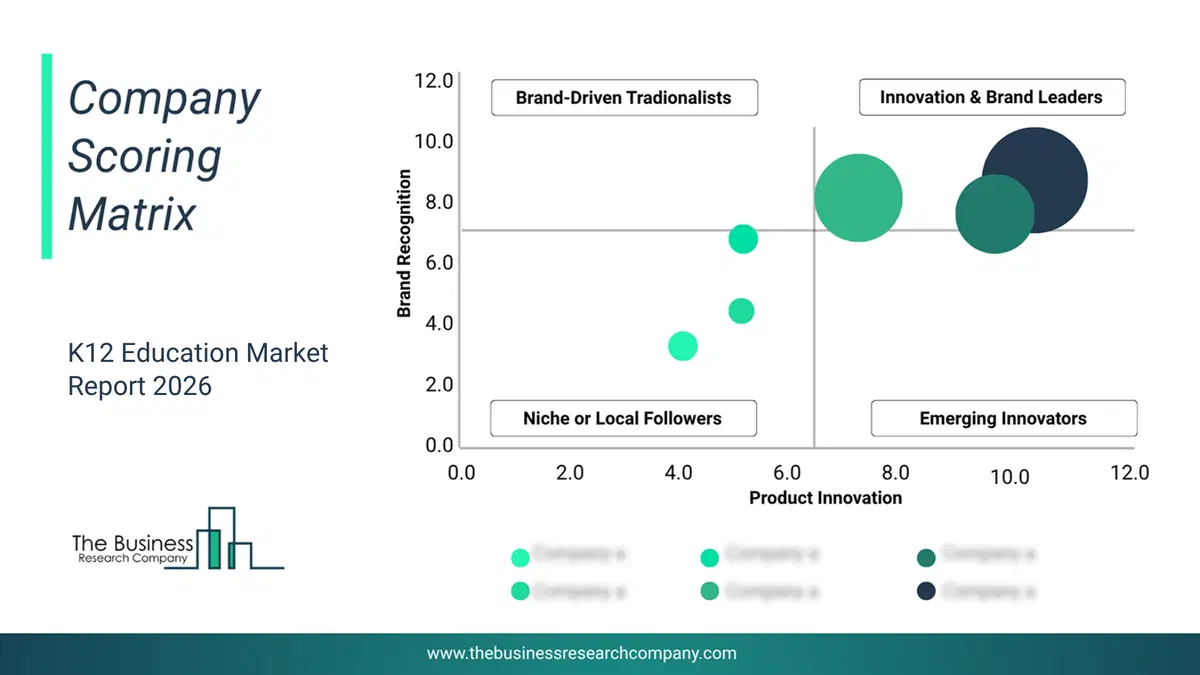
This chart maps companies by product innovation and brand strength, with bubble size indicating relative revenue, helping identify market leaders, challengers, and niche players. This is an illustrative chart; the full report provides a complete and accurate competitive analysis.
Global K12 Education Market Trends and Insights
Major companies operating in the K–12 education market are focusing on developing innovative products such as advanced personalized communication platforms to enhance individualized instruction, strengthen family engagement, and improve student outcomes. Personalized student communication platforms are digital solutions that use data-driven insights to tailor interactions among educators, students, and families, enabling timely interventions and improved academic support. For instance, in February 2024, SchoolStatus, a US-based provider of K–12 data-driven solutions, launched a comprehensive K–12 student success platform featuring SchoolStatus Attend and SchoolStatus Connect. SchoolStatus Attend streamlines attendance management by automating intervention workflows, reducing administrative workload by up to 75%, and addressing chronic absenteeism, while SchoolStatus Connect enables personalized, multi-channel communication with families and provides a unified view of student performance. Both tools enhance collaboration between educators and families, driving improved student engagement and attendance.What Are Latest Mergers And Acquisitions In The K12 Education Market?
In March 2023, LEAD, an India-based Edtech company, acquired a K-12 learning business in India from Pearson India Education Services Private Limited for an undisclosed amount. This acquisition will further enhance LEAD's product portfolio to cater to the diverse learning needs of affordable private schools in smaller towns and high-fee private schools in larger cities. Pearson India Education Services Private Limited is an India-based educational services provider specializing in K-12 learning solutions.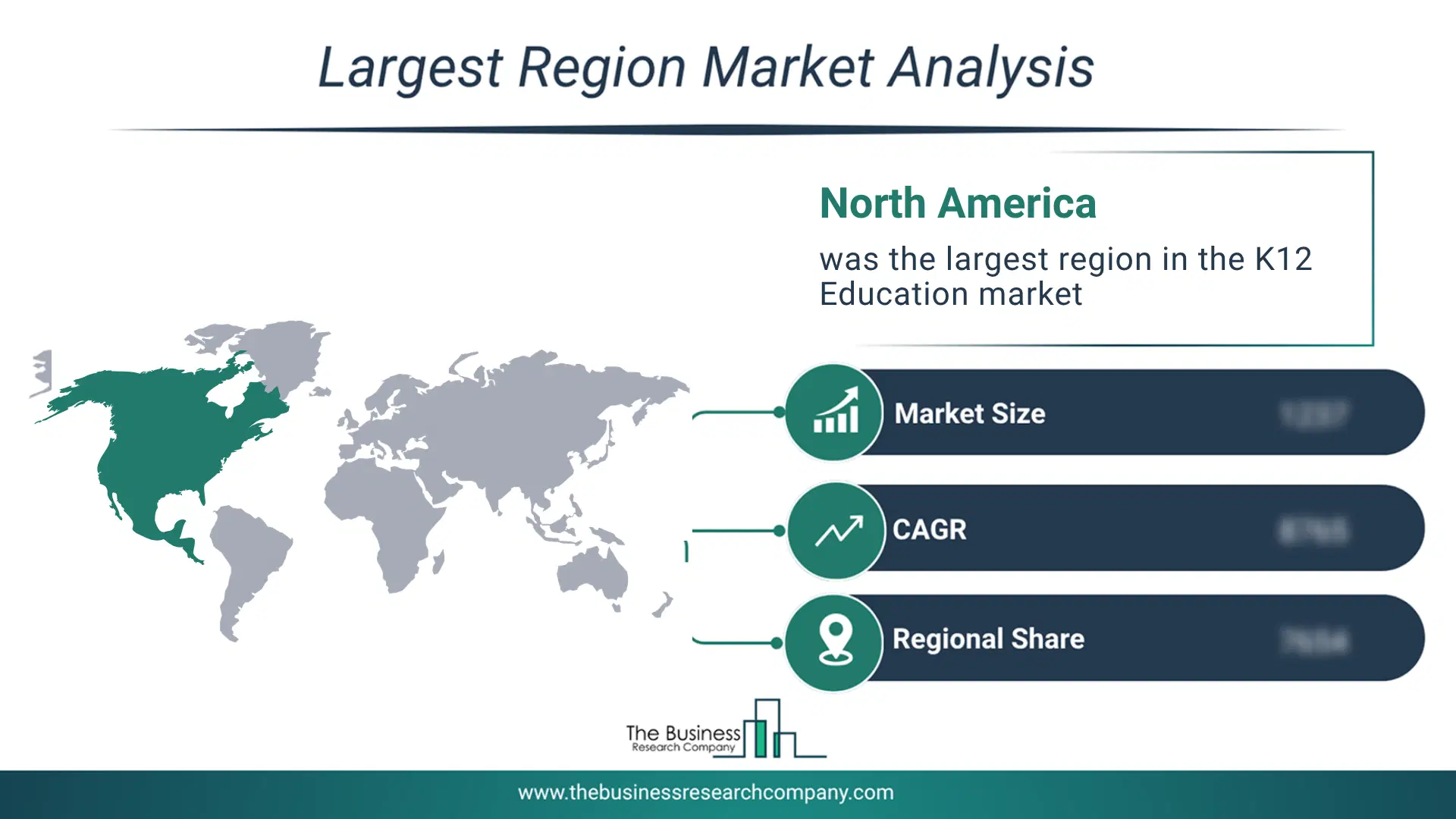
Regional Insights
North America was the largest region in the K-12 education market in 2025. Asia-Pacific is expected to be the fastest-growing region in the forecast period. The regions covered in this market report are Asia-Pacific, South East Asia, Western Europe, Eastern Europe, North America, South America, Middle East, Africa. The countries covered in this market report are Australia, Brazil, China, France, Germany, India, Indonesia, Japan, Taiwan, Russia, South Korea, UK, USA, Canada, Italy, Spain.What Defines the K12 Education Market?
The K-12 education market consists of revenues earned by entities through support services, technology services, special education services, and parental and community involvement. The market value includes the value of related goods sold by the service provider or included within the service offering. The K-12 education market also includes sales of digital learning tools, technology hardware, and assessment tools. Values in this market are ‘factory gate’ values, that is, the value of goods sold by the manufacturers or creators of the goods, whether to other entities (including downstream manufacturers, wholesalers, distributors, and retailers) or directly to end customers. The value of goods in this market includes related services sold by the creators of the goods.How is Market Value Defined and Measured?
The market value is defined as the revenues that enterprises gain from the sale of goods and/or services within the specified market and geography through sales, grants, or donations in terms of the currency (in USD unless otherwise specified). The revenues for a specified geography are consumption values that are revenues generated by organizations in the specified geography within the market, irrespective of where they are produced. It does not include revenues from resales along the supply chain, either further along the supply chain or as part of other products.
This chart presents market attractiveness based on a quantitative evaluation of growth, competition, strategic alignment, and risk, offering a clear view of opportunity areas for decision-making. This chart is for illustrative purposes; the full report contains the complete analysis.

This chart highlights the Total Addressable Market (TAM) by estimating the maximum revenue opportunity using an assumption-driven approach, supporting strategic planning and opportunity sizing across markets. The chart is illustrative; the full report provides a more comprehensive analysis.
What Key Data and Analysis Are Included in the K12 Education Market Report 2026?
The k12 education market research report is one of a series of new reports from The Business Research Company that provides market statistics, including industry global market size, regional shares, competitors with the market share, detailed market segments, market trends and opportunities, and any further data you may need to thrive in the k12 education industry. The market research report delivers a complete perspective of everything you need, with an in-depth analysis of the current and future state of the industry.K12 Education Market Report Forecast Analysis
| Report Attribute | Details |
|---|---|
| Market Size Value In 2026 | $168.65 billion |
| Revenue Forecast In 2030 | $268.12 billion |
| Growth Rate | CAGR of 13.9% from 2026 to 2030 |
| Base Year For Estimation | 2025 |
| Actual Estimates/Historical Data | 2020-2025 |
| Forecast Period | 2026 - 2030 |
| Market Representation | Revenue in USD Billion and CAGR from 2026 to 2030 |
| Segments Covered | Type, Curriculum, Spend Analysis, Deployment Mode, Application |
| Regional Scope | Asia-Pacific, Western Europe, Eastern Europe, North America, South America, Middle East, Africa |
| Country Scope | The countries covered in the report are Australia, Brazil, China, France, Germany, India, Indonesia, Japan, Taiwan, Russia, South Korea, UK, USA, Canada, Italy, Spain. |
| Key Companies Profiled | Apple Inc., Alphabet Inc., Samsung Electronics Co. Ltd., Microsoft Corporation, Dell Technologies Inc., Amazon Web Services (AWS), International Business Machines Corporation (IBM), Oracle Corporation, Adobe Inc., Pearson plc, McGraw-Hill Education Inc., Stride Inc. ( K12 Inc.), Cengage Learning Inc. (Cengage Group), TAL Education Group, Blackboard Inc., Coursera Inc., SMART Technologies ULC, D2L Corporation, Finalsite LLC, Tata ClassEdge, Clever Inc., Bettermarks GmbH, Minerva Project Inc. |
| Customization Scope | Request for Customization |
| Pricing And Purchase Options | Explore Purchase Options |