
K12 Education Technology Market Report 2026
Global Outlook – By Type (Hardware, Solution, Software, Support, Learning Content Management Systems (LCMS), Learning Management Systems (LMS), Learning Content Development Systems (LCDS), Assessment Systems, Student Response Systems (SRS), Other Types), By Technology (Educational Gaming, Educational Analytics, Educational Enterprise Resource Planning (ERP), Educational Security, Educational Dashboard), By Applications (Online, Offline), By Downstream Industry (Pre-Primary School, Primary School, Middle School, High School) – Market Size, Trends, Strategies, and Forecast to 2030
K12 Education Technology Market Overview
• K12 Education Technology market size has reached to $31.99 billion in 2025 • Expected to grow to $96.5 billion in 2030 at a compound annual growth rate (CAGR) of 24.7% • Growth Driver: Government Initiatives In Education To Propel Growth In K–12 Education Technology Market • Market Trend: Advancements in Personalized Communication Platforms for K–12 Education • North America was the largest region in 2025.Market Gains By 2030 – Top Opportunities By Segment
Market Gain identifies the most promising market opportunities by highlighting the segments or products expected to generate the highest incremental revenue growth over the next five years.
What Is Covered Under K12 Education Technology Market?
K-12 education technology refers to digital tools, resources, and platforms that are specifically tailored to support teaching, learning, and administrative tasks. K-12 education technology is utilized to integrate digital tools and resources into teaching and learning processes within primary and secondary education settings. The main types of K12 education technology are hardware, solution, software, support, learning content management systems (LCMS), learning management systems (LMS), learning content development systems (LCDS), assessment systems, student response systems (SRS), and others. Hardware refers to the physical components of a computer system that can be touched and seen, such as the central processing unit (CPU), memory, motherboard, and storage devices. The technology includes educational gaming, educational analytics, educational enterprise resource planning (ERP), educational security, and educational dashboard. There are various applications such as online, and offline for downstream industry such as pre-primary school, primary school, middle school, and high school.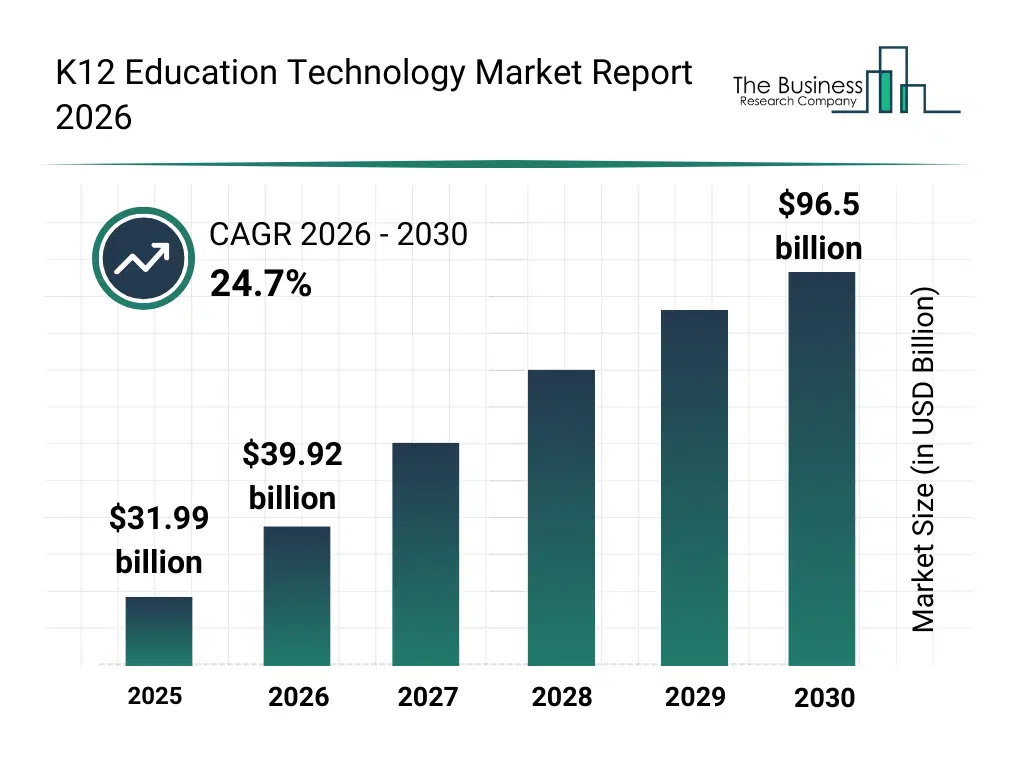
What Is The K12 Education Technology Market Size and Share 2026?
The K12 education technology market size has grown exponentially in recent years. It will grow from $31.99 billion in 2025 to $39.92 billion in 2026 at a compound annual growth rate (CAGR) of 24.8%. The growth in the historic period can be attributed to increasing government investment in digital education, expansion of school internet connectivity, adoption of classroom hardware solutions, rising demand for student engagement tools, growth of educational content digitization.What Is The K12 Education Technology Market Growth Forecast?
The K12 education technology market size is expected to see exponential growth in the next few years. It will grow to $96.5 billion in 2030 at a compound annual growth rate (CAGR) of 24.7%. The growth in the forecast period can be attributed to increasing integration of ai-based learning tools, rising investments in virtual and augmented reality education, expansion of cloud-based education platforms, growing focus on cybersecurity in schools, increasing adoption of adaptive learning systems. Major trends in the forecast period include increasing adoption of interactive learning technologies, rising use of educational software platforms, growing demand for online learning solutions, expansion of data-driven education tools, enhanced focus on digital classroom integration.
Global K12 Education Technology Market Segmentation
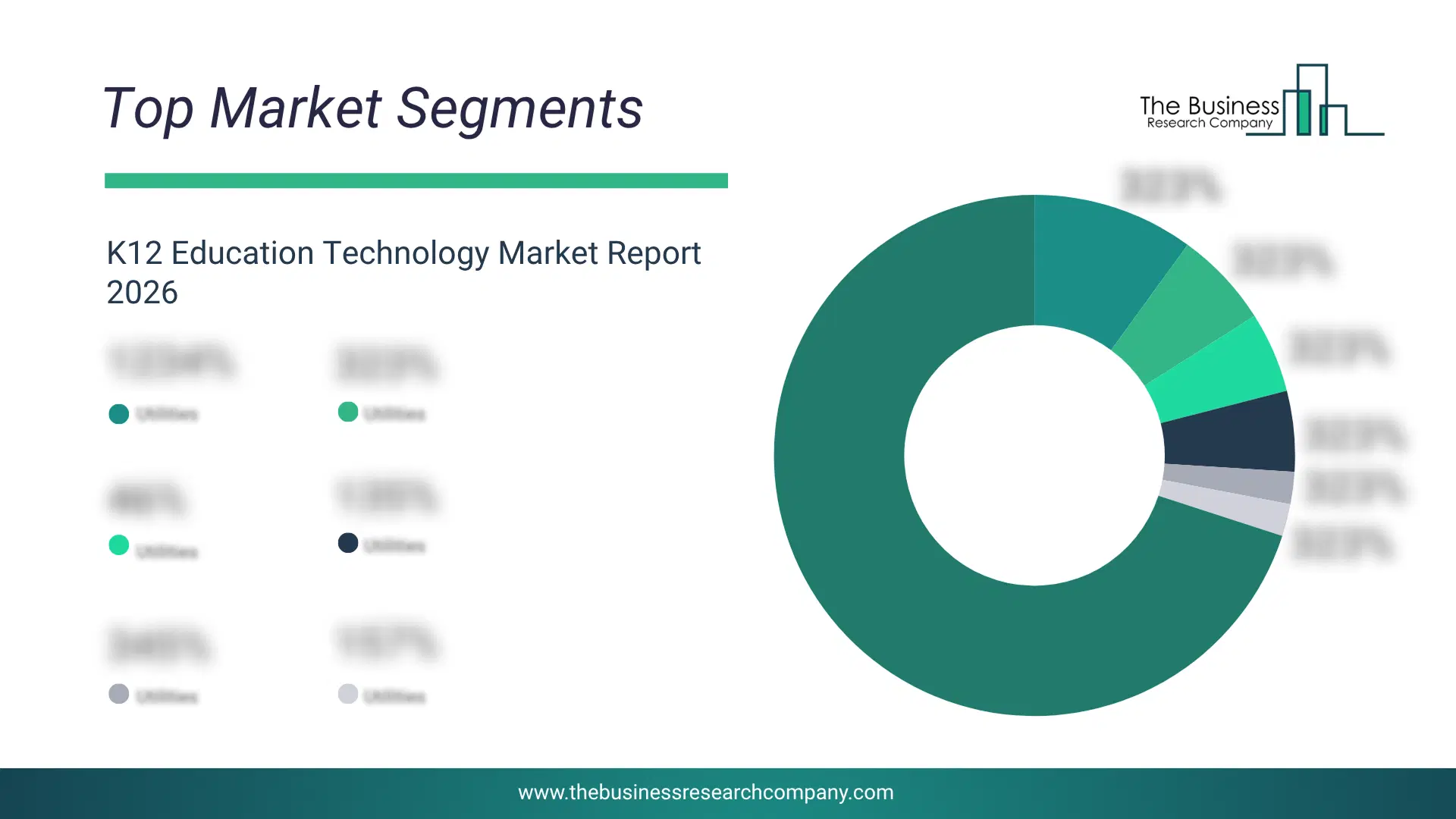
1) By Type: Hardware, Solution, Software, Support, Learning Content Management Systems (LCMS), Learning Management Systems (LMS), Learning Content Development Systems (LCDS), Assessment Systems, Student Response Systems (SRS), Other Types 2) By Technology: Educational Gaming, Educational Analytics, Educational Enterprise Resource Planning (ERP), Educational Security, Educational Dashboard 3) By Applications: Online, Offline 4) By Downstream Industry: Pre-Primary School, Primary School, Middle School, High School Subsegments: 1) By Hardware: Interactive Whiteboards, Tablets And Laptops, Student Response Devices, Classroom Projectors, Document Cameras 2) By Solution: Classroom Management Solutions, Collaboration Tools, Cloud-Based Solutions, Virtual Classrooms, Communication Platforms 3) By Software: Educational Software Applications, Classroom Management Software, Educational Gaming Software, Simulation And Virtual Lab Software, Mobile Learning Apps 4) By Support: Technical Support Services, Maintenance Services, Professional Development And Training, IT Support And Consulting, Network And Infrastructure Support 5) By Learning Content Management Systems (LCMS): Course Development Tools, Content Authoring Platforms, Content Repositories, Multimedia Learning Content Management 6) By Learning Management Systems (LMS): Cloud-Based LMS, On-Premise LMS, K-12 Specific LMS, Mobile Learning Management Systems 7) By Learning Content Development Systems (LCDS): Content Creation Software, Authoring Tools, Adaptive Learning Platforms, Course Design And Curriculum Development Tools 8) By Assessment Systems: Formative Assessment Tools, Summative Assessment Systems, Digital Assessment Platforms, Online Testing Systems, Performance-Based Assessment Tools 9) By Student Response Systems (SRS): Clickers Or Response Pads, Real-Time Polling Tools, Interactive Quizzes And Surveys, Audience Response Software 10) By Other Types: Artificial Intelligence In Education, Virtual And Augmented Reality Learning Tools, Speech Recognition Technology, Adaptive Learning Technologies, Gamification In Education The top segments in the k-12 education technology market will be: • Online will reach $25012.13 Million by 2025. • Hardware will reach $11893.76 Million by 2025. • Software will reach $10334.31 Million by 2025. • Primary School will reach $9863.99 Million by 2025. • High School will reach $9441.13 Million by 2025.What Is The Driver Of The K12 Education Technology Market?
The involvement of the government in enhancing the education system is expected to propel the growth of the K–12 education technology market going forward. The educational system refers to the framework and structure comprising institutions, policies, and practices designed to facilitate learning and development within a society. The rising government involvement in the education system reflects a growing recognition of education's crucial role in national development, economic competitiveness, and social equity. The government's involvement in K-12 educational technology aims to ensure equitable access, promote innovation, and enhance digital literacy among students nationwide. For instance, in November 2025, The Department for Education, a UK-based government organization, total UK government expenditure on education across the UK increased by 3.8% from financial year 2023-24 to financial year 2024-25. Therefore, the involvement of the government in enhancing the education system is driving the growth of the K–12 education technology market.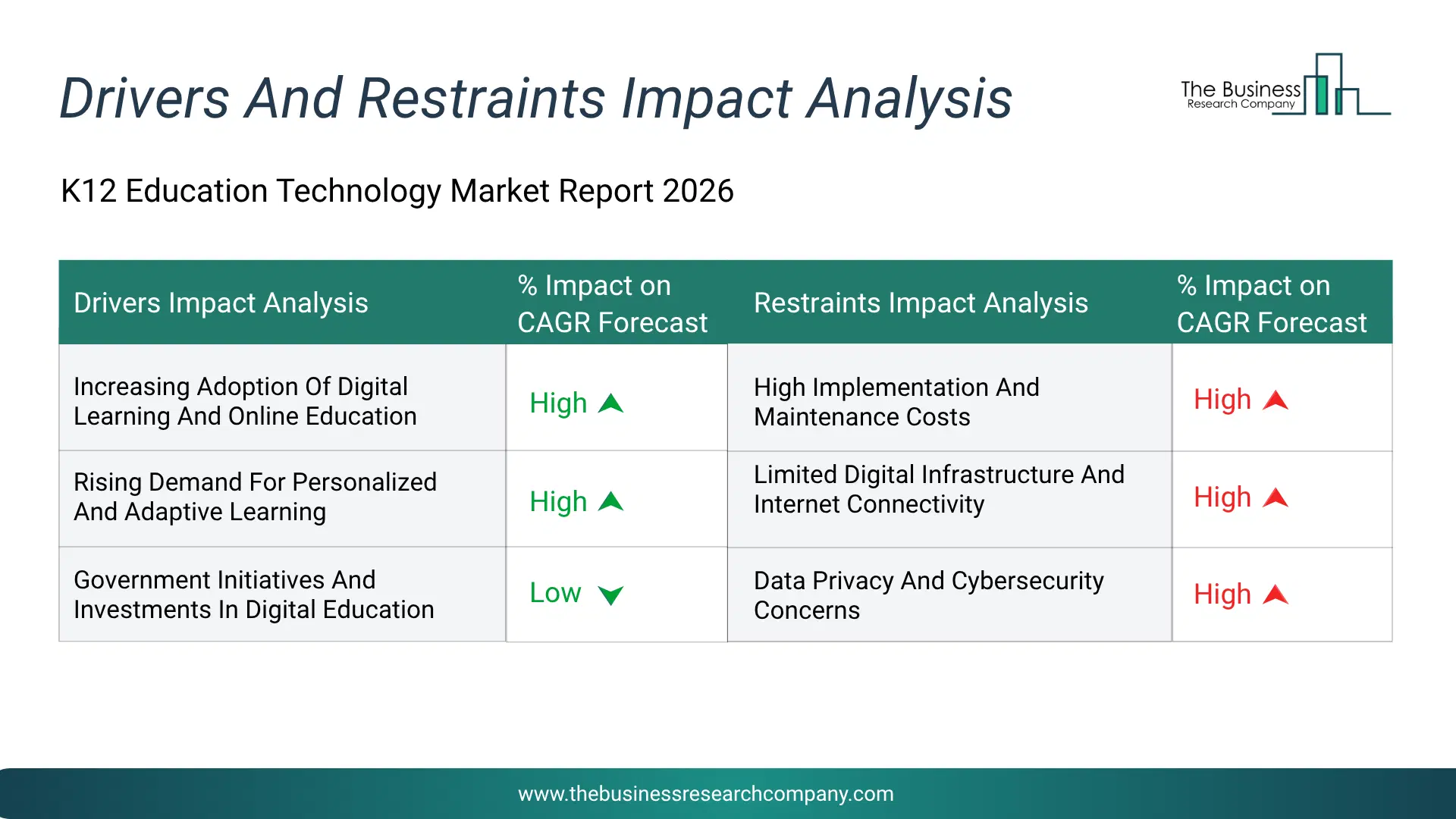
Infographic Chart Showing Key Market Drivers Analysis And Restraints For K12 Education Technology Market
The chart presents an impact analysis of key drivers and restraints, quantifying their relative influence on the market's growth rate and helping assess the balance between growth enablers and limiting factors. This chart offers a high-level perspective; the full report contains more detailed insights.
How Will The Drivers Impact Growth In The Global K-12 Education Technology Market?
• Growing Need for Personalized Learning (Medium) – The growing demand for personalized learning will become a key driver of growth in the K-12 education technology market by 2030. The demand for personalized learning drives the adoption of K-12 education technology by enabling tailored educational experiences that cater to individual student needs, learning speeds and interests. Edtech platforms use data analytics, AI and adaptive learning tools to offer customized content and real-time feedback, enhancing student engagement and outcomes. This individualized approach helps educators identify learning gaps early and intervene more effectively. As a result, the growing demand for personalized learning is anticipated to contributing to a 1.5% annual growth in the market. • Favourable Government Initiatives (Medium) – The favourable government initiatives will emerge as a major factor driving the expansion of the K-12 education technology market by 2030. Favourable government initiatives help the K-12 education technology market by providing funding, policy support and infrastructure development that enable wider access to digital learning tools. Programs promoting digital literacy and school connectivity reduce the digital divide, especially in underserved areas. Additionally, government endorsement encourages schools and districts to adopt innovative edtech solutions, accelerating modernization of classrooms. These initiatives collectively drive market growth and improve the quality and reach of education Consequently, the accelerating favourable government initiatives capabilities is projected to contributing to a 1.0% annual growth in the market. • Rising Integration Of AI And Machine Learning (Low) – The rising integration of AI and machine learning processes will serve as a key growth catalyst for the K-12 education technology market by 2030, integration of AI and Machine Learning in K-12 education technology helps personalize learning by adapting content and pace to each student’s needs, improving engagement and outcomes. These technologies enable real-time performance analytics, allowing teachers to identify learning gaps and intervene more effectively. AI-powered tools also automate administrative tasks like grading and attendance, freeing up educators’ time for instruction. Additionally, intelligent tutoring systems and chatbots offer students round-the-clock support, enhancing the overall learning experience. Therefore, this rising integration of ai and machine learning operations is projected to supporting to a 0.8% annual growth in the market. • Increasing Use Of Gamified Learning Platforms (Low) – The increasing use of gamified learning platforms will become a significant driver contributing to the growth of the K-12 education technology market by 2030 Investments in biopharmaceutical manufacturing drive demand for hygienic pumps and valves by emphasizing strict contamination control and product purity. As production scales and processes become more complex, manufacturers require reliable, sanitary fluid handling equipment that meets rigorous regulatory standards. These investments also encourage innovation in pump and valve designs, focusing on single-use systems, enhanced cleanability and material compatibility. Ultimately, this boosts the market for advanced hygienic pumps and valves tailored to biopharma. Consequently, the increasing use of gamified learning platforms strategies is projected to contributing to a 0.5% annual growth in the market.How Will The Restraints Impact Growth In The Global K-12 Education Technology Market?
• Lack of Skilled Teachers (Medium) – Lack of Skilled Teachers will restrict the growth of the K-12 Education Technology market during the forecast period. The effective integration of education technology requires skilled teachers with proficiency in using digital tools and platforms. The shortage of qualified teachers with technology training limits the adoption of EdTech solutions. Skill gaps affect the effectiveness of technology implementation and can lead to underutilization of EdTech investments. • High Infrastructure Costs (Low) – High Infrastructure Costs will restrict the growth of the K-12 Education Technology market during the forecast period. EdTech implementation requires significant investment in hardware, connectivity, software, and support infrastructure. High infrastructure costs create barriers for schools with limited budgets, particularly in developing regions. Cost constraints can lead to delayed adoption and create digital divides in education, affecting market growth.Key Players In The Global K12 Education Technology Market
Major companies operating in the K12 education technology market are Apple Inc., Google LLC, Samsung Electronics Co LTD, Microsoft Corporation, International Business Machines (IBM) Corporation, Pearson plc, TAL Education Group, VIPKID, Sanoma, BlackBoard, BYJU'S, PowerSchool, Acro Platform LTD, Chungdahm Learning, Tata Class Edge, Learnosity, Illuminate Education, iTutorGroup, Educomp Solutions Limited (ESL), Kroton Educacional SA, D2L Corporation, Toppr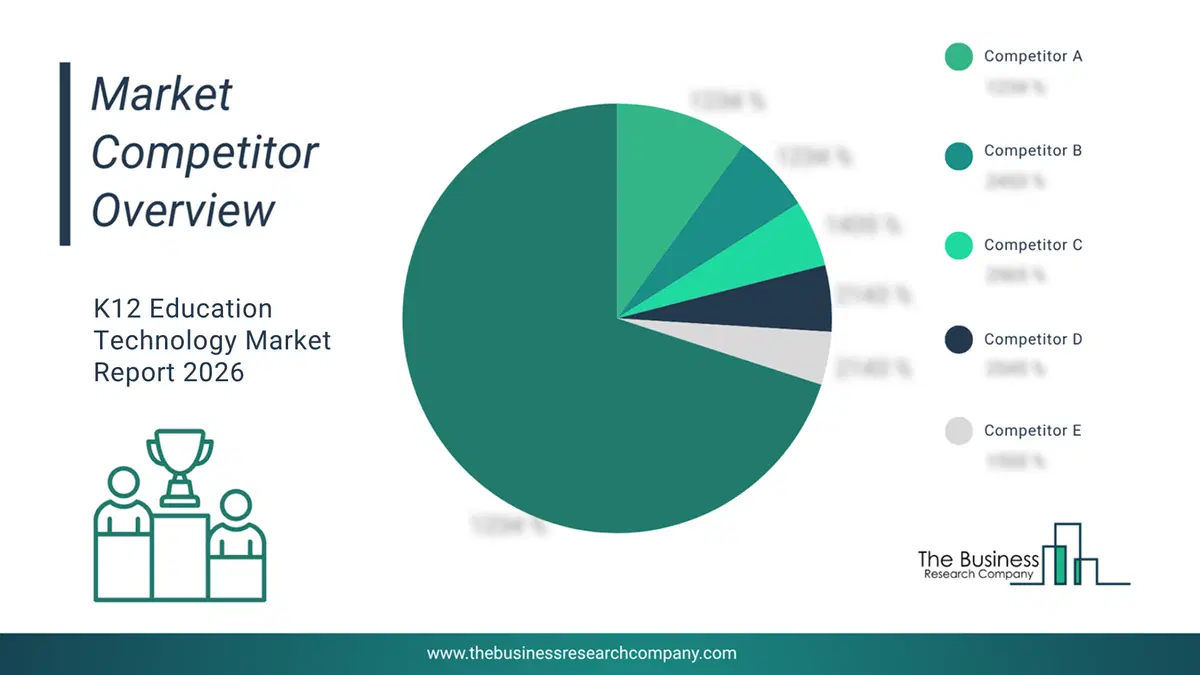
This chart is for illustrative purposes; the full report includes a detailed competitor analysis and comprehensive overview of the top 10 companies in the market.
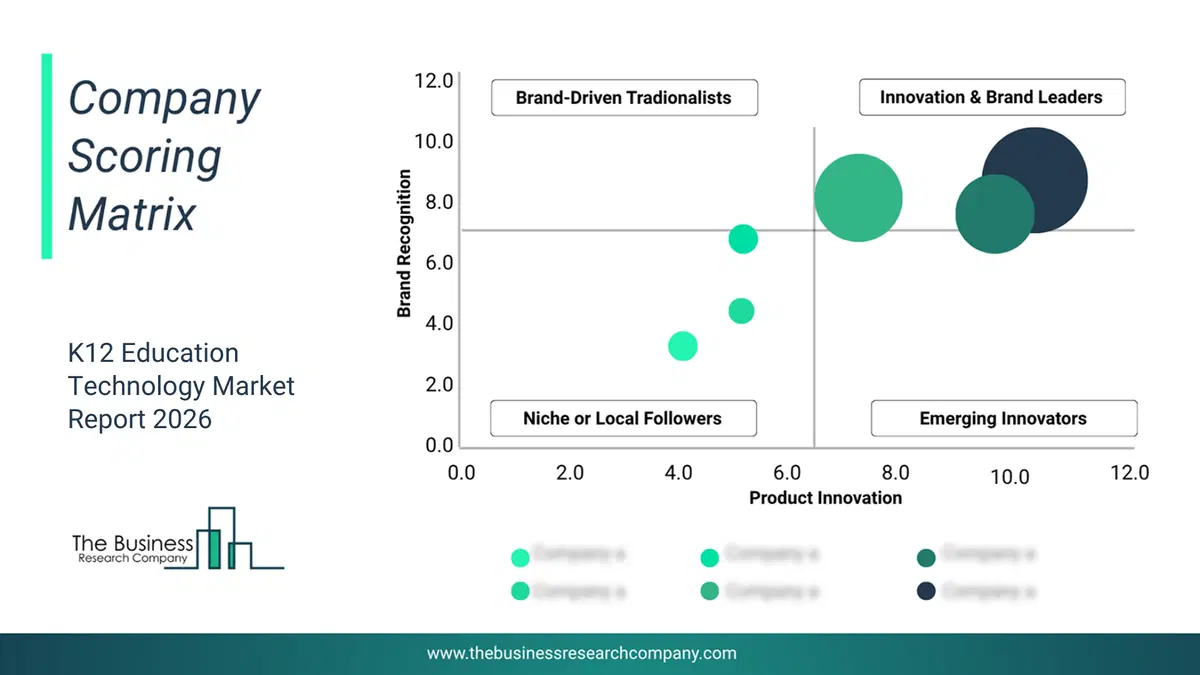
This chart maps companies by product innovation and brand strength, with bubble size indicating relative revenue, helping identify market leaders, challengers, and niche players. This is an illustrative chart; the full report provides a complete and accurate competitive analysis.
Global K12 Education Technology Market Trends and Insights
Major companies operating in the K–12 education market are focusing on developing advanced solutions, such as personalized communication platforms to enhance individualized instruction and improve student management and outcomes. A personalized student communication platform is a digital tool that tailors communication between educators, students, and families to enhance engagement and support academic success. For instance, in February 2024, SchoolStatus, a US-based provider of K-12 data-driven solutions, launched a K-12 student success platform. This SchoolStatus platform offers two key solutions such as SchoolStatus Attend and SchoolStatus Connect. SchoolStatus Attend simplifies attendance management by automating interventions, reducing administrative tasks by up to 75%, and tackling absenteeism. SchoolStatus Connect enables personalized, multi-channel communication with families, providing a comprehensive view of student performance. Both tools enhance collaboration between educators and families, driving improved student engagement and attendance.What Are Latest Mergers And Acquisitions In The K12 Education Technology Market?
In December 2024, Imagine Learning LLC, a US-based education technology company, acquired Pango Education for an undisclosed amount. With this acquisition, Imagine Learning aims to accelerate the development of its curriculum-informed AI tools and strengthen its AI-powered personalized K–12 solutions to better support educators with standards-aligned, time-saving instructional resources. Pango Education Limited is a UK-based education technology company that specializes in providing a generative AI platform that helps K–12 teachers quickly create custom lesson plans and assessments while streamlining access to diverse curriculum materials for more efficient and effective classroom instruction.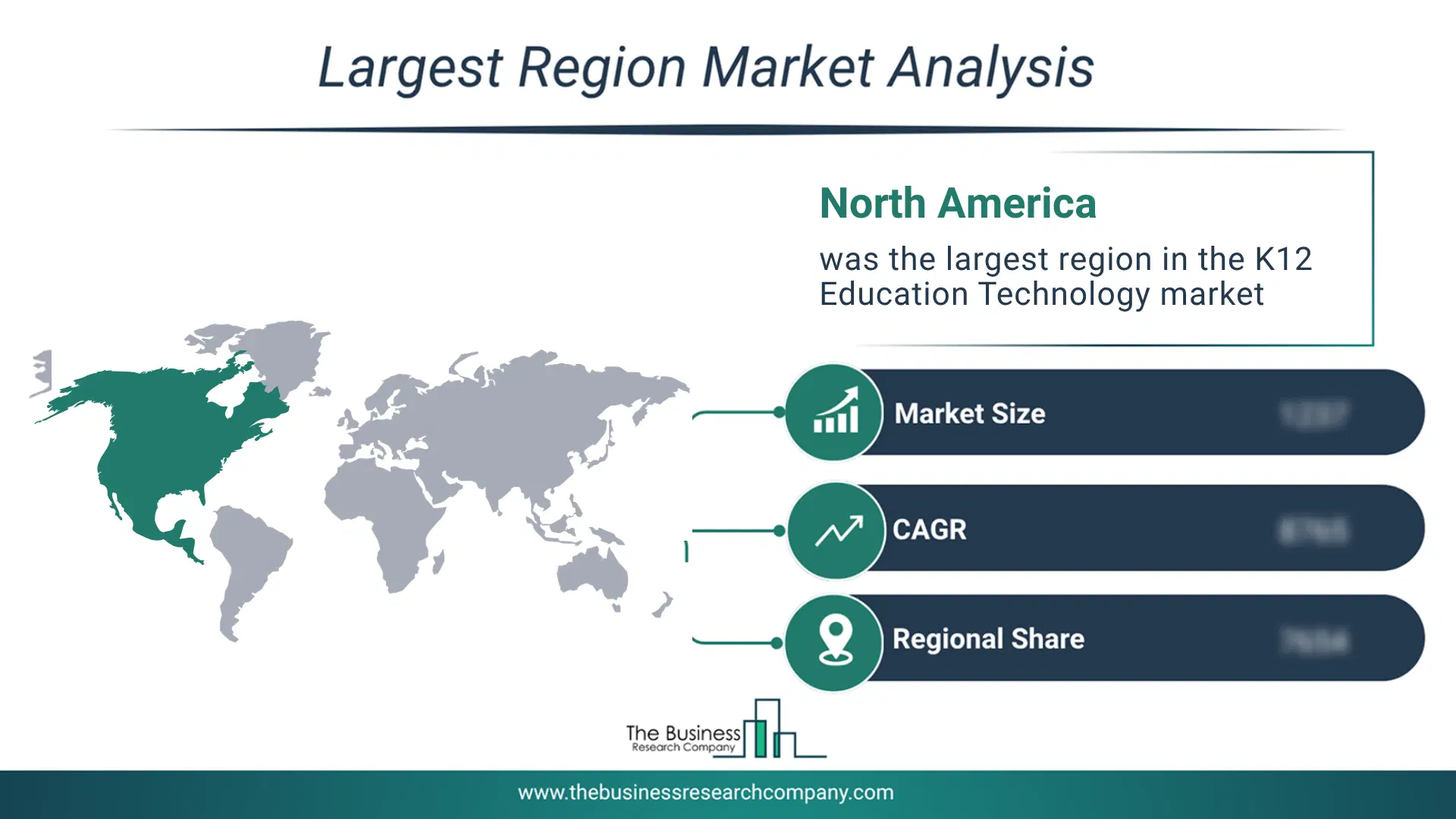
Regional Insights
North America was the largest region in the K12 education technology market in 2025. The regions covered in this market report are Asia-Pacific, South East Asia, Western Europe, Eastern Europe, North America, South America, Middle East, Africa. The countries covered in this market report are Australia, Brazil, China, France, Germany, India, Indonesia, Japan, Taiwan, Russia, South Korea, UK, USA, Canada, Italy, Spain.What Defines the K12 Education Technology Market?
The K12 education technology market consists of revenues earned by entities by providing services such as professional development, support, and training. The market value includes the value of related goods sold by the service provider or included within the service offering. The K12 education technology market also includes sales of learning management systems, virtual reality (VR) and augmented reality (AR) tools, and analytics tools. Values in this market are ‘factory gate’ values, that is the value of goods sold by the manufacturers or creators of the goods, whether to other entities (including downstream manufacturers, wholesalers, distributors and retailers) or directly to end customers. The value of goods in this market includes related services sold by the creators of the goods.How is Market Value Defined and Measured?
The market value is defined as the revenues that enterprises gain from the sale of goods and/or services within the specified market and geography through sales, grants, or donations in terms of the currency (in USD unless otherwise specified). The revenues for a specified geography are consumption values that are revenues generated by organizations in the specified geography within the market, irrespective of where they are produced. It does not include revenues from resales along the supply chain, either further along the supply chain or as part of other products.
This chart presents market attractiveness based on a quantitative evaluation of growth, competition, strategic alignment, and risk, offering a clear view of opportunity areas for decision-making. This chart is for illustrative purposes; the full report contains the complete analysis.

This chart highlights the Total Addressable Market (TAM) by estimating the maximum revenue opportunity using an assumption-driven approach, supporting strategic planning and opportunity sizing across markets. The chart is illustrative; the full report provides a more comprehensive analysis.
What Key Data and Analysis Are Included in the K12 Education Technology Market Report 2026?
The k12 education technology market research report is one of a series of new reports from The Business Research Company that provides market statistics, including industry global market size, regional shares, competitors with the market share, detailed market segments, market trends and opportunities, and any further data you may need to thrive in the k12 education technology industry. The market research report delivers a complete perspective of everything you need, with an in-depth analysis of the current and future state of the industry.K12 Education Technology Market Report Forecast Analysis
| Report Attribute | Details |
|---|---|
| Market Size Value In 2026 | $39.92 billion |
| Revenue Forecast In 2030 | $96.5 billion |
| Growth Rate | CAGR of 24.8% from 2026 to 2030 |
| Base Year For Estimation | 2025 |
| Actual Estimates/Historical Data | 2020-2025 |
| Forecast Period | 2026 - 2030 |
| Market Representation | Revenue in USD Billion and CAGR from 2026 to 2030 |
| Segments Covered | Type, Technology, Applications, Downstream Industry |
| Regional Scope | Asia-Pacific, Western Europe, Eastern Europe, North America, South America, Middle East, Africa |
| Country Scope | The countries covered in the report are Australia, Brazil, China, France, Germany, India, Indonesia, Japan, Taiwan, Russia, South Korea, UK, USA, Canada, Italy, Spain. |
| Key Companies Profiled | Apple Inc., Google LLC, Samsung Electronics Co LTD, Microsoft Corporation, International Business Machines (IBM) Corporation, Pearson plc, TAL Education Group, VIPKID, Sanoma, BlackBoard, BYJU'S, PowerSchool, Acro Platform LTD, Chungdahm Learning, Tata Class Edge, Learnosity, Illuminate Education, iTutorGroup, Educomp Solutions Limited (ESL), Kroton Educacional SA, D2L Corporation, Toppr |
| Customization Scope | Request for Customization |
| Pricing And Purchase Options | Explore Purchase Options |